Leviticus 3:16

Hebrew (Westminster Leningrad Codex) Leviticus 3:16 appears in the Hebrew Old Testament. The text above is from the Westminster Leningrad Codex. Each word links to its Strong’s number, a concise gloss, and parsing drawn from the Open Scriptures Hebrew Bible morphology. Click any word for its full Brown-Driver-Briggs (BDB) entry.
Download image
Cite this verse

Leviticus 3:16 (World English Bible). Public Domain. Lemma interlinear Bible study tool, https://lemma.gebible.app/v/leviticus/3/16.

Show BibTeX & RIS
BibTeX
RIS
English Translation
The priest shall burn them on the altar: it is the food of the offering made by fire, for a sweet savor; all the fat is Yahweh's.
World English Bible · Public Domain
Download a study sheet

One document with this verse’s original text, its word-by-word gloss line, the meaning frame, cross-references with their text, attributed commentary, and full source and license credits — printable, and it pastes into notes with its structure intact.

This verse Autodidact and up

Study sheet (.html) Plain text (.txt)

A passage Seminary Student

Up to 50 verses in one chapter. A passage sheet keeps up to 6 commentary sources and 12 cross-references per verse, in the order this page ranks them, and says so on the sheet whenever that leaves anything out. Ask for a single verse and you get the Autodidact verse sheet above.

Everything on this page stays free to read, with no account — the sheet is a download of what is already on screen, not access to it.

Want to remove ads? Support Godless Engineer
Compare translations 3

The same verse in 3 English versions, stacked beneath the original-language interlinear above. Click any original word for its lexicon entry.

Each is an independent rendering of the whole verse — the interlinear is not word-aligned to these translations.

Highlighted words mark where these versions differ — a whole-verse word diff, not a word-by-word alignment.

  • World English Bible Public Domain
    The priest shall burn them on the altar: it is the food of the offering made by fire, for a sweet savor; all the fat is Yahweh's.
  • King James Version Public Domain
    And the priest shall burn them upon the altar: it is the food of the offering made by fire for a sweet savor: all the fat is the LORD's.
  • unfoldingWord Literal Text CC BY-SA 4.0
    And the priest shall cause them to become smoke on the altar, a food gift as a scent of pleasing. All the fat for Yahweh.

unfoldingWord Literal Text — © unfoldingWord, licensed CC BY-SA 4.0. Word-aligned USFM3 via Door43 (git.door43.org/unfoldingWord/en_ult).

Versions to compare (up to 4)

3 of 4 selected

Show all 18 translations

Every available English version of this verse, each an independent rendering of the whole verse.

  • World English Bible Public Domain
    The priest shall burn them on the altar: it is the food of the offering made by fire, for a sweet savor; all the fat is Yahweh's.
  • Berean Standard Bible Public Domain
    Then the priest is to burn the food on the altar as an offering made by fire, a pleasing aroma. All the fat is the LORD’s.
  • Majority Standard Bible Public Domain
    Then the priest is to burn the food on the altar as a food offering, a pleasing aroma. All the fat is the LORD’s.
  • King James Version Public Domain
    And the priest shall burn them upon the altar: it is the food of the offering made by fire for a sweet savor: all the fat is the LORD's.
  • American Standard Version (1901) Public Domain
    And the priest shall burn them upon the altar: it is the food of the offering made by fire, for a sweet savor; all the fat is Jehovah's.
  • Revised Version (1885) Public Domain
    And the priest shall burn them upon the altar: it is the food of the offering made by fire, for a sweet savour: all the fat is the LORD’S.
  • Geneva Bible (1599) Public Domain
    So the Priest shall burne them vpon the altar, as the meate of an offering made by fire for a sweete sauour: all the fatte is the Lordes.
  • Douay-Rheims (1899) Public Domain
    And the priest shall burn them upon the altar, for the food of the fire, and of a most sweet savour. All the fat shall be the Lord's.
  • Young's Literal Translation Public Domain
    and the priest hath made them a perfume on the altar -- bread of a fire-offering, for sweet fragrance; all the fat `is' Jehovah's.
  • Literal Standard Version CC BY-SA 4.0
    and the priest has made them an incense on the altar [as] bread of a fire-offering, for refreshing fragrance; all the fat [is] YHWH’s.
  • Unlocked Literal Bible CC BY-SA 4.0
    The priest will burn all that on the altar as a burnt offering of food, to produce a sweet aroma. All the fat belongs to Yahweh.
  • unfoldingWord Literal Text CC BY-SA 4.0
    And the priest shall cause them to become smoke on the altar, a food gift as a scent of pleasing. All the fat for Yahweh.
  • Darby Bible Public Domain
    and the priest shall burn them on the altar: [it is] the food of the offering by fire for a sweet odour. All the fat [shall be] Jehovah's.
  • World Messianic Bible Public Domain
    The priest shall burn them on the altar: it is the food of the offering made by fire, for a pleasant aroma; all the fat is the LORD’s.
  • Webster's Bible Public Domain
    And the priest shall burn them upon the altar: it is the food of the offering made by fire for a sweet savor: all the fat is the LORD'S.
  • Free Bible Version CC BY-SA 4.0
    Then the priest is to burn this on the altar as a food offering, an offering to the Lord using fire. All the fat is for the Lord.
  • Bible in Basic English Public Domain
    That it may be burned by the priest on the altar; it is the food of the offering made by fire for a sweet smell: all the fat is the Lord's.
  • JPS Tanakh (1917) Public Domain
    And the priest shall make them smoke upon the altar; it is the food of the offering made by fire, for a sweet savour; all the fat is the LORD'S.

Literal Standard Version (2020), Covenant Press — licensed CC BY-SA 4.0. Text via the HelloAO Bible API (eBible.org). Unlocked Literal Bible (unfoldingWord) — licensed CC BY-SA 4.0. Text via the HelloAO Bible API (eBible.org). unfoldingWord Literal Text — © unfoldingWord, licensed CC BY-SA 4.0. Word-aligned USFM3 via Door43 (git.door43.org/unfoldingWord/en_ult). Free Bible Version, Dr. Jonathan Gallagher — licensed CC BY-SA 4.0. Text via the HelloAO Bible API (eBible.org).

Word by word

More ways to search: Search by grammar → Find every occurrence → Compare this word →

Practice this passage: Drill this verse → Learn its vocabulary →

נִיחֹ֔חַ
nîychôwach
H5207
“soothing”
Noun, Common, Masculine, Singular, Absolute
Part of Speech
Noun
Type
Common
Gender
Masculine
Number
Singular
State
Absolute
Full BDB Definition

Origin: from H5117

TWOT: 1323c

soothing, quieting, tranquillising
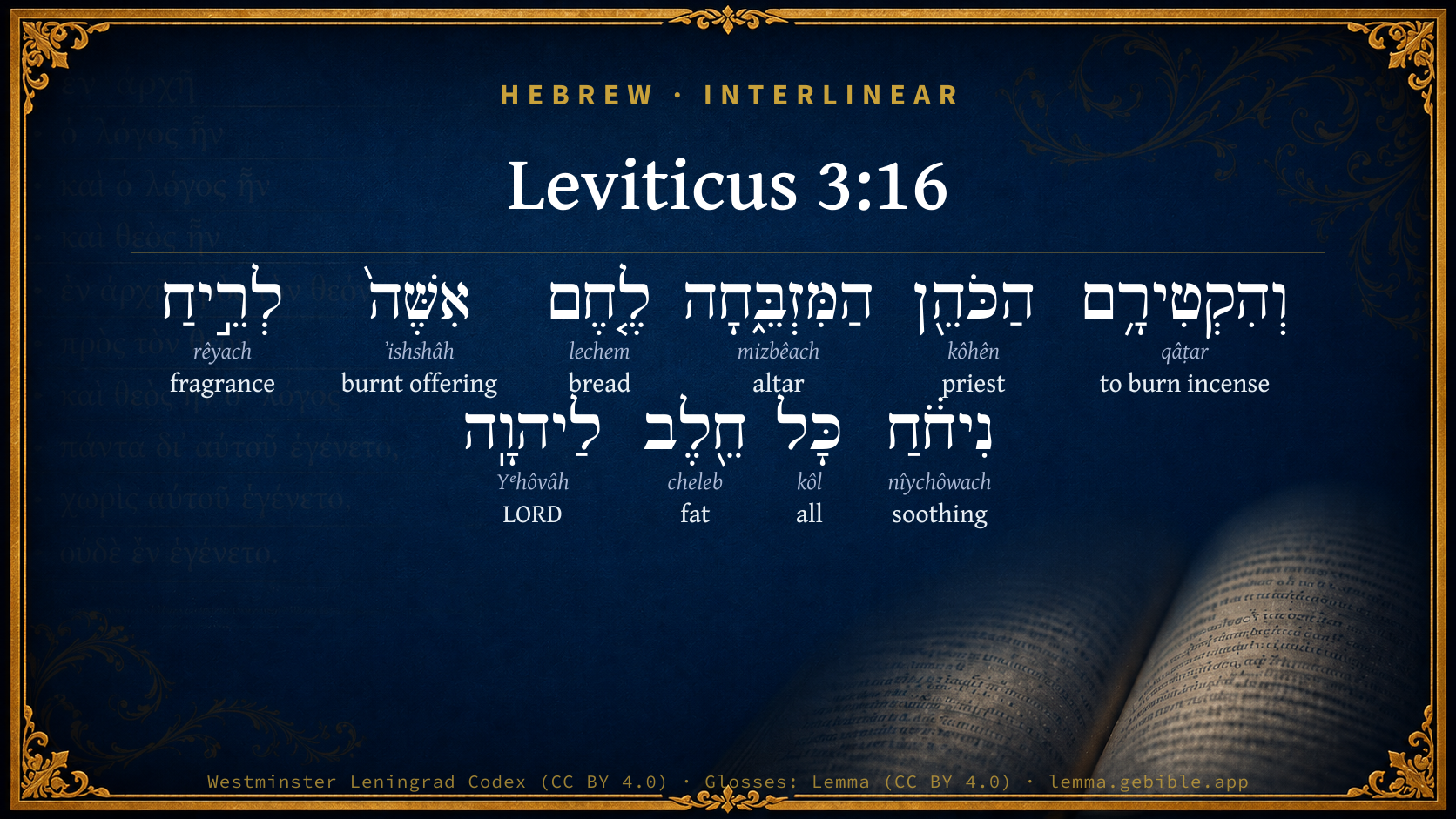
  1. וְהִקְטִירָ֥ם qâṭar H6999 “and · to burn incense · them” Conjunction + Verb, Hiphil, Sequential Perfect, 3rd Person, Masculine, Singular + Suffix, Personal, 3rd Person, Masculine, Plural
  2. הַכֹּהֵ֖ן kôhên H3548 “the · priest” Particle, Definite Article + Noun, Common, Masculine, Singular, Absolute
  3. הַמִּזְבֵּ֑חָה mizbêach H4196 “the · altar · toward” Particle, Definite Article + Noun, Common, Masculine, Singular, Absolute + Suffix, Demonstrative
  4. לֶ֤חֶם lechem H3899 “bread of” Noun, Common, Both, Singular, Construct
  5. אִשֶּׁה֙ ʼishshâh H801 “burnt offering” Noun, Common, Masculine, Singular, Absolute
  6. לְרֵ֣יחַ rêyach H7381 “to/for · fragrance of” Preposition + Noun, Common, Masculine, Singular, Construct
  7. כָּל kôl H3605 “all of” Noun, Common, Masculine, Singular, Construct
  8. חֵ֖לֶב cheleb H2459 “fat” Noun, Common, Masculine, Singular, Absolute
  9. לַיהוָֽה Yᵉhôvâh H3068 “to/for · LORD” Preposition + Noun, Proper

About this verse

These counts appear in no published source. They are computed here, from the morphology-tagged text and Lemma’s own curated glosses. What Lemma adds →

10
words
10
distinct lemmas
Pentateuch
section

Shared distinctive vocabulary

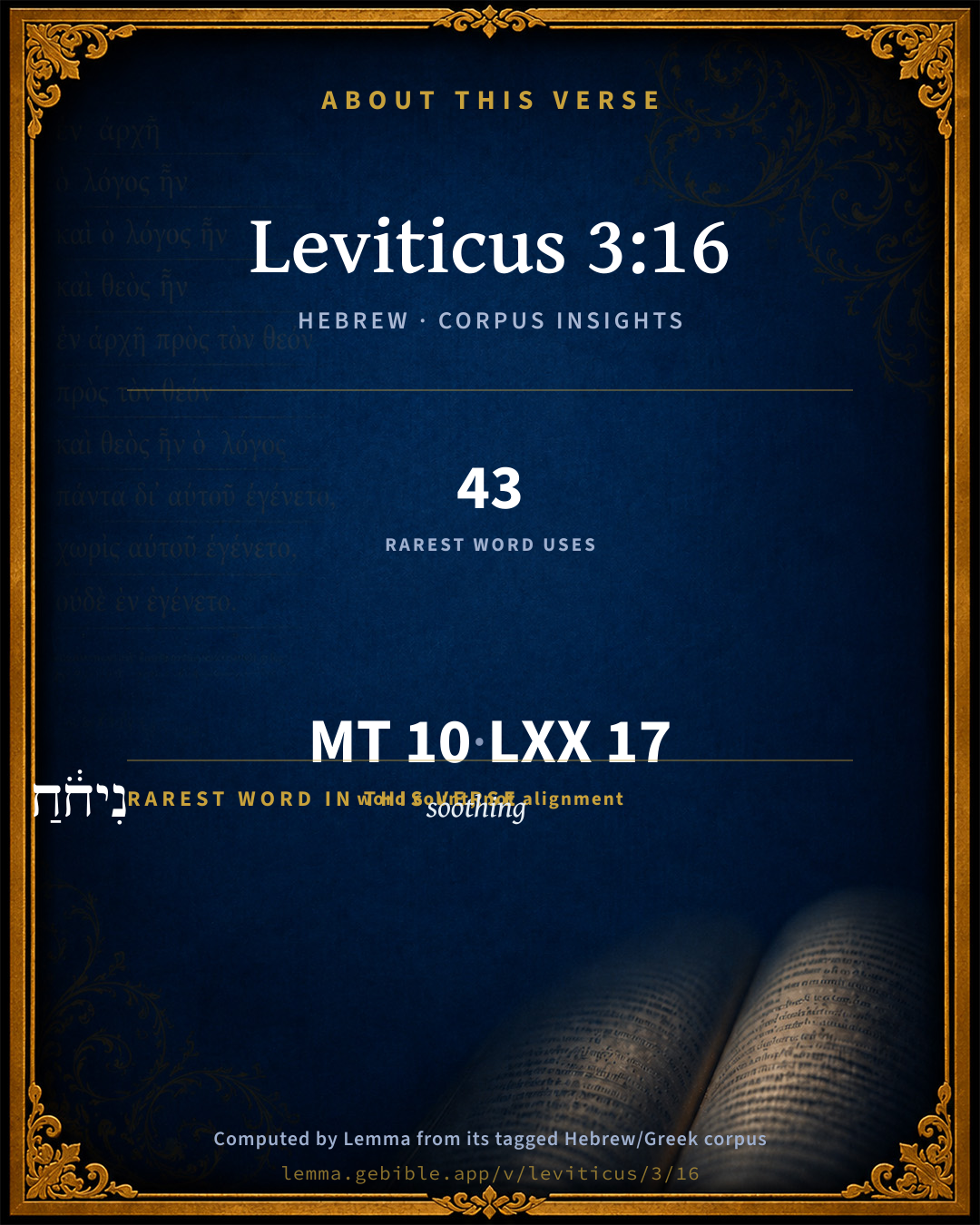
נִיחֹ֔חַ soothing H5207 occurs in 43 verses of the Hebrew Bible. Also found in:

Grammatical profile

  • 1 verb
  • 9 nouns

Verb forms

  • וְהִקְטִירָ֥ם Hiphil · Sequential Perfect

Hebrew & Septuagint length

In English translation the verse runs 27 words from the Hebrew and 29 from the Septuagint (LXX English) — closely comparable.

A rough comparison of the two English renderings, which tokenize alike — not a word-level alignment.

Word counts can differ between the Hebrew and the Greek without any difference in meaning — e.g. the Hebrew direct-object marker אֵת has no separate Greek word, and Greek often adds the article ὁ.

In the original languages it is 10 Hebrew tokens and 17 Greek tokens — but the two are counted differently (Hebrew bundles its prefixes and suffixes into one token; the Greek is in lemma form), so that isn’t a like-for-like length.

Cross-references

16

Topical passages linked to Leviticus 3:16 in the Treasury of Scripture Knowledge — connected by theme and wording, ordered by reader-vote popularity; previews shown in the World English Bible.

  • Leviticus 7:23–25 "Speak to the children of Israel, saying, 'You shall eat no fat, of ox, or sheep, or goat.
  • Exodus 29:13 You shall take all the fat that covers the innards, the cover of the liver, the two kidneys, and the fat that is on them, and burn them on the altar.
  • Exodus 29:22 Also you shall take some of the ram's fat, the fat tail, the fat that covers the innards, the cover of the liver, the two kidneys, the fat that is on them, and the right thigh (for it is a ram of consecration),
  • Leviticus 3:3–5 He shall offer of the sacrifice of peace offerings an offering made by fire to Yahweh; the fat that covers the innards, and all the fat that is on the innards,
  • Leviticus 3:9–11 He shall offer from the sacrifice of peace offerings an offering made by fire to Yahweh; its fat, the entire tail fat, he shall take away close to the backbone; and the fat that covers the inwards, and all the fat that is on the inwards,
  • Leviticus 3:14–15 He shall offer from it as his offering, an offering made by fire to Yahweh; the fat that covers the innards, and all the fat that is on the innards,
  • Leviticus 4:8–19 He shall take all the fat of the bull of the sin offering off of it; the fat that covers the innards, and all the fat that is on the innards,
  • Leviticus 4:26 All its fat he shall burn on the altar, like the fat of the sacrifice of peace offerings; and the priest shall make atonement for him concerning his sin, and he will be forgiven.
  • Leviticus 4:31 All its fat he shall take away, like the fat is taken away from off of the sacrifice of peace offerings; and the priest shall burn it on the altar for a sweet savor to Yahweh; and the priest shall make atonement for him, and he will be forgiven.
  • 1 Samuel 2:15–16 Yes, before they burnt the fat, the priest's servant came, and said to the man who sacrificed, Give flesh to roast for the priest; for he will not have boiled flesh of you, but raw.
  • Isaiah 53:10 Yet it pleased Yahweh to bruise him; he has put him to grief: when you shall make his soul an offering for sin, he shall see [his] seed, he shall prolong his days, and the pleasure of Yahweh shall prosper in his hand.
  • Matthew 22:37 Jesus said to him, "'You shall love the Lord your God with all your heart, and with all your soul, and with all your mind.'
  • Leviticus 8:25 He took the fat, and the fat tail, and all the fat that was on the innards, and the cover of the liver, and the two kidneys, and their fat, and the right thigh;
  • Leviticus 9:24 There came forth fire from before Yahweh, and consumed the burnt offering and the fat upon the altar: and when all the people saw it, they shouted, and fell on their faces.
  • Leviticus 17:6 The priest shall sprinkle the blood on the altar of Yahweh at the door of the Tent of Meeting, and burn the fat for a sweet savor to Yahweh.
  • 2 Chronicles 7:7 Moreover Solomon made the middle of the court holy that was before the house of Yahweh; for there he offered the burnt offerings, and the fat of the peace-offerings, because the brazen altar which Solomon had made was not able to receive the burnt offering, and the meal-offering, and the fat.

Cross-references courtesy of OpenBible.info (CC BY 4.0).

Hebrew and Greek witnesses Masoretic Hebrew ↔ Greek Septuagint

The same verse in the two great witnesses to the Old Testament, shown verse-for-verse.

These are two independent witnesses, not word-aligned to each other, and the Septuagint is shown in lemma (dictionary) form.

Hebrew Leviticus 3:16 Masoretic · Westminster Leningrad Codex

וְהִקְטִירָ֥ם הַכֹּהֵ֖ן הַמִּזְבֵּ֑חָה לֶ֤חֶם אִשֶּׁה֙ לְרֵ֣יחַ נִיחֹ֔חַ כָּל חֵ֖לֶב לַיהוָֽה

The priest shall burn them on the altar: it is the food of the offering made by fire, for a sweet savor; all the fat is Yahweh's.

World English Bible · Public Domain

Greek LXX Leviticus 3:16 Septuagint · lemma form

καί ἀναφέρω ὁ ἱερεύς ἐπί ὁ θυσιαστήριον κάρπωμα ὀσμή εὐωδία ὁ κύριος πᾶς ὁ στέαρ ὁ κύριος

And the priest shall offer it upon the altar: it is a burnt offering, a smell of sweet savor to the Lord. All the fat belongs to the Lord.

LXX2012 (modern English Septuagint) · Public Domain

Hebrew: Westminster Leningrad Codex (CC BY 4.0). Greek: Septuagint (public domain); English from LXX2012 (modern English Septuagint) (Public Domain). How the Septuagint differs from the Hebrew →

Targum (Aramaic paraphrase)

2

The Targum is the ancient Jewish Aramaic paraphrase of the Hebrew Scriptures — an interpretive translation, not the Hebrew text itself. Onkelos (literal) and Pseudo-Jonathan (expansive) render the Torah, and Jonathan the Prophets. Coverage is partial: where no permissively-licensed English translation exists for a verse, only the Aramaic is shown. This is verse-level text, not a word-by-word alignment to the Hebrew.

  1. Targum Onkelos Torah (Genesis–Deuteronomy)
    וְיַסְקִנוּן כַּהֲנָא לְמַדְבְּחָא לְחֵם קֻרְבָּנָא לְאִתְקַבָּלָא בְּרַעֲוָא כָּל תַּרְבָּא קֳדָם יְיָ

    (no public-domain English translation for this verse)

    Targum Onkelos — Aramaic: “Onkelos Genesis” (public domain); “Onkelos Exodus” (public domain); “Onkelos Leviticus” (public domain); “Onkelos Numbers” (public domain); “Onkelos Deuteronomy” (public domain). English: “Sefaria Community Translation” (CC0 1.0 (public-domain dedication)); “J.W. Etheridge. The Targums of Onkelos and Jonathan Ben Uzziel on the Pentateuch. London: Longmans, Green, 1862” (public domain). Text via Sefaria.

  2. Targum Pseudo-Jonathan Torah (Genesis–Deuteronomy)
    וְיַסְקִינוּן כַּהֲנָא לְמַדְבְּחָא לְחֵם קוּרְבָּנָא לְאִתְקַבָּלָא בְּרַעֲוָא כָּל תְּרֵיב קֳדָם יְיָ

    And the priest shall sacrifice them at the altar, the meat of an oblation to be received with favour. All the fat (shall be offered) before the Lord.

    Targum Pseudo-Jonathan — Aramaic: “Targum Jonathan on Genesis” (public domain); “Targum Jonathan on Exodus” (public domain); “Targum Jonathan on Leviticus” (public domain); “Targum Jonathan on Numbers” (public domain); “Targum Jonathan on Deuteronomy” (public domain). English: “The Targum of Jonathan ben Uzziel, trans. J. W. Etheridge, London, 1862” (public domain). Text via Sefaria.

Commentary

Notes on Leviticus 3:16 from classic Christian and Jewish commentators (each source and its license shown beneath its notes). The classic Christian expositions comment on the surrounding passage and are grouped to its opening verse, so a note may address several verses; the Jewish commentaries on the Tanakh (Rashi and others) are per-verse, so they appear only where the commentator wrote on this verse.

Lemma curates 59 commentaries, every one of them public domain or Creative Commons licensed, each selected and text-cleaned for this edition rather than reprinted as found. About our sources →

Joseph Benson's Commentary

Lev 3:16. Shall burn them — The parts mentioned, among which the tail is not one, as it was in the sheep, because that in goats is a refuse part. All the fat is the Lord’s — This is to be limited, 1st, To those beasts which were offered or offerable in sacrifice, as it is explained, Lev 7:23; Lev 7:25. 2d, To that kind of fat which is above mentioned, and required to be offered, which was separated, or easily separable from the flesh: for the fat which was here and there mixed with the flesh they might eat.

Joseph Benson's Commentary on the Old and New Testaments (1811–1818) — public domain. Text from a community e-Sword module.

The Expositor's Bible

THE PROHIBITION OF FAT AND BLOOD

Lev_3:16-17; Lev_7:22-27; Lev_17:10-16

And the priest shall burn them upon the altar: it is the food of the offering made by fire, for a sweet savour: all the fat is the Lords. It shall be a perpetual statute throughout your generations in all your dwellings, that ye shall eat neither fat nor blood. And the Lord spake unto Moses, saving, Speak unto the children of Israel, saying, Ye shall eat no fat, of ox, or sheep, or goat. And the fat of that which dieth of itself, and the fat of that which is torn of beasts, may be used for any other service; but ye shall in no wise eat of it. For whosoever eateth the fat of the beast, of which men offer an offering made by fire unto the Lord, even the soul that eateth it shall be cut off from his people. And ye shall eat no man net of blood, whether it be of fowl or of beast, in any of your dwellings. Whosoever it be that eateth any blood, that soul shall be cut off from his people And whatsoever man there be of the house of Israel, or of the strangers that sojourn among them, that eateth any manner of blood; I will set My face against that soul that eateth blood, and will cut him off from among his people. For the life of the flesh is in the blood: and I have given it to you upon the altar to make atonement for your souls: for it is the blood that maketh atonement by reason of the life. Therefore I said unto the children of Israel, No soul of you shall eat blood, neither shall any stranger that sojourneth among you eat blood. And whatsoever man there be of the children of Israel, or of the strangers that sojourn among them, which taketh in hunting any beast or fowl that may be eaten; he shall pour out the blood thereof, and cover it with dust. For as to the life of all flesh, the blood thereof is all one with the life thereof: therefore I said unto the children of Israel, Ye shall eat the blood of no manner of flesh: for the life of all flesh is the blood thereof: whosoever eateth it shall be cut off. And every soul that eateth that which dieth of itself, or that which is torn of beasts, whether he be homeborn or a stranger, he shall, wash his clothes, and bathe himself in water, and be unclean until the even: then shall he be clean. But if he wash them not, nor bathe his flesh, then "he shall bear his iniquity."

The chapter concerning the peace offering ends (Lev_3:16-17) with these words: "All the fat is the Lords. It shall be a perpetual statute for you throughout your generations, that ye shall eat neither fat nor blood."

To this prohibition so much importance was attached that in the supplemental "law of the peace offering" {Lev_7:22-27} it is repeated with added explanation and solemn warning, thus: "And the Lord spake unto Moses, saying, Speak unto the children of Israel, saying. Ye shall eat no manner of fat, of ox, or of sheep, or of goat. And the fat of the beast that dieth of itself, and the fat of that which is torn with beasts, may be used for any other service: but ye shall in no wise eat of it. For whosoever eateth the fat of the beast, of which men offer an offering made by fire unto the Lord, even the soul that eateth it shall be cut off from his people. And ye shall eat no manner of blood, whether it be of fowl or of beast, in any of your dwellings. Whosoever it be that eateth any blood, that soul shall be cut off from his people."

From which it appears that this prohibition of the eating of fat referred only to the fat of such beasts as were used for sacrifice. With these, however, the law was absolute, whether the animal was presented for sacrifice, or only slain for food. It held good with regard to these animals, even when, because of the manner of their death, they could not be used for sacrifice. In such cases, though the fat might be used for other purposes, still it must not be used for food.

The prohibition of the blood as food appears from Lev_17:10 to have been absolutely universal; it is said, "Whatsoever man there be of the house of Israel, or of the strangers that sojourn among them, that eateth any manner of blood, I will set My face against that soul that eateth blood, and will cut him off from among his people."

The reason for the prohibition of the eating of blood, whether in the case of the sacrificial feasts of the peace offerings or on other occasions, is given, {Lev_17:11-12} in these words: "For the life of the flesh is in the blood: and I have given it to you upon the altar to make atonement for your souls: for it is the blood that maketh atonement by reason of the life. Therefore I said unto the children of Israel, No soul of you shall eat blood, neither shall any stranger that sojourneth among you eat blood."

And the prohibition is then extended to include not only the blood of animals which were used upon the altar, but also such as were taken in hunting, thus (Lev_17:13): "And whatsoever man there be of the children of Israel, or of the strangers that sojourn among them, which taketh in hunting any beast or fowl that may be eaten, he shall pour out the blood thereof, and cover it with dust," as something of peculiar sanctity; and then the reason previously given is repeated with emphasis (Lev_17:14): "For as to the life of all flesh, the blood thereof is all one with the life thereof: therefore I said unto the children of Israel, Ye shall eat the blood of no manner of flesh: for the life of all flesh is the blood thereof; whosoever eateth it shall be cut off."

And since, when an animal died from natural causes, or through being torn of a beast, the blood would be drawn from the flesh either not at all or but imperfectly, as further guarding against the possibility of eating blood, it is ordered (Lev_17:15-16) that he who does this shall be held unclean: "Every soul that eateth that which dieth of itself, or that which is torn of beasts, whether he be home born or a stranger, he shall wash his clothes, and bathe himself in water, and be unclean until the even. But if he wash them not nor bathe his flesh, then he shall bear his iniquity."

These passages explicitly state the reason for the prohibition by God of the use of blood for food to be the fact that, as the vehicle of the life, it has been appointed by Him as the means of expiation for sin upon the altar. And the reason for the prohibition of the fat is similar; namely, its appropriation for God upon the altar, as in the peace offerings, the sin offerings, and the guilt offerings; "all the fat is the Lords."

Thus the Israelite, by these two prohibitions, was to be continually reminded, so often as he partook of his daily food, of two things: by the one, of atonement by the blood as the only ground of acceptance; and by the other, of Gods claim on the man redeemed by the blood, for the consecration of his best. Not only so, but by the frequent repetition, and still more by the heavy penalty attached to the violation of these laws, he was reminded of the exceeding importance that these two things had in the mind of God. If he eat the blood of any animal claimed by God for the altar, he should be cut off from his people; that is, outlawed, and cut off from all covenant privilege as a citizen of the kingdom of God in Israel. And even though the blood were that of the beast taken in the chase, still ceremonial purification was required as the condition of resuming his covenant position.

Nothing, doubtless, seems to most Christians of our day more remote from practical religion than these regulations touching the fat and the blood which are brought before us with such fulness in the law of the peace offering and elsewhere. And yet nothing is of more present day importance in this law than the principles which underlie these regulations. For as with type, so with antitype. No less essential to the admission of the sinful man into that blessed fellowship with a reconciled God, which the peace offering typified, is the recognition of the supreme sanctity of the precious sacrificial blood of the Lamb of God; no less essential to the life of happy communion with God, is the ready consecration of the best fruit of our life to Him.

Surely, both of these, and especially the first, are truths for our time. For no observing man can fail to recognise the very ominous fact that a constantly increasing number, even of professed preachers of the Gospel, in so many words refuse to recognise the place which propitiatory blood has in the Gospel of Christ, and to admit its preeminent sanctity as consisting in this, that it was given on the altar to make atonement for our souls. Nor has the present generation outgrown the need of the other reminder touching the consecration of the best to the Lord. How many there are, comfortable, easy-going Christians, whose principle-if one might speak in the idiom of the Mosaic law-would rather seem to be, ever to give the lean to God, and keep the fat, the best fruit of their life and activity, for themselves! Such need to be most urgently and solemnly reminded that in spirit the warning against the eating of the blood and the fat is in full force. It was written of such as should break this law, "that soul shall be cut off from his people." And so in the Epistle to the Hebrews {Heb_10:26-29} we find one of its most solemn warnings directed to those who "count this blood of the covenant," the blood of Christ, "an unholy (i.e., common) thing"; as exposed by this, their undervaluation of the sanctity of the blood, to a "sorer punishment" than overtook him that "set at naught Moses law," even the retribution of Him who said, "Vengeance is Mine; I will repay, saith the Lord."

And so in this law of the peace offerings, which ordains the conditions of the holy feast of fellowship with a reconciled God, we find these two things made fundamental in the symbolism: full recognition of the sanctity of the blood as that which atones for the soul; and the full consecration of the redeemed and pardoned soul to the Lord. So was it in the symbol; and so shall it be when the sacrificial feast shall at last receive its most complete fulfilment in the communion of the redeemed with Christ in glory. There will be no differences of opinion then and there, either as to the transcendent value of that precious blood which made atonement, or as to the full consecration which such a redemption requires from the redeemed.

William Robertson Nicoll, ed., The Expositor's Bible (London: Hodder & Stoughton, 1887–1910) — public domain. 65 of 66 books (1 Corinthians is not separately keyed, as that volume carries no machine-parseable verse references); section-level commentary keyed to the opening verse. Introductory and overview sections not keyed to a specific passage are excluded.

Ellicott's Commentary for English Readers

(16) Shall burn them.—That is, the fat pieces which have thus been specified (see Lev_4:35), because they constitute the bread of Jehovah; they are to ascend in a sweet-smelling savour to heaven. (See Lev_1:9).

All the fat is the Lord’s.—This part of the verse is intimately connected with the following verse. As the fat belongs to the Lord, it is therefore enacted as a perpetual statute that it must never be eaten.

A Bible Commentary for English Readers, edited by Charles John Ellicott (1878–1897) — public domain. Text from a community e-Sword module.

Albert Barnes' Notes on the Bible

Rather, as food of an offering made by fire for a sweet savour, shall all the fat be for Yahweh. Our bodily taste and smell furnish figures of the satisfaction with which the Lord accepts the appointed symbols of the true worship of the heart. All that was sent up in the fire of the altar, including the parts of the sin-offering Lev 4:31, as well as the burnt-offering (Lev 1:9, etc.), was accepted for “a sweet savour”: but the word food may here have a special fitness in its application to the peace-offering, which served for food also to the priests and the offerer, and so symbolized communion between the Lord, His ministers, and His worshippers.

The fat is the Lord’s - The significance of this appears to consist in the fact that its proper development in the animal is, in general, a mark of perfection.

Albert Barnes' Notes on the Bible (1834–1885) — public domain. Text from a community e-Sword/MySword module.

Matthew Poole's English Annotations

The priest shall burn them, the parts mentioned, among which the tail is not one, as it was in the sheep, because that in goats is a refuse part.

All the fat: this is to be limited,

1. To those beasts which were offered or might be offered in sacrifice, as it is explained and restrained Lev 7:23,25.

2. To that kind of fat which is here above mentioned, and required to be offered, which was separated, or easily separable, from the flesh; for the fat which was here and there mixed with the flesh they might eat, Deu 32:14; Neh 8:10.

Matthew Poole's English Annotations on the Holy Bible (1683–1685) — public domain. Text from a community e-Sword/MySword module.

The Pulpit Commentary

Vers. 16, 17. Jehovah"s portion.

As the Author of life and the Giver of all bounty, God might have claimed the whole of every sacrifice. But he discriminated between the parts of the victim, sometimes reserving for himself the greater share, at other times only a small proportion of that presented to him. In the peace offering there was selected for the altar, as God"s perquisite, the "fat" of the animal, and the remainder went to the priests and the offerer.

I LEARN THAT NOT THE MEANEST BUT THE CHOICEST PORTIONS MUST BE RESERVED FOR GOD"S SERVICE. Low conceptions of his majesty and perfection lead to such religious observance as is an insult rather than an honour. To defer reading the Scriptures or prayer till the mind and body are fatigued, is an infraction of this rule. Let our freshest moments, our sweetest morsels of thought and power, be set apart for the Lord! And similarly, ask not, How near can I walk to the dividing line between the Church and the world? or, Which of my amusements can I with least self-denial renounce in order to do his will? May we not behold the same lesson inculcated in the distinction indicated in this chapter, between a peace and a burnt offering? The latter, being wholly devoted to the Lord, must consist of a male victim; the former, intended principally for the participation of the offerers, may be male or female (verse 1). It cannot be right, then, to imagine that any qualifications will suffice for entire consecration to God"s work. Ministers and missionaries should be numbered amongst men of highest intellect and intensest spirituality.

II SEE HOW GOD ACCEPTS THE OFFERINGS OF HIS CREATURES AS THE MATERIALS FOR HIS DELIGHT AND GLORY. The burnt fat is "food" for the fire offering, and is termed in another place, the "bread of God." It becomes "a sweet savour" that is, eminently pleasing to the Holy One. In the word "food" we discern the purport of the peace offering as a sacrificial meal, in which, by returning to God what he had previously bestowed, the worshipper:

1. Acknowledged his indebtedness and thanks.

2. Was made a guest at the table of the Lord, inasmuch as he ate part of the animal that was "food for the fire offering;" and

3. Had all his other provisions sanctified for the sustenance of life, being allowed to consume the entire portions of animals not fit for sacrifice.

III RECOLLECT THE OBLIGATORINESS OF DIVINE STATUTES.

1. They prohibit as well as command. "Thou shalt not" occupies as prominent a position in the Decalogue as "Thou shalt." Not only does man need both to try him (as with our first parents) and direct him, but one really involves the other. Observe that what man might not consume himself might be properly consumed on the altar; so the adoration and. unquestioning fidelity that are out of place in reference to any finite beings, are becoming in relation to God.

2. They are equally binding on all generations. They respect us as well as our fathers, and herein the laws of God differ from the mutable proclamations of human lawgivers. The precepts of God only change with a new dispensation. This is the meaning of the word "perpetual." There is a sense, indeed, in which no Divine statute alters, being continued in spirit though the letter may have varied.

3. They enter into all phases of life. The prohibition was to be acted upon in "the dwellings" as well as at the tabernacle. Let us not make too great a distinction between the homage of the house of God and the home or the workshop and the factory! It is the characteristic of the gospel times to have the Law written on the heart, so that we carry it with us wherever we go. Thus are we prevented from sinning against God. S.R.A.

The Pulpit Commentary (1880–1919), ed. H.D.M. Spence-Jones & Joseph S. Exell — public domain. Text from a community e-Sword module.

John Wesley's Explanatory Notes

Shall burn them - The parts mentioned, among which the tail is not one, as it was in the sheep. because that in goats is a refuse part. All the fat - This is to be limited,

1. To those beasts, which were offered or offerable in sacrifice, as it is explained, chap. vii, 23, 25.

2. To that kind of fat which is above-mentioned, and required to be offered, which was separated, or easily separable from the flesh for the fat which was here and there mixed with the flesh they might eat.

John Wesley, Explanatory Notes Upon the Whole Bible (1754–1765) — public domain. Text via the GEBible commentary corpus.

Lesson kit

Teaching starters — assembled from the data on this page, not authored interpretation. Every prompt links to the verse data it draws on. Edit before teaching.

Leviticus, in the Pentateuch, opens this verse with 10 words (10 distinct Hebrew lemmas). Its most distinctive word is nîychôwach (“soothing”). A historical commentator’s framing appears above. Read the whole chapter for the surrounding context.

Discussion questions

  1. How does “soothing” (nîychôwach) shape what this verse is saying?
  2. Genesis 8:21 shares the word «soothing» with this verse. How do the two illuminate each other?
  3. These translations render this verse differently; the difference is in the English rendering, not the original. What questions does that raise?
  4. The verb «וְהִקְטִירָ֥ם» is Hiphil Sequential Perfect. How does its form color the action?
  5. Reading how Joseph Benson's Commentary and The Expositor's Bible read this verse, where do the two commentators agree and where do they part?

Things to notice

Reading settings

Reading text

Shown beneath each verse's original-language words.

Old Testament
Old Testament edition

Read the OT as the Masoretic Hebrew (MT) or the Greek Septuagint (LXX).

English shown for the Greek Septuagint (in the Hebrew ↔ Greek comparison).

Comparing translations? Open the Compare panel on any verse page to stack up to four side by side.