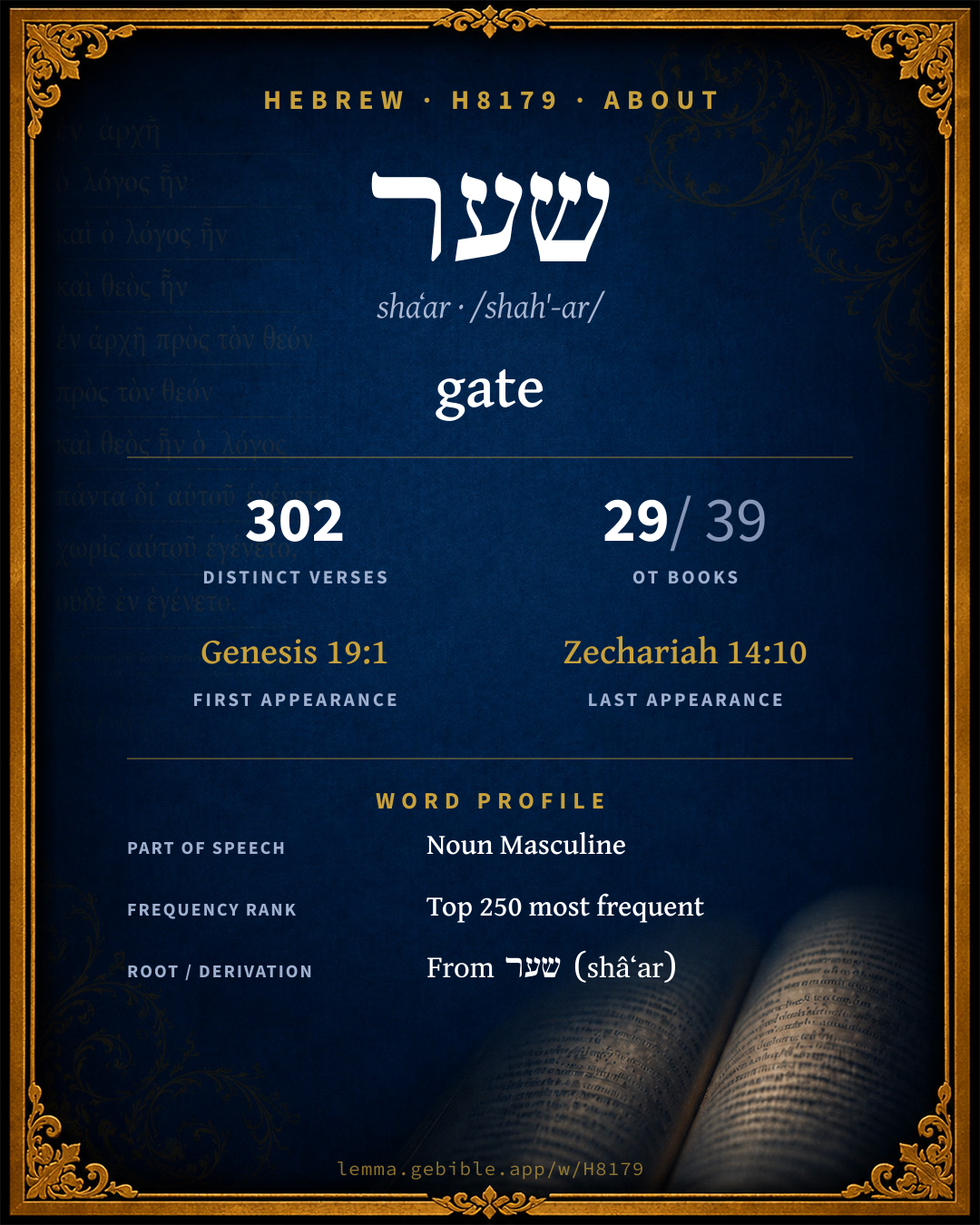
שַׁ֫עַר
gate
‘gate’ is one of 5 main senses fuller range ↓
Full lexicon entry — Brown-Driver-Briggs (BDB)
From Brown-Driver-Briggs (BDB)
Where this word appears
See every Construct-state word in the Hebrew Bible →
Grammar key — what these labels mean
Part of speech
- Noun
- A naming word — a person, place, thing, or idea.
Noun type
- Common
- A common noun — a general class of person, place, or thing (“king,” “city,” “water”), not a specific name.
State
- Construct
- A noun bound to a following noun in a possessive / “of” relationship (the construct chain).
- Absolute
- The independent form of a noun, not bound to a following word.
Gender
- Masculine
- Grammatically masculine.
Number
- Singular
- One.
- Plural
- More than one (in Hebrew, generally three or more).
Grammatical forms
- Noun, Common, Masculine, Singular, Construct 144 times (38%)
- Noun, Common, Masculine, Singular, Absolute 116 times (31%)
- Noun, Common, Masculine, Plural, Construct 84 times (22%)
- Noun, Common, Masculine, Plural, Absolute 31 times (8%)
Parsed forms decoded from the imported morphology (morphhb / Westminster Leningrad Codex — WLC text public domain, morphhb tagging CC BY 4.0), counted across 375 parsed occurrences — not distinct verses.
Page 1 of 2 — showing verses 1–200 of 302 distinct verses where H8179 appears, across 29 books. Click any verse to open its interlinear word-by-word view. Verse text shown in the World English Bible for context — . Each verse’s Hebrew form is shown with its reference; the English is not keyword-highlighted, since the data carries no word-level English alignment. Use “Compare translations” on any verse to read it across multiple English versions. This concordance covers the Hebrew Bible; Septuagint (Greek Old Testament) occurrences are not indexed here.
Genesis 8 verses
- Genesis 19:1 בְּ/שַֽׁעַר prep + n c ms cs The two angels came to Sodom at evening. Lot sat in the gate of Sodom. Lot saw them, and rose up to meet them. He bowed himself with his face to the earth,
- Genesis 22:17 שַׁ֥עַר n c ms cs that in blessing I will bless you, and in multiplying I will multiply your seed as the stars of the heavens, and as the sand which is on the seashore. Your seed will possess the gate of his enemies.
- Genesis 23:10 שַֽׁעַר n c ms cs Now Ephron was sitting in the midst of the children of Heth. Ephron the Hittite answered Abraham in the hearing of the children of Heth, even of all who went in at the gate of his city, saying,
- Genesis 23:18 שַֽׁעַר n c ms cs to Abraham for a possession in the presence of the children of Heth, before all who went in at the gate of his city.
- Genesis 24:60 שַׁ֥עַר n c ms cs They blessed Rebekah, and said to her, "Our sister, may you be the mother of thousands of ten thousands, and let your seed possess the gate of those who hate them."
- Genesis 28:17 שַׁ֥עַר n c ms cs He was afraid, and said, "How dreadful is this place! This is none other than God's house, and this is the gate of heaven."
- Genesis 34:20 שַׁ֣עַר n c ms cs Hamor and Shechem, his son, came to the gate of their city, and talked with the men of their city, saying,
- Genesis 34:24 שַׁ֣עַר שַׁ֥עַר n c ms cs n c ms cs All who went out of the gate of his city listened to Hamor, and to Shechem his son; and every male was circumcised, all who went out of the gate of his city.
Exodus 11 verses
- Exodus 20:10 בִּ/שְׁעָרֶֽי/ךָ prep + n c mp cs + sfx pers 2ms but the seventh day is a Sabbath to Yahweh your God. You shall not do any work in it, you, nor your son, nor your daughter, your man-servant, nor your maid-servant, nor your cattle, nor your stranger who is within your gates;
- Exodus 27:16 וּ/לְ/שַׁ֨עַר conj + prep + n c ms cs For the gate of the court shall be a screen of twenty cubits, of blue, and purple, and scarlet, and fine twined linen, the work of the embroiderer; their pillars four, and their sockets four.
- Exodus 32:26 בְּ/שַׁ֣עַר prep + n c ms cs then Moses stood in the gate of the camp, and said, "Whoever is on Yahweh's side, come to me!" All the sons of Levi gathered themselves together to him.
- Exodus 32:27 מִ/שַּׁ֤עַר לָ/שַׁ֨עַר֙ prep + n c ms prep det + n c ms He said to them, "Thus says Yahweh, the God of Israel, 'Every man put his sword on his thigh, and go back and forth from gate to gate throughout the camp, and every man kill his brother, and every man his companion, and every man his neighbor."
- Exodus 35:17 שַׁ֥עַר n c ms cs the hangings of the court, its pillars, their sockets, and the screen for the gate of the court;
- Exodus 38:15 לְ/שַׁ֣עַר prep + n c ms cs and so for the other side: on this hand and that hand by the gate of the court were hangings of fifteen cubits; their pillars three, and their sockets three.
- Exodus 38:18 שַׁ֤עַר n c ms cs The screen for the gate of the court was the work of the embroiderer, of blue, purple, scarlet, and fine twined linen. Twenty cubits was the length, and the height in the breadth was five cubits, like to the hangings of the court.
- Exodus 38:31 שַׁ֣עַר n c ms cs the sockets around the court, the sockets of the gate of the court, all the pins of the tent, and all the pins around the court.
- Exodus 39:40 לְ/שַׁ֣עַר prep + n c ms cs the hangings of the court, its pillars, its sockets, the screen for the gate of the court, its cords, its pins, all the instruments of the service of the tent, for the tent of meeting,
- Exodus 40:8 שַׁ֥עַר n c ms cs You shall set up the court around it, and hang up the screen of the gate of the court.
- Exodus 40:33 שַׁ֣עַר n c ms cs He raised up the court around the tent and the altar, and set up the screen of the gate of the court. So Moses finished the work.
Numbers 1 verse
Deuteronomy 33 verses
- Deuteronomy 5:14 בִּ/שְׁעָרֶ֔י/ךָ prep + n c mp cs + sfx pers 2ms but the seventh day is a Sabbath to Yahweh your God: [in it] you shall not do any work, you, nor your son, nor your daughter, nor your man-servant, nor your maid-servant, nor your ox, nor your donkey, nor any of your cattle, nor your stranger who is within your gates; that your man-servant and your maid-servant may rest as well as you.
- Deuteronomy 6:9 וּ/בִ/שְׁעָרֶֽי/ךָ conj + prep + n c mp cs + sfx pers 2ms You shall write them on the door-posts of your house, and on your gates.
- Deuteronomy 11:20 וּ/בִ/שְׁעָרֶֽי/ךָ conj + prep + n c mp cs + sfx pers 2ms You shall write them on the door-posts of your house, and on your gates;
- Deuteronomy 12:12 בְּ/שַֽׁעֲרֵי/כֶ֔ם prep + n c mp cs + sfx pers 2mp You shall rejoice before Yahweh your God, you, and your sons, and your daughters, and your men-servants, and your maid-servants, and the Levite who is within your gates, because he has no portion nor inheritance with you.
- Deuteronomy 12:15 שְׁעָרֶ֑י/ךָ n c mp cs + sfx pers 2ms Notwithstanding, you may kill and eat flesh within all your gates, after all the desire of your soul, according to the blessing of Yahweh your God which he has given you: the unclean and the clean may eat of it, as of the gazelle, and as of the hart.
- Deuteronomy 12:17 בִּ/שְׁעָרֶ֗י/ךָ prep + n c mp cs + sfx pers 2ms You may not eat within your gates the tithe of your grain, or of your new wine, or of your oil, or the firstborn of your herd or of your flock, nor any of your vows which you vow, nor your freewill-offerings, nor the heave-offering of your hand;
- Deuteronomy 12:18 בִּ/שְׁעָרֶ֑י/ךָ prep + n c mp cs + sfx pers 2ms but you shall eat them before Yahweh your God in the place which Yahweh your God shall choose, you, and your son, and your daughter, and your man-servant, and your maid-servant, and the Levite who is within your gates: and you shall rejoice before Yahweh your God in all that you put your hand to.
- Deuteronomy 12:21 בִּ/שְׁעָרֶ֔י/ךָ prep + n c mp cs + sfx pers 2ms If the place which Yahweh your God shall choose, to put his name there, be too far from you, then you shall kill of your herd and of your flock, which Yahweh has given you, as I have commanded you; and you may eat within your gates, after all the desire of your soul.
- Deuteronomy 14:21 בִּ/שְׁעָרֶ֜י/ךָ prep + n c mp cs + sfx pers 2ms You shall not eat of anything that dies of itself: you may give it to the foreigner living among you who is within your gates, that he may eat it; or you may sell it to a foreigner: for you are a holy people to Yahweh your God. You shall not boil a kid in its mother's milk.
- Deuteronomy 14:27 בִּ/שְׁעָרֶ֖י/ךָ prep + n c mp cs + sfx pers 2ms The Levite who is within your gates, you shall not forsake him; for he has no portion nor inheritance with you.
- Deuteronomy 14:28 בִּ/שְׁעָרֶֽי/ךָ prep + n c mp cs + sfx pers 2ms At the end of every three years you shall bring forth all the tithe of your increase in the same year, and shall lay it up within your gates:
- Deuteronomy 14:29 בִּ/שְׁעָרֶ֔י/ךָ prep + n c mp cs + sfx pers 2ms and the Levite, because he has no portion nor inheritance with you, and the foreigner living among you, and the fatherless, and the widow, who are within your gates, shall come, and shall eat and be satisfied; that Yahweh your God may bless you in all the work of your hand which you do.
- Deuteronomy 15:7 שְׁעָרֶ֔י/ךָ n c mp cs + sfx pers 2ms If there be with you a poor man, one of your brothers, within any of your gates in your land which Yahweh your God gives you, you shall not harden your heart, nor shut your hand from your poor brother;
- Deuteronomy 15:22 בִּ/שְׁעָרֶ֖י/ךָ prep + n c mp cs + sfx pers 2ms You shall eat it within your gates: the unclean and the clean [shall eat it] alike, as the gazelle, and as the hart.
- Deuteronomy 16:5 שְׁעָרֶ֔י/ךָ n c mp cs + sfx pers 2ms You may not sacrifice the Passover within any of your gates, which Yahweh your God gives you;
- Deuteronomy 16:11 בִּ/שְׁעָרֶ֔י/ךָ prep + n c mp cs + sfx pers 2ms and you shall rejoice before Yahweh your God, you, and your son, and your daughter, and your man-servant, and your maid-servant, and the Levite who is within your gates, and the foreigner, and the fatherless, and the widow, who are in the midst of you, in the place which Yahweh your God shall choose, to cause his name to dwell there.
- Deuteronomy 16:14 בִּ/שְׁעָרֶֽי/ךָ prep + n c mp cs + sfx pers 2ms and you shall rejoice in your feast, you, and your son, and your daughter, and your man-servant, and your maid-servant, and the Levite, and the foreigner, and the fatherless, and the widow, who are within your gates.
- Deuteronomy 16:18 שְׁעָרֶ֔י/ךָ n c mp cs + sfx pers 2ms Judges and officers shall you make you in all your gates, which Yahweh your God gives you, according to your tribes; and they shall judge the people with righteous judgment.
- Deuteronomy 17:2 שְׁעָרֶ֔י/ךָ n c mp cs + sfx pers 2ms If there be found in the midst of you, within any of your gates which Yahweh your God gives you, man or woman, who does that which is evil in the sight of Yahweh your God, in transgressing his covenant,
- Deuteronomy 17:5 שְׁעָרֶ֔י/ךָ n c mp cs + sfx pers 2ms then shall you bring forth that man or that woman, who has done this evil thing, to your gates, even the man or the woman; and you shall stone them to death with stones.
- Deuteronomy 17:8 בִּ/שְׁעָרֶ֑י/ךָ prep + n c mp cs + sfx pers 2ms If there arise a matter too hard for you in judgment, between blood and blood, between plea and plea, and between stroke and stroke, being matters of controversy within your gates; then shall you arise, and go up to the place which Yahweh your God shall choose;
- Deuteronomy 18:6 שְׁעָרֶ֨י/ךָ֙ n c mp cs + sfx pers 2ms If a Levite comes from any of your gates out of all Israel, where he lives as a foreigner, and comes with all the desire of his soul to the place which Yahweh shall choose;
- Deuteronomy 21:19 שַׁ֥עַר n c ms cs then shall his father and his mother lay hold on him, and bring him out to the elders of his city, and to the gate of his place;
- Deuteronomy 22:15 הַ/שָּֽׁעְרָ/ה ptcl def.art + n c ms + sfx dem then shall the father of the young lady, and her mother, take and bring forth the tokens of the young lady's virginity to the elders of the city in the gate;
- Deuteronomy 22:24 שַׁ֣עַר n c ms cs then you shall bring them both out to the gate of that city, and you shall stone them to death with stones; the lady, because she didn't cry, being in the city; and the man, because he has humbled his neighbor's wife: so you shall put away the evil from the midst of you.
- Deuteronomy 23:16 שְׁעָרֶ֖י/ךָ n c mp cs + sfx pers 2ms he shall dwell with you, in the midst of you, in the place which he shall choose within one of your gates, where it pleases him best: you shall not oppress him.
- Deuteronomy 24:14 בִּ/שְׁעָרֶֽי/ךָ prep + n c mp cs + sfx pers 2ms You shall not oppress a hired servant who is poor and needy, whether he be of your brothers, or of your foreigners who are in your land within your gates:
- Deuteronomy 25:7 הַ/שַּׁ֜עְרָ/ה ptcl def.art + n c ms + sfx dem If the man doesn't want to take his brother's wife, then his brother's wife shall go up to the gate to the elders, and say, My husband's brother refuses to raise up to his brother a name in Israel; he will not perform the duty of a husband's brother to me.
- Deuteronomy 26:12 בִ/שְׁעָרֶ֖י/ךָ prep + n c mp cs + sfx pers 2ms When you have made an end of tithing all the tithe of your increase in the third year, which is the year of tithing, then you shall give it to the Levite, to the foreigner, to the fatherless, and to the widow, that they may eat within your gates, and be filled.
- Deuteronomy 28:52 שְׁעָרֶ֗י/ךָ שְׁעָרֶ֔י/ךָ n c mp cs + sfx pers 2ms n c mp cs + sfx pers 2ms They shall besiege you in all your gates, until your high and fortified walls come down, in which you trusted, throughout all your land; and they shall besiege you in all your gates throughout all your land, which Yahweh your God has given you.
- Deuteronomy 28:55 שְׁעָרֶֽי/ךָ n c mp cs + sfx pers 2ms so that he will not give to any of them of the flesh of his children whom he shall eat, because he has nothing left him, in the siege and in the distress with which your enemy shall distress you in all your gates.
- Deuteronomy 28:57 בִּ/שְׁעָרֶֽי/ךָ prep + n c mp cs + sfx pers 2ms and toward her young one who comes out from between her feet, and toward her children whom she shall bear; for she shall eat them for want of all things secretly, in the siege and in the distress with which your enemy shall distress you in your gates.
- Deuteronomy 31:12 בִּ/שְׁעָרֶ֑י/ךָ prep + n c mp cs + sfx pers 2ms Assemble the people, the men and the women and the little ones, and your foreigner who is within your gates, that they may hear, and that they may learn, and fear Yahweh your God, and observe to do all the words of this law;
Joshua 5 verses
- Joshua 2:5 הַ/שַּׁ֜עַר ptcl def.art + n c ms and it happened about the time of the shutting of the gate, when it was dark, that the men went out; where the men went I don't know: pursue after them quickly; for you will overtake them.
- Joshua 2:7 וְ/הַ/שַּׁ֣עַר conj + ptcl def.art + n c ms The men pursued after them the way to the Jordan to the fords: and as soon as those who pursued after them were gone out, they shut the gate.
- Joshua 7:5 הַ/שַּׁ֨עַר֙ ptcl def.art + n c ms The men of Ai struck of them about thirty-six men; and they chased them [from] before the gate even to Shebarim, and struck them at the descent; and the hearts of the people melted, and became as water.
- Joshua 8:29 שַׁ֣עַר n c ms cs The king of Ai he hanged on a tree until the evening: and at the going down of the sun Joshua commanded, and they took his body down from the tree, and cast it at the entrance of the gate of the city, and raised thereon a great heap of stones, to this day.
- Joshua 20:4 שַׁ֣עַר n c ms cs He shall flee to one of those cities, and shall stand at the entrance of the gate of the city, and declare his cause in the ears of the elders of that city; and they shall take him into the city to them, and give him a place, that he may dwell among them.
Judges 9 verses
- Judges 5:8 שְׁעָרִ֑ים n c mp They chose new gods; Then was war in the gates: Was there a shield or spear seen Among forty thousand in Israel?
- Judges 5:11 לַ/שְּׁעָרִ֖ים prep det + n c mp Far from the noise of archers, in the places of drawing water, There shall they rehearse the righteous acts of Yahweh, [Even] the righteous acts of his rule in Israel. Then the people of Yahweh went down to the gates.
- Judges 9:35 שַׁ֣עַר n c ms cs Gaal the son of Ebed went out, and stood in the entrance of the gate of the city: and Abimelech rose up, and the people who were with him, from the ambush.
- Judges 9:40 הַ/שָּֽׁעַר ptcl def.art + n c ms Abimelech chased him, and he fled before him, and there fell many wounded, even to the entrance of the gate.
- Judges 9:44 שַׁ֣עַר n c ms cs Abimelech, and the companies that were with him, rushed forward, and stood in the entrance of the gate of the city: and the two companies rushed on all who were in the field, and struck them.
- Judges 16:2 בְּ/שַׁ֣עַר prep + n c ms cs [It was told] the Gazites, saying, Samson is come here. They compassed him in, and laid wait for him all night in the gate of the city, and were quiet all the night, saying, [Let be] until morning light, then we will kill him.
- Judges 16:3 שַֽׁעַר n c ms cs Samson lay until midnight, and arose at midnight, and laid hold of the doors of the gate of the city, and the two posts, and plucked them up, bar and all, and put them on his shoulders, and carried them up to the top of the mountain that is before Hebron.
- Judges 18:16 הַ/שָּׁ֑עַר ptcl def.art + n c ms The six hundred men girt with their weapons of war, who were of the children of Dan, stood by the entrance of the gate.
- Judges 18:17 הַ/שַּׁ֔עַר ptcl def.art + n c ms The five men who went to spy out the land went up, and came in there, and took the engraved image, and the ephod, and the teraphim, and the molten image: and the priest stood by the entrance of the gate with the six hundred men girt with weapons of war.
Ruth 4 verses
- Ruth 3:11 שַׁ֣עַר n c ms cs Now, my daughter, don't be afraid; I will do to you all that you say; for all the city of my people does know that you are a worthy woman.
- Ruth 4:1 הַ/שַּׁעַר֮ ptcl def.art + n c ms Now Boaz went up to the gate, and sat him down there: and, behold, the near kinsman of whom Boaz spoke came by; to whom he said, Ho, such a one! turn aside, sit down here. He turned aside, and sat down.
- Ruth 4:10 וּ/מִ/שַּׁ֣עַר conj + prep + n c ms cs Moreover Ruth the Moabitess, the wife of Mahlon, have I purchased to be my wife, to raise up the name of the dead on his inheritance, that the name of the dead not be cut off from among his brothers, and from the gate of his place: you are witnesses this day.
- Ruth 4:11 בַּ/שַּׁ֛עַר prep det + n c ms All the people who were in the gate, and the elders, said, We are witnesses. Yahweh make the woman who has come into your house like Rachel and like Leah, which two built the house of Israel: and do you worthily in Ephrathah, and be famous in Bethlehem:
1 Samuel 4 verses
- 1 Samuel 4:18 הַ/שַּׁ֗עַר ptcl def.art + n c ms It happened, when he made mention of the ark of God, that [Eli] fell from off his seat backward by the side of the gate; and his neck broke, and he died: for he was an old man, and heavy. He had judged Israel forty years.
- 1 Samuel 9:18 הַ/שָּׁ֑עַר ptcl def.art + n c ms Then Saul drew near to Samuel in the gate, and said, Tell me, Please, where the seer's house is.
- 1 Samuel 17:52 שַׁעֲרֵ֣י n c mp cs The men of Israel and of Judah arose, and shouted, and pursued the Philistines, until you come to Gai, and to the gates of Ekron. The wounded of the Philistines fell down by the way to Shaaraim, even to Gath, and to Ekron.
- 1 Samuel 21:13 הַ/שַּׁ֔עַר ptcl def.art + n c ms He changed his behavior before them, and feigned himself mad in their hands, and scrabbled on the doors of the gate, and let his spittle fall down on his beard.
2 Samuel 10 verses
- 2 Samuel 3:27 הַ/שַּׁ֔עַר ptcl def.art + n c ms When Abner was returned to Hebron, Joab took him aside into the midst of the gate to speak with him quietly, and struck him there in the body, so that he died, for the blood of Asahel his brother.
- 2 Samuel 10:8 הַ/שָּׁ֑עַר ptcl def.art + n c ms The children of Ammon came out, and put the battle in array at the entrance of the gate: and the Syrians of Zobah and of Rehob, and the men of Tob and Maacah, were by themselves in the field.
- 2 Samuel 11:23 הַ/שָּֽׁעַר ptcl def.art + n c ms The messenger said to David, The men prevailed against us, and came out to us into the field, and we were on them even to the entrance of the gate.
- 2 Samuel 15:2 הַ/שָּׁ֑עַר ptcl def.art + n c ms Absalom rose up early, and stood beside the way of the gate: and it was so, that when any man had a suit which should come to the king for judgment, then Absalom called to him, and said, Of what city are you? He said, Your servant is of one of the tribes of Israel.
- 2 Samuel 18:4 הַ/שַּׁ֔עַר ptcl def.art + n c ms The king said to them, What seems you best I will do. The king stood by the gate-side, and all the people went out by hundreds and by thousands.
- 2 Samuel 18:24 הַ/שְּׁעָרִ֑ים הַ/שַּׁ֨עַר֙ ptcl def.art + n c mp ptcl def.art + n c ms Now David was sitting between the two gates: and the watchman went up to the roof of the gate to the wall, and lifted up his eyes, and looked, and, behold, a man running alone.
- 2 Samuel 18:33 הַ/שַּׁ֖עַר ptcl def.art + n c ms The king was much moved, and went up to the chamber over the gate, and wept: and as he went, thus he said, my son Absalom, my son, my son Absalom! would I had died for you, Absalom, my son, my son!
- 2 Samuel 19:8 בַּ/שָּׁ֑עַר בַּ/שַּׁ֔עַר prep det + n c ms prep det + n c ms Then the king arose, and sat in the gate. They told to all the people, saying, Behold, the king is sitting in the gate: and all the people came before the king. Now Israel had fled every man to his tent.
- 2 Samuel 23:15 בַּ/שָּֽׁעַר prep det + n c ms David longed, and said, Oh that one would give me water to drink of the well of Bethlehem, which is by the gate!
- 2 Samuel 23:16 בַּ/שַּׁ֔עַר prep det + n c ms The three mighty men broke through the host of the Philistines, and drew water out of the well of Bethlehem, that was by the gate, and took it, and brought it to David: but he would not drink of it, but poured it out to Yahweh.
1 Kings 2 verses
- 1 Kings 8:37 שְׁעָרָ֑י/ו n c mp cs + sfx pers 3ms If there be in the land famine, if there be pestilence, if there be blasting [or] mildew, locust [or] caterpillar; if their enemy besiege them in the land of their cities; whatever plague, whatever sickness there be;
- 1 Kings 22:10 שַׁ֣עַר n c ms cs Now the king of Israel and Jehoshaphat the king of Judah were sitting each on his throne, arrayed in their robes, in an open place at the entrance of the gate of Samaria; and all the prophets were prophesying before them.
2 Kings 13 verses
- 2 Kings 7:1 בְּ/שַׁ֥עַר prep + n c ms cs Elisha said, Hear you the word of Yahweh: thus says Yahweh, Tomorrow about this time shall a measure of fine flour be [sold] for a shekel, and two measures of barley for a shekel, in the gate of Samaria.
- 2 Kings 7:3 הַ/שָּׁ֑עַר ptcl def.art + n c ms Now there were four leprous men at the entrance of the gate: and they said one to another, Why sit we here until we die?
- 2 Kings 7:17 הַ/שַּׁ֔עַר בַּ/שַּׁ֖עַר ptcl def.art + n c ms prep det + n c ms The king appointed the captain on whose hand he leaned to have the charge of the gate: and the people trod on him in the gate, and he died as the man of God had said, who spoke when the king came down to him.
- 2 Kings 7:18 בְּ/שַׁ֖עַר prep + n c ms cs It happened, as the man of God had spoken to the king, saying, Two measures of barley for a shekel, and a measure of fine flour for a shekel, shall be tomorrow about this time in the gate of Samaria;
- 2 Kings 7:20 בַּ/שַּׁ֖עַר prep det + n c ms it happened even so to him; for the people trod on him in the gate, and he died.
- 2 Kings 9:31 בַ/שָּׁ֑עַר prep det + n c ms As Jehu entered in at the gate, she said, Is it peace, you Zimri, your master's murderer?
- 2 Kings 10:8 הַ/שַּׁ֖עַר ptcl def.art + n c ms There came a messenger, and told him, saying, They have brought the heads of the king's sons. He said, Lay you them in two heaps at the entrance of the gate until the morning.
- 2 Kings 11:6 בְּ/שַׁ֣עַר בַּ/שַּׁ֖עַר prep + n c ms cs prep det + n c ms A third part shall be at the gate Sur; and a third part at the gate behind the guard: so shall you keep the watch of the house, and be a barrier.
- 2 Kings 11:19 שַׁ֥עַר n c ms cs He took the captains over hundreds, and the Carites, and the guard, and all the people of the land; and they brought down the king from the house of Yahweh, and came by the way of the gate of the guard to the king's house. He sat on the throne of the kings.
- 2 Kings 14:13 בְּ/שַׁ֤עַר שַׁ֣עַר prep + n c ms cs n c ms cs Jehoash king of Israel took Amaziah king of Judah, the son of Jehoash the son of Ahaziah, at Beth-shemesh, and came to Jerusalem, and broke down the wall of Jerusalem from the gate of Ephraim to the corner gate, four hundred cubits.
- 2 Kings 15:35 שַׁ֥עַר n c ms cs However the high places were not taken away: the people still sacrificed and burned incense in the high places. He built the upper gate of the house of Yahweh.
- 2 Kings 23:8 הַ/שְּׁעָרִ֗ים שַׁ֤עַר בְּ/שַׁ֥עַר ptcl def.art + n c mp n c ms cs prep + n c ms cs He brought all the priests out of the cities of Judah, and defiled the high places where the priests had burned incense, from Geba to Beersheba; and he broke down the high places of the gates that were at the entrance of the gate of Joshua the governor of the city, which were on a man's left hand at the gate of the city.
- 2 Kings 25:4 שַׁ֣עַר n c ms Then a breach was made in the city, and all the men of war [fled] by night by the way of the gate between the two walls, which was by the king's garden (now the Chaldeans were against the city round about); and [the king] went by the way of the Arabah.
1 Chronicles 8 verses
- 1 Chronicles 9:18 בְּ/שַׁ֥עַר prep + n c ms cs who hitherto [waited] in the king's gate eastward: they were the porters for the camp of the children of Levi.
- 1 Chronicles 9:23 הַ/שְּׁעָרִ֧ים ptcl def.art + n c mp So they and their children had the oversight of the gates of the house of Yahweh, even the house of the tent, by wards.
- 1 Chronicles 11:17 בַּ/שָּֽׁעַר prep det + n c ms David longed, and said, Oh that one would give me water to drink of the well of Bethlehem, which is by the gate!
- 1 Chronicles 11:18 בַּ/שַּׁ֔עַר prep det + n c ms The three broke through the host of the Philistines, and drew water out of the well of Bethlehem, that was by the gate, and took it, and brought it to David: but David would not drink of it, but poured it out to Yahweh,
- 1 Chronicles 16:42 לַ/שָּֽׁעַר prep det + n c ms and with them Heman and Jeduthun [with] trumpets and cymbals for those that should sound aloud, and [with] instruments for the songs of God; and the sons of Jeduthun to be at the gate.
- 1 Chronicles 22:3 הַ/שְּׁעָרִ֛ים ptcl def.art + n c mp David prepared iron in abundance for the nails for the doors of the gates, and for the couplings; and brass in abundance without weight;
- 1 Chronicles 26:13 לְ/שַׁ֥עַר וָ/שָֽׁעַר prep + n c ms conj + n c ms They cast lots, the small as well as the great, according to their fathers' houses, for every gate.
- 1 Chronicles 26:16 שַׁ֣עַר n c ms cs To Shuppim and Hosah westward, by the gate of Shallecheth, at the causeway that goes up, watch against watch.
2 Chronicles 15 verses
- 2 Chronicles 6:28 שְׁעָרָ֑י/ו n c mp cs + sfx pers 3ms If there be in the land famine, if there be pestilence, if there be blasting or mildew, locust or caterpillar; if their enemies besiege them in the land of their cities; whatever plague or whatever sickness there be;
- 2 Chronicles 8:14 לְ/שַׁ֣עַר וָ/שָׁ֑עַר prep + n c ms conj + n c ms He appointed, according to the ordinance of David his father, the divisions of the priests to their service, and the Levites to their offices, to praise, and to minister before the priests, as the duty of every day required; the doorkeepers also by their divisions at every gate: for so had David the man of God commanded.
- 2 Chronicles 18:9 שַׁ֣עַר n c ms cs Now the king of Israel and Jehoshaphat the king of Judah sat each on his throne, arrayed in their robes, and they were sitting in an open place at the entrance of the gate of Samaria; and all the prophets were prophesying before them.
- 2 Chronicles 23:5 בְּ/שַׁ֣עַר prep + n c ms cs and a third part shall be at the king's house; and a third part at the gate of the foundation: and all the people shall be in the courts of the house of Yahweh.
- 2 Chronicles 23:15 שַֽׁעַר n c ms cs So they made way for her; and she went to the entrance of the horse gate to the king's house: and they killed her there.
- 2 Chronicles 23:19 שַׁעֲרֵ֖י n c mp cs He set the porters at the gates of the house of Yahweh, that no one who was unclean in anything should enter in.
- 2 Chronicles 23:20 שַׁ֥עַר n c ms cs He took the captains of hundreds, and the nobles, and the governors of the people, and all the people of the land, and brought down the king from the house of Yahweh: and they came through the upper gate to the king's house, and set the king on the throne of the kingdom.
- 2 Chronicles 24:8 בְּ/שַׁ֥עַר prep + n c ms cs So the king commanded, and they made a chest, and set it outside at the gate of the house of Yahweh.
- 2 Chronicles 25:23 מִ/שַּׁ֤עַר שַׁ֣עַר prep + n c ms cs n c ms cs Joash king of Israel took Amaziah king of Judah, the son of Joash the son of Jehoahaz, at Beth-shemesh, and brought him to Jerusalem, and broke down the wall of Jerusalem from the gate of Ephraim to the corner gate, four hundred cubits.
- 2 Chronicles 26:9 שַׁ֧עַר שַׁ֥עַר n c ms cs n c ms cs Moreover Uzziah built towers in Jerusalem at the corner gate, and at the valley gate, and at the turning [of the wall], and fortified them.
- 2 Chronicles 27:3 שַׁ֥עַר n c ms cs He built the upper gate of the house of Yahweh, and on the wall of Ophel he built much.
- 2 Chronicles 31:2 בְּ/שַׁעֲרֵ֖י prep + n c mp cs Hezekiah appointed the divisions of the priests and the Levites after their divisions, every man according to his service, both the priests and the Levites, for burnt offerings and for peace-offerings, to minister, and to give thanks, and to praise in the gates of the camp of Yahweh.
- 2 Chronicles 32:6 שַׁ֣עַר n c ms cs He set captains of war over the people, and gathered them together to him in the broad place at the gate of the city, and spoke comfortably to them, saying,
- 2 Chronicles 33:14 בְ/שַׁ֤עַר prep + n c ms cs Now after this he built an outer wall to the city of David, on the west side of Gihon, in the valley, even to the entrance at the fish gate; and he compassed Ophel about [with it], and raised it up to a very great height: and he put valiant captains in all the fortified cities of Judah.
- 2 Chronicles 35:15 לְ/שַׁ֣עַר וָ/שָׁ֑עַר prep + n c ms conj + n c ms The singers the sons of Asaph were in their place, according to the commandment of David, and Asaph, and Heman, and Jeduthun the king's seer; and the porters were at every gate: they didn't need to depart from their service; for their brothers the Levites prepared for them.
Nehemiah 31 verses
- Nehemiah 1:3 וּ/שְׁעָרֶ֖י/הָ conj + n c mp cs + sfx pers 3fs They said to me, The remnant who are left of the captivity there in the province are in great affliction and reproach: the wall of Jerusalem also is broken down, and the gates of it are burned with fire.
- Nehemiah 2:3 וּ/שְׁעָרֶ֖י/הָ conj + n c mp cs + sfx pers 3fs I said to the king, Let the king live forever: why should not my face be sad, when the city, the place of my fathers' tombs, lies waste, and the gates of it are consumed with fire?
- Nehemiah 2:8 שַׁעֲרֵ֨י n c mp cs and a letter to Asaph the keeper of the king's forest, that he may give me timber to make beams for the gates of the castle which appertains to the house, and for the wall of the city, and for the house that I shall enter into. The king granted me, according to the good hand of my God on me.
- Nehemiah 2:13 בְ/שַֽׁעַר שַׁ֖עַר וּ/שְׁעָרֶ֖י/הָ prep + n c ms cs n c ms cs conj + n c mp cs + sfx pers 3fs I went out by night by the valley gate, even toward the jackal's well, and to the dung gate, and viewed the walls of Jerusalem, which were broken down, and the gates of it were consumed with fire.
- Nehemiah 2:14 שַׁ֣עַר n c ms cs Then I went on to the spring gate and to the king's pool: but there was no place for the animal that was under me to pass.
- Nehemiah 2:15 בְּ/שַׁ֥עַר prep + n c ms cs Then went I up in the night by the brook, and viewed the wall; and I turned back, and entered by the valley gate, and so returned.
- Nehemiah 2:17 וּ/שְׁעָרֶ֖י/הָ conj + n c mp cs + sfx pers 3fs Then said I to them, You see the evil case that we are in, how Jerusalem lies waste, and the gates of it are burned with fire: come, and let us build up the wall of Jerusalem, that we be no more a reproach.
- Nehemiah 3:1 שַׁ֣עַר n c ms cs Then Eliashib the high priest rose up with his brothers the priests, and they built the sheep gate; they sanctified it, and set up the doors of it; even to the tower of Hammeah they sanctified it, to the tower of Hananel.
- Nehemiah 3:3 שַׁ֣עַר n c ms cs The fish gate did the sons of Hassenaah build; they laid the beams of it, and set up the doors of it, the bolts of it, and the bars of it.
- Nehemiah 3:6 שַׁ֨עַר n c ms cs The old gate repaired Joiada the son of Paseah and Meshullam the son of Besodeiah; they laid the beams of it, and set up the doors of it, and the bolts of it, and the bars of it.
- Nehemiah 3:13 שַׁ֨עַר שַׁ֥עַר n c ms cs n c ms cs The valley gate repaired Hanun, and the inhabitants of Zanoah; they built it, and set up the doors of it, the bolts of it, and the bars of it, and one thousand cubits of the wall to the dung gate.
- Nehemiah 3:14 שַׁ֣עַר n c ms cs The dung gate repaired Malchijah the son of Rechab, the ruler of the district of Beth Haccherem; he built it, and set up the doors of it, the bolts of it, and the bars of it.
- Nehemiah 3:15 שַׁ֨עַר n c ms cs The spring gate repaired Shallun the son of Colhozeh, the ruler of the district of Mizpah; he built it, and covered it, and set up the doors of it, the bolts of it, and the bars of it, and the wall of the pool of Shelah by the king's garden, even to the stairs that go down from the city of David.
- Nehemiah 3:26 שַׁ֤עַר n c ms cs (Now the Nethinim lived in Ophel, to the place over against the water gate toward the east, and the tower that stands out.)
- Nehemiah 3:28 שַׁ֣עַר n c ms cs Above the horse gate repaired the priests, everyone over against his own house.
- Nehemiah 3:29 שַׁ֥עַר n c ms cs After them repaired Zadok the son of Immer over against his own house. After him repaired Shemaiah the son of Shecaniah, the keeper of the east gate.
- Nehemiah 3:31 שַׁ֣עַר n c ms cs After him repaired Malchijah one of the goldsmiths to the house of the Nethinim, and of the merchants, over against the gate of Hammiphkad, and to the ascent of the corner.
- Nehemiah 3:32 לְ/שַׁ֣עַר prep + n c ms cs Between the ascent of the corner and the sheep gate repaired the goldsmiths and the merchants.
- Nehemiah 6:1 בַ/שְּׁעָרִֽים prep det + n c mp Now it happened, when it was reported to Sanballat and Tobiah, and to Geshem the Arabian, and to the rest of our enemies, that I had built the wall, and that there was no breach left therein; (though even to that time I had not set up the doors in the gates;)
- Nehemiah 7:3 שַׁעֲרֵ֤י n c mp cs I said to them, Don't let the gates of Jerusalem be opened until the sun be hot; and while they stand [on guard], let them shut the doors, and bar you them: and appoint watches of the inhabitants of Jerusalem, everyone in his watch, and everyone [to be] over against his house.
- Nehemiah 8:1 שַֽׁעַר n c ms cs All the people gathered themselves together as one man into the broad place that was before the water gate; and they spoke to Ezra the scribe to bring the book of the law of Moses, which Yahweh had commanded to Israel.
- Nehemiah 8:3 שַֽׁעַר n c ms cs He read therein before the broad place that was before the water gate from early morning until midday, in the presence of the men and the women, and of those who could understand; and the ears of all the people were [attentive] to the book of the law.
- Nehemiah 8:16 שַׁ֣עַר שַׁ֥עַר n c ms cs n c ms cs So the people went forth, and brought them, and made themselves booths, everyone on the roof of his house, and in their courts, and in the courts of the house of God, and in the broad place of the water gate, and in the broad place of the gate of Ephraim.
- Nehemiah 11:19 בַּ/שְּׁעָרִ֑ים prep det + n c mp Moreover the porters, Akkub, Talmon, and their brothers, who kept watch at the gates, were one hundred seventy-two.
- Nehemiah 12:25 הַ/שְּׁעָרִֽים ptcl def.art + n c mp Mattaniah, and Bakbukiah, Obadiah, Meshullam, Talmon, Akkub, were porters keeping the watch at the store-houses of the gates.
- Nehemiah 12:30 הַ/שְּׁעָרִ֖ים ptcl def.art + n c mp The priests and the Levites purified themselves; and they purified the people, and the gates, and the wall.
- Nehemiah 12:31 לְ/שַׁ֖עַר prep + n c ms cs Then I brought up the princes of Judah on the wall, and appointed two great companies who gave thanks and went in procession. [One went] on the right hand on the wall toward the dung gate;
- Nehemiah 12:37 שַׁ֨עַר שַׁ֥עַר n c ms cs n c ms cs By the spring gate, and straight before them, they went up by the stairs of the city of David, at the ascent of the wall, above the house of David, even to the water gate eastward.
- Nehemiah 12:39 לְ/שַֽׁעַר שַׁ֨עַר שַׁ֣עַר שַׁ֣עַר בְּ/שַׁ֖עַר prep + n c ms cs n c ms cs n c ms cs n c ms cs prep + n c ms cs and above the gate of Ephraim, and by the old gate, and by the fish gate, and the tower of Hananel, and the tower of Hammeah, even to the sheep gate: and they stood still in the gate of the guard.
- Nehemiah 13:19 שַׁעֲרֵ֨י הַ/שְּׁעָרִ֔ים n c mp cs ptcl def.art + n c mp It came to pass that, when the gates of Jerusalem began to be dark before the Sabbath, I commanded that the doors should be shut, and commanded that they should not be opened until after the Sabbath: and some of my servants set I over the gates, that there should no burden be brought in on the Sabbath day.
- Nehemiah 13:22 הַ/שְּׁעָרִ֔ים ptcl def.art + n c mp I commanded the Levites that they should purify themselves, and that they should come and keep the gates, to sanctify the Sabbath day. Remember to me, my God, this also, and spare me according to the greatness of your loving kindness.
Esther 10 verses
- Esther 2:19 בְּ/שַֽׁעַר prep + n c ms cs When the virgins were gathered together the second time, then Mordecai was sitting in the king's gate.
- Esther 2:21 בְּ/שַֽׁעַר prep + n c ms cs In those days, while Mordecai was sitting in the king's gate, two of the king's chamberlains, Bigthan and Teresh, of those who kept the threshold, were angry, and sought to lay hands on the king Ahasuerus.
- Esther 3:2 בְּ/שַׁ֣עַר prep + n c ms cs All the king's servants, who were in the king's gate, bowed down, and did reverence to Haman; for the king had so commanded concerning him. But Mordecai didn't bow down, nor did him reverence.
- Esther 3:3 בְּ/שַׁ֥עַר prep + n c ms cs Then the king's servants, who were in the king's gate, said to Mordecai, Why disobey you the king's commandment?
- Esther 4:2 שַֽׁעַר שַׁ֥עַר n c ms cs n c ms cs and he came even before the king's gate: for none might enter within the king's gate clothed with sackcloth.
- Esther 4:6 שַֽׁעַר n c ms cs So Hathach went forth to Mordecai to the broad place of the city, which was before the king's gate.
- Esther 5:9 בְּ/שַׁ֣עַר prep + n c ms cs Then went Haman forth that day joyful and glad of heart: but when Haman saw Mordecai in the king's gate, that he didn't stand up nor move for him, he was filled with wrath against Mordecai.
- Esther 5:13 בְּ/שַׁ֥עַר prep + n c ms cs Yet all this avails me nothing, so long as I see Mordecai the Jew sitting at the king's gate.
- Esther 6:10 בְּ/שַׁ֣עַר prep + n c ms cs Then the king said to Haman, Make haste, and take the clothing and the horse, as you have said, and do even so to Mordecai the Jew, who sits at the king's gate: let nothing fail of all that you have spoken.
- Esther 6:12 שַׁ֣עַר n c ms cs Mordecai came again to the king's gate. But Haman hurried to his house, mourning and having his head covered.
Job 4 verses
- Job 5:4 בַ֝/שַּׁ֗עַר prep det + n c ms His children are far from safety, They are crushed in the gate. Neither is there any to deliver them,
- Job 29:7 שַׁ֣עַר n c ms When I went forth to the city gate, When I prepared my seat in the street,
- Job 31:21 בַ֝/שַּׁ֗עַר prep det + n c ms If I have lifted up my hand against the fatherless, Because I saw my help in the gate:
- Job 38:17 שַׁעֲרֵי וְ/שַׁעֲרֵ֖י n c mp cs conj + n c mp cs Have the gates of death been revealed to you? Or have you seen the gates of the shadow of death?
Psalms 13 verses
- Psalms 9:13 מִ/שַּׁ֥עֲרֵי prep + n c mp cs Have mercy on me, Yahweh. See my affliction by those who hate me, And lift me up from the gates of death;
- Psalms 9:14 בְּ/שַֽׁעֲרֵ֥י prep + n c mp cs That I may show forth all your praise. In the gates of the daughter of Zion, I will rejoice in your salvation.
- Psalms 24:7 שְׁעָרִ֨ים n c mp Lift up your heads, you gates; Be lifted up, you everlasting doors: The King of glory will come in.
- Psalms 24:9 שְׁעָרִ֨ים n c mp Lift up your heads, you gates; Yes, lift them up, you everlasting doors: The King of glory will come in.
- Psalms 69:12 שָׁ֑עַר n c ms Those who sit in the gate talk about me. I am the song of the drunkards.
- Psalms 87:2 שַׁעֲרֵ֣י n c mp cs Yahweh loves the gates of Zion more than all the dwellings of Jacob.
- Psalms 100:4 שְׁעָרָ֨י/ו n c mp cs + sfx pers 3ms Enter into his gates with thanksgiving, Into his courts with praise. Give thanks to him, and bless his name.
- Psalms 107:18 שַׁ֥עֲרֵי n c mp cs Their soul abhors all kinds of food. They draw near to the gates of death.
- Psalms 118:19 שַׁעֲרֵי n c mp cs Open to me the gates of righteousness. I will enter into them. I will give thanks to Yah.
- Psalms 118:20 הַ/שַּׁ֥עַר ptcl def.art + n c ms This is the gate of Yahweh; The righteous will enter into it.
- Psalms 122:2 בִּ֝/שְׁעָרַ֗יִ/ךְ prep + n c mp cs + sfx pers 2fs Our feet are standing within your gates, Jerusalem;
- Psalms 127:5 בַּ/שָּֽׁעַר prep det + n c ms Happy is the man who has his quiver full of them. They won't be disappointed when they speak with their enemies in the gate.
- Psalms 147:13 שְׁעָרָ֑יִ/ךְ n c mp cs + sfx pers 2fs For he has strengthened the bars of your gates. He has blessed your children within you.
Proverbs 7 verses
- Proverbs 1:21 שְׁעָרִ֥ים n c mp She calls at the head of noisy places. At the entrance of the city gates, she utters her words:
- Proverbs 8:3 שְׁעָרִ֥ים n c mp Beside the gates, at the entry of the city, At the entry doors, she cries aloud:
- Proverbs 14:19 שַׁעֲרֵ֥י n c mp cs The evil bow down before the good, And the wicked at the gates of the righteous.
- Proverbs 22:22 בַ/שָּֽׁעַר prep det + n c ms Don't exploit the poor, because he is poor; And don't crush the needy in court;
- Proverbs 24:7 בַּ֝/שַּׁ֗עַר prep det + n c ms Wisdom is too high for a fool: He doesn't open his mouth in the gate.
- Proverbs 31:23 בַּ/שְּׁעָרִ֣ים prep det + n c mp Her husband is respected in the gates, When he sits among the elders of the land.
- Proverbs 31:31 בַ/שְּׁעָרִ֣ים prep det + n c mp Give her of the fruit of her hands! Let her works praise her in the gates!
Song of Solomon 1 verse
Isaiah 12 verses
- Isaiah 14:31 שַׁ֨עַר֙ n c ms Howl, gate; cry, city; you are melted away, Philistia, all of you; for there comes a smoke out of the north, and there is no straggler in his ranks.
- Isaiah 22:7 הַ/שָּֽׁעְרָ/ה ptcl def.art + n c ms + sfx dem It happened that your choicest valleys were full of chariots, and the horsemen set themselves in array at the gate.
- Isaiah 24:12 שָֽׁעַר n c ms In the city is left desolation, and the gate is struck with destruction.
- Isaiah 26:2 שְׁעָרִ֑ים n c mp Open you the gates, that the righteous nation which keeps faith may enter in.
- Isaiah 28:6 שָֽׁעְרָ/ה n c ms + sfx dem and a spirit of justice to him who sits in judgment, and strength to those who turn back the battle at the gate.
- Isaiah 29:21 בַּ/שַּׁ֖עַר prep det + n c ms that make a man an offender in [his] cause, and lay a snare for him who reproves in the gate, and turn aside the just with a thing of nothing.
- Isaiah 38:10 בְּ/שַׁעֲרֵ֣י prep + n c mp cs I said, In the noontide of my days I shall go into the gates of Sheol: I am deprived of the residue of my years.
- Isaiah 45:1 וּ/שְׁעָרִ֖ים conj + n c mp Thus says Yahweh to his anointed, to Cyrus, whose right hand I have held, to subdue nations before him, and I will loose the loins of kings; to open the doors before him, and the gates shall not be shut:
- Isaiah 54:12 וּ/שְׁעָרַ֖יִ/ךְ conj + n c mp cs + sfx pers 2fs I will make your pinnacles of rubies, and your gates of emeralds, and all your border of precious stones.
- Isaiah 60:11 שְׁעָרַ֧יִ/ךְ n c mp cs + sfx pers 2fs Your gates also shall be open continually; they shall not be shut day nor night; that men may bring to you the wealth of the nations, and their kings led captive.
- Isaiah 60:18 וּ/שְׁעָרַ֖יִ/ךְ conj + n c mp cs + sfx pers 2fs Violence shall no more be heard in your land, desolation nor destruction within your borders; but you shall call your walls Salvation, and your gates Praise.
About this entry
At a glance — auto-summarized from this page’s data, not written by a person. Every figure links to its source below. This summary describes the numbers; it doesn’t interpret them.
The Hebrew noun שער centers on the idea of “gate.” Its meaning spans more than one sense — see its full sense range. Spanning 302 verses in 29 books, it ranks among the common words of the Hebrew Bible. Its earliest occurrence is Genesis 19:1. Related forms include שער, שער and שער. Dig into 302-verse concordance and the renderings breakdown below.
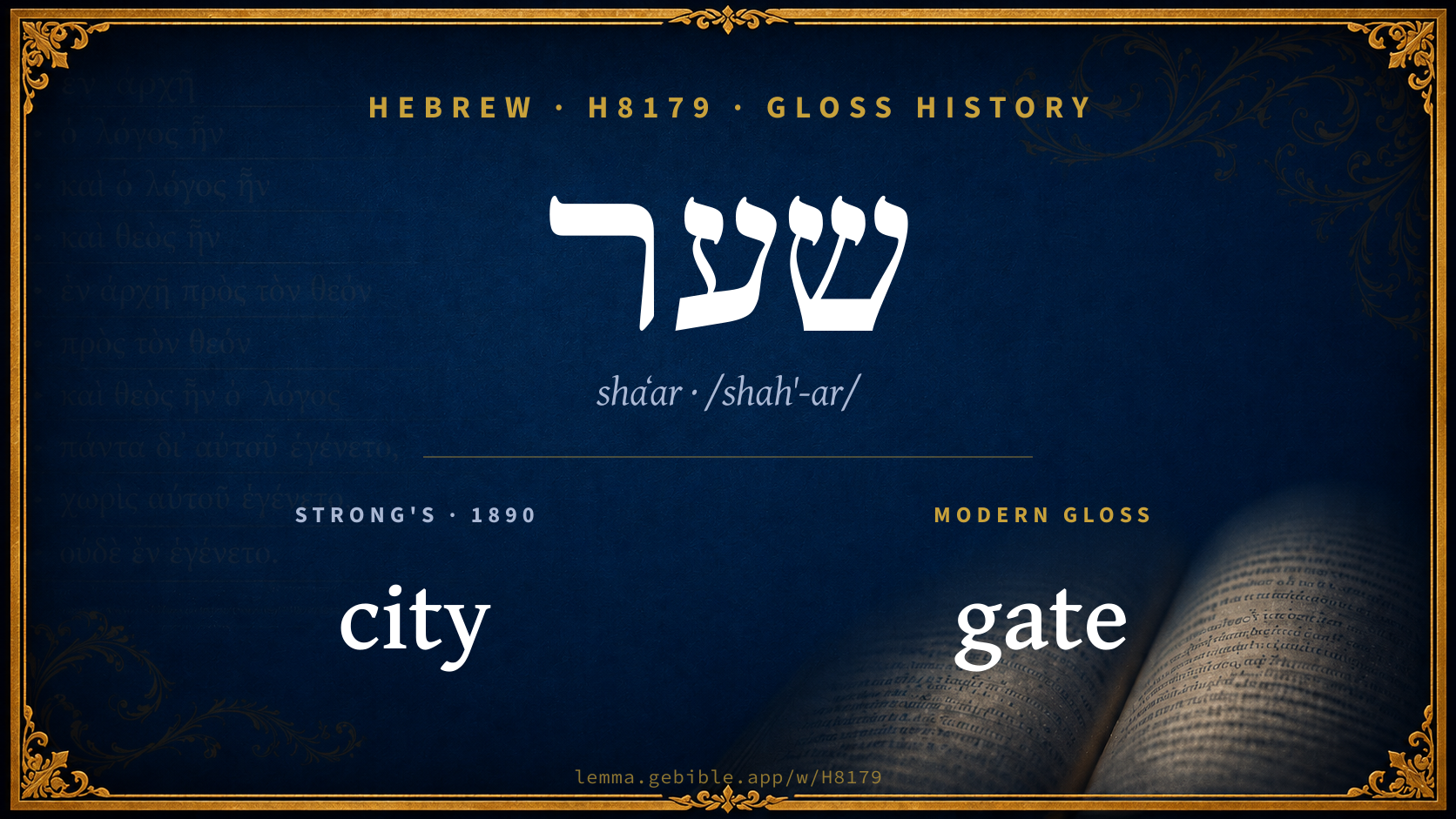
Gloss history
Strong's 1890 vs modern scholarship
About this word
Strong's H8179 catalogs a Hebrew word from the Hebrew Old Testament.
These counts are not copied from any lexicon or concordance. They are computed here, from the morphology-tagged Hebrew Old Testament. What Lemma adds →
- 302
- distinct verses
- The word appears in 302 distinct verses.
- 29 / 39
- OT books
- The word appears in 29 of 39 Old Testament books.
- #135
- by frequency
- Top 250 most frequent Hebrew words (rank 135 of 8,640 Hebrew words by occurrence).
View all 302 occurrences in the concordance →
Most concentrated in
- Ezekiel 59 verses 20%
- Deuteronomy 33 verses 11%
- Nehemiah 31 verses 10%
By section of the Old Testament
By traditional corpus
Conventional, traditional groupings — biblical authorship is debated, so this is a traditional corpus grouping, not an authorship claim. Each share is this word’s portion of its verses in that division of the Hebrew canon. Each figure is a share of the word’s 302 distinct verses.
- Prophets (Nevi'im) 152 verses · 50%
- Writings (Ketuvim) 97 verses · 32%
- Torah (Pentateuch) 53 verses · 18%
How translations render this word
Counts come from each version’s own published word-to-Strong’s tagging or interlinear alignment — an approximate guide to how each version renders this word, not a word-level alignment the data otherwise carries. Because each total is that version’s own tagged count, the per-version totals vary from one another and need not match the appearance or distinct-verse counts above. These counts may also differ from a printed concordance because Lemma counts each distinctly tagged rendering and does not collapse phrase taggings into a single head-word total. This is a fixed set of word-tagged versions (KJV, ASV, BSB, ULT) and does not change with the reading translation you choose elsewhere. Each version’s license is shown beside its name below (and on Sources).
BDB lists this Strong’s number as 2 distinct words (homographs). Each count above pools all of them and is not split by sense — see the Senses section below. A low-frequency rendering may belong to a different one of those words, not the primary meaning.
- King James Version†: Gate 232×, Gates 75×, Within thy gates 7×
- American Standard Version†: Gate 208×, Gates 66×, 's gate 13×
- Berean Standard Bible†: Gate 186×, Gates 77×, Gateway 29×
- unfoldingWord Literal Text†: Gate 117×, Gate of 91×, Gates 68×
King James Version Public Domain
Renders H8179 across 371† tagged occurrences — most commonly:
Plus 35 renderings that appear only once — usually multi-word phrases or single function words the recovered tagging swept in, not distinct renderings.
American Standard Version Public Domain
Renders H8179 across 373† tagged occurrences — most commonly:
Plus other, less common renderings. Plus 48 renderings that appear only once — usually multi-word phrases or single function words the recovered tagging swept in, not distinct renderings.
Berean Standard Bible Public Domain
Renders H8179 across 361† tagged occurrences — most commonly:
Plus other, less common renderings. Plus 20 renderings that appear only once — usually multi-word phrases or single function words the recovered tagging swept in, not distinct renderings. Not rendered by a distinct English word in 12 further occurrences.
unfoldingWord Literal Text CC BY-SA 4.0
Renders H8179 across 384† tagged occurrences — most commonly:
Plus other, less common renderings. Plus 25 renderings that appear only once — usually multi-word phrases or single function words the recovered tagging swept in, not distinct renderings.
11 senses and sub-senses in the full BDB
What do BDB’s symbols mean?
BDB uses these scholarly abbreviations:
| Symbol | Meaning |
|---|---|
| 𝔊 | the Septuagint (the ancient Greek translation, LXX) |
| 𝔙 | the Vulgate (the Latin translation) |
| 𝔖 | the Syriac version (the Peshitta) |
| 𝔗 | the Targum (the Aramaic translation) |
| ψ | the Psalms |
| √ | root (the underlying root or stem) |
| ‖ | parallel passage (a synonymous or contrasted parallel) |
| † | the dagger: every passage where the word occurs is cited |
The 11 senses and sub-senses the full Brown-Driver-Briggs lexicon distinguishes for this word, in lexicon order (not ranked by frequency), with BDB’s own verbatim wording and sub-sense lettering. Shown in Hebrew script with BDB’s own scholarly abbreviations. The condensed entry is in the Lexicon Entry tab. See also the Forms in the corpus table below.
שער I
- 1.
- a. gate, entrance to city, shut (סָגַר) by night Jos 2:5, 7 (JE), cf. Is 45:1, opened (פָּתַח) by day Ne 7:3, cf. Is 60:11; for entrance (בּוֹא), and exit (יָצָא) Je 17:19, 20, 21, 24, 25, 27; La 4:12; Ez 26:10 +; עָבַר שׁ׳ Mi 2:13 pass out through (disreg.accents), ע׳ בַּשׁ׳ Is 62:10; with bars ψ 147:13; attacked Ez 21:20, 27, cf. Is 28:6; Mi 1:9, 12; 1 S 17:52; on Ju 5:8, 11 v. Comm.; burned (by foe) Je 19:27; 51:58; Ne 1:3; 2:3, 13, 17; as giving control, possession, of city, יָרַשׁ אֵת שׁ׳ אֹיְבָיו Gn 22:17; 24:60 (J); פֶּתַח הַשּׁ׳ Ju 9:40 + (v. פ׳), דַּלְתוֹת הַשּׁ׳ 1 S 21:14 + (v. ד׳ 3); פֶּתַח־הַשּׁ׳ Ju 18:16, 17 of farm or village; so of camp Ex 32:26, 27 (J). In cities, elaborate structure, with roof 2 S 18:24, upper chamber 19:1; cf. שְׂאוּ שְׁעָרִים רָאשֵׁיכֶם ψ 24:7, 9; write laws בִּשׁ׳ Dt 6:9 (+ עַל־מְזֻזוֹת בֵּיתֶ֑ךָ), 11:20 (+ id.); בְּתוֹךְ הַשּׁ׳ 1 S 9:18, אֶל־תּוֹךְ הַשּׁ׳ 2 S 3:27; (לְ)יַד שׁ׳ as public, 1 S 4:18, + v 13 𝔊 Th We Dr al., cf. 2 S 15:2; 18:4 Pr 8:3 (‖ מְבוֹא פְתָחִים). e.g. Joshua 2:5
- b. particular gates of Jerusalem are: (1) שׁ׳ אֶפְרַיִם 2 K 14:13 ‖ 2 Ch 25:23; Ne 8:16; 12:39; (2) שׁ׳ הָאַשְׁפֹּת Ne 2:13; 3:14; 12:31 = שׁ׳ הָֽשְׁפוֹת 3:13; (3) שׁ׳ בִּנְיָמִין Je 37:13; 38:7; Zc 14:10; (4) שׁ׳ הנַּיִא Ne 2:13; 15; 3:13 2 Ch 26:9; (5) שׁ׳ הַדָּגִים Zp 1:10; Ne 3:3; 12:39; 2 Ch 33:14; (6) שׁ׳ בֵּין הַחֹמֹתַיִם 2 K 25:4 = Je 52:7, cf. Je 39:4; (7) שׁ׳ החרסות Je 19:2; (8) שׁ׳ הַיְשָׁנָח Ne 3:6; 12:39; (9) שׁ׳ הַמִּזְרָה 3:29; (10) שׁ׳ הַמַּטָּרָה 12:39; (11) שׁ׳ הַמּֽ֑יִם 8:1, 3, 16; (12) שׁ׳ הַמַּיִם לַמִּזְרָ֑ח 3:26, cf. 12:37; (13) שׁ׳ הַמִּפְקָ֑ד 3:31; (14) שׁ׳ הָעַיִן 2:14; 3:15; 12:37; (15) שׁ׳ הַסּוּסִים Je 31:40; Ne 3:28 (cf. 3 b); (16) שׁ׳ הַפִּנָּה 2 K 14:13 ‖ 2 Ch 25:23 (read הַפִּנָּה for הַפּוֹנֶה), Je 31:38; 2 Ch 26:9; prob. = שׁ׳ הָפִּנִּים Zc 14:10; (17) שׁ׳ הַצֹּאן Ne 3:1, 32; 12:39; (18) שׁ׳ הַרִאשׁוֹן Zc 14:10;—on sites and rel. to each other v. RS-GASmEncy. Bib. jerusalem ConderHast DB id. BuhlG. 133 ff. Bd.Pai. s. v. MurrayHd. Bk. s.v. Be-RyNe p. 182 ff. GuZPV, especially v (1882), 7 ff., viii (1885), 245 ff. Comm.ad loc. var. e.g. 2 Kings 14:13
- c. of Ezekiel’s holy city, שַׁעֲרִי הָעִיר Ez 48:31, three on each side, named for tribes, v 31(×4) + 12 times Ez 48. e.g. Ezekiel 48:31
- 2.
- a. gate = space inside gate, as public meeting-place, market 2 K 7:1, 18, place of public well 2 S 23:15, 16 = 1 Ch 11:17, 18; where elders, judges, king, sat officially Dt 21:19; 22:15; Am 5:12, 15; Is 29:21; 2 S 18:24; 19:9; 1 K 22:10 = 2 Ch 18:9; Gn 19:1 (J) Pr 24:7; Jb 5:4; 31:21; Ru 4:1, 11; Pr 31:23, 31, etc.; of conqueror Je 1:15; appar. = רְחוֹב שׁ׳ Gn 19:2 (J) Ne 8:16; 1 Ch 9:16 + (v. i. ר׳); Gn 34:20 (P) one came unto gate (בָּא אֶל־), so בָּאֵי שׁ׳ 23:10, 18 (P) those entering the gate, i.e. having citizens’ rights; also went out (to), יָצָא שׁ׳ Jb 29:7 (i.e., in this case, from his own house, outside the city), hence כָּל־יֹצְאֵי שׁ׳ Gn 34:24(×2) (P; cf. also הוֹצִיא אֶל־ Dt 21:19; 22:15, 24); hence = body of citizens, כָּל־שׁ׳ עַמִּי Ru 3:11. e.g. 2 Kings 7:1
- b. hence also = city Is 14:31 (‖ עִיר), ψ 87:2, etc. e.g. Isaiah 14:31
- c. specif. in Dt, בִּשְׁעָרֶיךָ in thy gates, i.e. thy cities, towns, etc., Dt 5:14 = Ex 20:10; Dt 12:12, 15, 17, 21 + 22 times Dt + 1 K 8:37 (read בְּאַחַד שׁ׳, cf. Dt 18:6; 23:17, so 𝔊; 𝔖 mod.), so ‖ 2 Ch 6:28, + (perhaps) Je 14:2 (but 15:7 Na 3:13 fig. of gates as entrance to land); of private house, שַׁעֲרֵי צַדִּיק Pr 14:19 (perhaps cf. Ju 18:16 1 a supr.). e.g. Deuteronomy 5:14
- 3.
- a. gate of royal castle or palace 2 K 9:31; Je 22:2, 4; Ne 2:8; Est 2:19 + 10 times Est; specif. (of king of Judah), שׁ׳ סוּר 2 K 11:6 = שׁ׳ הַיְסוֹד 2 Ch 23:5 (v. ס׳, יס׳), שׁ׳ הָרָצִים 2 K 11:19, הַשּׁ׳ אַחַר הָר׳ v 6; שׁ׳ הַסּוּסִים בֵּית הַמּ׳ 2 Ch 23:15 (= מְבוֹא הַסּ׳ ‖ 2 K 11:16); appar. of official residence, פֶּתַח שׁ׳ יְהוֹשֻׁעַ 2 K 23:8. e.g. 2 Kings 9:31
- b. of temple Je 7:2(×2) 1 Ch 9:23; 16:42 + 12 times Ch, incl. שַׁעֲרֵי מַחֲנוֹת י׳ 2 Ch 31:2 (v. מַחֲנֶה 1, p. 334), cf. ψ 100:4; 118:20, שַׁעֲרֵי צֶדֶק v 19; specif. שׁ׳ בִּנְיָמִין הָעֶלְיוֹן Je 20:2, and (om. בִּנְי׳) 2 K 15:35 = 2 Ch 27:3; Ez 9:2; 2 Ch 23:20, י׳ הֶחָדָשׁ (בֵּית) שׁ׳ Je 26:10; 36:10, שׁ׳ הַפְּנִימִית הַפּוֹנֶה צָפ֫וֹנָה Ez 8:3 cf. v 14, 8:5, שׁ׳ הַמִּזְבֵּחַ שַׁעַר בֵּית י׳ הַקַּדְמֹנִי 10:19; 11:1; שׁ׳ שַׁלֶּכֶת 1 Ch 26:16; שַׁעַר הַמֶּלֶךְ 1 Ch 9:18. e.g. Jeremiah 7:2
- c. of Ezekiel’s temple and courts Ez 40:3, 6; 44:11, 17 + 67 times Ez 40–47. e.g. Ezekiel 40:3
- d. of court of tabern. (P), שׁ׳ הֶחָצֵר Ex 27:16; 35:17 + 6 times Ex + Nu 4:36. e.g. Exodus 27:16
- 4. fig. זֶה שׁ׳ הַשָּׁמַיִם Gn 28:17 (E; ‖ בֵּית אֱלֹהִים); pl. שַׁעֲרֵי שְׁאוֹל Is 38:10; שׁ׳־מָוֶת Jb 38:17 ψ 9:14; 107:18; שׁ׳ צַלְמָוֶת Jb 38:17. e.g. Genesis 28:17
שער II [m.] measure (proposes reckoning)
Senses from the full Brown-Driver-Briggs lexicon (Brown, Driver, Briggs; Oxford 1906 — public domain), digitized via Sefaria, supplemented by the OpenScriptures HebrewLexicon (CC BY 4.0). Full attribution on Sources.
Word origin
I. n.m. 2 S 18:24 (f. Is 14:31 in personif., AlbrZAW xvi (1896), 86) gate;—שׁ׳ abs. Ju 9:40 +, cstr. Gn 22:17 +; c. ה loc., שָׁ֑עְרָה Is 28:6 +; pl. שְׁעָרִים 2 S 18:24 +, cstr. שַׁעֲרֵי 1 S 17:52 +; sf. שְׁעָרֶיךָ Dt 12:15 +, שַׁעֲרֵיהֶם Ez 21:20; 48:34, etc.;—
II. n.[m.] measure (proposes reckoning);—pl. מֵאָה שְׁעָרִים Gn 26:12 (J) 100 measures, i.e. 100 for one = 100-fold.
— Brown-Driver-Briggs (Oxford 1906, public domain), digitized via Sefaria, supplemented by the OpenScriptures HebrewLexicon (CC BY 4.0). See Sources.
Derived from שער (shâʻar) (H8176) — to calculate.
Jastrow Dictionary
A second Hebrew/Aramaic lexicon for comparison, covering Aramaic and post-biblical (Talmudic, Targumic, Midrashic) usage that the biblical-Hebrew BDB does not. Matched by lemma rather than by Strong’s number, so a lemma may carry more than one Jastrow headword (shown separately below), and the entries cover usage well beyond the Bible.
שָׁעַר I
- to keep the gate.—V. שׁוֹעֵר.
- same. Arakh. 11ᵇ משורר ששי׳ בשל חבירו a Levite chorister that helped in attending to the gate in his neighbor’s stead.—Part. מְשׁוֹעֵר; pl. מְשׁוֹעֲרִים (formed by analogy to מְשׁוֹרֵר, v. שִׁיר I). Ib. מש׳ ששורר, v. שִׁיר I. Ib. ולא מן המש׳ (Sifré Num. 116; Yalk. ib. 752 השׁוֹעֲרִים), v. שִׁיר I.
שָׁעַר II
- v. שַׁעַר) to divide, distribute. [Midr. Till. to Ps. XIV שיערו, v. infra.]
- 1. to apportion, estimate, measure, calculate. Ḥull. VII, 4 כיצד מְשׁעֲרִין אותה וכ׳ how do we define the proportions of the mixture (to find out whether the forbidden admixture is large enough to impart its taste to the permitted portion)? As if it were an admixture of meat in a vegetable dish. Ib. 97ᵇ כשהן משערין משערין וכ׳ when we define the proportions, we include in the calculation the broth &c. Ib. כל איסורין … מְשַׁעֲרִינָן וכ׳ in all admixtures of Biblically forbidden matter we assume for calculation that the forbidden matter was onions or porret. Ib. שִׁיעֲרוּ חכמים וכ׳ the scholars have calculated that of all forbidden substances none give a stronger taste than onions &c. Lev. R. s. 37 מְשָׁעֵר את … באיטלקית (some ed. מְשָׁעֵיר) do you estimate that in all I drank at my meal there would have been a quarter of a Log of Italian (unmixed) wine? Koh. R. to V, 8 שיערו אותה, v. next w.; a. fr.—Midr. Till. to Ps. CXIV (expl. סֹלּוּ, Ps. LXVIII, 5) שַׁעֲרוּ לפניו דרכיכם (not שיע׳; ed. Bub. שפרו, a glossator’s emendation) measure your ways before the Lord (cmp. שׁוּם I). Pesik. Zutr. Haaz. (ed. Bub. p. 114) (ref. to שערום, Deut. XXXII, 17) לא שִׁיעֲרוּם וכ׳ whom your fathers never appraised, to find out whether or not they are of use; Yalk. Deut. 545 לא שערום. e.g. Psalms 68:5
- 2. (v. שַׁעַר) to superintend the market, v. מְשָׁעֵר.
- to be estimated, measured. Ukts. II, 8 מִשְׁתַּעֲרִין בכמות שהן are measured as they are (not compressed); מִשְׁתַּעֶרֶת בכמות שהיא is measured as it is.
שְׁעַר
- Pa. שַׁעֵיר same, to measure, calculate. Targ. O. Gen. XXVI, 12 בדשַׁעֲרוּהִי ed. Berl. (oth. ed. בדשַׁעֲרוֹהִי; Y. בדשַׁעֲרוֹי; h. text שערים).—Ḥull. 97ᵇ ולִישַׁעֲרִינְהוּ בפלפלין וכ׳ why not use as a standard (for calculation in the case of admixtures of forbidden substances) pepper or spices which are not neutralized in a mass of a thousand times their quantity? Ib. בדידיה מְשַׁעֲרִינָן או בדנפיק מיניה משערינן do we calculate the proportions by the actual size of the admixture, or by the quantity that has come out of it (has been absorbed in the dish)? Y. Kil. IX, 32ᵈ top שַׁעֲרוּנָהּ רבנין וכ׳ the Rabbis made the calculation, and it (the well of Miriam) was exactly opposite the middle gate &c.; Lev. R. s. 22 שערותא (corr. acc.); Koh. R. to V, 8 שיערו אותה וכ׳ (Hebr.).
שָׂעַר
- to be rough, denom. שֵׂעָר; to shudder, fear. Sifré Deut. 318 (expl. שערום, Deut. XXXII, 17) שלא עמדה שערת וכ׳ your fathers’ hair did not stand on end before them (v. שָׁעַר II); Yalk. ib. 545. e.g. Deuteronomy 32:17
- (denom. of שֵׂעָר) to grow hair, be hairy. Ḥull. 44ᵃ עד מקום שיַשְׂעִיר Ms. M. a Rashi (ed. כדי, corr. acc.) to the place (of the stomach) where it becomes covered with hair. Ib. (Chald. diction) תורא דמַשְׂעִיר טפי an ox, which is more hairy (on the stomach). Nidd. 25ᵇ עד שישעיר until the embryo has hair.
שְׂעַר
- , Af. אַשְׂעִיר, v. preced.
שֵׂעָר
- preced.) hair. Meg. 18ᵃ, a. e. מסלסל בשׂעַרְךָ, v. סִלְסֵל. Naz. I, 2 הכביד שַׂעֲרוֹ, v. כָּבֵד I. Ib. 4ᵇ לשחת ש׳ וכ׳ to ruin such fine hair; Tosef. ib. IV, 7. Yoma 47ᵃ קלעי שַׂעֲרִי, v. קֶלַע II; a. fr.—Trnsf. crown, ramification of a tree; panicle, stem and pod of leguminous plants. Peah II, 3, a. e. ש׳ כותש, v. כָּתַשׁ; Y. ib. 17ᵃ top סֵעָר. Kil. IV, 9 היה הופך ש׳ שתי וכ׳ he turned the branches of two rows of vines towards one side; B. Bath. 82ᵇ. Sabb. XXI, 3 ש׳ של אפונין וש׳ וכ׳ the panicles (pods) of beans and of lentils. Tosef. Ukts. I, 8 סֵיאָר ed. Zuck. (Var. שיע, read as ed. T’bul Yom III: שיער) the panicle of a pomegranate; a. fr.—Pl., v. שַׂעֲרָה
שְׂעַר ²
- ch., v. שַׂעֲרָא
שַׁעַר
- שער to divide, break open)
- 1. gate, open place for public and private transactions. Sifré Deut. 242 (ref. to Deut. XXII, 24 ש׳ שנמצאת בו וכ׳ the gate (of the place) where she was found, and not the gate where she was judged. Keth. 45ᵇ (ref. to Deut. XVII, 5) ש׳ שעבד בו the gate (of the place) where he worshipped the idol. Midd. I, 3 ש׳ המזרחי the eastern Temple gate; a. v. fr.—Pl. שְׁעָרִים, שְׁעָרִין; constr. שַׁעֲרֵי. Ib. חמשה ש׳ היו וכ׳ the Temple mount had five gates; שני ש׳ חולדה two ḥuldah gates, v. חוּלְדָּה II. Ib. 4; a. v. fr. e.g. Deuteronomy 22:24
- 2. market, market price. B. Mets. V, 7 שיצא הש׳, v. פָּסַק. Ib. (72ᵇ) כש׳ הגבוה (Bab. ed. בש׳) according to the price at the height of the market, i.e. the lowest price. Ib. 8 כש׳ הזול according to the lowest market price. Ib. 1 לקח … וכן הש׳ if he bought wheat of him, at a gold Denar a Kor, and such was the market price. Gitt. 57ᵃ נחסר הש׳ מודיא אחת the price went down one Modius, i.e. from forty Modii to thirty-nine for a Denar; וחזר הש׳ למקומו the price went back to its former figure; a. fr.—Pl. as ab. B. Bath. 89ᵃ לש׳ for the regulation of market prices, v. אֲגַרְדְּמִיס; Y. ib. V, end, 15ᵇ שִׁיעוּרִין, a. שִׁיעוּרַיָּיא.
שַׁעַר II
- estimation, proportion. — Pl. שְׁעָרִים. Gen. R. s. 64 (ref. to Gen. XXVI, 12) מאה כורים מאה ש׳ מאה מניינים מאה ש׳ וכ׳ one hundred Kor; one hundred proportions, one hundred quantities; one hundred sh’ʿarim, this shows that they had made an estimate of it (the crop of the field), and it brought a hundred times the estimated quantity; Yalk. ib. 111 (corr. acc.); Pirké d’R. El. ch. XXXIII וכל דבר … מאה ש׳ של ממון וכ׳ and for every thing that he gave tithes of, the Lord sent him one hundred times the value, and he blessed him. e.g. Genesis 26:12
A Dictionary of the Targumim, the Talmud Babli and Yerushalmi, and the Midrashic Literature (Marcus Jastrow; London, Luzac, 1903) — Public Domain. Digitized via Sefaria. Digitized via Sefaria. Full attribution on Sources.
Forms in the corpus
The 141 distinct written forms H8179 takes in the Hebrew Bible, most frequent first — each parse links to that state’s occurrences in the concordance. Hebrew forms include their vowel points and cantillation, so a single lemma takes many written forms.
The 60 most common forms are shown; 81 rarer forms follow in the full concordance.
Same root — word family
Other BDB entries built from the same root as H8179, grouped by Strong’s listed origin. These share a root / origin per the lexicon — not necessarily a shared meaning. Each links to that word’s own entry.
Derives from
Shares the same root
Derived from this word
Proper names from this root
People and places named from this root — a name, not an additional meaning of the word.
Compare all same-root words → Showing 4 of 9 — not the complete family. 2 of the same-root words are proper names (people or places). They share a root, not necessarily a meaning.
Septuagint verse parallels
This word appears in 260 verses that also exist in the Greek Old Testament (Septuagint), out of the 302 Hebrew verses it occurs in. You can read those verses in Greek by switching the Old Testament edition to the Septuagint.
Read these verses in the Septuagint
- Genesis 19:1
- Exodus 20:10
- Numbers 4:26
- Deuteronomy 5:14
- Joshua 2:5
- Judges 5:8
- Ruth 3:11
- 1 Samuel 4:18
- 2 Samuel 3:27
- 1 Kings 8:37
- 2 Kings 7:1
- 1 Chronicles 9:18
This is a verse-level parallel only — the same verses exist in both the Hebrew and Greek Old Testaments. No word-level Hebrew↔Greek correspondence is claimed: the data carries no such alignment, so no Greek word is shown as this Hebrew word’s translation. Coverage is not total — the Septuagint omits the deuterocanon and renumbers the Psalms, so some Hebrew verses have no direct Greek parallel.