Nehemiah 3:29

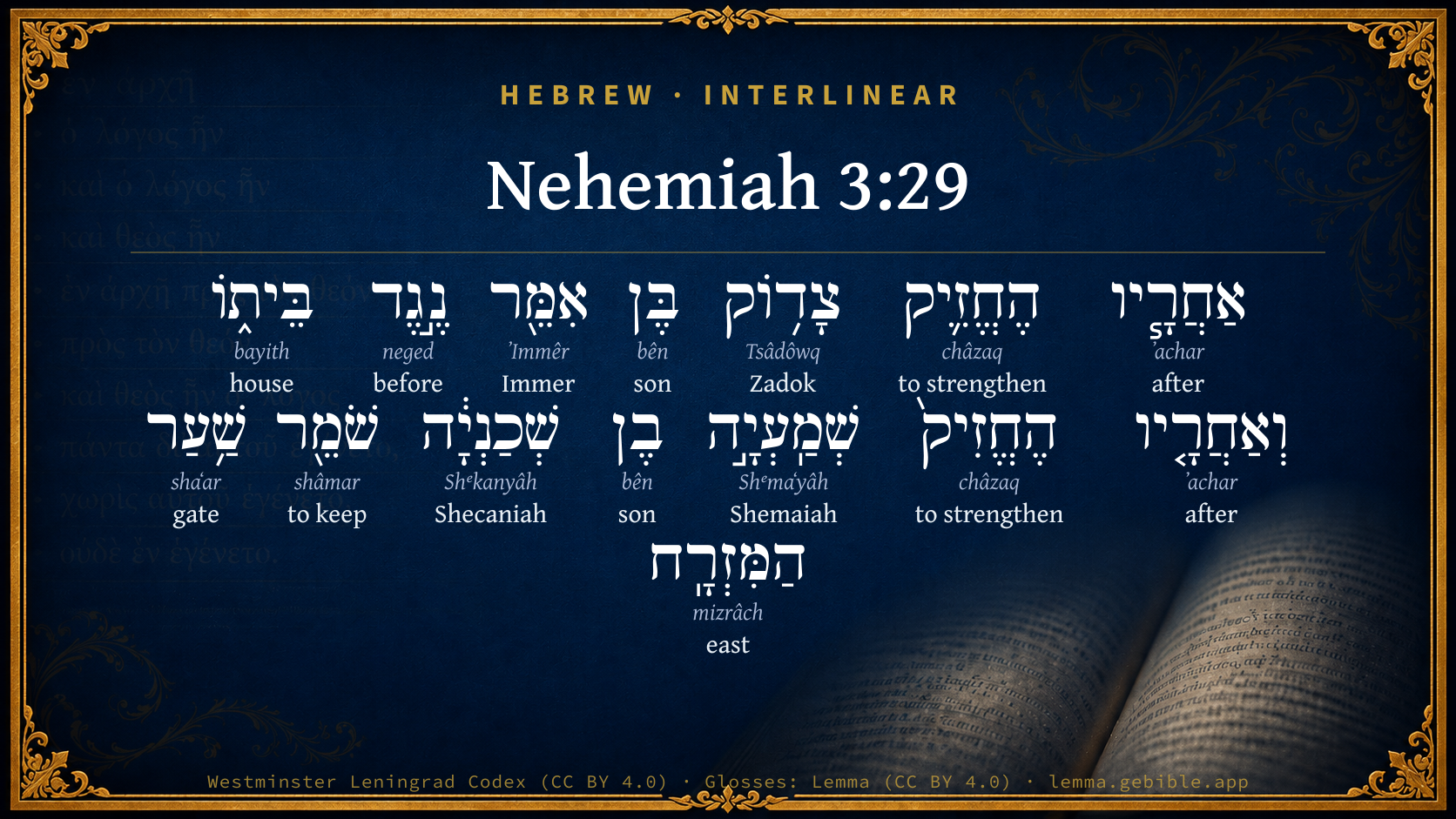
Hebrew (Westminster Leningrad Codex) Nehemiah 3:29 appears in the Hebrew Old Testament. The text above is from the Westminster Leningrad Codex. Each word links to its Strong’s number, a concise gloss, and parsing drawn from the Open Scriptures Hebrew Bible morphology. Click any word for its full Brown-Driver-Briggs (BDB) entry.
Download image
Cite this verse

Nehemiah 3:29 (World English Bible). Public Domain. Lemma interlinear Bible study tool, https://lemma.gebible.app/v/nehemiah/3/29.

Show BibTeX & RIS
BibTeX
RIS
English Translation
After them repaired Zadok the son of Immer over against his own house. After him repaired Shemaiah the son of Shecaniah, the keeper of the east gate.
World English Bible · Public Domain
Download a study sheet

One document with this verse’s original text, its word-by-word gloss line, the meaning frame, cross-references with their text, attributed commentary, and full source and license credits — printable, and it pastes into notes with its structure intact.

This verse Autodidact and up

Study sheet (.html) Plain text (.txt)

A passage Seminary Student

Up to 50 verses in one chapter. A passage sheet keeps up to 6 commentary sources and 12 cross-references per verse, in the order this page ranks them, and says so on the sheet whenever that leaves anything out. Ask for a single verse and you get the Autodidact verse sheet above.

Everything on this page stays free to read, with no account — the sheet is a download of what is already on screen, not access to it.

Want to remove ads? Support Godless Engineer
Compare translations 3

The same verse in 3 English versions, stacked beneath the original-language interlinear above. Click any original word for its lexicon entry.

Each is an independent rendering of the whole verse — the interlinear is not word-aligned to these translations.

Highlighted words mark where these versions differ — a whole-verse word diff, not a word-by-word alignment.

  • World English Bible Public Domain
    After them repaired Zadok the son of Immer over against his own house. After him repaired Shemaiah the son of Shecaniah, the keeper of the east gate.
  • King James Version Public Domain
    After them repaired Zadok the son of Immer over against his house. After him repaired also Shemaiah the son of Shechaniah, the keeper of the east gate.
  • unfoldingWord Literal Text CC BY-SA 4.0
    After him, Zadok the son of Immer strengthened in front of his house. And after him, Shemaiah, the son of Shecaniah, the keeper of the gate of the east, strengthened.

unfoldingWord Literal Text — © unfoldingWord, licensed CC BY-SA 4.0. Word-aligned USFM3 via Door43 (git.door43.org/unfoldingWord/en_ult).

Versions to compare (up to 4)

3 of 4 selected

Show all 18 translations

Every available English version of this verse, each an independent rendering of the whole verse.

  • World English Bible Public Domain
    After them repaired Zadok the son of Immer over against his own house. After him repaired Shemaiah the son of Shecaniah, the keeper of the east gate.
  • Berean Standard Bible Public Domain
    Next to them, Zadok son of Immer made repairs opposite his house, and next to him, Shemaiah son of Shecaniah, the guard of the East Gate, made repairs.
  • Majority Standard Bible Public Domain
    Next to them, Zadok son of Immer made repairs opposite his house, and next to him, Shemaiah son of Shecaniah, the guard of the East Gate, made repairs.
  • King James Version Public Domain
    After them repaired Zadok the son of Immer over against his house. After him repaired also Shemaiah the son of Shechaniah, the keeper of the east gate.
  • American Standard Version (1901) Public Domain
    After them repaired Zadok the son of Immer over against his own house. And after him repaired Shemaiah the son of Shecaniah, the keeper of the east gate.
  • Revised Version (1885) Public Domain
    After them repaired Zadok the son of Immer over against his own house. And after him repaired Shemaiah the son of Shecaniah, the keeper of the east gate.
  • Geneva Bible (1599) Public Domain
    After them fortified Zadok the sonne of Immer ouer against his house: and after him fortified Shemaiah, the sonne of Shechadiah the keeper of the East gate.
  • Douay-Rheims (1899) Public Domain
    After them built Sadoc the son of Emmer over against his house. And after him built Semaia the son of Sechenias, keeper of the east gate.
  • Young's Literal Translation Public Domain
    After them hath Zadok son of Immer strengthened, over against his house; and after him hath Shemaiah son of Shechaniah, keeper of the east gate, strengthened.
  • Literal Standard Version CC BY-SA 4.0
    After them Zadok son of Immer has strengthened opposite his house; and after him Shemaiah son of Shechaniah, keeper of the East Gate, has strengthened.
  • Unlocked Literal Bible CC BY-SA 4.0
    After them Zadok son of Immer repaired the section opposite his own house. Then after him Shemaiah son of Shecaniah, the keeper of the east gate, repaired.
  • unfoldingWord Literal Text CC BY-SA 4.0
    After him, Zadok the son of Immer strengthened in front of his house. And after him, Shemaiah, the son of Shecaniah, the keeper of the gate of the east, strengthened.
  • Darby Bible Public Domain
    After them repaired Zadok the son of Immer over against his house. And after him repaired also Shemaiah the son of Shechaniah, the keeper of the east gate.
  • World Messianic Bible Public Domain
    After them, Zadok the son of Immer made repairs across from his own house. After him, Shemaiah the son of Shecaniah, the keeper of the east gate, made repairs.
  • Webster's Bible Public Domain
    After them repaired Zadok the son of Immer over against his house. After him repaired also Shemaiah the son of Shechaniah, the keeper of the east gate.
  • Free Bible Version CC BY-SA 4.0
    Next was Zadok, son of Immer, who worked opposite his house, and next was Shemaiah, son of Shecaniah, the guard at the East Gate.
  • Bible in Basic English Public Domain
    After them Zadok, the son of Immer, was working opposite his house. And after him Shemaiah, the son of Shecaniah, the keeper of the east door.
  • JPS Tanakh (1917) Public Domain
    After them repaired Zadok the son of Immer over against his own house. And after him repaired Shemaiah the son of Shecaniah, the keeper of the east gate.

Literal Standard Version (2020), Covenant Press — licensed CC BY-SA 4.0. Text via the HelloAO Bible API (eBible.org). Unlocked Literal Bible (unfoldingWord) — licensed CC BY-SA 4.0. Text via the HelloAO Bible API (eBible.org). unfoldingWord Literal Text — © unfoldingWord, licensed CC BY-SA 4.0. Word-aligned USFM3 via Door43 (git.door43.org/unfoldingWord/en_ult). Free Bible Version, Dr. Jonathan Gallagher — licensed CC BY-SA 4.0. Text via the HelloAO Bible API (eBible.org).

Word by word

More ways to search: Search by grammar → Find every occurrence → Compare this word →

Practice this passage: Drill this verse → Learn its vocabulary →

אִמֵּ֖ר
ʼImmêr
H564
“Immer”
Noun, Proper
Part of Speech
Noun
Type
Proper
Full BDB Definition

Origin: from H559

TWOT: None

Immer = "he hath said" - a priest in David's time - a priest in Jeremiah's time - the father of Zadok the priest - an ancestor of a priest
  1. אַחֲרָ֧יו ʼachar H310 “after · him” Preposition + Suffix, Personal, 3rd Person, Masculine, Singular
  2. הֶחֱזִ֛יק châzaq H2388 “to strengthen” Verb, Hiphil, Perfect, 3rd Person, Masculine, Singular
  3. צָד֥וֹק Tsâdôwq H6659 “Zadok” Noun, Proper
  4. בֶּן bên H1121 “son of” Noun, Common, Masculine, Singular, Construct
  5. נֶ֣גֶד neged H5048 “before” Preposition
  6. בֵּית֑וֹ bayith H1004 “house · his” Noun, Common, Masculine, Singular, Construct + Suffix, Personal, 3rd Person, Masculine, Singular
  7. וְאַחֲרָ֤יו ʼachar H310 “and · after · him” Conjunction + Preposition + Suffix, Personal, 3rd Person, Masculine, Singular
  8. הֶחֱזִיק֙ châzaq H2388 “to strengthen” Verb, Hiphil, Perfect, 3rd Person, Masculine, Singular
  9. שְׁמַֽעְיָ֣ה Shᵉmaʻyâh H8098 “Shemaiah” Noun, Proper
  10. בֶן bên H1121 “son of” Noun, Common, Masculine, Singular, Construct
  11. שְׁכַנְיָ֔ה Shᵉkanyâh H7935 “Shecaniah” Noun, Proper
  12. שֹׁמֵ֖ר shâmar H8104 “keeping” Verb, Qal, Participle Active, Masculine, Singular, Construct
  13. שַׁ֥עַר shaʻar H8179 “gate of” Noun, Common, Masculine, Singular, Construct
  14. הַמִּזְרָֽח mizrâch H4217 “the · east” Particle, Definite Article + Noun, Common, Masculine, Singular, Absolute

About this verse

These counts appear in no published source. They are computed here, from the morphology-tagged text and Lemma’s own curated glosses. What Lemma adds →

15
words
12
distinct lemmas
Historical
section

Notable vocabulary

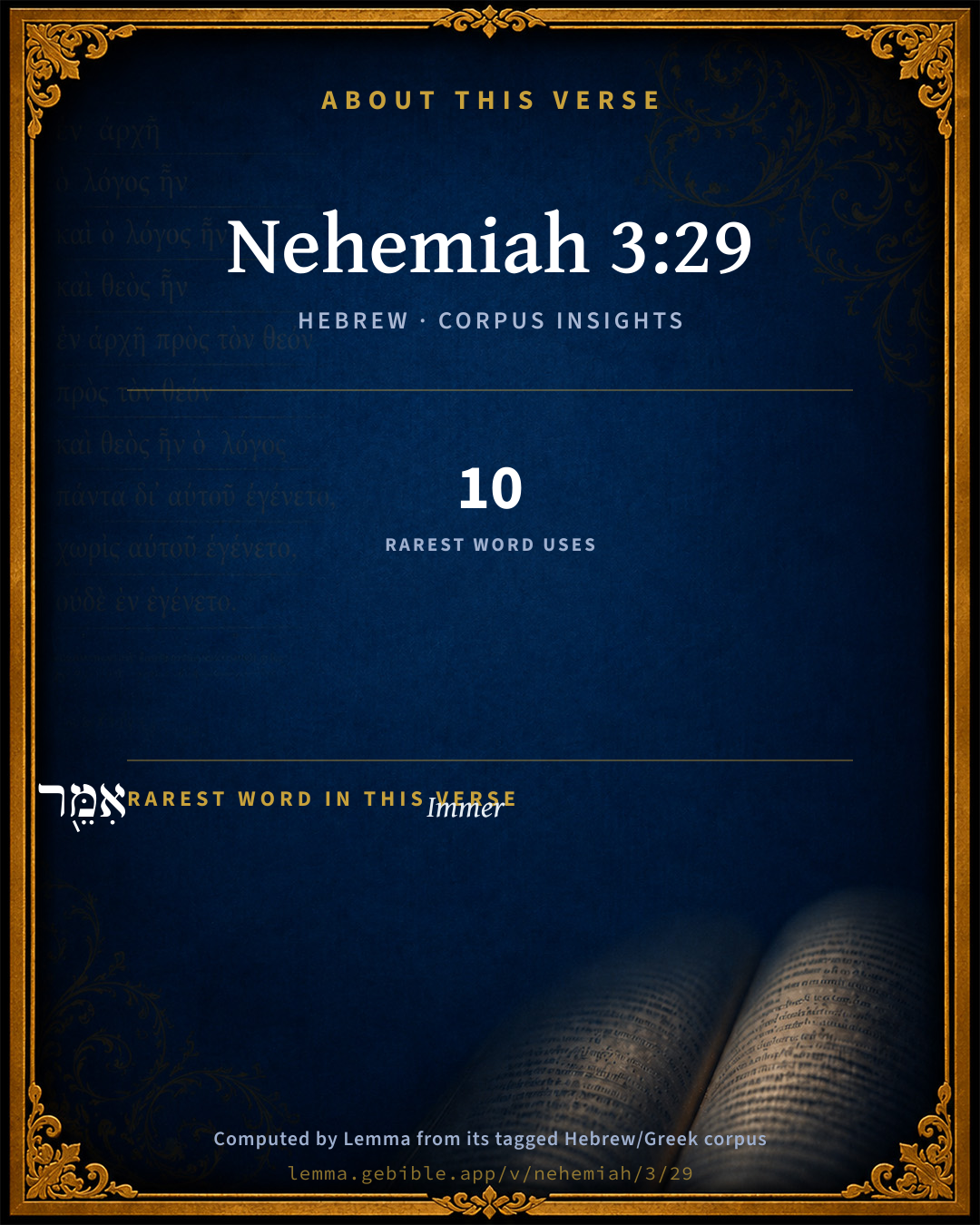
The rarest word here is אִמֵּ֖ר Immer H564 — appearing just 10 times in the whole Hebrew Bible.

Shared distinctive vocabulary

אִמֵּ֖ר Immer H564 occurs in 10 verses of the Hebrew Bible. Also found in:

Grammatical profile

  • 3 verbs
  • 9 nouns
  • 3 prepositions

Verb forms

  • הֶחֱזִ֛יק Hiphil · Perfect
  • הֶחֱזִיק֙ Hiphil · Perfect
  • שֹׁמֵ֖ר Qal · Participle Active

Repetition

Words recur within this verse — often emphatic in Hebrew:

  • אַחֲרָ֧יו after H310 ×2
  • הֶחֱזִ֛יק to strengthen H2388 ×2
  • בֶּן son H1121 ×2

Cross-references

4

Topical passages linked to Nehemiah 3:29 in the Treasury of Scripture Knowledge — connected by theme and wording, ordered by reader-vote popularity; previews shown in the World English Bible.

  • Ezra 2:37 The children of Immer, one thousand fifty-two.
  • Ezra 10:2 Shecaniah the son of Jehiel, one of the sons of Elam, answered Ezra, We have trespassed against our God, and have married foreign women of the peoples of the land: yet now there is hope for Israel concerning this thing.
  • Nehemiah 7:40 The children of Immer, one thousand fifty-two.
  • Jeremiah 19:2 and go forth to the valley of the son of Hinnom, which is by the entry of the gate Harsith, and proclaim there the words that I shall tell you;

Cross-references courtesy of OpenBible.info (CC BY 4.0).

Hebrew and Greek witnesses Masoretic Hebrew ↔ Greek Septuagint

The same verse in the two great witnesses to the Old Testament, shown verse-for-verse.

These are two independent witnesses, not word-aligned to each other, and the Septuagint is shown in lemma (dictionary) form.

Hebrew Nehemiah 3:29 Masoretic · Westminster Leningrad Codex

אַחֲרָ֧יו הֶחֱזִ֛יק צָד֥וֹק בֶּן אִמֵּ֖ר נֶ֣גֶד בֵּית֑וֹ וְאַחֲרָ֤יו הֶחֱזִיק֙ שְׁמַֽעְיָ֣ה בֶן שְׁכַנְיָ֔ה שֹׁמֵ֖ר שַׁ֥עַר הַמִּזְרָֽח

After them repaired Zadok the son of Immer over against his own house. After him repaired Shemaiah the son of Shecaniah, the keeper of the east gate.

World English Bible · Public Domain

Greek LXX Structure differs

The Septuagint has no separate book of Nehemiah. Its Greek text is the second half of Esdras B (2 Esdras), chapters 11–23; Ezra is the first half (1–10).

A verse-for-verse comparison isn’t shown here because the chapters and verses don’t line up. Switch to the LXX edition with the MT / LXX toggle above to read the Greek directly.

On this verse, Haydock's Catholic Bible Commentary discusses the Septuagint’s reading. Read the note in Commentary ↓

Hebrew: Westminster Leningrad Codex (CC BY 4.0). Greek: Septuagint (public domain); English from a public-domain English Septuagint. How the Septuagint differs from the Hebrew →

Commentary

Notes on Nehemiah 3:29 from classic Christian and Jewish commentators (each source and its license shown beneath its notes). The classic Christian expositions comment on the surrounding passage and are grouped to its opening verse, so a note may address several verses; the Jewish commentaries on the Tanakh (Rashi and others) are per-verse, so they appear only where the commentator wrote on this verse.

Lemma curates 59 commentaries, every one of them public domain or Creative Commons licensed, each selected and text-cleaned for this edition rather than reprinted as found. About our sources →

Trapp's Complete Commentary

John Trapp

Neh 3:29 After them repaired Zadok the son of Immer over against his house. After him repaired also Shemaiah the son of Shechaniah, the keeper of the east gate.

Ver. 29. Shemaiah the son of Shechaniah] Egregie cordatus homo, Ezr 8:16.

John Trapp, A Commentary or Exposition upon All the Books of the Old and New Testament (1647–1656) — public domain. Text from a community e-Sword module.

Ellicott's Commentary for English Readers

(29) Shemaiah the son of Shechaniah.—The name in 1Ch_3:22 of a descendant of David.

A Bible Commentary for English Readers, edited by Charles John Ellicott (1878–1897) — public domain. Text from a community e-Sword module.

The Cambridge Bible for Schools and Colleges

gen. ed. J. J. S. Perowne

29. After them] R.V. marg. ‘Heb. him’. See note on Neh_3:3.

Zadok the son of Immer] The head of the priestly family of Immer. See Ezr_2:37.

After him] R.V. And after him.

the keeper of the east gate] This has sometimes been identified with ‘the water gate’ of Neh_3:26. But it is very improbable that, in a topographical chapter such as this, the same gate should be mentioned by two different names without any word of explanation.

Considering that the previous name is that of a priest, it is natural to suppose that Shemaiah, ‘the keeper of the east gate,’ was a Levite, and the east gate was the eastern approach to the Temple precincts.

The Cambridge Bible for Schools and Colleges (gen. ed. J. J. S. Perowne; Cambridge University Press, 1878–1918) — public domain. Text from a community e-Sword module.

John Gill's Exposition

After him repaired Malchiah, the goldsmith's son,.... Or the son of Tzoreph, as some, so called from his business:

unto the place of the Nethinims, and of the merchants; he repaired up to the place where these dwelt:

over against the gate Miphkad; where some think was an house of visitation or correction; and others, where the sanhedrim sat, tried causes, and exercised justice:

and to the going up of the corner; from the east to the north.

John Gill's Exposition of the Whole Bible (1746–1763) — public domain (CC PDM 1.0). Text via the HelloAO Bible API.

Haydock's Catholic Bible Commentary

After him, Semaia; as the Septuagint, &c., intimate; and not (Calmet) "after me," as if Nehemias spoke of himself, as some Hebrew copies require. (Junius) (Grotius) --- Treasury, or "room." (Pagnin) --- Judgment. Septuagint, "Maphekad." Hebrew mopkod. Protestants, "miphkad," (Haydock) may signify "command, review," &c. We can only guess at the reason of this appellation. (Calmet) --- Perhaps the cause of the Nathinites were here decided, (Menochius) as well as those of others. It seems to be the same with the watch-gate, (chap. xii. 38.) and led not out of the city, but into the street of the Nathinites. (Tirinus)

George Leo Haydock (1774–1849), Haydock's Catholic Family Bible and Commentary, 1859 edition — public domain. Excludes Psalms (Douay-Rheims chapter numbering differs from Protestant) and Deuterocanonical books (Catholic canon only).

Matthew Poole's English Annotations

To wit, of the city, or of the temple; which being the chief gate, was committed to his particular care and custody.

Matthew Poole's English Annotations on the Holy Bible (1683–1685) — public domain. Text from a community e-Sword/MySword module.

Whedon's Commentary on the Bible

Daniel D. Whedon

29. Keeper of the east gate — This does not imply that the east gate was anywhere near the wall which Shemaiah repaired. The expression naturally designates some gate in the eastern wall of the city.

Daniel D. Whedon (gen. ed.), Commentary on the Old and New Testaments (1874–1909) — public domain. Text from a community e-Sword module.

The Pulpit Commentary

Shemaiah the son of Shechaniah is very possibly the descendant of David mentioned in 1Ch_3:22. He must have been an old man, as his son, Hattush, had returned to Jerusalem with Ezra; (Ezr_8:2, Ezr_8:3) but still he may have taken part in the work. That he was keeper of the east gate does not militate against this hypothesis, for that post was an honourable one, and it is not to be supposed that all the descendants of David were in flourishing circumstances. By "the east gate" we are perhaps to understand "the water gate towards the east" of ver. 26.

The Pulpit Commentary (1880–1919), ed. H.D.M. Spence-Jones & Joseph S. Exell — public domain. Text from a community e-Sword module.

Lesson kit

Teaching starters — assembled from the data on this page, not authored interpretation. Every prompt links to the verse data it draws on. Edit before teaching.

Nehemiah, in the Historical, opens this verse with 15 words (12 distinct Hebrew lemmas). Its most distinctive word is ʼImmêr (“Immer”). A historical commentator’s framing appears above. Read the whole chapter for the surrounding context.

Discussion questions

  1. The word ʼImmêr carries the sense “Immer.” How does it shape the verse?
  2. How does 1 Chronicles 9:12, which shares the word «Immer», read alongside this verse?
  3. What does the repetition of “after” (2× in this one verse) do in this verse?
  4. These translations render this verse differently; the difference is in the English rendering, not the original. What questions does that raise?
  5. «הֶחֱזִ֛יק» is a Hiphil Perfect verb. How does that grammatical form shape the action described?
  6. Compare how Trapp's Complete Commentary and Ellicott's Commentary for English Readers read this verse. Where do they agree or differ?

Things to notice

Reading settings

Reading text

Shown beneath each verse's original-language words.

Old Testament
Old Testament edition

Read the OT as the Masoretic Hebrew (MT) or the Greek Septuagint (LXX).

English shown for the Greek Septuagint (in the Hebrew ↔ Greek comparison).

Comparing translations? Open the Compare panel on any verse page to stack up to four side by side.