
Deuteronomy 15:7

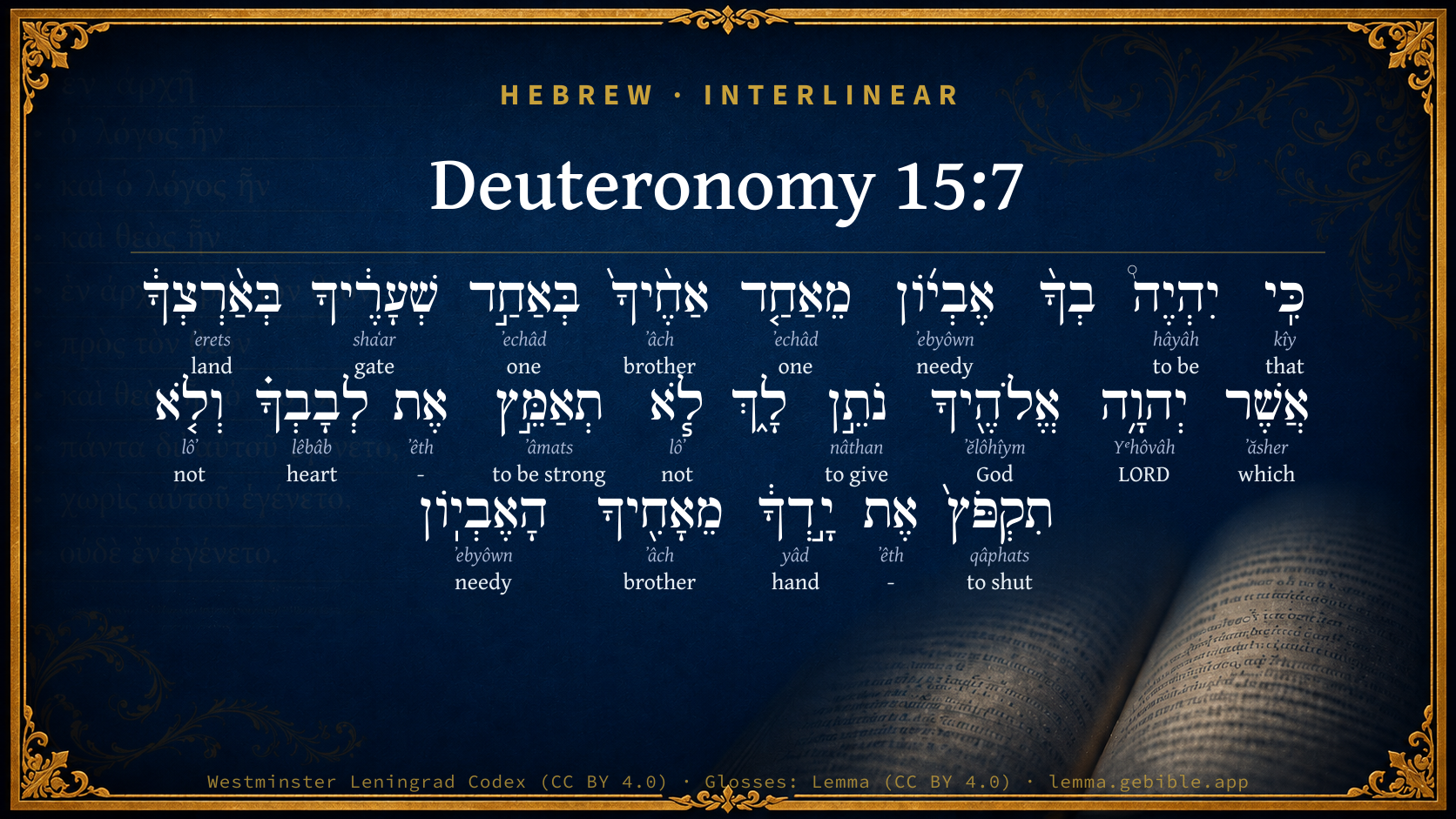
Hebrew (Westminster Leningrad Codex) Deuteronomy 15:7 appears in the Hebrew Old Testament. The text above is from the Westminster Leningrad Codex. Each word links to its Strong’s number, a concise gloss, and parsing drawn from the Open Scriptures Hebrew Bible morphology. Click any word for its full Brown-Driver-Briggs (BDB) entry.
Download image
Cite this verse

Deuteronomy 15:7 (World English Bible). Public Domain. Lemma interlinear Bible study tool, https://lemma.gebible.app/v/deuteronomy/15/7.

Show BibTeX & RIS
BibTeX
RIS
English Translation
If there be with you a poor man, one of your brothers, within any of your gates in your land which Yahweh your God gives you, you shall not harden your heart, nor shut your hand from your poor brother;
World English Bible · Public Domain
Highlights
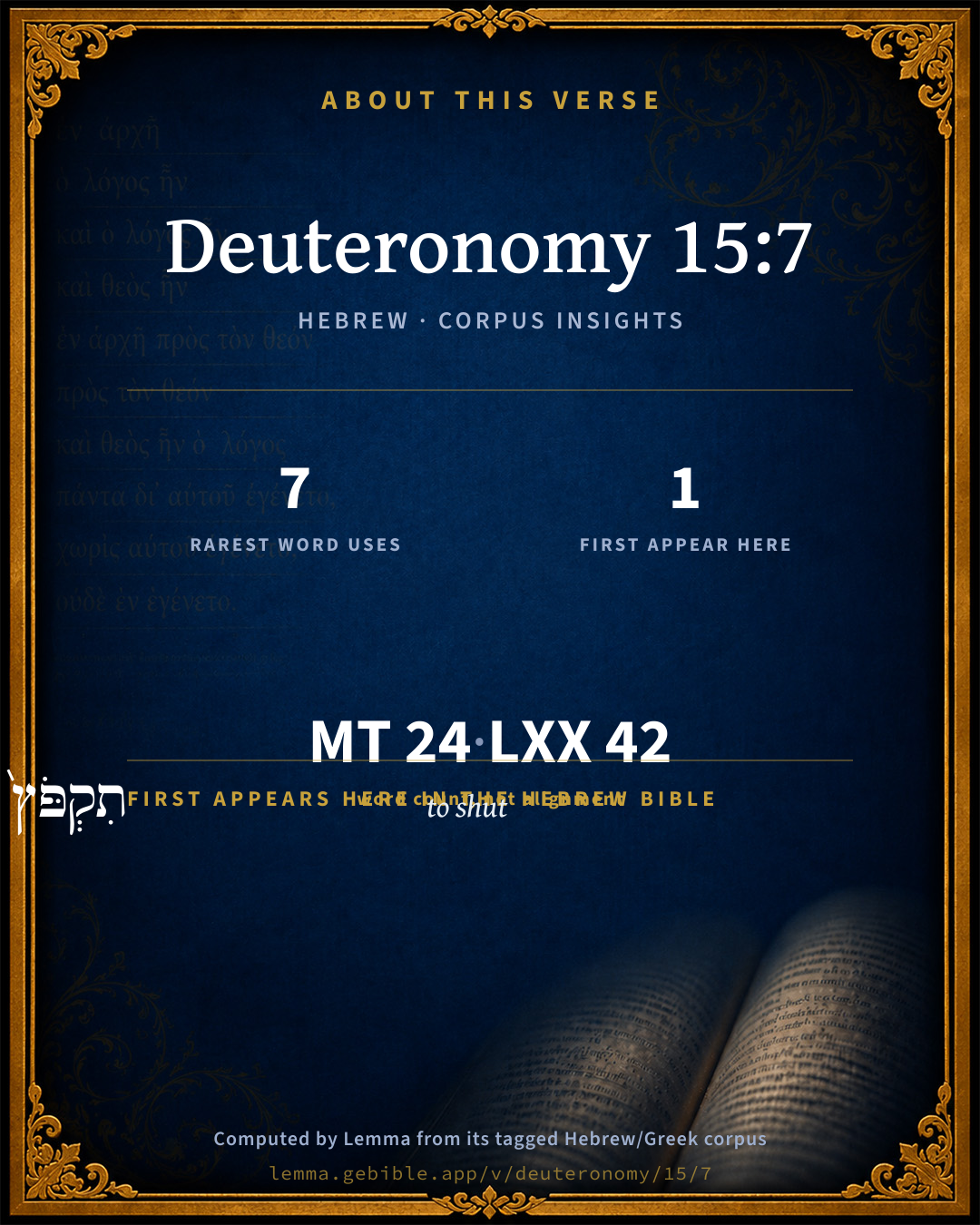
  • 1 first appearance in the Hebrew Bible
Full analysis ↓
Download a study sheet

One document with this verse’s original text, its word-by-word gloss line, the meaning frame, cross-references with their text, attributed commentary, and full source and license credits — printable, and it pastes into notes with its structure intact.

This verse Autodidact and up

Study sheet (.html) Plain text (.txt)

A passage Seminary Student

Up to 50 verses in one chapter. A passage sheet keeps up to 6 commentary sources and 12 cross-references per verse, in the order this page ranks them, and says so on the sheet whenever that leaves anything out. Ask for a single verse and you get the Autodidact verse sheet above.

Everything on this page stays free to read, with no account — the sheet is a download of what is already on screen, not access to it.

Want to remove ads? Support Godless Engineer
Compare translations 3

The same verse in 3 English versions, stacked beneath the original-language interlinear above. Click any original word for its lexicon entry.

Each is an independent rendering of the whole verse — the interlinear is not word-aligned to these translations.

Highlighted words mark where these versions differ — a whole-verse word diff, not a word-by-word alignment.

  • World English Bible Public Domain
    If there be with you a poor man, one of your brothers, within any of your gates in your land which Yahweh your God gives you, you shall not harden your heart, nor shut your hand from your poor brother;
  • King James Version Public Domain
    If there be among you a poor man of one of thy brethren within any of thy gates in thy land which the LORD thy God giveth thee, thou shalt not harden thine heart, nor shut thine hand from thy poor brother:
  • unfoldingWord Literal Text CC BY-SA 4.0
    If there is poor among you, from one of your brothers, within one of your gates in your land that Yahweh your God is giving to you, do not harden your heart, and do not shut your hand from your poor brother,

unfoldingWord Literal Text — © unfoldingWord, licensed CC BY-SA 4.0. Word-aligned USFM3 via Door43 (git.door43.org/unfoldingWord/en_ult).

Versions to compare (up to 4)

3 of 4 selected

Show all 18 translations

Every available English version of this verse, each an independent rendering of the whole verse.

  • World English Bible Public Domain
    If there be with you a poor man, one of your brothers, within any of your gates in your land which Yahweh your God gives you, you shall not harden your heart, nor shut your hand from your poor brother;
  • Berean Standard Bible Public Domain
    If there is a poor man among your brothers within any of the gates in the land that the LORD your God is giving you, then you are not to harden your heart or shut your hand from your poor brother.
  • Majority Standard Bible Public Domain
    If there is a poor man among your brothers within any of the gates in the land that the LORD your God is giving you, then you are not to harden your heart or shut your hand from your poor brother.
  • King James Version Public Domain
    If there be among you a poor man of one of thy brethren within any of thy gates in thy land which the LORD thy God giveth thee, thou shalt not harden thine heart, nor shut thine hand from thy poor brother:
  • American Standard Version (1901) Public Domain
    If there be with thee a poor man, one of thy brethren, within any of thy gates in thy land which Jehovah thy God giveth thee, thou shalt not harden thy heart, nor shut thy hand from thy poor brother;
  • Revised Version (1885) Public Domain
    If there be with thee a poor man, one of thy brethren, within any of thy gates in thy land which the LORD thy God giveth thee, thou shalt not harden thine heart, nor shut thine hand from thy poor brother:
  • Geneva Bible (1599) Public Domain
    If one of thy brethren with thee be poore within any of thy gates in thy land, which the Lord thy God giueth thee, thou shalt not harden thine heart, nor shut thine hand from thy poore brother:
  • Douay-Rheims (1899) Public Domain
    If one of thy brethren that dwelleth within the gates of thy city in the land which the Lord thy God will give thee, come to poverty: thou shalt not harden thy heart, nor close thy hand,
  • Young's Literal Translation Public Domain
    `When there is with thee any needy one of one of thy brethren, in one of thy cities, in thy land which Jehovah thy God is giving to thee, thou dost not harden thy heart, nor shut thy hand from thy needy brother;
  • Literal Standard Version CC BY-SA 4.0
    When there is with you any poor of one of your brothers, in one of your cities, in your land which your God YHWH is giving to you, you do not harden your heart, nor shut your hand from your needy brother;
  • Unlocked Literal Bible CC BY-SA 4.0
    If there is a poor man among you, one of your brothers, within any of your gates in your land that Yahweh your God is giving you, you must not harden your heart nor shut your hand from your poor brother;
  • unfoldingWord Literal Text CC BY-SA 4.0
    If there is poor among you, from one of your brothers, within one of your gates in your land that Yahweh your God is giving to you, do not harden your heart, and do not shut your hand from your poor brother,
  • Darby Bible Public Domain
    If there be amongst you a poor man, any one of thy brethren in one of thy gates, in thy land which Jehovah thy God giveth thee, thou shalt not harden thy heart, nor shut thy hand from thy brother in need;
  • World Messianic Bible Public Domain
    If a poor man, one of your brothers, is with you within any of your gates in your land which the LORD your God gives you, you shall not harden your heart, nor shut your hand from your poor brother;
  • Webster's Bible Public Domain
    If there shall be among you a poor man of one of thy brethren within any of thy gates in thy land which the LORD the God giveth thee, thou shalt not harden thy heart, nor shut thy hand from thy poor brother:
  • Free Bible Version CC BY-SA 4.0
    If there are Israelites who are poor in any of your towns in the country the Lord your God is giving you, don't act in an unfeeling or miserly way towards them.
  • Bible in Basic English Public Domain
    If in any of your towns in the land which the Lord your God is giving you, there is a poor man, one of your countrymen, do not let your heart be hard or your hand shut to him;
  • JPS Tanakh (1917) Public Domain
    If there be among you a needy man, one of thy brethren, within any of thy gates, in thy land which the LORD thy God giveth thee, thou shalt not harden thy heart, nor shut thy hand from thy needy brother;

Literal Standard Version (2020), Covenant Press — licensed CC BY-SA 4.0. Text via the HelloAO Bible API (eBible.org). Unlocked Literal Bible (unfoldingWord) — licensed CC BY-SA 4.0. Text via the HelloAO Bible API (eBible.org). unfoldingWord Literal Text — © unfoldingWord, licensed CC BY-SA 4.0. Word-aligned USFM3 via Door43 (git.door43.org/unfoldingWord/en_ult). Free Bible Version, Dr. Jonathan Gallagher — licensed CC BY-SA 4.0. Text via the HelloAO Bible API (eBible.org).

Word by word

More ways to search: Search by grammar → Find every occurrence → Compare this word →

Practice this passage: Drill this verse → Learn its vocabulary →

תִקְפֹּץ֙
qâphats
H7092
“to shut”
Verb, Qal, Imperfect, 2nd Person, Masculine, Singular
Part of Speech
Verb
Stem
Qal
Form
Imperfect
Person
2nd Person
Gender
Masculine
Number
Singular
Full BDB Definition

Origin: a primitive root

TWOT: 2051

to draw together, close, shut, shut up, stop up - (Qal) to shut - (Niphal) - to draw oneself together (of death) - to be shut up to death - (Piel) springing, skipping (participle)
  1. כִּֽי kîy H3588 “that” Conjunction
  2. יִהְיֶה֩ hâyâh H1961 “to be” Verb, Qal, Imperfect, 3rd Person, Masculine, Singular
  3. אֶבְי֜וֹן ʼebyôwn H34 “needy” Adjective, Adjective, Masculine, Singular, Absolute
  4. מֵאַחַ֤ד ʼechâd H259 “from · one” Preposition + Adjective, Cardinal number, Masculine, Singular, Construct
  5. אַחֶ֨יךָ֙ ʼâch H251 “brothers · your” Noun, Common, Masculine, Plural, Construct + Suffix, Personal, 2nd Person, Masculine, Singular
  6. בְּאַחַ֣ד ʼechâd H259 “in/at · one” Preposition + Adjective, Cardinal number, Masculine, Singular, Construct
  7. שְׁעָרֶ֔יךָ shaʻar H8179 “gates · your” Noun, Common, Masculine, Plural, Construct + Suffix, Personal, 2nd Person, Masculine, Singular
  8. בְּאַ֨רְצְךָ֔ ʼerets H776 “in/at · land · your” Preposition + Noun, Common, Both, Singular, Construct + Suffix, Personal, 2nd Person, Masculine, Singular
  9. אֲשֶׁר ʼăsher H834 “which” Particle, Relative
  10. יְהוָ֥ה Yᵉhôvâh H3068 “LORD” Noun, Proper
  11. אֱלֹהֶ֖יךָ ʼĕlôhîym H430 “God(s) · your” Noun, Common, Masculine, Plural, Construct + Suffix, Personal, 2nd Person, Masculine, Singular
  12. נֹתֵ֣ן nâthan H5414 “giving” Verb, Qal, Participle Active, Masculine, Singular, Absolute
  13. לֹ֧א lôʼ H3808 “not” Particle, Negative
  14. תְאַמֵּ֣ץ ʼâmats H553 “to be strong” Verb, Piel, Imperfect, 2nd Person, Masculine, Singular
  15. אֶת ʼêth H853 “-” Particle, Direct Object
  16. לְבָבְךָ֗ lêbâb H3824 “heart · your” Noun, Common, Masculine, Singular, Construct + Suffix, Personal, 2nd Person, Masculine, Singular
  17. וְלֹ֤א lôʼ H3808 “and · not” Conjunction + Particle, Negative
  18. אֶת ʼêth H853 “-” Particle, Direct Object
  19. יָ֣דְךָ֔ yâd H3027 “hand · your” Noun, Common, Both, Singular, Construct + Suffix, Personal, 2nd Person, Masculine, Singular
  20. מֵאָחִ֖יךָ ʼâch H251 “from · brother · your” Preposition + Noun, Common, Masculine, Singular, Construct + Suffix, Personal, 2nd Person, Masculine, Singular
  21. הָאֶבְיֽוֹן ʼebyôwn H34 “the · needy” Particle, Definite Article + Adjective, Adjective, Masculine, Singular, Absolute

About this verse

These counts appear in no published source. They are computed here, from the morphology-tagged text and Lemma’s own curated glosses. What Lemma adds →

24
words
17
distinct lemmas
Pentateuch
section

Notable vocabulary

The rarest word here is תִקְפֹּץ֙ to shut H7092 — appearing just 7 times in the whole Hebrew Bible.

First appearance in Scripture

This word makes its first canonical appearance in the Hebrew Bible here:

  • תִקְפֹּץ֙ to shut H7092

Shared distinctive vocabulary

תִקְפֹּץ֙ to shut H7092 occurs in 7 verses of the Hebrew Bible. Also found in:

Grammatical profile

  • 4 verbs
  • 8 nouns
  • 4 adjectives
  • 2 prepositions
  • 1 conjunction
  • 5 particles

Verb forms

  • יִהְיֶה֩ Qal · Imperfect
  • נֹתֵ֣ן Qal · Participle Active
  • תְאַמֵּ֣ץ Piel · Imperfect
  • תִקְפֹּץ֙ Qal · Imperfect

Repetition

Words recur within this verse — often emphatic in Hebrew:

  • אֶבְי֜וֹן needy H34 ×2
  • מֵאַחַ֤ד one H259 ×2
  • אַחֶ֨יךָ֙ brother H251 ×2
  • לֹ֧א not H3808 ×2

Hebrew & Septuagint length

In English translation the verse runs 40 words from the Hebrew and 54 from the Septuagint (LXX English) — closely comparable.

A rough comparison of the two English renderings, which tokenize alike — not a word-level alignment.

Word counts can differ between the Hebrew and the Greek without any difference in meaning — e.g. the Hebrew direct-object marker אֵת has no separate Greek word, and Greek often adds the article ὁ.

In the original languages it is 24 Hebrew tokens and 42 Greek tokens — but the two are counted differently (Hebrew bundles its prefixes and suffixes into one token; the Greek is in lemma form), so that isn’t a like-for-like length.

Cross-references

5

Topical passages linked to Deuteronomy 15:7 in the Treasury of Scripture Knowledge — connected by theme and wording, ordered by reader-vote popularity; previews shown in the World English Bible.

  • Deuteronomy 15:9 Beware that there not be a base thought in your heart, saying, The seventh year, the year of release, is at hand; and your eye be evil against your poor brother, and you give him nothing; and he cry to Yahweh against you, and it be sin to you.
  • Proverbs 21:13 Whoever stops his ears at the cry of the poor, He will also cry out, but shall not be heard.
  • 1 John 3:16–17 By this we know love, because he laid down his life for us. And we ought to lay down our lives for the brothers.
  • James 2:15–16 And if a brother or sister is naked and in lack of daily food,
  • Matthew 18:30 He would not, but went and cast him into prison, until he should pay back that which was due.

Cross-references courtesy of OpenBible.info (CC BY 4.0).

Hebrew and Greek witnesses Masoretic Hebrew ↔ Greek Septuagint

The same verse in the two great witnesses to the Old Testament, shown verse-for-verse.

These are two independent witnesses, not word-aligned to each other, and the Septuagint is shown in lemma (dictionary) form.

Hebrew Deuteronomy 15:7 Masoretic · Westminster Leningrad Codex

כִּֽי יִהְיֶה֩ בְךָ֨ אֶבְי֜וֹן מֵאַחַ֤ד אַחֶ֨יךָ֙ בְּאַחַ֣ד שְׁעָרֶ֔יךָ בְּאַ֨רְצְךָ֔ אֲשֶׁר יְהוָ֥ה אֱלֹהֶ֖יךָ נֹתֵ֣ן לָ֑ךְ לֹ֧א תְאַמֵּ֣ץ אֶת לְבָבְךָ֗ וְלֹ֤א תִקְפֹּץ֙ אֶת יָ֣דְךָ֔ מֵאָחִ֖יךָ הָאֶבְיֽוֹן

If there be with you a poor man, one of your brothers, within any of your gates in your land which Yahweh your God gives you, you shall not harden your heart, nor shut your hand from your poor brother;

World English Bible · Public Domain

Greek LXX Deuteronomy 15:7 Septuagint · lemma form

ἐάν δέ γίγνομαι ἐν σύ ἐνδεής ὁ ἀδελφός σύ ἐν εἷς ὁ πόλις σύ ἐν ὁ γῆ ὅς κύριος ὁ θεός σύ δίδωμι σύ οὐ ἀποστέργω ὁ καρδία σύ οὐδέ οὐ μή συνφίγγω ὁ χείρ σύ ἀπό ὁ ἀδελφός σύ ὁ ἐπιδέω

And if there shall be in the midst of you a poor man of your brethren in one of your cities in the land, which the Lord your God gives you, you shall not harden your heart, neither shall you by any means close up your hand from your brother who is in lack.

LXX2012 (modern English Septuagint) · Public Domain

Hebrew: Westminster Leningrad Codex (CC BY 4.0). Greek: Septuagint (public domain); English from LXX2012 (modern English Septuagint) (Public Domain). How the Septuagint differs from the Hebrew →

Targum (Aramaic paraphrase)

2

The Targum is the ancient Jewish Aramaic paraphrase of the Hebrew Scriptures — an interpretive translation, not the Hebrew text itself. Onkelos (literal) and Pseudo-Jonathan (expansive) render the Torah, and Jonathan the Prophets. Coverage is partial: where no permissively-licensed English translation exists for a verse, only the Aramaic is shown. This is verse-level text, not a word-by-word alignment to the Hebrew.

  1. Targum Onkelos Torah (Genesis–Deuteronomy)
    אֲרֵי יְהֵי בָךְ מִסְכֵּנָא מֵחַד מֵאַחָיךְ בַּחֲדָא מִקִרְוָיךְ בְּאַרְעָךְ דַיְיָ אֱלָהָךְ יָהֵב לָךְ לָא תַתְקֵף יָת לִבָּךְ וְלָא תִקְפֹּץ יָת יְדָךְ מֵאֲחוּךְ מִסְכֵּנָא

    (no public-domain English translation for this verse)

    Targum Onkelos — Aramaic: “Onkelos Genesis” (public domain); “Onkelos Exodus” (public domain); “Onkelos Leviticus” (public domain); “Onkelos Numbers” (public domain); “Onkelos Deuteronomy” (public domain). English: “Sefaria Community Translation” (CC0 1.0 (public-domain dedication)); “J.W. Etheridge. The Targums of Onkelos and Jonathan Ben Uzziel on the Pentateuch. London: Longmans, Green, 1862” (public domain). Text via Sefaria.

  2. Targum Pseudo-Jonathan Torah (Genesis–Deuteronomy)
    וְאִין לֵיתֵיכוֹן עֲסִיקִין בְּמִצְוָותָא דְאוֹרַיְיתָא וְיֶהֱוֵי בְּכוֹן מַסְכְּנָא מֵחַד אָחוּךְ בַּחֲדָא מִן קִרְוָוךְ בְּאַרְעָךְ דַיְיָ אֱלָהָךְ יָהֵיב לָךְ לָא תִתְקַף יַת לְבָבָךְ וְלָא תִמְנַע יַת אִידָךְ מֵאָחוּךְ מַסְכְּנָא

    But if you be not diligent in the precepts of the law, and there be among you a poor man in one of thy cities of the land which the Lord thy God giveth thee, thou shalt not harden thy heart, nor hold back thy hand from thy poor brother;

    Targum Pseudo-Jonathan — Aramaic: “Targum Jonathan on Genesis” (public domain); “Targum Jonathan on Exodus” (public domain); “Targum Jonathan on Leviticus” (public domain); “Targum Jonathan on Numbers” (public domain); “Targum Jonathan on Deuteronomy” (public domain). English: “The Targum of Jonathan ben Uzziel, trans. J. W. Etheridge, London, 1862” (public domain). Text via Sefaria.

Commentary

Notes on Deuteronomy 15:7 from classic Christian and Jewish commentators (each source and its license shown beneath its notes). The classic Christian expositions comment on the surrounding passage and are grouped to its opening verse, so a note may address several verses; the Jewish commentaries on the Tanakh (Rashi and others) are per-verse, so they appear only where the commentator wrote on this verse.

Lemma curates 59 commentaries, every one of them public domain or Creative Commons licensed, each selected and text-cleaned for this edition rather than reprinted as found. About our sources →

Trapp's Complete Commentary

John Trapp

Deu 15:7 If there be among you a poor man of one of thy brethren within any of thy gates in thy land which the LORD thy God giveth thee, thou shalt not harden thine heart, nor shut thine hand from thy poor brother:

Ver. 7. Thou shalt not harden thy heart.] But "draw out thy soul to the hungry." {Isa 58:10} Many have iron bowels and withered hands. See my "Commonplace of Alms."

John Trapp, A Commentary or Exposition upon All the Books of the Old and New Testament (1647–1656) — public domain. Text from a community e-Sword module.

Joseph Benson's Commentary

Deu 15:7-8. Thou shalt not shut thy hand from thy poor brother — Because this law might tend to make some people cautious and niggardly in lending to the poor, as being assured they should lose the debt at the seventh year, if it were not paid before; or, upon this account, might make them sparing of their charities in other matters; Moses here cautions them against being influenced by so mean a principle, and charges every Israelite to look upon his poor neighbour as a brother, equally related to God as himself, who therefore would be sure to punish all uncharitableness to such as were his own people, as he would be to bless and reward those who, with a generous and bountiful heart, gratefully depended on his providence, and obeyed his commands. Open thy hand — That is, deal bountifully and liberally with him.

Joseph Benson's Commentary on the Old and New Testaments (1811–1818) — public domain. Text from a community e-Sword module.

Geneva Bible (1599)

Geneva Bible translators

Or, any of thy cities.

Geneva Bible (1599) marginal notes — public domain. Text via Bolls.life.

Jamieson, Fausset & Brown

Robert Jamieson, A. R. Fausset & David Brown

If there be among you a poor man . . . thou shalt not harden thine heart--Lest the foregoing law should prevent the Israelites lending to the poor, Moses here admonishes them against so mean and selfish a spirit and exhorts them to give in a liberal spirit of charity and kindness, which will secure the divine blessing (Rom 12:8; Co2 9:7).

Jamieson, Fausset & Brown — Commentary Critical and Explanatory on the Whole Bible (1871) — public domain (CC PDM 1.0). Text via the HelloAO Bible API.

Ellicott's Commentary for English Readers

(7) A poor man.-”That needeth anything.”

Within any of thy gates.—“The poor of thine own city come before the poor of another city.”

Thou Shalt not harden.—“There are some men who ‘grieve’ (grudge) whether they give or not;” therefore it is said, “Thou shalt not harden thy heart; there are some who stretch out the hand (to give), and yet close it; therefore it is said, Thou shalt not shut thine hand.”

A Bible Commentary for English Readers, edited by Charles John Ellicott (1878–1897) — public domain. Text from a community e-Sword module.

The Cambridge Bible for Schools and Colleges

gen. ed. J. J. S. Perowne

7. with thee a poor man, one of thy brethren] Heb. in thee as in Deu_15:4; poor, better needy.

in any of thy gates] or townships; see on Deu_12:12.

harden thine heart] See on Deu_2:30; cp. 1Jn_3:17.

7–11. One of the most beautiful as it is one of the most characteristic passages in the laws of D: illustrating not only the humane spirit, and the practical thoughtfulness of this code, but its extension of the Law to the thoughts and interests of the heart: cp. Deu_5:21.

The Cambridge Bible for Schools and Colleges (gen. ed. J. J. S. Perowne; Cambridge University Press, 1878–1918) — public domain. Text from a community e-Sword module.

John Gill's Exposition

If there be among you a poor man of one of thy brethren,.... As there would be, according to the Targums of Jonathan and Jerusalem, if they did not keep the commandments of the law, and continue therein:

within any of thy gates, in the land which the Lord thy God giveth thee; a native of the land was to be preferred to a foreigner, and a brother, whether in relation or religion, to a proselyte of the gate; and the poor of a city to which a man belonged, to the poor of another city, as Jarchi observes; which he gathers from this phrase:

within any of thy gates: thou shalt not harden thine heart, nor shut thine hand from thy brother; so as not to pity his distressed case, and have no bowels of compassion for him, and feel for his want, and so as not to distribute to his necessities, and relieve him.

John Gill's Exposition of the Whole Bible (1746–1763) — public domain (CC PDM 1.0). Text via the HelloAO Bible API.

Whedon's Commentary on the Bible

Daniel D. Whedon

7. If there be… a poor man — In view of the requirement not to exact the return of money loaned to the poor man there might be reluctance to aid the poor in his need. Hence the charge, thou shalt not harden thine heart, nor shut thine hand from thy poor brother.

Daniel D. Whedon (gen. ed.), Commentary on the Old and New Testaments (1874–1909) — public domain. Text from a community e-Sword module.

The Pulpit Commentary

Vers. 7-11. The reference to the release leads to a prescription regarding readiness to lend to the poor. They were not to harden their hearts against their poorer brethren, nor were they, in the prospect of the year of release, to refuse to lend them what was necessary for their uses, but, on the contrary, were to open their heart and their hand to them according to their need, lest the poor should appeal against them to God, and sin should lie upon them.

Harden thine heart; literally, maize strong, so as to suppress natural compassion and sympathy.

Vers. 7-11. The duty of kindness to the poor.

There seems to be at first sight a discrepancy between the phrase in ver. 4 and that in ver. 11. The former is, "Save when there shall be no poor among you;" the latter, "The poor shall never cease out of the land." The first phrase is, however, a reason assigned for the injunction which had been given: it is equivalent to, "Simply, that there be no poor among you," i.e. this or that was an appointment in Israel, in order that the number ofthe poor might be reduced to a minimum, and that those who were poor might not become abjectly so. But no such external law could ever prevent some from falling back in the race. As long as men"s constitutions, capacities, and characters were widely different, so would their measure of success be. A leveling of circumstances could be brought about only through a leveling of men, after all had been brought to a uniform starting-point. Such genial enactments as the one in vers. 1-6 might prevent beggary, but would not do away with poverty. "The poor shall never cease out of the land." This phrase is not to be regarded as indicating a Divine appointment that it should he so, but as a Divine declaration that it would he so. As long as men are what they are, and the varied features of temperament and ability continue as they are, so long will there be abundant scope for the exercise of sympathy and of kindly help. The points noticeable in this paragraph are five.

1. Year after year fresh claims on the kindly help of the prosperous would be presented by their poorer brethren (ver. 11).

2. These claims were to be generously and even gladly met, as if it were a delight. We need not charge the writer with ministering to idleness and beggary (see reference to Michaelis, in previous Homily). The word for, yea, even the conception of, a beggar, as we now understand it, is entirely absent from the Mosaic statutes. Honest and diligent work is supposed to be universal; though it might not be uniformly skilful or successful.

3. The desire to evade any obligation thus presented, was a wicked violation of the spirit of the Law (ver. 9).

4. The cry of the neglected or oppressed poor would rise up to God, and be heard.

5. The Lord would remember the, sin of cruel neglect and unkindness, or of haughty coldness.

Now, this chapter generally, and therefore this paragraph as a part of it, may be viewed in one of two aspects: either as a section of the Mosaic code of jurisprudence, or as an inculcation of social duty. It would be obviously beyond or beside our province to deal with it in the former aspect; we are concerned solely with the latter. We need not ask whether, in our New Testament standard, kindness to the poor is enjoined? That is understood. Our one query is this

NOW THAT WE ARE UNDER CHRIST, AS OUR LEADER, HOW IS THE DUTY OF KINDNESS TO THE POOR PUT AND ENFORCED?

1. That duty which Moses enjoined as the leader and legislator of Jehovah"s people, our Lord Jesus Christ set on the ground of his own sovereign right, and enforced by his own example. In that wondrous chapter of John"s Gospel, the thirteenth, we are told that, when our Savior had washed his disciples" feet, he told them that he had given them an example that they should do as he had done to them, and also said, "Ye call me Master and Lord: and ye say well; for so I am. If I then, your Lord and Master," etc. We cannot suppose that this one act of kindness and condescension was merely meant to be literally followed. It must have been a kind of representative deed, in which our Lord virtually said, "In whatever way you may comfort or soothe a worn and weary brother by ministering to his wants, do not shrink from doing it, even though it may involve many a lowly, self-sacrificing act." Surely this covers the ground indicated in this paragraph, and includes the duty of giving to the poor and helping the needy, whatsoever their need may be.

2. Our Lord regards the poor and needy as his poor: all, generally, because he died for them; some, especially, because he lives in them. Hence, whoever would act towards them so as to show them the power and glory of a living Savior"s sympathy, must let the poor feel through him the warm touch era tender Savior"s love. Our Lord said in his intercessory prayer, "As thou hast sent me into the world, even so have I also sent them into the world." Thus believers are to act in the world in the name and on the behalf of our Lord Jesus Christ, as the friends and benefactors of men.

3. Our Lord reckons a kindness shown to men for his sake, as if it were done to him. Even in the Old Testament we get a thought akin to this. (Isa_63:9) But in the New Testament the truth is more clearly defined (cf. Act_9:4, where it is presented to us in connection with the reverse of kindness) in Mat_25:31 it is shown us more strikingly still. Christ and his people are one; and a kindness done to men, out of love to him, is done to him. Is there not a wondrous touch of nature here? Would not a mother feel a kindness shown to her son, for her sake, as if it were shown to her? If the mother were in England and the son in New Zealand, she would feel the same. And if the son were even base and unworthy, and love did cling to him for the mother"s sake, she could not feel the kindness the less. And we are permitted to take this thought up into the heavenly region, and to read the amazing words, "Inasmuch as ye have done it unto one of the least of these ye have done it unto me.

1. Of so much importance is this kindness to the poor for Christ"s sake to be reckoned by us, that we are to watch for and seize opportunities of doing "good unto all men, specially to them that are of the household of faith;" yea, so laboring, we are even to support the weak, recalling those priceless words which an apostle was mercifully led to save from the peril of unrecorded sayings, "It is more blessed to give than to receive." Whenever and wherever there is presented to us a case of genuine need, there is an opportunity for honoring our Savior which we must not suffer to pass by unimproved.

2. There are New Testament warnings against the neglect of the poor, which are not only not less severe than any in the Old Testaments they are even more so. We may arrange them in three classes, giving one specimen under each.

1Jn_3:17: If a man can knowingly neglect the poor, God"s love isnot in his heart. Where love dwells in the heart, there will be corresponding words on the tongue, and corresponding blessings in the hand.

Jam_2:5-9 Jam_5:1-4: The Apostle James declares that to neglect ordespise the poor is sin against God; and that the cries of oppressed poverty will be heard in heaven.

Mat_25:31-46: Our Lord has explicitly told us that in the dayof judgment, the one test which will be applied to men, and by which their destiny will be decided, will be that of kindness to the poor for his sake! Where that has been, penitence and faith have wrought out in love. Where that has not been, there has been no love, and, consequently, neither faith nor penitent obedience. It is not necessary to be openly wicked and profane, in order to incur rejection by the Great Judge at last. There may have been not a single vice which shocked society or violated outward propriety. Be it so. Even then the absence of the activities of love will be a man"s ruin. He who has not lived to save his brother will not himself be saved. A piety that is known only by negatives will be disowned by our sovereign Lord; while genuine, active, unselfish love, though it may have had but a limited sphere for service, oft shedding a tear that it could do no more, will meet with the holy Master"s loving recognition, and will receive his gracious reward!

Vers. 7-11. Open-handedness.

Having inculcated the forgiveness of a brother"s debts during the sabbatic year, Moses now proceeds to speak of the open-handedness which should precede that year. It might be made a pretext for refusing a poor brother a helping hand that the year was almost on when the debt would be cancelled legally; but to make this a pretext for niggardliness would only betray wickedness of heart. The most beautiful consideration is thus inculcated for the poor; and as "the poor shall never cease out of the land," there will be the call evermore for this open-handed-ness. Now this poor-law regulation is a most beautiful illustration of what God does for us; and something like it will yet supersede the hard-heartedness of our national systems.

I GENEROSITY SHOULD NOT BE TOO CALCULATING IN ITS TURN. Doubtless, often times it receives a noble return, but this should not be too much regarded, lest the speculative spirit mar the motive altogether. Nor again should we harden our hearts under the persuasion that our generosity is misspent, and that we shall never be repaid in any way. God has himself shown us true generosity in making his sun to shine on the evil as well as on the good, and in sending his rain upon the unjust as well as the just. And hence we are exhorted to "lend, hoping for nothing again; and your reward shall be great, and ye shall be the children of the Highest: for he is kind unto the unthankful and to the evil". (Luk_6:35) There is something noble in an uncalculating generosity.

II IT IS THE NEED OF THE POOR BROTHER WHICH WE ARE BOUND TO SUPPLY. That is, we are asked to supply him not with the luxuries or comforts of life, as if to these he had a right; but with his needs. The open-handedness will be considerate so far as not to encourage unworthy dependence. The brother will be helped in a brotherly way enabled to help himself, and having his needs only supplied. This principle has been urged in connection with our national poor-law system. If it is lost sight of, then a premium is paid to idleness, and the "ne"er-do-wells" become the favorites of fortune. Our Father in heaven acts in the same wholesome fashion. "He supplies all our need according to his riches in glory by Christ Jesus." He supplies us with salvation because we cannot save ourselves; he supplies us with what enables us to help ourselves. He could keep the whole world in idleness, "ladies and gentlemen at large," but he prefers to keep the whole world in work. Our reliance on God is for our need.

III OPEN-HANDEDNESS FOR GOD"S SAKE IS SURE OF ITS REWARD, "The liberal soul shall be made fat." "He that watereth others shall be watered also himself." "There is that scattereth and yet increaseth." In this way the Lord showeth in both dispensations how "he loveth a cheerful giver." When a religious man, acting on principle, lives an openhanded life, he has the finest business stimulus. He works that he may have the more to give, and thus be the more God-like. There is nothing so hallows business in all its ramifications as this desire to be able to help those in need.

IV IT IS A SOLEMN THOUGHT THAT THE POOR ARE NEVER TO CEASE OUT OF THE LAND IN THE PRESENT DISPENSATION. The unequal distribution of wealth, the improvident habits of many, and the pressure of population upon subsistence seem destined to keep the poor always with us. And in consequence our Savior stepped out of his rich condition in the bosom and home of the Father and became poor, that he might call every poor man a brother, and leave the poor his legatees after his departure. We need the spectacle of poverty to move our hard hearts to the generosity required. Were abundance the rule, and no human being wanted bread, the selfishness of the race would know no bounds. But the poor ones call for the sympathy which Jesus so abundantly deserves, and we can now sell our spikenard and give to them with all the careful calculation which a Judas once desired. (Joh 12:l-8)

Let our help to others be systematic, because conscientious, and then shall it prove a perennial rill, benefiting the lives of many as it wends its way down the vale of years to the ocean that engulfs us all. R.M.E.

The Pulpit Commentary (1880–1919), ed. H.D.M. Spence-Jones & Joseph S. Exell — public domain. Text from a community e-Sword module.

Keil & Delitzsch

C. F. Keil & F. Delitzsch

And in general Israel was to be ready to lend to the poor among its brethren, not to harden its heart, to be hard-hearted, but to lend to the poor brother מחסרו דּי, "the sufficiency of his need," whatever he might need to relieve his wants.

Keil & Delitzsch — Biblical Commentary on the Old Testament (1861–1891) — public domain (CC PDM 1.0). Text via the HelloAO Bible API. (Old Testament only.)

unfoldingWord translationNotes

Door43 World Missions Community

If there is a poor man

Here "man" means a person in general. AT: "If there is a poor person"

one of your brothers

"one of your fellow Israelites"

within any of your gates

Here "gates" represents the entire city or town. AT: "within any of your towns" (See: Synecdoche)

you must not harden your heart

Being stubborn is spoken of as if the person hardened their heart. AT: "you must not be stubborn" (See: Metaphor)

nor shut your hand from your poor brother

A person who refuses to provide for a poor person is spoken of as if he were shutting his hand so that the poor person cannot get anything from him. AT: "nor refuse to help your fellow Israelite who is poor" (See: Metaphor)

but you must surely open your hand to him

A person who helps a poor person is spoken of as if he were opening his hand to him. AT: "but you must surely help him" (See: Metaphor)

translationWords

brother

gate

hard

heart

hand

unfoldingWord translationNotes — © Distant Shores Media and the Door43 World Missions Community, licensed CC BY-SA 4.0. Source: git.door43.org/Door43/en_tn.

Rashi

Rabbi Shlomo Yitzchaki (Rashi)

כי יהיה בך אביון IF THERE BE AMONG YOU A NEEDY MAN — The most needy has preference (Sifrei Devarim 116:4);

מאחד אחיך ONE OF THY BRETHREN — thy brother on thy fathers side has preference over thy brother on thy mother’s side (Sifrei Devarim 116:5);

שעריך [WITHIN ANY OF] THY GATES — this implies that the poor of thine own city have preference over the poor of another city (Sifrei Devarim 116:6; cf. Rashi on Exodus 22:24).

לא תאמץ THOU SHALT NOT MAKE [THY HEART] OBSTINATE — There are people who painfully deliberate whether they should give or not, therefore Scripture states, “thou shalt not make thy heart obstinate”; there again are people who stretch their hand forth (show readiness to give) but then close it, therefore it is written, “thou shalt not close thine hand” (Sifrei Devarim 116:10-11).

מאחיך מאביון [NOR CLOSE THINE HAND] FROM THY NEEDY BROTHER — If you will not give him you will become in the end a brother of the needy (become as needy as himself) (cf. Sifrei Devarim 116:12).

Rashi on the Tanakh — English translations: “The Judaica Press complete Tanach with Rashi, translated by A. J. Rosenberg” (CC BY 4.0); “Pentateuch with Rashi's commentary by M. Rosenbaum and A.M. Silbermann, 1929-1934” (public domain); “The Metsudah Tanach series, Lakewood, N.J” (CC BY 4.0); and “The Book of Joshua, Metsudah Publications, 1997” (CC BY 4.0). Text via Sefaria.

Ibn Ezra

Rabbi Abraham ibn Ezra

Do not harden your heart. To speak to yourself good words.

Ibn Ezra on the Tanakh — English translations: “Sefaria Community Translation” (CC0 1.0 (public-domain dedication)); “Yalkut, Sifsei Chachomim Chumash, Metsudah Publications, 2009” (CC BY 4.0); and “Commentary of Ibn Ezra on Isaiah - trans. by M. Friedlander, 1873” (public domain). Text via Sefaria.

Lesson kit

Teaching starters — assembled from the data on this page, not authored interpretation. Every prompt links to the verse data it draws on. Edit before teaching.

Deuteronomy, in the Pentateuch, opens this verse with 24 words (17 distinct Hebrew lemmas). Its most distinctive word is qâphats (“to shut”). A historical commentator’s framing appears above. Read the whole chapter for the surrounding context.

Discussion questions

  1. How does “to shut” (qâphats) shape what this verse is saying?
  2. The word “to shut” first appears here in Scripture. What is being introduced at this debut?
  3. Job 5:16 shares the word «to shut» with this verse. How do the two illuminate each other?
  4. “needy” occurs 2× in this one verse. What is the effect of the repetition?
  5. These translations render this verse differently. What is at stake in choosing one wording over another?
  6. The verb «יִהְיֶה֩» is Qal Imperfect. How does its form color the action?
  7. Reading how Trapp's Complete Commentary and Joseph Benson's Commentary read this verse, where do the two commentators agree and where do they part?

Things to notice

Reading settings

Reading text

Shown beneath each verse's original-language words.

Old Testament
Old Testament edition

Read the OT as the Masoretic Hebrew (MT) or the Greek Septuagint (LXX).

English shown for the Greek Septuagint (in the Hebrew ↔ Greek comparison).

Comparing translations? Open the Compare panel on any verse page to stack up to four side by side.