
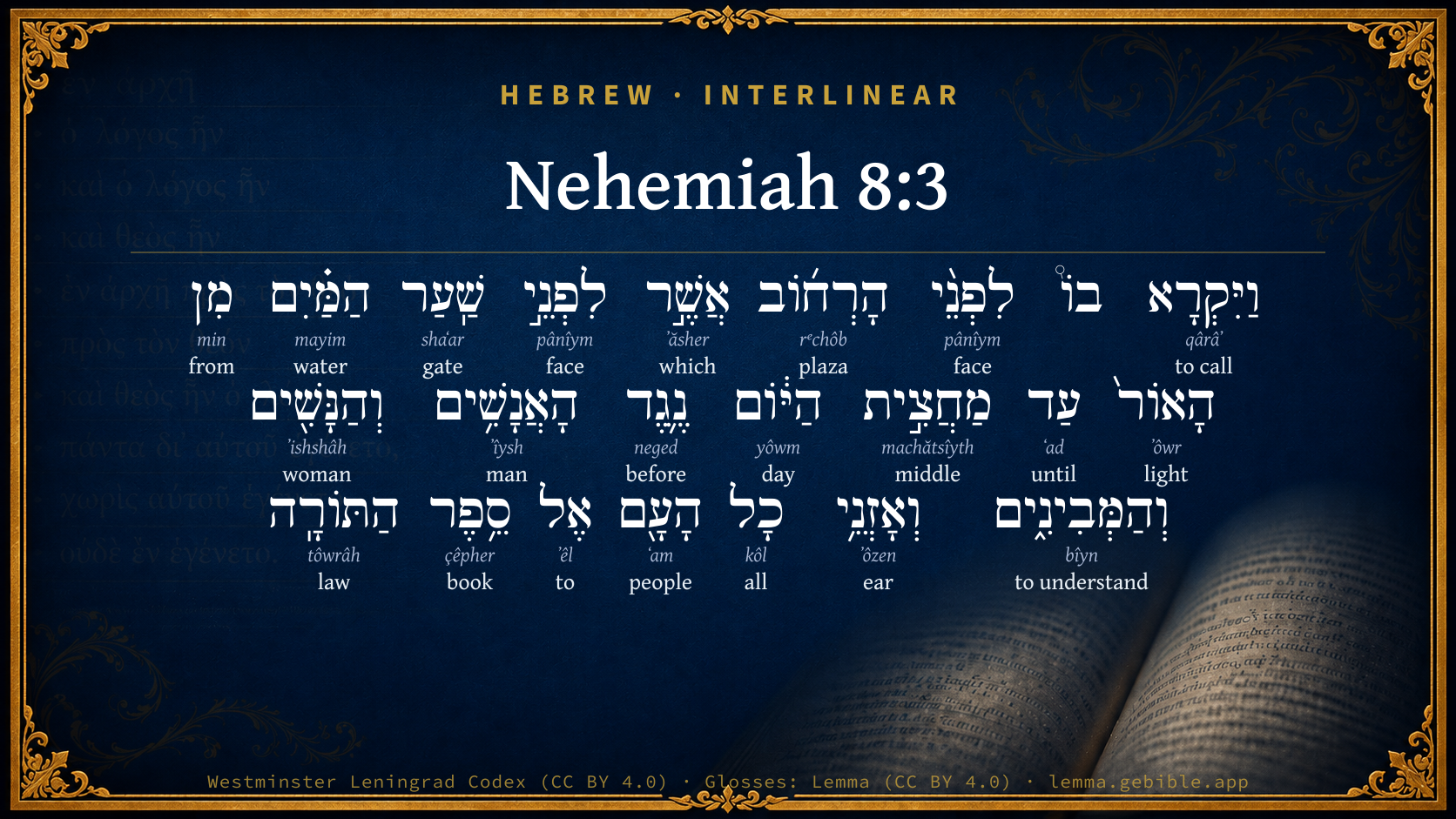
Nehemiah 8:3

Hebrew (Westminster Leningrad Codex) Nehemiah 8:3 appears in the Hebrew Old Testament. The text above is from the Westminster Leningrad Codex. Each word links to its Strong’s number, a concise gloss, and parsing drawn from the Open Scriptures Hebrew Bible morphology. Click any word for its full Brown-Driver-Briggs (BDB) entry.
Download image
Cite this verse

Nehemiah 8:3 (World English Bible). Public Domain. Lemma interlinear Bible study tool, https://lemma.gebible.app/v/nehemiah/8/3.

Show BibTeX & RIS
BibTeX
RIS
English Translation
He read therein before the broad place that was before the water gate from early morning until midday, in the presence of the men and the women, and of those who could understand; and the ears of all the people were [attentive] to the book of the law.
World English Bible · Public Domain
Download a study sheet

One document with this verse’s original text, its word-by-word gloss line, the meaning frame, cross-references with their text, attributed commentary, and full source and license credits — printable, and it pastes into notes with its structure intact.

This verse Autodidact and up

Study sheet (.html) Plain text (.txt)

A passage Seminary Student

Up to 50 verses in one chapter. A passage sheet keeps up to 6 commentary sources and 12 cross-references per verse, in the order this page ranks them, and says so on the sheet whenever that leaves anything out. Ask for a single verse and you get the Autodidact verse sheet above.

Everything on this page stays free to read, with no account — the sheet is a download of what is already on screen, not access to it.

Want to remove ads? Support Godless Engineer
Compare translations 3

The same verse in 3 English versions, stacked beneath the original-language interlinear above. Click any original word for its lexicon entry.

Each is an independent rendering of the whole verse — the interlinear is not word-aligned to these translations.

Highlighted words mark where these versions differ — a whole-verse word diff, not a word-by-word alignment.

  • World English Bible Public Domain
    He read therein before the broad place that was before the water gate from early morning until midday, in the presence of the men and the women, and of those who could understand; and the ears of all the people were [attentive] to the book of the law.
  • King James Version Public Domain
    And he read therein before the street that was before the water gate from the morning until midday, before the men and the women, and those that could understand; and the ears of all the people were attentive unto the book of the law.
  • unfoldingWord Literal Text CC BY-SA 4.0
    And he read it aloud before the face of the open area that is before the face of the gate of water, from the light until the middle of the day, in front of the men and the women, and the ones who were understanding. And the ears of all the people listened to the book of the law.

unfoldingWord Literal Text — © unfoldingWord, licensed CC BY-SA 4.0. Word-aligned USFM3 via Door43 (git.door43.org/unfoldingWord/en_ult).

Versions to compare (up to 4)

3 of 4 selected

Show all 18 translations

Every available English version of this verse, each an independent rendering of the whole verse.

  • World English Bible Public Domain
    He read therein before the broad place that was before the water gate from early morning until midday, in the presence of the men and the women, and of those who could understand; and the ears of all the people were [attentive] to the book of the law.
  • Berean Standard Bible Public Domain
    So Ezra read it aloud from daybreak until noon as he faced the square before the Water Gate, in front of the men and women and those who could understand. And all the people listened attentively to the Book of the Law.
  • Majority Standard Bible Public Domain
    So Ezra read it aloud from daybreak until noon as he faced the square before the Water Gate, in front of the men and women and those who could understand. And all the people listened attentively to the Book of the Law.
  • King James Version Public Domain
    And he read therein before the street that was before the water gate from the morning until midday, before the men and the women, and those that could understand; and the ears of all the people were attentive unto the book of the law.
  • American Standard Version (1901) Public Domain
    And he read therein before the broad place that was before the water gate from early morning until midday, in the presence of the men and the women, and of those that could understand; and the ears of all the people were `attentive' unto the book of the law.
  • Revised Version (1885) Public Domain
    And he read therein before the broad place that was before the water gate from early morning until midday, in the presence of the men and the women, and of those that could understand; and the ears of all the people were attentive unto the book of the law.
  • Geneva Bible (1599) Public Domain
    And he read therein in the streete that was before the watergate (from the morning vntill the midday) before men and women, and them that vnderstoode it, and the eares of all the people hearkened vnto the booke of the Lawe.
  • Douay-Rheims (1899) Public Domain
    And he read it plainly in the street that was before the water gate, from the morning until midday, before the men, and the women, and all those that could understand: and the ears of all the people were attentive to the book.
  • Young's Literal Translation Public Domain
    and he readeth in it before the broad place that `is' before the water-gate, from the light till the middle of the day, over-against the men, and the women, and those intelligent, and the ears of all the people `are' unto the book of the law.
  • Literal Standard Version CC BY-SA 4.0
    and he reads in it before the broad place that [is] before the Water Gate, from the light until the middle of the day, in front of the men, and the women, and those intelligent, and the ears of all the people [are] toward the Scroll of the Law.
  • Unlocked Literal Bible CC BY-SA 4.0
    He faced the open area in front of the Water Gate, and he read from it from early morning until midday, before men and women, and any who could understand, and all the people listened attentively to the book of the law.
  • unfoldingWord Literal Text CC BY-SA 4.0
    And he read it aloud before the face of the open area that is before the face of the gate of water, from the light until the middle of the day, in front of the men and the women, and the ones who were understanding. And the ears of all the people listened to the book of the law.
  • Darby Bible Public Domain
    And he read in it before the open place that was before the water-gate from the morning until midday, in presence of the men and the women, and those that could understand. And the ears of all the people were [attentive] to the book of the law.
  • World Messianic Bible Public Domain
    He read from it before the wide place that was in front of the water gate from early morning until midday, in the presence of the men and the women, and of those who could understand. The ears of all the people were attentive to the scroll of the Torah.
  • Webster's Bible Public Domain
    And he read therein before the street that was before the water-gate from the morning until mid-day, before the men and the women, and those that could understand; and the ears of all the people were attentive to the book of the law.
  • Free Bible Version CC BY-SA 4.0
    He read from it in front of the square before the Water Gate from early morning till noon to everyone there, the men and the women and those who could understand. All the people listened carefully to the Book of the Law.
  • Bible in Basic English Public Domain
    He was reading it in the wide place in front of the water-doorway, from early morning till the middle of the day, in the hearing of all those men and women whose minds were able to take it in; and the ears of all the people were open to the book of the law.
  • JPS Tanakh (1917) Public Domain
    And he read therein before the broad place that was before the water gate from early morning until midday, in the presence of the men and the women, and of those that could understand; and the ears of all the people were attentive unto the book of the Law.

Literal Standard Version (2020), Covenant Press — licensed CC BY-SA 4.0. Text via the HelloAO Bible API (eBible.org). Unlocked Literal Bible (unfoldingWord) — licensed CC BY-SA 4.0. Text via the HelloAO Bible API (eBible.org). unfoldingWord Literal Text — © unfoldingWord, licensed CC BY-SA 4.0. Word-aligned USFM3 via Door43 (git.door43.org/unfoldingWord/en_ult). Free Bible Version, Dr. Jonathan Gallagher — licensed CC BY-SA 4.0. Text via the HelloAO Bible API (eBible.org).

Word by word

More ways to search: Search by grammar → Find every occurrence → Compare this word →

Practice this passage: Drill this verse → Learn its vocabulary →

מַחֲצִ֣ית
machătsîyth
H4276
“middle of”
Noun, Common, Feminine, Singular, Construct
Part of Speech
Noun
Type
Common
Gender
Feminine
Number
Singular
State
Construct
Full BDB Definition

Origin: from H2673

TWOT: 719e

half, middle - half - middle, midday, noon
  1. וַיִּקְרָא qârâʼ H7121 “and · to call” Conjunction + Verb, Qal, Sequential Imperfect, 3rd Person, Masculine, Singular
  2. לִפְנֵ֨י pânîym H6440 “to/for · face(s) of” Preposition + Noun, Common, Both, Plural, Construct
  3. הָרְח֜וֹב rᵉchôb H7339 “the · plaza” Particle, Definite Article + Noun, Common, Feminine, Singular, Absolute
  4. אֲשֶׁ֣ר ʼăsher H834 “which” Particle, Relative
  5. לִפְנֵ֣י pânîym H6440 “to/for · face(s) of” Preposition + Noun, Common, Both, Plural, Construct
  6. שַֽׁעַר shaʻar H8179 “gate of” Noun, Common, Masculine, Singular, Construct
  7. הַמַּ֗יִם mayim H4325 “the · water(s)” Particle, Definite Article + Noun, Common, Masculine, Plural, Absolute
  8. מִן min H4480 “from” Preposition
  9. הָאוֹר֙ ʼôwr H216 “the · light” Particle, Definite Article + Noun, Common, Both, Singular, Absolute
  10. עַד ʻad H5704 “until” Preposition
  11. הַיּ֔וֹם yôwm H3117 “the · day” Particle, Definite Article + Noun, Common, Masculine, Singular, Absolute
  12. נֶ֛גֶד neged H5048 “before” Preposition
  13. הָאֲנָשִׁ֥ים ʼîysh H376 “the · men” Particle, Definite Article + Noun, Common, Masculine, Plural, Absolute
  14. וְהַנָּשִׁ֖ים ʼishshâh H802 “and · the · women” Conjunction + Particle, Definite Article + Noun, Common, Feminine, Plural, Absolute
  15. וְהַמְּבִינִ֑ים bîyn H995 “and · the · understanding” Conjunction + Particle, Definite Article + Verb, Hiphil, Participle Active, Masculine, Plural, Absolute
  16. וְאָזְנֵ֥י ʼôzen H241 “and · ears of” Conjunction + Noun, Common, Feminine, Dual, Construct
  17. כָל kôl H3605 “all of” Noun, Common, Masculine, Singular, Construct
  18. הָעָ֖ם ʻam H5971 “the · people” Particle, Definite Article + Noun, Common, Masculine, Singular, Absolute
  19. אֶל ʼêl H413 “to” Preposition
  20. סֵ֥פֶר çêpher H5612 “book of” Noun, Common, Masculine, Singular, Construct
  21. הַתּוֹרָֽה tôwrâh H8451 “the · law” Particle, Definite Article + Noun, Common, Feminine, Singular, Absolute

About this verse

These counts appear in no published source. They are computed here, from the morphology-tagged text and Lemma’s own curated glosses. What Lemma adds →

23
words
21
distinct lemmas
Historical
section

Notable vocabulary

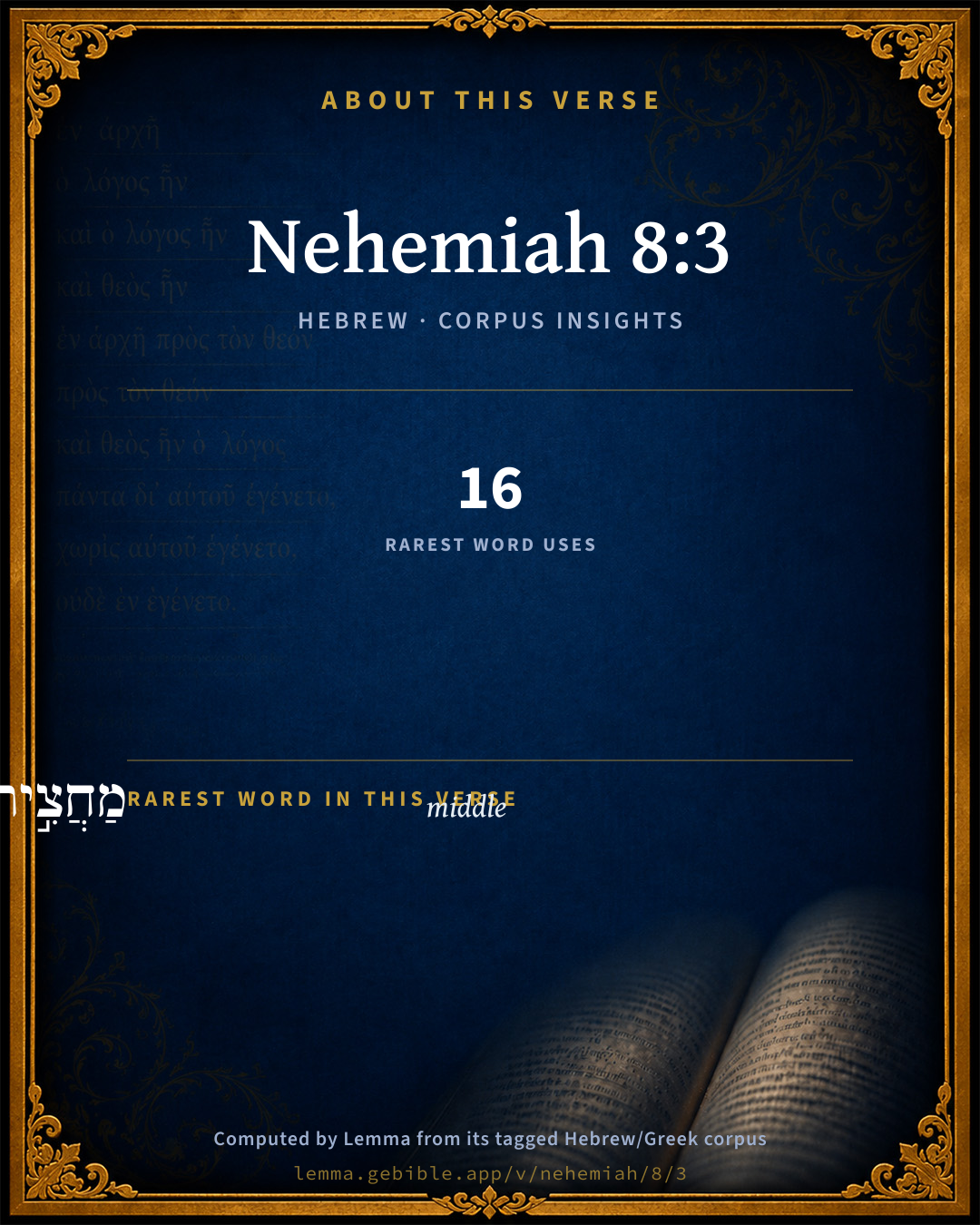
The rarest word here is מַחֲצִ֣ית middle H4276 — appearing just 16 times in the whole Hebrew Bible.

Shared distinctive vocabulary

מַחֲצִ֣ית middle H4276 occurs in 14 verses of the Hebrew Bible. Also found in:

Grammatical profile

  • 2 verbs
  • 15 nouns
  • 5 prepositions
  • 1 particle

Verb forms

  • וַיִּקְרָא Qal · Sequential Imperfect
  • וְהַמְּבִינִ֑ים Hiphil · Participle Active

Repetition

A word recurs within this verse — often emphatic in Hebrew:

  • לִפְנֵ֨י face H6440 ×2

Cross-references

17

Topical passages linked to Nehemiah 8:3 in the Treasury of Scripture Knowledge — connected by theme and wording, ordered by reader-vote popularity; previews shown in the World English Bible.

  • Revelation 3:22 He who has an ear, let him hear what the Spirit says to the assemblies."
  • Luke 4:16–20 He came to Nazareth, where he had been brought up. He entered, as was his custom, into the synagogue on the Sabbath day, and stood up to read.
  • Hebrews 2:1–3 Therefore we ought to pay greater attention to the things that were heard, lest perhaps we drift away.
  • Revelation 2:29 He who has an ear, let him hear what the Spirit says to the assemblies.
  • Matthew 7:28–29 It happened, when Jesus had finished saying these things, that the multitudes were astonished at his teaching,
  • Mark 12:37 Therefore David himself calls him Lord, so how can he be his son?" The common people heard him gladly.
  • Luke 8:18 Be careful therefore how you hear. For whoever has, to him will be given; and whoever doesn't have, from him will be taken away even that which he thinks he has."
  • Luke 19:48 They couldn't find what they might do, for all the people hung on to every word that he said.
  • Acts 13:15 After the reading of the law and the prophets, the rulers of the synagogue sent to them, saying, "Brothers, if you have any word of exhortation for the people, speak."
  • Acts 13:27 For those who dwell in Jerusalem, and their rulers, because they didn't know him, nor the voices of the prophets which are read every Sabbath, fulfilled them by condemning him.
  • Acts 15:21 For Moses from generations of old has in every city those who preach him, being read in the synagogues every Sabbath."
  • Acts 16:14 A certain woman named Lydia, a seller of purple, of the city of Thyatira, one who worshiped God, heard us; whose heart the Lord opened to listen to the things which were spoken by Paul.
  • Acts 17:11 Now these were more noble than those in Thessalonica, in that they received the word with all readiness of the mind, examining the Scriptures daily to see whether these things were so.
  • Acts 28:23 When they had appointed him a day, many people came to him at his lodging. He explained to them, testifying about the Kingdom of God, and persuading them concerning Jesus, both from the law of Moses and from the prophets, from morning until evening.
  • 1 Thessalonians 2:13 For this cause we also thank God without ceasing, that, when you received from us the word of the message of God, you accepted it not as the word of men, but, as it is in truth, the word of God, which also works in you who believe.
  • Acts 20:7 On the first day of the week, when the disciples were gathered together to break bread, Paul talked with them, intending to depart on the next day, and continued his speech until midnight.
  • Acts 20:11 When he had gone up, and had broken bread, and eaten, and had talked with them a long while, even until break of day, he departed.

Cross-references courtesy of OpenBible.info (CC BY 4.0).

Hebrew and Greek witnesses Masoretic Hebrew ↔ Greek Septuagint

The same verse in the two great witnesses to the Old Testament, shown verse-for-verse.

These are two independent witnesses, not word-aligned to each other, and the Septuagint is shown in lemma (dictionary) form.

Hebrew Nehemiah 8:3 Masoretic · Westminster Leningrad Codex

וַיִּקְרָא בוֹ֩ לִפְנֵ֨י הָרְח֜וֹב אֲשֶׁ֣ר לִפְנֵ֣י שַֽׁעַר הַמַּ֗יִם מִן הָאוֹר֙ עַד מַחֲצִ֣ית הַיּ֔וֹם נֶ֛גֶד הָאֲנָשִׁ֥ים וְהַנָּשִׁ֖ים וְהַמְּבִינִ֑ים וְאָזְנֵ֥י כָל הָעָ֖ם אֶל סֵ֥פֶר הַתּוֹרָֽה

He read therein before the broad place that was before the water gate from early morning until midday, in the presence of the men and the women, and of those who could understand; and the ears of all the people were [attentive] to the book of the law.

World English Bible · Public Domain

Greek LXX Structure differs

The Septuagint has no separate book of Nehemiah. Its Greek text is the second half of Esdras B (2 Esdras), chapters 11–23; Ezra is the first half (1–10).

A verse-for-verse comparison isn’t shown here because the chapters and verses don’t line up. Switch to the LXX edition with the MT / LXX toggle above to read the Greek directly.

On this verse, The Cambridge Bible for Schools and Colleges discusses the Septuagint’s reading. Read the note in Commentary ↓

Hebrew: Westminster Leningrad Codex (CC BY 4.0). Greek: Septuagint (public domain); English from a public-domain English Septuagint. How the Septuagint differs from the Hebrew →

Commentary

Notes on Nehemiah 8:3 from classic Christian and Jewish commentators (each source and its license shown beneath its notes). The classic Christian expositions comment on the surrounding passage and are grouped to its opening verse, so a note may address several verses; the Jewish commentaries on the Tanakh (Rashi and others) are per-verse, so they appear only where the commentator wrote on this verse.

Lemma curates 59 commentaries, every one of them public domain or Creative Commons licensed, each selected and text-cleaned for this edition rather than reprinted as found. About our sources →

Trapp's Complete Commentary

John Trapp

Neh 8:3 And he read therein before the street that [was] before the water gate from the morning until midday, before the men and the women, and those that could understand; and the ears of all the people [were attentive] unto the book of the law.

Ver. 3. And he read therein] As a scribe, he wrote the law; and as a priest, he read and expounded it. This was Christ’s own custom, Luk 4:16, and the Jews’, Act 13:15; Act 13:27; Act 15:21, and is still to this day; one lesson is ever read out of the law in their public meetings; and another out of the prophets correspondent to the former in argument. The Holy Scripture is called Mikre, the reading of Neh 8:9, because it ought to be read to all; and the word, as if all the use of our ears were to hear this word.

From the morning until midday] This was a great while; five or six hours together they spent in holy duties, whereas the most amongst us think long of an hour; they sit as it were in the stocks whiles they are hearing the word read or preached, and come out of the church when the tedious sermon runneth somewhat beyond the glass, like prisoners out of a jail.

And the ears of the people were attentive to the book] Heb. Were to the book of the law; which phrase importeth both their attention and affection to what they heard delivered. They drew up the ears of their souls to the ears of their bodies; and so one sound pierced both. See the like Luk 19:48, they hung upon Christ’s holy lips, as loth to lose any part of that precious language. The Jews at this day, though they give very great outward respect to their Torah, or book of the law (carrying it about their synagogue at the end of service in procession, and the like), yet for any show of attention or elevation of spirit I could never discern (saith one that had been much amongst them), but they are as reverend in their synagogues as grammar boys are at school when their master is absent.

John Trapp, A Commentary or Exposition upon All the Books of the Old and New Testament (1647–1656) — public domain. Text from a community e-Sword module.

Joseph Benson's Commentary

Neh 8:3. He read therein, from the morning until mid-day — In the Hebrew, the words are, from the light, that is, from the break of day, or the sun-rising, until noon: Then, it is likely, they went to take some refreshment, it being a festival, and a day of great rejoicing.

Joseph Benson's Commentary on the Old and New Testaments (1811–1818) — public domain. Text from a community e-Sword module.

Tyndale Open Study Notes

Tyndale Open Resources

8:3 The timeframe from early morning until noon provided about six hours for reading and interpreting (8:7-8). • understand (see also 8:2, 8, 12): This was not just a ritual reading of the law. It included explanations, insight, and application.

Tyndale Open Study Notes — © Tyndale Open Resources, licensed CC BY-SA 4.0. Text via the HelloAO Bible API.

Geneva Bible (1599)

Geneva Bible translators

This declareth the great zeal, that the people had to hear the word of God.

Geneva Bible (1599) marginal notes — public domain. Text via Bolls.life.

Ellicott's Commentary for English Readers

(3) From the morning.—From daylight. The Book of the Law must have been a comprehensive one. Out of it Ezra and his companions read hour after hour, selecting appropriate passages.

And the ears of all the people . . . unto the book.—A general statement; the detail now follows.

A Bible Commentary for English Readers, edited by Charles John Ellicott (1878–1897) — public domain. Text from a community e-Sword module.

The Cambridge Bible for Schools and Colleges

gen. ed. J. J. S. Perowne

3. before the street] R.V. before the broad place. The ‘broad place’ was before the water-gate; Ezra read before the broad place. In each case the preposition seems to mean on the W. side, i.e. in front of looking eastward. The Vulgate ‘in plateâ.’ The LXX. omits the reference to the locality in this verse.

from the morning] R.V. from early morning. Marg. Heb. from the light. The process of reading ‘from morn till midday’ is explained in the following verses (4–8). It was not consecutive reading for seven hours. Ezra had others standing by to relieve him: the reading was also interrupted by exposition.

before] R.V. in the presence of. A different preposition from that used earlier in the verse.

attentive unto the book of the law] Vulgate ‘erectæ ad librum.’

The Cambridge Bible for Schools and Colleges (gen. ed. J. J. S. Perowne; Cambridge University Press, 1878–1918) — public domain. Text from a community e-Sword module.

John Gill's Exposition

And he read therein,.... Some passages in it, here and there, which it was necessary the people should have knowledge of; for it can hardly be thought be began and read on just in the order in which it was: this he did

before the street; at the top of it, at one end of it:

that was before the water gate; which looked directly to that:

from the morning until midday; from the rising of the sun to noon, so that he must read six hours; but very probably was relieved at times by the men with him, after mentioned:

before the men and the women, and those that could understand; see Neh 8:2,

and the ears of all the people were attentive unto the book of the law; to the hearing of it read, and to the things contained in it; hence Maimonides (h) gathers, that as soon as the reader begins the reading of the law, it is not lawful to speak about anything, not even the constitutions of the law, but silently to attend to what is read.

(h) Hilchot Tephillah, c. 12. sect. 9.

John Gill's Exposition of the Whole Bible (1746–1763) — public domain (CC PDM 1.0). Text via the HelloAO Bible API.

Haydock's Catholic Bible Commentary

In plainly. Protestants, "therein, before the street." (Haydock) --- Esdras probably read select pieces from Leviticus, &c., but principally from Deuteronomy. (Menochius)

George Leo Haydock (1774–1849), Haydock's Catholic Family Bible and Commentary, 1859 edition — public domain. Excludes Psalms (Douay-Rheims chapter numbering differs from Protestant) and Deuterocanonical books (Catholic canon only).

Whedon's Commentary on the Bible

Daniel D. Whedon

3. He read… from the morning until midday — Relieved and assisted at times by the priests and Levites beside him.

Daniel D. Whedon (gen. ed.), Commentary on the Old and New Testaments (1874–1909) — public domain. Text from a community e-Sword module.

The Pulpit Commentary

From the morning until midday. Or, "from daylight." He began as soon as it was light enough, and read on (he and his assistants ver. 7) till noon, that is, for six hours or more. The reading appears to have been varied by occasional exposition (vers. 7, 8). The ears of all the people were attentive. Though there is no word in the Hebrew for "attentive," yet the meaning is quite correctly given: "the ears of all the people were to the book" & Ntilde; fixed on that, and on nothing else.

Attentive hearers.

"The ears of all the people were attentive unto the book of the law." Literally, and more expressive, "were unto the book of the law," as if their ears had been directed towards the book. A state of things very different from that which prevails in many congregations, especially during the reading of the Scriptures. It is worth considering how devout attention may be secured. Doubtless much depends on the reader or preacher. It is impossible to attend to some men. Those who officiated on the occasion referred to in the text are good models, as to the distinctness of their utterance and the pains they took to give the sense, etc. As to the hearers, they will acquire the habit of fixed and sustained attention by care in reference to the following particulars:

I PREVIOUS PREPARATION. Not waiting until within the walls of the sanctuary before seeking to be fitted for the service, but by definitely laying aside the world"s business on Saturday night, and by religious exercises at home, and devout thought and feeling on the way to church, cultivating a state of mind and heart suitable for public worship. Yea, the whole life will be a preparation if spent earnestly in God"s service.

II SERIOUS INTENTION. The earnest desire and purpose to obtain spiritual good at the service.

III CONSIDERATION OF THE PRESENCE OF GOD. Active faith in him as near, inviting to communion with himself, observing the state and conduct of each professing worshipper, speaking in the word and by the preacher, claiming a reverent regard to his declarations, ready to bless and save.

IV SELF-CONTROL. Over the thoughts; swiftly banishing such as would divert from the sacred business in hand. Over the eyes, lest they conquer the ears.

V Withal, PRAYER. The Divine assistance being invoked in momentary silent ejaculations, whenever the attention flags or wanders. In conclusion, let the habitually inattentive bear in mind that

1. They are necessarily great losers. Attention is the first condition of gaining good from public teaching. The loss thus sustained is of the highest and most lasting blessings. It is likely to include the loss of their souls.

2. They are guilty of great sin.

The Pulpit Commentary (1880–1919), ed. H.D.M. Spence-Jones & Joseph S. Exell — public domain. Text from a community e-Sword module.

Rashi

Rabbi Shlomo Yitzchaki (Rashi)

from the light of the beginning of the day.

to the Scroll of the Law All the people inclined their ears.

Rashi on the Tanakh — English translations: “The Judaica Press complete Tanach with Rashi, translated by A. J. Rosenberg” (CC BY 4.0); “Pentateuch with Rashi's commentary by M. Rosenbaum and A.M. Silbermann, 1929-1934” (public domain); “The Metsudah Tanach series, Lakewood, N.J” (CC BY 4.0); and “The Book of Joshua, Metsudah Publications, 1997” (CC BY 4.0). Text via Sefaria.

Lesson kit

Teaching starters — assembled from the data on this page, not authored interpretation. Every prompt links to the verse data it draws on. Edit before teaching.

Nehemiah, in the Historical, opens this verse with 23 words (21 distinct Hebrew lemmas). Its most distinctive word is machătsîyth (“middle”). A historical commentator’s framing appears above. Read the whole chapter for the surrounding context.

Discussion questions

  1. The word machătsîyth carries the sense “middle.” How does it shape the verse?
  2. Exodus 30:13 shares the word «middle» with this verse. How do the two illuminate each other?
  3. “face” occurs 2× in this one verse. What is the effect of the repetition?
  4. These translations render this verse differently. What is at stake in choosing one wording over another?
  5. The verb «וַיִּקְרָא» is Qal Sequential Imperfect. How does its form color the action?
  6. Reading how Trapp's Complete Commentary and Joseph Benson's Commentary read this verse, where do the two commentators agree and where do they part?

Things to notice

Reading settings

Reading text

Shown beneath each verse's original-language words.

Old Testament
Old Testament edition

Read the OT as the Masoretic Hebrew (MT) or the Greek Septuagint (LXX).

English shown for the Greek Septuagint (in the Hebrew ↔ Greek comparison).

Comparing translations? Open the Compare panel on any verse page to stack up to four side by side.