
Deuteronomy 12:15

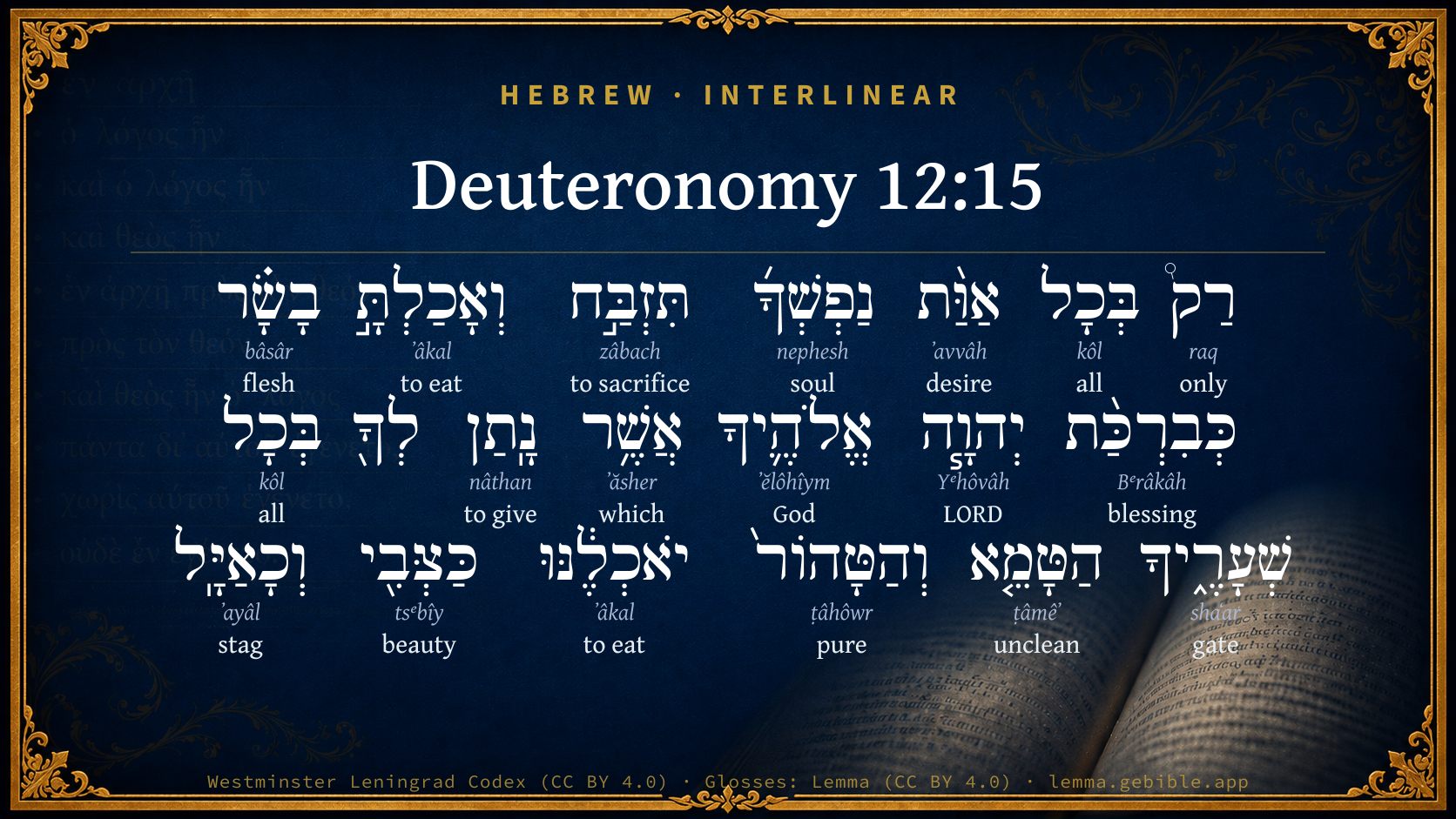
Hebrew (Westminster Leningrad Codex) Deuteronomy 12:15 appears in the Hebrew Old Testament. The text above is from the Westminster Leningrad Codex. Each word links to its Strong’s number, a concise gloss, and parsing drawn from the Open Scriptures Hebrew Bible morphology. Click any word for its full Brown-Driver-Briggs (BDB) entry.
Download image
Cite this verse

Deuteronomy 12:15 (World English Bible). Public Domain. Lemma interlinear Bible study tool, https://lemma.gebible.app/v/deuteronomy/12/15.

Show BibTeX & RIS
BibTeX
RIS
English Translation
Notwithstanding, you may kill and eat flesh within all your gates, after all the desire of your soul, according to the blessing of Yahweh your God which he has given you: the unclean and the clean may eat of it, as of the gazelle, and as of the hart.
World English Bible · Public Domain
Highlights
  • 3 first appearances in the Hebrew Bible
Full analysis ↓
Download a study sheet

One document with this verse’s original text, its word-by-word gloss line, the meaning frame, cross-references with their text, attributed commentary, and full source and license credits — printable, and it pastes into notes with its structure intact.

This verse Autodidact and up

Study sheet (.html) Plain text (.txt)

A passage Seminary Student

Up to 50 verses in one chapter. A passage sheet keeps up to 6 commentary sources and 12 cross-references per verse, in the order this page ranks them, and says so on the sheet whenever that leaves anything out. Ask for a single verse and you get the Autodidact verse sheet above.

Everything on this page stays free to read, with no account — the sheet is a download of what is already on screen, not access to it.

Want to remove ads? Support Godless Engineer
Compare translations 3

The same verse in 3 English versions, stacked beneath the original-language interlinear above. Click any original word for its lexicon entry.

Each is an independent rendering of the whole verse — the interlinear is not word-aligned to these translations.

Highlighted words mark where these versions differ — a whole-verse word diff, not a word-by-word alignment.

  • World English Bible Public Domain
    Notwithstanding, you may kill and eat flesh within all your gates, after all the desire of your soul, according to the blessing of Yahweh your God which he has given you: the unclean and the clean may eat of it, as of the gazelle, and as of the hart.
  • King James Version Public Domain
    Notwithstanding thou mayest kill and eat flesh in all thy gates, whatsoever thy soul lusteth after, according to the blessing of the LORD thy God which he hath given thee: the unclean and the clean may eat thereof, as of the roebuck, and as of the hart.
  • unfoldingWord Literal Text CC BY-SA 4.0
    Only, you may kill and eat animals within all your gates, in all the desire of your soul, according to the blessing of Yahweh your God that he has given to you; the unclean and the clean may eat it, such as the gazelle and the deer.

unfoldingWord Literal Text — © unfoldingWord, licensed CC BY-SA 4.0. Word-aligned USFM3 via Door43 (git.door43.org/unfoldingWord/en_ult).

Versions to compare (up to 4)

3 of 4 selected

Show all 18 translations

Every available English version of this verse, each an independent rendering of the whole verse.

  • World English Bible Public Domain
    Notwithstanding, you may kill and eat flesh within all your gates, after all the desire of your soul, according to the blessing of Yahweh your God which he has given you: the unclean and the clean may eat of it, as of the gazelle, and as of the hart.
  • Berean Standard Bible Public Domain
    But whenever you want, you may slaughter and eat meat within any of your gates, according to the blessing the LORD your God has given you. Both the ceremonially clean and unclean may eat it as they would a gazelle or deer,
  • Majority Standard Bible Public Domain
    But whenever you want, you may slaughter and eat meat within any of your gates, according to the blessing the LORD your God has given you. Both the ceremonially clean and unclean may eat it as they would a gazelle or deer,
  • King James Version Public Domain
    Notwithstanding thou mayest kill and eat flesh in all thy gates, whatsoever thy soul lusteth after, according to the blessing of the LORD thy God which he hath given thee: the unclean and the clean may eat thereof, as of the roebuck, and as of the hart.
  • American Standard Version (1901) Public Domain
    Notwithstanding, thou mayest kill and eat flesh within all thy gates, after all the desire of thy soul, according to the blessing of Jehovah thy God which he hath given thee: the unclean and the clean may eat thereof, as of the gazelle, and as of the hart.
  • Revised Version (1885) Public Domain
    Notwithstanding thou mayest kill and eat flesh within all thy gates, after all the desire of thy soul, according to the blessing of the LORD thy God which he hath given thee: the unclean and the clean may eat thereof, as of the gazelle, and as of the hart.
  • Geneva Bible (1599) Public Domain
    Notwithstanding thou maiest kill and eate flesh in all thy gates, whatsoeuer thine heart desireth, according to the blessing of the Lord thy God which he hath giuen thee: both the vncleane and the cleane may eate thereof, as of the roe bucke, and of the hart.
  • Douay-Rheims (1899) Public Domain
    But if thou desirest to eat, and the eating of flesh delight thee, kill, and eat according to the blessing of the Lord thy God, which he hath given thee, in thy cities: whether it be unclean, that is to say, having blemish or defect: or clean, that is to say, sound and without blemish, such as may be offered, as the roe, and the hart, shalt thou eat it:
  • Young's Literal Translation Public Domain
    `Only, with all the desire of thy soul thou dost sacrifice, and hast eaten flesh according to the blessing of Jehovah thy God which He hath given to thee, in all thy gates; the unclean and the clean do eat it, as of the roe, and as of the hart.
  • Literal Standard Version CC BY-SA 4.0
    Nevertheless, you slaughter anything of the desire of your soul, and have eaten [its] flesh according to the blessing of your God YHWH which He has given to you in all your gates; the unclean and the clean eat it, as [if] the roe and as [if] the deer.
  • Unlocked Literal Bible CC BY-SA 4.0
    However, you may kill and eat animals within all your gates, as you wish, receiving the blessing of Yahweh your God for all that he has given you; the unclean and the clean persons both may eat of it, animals such as the gazelle and the deer.
  • unfoldingWord Literal Text CC BY-SA 4.0
    Only, you may kill and eat animals within all your gates, in all the desire of your soul, according to the blessing of Yahweh your God that he has given to you; the unclean and the clean may eat it, such as the gazelle and the deer.
  • Darby Bible Public Domain
    Nevertheless, according to all the desire of thy soul thou mayest slay and eat flesh in all thy gates, according to the blessing of Jehovah thy God which he hath given thee: the unclean and the clean may eat thereof, as of the gazelle, and the hart.
  • World Messianic Bible Public Domain
    Yet you may kill and eat meat within all your gates, after all the desire of your soul, according to the LORD your God’s blessing which he has given you. The unclean and the clean may eat of it, as of the gazelle and the deer.
  • Webster's Bible Public Domain
    Notwithstanding, thou mayest kill and eat flesh in all thy gates, whatever thy soul desireth, according to the blessing of the LORD thy God which he hath given thee: the unclean and the clean may eat of it as of the roebuck, and as of the hart.
  • Free Bible Version CC BY-SA 4.0
    Of course you can slaughter and eat meat wherever you are, anytime you want, depending on how much the Lord your God has blessed you. All of you, whether you're ceremonially clean or not, can it eat it just like you would a gazelle or a deer,
  • Bible in Basic English Public Domain
    Only you may put to death animals, such as the gazelle or the roe, for your food in any of your towns, at the desire of your soul, in keeping with the blessing of the Lord your God which he has given you: the unclean and the clean may take of it.
  • JPS Tanakh (1917) Public Domain
    Notwithstanding thou mayest kill and eat flesh within all thy gates, after all the desire of thy soul, according to the blessing of the LORD thy God which He hath given thee; the unclean and the clean may eat thereof, as of the gazelle, and as of the hart.

Literal Standard Version (2020), Covenant Press — licensed CC BY-SA 4.0. Text via the HelloAO Bible API (eBible.org). Unlocked Literal Bible (unfoldingWord) — licensed CC BY-SA 4.0. Text via the HelloAO Bible API (eBible.org). unfoldingWord Literal Text — © unfoldingWord, licensed CC BY-SA 4.0. Word-aligned USFM3 via Door43 (git.door43.org/unfoldingWord/en_ult). Free Bible Version, Dr. Jonathan Gallagher — licensed CC BY-SA 4.0. Text via the HelloAO Bible API (eBible.org).

Word by word

More ways to search: Search by grammar → Find every occurrence → Compare this word →

Practice this passage: Drill this verse → Learn its vocabulary →

אַוַּ֨ת
ʼavvâh
H185
“desire of”
Noun, Common, Feminine, Singular, Construct
Part of Speech
Noun
Type
Common
Gender
Feminine
Number
Singular
State
Construct
Full BDB Definition

Origin: from H183

TWOT: 40b

desire, lust, will (not necessarily evil)
  1. רַק֩ raq H7535 “only” Particle, Accusative
  2. בְּכָל kôl H3605 “in/at · all of” Preposition + Noun, Common, Masculine, Singular, Construct
  3. נַפְשְׁךָ֜ nephesh H5315 “soul · your” Noun, Common, Both, Singular, Construct + Suffix, Personal, 2nd Person, Masculine, Singular
  4. תִּזְבַּ֣ח zâbach H2076 “to sacrifice” Verb, Qal, Imperfect, 2nd Person, Masculine, Singular
  5. וְאָכַלְתָּ֣ ʼâkal H398 “and · to eat” Conjunction + Verb, Qal, Sequential Perfect, 2nd Person, Masculine, Singular
  6. בָשָׂ֗ר bâsâr H1320 “flesh” Noun, Common, Masculine, Singular, Absolute
  7. כְּבִרְכַּ֨ת Bᵉrâkâh H1293 “like/as · blessing of” Preposition + Noun, Common, Feminine, Singular, Construct
  8. יְהוָ֧ה Yᵉhôvâh H3068 “LORD” Noun, Proper
  9. אֱלֹהֶ֛יךָ ʼĕlôhîym H430 “God(s) · your” Noun, Common, Masculine, Plural, Construct + Suffix, Personal, 2nd Person, Masculine, Singular
  10. אֲשֶׁ֥ר ʼăsher H834 “which” Particle, Relative
  11. נָֽתַן nâthan H5414 “to give” Verb, Qal, Perfect, 3rd Person, Masculine, Singular
  12. בְּכָל kôl H3605 “in/at · all of” Preposition + Noun, Common, Masculine, Singular, Construct
  13. שְׁעָרֶ֑יךָ shaʻar H8179 “gates · your” Noun, Common, Masculine, Plural, Construct + Suffix, Personal, 2nd Person, Masculine, Singular
  14. הַטָּמֵ֤א ṭâmêʼ H2931 “the · unclean” Particle, Definite Article + Adjective, Adjective, Masculine, Singular, Absolute
  15. וְהַטָּהוֹר֙ ṭâhôwr H2889 “and · the · pure” Conjunction + Particle, Definite Article + Adjective, Adjective, Masculine, Singular, Absolute
  16. יֹאכְלֶ֔נּוּ ʼâkal H398 “to eat · him” Verb, Qal, Imperfect, 3rd Person, Masculine, Singular + Suffix, Personal, 3rd Person, Masculine, Singular
  17. כַּצְּבִ֖י tsᵉbîy H6643 “like/as the · beauty” Preposition, Determined + Noun, Common, Both, Singular, Absolute
  18. וְכָאַיָּֽל ʼayâl H354 “and · like/as the · stag” Conjunction + Preposition, Determined + Noun, Common, Both, Singular, Absolute

About this verse

These counts appear in no published source. They are computed here, from the morphology-tagged text and Lemma’s own curated glosses. What Lemma adds →

20
words
17
distinct lemmas
Pentateuch
section

Notable vocabulary

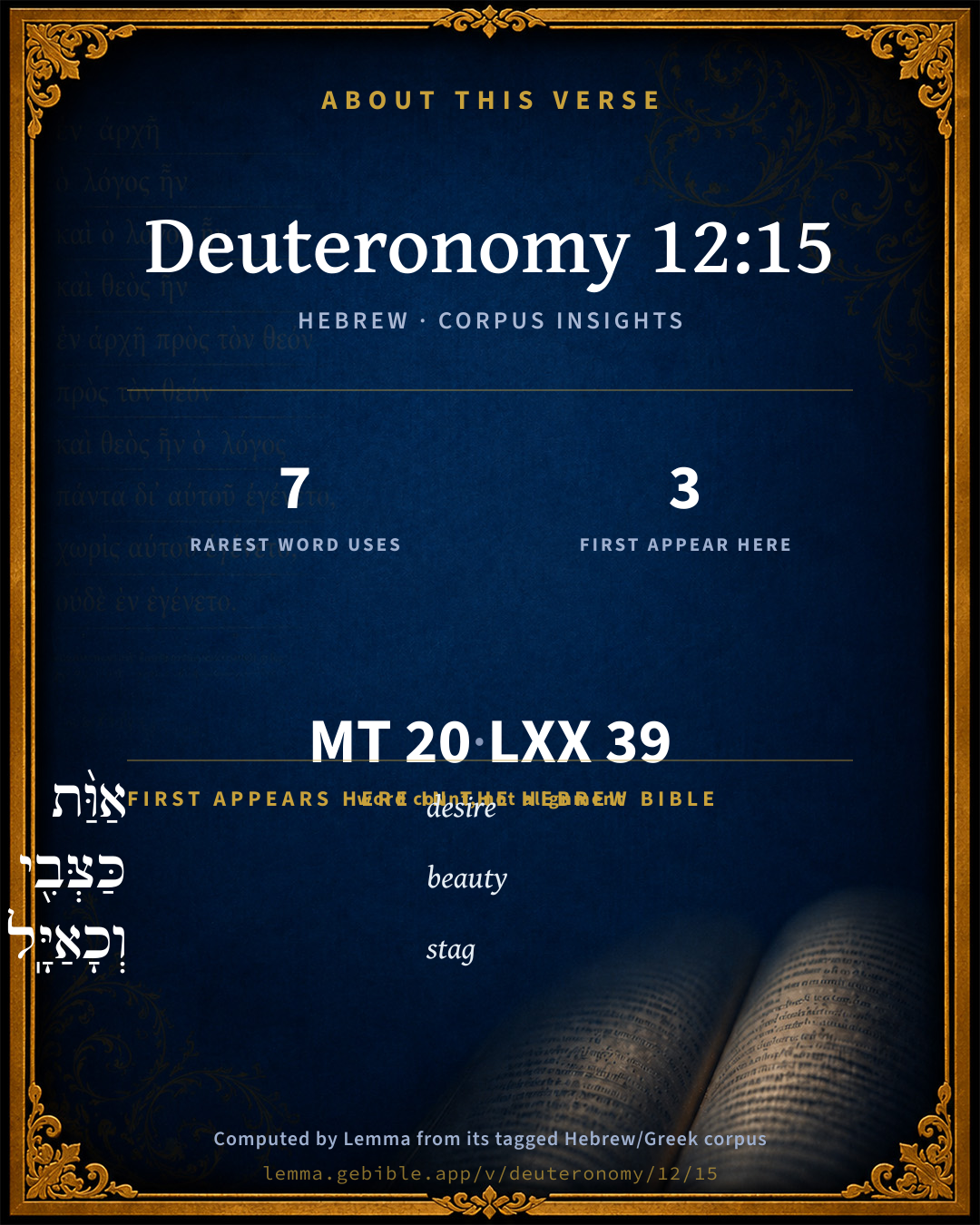
The rarest word here is אַוַּ֨ת desire H185 — appearing just 7 times in the whole Hebrew Bible.

First appearance in Scripture

These words make their first canonical appearance in the Hebrew Bible here:

  • אַוַּ֨ת desire H185
  • כַּצְּבִ֖י beauty H6643
  • וְכָאַיָּֽל stag H354

Shared distinctive vocabulary

אַוַּ֨ת desire H185 occurs in 7 verses of the Hebrew Bible. Also found in:

Grammatical profile

  • 4 verbs
  • 11 nouns
  • 2 adjectives
  • 1 preposition
  • 2 particles

Verb forms

  • תִּזְבַּ֣ח Qal · Imperfect
  • וְאָכַלְתָּ֣ Qal · Sequential Perfect
  • נָֽתַן Qal · Perfect
  • יֹאכְלֶ֔נּוּ Qal · Imperfect

Repetition

Words recur within this verse — often emphatic in Hebrew:

  • בְּכָל all H3605 ×2
  • וְאָכַלְתָּ֣ to eat H398 ×2

Hebrew & Septuagint length

In English translation the verse runs 49 words from the Hebrew and 51 from the Septuagint (LXX English) — closely comparable.

A rough comparison of the two English renderings, which tokenize alike — not a word-level alignment.

Word counts can differ between the Hebrew and the Greek without any difference in meaning — e.g. the Hebrew direct-object marker אֵת has no separate Greek word, and Greek often adds the article ὁ.

In the original languages it is 20 Hebrew tokens and 39 Greek tokens — but the two are counted differently (Hebrew bundles its prefixes and suffixes into one token; the Greek is in lemma form), so that isn’t a like-for-like length.

Cross-references

5

Topical passages linked to Deuteronomy 12:15 in the Treasury of Scripture Knowledge — connected by theme and wording, ordered by reader-vote popularity; previews shown in the World English Bible.

  • Deuteronomy 14:5 the hart, and the gazelle, and the roebuck, and the wild goat, and the ibex, and the antelope, and the chamois.
  • Deuteronomy 12:20–23 When Yahweh your God shall enlarge your border, as he has promised you, and you shall say, I will eat flesh, because your soul desires to eat flesh; you may eat flesh, after all the desire of your soul.
  • Deuteronomy 14:26 and you shall bestow the money for whatever your soul desires, for oxen, or for sheep, or for wine, or for strong drink, or for whatever your soul asks of you; and you shall eat there before Yahweh your God, and you shall rejoice, you and your household.
  • Deuteronomy 15:22–23 You shall eat it within your gates: the unclean and the clean [shall eat it] alike, as the gazelle, and as the hart.
  • Leviticus 17:3–5 Whatever man there is of the house of Israel, who kills an ox, or lamb, or goat, in the camp, or who kills it outside the camp,

Cross-references courtesy of OpenBible.info (CC BY 4.0).

Hebrew and Greek witnesses Masoretic Hebrew ↔ Greek Septuagint

The same verse in the two great witnesses to the Old Testament, shown verse-for-verse.

These are two independent witnesses, not word-aligned to each other, and the Septuagint is shown in lemma (dictionary) form.

Hebrew Deuteronomy 12:15 Masoretic · Westminster Leningrad Codex

רַק֩ בְּכָל אַוַּ֨ת נַפְשְׁךָ֜ תִּזְבַּ֣ח וְאָכַלְתָּ֣ בָשָׂ֗ר כְּבִרְכַּ֨ת יְהוָ֧ה אֱלֹהֶ֛יךָ אֲשֶׁ֥ר נָֽתַן לְךָ֖ בְּכָל שְׁעָרֶ֑יךָ הַטָּמֵ֤א וְהַטָּהוֹר֙ יֹאכְלֶ֔נּוּ כַּצְּבִ֖י וְכָאַיָּֽל

Notwithstanding, you may kill and eat flesh within all your gates, after all the desire of your soul, according to the blessing of Yahweh your God which he has given you: the unclean and the clean may eat of it, as of the gazelle, and as of the hart.

World English Bible · Public Domain

Greek LXX Deuteronomy 12:15 Septuagint · lemma form

ἀλλά ἤ ἐν πᾶς ἐπιθυμία σύ θύω καί ἐσθίω κρέας κατά ὁ εὐλογία κύριος ὁ θεός σύ ὅς δίδωμι σύ ἐν πᾶς πόλις ὁ ἀκάθαρτος ἐν σύ καί ὁ καθαρός ἐπί ὁ αὐτός ἐσθίω αὐτός ὡς δορκάς ἤ ἔλαφος

But you shall kill according to all your desire, and shall eat flesh according to the blessing of the Lord your God, which he has given you in every city; the unclean that is within you and the clean shall eat it on equal terms, as the doe or the stag.

LXX2012 (modern English Septuagint) · Public Domain

Hebrew: Westminster Leningrad Codex (CC BY 4.0). Greek: Septuagint (public domain); English from LXX2012 (modern English Septuagint) (Public Domain). How the Septuagint differs from the Hebrew →

Targum (Aramaic paraphrase)

2

The Targum is the ancient Jewish Aramaic paraphrase of the Hebrew Scriptures — an interpretive translation, not the Hebrew text itself. Onkelos (literal) and Pseudo-Jonathan (expansive) render the Torah, and Jonathan the Prophets. Coverage is partial: where no permissively-licensed English translation exists for a verse, only the Aramaic is shown. This is verse-level text, not a word-by-word alignment to the Hebrew.

  1. Targum Onkelos Torah (Genesis–Deuteronomy)
    לְחוֹד בְּכָל רְעוּת נַפְשָׁךְ תִּכּוֹס וְתֵיכוּל בִּשְׂרָא כְּבִרְכְּתָא דַיְיָ אֱלָהָךְ דִי יְהַב לָךְ בְּכָל קִרְוָיךְ מְסָאָבָא וְדַכְיָא יֵכְלֻנֵהּ כִּבְשַׂר טַבְיָא וְאַיְלָא

    (no public-domain English translation for this verse)

    Targum Onkelos — Aramaic: “Onkelos Genesis” (public domain); “Onkelos Exodus” (public domain); “Onkelos Leviticus” (public domain); “Onkelos Numbers” (public domain); “Onkelos Deuteronomy” (public domain). English: “Sefaria Community Translation” (CC0 1.0 (public-domain dedication)); “J.W. Etheridge. The Targums of Onkelos and Jonathan Ben Uzziel on the Pentateuch. London: Longmans, Green, 1862” (public domain). Text via Sefaria.

  2. Targum Pseudo-Jonathan Torah (Genesis–Deuteronomy)
    לְחוֹד בְּכָל רַעֲוַות נַפְשְׁכוֹן תִּיכְסוּן וְתֵיכְלוּן בִּישְרָא הֵי כְּבִרְכָתָא דַיְיָ אֱלָהָכוֹן דִּיהַב לְכוֹן בְּכָל קִירְוֵיכוֹן דִּמְסָאֲבִין מִן לְמִיקְרַב לְקוּדְשַׁיָא וְדִדְכִין לְמִקְרַב לְקוּדְשַׁיָא כַּחֲדָא יֵיכְלוּן יָתֵיהּ כְּבִישְרֵיהּ דְּטַבְיָא וּכְאַיְלָא

    Nevertheless, after every wish of your soul, you may kill and eat flesh according to the blessing of the Lord your God, which He will give you in all your cities; they who are unclean so as not to be able to offer holy things, and they who are clean that they may offer holy things, may eat of it alike, as the flesh of the antelope or of the hart.

    Targum Pseudo-Jonathan — Aramaic: “Targum Jonathan on Genesis” (public domain); “Targum Jonathan on Exodus” (public domain); “Targum Jonathan on Leviticus” (public domain); “Targum Jonathan on Numbers” (public domain); “Targum Jonathan on Deuteronomy” (public domain). English: “The Targum of Jonathan ben Uzziel, trans. J. W. Etheridge, London, 1862” (public domain). Text via Sefaria.

Commentary

Notes on Deuteronomy 12:15 from classic Christian and Jewish commentators (each source and its license shown beneath its notes). The classic Christian expositions comment on the surrounding passage and are grouped to its opening verse, so a note may address several verses; the Jewish commentaries on the Tanakh (Rashi and others) are per-verse, so they appear only where the commentator wrote on this verse.

Lemma curates 59 commentaries, every one of them public domain or Creative Commons licensed, each selected and text-cleaned for this edition rather than reprinted as found. About our sources →

Trapp's Complete Commentary

John Trapp

Deu 12:15 Notwithstanding thou mayest kill and eat flesh in all thy gates, whatsoever thy soul lusteth after, according to the blessing of the LORD thy God which he hath given thee: the unclean and the clean may eat thereof, as of the roebuck, and as of the hart.

Ver. 15. According to the blessing.] God allows his not only a sufficiency, but an honest affluency, so they keep within the bounds of their ability.

John Trapp, A Commentary or Exposition upon All the Books of the Old and New Testament (1647–1656) — public domain. Text from a community e-Sword module.

Keil & Delitzsch

C. F. Keil & F. Delitzsch

But if these instructions were really to be observed by the people in Canaan, it was necessary that the law which had been given with reference to the journey through the wilderness, viz., that no animal should be slain anywhere else than at the tabernacle in the same manner as a slain-offering (Lev 17:3-6), should be abolished. This is done in Deu 12:15, where Moses, in direct connection with what goes before, allows the people, as an exception (רק, only) to the rules laid down in Deu 12:4-14, to kill and eat flesh for their own food according to all their soul's desire. Flesh that was slaughtered for food could be eaten by both clean and unclean, such for example as the roebuck and the hart, animals which could not be offered in sacrifice, and in which, therefore, the distinction between clean and unclean on the part of the eaters did not come into consideration at all.

Deu 12:16

But blood was forbidden to be eaten (see at Lev 17:10.). The blood was to be poured out upon the earth like water, that it might suck it in, receive it into its bosom.

Deu 12:17-19

Sacrificial meals could only be held at the sanctuary; and the Levite was not to be forgotten or neglected in connection with them (see at Deu 12:6, Deu 12:7, and Deu 12:12). תוּכל לא, "thou must not," as in Deu 7:22.

Keil & Delitzsch — Biblical Commentary on the Old Testament (1861–1891) — public domain (CC PDM 1.0). Text via the HelloAO Bible API. (Old Testament only.)

Tyndale Open Study Notes

Tyndale Open Resources

12:15 butcher your animals . . . whenever you want: This instruction refers to animals for eating, not for a ritual sacrifice. • ceremonially clean or unclean: The slaughter of animals for food could take place without the slayer undergoing the purification rituals necessary when sacrificial animals were slain.

Tyndale Open Study Notes — © Tyndale Open Resources, licensed CC BY-SA 4.0. Text via the HelloAO Bible API.

Geneva Bible (1599)

Geneva Bible translators

Everyone might eat at home as well the beast appointed for sacrifice, as the other.

As God hath given thee power and ability.

Geneva Bible (1599) marginal notes — public domain. Text via Bolls.life.

Jamieson, Fausset & Brown

Robert Jamieson, A. R. Fausset & David Brown

Notwithstanding thou mayest kill and eat flesh in all thy gates--Every animal designed for food, whether ox, goat, or lamb, was during the abode in the wilderness ordered to be slain as a peace offering at the door of the tabernacle; its blood to be sprinkled, and its fat burnt upon the altar by the priest. The encampment, being then round about the altar, made this practice, appointed to prevent idolatry, easy and practicable. But on the settlement in the promised land, the obligation to slay at the tabernacle was dispensed with. The people were left at liberty to prepare their meat in their cities or homes.

according to the blessing of the Lord thy God which he hath given thee--The style of living should be accommodated to one's condition and means--profuse and riotous indulgence can never secure the divine blessing.

the unclean and the clean may eat thereof--The unclean here are those who were under some slight defilement, which, without excluding them from society, yet debarred them from eating any of the sacred meats (Lev 7:20). They were at liberty freely to partake of common articles of food.

of the roebuck--the gazelle.

and as of the hart--The Syrian deer (Cervus barbatus) is a species between our red and fallow deer, distinguished by the want of a bis-antler, or second branch on the horns, reckoning from below, and for a spotted livery which is effaced only in the third or fourth year.

Jamieson, Fausset & Brown — Commentary Critical and Explanatory on the Whole Bible (1871) — public domain (CC PDM 1.0). Text via the HelloAO Bible API.

Adam Clarke's Commentary

Verse 15. Thou mayest kill and eat flesh in all thy gates] With the proviso that the blood be poured out on the ground.

1. The blood should not be eaten.

2. It should be poured out by way of sacrifice. I think this is the meaning; and not that they should pour out the blood with as little ceremony and respect as they poured water upon the ground, which is the meaning according to Calmet and others.

The roebuck, and - the hart] It is very likely that by צבי tsebi the antelope is meant; and by איל aiyal, the hart or deer. This is the opinion of Dr. Shaw; and from the report of travellers we learn that both these animals are found in that desert to the present day. See Harmer, vol. iv., p. 25, c. Of the propriety of eating clean animals there could be no question, but the blood must be poured out yet there were cases in which they might kill and eat in all their gates, cities, and dwellings - such as the roebuck and the hart, or all clean wild beasts, for these being taken in hunting, and frequently shot by arrows, their blood could not be poured out at the altar. Therefore the command appears to take in only such tame beasts as were used for food.

Adam Clarke's Commentary on the Bible (1810–1826) — public domain. Text from a community e-Sword/MySword module.

Ellicott's Commentary for English Readers

(15) Notwithstanding thou mayest kill and eat flesh.—This may very possibly be intended as a slight modification of a law made for the wilderness journey (Lev_17:3-4). There the “killing” of an ox, or lamb, or goat is forbidden anywhere except at the door of the tabernacle. The word “kill,” though often used sacrificially, cannot be limited to sacrifice in that place, although the animals mentioned are all sacrificial animals. It would seem that the practice of sacrificing those animals elsewhere, very possibly for the sake of the feast which followed, had become so common that it was necessary to forbid the killing of them anywhere but at the door of the tabernacle. But the continuance of this precept in Canaan would stop the eating of flesh altogether. Hence the exception made here.

As of the roebuck, and as of the hart.—The frequent mention of these animals in this connection suggests the idea that the hunting and catching of them may not have been an uncommon thing in the wilderness.

A Bible Commentary for English Readers, edited by Charles John Ellicott (1878–1897) — public domain. Text from a community e-Sword module.

John Gill's Exposition

Notwithstanding, thou mayest kill and eat flesh in all thy gates,.... They might kill such cattle that were allowed for food, and eat the flesh of them in theie own cities and houses in which they dwelt; they were not obliged to bring these to the place God should choose, and kill them there, as they had been wont to bring them to the tabernacle while in the wilderness:

whatsoever thy soul lusteth after; whatever they had a mind to, or their appetite craved, and were desirous of, provided it was not any thing forbidden, but was allowed to be eaten:

according to the blessing of the Lord thy God which he hath given thee; which it was in the power of their hands to procure for themselves; they might live according to their abilities, and keep a table answerable to what God had blessed them with; from which they were so far from being restrained, that it was rather commendable in them so to do, provided they did not indulge to luxury and intemperance:

the clean and the unclean may eat thereof; that is, such in their families who laboured under any ceremonial uncleanness by the touch of a dead body, or by reason of issues and menstrues; these, as well as those who were free from anything of this kind, might eat of common food in their houses, though they might not eat of the holy things; see Lev 7:20.

as of the roebuck, and as of the hart; that is, as those were clean creatures, and allowed for food, Deu 14:5 so they might eat of oxen or sheep, or lambs or rams, and goats, though they were creatures used in sacrifice.

John Gill's Exposition of the Whole Bible (1746–1763) — public domain (CC PDM 1.0). Text via the HelloAO Bible API.

Albert Barnes' Notes on the Bible

While a stringent injunction is laid down that the old rule (compare Lev 17:3, etc.) must be adhered to as regards animals slain in sacrifice, yet permission is now given to slaughter at home what was necessary for the table. The ceremonial distinctions did not apply in such cases, anymore than to “the roebuck” (or gazelle) “and hart,” animals allowed for food but not for sacrifice.

Albert Barnes' Notes on the Bible (1834–1885) — public domain. Text from a community e-Sword/MySword module.

Haydock's Catholic Bible Commentary

But. Hebrew, "Yet thou mayst kill and eat the flesh which thy soul desireth in all thy gates, with which the Lord thy God hath blessed thee, the unclean and the clean may eat thereof, as of the roe buck," &c. (Haydock) --- The Vulgate translates ver. 22 in this sense, intimating that these meats did not contract any such peculiar sanctity, as to exclude those who were unclean, ver. 20., and Leviticus xvii. 3. Fagius pretends, that only the clean were allowed as yet to eat of such meats, though the unclean might eat in the promised land what was lawful, without bringing the beast to be slain before the tabernacle. But this opinion seems to have no solid foundation. Unclean beasts could never be eaten. (Calmet) --- But those which had any defect, were excluded from being sacrificed, Leviticus xxii. 22. (Menochius)

George Leo Haydock (1774–1849), Haydock's Catholic Family Bible and Commentary, 1859 edition — public domain. Excludes Psalms (Douay-Rheims chapter numbering differs from Protestant) and Deuterocanonical books (Catholic canon only).

Matthew Poole's English Annotations

Thou mayest kill and eat flesh, to wit, for thy common use and food.

In all thy gates, i.e. thy cities or dwellings.

Whatsoever thy soul lusteth after; what you shall desire either for quantity or quality, provided always you observe the laws given you elsewhere about avoiding excess and uncleanness in the things you eat.

Which he hath given thee, according to thy quality and estate; whereby he manifestly condemns those who profusely and riotously spend other men’s money, and live at a rate which their consciences know to be much above their ability; which certainly is an ungodly and unrighteous, though too common, practice.

The unclean, who is forbidden to eat of holy meats, Lev 7:20.

May eat thereof, to wit, of any sort of creatures, even of those sorts which are offered to God in sacrifices, which are as free to your use as the

roebuck and the

hart, which were not accepted in sacrifice, Lev 22:19; yet were clean beasts, Deu 14:5; and therefore here is a tacit exception of unclean beasts.

Matthew Poole's English Annotations on the Holy Bible (1683–1685) — public domain. Text from a community e-Sword/MySword module.

Whedon's Commentary on the Bible

Daniel D. Whedon

15. Eat flesh in all thy gates — The people had been forbidden during their march through the desert to kill an ox or lamb or goat in the camp. In every case the animal to be killed was to be brought to the tabernacle. See Lev_17:3-4. Moses now modifies this requirement. The people are allowed to kill animals for food away from the sanctuary; but the requirement is to be observed in respect to animals killed for sacrifice.

Lusteth after — Better rendered, desireth, as of the roebuck, and as of the hart. These animals could not be offered in sacrifice, but might be eaten. They were clean for food, but could not be offered to Jehovah.

Daniel D. Whedon (gen. ed.), Commentary on the Old and New Testaments (1874–1909) — public domain. Text from a community e-Sword module.

The Pulpit Commentary

Vers. 15, 16, 20-26. The Divine regulation of food.

All animals for food had formerly to be killed at the door of the tabernacle. (Lev_16:1-8) Probably the rule was not strictly observed (ver. 8), but in view of the occupation of the land, the prohibition is relaxed. Note

I OUR BIGHTS IN THE USE OF FOOD TAKE THEIR ORIGIN FROM GOD. This is taught in the account of creation, (Gen_1:29, Gen_1:30) in the grant of flesh to Noah, (Gen_9:3, Gen_9:4) in the Levitical restrictions on animal food, (Le 11) and in passages like the present.

II OUR MANNER OF THE USE OF FOOD OUGHT TO BE GLORIFYING TO GOD. "Eating and drinking" is to be to God"s glory. (1Co_10:31)

1. God"s gift to be recognized in food. A motive for thankfulness.

2. God"s blessing to be sought upon it. The example of Christ in this respect is noteworthy. (Mat_14:19, etc.)

3. Self-restraint is to be exercised in the partaking of it. The blood was not to be eaten. J.O.

Vers. 15-19. Private worship not the substitute for public.

While the central altar was ordained for the reception of the sacrifices and the place for the love-feasts of God"s people, they were also allowed to slay and eat flesh meat at home. It must, of course, consist of the flesh of clean animals, and the blood must be carefully poured out unto the Lord; but, after these precautions, it was perfectly possible for the Jew to live luxuriously at home. In these circumstances he might say that the flesh killed carefully at home tasted as sweet as any peace offering enjoyed at the tabernacle, and that he would not trouble himself about the journey to the central altar. Such a conclusion the Lord expressly forbids. How, in such circumstances, will the Levites be sustained? Such private luxury must not be substituted for the public peace offering and the Levitical support connected with the ritual.

I THERE IS A GREAT TEMPTATION WITH LUKEWARM PEOPLE TO MAKE PRIVATE WORSHIP DO DUTY FOR PUBLIC. It is insinuated that the Bible can be as well studied, and prayer as faithfully observed, and praise as joyfully rendered, amid the sanctities of home as in any congregation. But the fact is that the private worship is a sorry substitute for the public. Not to speak of the promise," The Lord loveth the gates of Zion better than all the dwellings of Jacob," there is in the public congregation a power of sympathy, solemnity, and attention which is missed elsewhere. The private services, when separated from the public, fail to reach the professed ideal, and religious feebleness is the usual result.

II PRIVATE CELEBRATIONS OF PUBLIC SOLEMNITIES ARE MOST PROPERLY FORBIDDEN. The Jew might have excused himself from journeying to the central altar by resolving on the solemnities at home. "I can share the tithes, and firstlings, and vows, and freewill offerings, and heave offerings with my neighbors, and not bother taking them to the tabernacle." And so men can still abstain from membership in Church organizations under the plea of private baptisms and private "tables;" but all this presumption is an abomination unto the Lord.

III IT DENIES TO THE PUBLIC MINISTERS OF GOD THEIR DUE RIGHTS. For Levitical support, so carefully guarded in the commandment here, is surely equivalent to "ministerial support" still. The ministry of the Word means an order of men set apart from the secularities of life to give themselves unto prayer and to the ministry of the Word. (Act_6:4) If it is highly expedient, as well as divinely ordained, that such an order should exist, then it is a serious responsibility on the part of any private person to refuse to acknowledge this Divine ordinance and its attendant rights. The pitifulness of the excuse, moreover, in refusing ministerial support because of private scruples, must strike the most superficial judge.

IV THE LORD LEAVES THE LEVITE AS A CHARGE UPON THE GENEROSITY OF THE PEOPLE. The Levite was to be as a guest within the gates of the Jew (ver. 18). All the rights of hospitality, so to speak, were to be his. Moreover, it was to be an unending charge. "Take heed to thyself that thou forsake not the Levite as long as thou livest upon the earth." Thus an order of men are left upon the generosity of the people, to have their share as long as the world lasts. So is it with the Christian ministry. Public services, the public organizations of the Church, are all to be continued till the end of time, and hence the ministry will continue. Nor will its support severely tax the loyal Christian people. We see how intimately the interests of God"s servants are bound, up with proper views about private and public worship. If these are judiciously disseminated, there is no fear of the Lord"s servants being neglected. God"s rights in the ordering of his worship must be first vindicated and recognized, and then-his servants" rights will follow. R.M.E.

The Pulpit Commentary (1880–1919), ed. H.D.M. Spence-Jones & Joseph S. Exell — public domain. Text from a community e-Sword module.

unfoldingWord translationNotes

Door43 World Missions Community

However, you may kill and eat animals within all your gates

The people could only kill animals as sacrifices in the place that Yahweh would choose. They could kill animals for food anywhere they wanted. The full meaning of this statement can be made explicit. (See: Assumed Knowledge and Implicit Information)

within all your gates

Here "gates" represents the whole city. AT: "inside your city" or "at your homes" (See: Synecdoche)

the unclean ... persons

A person who is not acceptable for God's purposes is spoken of as if the person were physically unclean. (See: Metaphor)

the clean persons

A person who is acceptable for God's purposes is spoken of as if the person were physically clean. (See: Metaphor)

the gazelle and the deer

These are wild animals with long thin legs that can run quickly. AT: "the antelope and the deer" (See: Translate Unknowns)

But you will not eat the blood

The blood represents life and God did not allow the people to eat the blood along with the meat. The full meaning of this statement can be made explicit. (See: Assumed Knowledge and Implicit Information)

translationWords

gate

receive

bless

clean

clean

blood

earth

water

unfoldingWord translationNotes — © Distant Shores Media and the Door43 World Missions Community, licensed CC BY-SA 4.0. Source: git.door43.org/Door43/en_tn.

Rashi

Rabbi Shlomo Yitzchaki (Rashi)

רק בכל אות נפשך HOWEVER [THOU MAYEST SLAUGHTER AND EAT FLESH IN ALL THY GATES] IN EVERY LONGING OF THY SOUL — About what is Scripture here speaking? If you say that it speaks about בשר תאוה (flesh eaten for satisfying the appetite — an ordinary meal of meat and not a sacrificial meal) and that this verse is intended to permit it to them without offering the fat portions on the altar, behold, it states in another passage (v. 20) “When the Lord thy God shall enlarge thy boundary … and thou shalt say, I will eat flesh, [because thy soul longeth to eat flesh; thou mayest eat flesh in every longing of thy soul]”! About what, then, is this verse speaking? About consecrated animals which had become blemished, — that they must be redeemed and may then be eaten in anyplace (בכל שעריך). One might think that they may be redeemed and thus divested of their holy character also on account of a transitory blemish! Scripture, however, uses the expression רק (which word has a limitative force) (Sifrei Devarim 71:1).

תזבח ואכלת THOU MAYEST SLAUGHTER AND EAT [FLESH] — You have no permission to use their fleece or milk (those of consecrated animals that had become blemished), but only the eating of their flesh after ritual slaughtering is permitted (cf. Sifrei Devarim 71:2-3; Bekhorot 15b).

הטמא והטהור THE UNCLEAN AND THE CLEAN [MAY EAT THEREOF] — Because they (the consecrated animals that had become blemished) came to their present status by virtue of once having been consecrated animals, of which it is stated, (Leviticus 7:19) “And the flesh of offerings that toucheth any unclean thing shall not be eaten”, it felt it necessary explicitly to permit in their case that an unclean and a clean person may eat out of the same dish (i.e. together) (cf. Sifrei Devarim 71:7),

כצבי וכאיל AS OF THE GAZELLE AND OF THE HART of which no sacrifice is ever brought.

כצבי וכאיל AS OF THE GAZELLE, AND OF THE HART — These apparently redundant words are intended to exempt them (the פסולי המקדשין שנפדו) from the dues of “the shoulder, the two cheeks and the maw” (Deuteronomy 18:3) which are compulsory gifts to the priests in the case of non-holy (חולין) animals (Chullin 130a; Sifrei Devarim 71:9).

Rashi on the Tanakh — English translations: “The Judaica Press complete Tanach with Rashi, translated by A. J. Rosenberg” (CC BY 4.0); “Pentateuch with Rashi's commentary by M. Rosenbaum and A.M. Silbermann, 1929-1934” (public domain); “The Metsudah Tanach series, Lakewood, N.J” (CC BY 4.0); and “The Book of Joshua, Metsudah Publications, 1997” (CC BY 4.0). Text via Sefaria.

Lesson kit

Teaching starters — assembled from the data on this page, not authored interpretation. Every prompt links to the verse data it draws on. Edit before teaching.

Deuteronomy, in the Pentateuch, opens this verse with 20 words (17 distinct Hebrew lemmas). Its most distinctive word is ʼavvâh (“desire”). A historical commentator’s framing appears above. Read the whole chapter for the surrounding context.

Discussion questions

  1. The word ʼavvâh carries the sense “desire.” How does it shape the verse?
  2. 3 words here appear for the first time in Scripture. What is being introduced at this debut?
  3. Deuteronomy 12:20 shares the word «desire» with this verse. How do the two illuminate each other?
  4. “all” occurs 2× in this one verse. What is the effect of the repetition?
  5. These translations render this verse differently; the difference is in the English rendering, not the original. What questions does that raise?
  6. The verb «תִּזְבַּ֣ח» is Qal Imperfect. How does its form color the action?
  7. Reading how Trapp's Complete Commentary and Keil & Delitzsch read this verse, where do the two commentators agree and where do they part?

Things to notice

Reading settings

Reading text

Shown beneath each verse's original-language words.

Old Testament
Old Testament edition

Read the OT as the Masoretic Hebrew (MT) or the Greek Septuagint (LXX).

English shown for the Greek Septuagint (in the Hebrew ↔ Greek comparison).

Comparing translations? Open the Compare panel on any verse page to stack up to four side by side.