
2 Kings 7:17

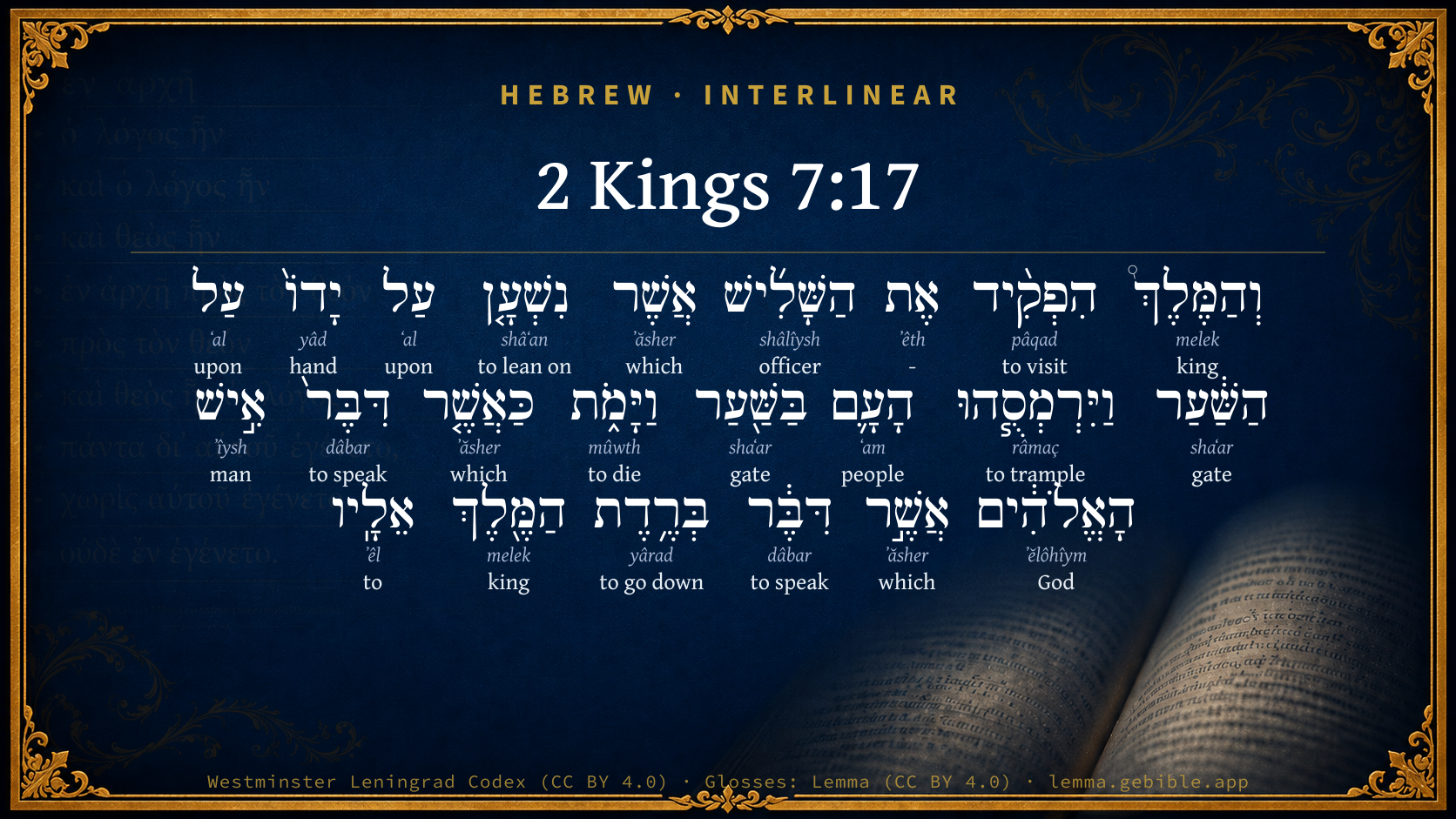
Hebrew (Westminster Leningrad Codex) 2 Kings 7:17 appears in the Hebrew Old Testament. The text above is from the Westminster Leningrad Codex. Each word links to its Strong’s number, a concise gloss, and parsing drawn from the Open Scriptures Hebrew Bible morphology. Click any word for its full Brown-Driver-Briggs (BDB) entry.
Download image
Cite this verse

2 Kings 7:17 (World English Bible). Public Domain. Lemma interlinear Bible study tool, https://lemma.gebible.app/v/2-kings/7/17.

Show BibTeX & RIS
BibTeX
RIS
English Translation
The king appointed the captain on whose hand he leaned to have the charge of the gate: and the people trod on him in the gate, and he died as the man of God had said, who spoke when the king came down to him.
World English Bible · Public Domain
Highlights
  • 1 first appearance in the Hebrew Bible
Full analysis ↓
Download a study sheet

One document with this verse’s original text, its word-by-word gloss line, the meaning frame, cross-references with their text, attributed commentary, and full source and license credits — printable, and it pastes into notes with its structure intact.

This verse Autodidact and up

Study sheet (.html) Plain text (.txt)

A passage Seminary Student

Up to 50 verses in one chapter. A passage sheet keeps up to 6 commentary sources and 12 cross-references per verse, in the order this page ranks them, and says so on the sheet whenever that leaves anything out. Ask for a single verse and you get the Autodidact verse sheet above.

Everything on this page stays free to read, with no account — the sheet is a download of what is already on screen, not access to it.

Want to remove ads? Support Godless Engineer
Compare translations 3

The same verse in 3 English versions, stacked beneath the original-language interlinear above. Click any original word for its lexicon entry.

Each is an independent rendering of the whole verse — the interlinear is not word-aligned to these translations.

Highlighted words mark where these versions differ — a whole-verse word diff, not a word-by-word alignment.

  • World English Bible Public Domain
    The king appointed the captain on whose hand he leaned to have the charge of the gate: and the people trod on him in the gate, and he died as the man of God had said, who spoke when the king came down to him.
  • King James Version Public Domain
    And the king appointed the lord on whose hand he leaned to have the charge of the gate: and the people trode upon him in the gate, and he died, as the man of God had said, who spake when the king came down to him.
  • unfoldingWord Literal Text CC BY-SA 4.0
    And the king appointed the captain whom he was leaning himself on his hand over the gate, but the people trampled him in the gate, and he died, just as the man of God had spoken, what he spoke when the king came down to him.

unfoldingWord Literal Text — © unfoldingWord, licensed CC BY-SA 4.0. Word-aligned USFM3 via Door43 (git.door43.org/unfoldingWord/en_ult).

Versions to compare (up to 4)

3 of 4 selected

Show all 18 translations

Every available English version of this verse, each an independent rendering of the whole verse.

  • World English Bible Public Domain
    The king appointed the captain on whose hand he leaned to have the charge of the gate: and the people trod on him in the gate, and he died as the man of God had said, who spoke when the king came down to him.
  • Berean Standard Bible Public Domain
    Now the king had appointed the officer on whose arm he leaned to be in charge of the gate, but the people trampled him in the gateway, and he died, just as the man of God had foretold when the king had come to him.
  • Majority Standard Bible Public Domain
    Now the king had appointed the officer on whose arm he leaned to be in charge of the gate, but the people trampled him in the gateway, and he died, just as the man of God had foretold when the king had come to him.
  • King James Version Public Domain
    And the king appointed the lord on whose hand he leaned to have the charge of the gate: and the people trode upon him in the gate, and he died, as the man of God had said, who spake when the king came down to him.
  • American Standard Version (1901) Public Domain
    And the king appointed the captain on whose hand he leaned to have the charge of the gate: and the people trod upon him in the gate, and he died as the man of God had said, who spake when the king came down to him.
  • Revised Version (1885) Public Domain
    And the king appointed the captain on whose hand he leaned to have the charge of the gate: and the people trode upon him in the gate, and he died as the man of God had said, who spake when the king came down to him.
  • Geneva Bible (1599) Public Domain
    And the King gaue the prince (on whose hande he leaned) the charge of the gate, and the people trode vpon him in the gate, and he dyed, as the man of God had saide, which spake it, when the King came downe to him.
  • Douay-Rheims (1899) Public Domain
    And the king appointed that lord on whose hand he leaned, to stand at the gate: and the people trod upon him in the entrance of the gate; and he died, as the man of God had said, when the king came down to him.
  • Young's Literal Translation Public Domain
    And the king hath appointed the captain, by whose hand he is supported, over the gate, and the people tread him down in the gate, and he dieth, as the man of God spake, which he spake in the coming down of the king unto him,
  • Literal Standard Version CC BY-SA 4.0
    And the king has appointed the captain, by whose hand he is supported, over the gate, and the people tread him down in the gate, and he dies, as the man of God spoke, which he spoke in the coming down of the king to him,
  • Unlocked Literal Bible CC BY-SA 4.0
    The king had ordered the captain on whose hand he had leaned to be in charge of the gate, and the people trampled him down in the gateway. He died as the man of God had said, who spoke when the king had come down to him.
  • unfoldingWord Literal Text CC BY-SA 4.0
    And the king appointed the captain whom he was leaning himself on his hand over the gate, but the people trampled him in the gate, and he died, just as the man of God had spoken, what he spoke when the king came down to him.
  • Darby Bible Public Domain
    And the king had appointed the captain on whose hand he leaned to have the charge of the gate; and the people trampled upon him in the gate, and he died, according to what the man of God had said, -- what he had said when the king came down to him.
  • World Messianic Bible Public Domain
    The king had appointed the captain on whose hand he leaned to be in charge of the gate; and the people trampled over him in the gate, and he died as the man of God had said, who spoke when the king came down to him.
  • Webster's Bible Public Domain
    And the king appointed the lord on whose hand he leaned to have the charge of the gate: and the people trod upon him in the gate, and he died, as the man of God had said, who spoke when the king came down to him.
  • Free Bible Version CC BY-SA 4.0
    The king had put the officer who was his assistant in charge of the gate. In their rush the people trampled him in the gateway and he died, just as the man of God had said when the king visited him.
  • Bible in Basic English Public Domain
    And the king gave authority to that captain, on whose arm he was supported, to have control over the doorway into the town; but he was crushed to death there under the feet of the people, as the man of God had said when the king went down to him.
  • JPS Tanakh (1917) Public Domain
    And the king appointed the captain on whose hand he leaned to have the charge of the gate; and the people trod upon him in the gate, and he died as the man of God had said, who spoke when the king came down to him.

Literal Standard Version (2020), Covenant Press — licensed CC BY-SA 4.0. Text via the HelloAO Bible API (eBible.org). Unlocked Literal Bible (unfoldingWord) — licensed CC BY-SA 4.0. Text via the HelloAO Bible API (eBible.org). unfoldingWord Literal Text — © unfoldingWord, licensed CC BY-SA 4.0. Word-aligned USFM3 via Door43 (git.door43.org/unfoldingWord/en_ult). Free Bible Version, Dr. Jonathan Gallagher — licensed CC BY-SA 4.0. Text via the HelloAO Bible API (eBible.org).

Word by word

More ways to search: Search by grammar → Find every occurrence → Compare this word →

Practice this passage: Drill this verse → Learn its vocabulary →

וַיִּרְמְסֻ֧הוּ
râmaç
H7429
“and · to trample · him”
Conjunction + Verb, Qal, Sequential Imperfect, 3rd Person, Masculine, Plural + Suffix, Personal, 3rd Person, Masculine, Singular
Part of Speech
Conjunction + Verb
Stem
Qal
Form
Sequential Imperfect
Person
3rd Person
Gender
Masculine
Number
Plural
Full BDB Definition

Origin: a primitive root

TWOT: 2176

to trample - (Qal) - to trample - trampler (participle) - (Niphal) to be trampled
  1. וְהַמֶּלֶךְ֩ melek H4428 “and · the · king” Conjunction + Particle, Definite Article + Noun, Common, Masculine, Singular, Absolute
  2. הִפְקִ֨יד pâqad H6485 “to visit” Verb, Hiphil, Perfect, 3rd Person, Masculine, Singular
  3. אֶת ʼêth H853 “-” Particle, Direct Object
  4. הַשָּׁלִ֜ישׁ shâlîysh H7991 “the · officer” Particle, Definite Article + Noun, Common, Masculine, Singular, Absolute
  5. אֲשֶׁר ʼăsher H834 “which” Particle, Relative
  6. נִשְׁעָ֤ן shâʻan H8172 “leaning on” Verb, Niphal, Participle Active, Masculine, Singular, Absolute
  7. עַל ʻal H5921 “upon” Preposition
  8. יָדוֹ֙ yâd H3027 “hand · his” Noun, Common, Both, Singular, Construct + Suffix, Personal, 3rd Person, Masculine, Singular
  9. עַל ʻal H5921 “upon” Preposition
  10. הַשַּׁ֔עַר shaʻar H8179 “the · gate” Particle, Definite Article + Noun, Common, Masculine, Singular, Absolute
  11. הָעָ֛ם ʻam H5971 “the · people” Particle, Definite Article + Noun, Common, Masculine, Singular, Absolute
  12. בַּשַּׁ֖עַר shaʻar H8179 “in/at the · gate” Preposition, Determined + Noun, Common, Masculine, Singular, Absolute
  13. וַיָּמֹ֑ת mûwth H4191 “and · to die” Conjunction + Verb, Qal, Sequential Imperfect, 3rd Person, Masculine, Singular
  14. כַּאֲשֶׁ֤ר ʼăsher H834 “like/as · which” Preposition + Particle, Relative
  15. דִּבֶּר֙ dâbar H1696 “to speak” Verb, Piel, Perfect, 3rd Person, Masculine, Singular
  16. אִ֣ישׁ ʼîysh H376 “man of” Noun, Common, Masculine, Singular, Construct
  17. הָאֱלֹהִ֔ים ʼĕlôhîym H430 “the · God(s)” Particle, Definite Article + Noun, Common, Masculine, Plural, Absolute
  18. אֲשֶׁ֣ר ʼăsher H834 “which” Particle, Relative
  19. דִּבֶּ֔ר dâbar H1696 “to speak” Verb, Piel, Perfect, 3rd Person, Masculine, Singular
  20. בְּרֶ֥דֶת yârad H3381 “in/at · to go down” Preposition + Verb, Qal, Infinitive Construct
  21. הַמֶּ֖לֶךְ melek H4428 “the · king” Particle, Definite Article + Noun, Common, Masculine, Singular, Absolute
  22. אֵלָֽיו ʼêl H413 “to · him” Preposition + Suffix, Personal, 3rd Person, Masculine, Singular

About this verse

These counts appear in no published source. They are computed here, from the morphology-tagged text and Lemma’s own curated glosses. What Lemma adds →

23
words
17
distinct lemmas
Historical
section

Notable vocabulary

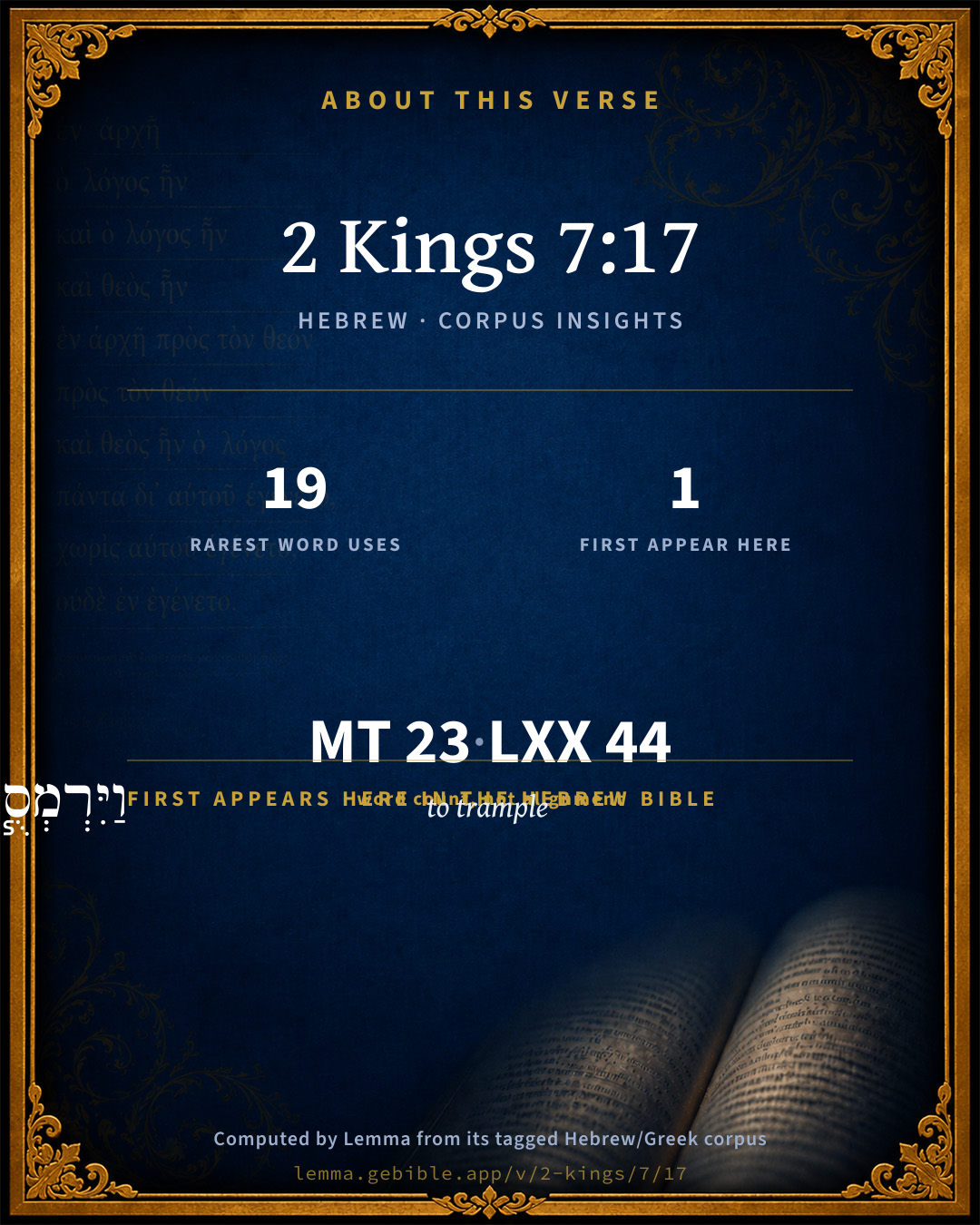
The rarest word here is וַיִּרְמְסֻ֧הוּ to trample H7429 — appearing just 19 times in the whole Hebrew Bible.

First appearance in Scripture

This word makes its first canonical appearance in the Hebrew Bible here:

  • וַיִּרְמְסֻ֧הוּ to trample H7429

Shared distinctive vocabulary

וַיִּרְמְסֻ֧הוּ to trample H7429 occurs in 19 verses of the Hebrew Bible. Also found in:

Grammatical profile

  • 7 verbs
  • 9 nouns
  • 3 prepositions
  • 4 particles

Verb forms

  • הִפְקִ֨יד Hiphil · Perfect
  • נִשְׁעָ֤ן Niphal · Participle Active
  • וַיִּרְמְסֻ֧הוּ Qal · Sequential Imperfect
  • וַיָּמֹ֑ת Qal · Sequential Imperfect
  • דִּבֶּר֙ Piel · Perfect
  • דִּבֶּ֔ר Piel · Perfect
  • בְּרֶ֥דֶת Qal · Infinitive Construct

Repetition

Words recur within this verse — often emphatic in Hebrew:

  • וְהַמֶּלֶךְ֩ king H4428 ×2
  • עַל upon H5921 ×2
  • הַשַּׁ֔עַר gate H8179 ×2
  • דִּבֶּר֙ to speak H1696 ×2
  • אֲשֶׁר which H834 ×3

Hebrew & Septuagint length

In English translation the verse runs 45 words from the Hebrew and 46 from the Septuagint (LXX English) — closely comparable.

A rough comparison of the two English renderings, which tokenize alike — not a word-level alignment.

Word counts can differ between the Hebrew and the Greek without any difference in meaning — e.g. the Hebrew direct-object marker אֵת has no separate Greek word, and Greek often adds the article ὁ.

In the original languages it is 23 Hebrew tokens and 44 Greek tokens — but the two are counted differently (Hebrew bundles its prefixes and suffixes into one token; the Greek is in lemma form), so that isn’t a like-for-like length.

Cross-references

7

Topical passages linked to 2 Kings 7:17 in the Treasury of Scripture Knowledge — connected by theme and wording, ordered by reader-vote popularity; previews shown in the World English Bible.

  • 2 Kings 6:32 But Elisha was sitting in his house, and the elders were sitting with him; and [the king] sent a man from before him: but before the messenger came to him, he said to the elders, See you how this son of a murderer has sent to take away my head? behold, when the messenger comes, shut the door, and hold the door fast against him: isn't the sound of his master's feet behind him?
  • 2 Kings 7:2 Then the captain on whose hand the king leaned answered the man of God, and said, Behold, if Yahweh should make windows in heaven, might this thing be? He said, Behold, you shall see it with your eyes, but shall not eat of it.
  • Judges 20:43 They enclosed the Benjamites round about, [and] chased them, [and] trod them down at [their] resting-place, as far as over against Gibeah toward the sunrise.
  • 2 Kings 9:33 He said, Throw her down. So they threw her down; and some of her blood was sprinkled on the wall, and on the horses: and he trod her under foot.
  • Isaiah 25:10 For in this mountain will the hand of Yahweh rest; and Moab shall be trodden down in his place, even as straw is trodden down in the water of the dung-hill.
  • Micah 7:10 Then my enemy will see it, And shame will cover her who said to me, Where is Yahweh your God? Then my enemy will see me and will cover her shame. Now she will be trodden down like the mire of the streets.
  • Hebrews 10:29 How much worse punishment, do you think, will he be judged worthy of, who has trodden under foot the Son of God, and has counted the blood of the covenant with which he was sanctified an unholy thing, and has insulted the Spirit of grace?

Cross-references courtesy of OpenBible.info (CC BY 4.0).

Hebrew and Greek witnesses Masoretic Hebrew ↔ Greek Septuagint

The same verse in the two great witnesses to the Old Testament, shown verse-for-verse.

These are two independent witnesses, not word-aligned to each other, and the Septuagint is shown in lemma (dictionary) form.

Hebrew 2 Kings 7:17 Masoretic · Westminster Leningrad Codex

וְהַמֶּלֶךְ֩ הִפְקִ֨יד אֶת הַשָּׁלִ֜ישׁ אֲשֶׁר נִשְׁעָ֤ן עַל יָדוֹ֙ עַל הַשַּׁ֔עַר וַיִּרְמְסֻ֧הוּ הָעָ֛ם בַּשַּׁ֖עַר וַיָּמֹ֑ת כַּאֲשֶׁ֤ר דִּבֶּר֙ אִ֣ישׁ הָאֱלֹהִ֔ים אֲשֶׁ֣ר דִּבֶּ֔ר בְּרֶ֥דֶת הַמֶּ֖לֶךְ אֵלָֽיו

The king appointed the captain on whose hand he leaned to have the charge of the gate: and the people trod on him in the gate, and he died as the man of God had said, who spoke when the king came down to him.

World English Bible · Public Domain

Greek LXX 2 Kings 7:17 Septuagint · lemma form

καί ὁ βασιλεύς καταἵστημι ὁ τριστάτης ἐπί ὅς ὁ βασιλεύς ἐπι ἀναπαύω ἐπί ὁ χείρ αὐτός ἐπί ὁ πύλη καί συνπατέω αὐτός ὁ λαός ἐν ὁ πύλη καί ἀποθνήσκω καθά λαλέω ὁ ἄνθρωπος ὁ θεός ὅς λαλέω ἐν ὁ καταβαίνω ὁ ἄγγελος πρός αὐτός

And the king appointed the officer on whose hand the king leaned to have charge over the gate: and the people trampled on him in the gate, and he died, as the man of God had said, who spoke when the messenger came down to him.

LXX2012 (modern English Septuagint) · Public Domain

Hebrew: Westminster Leningrad Codex (CC BY 4.0). Greek: Septuagint (public domain); English from LXX2012 (modern English Septuagint) (Public Domain). How the Septuagint differs from the Hebrew →

Targum (Aramaic paraphrase)

1

The Targum is the ancient Jewish Aramaic paraphrase of the Hebrew Scriptures — an interpretive translation, not the Hebrew text itself. Onkelos (literal) and Pseudo-Jonathan (expansive) render the Torah, and Jonathan the Prophets. Coverage is partial: where no permissively-licensed English translation exists for a verse, only the Aramaic is shown. This is verse-level text, not a word-by-word alignment to the Hebrew.

  1. Targum Jonathan Prophets (Joshua–Malachi)
    וּמַלְכָּא מַנֵי יַת גִבָּרָא דִסְמִיךְ עַל יְדוֹהִי עַל תַּרְעָא וְדָשׁוּהִי עַמָא בְּתַרְעָא וּמִית כְּמָא דְמַלֵיל נְבִיָא דַייָ דְמַלֵיל כַּד נְחַת מַלְכָּא לְוָתֵיהּ:

    (no public-domain English translation for this verse)

    Targum Jonathan — Aramaic: “Mikraot Gedolot” (public domain). English: “Sefaria Community Translation” (CC0 1.0 (public-domain dedication)); “London "Chaldee Paraphrase," 1871” (public domain). Text via Sefaria.

Commentary

Notes on 2 Kings 7:17 from classic Christian and Jewish commentators (each source and its license shown beneath its notes). The classic Christian expositions comment on the surrounding passage and are grouped to its opening verse, so a note may address several verses; the Jewish commentaries on the Tanakh (Rashi and others) are per-verse, so they appear only where the commentator wrote on this verse.

Lemma curates 59 commentaries, every one of them public domain or Creative Commons licensed, each selected and text-cleaned for this edition rather than reprinted as found. About our sources →

Jamieson, Fausset & Brown

Robert Jamieson, A. R. Fausset & David Brown

THE UNBELIEVING LORD TRODDEN TO DEATH. (Kg2 7:17-20)

the king appointed the lord on whose hand he leaned,--&c. The news spread like lightning through the city, and was followed, as was natural, by a popular rush to the Syrian camp. To keep order at the gate, the king ordered his minister to keep guard; but the impetuosity of the famishing people could not be resisted. The lord was trodden to death, and Elisha's prophecy in all respects accomplished.

Next: 2 Kings Chapter 8

Jamieson, Fausset & Brown — Commentary Critical and Explanatory on the Whole Bible (1871) — public domain (CC PDM 1.0). Text via the HelloAO Bible API.

Trapp's Complete Commentary

John Trapp

2Ki 7:17 And the king appointed the lord on whose hand he leaned to have the charge of the gate: and the people trode upon him in the gate, and he died, as the man of God had said, who spake when the king came down to him.

Ver. 17. And the king appointed.] Not without a divine overruling providence, for a just punishment of this profane prince’s unbelief.

And the people trode upon him in the gate.] Whether he had been an oppressor of the people, and was therefore justly trodden to death by them, is uncertain: but that he had shamefully trodden underfoot the honour of God’s power, is upon record, {2Ki 7:2} wherefore he was worthily trampled on by the hungry people, who would not be kept in by his authority. The belly hath no ears, we say; and hunger breaketh through stone walls. Such a like death Constantinus Paleologus, the last Greek emperor, suffered in the gate of Constantinople, when the Turkish army pressed into that city and took it, A.D. 1453.

John Trapp, A Commentary or Exposition upon All the Books of the Old and New Testament (1647–1656) — public domain. Text from a community e-Sword module.

The Biblical Illustrator

Joseph S. Exell

2Ki_7:17-20

And it came to pass as the man of God had spoken.

Gods promise realised and His truth vindicated

We have here an instance of two things--

I. Gods promise realised. In the first verse of this chapter Elisha had said. Hear ye the word of the Lord, Thus saith the Lord, To-morrow, about this time, shall a measure of fine flour be sold for a shekel. The morrow had come, and here is the fine flour and the barley selling in the gate of Samaria. Here is the Divine promise fulfilled to the letter. God is ever faithful Who hath promised.

II. Gods truth vindicated. The haughty courtier said to the prophet yesterday, when he was told that a measure of fine flour would be sold for a shekel, If the Lord would make windows in heaven, then might this thing be. As if he had said, Do not presume to impose on me, a man of my intelligence and importance. The intellectual rabble may believe in you, but I cannot. Whereupon the prophet replied, Thou shalt see it with thine eyes, but shalt not eat thereof. And so it became. Here are the flour and the barley, and there lies dead the haughty sceptic. Truth has ever vindicated itself, and will ever do so. Mens unbelief in facts does not either destroy or weaken facts, the facts remain. Though all the world deny the existence of a God, moral obligation and future retribution, the facts remain. (Homilist.)

The people trode upon him in the gate, and he died.

The fate of unbelief

1. We see that God will punish unbelief. There is an impression in the minds of many that the old dispensation was one of works, and that belief or faith in God is a doctrine only of the new. It is, however, the teaching of the entire Bible, and for all time, that in the eye of God the great sin of man is unbelief. The language is clear and unmistakable. Without faith it is impossible to please Him. He that cometh unto Him must believe that He is, and that He is the rewarder of them that seek Him. He must believe that when the necessities of His kingdom on earth, or the wants and salvation of His people demand it, no laws of nature can stand in the way of His giving relief.

2. We note that this mans final doom was pronounced at least one whole day before his death. The blood of Jesus Christ cleanseth from all sin, and yet there is such a thing as a sin that shall never be forgiven. I believe this is oftener committed by what the world calls moral men than by the desperately wicked. I believe it consists in a deliberate and persistent rejection of Gods truth with the heart, while that truth is clearly known with the head. It is a combination of light in the understanding and determined darkness in the will. This man had been privileged to walk with Gods servant, but would not walk with God.

3. We note that this man perished in sight of blessing. It is possible to realise truth too late. It has been forcefully said, earth is the only place in Gods universe where there is any infidelity. Hell itself is nothing but the truth believed too late. The fabled Tantalus was placed in sight of water and food, yet left to die of thirst and starvation. Dives lifted up his eyes in torment and saw Lazarus in Abrahams bosom, and there is such a thing as rejecting the offers of Jesus and then being compelled to witness the delight of those who are foolish enough to believe Gods promises and wise enough to accept them. (W. H. MCaughey, D. D.)

.

The Biblical Illustrator, edited by Joseph S. Exell (c. 1880s–1900s) — public domain. Text from a community e-Sword module.

Joseph Benson's Commentary

2Ki 7:17-20. The king appointed the lord to have the charge of the gate — To prevent tumults and disorders among the people, and to take care to have the gates shut, if need were, and if the Syrians should happen to return upon them. And that lord answered, &c. — This part of the history is repeated, because it attests a remarkable fulfilment of a divine prediction. The people trode upon him in the gate, and he died — Before he could enjoy, in any measure, the benefit of that plenty which God had bestowed upon them. This fact is an awful proof how heinously God resents men’s distrust of him, and of his power, providence, and promise. When Israel said, Can God furnish a table? the Lord heard and was wroth. Infinite wisdom will not be limited by our folly. God never promises the end, but he knows where to provide the means. Here also we learn how certain God’s threatenings are, and how sure to fall on the heads of the guilty. Let all men fear before the great God, who treads upon princes as mortar, and is terrible to the kings of the earth.

Joseph Benson's Commentary on the Old and New Testaments (1811–1818) — public domain. Text from a community e-Sword module.

Geneva Bible (1599)

Geneva Bible translators

As the people preased out of the gate to run to the Syrian’s tents, where they had heard was meat, and great spoil left.

Geneva Bible (1599) marginal notes — public domain. Text via Bolls.life.

Adam Clarke's Commentary

Verse 17. And the people trode upon him] This officer being appointed by the king to have the command of the gate, the people rushing out to get spoil, and in to carry it to their houses, he was borne down by the multitude and trodden to death. This also was foreseen by the spirit of prophecy. The literal and exact fulfillment of such predictions must have acquired the prophet a great deal of credit in Israel.

DR. Lightfoot remarks that, between the first and last year of Jehoram son of Jehoshaphat, there are very many occurrences mentioned which are not referred nor fixed to their proper year; and, therefore, they must be calculated in a gross sum, as coming to pass in one of these years. These are the stories contained in chapters iv., v., vi., and vii., of this book; and in 2Ch 21:6-19. They may be calculated thus: In the first year of Jehoram, Elisha, returning out of Moab into the land of Israel, multiplies the widow's oil; he is lodged in Shunem, and assures his hostess of a child. The seven years' famine was then begun, and he gives the Shunammite warning of its continuance.

The second year she bears her child in the land of the Philistines, 2Kg 8:2. And Elisha resides among the disciples of the prophets at Gilgal, heals the poisoned pottage, and feeds one hundred men with twenty barley loaves and some ears of corn. That summer he cures Naaman of his leprosy, the only cure of this kind done till Christ came.

The third year he makes iron to swim, prevents the Syrians' ambushments, strikes those with blindness who were sent to seize him, and sends them back to their master.

The fourth year Jehoshaphat dies, and Edom rebels and shakes off the yoke laid upon them by David: Libnah also rebels.

The fifth year Samaria is besieged by Ben-hadad, the city is most grievously afflicted; and, after being nearly destroyed by famine, it is suddenly relieved by a miraculous interference of God, which had been distinctly foretold by Elisha.

The sixth year the Philistines and Arabians oppress Jehoram, king of Judah, and take captive his wives and children, leaving only one son behind.

The seventh year Jehoram falls into a grievous sickness, so that his bowels fall out, 2Ch 21:19. And in the same year the seven years' famine ends about the time of harvest; and at that harvest, the Shunammite's son dies, and is restored to life by Elisha, though the story of his birth and death is related together; and yet some years must have passed between them. Not long after this the Shunammite goes to the king to petition to be restored to her own land, which she had left in the time of the famine, and had sojourned in the land of the Philistines.

This year Elisha is at Damascus, Ben-hadad falls sick; Hazael stifles him with a wet cloth, and reigns in his stead. All these things Dr. Lightfoot supposes happened between A.M. 3110 and 3117. - See Lightfoot's Works, vol. i., p. 88. In examining the facts recorded in these books, we shall always find it difficult, and sometimes impossible, to ascertain the exact chronology. The difficulty is increased by a custom common among these annalists, the giving the whole of a story at once, though several incidents took place at the distance of some years from the commencement of the story: as they seem unwilling to have to recur to the same history in the chronological order of its facts.

Adam Clarke's Commentary on the Bible (1810–1826) — public domain. Text from a community e-Sword/MySword module.

Ellicott's Commentary for English Readers

(17) And the king appointed.—Rather, Now the king had appointed.

The lord.—The adjutant (2Ki_7:2).

To have the charge of the gate.—To maintain order as the famished crowd poured out of the city.

Trode upon him.—Trampled him down, as he was trying to discharge his duty. This probably happened, as Thenius suggests, when the crowd was returning from the Syrian camp, wild with excess of food and drink, after their long abstinence. Thus he “saw the plenty with his eyes, but did not eat thereof” (2Ki_7:2). Reuss thinks the charge of the gate is equivalent to the charge of the market, as the market was held on the space adjoining the gate.

Had said.—Spake.

Who spake.—This is probably a spurious repetition. It is wanting in some Hebrew MSS., and in the Syriac, Vulg., and Arabic versions. If retained in the text, we must render, “And he died, according to that which the man of God spake, which he spake when the king,” &c. But perhaps the reading of one Hebrew MS. is correct: “And he died, according to the word of the man of God, which he spake,” &c.

A Bible Commentary for English Readers, edited by Charles John Ellicott (1878–1897) — public domain. Text from a community e-Sword module.

The Cambridge Bible for Schools and Colleges

gen. ed. J. J. S. Perowne

17–20. The unbelieving captain is trodden to death in the gate (Not in Chronicles)

17. the king appointed the lord] R.V. captain. For the change cf. verse 2. The captain was told off to restrain the impetuosity of the crowd, where crowding would be most dangerous.

as the man of God had said, who spake when the king came down to him] These words help us to understand the somewhat broken connexion of the language in verses 32 and 33 of the last chapter. Jehoram himself came down to Elisha’s house after he had sent his messenger. Hence Elisha says ‘Is not the sound of his master’s feet behind him?’ (the messenger). And we can then understand the question in the following verse, which is intelligible in the mouth of the king, but could hardly have been spoken by the messenger.

The Cambridge Bible for Schools and Colleges (gen. ed. J. J. S. Perowne; Cambridge University Press, 1878–1918) — public domain. Text from a community e-Sword module.

John Gill's Exposition

And the king appointed the lord, on whose hand he leaned, to have the charge of the gate,.... Not to keep out the enemy, of which there was no danger; but to prevent disorders and tumults among the people, and that they might go out in an orderly and regular manner:

and the people trod upon him in the gate; being eager to get out for food; and he endeavouring to keep order among them, they pressed upon him, and threw him down, and trampled him under foot; or he was placed here to regulate the market, that everyone might be supplied in course, but through the people's pressing to get provisions, he was overborne, and trod upon:

and died, as the man of God had said, who spake when the king came down to him; so that he saw the plenty, but partook not of it, as he said, see Kg2 7:2.

John Gill's Exposition of the Whole Bible (1746–1763) — public domain (CC PDM 1.0). Text via the HelloAO Bible API.

Haydock's Catholic Bible Commentary

Gate, to prevent confusion and accidents, (Josephus) or to guard against any return of the enemy. (Menochius)

George Leo Haydock (1774–1849), Haydock's Catholic Family Bible and Commentary, 1859 edition — public domain. Excludes Psalms (Douay-Rheims chapter numbering differs from Protestant) and Deuterocanonical books (Catholic canon only).

Matthew Poole's English Annotations

To have the charge of the gate; partly to prevent tumults and disorders and mischiefs amongst the people; and partly to take order about the shutting of the gates, if need were, and if the Syrians should happen to return upon them.

Matthew Poole's English Annotations on the Holy Bible (1683–1685) — public domain. Text from a community e-Sword/MySword module.

Whedon's Commentary on the Bible

Daniel D. Whedon

17. Trode upon him in the gate — He was overrun and trodden down in the rush and furor of the famished populace as they went forth to gather up the spoils of the enemy’s camp. Thus all the predictions of Elisha were literally and signally fulfilled.

Daniel D. Whedon (gen. ed.), Commentary on the Old and New Testaments (1874–1909) — public domain. Text from a community e-Sword module.

The Pulpit Commentary

And the king appointed the lord on whose hand he leaned to have the charge of the gate. Anticipating disorder, unless special care were taken, through the probable eagerness of the people to purchase the corn which was offered to them at so moderate a rate, Jehoram appointed the officer on whose arm he had leant when he visited the house of Elisha (see ver. 2), to have the charge of the gate, and preside over the sale. Probably there was no thought of the post being one of danger. And the people trod upon him in the gate, and he died. It has been questioned whether the death was accidental (Bahr), and suggested that the eager and famished people resisted his authority, and violently bore down his attempts to control them. But there is nothing in the text that is incompatible with an accidental death. Such deaths ate not uncommon in dense crowds of anxious and excited people. As the man of God had said, who spake when the king came down to him. The varieties of reading here do not affect the general sense. The writer"s intention is to lay special stress on the fulfillment of Elisha"s prophecy; and to emphasize the punishment that follows on a lack of faith. The concluding passage of the chapter is, as Bahr says, "a finger of warning to unbelievers.

Vers. 17-20. God"s promise realized and his truth vindicated.

the king appointed the lord on whose hand he leaned to have the charge of the gate," etc. We have here an instance of two things.

I GOD"S PROMISE REALIZED. In the first verse of this chapter Elisha had said, "Hear ye the word of the Lord; Thus saith the Lord, Tomorrow about this time shall a measure of fine flour be sold for a shekel." The morrow had come, and here is the fine flour and the barley being sold in the gate of Samaria. Here is the Divine promise fulfilled to the letter. God is ever faithful who hath promised. If a being makes a promise, and it is not fulfilled, it must be for one of three reasons either because he was insincere when he made the promise, or subsequently changed his mind, or met with unforeseen difficulties which he had not the power to surmount. None of these can be applied to the all-truthful, unchangeable, all-seeing, and almighty God.

II GOD"S TRUTH VINDICATED. The haughty courtier said to the prophet yesterday, when he was told that a measure of fine flour would be sold for a shekel, "If the Lord would make windows in heaven, might this thing be?" As if he had said, "Do not presume to impose on me, a man of my intelligence and importance. The intellectual rabble may believe in you, but I cannot." Whereupon the prophet replied, "Thou shalt see it with thine eyes, but shalt not eat thereof." And so it came to pass. Here are the flour and the barley, and there lies dead the haughty skeptic. "And so it fell out unto him: for the people trod upon him in the gate, and he died." Truth has ever vindicated itself, and will ever do so. Men"s unbelief in facts does not either destroy or weaken facts; the facts remain. Though all the world deny the existence of a God, moral obligation, and future retribution, the facts remain. D.T.

The Pulpit Commentary (1880–1919), ed. H.D.M. Spence-Jones & Joseph S. Exell — public domain. Text from a community e-Sword module.

Rashi

Rabbi Shlomo Yitzchaki (Rashi)

Upon whose hand he leaned. On the day before, when he came to Elisha’s house.

Rashi on the Tanakh — English translations: “The Judaica Press complete Tanach with Rashi, translated by A. J. Rosenberg” (CC BY 4.0); “Pentateuch with Rashi's commentary by M. Rosenbaum and A.M. Silbermann, 1929-1934” (public domain); “The Metsudah Tanach series, Lakewood, N.J” (CC BY 4.0); and “The Book of Joshua, Metsudah Publications, 1997” (CC BY 4.0). Text via Sefaria.

Lesson kit

Teaching starters — assembled from the data on this page, not authored interpretation. Every prompt links to the verse data it draws on. Edit before teaching.

2 Kings, in the Historical, opens this verse with 23 words (17 distinct Hebrew lemmas). Its most distinctive word is râmaç (“to trample”). A historical commentator’s framing appears above. Read the whole chapter for the surrounding context.

Discussion questions

  1. What does “to trample” (râmaç) contribute to the verse as a whole?
  2. This is the first place “to trample” appears in Scripture (first appears here). What does its debut here establish?
  3. How does 2 Kings 7:20, which shares the word «to trample», read alongside this verse?
  4. What does the repetition of “king” (2× in this one verse) do in this verse?
  5. These translations render this verse differently; the difference is in the English rendering, not the original. What questions does that raise?
  6. «הִפְקִ֨יד» is a Hiphil Perfect verb. How does that grammatical form shape the action described?
  7. Compare how Jamieson, Fausset & Brown and Trapp's Complete Commentary read this verse. Where do they agree or differ?

Things to notice

Reading settings

Reading text

Shown beneath each verse's original-language words.

Old Testament
Old Testament edition

Read the OT as the Masoretic Hebrew (MT) or the Greek Septuagint (LXX).

English shown for the Greek Septuagint (in the Hebrew ↔ Greek comparison).

Comparing translations? Open the Compare panel on any verse page to stack up to four side by side.