
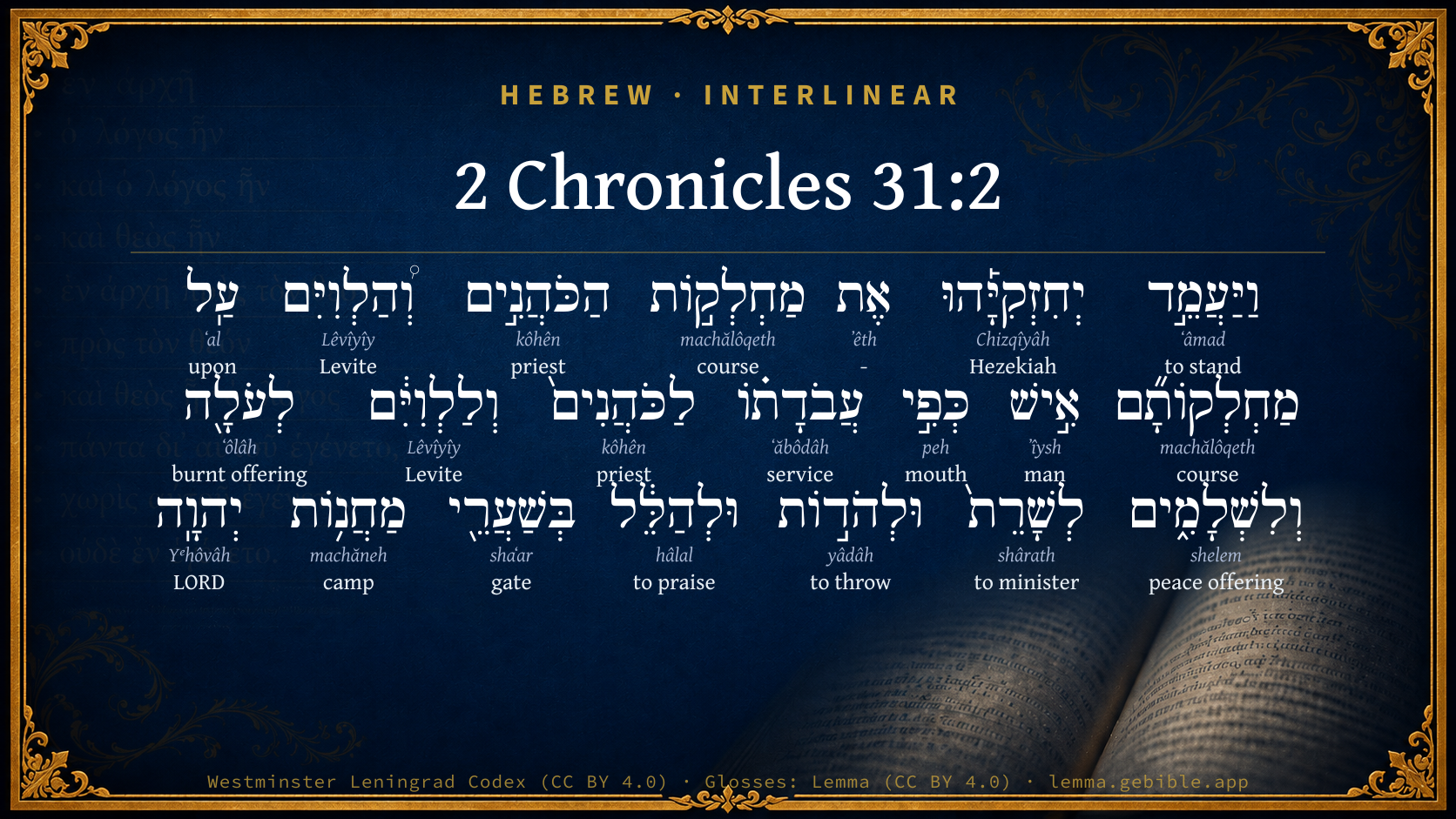
2 Chronicles 31:2

Hebrew (Westminster Leningrad Codex) 2 Chronicles 31:2 appears in the Hebrew Old Testament. The text above is from the Westminster Leningrad Codex. Each word links to its Strong’s number, a concise gloss, and parsing drawn from the Open Scriptures Hebrew Bible morphology. Click any word for its full Brown-Driver-Briggs (BDB) entry.
Download image
Cite this verse

2 Chronicles 31:2 (World English Bible). Public Domain. Lemma interlinear Bible study tool, https://lemma.gebible.app/v/2-chronicles/31/2.

Show BibTeX & RIS
BibTeX
RIS
English Translation
Hezekiah appointed the divisions of the priests and the Levites after their divisions, every man according to his service, both the priests and the Levites, for burnt offerings and for peace-offerings, to minister, and to give thanks, and to praise in the gates of the camp of Yahweh.
World English Bible · Public Domain
Download a study sheet

One document with this verse’s original text, its word-by-word gloss line, the meaning frame, cross-references with their text, attributed commentary, and full source and license credits — printable, and it pastes into notes with its structure intact.

This verse Autodidact and up

Study sheet (.html) Plain text (.txt)

A passage Seminary Student

Up to 50 verses in one chapter. A passage sheet keeps up to 6 commentary sources and 12 cross-references per verse, in the order this page ranks them, and says so on the sheet whenever that leaves anything out. Ask for a single verse and you get the Autodidact verse sheet above.

Everything on this page stays free to read, with no account — the sheet is a download of what is already on screen, not access to it.

Want to remove ads? Support Godless Engineer
Compare translations 3

The same verse in 3 English versions, stacked beneath the original-language interlinear above. Click any original word for its lexicon entry.

Each is an independent rendering of the whole verse — the interlinear is not word-aligned to these translations.

Highlighted words mark where these versions differ — a whole-verse word diff, not a word-by-word alignment.

  • World English Bible Public Domain
    Hezekiah appointed the divisions of the priests and the Levites after their divisions, every man according to his service, both the priests and the Levites, for burnt offerings and for peace-offerings, to minister, and to give thanks, and to praise in the gates of the camp of Yahweh.
  • King James Version Public Domain
    And Hezekiah appointed the courses of the priests and the Levites after their courses, every man according to his service, the priests and Levites for burnt offerings and for peace offerings, to minister, and to give thanks, and to praise in the gates of the tents of the LORD.
  • unfoldingWord Literal Text CC BY-SA 4.0
    And Hezekiah appointed the divisions of the priests and the Levites according to their divisions, each according to the mouth of his service, for the priests and for the Levites for burnt offering and for peace offerings, to minister, and to give thanks, and to praise at the gates of the camp of Yahweh.

unfoldingWord Literal Text — © unfoldingWord, licensed CC BY-SA 4.0. Word-aligned USFM3 via Door43 (git.door43.org/unfoldingWord/en_ult).

Versions to compare (up to 4)

3 of 4 selected

Show all 18 translations

Every available English version of this verse, each an independent rendering of the whole verse.

  • World English Bible Public Domain
    Hezekiah appointed the divisions of the priests and the Levites after their divisions, every man according to his service, both the priests and the Levites, for burnt offerings and for peace-offerings, to minister, and to give thanks, and to praise in the gates of the camp of Yahweh.
  • Berean Standard Bible Public Domain
    Hezekiah reestablished the divisions of the priests and Levites—each of them according to their duties as priests or Levites—for the burnt offerings and peace offerings, for ministry, for giving thanks, and for singing praises at the gates of the LORD’s dwelling.
  • Majority Standard Bible Public Domain
    Hezekiah reestablished the divisions of the priests and Levites—each of them according to their duties as priests or Levites—for the burnt offerings and peace offerings, for ministry, for giving thanks, and for singing praises at the gates of the LORD’s dwelling.
  • King James Version Public Domain
    And Hezekiah appointed the courses of the priests and the Levites after their courses, every man according to his service, the priests and Levites for burnt offerings and for peace offerings, to minister, and to give thanks, and to praise in the gates of the tents of the LORD.
  • American Standard Version (1901) Public Domain
    And Hezekiah appointed the courses of the priests and the Levites after their courses, every man according to his service, both the priests and the Levites, for burnt-offerings and for peace-offerings, to minister, and to give thanks, and to praise in the gates of the camp of Jehovah.
  • Revised Version (1885) Public Domain
    And Hezekiah appointed the courses of the priests and the Levites after their courses, every man according to his service, both the priests and the Levites, for burnt offerings and for peace offerings, to minister, and to give thanks, and to praise in the gates of the camp of the LORD.
  • Geneva Bible (1599) Public Domain
    And Hezekiah appoynted the courses of the Priests and Leuites by their turnes, euery man according to his office, both Priestes and Leuites, for the burnt offring and peace offrings, to minister and to giue thankes, and to prayse in the gates of the tentes of the Lord.
  • Douay-Rheims (1899) Public Domain
    And Ezechias appointed companies of the priests, and the Levites, by their courses, every man in his own office, to wit, both of the priests, and of the Levites, for holocausts, and for peace offerings, to minister, and to praise, and to sing in the gates of the camp of the Lord.
  • Young's Literal Translation Public Domain
    And Hezekiah appointeth the courses of the priests, and of the Levites, by their courses, each according to his service, of the priests and of the Levites, for burnt-offering, and for peace-offerings, to minister, and to give thanks, and to give praise in the gates of the camps of Jehovah.
  • Literal Standard Version CC BY-SA 4.0
    And Hezekiah appoints the divisions of the priests and of the Levites, by their divisions, each according to his service, of the priests and of the Levites, for burnt-offering and for peace-offerings, to minister and to give thanks, and to give praise in the gates of the camps of YHWH.
  • Unlocked Literal Bible CC BY-SA 4.0
    Hezekiah assigned the divisions of the priests and the Levites organized by their divisions, each man assigned to his work, both the priests and the Levites. He assigned them to make the burnt offerings and fellowship offerings, to serve, to give thanks, and to praise at the gates of Yahweh's temple.
  • unfoldingWord Literal Text CC BY-SA 4.0
    And Hezekiah appointed the divisions of the priests and the Levites according to their divisions, each according to the mouth of his service, for the priests and for the Levites for burnt offering and for peace offerings, to minister, and to give thanks, and to praise at the gates of the camp of Yahweh.
  • Darby Bible Public Domain
    And Hezekiah appointed the divisions of the priests, and the Levites after their divisions, every man according to his service, as well the priests as the Levites, for burnt-offerings and for peace-offerings, to serve and to give thanks and to praise in the gates of the courts of Jehovah.
  • World Messianic Bible Public Domain
    Hezekiah appointed the divisions of the priests and the Levites after their divisions, every man according to his service, both the priests and the Levites, for burnt offerings and for peace offerings, to minister, to give thanks, and to praise in the gates of the LORD’s camp.
  • Webster's Bible Public Domain
    And Hezekiah appointed the courses of the priests and the Levites after their courses, every man according to his service, the priests and Levites for burnt-offerings and for peace-offerings, to minister, and to give thanks, and to praise in the gates of the tents of the LORD.
  • Free Bible Version CC BY-SA 4.0
    Then Hezekiah reallocated the divisions of the priests and Levites, each according to their service: presenting burnt offerings and friendship offerings, serving, giving thanks, and singing praises at the entrances of the Lord's Temple.
  • Bible in Basic English Public Domain
    Then Hezekiah put in order the divisions of the priests and Levites, every man in his division, in relation to his work, for the burned offerings and peace-offerings, and for the ordering of worship and for giving praise at the doors of the Lord's house.
  • JPS Tanakh (1917) Public Domain
    And Hezekiah appointed the courses of the priest and the Levites after their courses, every man according to his service, both the priests and the Levites, for burnt-offerings and for peace-offerings, to minister, and to give thanks, and to praise in the gates of the camp of the LORD.

Literal Standard Version (2020), Covenant Press — licensed CC BY-SA 4.0. Text via the HelloAO Bible API (eBible.org). Unlocked Literal Bible (unfoldingWord) — licensed CC BY-SA 4.0. Text via the HelloAO Bible API (eBible.org). unfoldingWord Literal Text — © unfoldingWord, licensed CC BY-SA 4.0. Word-aligned USFM3 via Door43 (git.door43.org/unfoldingWord/en_ult). Free Bible Version, Dr. Jonathan Gallagher — licensed CC BY-SA 4.0. Text via the HelloAO Bible API (eBible.org).

Word by word

More ways to search: Search by grammar → Find every occurrence → Compare this word →

Practice this passage: Drill this verse → Learn its vocabulary →

מַחְלְק֣וֹת
machălôqeth
H4256
“courses of”
Noun, Common, Feminine, Plural, Construct
Part of Speech
Noun
Type
Common
Gender
Feminine
Number
Plural
State
Construct
Full BDB Definition

Origin: from H2505

TWOT: 669d

division, course, class, share, allotment - division, part - division, class, course - of priests, Levites (technical term of organisation)
  1. וַיַּעֲמֵ֣ד ʻâmad H5975 “and · to stand” Conjunction + Verb, Hiphil, Sequential Imperfect, 3rd Person, Masculine, Singular
  2. יְחִזְקִיָּ֡הוּ Chizqîyâh H2396 “Hezekiah” Noun, Proper
  3. אֶת ʼêth H853 “-” Particle, Direct Object
  4. הַכֹּהֲנִ֣ים kôhên H3548 “the · priests” Particle, Definite Article + Noun, Common, Masculine, Plural, Absolute
  5. וְ֠הַלְוִיִּם Lêvîyîy H3881 “and · the · Levites” Conjunction + Particle, Definite Article + Noun, Gentilic, Masculine, Plural, Absolute
  6. עַֽל ʻal H5921 “upon” Preposition
  7. מַחְלְקוֹתָ֞ם machălôqeth H4256 “courses · their” Noun, Common, Feminine, Plural, Construct + Suffix, Personal, 3rd Person, Masculine, Plural
  8. אִ֣ישׁ ʼîysh H376 “man” Noun, Common, Masculine, Singular, Absolute
  9. כְּפִ֣י peh H6310 “like/as · mouth of” Preposition + Noun, Common, Masculine, Singular, Construct
  10. עֲבֹדָת֗וֹ ʻăbôdâh H5656 “service · his” Noun, Common, Feminine, Singular, Construct + Suffix, Personal, 3rd Person, Masculine, Singular
  11. לַכֹּהֲנִים֙ kôhên H3548 “to/for the · priests” Preposition, Determined + Noun, Common, Masculine, Plural, Absolute
  12. וְלַלְוִיִּ֔ם Lêvîyîy H3881 “and · to/for the · Levites” Conjunction + Preposition, Determined + Noun, Gentilic, Masculine, Plural, Absolute
  13. לְעֹלָ֖ה ʻôlâh H5930 “to/for · burnt offering” Preposition + Noun, Common, Feminine, Singular, Absolute
  14. וְלִשְׁלָמִ֑ים shelem H8002 “and · to/for · peace offerings” Conjunction + Preposition + Noun, Common, Masculine, Plural, Absolute
  15. לְשָׁרֵת֙ shârath H8334 “to minister” Preposition + Verb, Piel, Infinitive Construct
  16. וּלְהֹד֣וֹת yâdâh H3034 “and · to throw” Conjunction + Preposition + Verb, Hiphil, Infinitive Construct
  17. וּלְהַלֵּ֔ל hâlal H1984 “and · to praise” Conjunction + Preposition + Verb, Piel, Infinitive Construct
  18. בְּשַׁעֲרֵ֖י shaʻar H8179 “in/at · gates of” Preposition + Noun, Common, Masculine, Plural, Construct
  19. מַחֲנ֥וֹת machăneh H4264 “camps of” Noun, Common, Both, Plural, Construct
  20. יְהוָֽה Yᵉhôvâh H3068 “LORD” Noun, Proper

About this verse

These counts appear in no published source. They are computed here, from the morphology-tagged text and Lemma’s own curated glosses. What Lemma adds →

21
words
18
distinct lemmas
Historical
section

Shared distinctive vocabulary

מַחְלְק֣וֹת course H4256 occurs in 36 verses of the Hebrew Bible. Also found in:

Grammatical profile

  • 4 verbs
  • 15 nouns
  • 1 preposition
  • 1 particle

Verb forms

  • וַיַּעֲמֵ֣ד Hiphil · Sequential Imperfect
  • לְשָׁרֵת֙ Piel · Infinitive Construct
  • וּלְהֹד֣וֹת Hiphil · Infinitive Construct
  • וּלְהַלֵּ֔ל Piel · Infinitive Construct

Repetition

Words recur within this verse — often emphatic in Hebrew:

  • מַחְלְק֣וֹת course H4256 ×2
  • הַכֹּהֲנִ֣ים priest H3548 ×2
  • וְ֠הַלְוִיִּם Levite H3881 ×2

Hebrew & Septuagint length

In English translation the verse runs 48 words from the Hebrew and 60 from the Septuagint (LXX English) — closely comparable.

A rough comparison of the two English renderings, which tokenize alike — not a word-level alignment.

Word counts can differ between the Hebrew and the Greek without any difference in meaning — e.g. the Hebrew direct-object marker אֵת has no separate Greek word, and Greek often adds the article ὁ.

Cross-references

16

Topical passages linked to 2 Chronicles 31:2 in the Treasury of Scripture Knowledge — connected by theme and wording, ordered by reader-vote popularity; previews shown in the World English Bible.

  • 1 Chronicles 24:1 Thes were the divisions of the sons of Aaron. The sons of Aaron: Nadab and Abihu, Eleazar and Ithamar.
  • 1 Chronicles 16:4–6 He appointed certain of the Levites to minister before the ark of Yahweh, and to celebrate and to thank and praise Yahweh, the God of Israel:
  • 1 Chronicles 16:37 So he left there, before the ark of the covenant of Yahweh, Asaph and his brothers, to minister before the ark continually, as every day's work required;
  • 1 Chronicles 16:40–41 to offer burnt offerings to Yahweh on the altar of burnt offering continually morning and evening, even according to all that is written in the law of Yahweh, which he commanded to Israel;
  • 1 Chronicles 23:1–26 Now David was old and full of days; and he made Solomon his son king over Israel.
  • 1 Chronicles 23:28–31 For their office was to wait on the sons of Aaron for the service of the house of Yahweh, in the courts, and in the chambers, and in the purifying of all holy things, even the work of the service of the house of God;
  • 1 Chronicles 25:1–3 Moreover, David and the captains of the host set apart for the service certain of the sons of Asaph, and of Heman, and of Jeduthun, who should prophesy with harps, with psalteries, and with cymbals: and the number of those who did the work according to their service was:
  • 2 Chronicles 5:11 It happened, when the priests were come out of the holy place, (for all the priests who were present had sanctified themselves, and did not keep their divisions;
  • 2 Chronicles 8:14 He appointed, according to the ordinance of David his father, the divisions of the priests to their service, and the Levites to their offices, to praise, and to minister before the priests, as the duty of every day required; the doorkeepers also by their divisions at every gate: for so had David the man of God commanded.
  • 2 Chronicles 23:8 So the Levites and all Judah did according to all that Jehoiada the priest commanded: and they took every man his men, those who were to come in on the Sabbath; with those who were to go out on the Sabbath; for Jehoiada the priest didn't dismiss the shift.
  • 2 Chronicles 29:24–26 and the priests killed them, and they made a sin-offering with their blood on the altar, to make atonement for all Israel; for the king commanded [that] the burnt offering and the sin-offering [should be made] for all Israel.
  • Ezra 6:18 They set the priests in their divisions, and the Levites in their courses, for the service of God, which is at Jerusalem; as it is written in the book of Moses.
  • Nehemiah 11:17 and Mattaniah the son of Mica, the son of Zabdi, the son of Asaph, who was the chief to begin the thanksgiving in prayer, and Bakbukiah, the second among his brothers; and Abda the son of Shammua, the son of Galal, the son of Jeduthun.
  • Psalms 134:1–135:3 Look! Praise Yahweh, all you servants of Yahweh, Who stand by night in Yahweh's house!
  • Jeremiah 33:11 the voice of joy and the voice of gladness, the voice of the bridegroom and the voice of the bride, the voice of those who say, Give thanks to Yahweh of Hosts, for Yahweh is good, for his loving kindness endures forever; [and of them] who bring [sacrifices of] thanksgiving into the house of Yahweh. For I will cause the captivity of the land to return as at the first, says Yahweh.
  • Luke 1:5 There was in the days of Herod, the king of Judea, a certain priest named Zacharias, of the priestly division of Abijah. He had a wife of the daughters of Aaron, and her name was Elizabeth.

Cross-references courtesy of OpenBible.info (CC BY 4.0).

Hebrew and Greek witnesses Masoretic Hebrew ↔ Greek Septuagint

The same verse in the two great witnesses to the Old Testament, shown verse-for-verse.

These are two independent witnesses, not word-aligned to each other, and the Septuagint is shown in lemma (dictionary) form.

Hebrew 2 Chronicles 31:2 Masoretic · Westminster Leningrad Codex

וַיַּעֲמֵ֣ד יְחִזְקִיָּ֡הוּ אֶת מַחְלְק֣וֹת הַכֹּהֲנִ֣ים וְ֠הַלְוִיִּם עַֽל מַחְלְקוֹתָ֞ם אִ֣ישׁ כְּפִ֣י עֲבֹדָת֗וֹ לַכֹּהֲנִים֙ וְלַלְוִיִּ֔ם לְעֹלָ֖ה וְלִשְׁלָמִ֑ים לְשָׁרֵת֙ וּלְהֹד֣וֹת וּלְהַלֵּ֔ל בְּשַׁעֲרֵ֖י מַחֲנ֥וֹת יְהוָֽה

Hezekiah appointed the divisions of the priests and the Levites after their divisions, every man according to his service, both the priests and the Levites, for burnt offerings and for peace-offerings, to minister, and to give thanks, and to praise in the gates of the camp of Yahweh.

World English Bible · Public Domain

Greek LXX 2 Chronicles 31:2 Septuagint · lemma form

καί τάσσω εζεκιας ὁ ἐφημερία ὁ ἱερεύς καί ὁ λευείτης καί ὁ ἐφημερία ἕκαστος κατά ὁ ἑαυτοῦ λειτουργία ὁ ἱερεύς καί ὁ λευείτης εἰς ὁ ὁλοκαύτωσις καί εἰς ὁ θυσία ὁ σωτήριον καί αἰνέω καί ἐκὁμολογέω καί λειτουργέω ἐν ὁ πύλη ἐν ὁ αὐλή οἶκος κύριος

And Ezekias appointed the courses of the priests and the Levites, and the courses of each one according to his ministry, to the priests and to the Levites, for the whole burnt offering, and for the peace-offering, and to praise, and to give thanks, and to minister in the gates, and in the courts of the house of the Lord.

LXX2012 (modern English Septuagint) · Public Domain

On this verse, Keil & Delitzsch discusses the Septuagint’s reading. Read the note in Commentary ↓

Hebrew: Westminster Leningrad Codex (CC BY 4.0). Greek: Septuagint (public domain); English from LXX2012 (modern English Septuagint) (Public Domain). How the Septuagint differs from the Hebrew →

Commentary

Notes on 2 Chronicles 31:2 from classic Christian and Jewish commentators (each source and its license shown beneath its notes). The classic Christian expositions comment on the surrounding passage and are grouped to its opening verse, so a note may address several verses; the Jewish commentaries on the Tanakh (Rashi and others) are per-verse, so they appear only where the commentator wrote on this verse.

Lemma curates 59 commentaries, every one of them public domain or Creative Commons licensed, each selected and text-cleaned for this edition rather than reprinted as found. About our sources →

Trapp's Complete Commentary

John Trapp

2Ch 31:2 And Hezekiah appointed the courses of the priests and the Levites after their courses, every man according to his service, the priests and Levites for burnt offerings and for peace offerings, to minister, and to give thanks, and to praise in the gates of the tents of the LORD.

Ver. 2. In the gates of the tents of the Lord,] i.e., Of the temple, fitly compared to a camp, for the watch and ward there kept by the priests, and for the convention of the people thither, as to their rendezvous, to pray, which is the chief service of our spiritual warfare.

John Trapp, A Commentary or Exposition upon All the Books of the Old and New Testament (1647–1656) — public domain. Text from a community e-Sword module.

Joseph Benson's Commentary

2Ch 31:2. In the gates of the tents of the Lord — That is, within the gates of the house of the Lord: which is here called tents, either because all houses are often so called, (see Jdg 19:9; Jdg 20:8; Psalm 79:25,) or because the host of the Lord, the priests and Levites, encamped there, and kept their stations and orders there by course: and perhaps also to intimate that it was shortly to be removed.

Joseph Benson's Commentary on the Old and New Testaments (1811–1818) — public domain. Text from a community e-Sword module.

Whedon's Commentary on the Bible

Daniel D. Whedon

REORGANIZATION OF THE LEVITES, 2Ch_31:2-21.

2. The priests and the Levites after their courses — The suspension of the temple service by Ahaz had disarranged the courses and work of the Levites, and so it behoved Hezekiah to re-organize these courses according to the divisions and arrangements which David had made. 1Ch_23:6; 1Ch_24:1.

In the gates of the tents of the Lord — Literally, in the gates of the camps of Jehovah; that is, the gates leading to the temple and its courts. The courts and chambers of the temple are spoken of as a fortified camp, even a group of camps, in which Jehovah’s ministers constantly watched and worshipped.

Daniel D. Whedon (gen. ed.), Commentary on the Old and New Testaments (1874–1909) — public domain. Text from a community e-Sword module.

Keil & Delitzsch

C. F. Keil & F. Delitzsch

Restoration of order in the public worship, and of the temple revenues and those of the priests. - Ch2 31:2. Hezekiah appointed the courses of the priests and Levites according to their courses, each according to the measure of his service (cf. Num 7:5, Num 7:7), viz., the priests and Levites (ולל לכה are subordinated to אישׁ in apposition by ל), for burnt-offerings and thank-offerings, to serve (to wait upon the worship), and to praise and thank (by song and instrumental music) in the gates of the camp of Jahve, i.e., in the temple and court of the priests; see on Ch1 9:18.

Ch2 31:3

And the portion of the king from his possession was for the burnt-offerings, etc.; that is, the material for the burnt-offerings which are commanded in Num 28 and 29 the king gave from his possessions, which are enumerated in Ch2 32:27-29.

Ch2 31:4-8

The priests and Levites received their maintenance from the first-fruits (Exo 23:19; Num 18:12; Deu 26:2) and the tithes, which the people had to pay from the produce of their cattle-breeding and their agriculture (Lev 27:30-33, cf. with Num 18:21-24). Hezekiah commanded the people, viz., the inhabitants of Jerusalem, to give this portion to the Levites and priests, that they might hold themselves firmly to the law of Jahve, i.e., might devote themselves to the duties laid upon them by the law, the attendance upon the worship, without being compelled to labour for their subsistence; cf. Neh 13:10.

Ch2 31:5-6

When the word (the royal command) went forth (spread abroad), the Israelites brought in abundance the first-fruits which had been assigned to the priests (Ch2 18:12.), and the tithes, which were paid to the whole tribe of Levi (Num 18:21-24). ישׂראל בּני, Ch2 31:6, are not the inhabitants of the northern kingdom, but the Israelites who had emigrated from that kingdom into Judah (as Ch2 30:25; Ch2 11:16; Ch2 10:17). קדשׁים מעשׂר, the tenth from the holy gifts which were consecrated to Jahve, is surprising, since in the law, Num 18:8., it is not the tenth of the consecrated gifts which is spoken of, but only הקּדשׁים תרוּמות (Num 18:19). Proceeding upon the assumption that all קדשׁים which were consecrated to Jahve were given over to the tribe of Levi, Bertheau finds no correspondence between the law and the statement of our verse, that the tenth of the holy things was given, and points out that the lxx seem to have read והקּשׁים ועז instead of קדשׁים m`sr, without, however, himself deciding in favour of that reading. But the lxx have rendered the words hmqdsym קדשׁים קדשׁים by ἐπιδέκατα αἰγῶν, καὶ ἡγίασαν, and consequently cannot have read ועז for מעשׂר, since in their translation epide'kata corresponds to m`sr. But the deviation of the statement in our verse from the law, Num 18, arises partly from an incorrect or inexact interpretation of the provisions of the law, Num 18:8. In the law, קדשׁים as such were not assigned to the tribe of Levi, or more correctly to the priests (Aaron and his sons), but only the לכל־קדשׁים תּרוּמות, the heave-offerings of all the holy gifts of the sons of Israel, i.e., the pieces or parts of the sacrificial gifts of the Israelites which were not burnt upon the altar, consequently the greater part of the meal, and oil, and flesh of the oblations, the sin-offerings, the trespass-offerings, and of the peace-offerings, the wave-breast and wave-thigh, and whatever else was waved in wave-offerings; see on Num 18:8. These Therumoth of the consecrated gifts are in our verse designated קדשׁים מעשׂר, because they were only a fragment of that which was consecrated to the Lord, just as the tenth was a fragment of the whole herd, and of the field produce. The statement of our verse, therefore, differs only in expression from the prescription of the law, but in substance it completely agrees with it. ער ערמות ויּתּנוּ, and they made many heaps, i.e., they brought the first-fruits and tithes in heaps.

Ch2 31:7

In the third month, consequently immediately at the end of the grain harvest, they commenced to found the heaps (to lay the foundation of the heaps); and in the seventh month, i.e., at the end of the fruit and wine harvest, they completed them (the heaps). In the third month fell pentecost, or the harvest feast; in the seventh, the feast of tabernacles, after the gathering in of all the fruits. ליסּוד has Daghesh in ס, because this verb in the imperf. assimilates its י like נ to the second radical, and the infinitive is formed after the imperf.; cf. Ew. 245, a.

Ch2 31:8-10

When Hezekiah and the priests saw these heaps, they praised the Lord and His people Israel.

The employment and storing of these gifts, Ch2 31:9-19. - Ch2 31:9. Hezekiah questioned (ידרשׁ) the priests and Levites concerning the heaps, i.e., not as to whether they were sufficient for the support of the priests and Levites, but as to how it happened that such masses had been heaped up. Thereupon Azariah the high priest (hardly the Azariah mentioned Ch2 26:17, who forty years before tried to prevent Uzziah from pressing into the holy place), of the house of Zadok, answered him: Since they began to bring (לביא for להביא) the heave-offerings into the house of the Lord, we have eaten and satisfied ourselves, and have left in plenty. The infin. absol. והותר ושׂבוע אכול stand in animated speech instead of the first pers. plur. perf. From the same animation arises the construction of את־ההמון with הנּותר; for "that which is left" signifies, and we have left this quantity here.

Ch2 31:11-12

Then the king commanded to prepare cells in the house of God for the storing of the provisions. Whether new cells were built, or cells already existing were prepared for this purpose, cannot be decided, since הכין may signify either. Into these cells they brought the תּרוּמה, which here denotes the first-fruits (cf. Ch2 31:5), the tithes, and the dedicated things, בּאמוּנה, with fidelity, cf. Ch2 19:9. עליהם, over them (the first-fruits, etc.) the Levite Cononiah was set as ruler (inspector), and his brother Shimei as second ruler (משׁנה).

Ch2 31:13-14

To them at their hand, i.e., as subordinate overseers, were given ten Levites, who are enumerated by name. Of the names, Jehiel and Mahath occur in Ch2 29:12 and Ch2 29:14. בּמפקד is translated by the Vulg. ex imperio, better ex mandato Hizkiae. Azariah, the prince of the house of God, is the high priest mentioned in Ch2 31:10. - To the fourteen Levites named in Ch2 31:13 and Ch2 31:14 was committed the oversight and storing of the first-fruits, tithes, and consecrated gifts. Besides these, there were special officers appointed for the distribution of them. - In Ch2 31:14-19 these are treated of; Ch2 31:14 dealing with the distribution of the voluntary gifts of God, i.e., all which was offered to God of spontaneous impulse (Lev 23:38; Deu 12:17), to which the first-fruits and tithes did not belong, they being assessments prescribed by the law. Over the freewill offerings the Levite Kore, the doorkeeper towards the east (see on Ch1 9:18), was set. His duty was to give (distribute) "the heave-offerings of Jahve," i.e., that portion of the thank-offerings which properly belonged to Jahve, and which was transferred by Him to the priests (Lev 7:14; Num 5:9), and the "most holy," i.e., that part of the sin and trespass offerings (Lev 6:10, Lev 6:22; Lev 7:6) and of the oblations (Lev 2:3, Lev 2:10) which was to be eaten by the priests in the holy place.

Ch2 31:15-16

Keil & Delitzsch — Biblical Commentary on the Old Testament (1861–1891) — public domain (CC PDM 1.0). Text via the HelloAO Bible API. (Old Testament only.)

Geneva Bible (1599)

Geneva Bible translators

That is, in the Temple, where they assembled as in a tent.

Geneva Bible (1599) marginal notes — public domain. Text via Bolls.life.

Jamieson, Fausset & Brown

Robert Jamieson, A. R. Fausset & David Brown

Hezekiah appointed the courses of the priests, &c.--The king now turned his attention to provide for the orderly performance of the temple-worship--arranging the priests and Levites in their courses, assigning to every one his proper place and functions--and issuing edicts for the regular payment of those dues from which the revenues of the sanctuary were derived. To set a proper example to his subjects, his own proportion was announced in the first instance, for to the king it belonged, out of his privy purse, to defray the expenses of the altar, both stated and occasional (Num 28:3-4, Num 28:9, Num 28:11, Num 28:19); and in making this contribution from his own means, Hezekiah followed the course which David and Solomon had taken before him (see Ch2 8:14; Kg1 9:25). Afterwards he reappointed the people's dues to the temple; and from its being necessary to issue a royal mandate in reference to this matter, it appears that the sacred tribute had been either totally neglected, or (as the idolatrous princes were known to appropriate it to their own purposes) the people had in many cases refused or evaded the duty. But with the improved state of public feeling, Hezekiah's commandment was readily obeyed, and contributions of first-fruits and tithes were poured in with great liberality from all parts of Judah, as well as from Israel. The first-fruits, even of some articles of produce that were unfit for sacrifice (Lev 2:11), such as honey (Margin, "dates"), were appropriated to the priests (Num 18:12-13; Deu 18:4). The tithes (Lev 27:31) were intended for the support of the whole Levitical tribe (Num 18:8, Num 18:20, Num 18:24).

Jamieson, Fausset & Brown — Commentary Critical and Explanatory on the Whole Bible (1871) — public domain (CC PDM 1.0). Text via the HelloAO Bible API.

Adam Clarke's Commentary

Verse 2. In the gates of the tents of the Lord.] That is, in the temple; for this was the house, tabernacle, tent, and camp, of the Most High.

Adam Clarke's Commentary on the Bible (1810–1826) — public domain. Text from a community e-Sword/MySword module.

Ellicott's Commentary for English Readers

(2) The courses . . . their courses.—Hezekiah restored the system of service in rotation, ascribed to David. (Comp. 2Ch_8:14, “according to the order of David.”)

Every man according to his service.—See the same phrase in Num_7:5; Num_7:7. Literally, after the mouth (i.e., rule, prescription) of his service.

The priests and Levites.—Literally, to the priests and Levites. The words depend upon those which immediately precede. LXX., καὶ τὰς ἐφημερίας ἑκάστου κατὰ τὴν ἑαυτοῦ λειτουργίαν τοῖς ἱερεῦσιν καὶ τοῖς Λευίταις.

To minister . . . praise.—The chronicler’s usual definition of the Levitical functions.

In the gates . . . Lord.—Literally, in the gates of the camps of Jehovah. Comp. 1Ch_9:18-19, where the phrase is explained.

A Bible Commentary for English Readers, edited by Charles John Ellicott (1878–1897) — public domain. Text from a community e-Sword module.

The Cambridge Bible for Schools and Colleges

gen. ed. J. J. S. Perowne

2–21 (not in 2 Kin.). Organisation of the Priests, Tithe

2. the courses] Cp. 1Ch_24:1 ff.

the priests and Levites] R.V. both the priests and the Levites.

in the gates] Cp. Deu_16:5.

the tents of the Lord] R.V. the camp of the LORD, i.e. (in the language of Deut.) “the place which the Lord chose,” Jerusalem or, more exactly, the Temple area. Cp. 1Ch_9:18, note.

The Cambridge Bible for Schools and Colleges (gen. ed. J. J. S. Perowne; Cambridge University Press, 1878–1918) — public domain. Text from a community e-Sword module.

John Gill's Exposition

And Hezekiah appointed the courses of the priests, and the Levites after their courses,.... As they were fixed by David, and were in the times of Jehoshaphat, and had been since interrupted, and which Hezekiah now restored, and placed them in their regular order:

every man according to his service, the priests and Levites for burnt offerings, and for peace offerings, to minister and to give thanks, and to praise in the gates of the tents of the Lord; or camp of the Lord, where they were posted, and lay as an host encamped, to keep the watch of the house of the Lord; the priests, they were appointed to offer the sacrifices of every sort; the Levites to minister to them in what they needed and required of them, and others of them to be singers in time of service, and others to be porters at the gate.

John Gill's Exposition of the Whole Bible (1746–1763) — public domain (CC PDM 1.0). Text via the HelloAO Bible API.

Albert Barnes' Notes on the Bible

The tents - literally, “the camps.” The temple is called the “camp of Yahweh” by an apt metaphor: the square enclosure, with its gates and stations, its guards and porters, its reliefs, its orderly arrangement, and the tabernacle, or tent, of the great commander in the midst, very much resembled a camp.

Albert Barnes' Notes on the Bible (1834–1885) — public domain. Text from a community e-Sword/MySword module.

Haydock's Catholic Bible Commentary

Praise: literally, "confess." H. --- There is a confession of God’s perfections, as well as of sin. W. --- Gates, within their respective courts. C. --- The Turks style the palace of their emperor, "the sublime porte." H. --- Camp, or temple. Sept. "in the gates, in the courts of the house of the Lord." M. --- Grabe has not in the gates. H. --- We know that they did not sing there, but in the courts, (C.) or halls. H.

George Leo Haydock (1774–1849), Haydock's Catholic Family Bible and Commentary, 1859 edition — public domain. Excludes Psalms (Douay-Rheims chapter numbering differs from Protestant) and Deuterocanonical books (Catholic canon only).

Matthew Poole's English Annotations

i.e. Within the gates of the house of the Lord; which is here called

tents, partly because all houses are oft so called, as Jdg 19:9; 20:8; Psa 69:25; and partly because the host of the Lord, to wit, the priests and Levites, frequently so called, encamped there, and kept their stations and orders there by course.

Matthew Poole's English Annotations on the Holy Bible (1683–1685) — public domain. Text from a community e-Sword/MySword module.

The Pulpit Commentary

And Hezekiah appointed the courses. The twenty-fourth and following two chapters of 1 Chronicles give in full the appointment and arrangement of these courses, now again thrown out of order. Appointed; Hebrew, rme) It is equivalent to saying Hezekiah re-established the courses. Of the tents. The word is not "tents," but the expressive and emphatic "camps" (twOgj) Order of the divinest kind, discipline of the most perfect sort, are the glory of the temple and temple service of old, of the Church, her ministers, her members, and all her pious work of more modern date.

Vers. 2-10.

The service of the consecrated life, and of the substance.

Hezekiah, as soon as the excitement of the great Passover and of the subsequent destruction of all idolatrous symbols was over, made wise arrangements for the regular service of Jehovah. And this included

I THE SERVICE OF THE CONSECRATED LIFE; that, namely, of the priests and the Levites (ver. 2). This service was threefold:

1. Discharging sacred functions at the altar; doing for the people that which only consecrated men could do presenting their sacrifices to Jehovah, thus standing between their fellows and their God, and constituting a medium of communion between them and him.

2. Inquiry into and acquisition of all possible knowledge of the Law (2Ch_17:9; Deu_33:10)

3. Conducting the service of song (ver. 2), and teaching the people the Law which they had themselves learned. There are many in the Christian Church who have undertaken to offer to their Divine Lord a consecrated life; and it devolves on them to yield to him their strength in these three ways.

(1) Ministration in his house or elsewhere; the special service which the minister of Christ, as such, can render; praying to God for his people, or helping them to draw nigh to God a very valuable, indeed inestimable, service.

(2) Earnest thought and inquiry; becoming more and more fully acquainted with the mind of Christ as that is revealed in his Word or in his providence, or through the experience or research of other servants of his.

(3) Utterance of the truth thus acquired; by teaching or preaching, in the sanctuary, or the school, or the house, personally or instrumentally. For the advancement of the kingdom of Christ it is needful that there should be a large number of men, answering to the priests and Levites, who shall regularly give a consecrated life to the service of the Lord.

II THE SERVICE OF THE SUBSTANCE. We have a very interesting instance here recorded of the full and cheerful dedication of the substance to the cause of God. Led as well as taught by Hezekiah, the people responded with tithes and firstfruits, so that there were "heaps "in the temple courts, even when everything had been taken that was required (Ver. 10). Even the remainder was "this great store." The scene suggests the truths:

1. That the offer of our substance is a most appropriate method of sacred service. How can we better express our gratitude to the great Giver of every good thing of every kind than by dedicating to him and to his service some serious proportion of the produce of our strength and skill?

2. That those who urge others to show this grace should be forward toillustrate it themselves (ver. 3).

3. That from those who have the greater privileges may be expected a veryclear encouragement by example (ver. 4).

4. That, if rightly addressed, the people of God may be trusted to make alair and even a liberal response (vers. 5, 6).

5. That such service, rendered in a religious spirit, will draw down theDivine blessing in abundance C.. (ver. 10; and see Mal_3:10)

The camp of the Lord.

I To WHAT THIS DESIGNATION BELONGED?

1. TO the tabernacle. (1Ch_9:19) The religious centre in Israel from the days of the conquest till the times of David and Solomon.

2. To the temple. (Ver. 2.) On Mount Moriah in Jerusalem, which Ahaz had closed during the latter years of his reign, (2Ch_28:24) but Hezekiah had now opened, cleansed, and rededicated to the worship of Jehovah (ch. 29., 30.).

3. To the Church of God.

(1) Under the Old Testament dispensation (Lev_14:8; Num_5:2 Deu_23:10) and

(2) under the New Testament dispensation. (Rev_20:9)

II WHAT THIS DESIGNATION MEANT.

1. That the Lord had pitched his tent there. This was true

(1) of the tabernacle, which was usually styled the dwelling, (Exo_25:9) and, when finished, was filled with the symbol of the Divine presence, the glory of the Lord; (Exo_40:34, Exo_40:35)

(2) of the temple of Solomon, which also was similarly named (2Ch_6:2) and inhabited; (2Ch_5:13, 2Ch_5:14)

(3) of the Old Testament Church as distinguished from its institutions; (Psa_132:13, Psa_132:14) and (4) of the New Testament Church or assembly of believers (Mat_18:20 Mat_28:20; 2Co_6:16)

2. That those amongst whom the Lord dwelt were warriors. This, again, was true

(1) of Israel, in the wilderness and in Canaan, her principal occupation in the latter place being fighting, not always with the Lord"s enemies, as should have been the case, but frequently with one another; and worshipping, though much oftener idols than Jehovah. So should it be true

(2) of Christian believers, as it is when they in any degree realize the ideal of their vocation to fight the good fight of faith, (1Ti_6:12) and to endure hardness as good soldiers of Jesus Christ. W. (2Ti_2:3)

The Pulpit Commentary (1880–1919), ed. H.D.M. Spence-Jones & Joseph S. Exell — public domain. Text from a community e-Sword module.

John Wesley's Explanatory Notes

The tents - Within the gates of the house of the Lord: which is here called tents, because the host of the Lord, the priests and Levites, encamped there. And perhaps to intimate, that it was shortly to be removed.

John Wesley, Explanatory Notes Upon the Whole Bible (1754–1765) — public domain. Text via the GEBible commentary corpus.

unfoldingWord translationNotes

Door43 World Missions Community

Hezekiah assigned the divisions of the priests and the Levites organized by their divisions, each man assigned to his work, both the priests and the Levites

This can be stated in active form. AT: "Hezekiah organized the priests and the Levites into groups. He assigned each priest and Levite to their duties" (See: Active or Passive)

assigned the king's portion for the burnt offerings from his own possessions

Hezekiah took the meat and grain used for the burnt offerings out of his own possessions.

the new moons

This was a festival coinciding with the movement of the moon.

the fixed festivals

This refers to festivals which occur on specific dates.

as it was written in the law of Yahweh

This can be stated in active form. AT: "just as Moses wrote in the law of Yahweh" or "just as Yahweh commanded in his law" (See: Active or Passive)

translationWords

Hezekiah

priest

works

burnt offering

fellowship offering

servant

gate

temple

possess

Sabbath

new moon

written

law

unfoldingWord translationNotes — © Distant Shores Media and the Door43 World Missions Community, licensed CC BY-SA 4.0. Source: git.door43.org/Door43/en_tn.

Rashi

Rabbi Shlomo Yitzchaki (Rashi)

each man according to his service the priests to minister, and the Levites to be singers and gate sentries, and every man at his proper service.

Rashi on the Tanakh — English translations: “The Judaica Press complete Tanach with Rashi, translated by A. J. Rosenberg” (CC BY 4.0); “Pentateuch with Rashi's commentary by M. Rosenbaum and A.M. Silbermann, 1929-1934” (public domain); “The Metsudah Tanach series, Lakewood, N.J” (CC BY 4.0); and “The Book of Joshua, Metsudah Publications, 1997” (CC BY 4.0). Text via Sefaria.

Lesson kit

Teaching starters — assembled from the data on this page, not authored interpretation. Every prompt links to the verse data it draws on. Edit before teaching.

2 Chronicles, in the Historical, opens this verse with 21 words (18 distinct Hebrew lemmas). Its most distinctive word is machălôqeth (“course”). A historical commentator’s framing appears above. Read the whole chapter for the surrounding context.

Discussion questions

  1. How does “course” (machălôqeth) shape what this verse is saying?
  2. Joshua 11:23 shares the word «course» with this verse. How do the two illuminate each other?
  3. “course” occurs 2× in this one verse. What is the effect of the repetition?
  4. These translations render this verse differently; the difference is in the English rendering, not the original. What questions does that raise?
  5. The verb «וַיַּעֲמֵ֣ד» is Hiphil Sequential Imperfect. How does its form color the action?
  6. Reading how Trapp's Complete Commentary and Joseph Benson's Commentary read this verse, where do the two commentators agree and where do they part?

Things to notice

Reading settings

Reading text

Shown beneath each verse's original-language words.

Old Testament
Old Testament edition

Read the OT as the Masoretic Hebrew (MT) or the Greek Septuagint (LXX).

English shown for the Greek Septuagint (in the Hebrew ↔ Greek comparison).

Comparing translations? Open the Compare panel on any verse page to stack up to four side by side.