
2 Kings 15:35

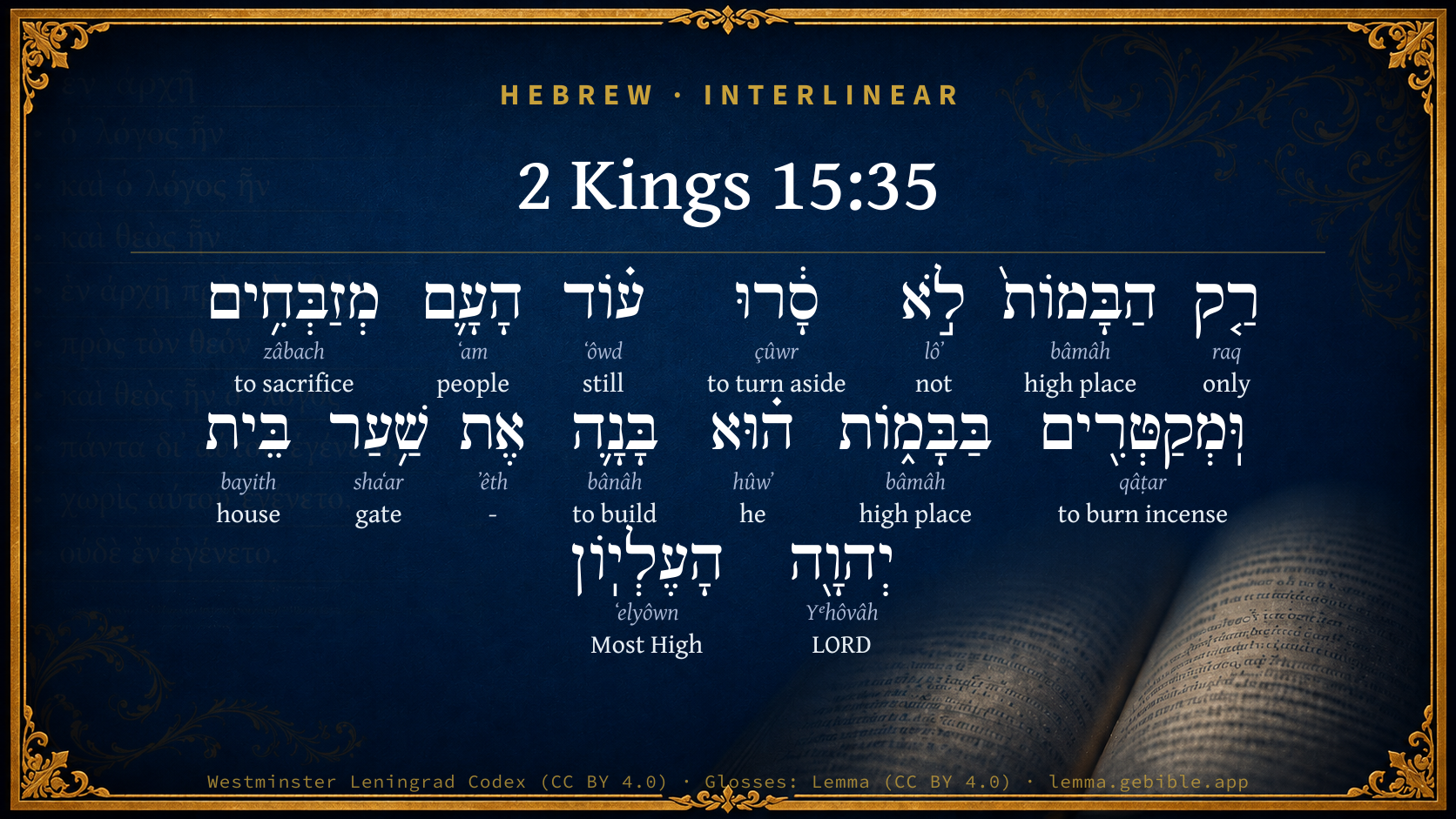
Hebrew (Westminster Leningrad Codex) 2 Kings 15:35 appears in the Hebrew Old Testament. The text above is from the Westminster Leningrad Codex. Each word links to its Strong’s number, a concise gloss, and parsing drawn from the Open Scriptures Hebrew Bible morphology. Click any word for its full Brown-Driver-Briggs (BDB) entry.
Download image
Cite this verse

2 Kings 15:35 (World English Bible). Public Domain. Lemma interlinear Bible study tool, https://lemma.gebible.app/v/2-kings/15/35.

Show BibTeX & RIS
BibTeX
RIS
English Translation
However the high places were not taken away: the people still sacrificed and burned incense in the high places. He built the upper gate of the house of Yahweh.
World English Bible · Public Domain
Download a study sheet

One document with this verse’s original text, its word-by-word gloss line, the meaning frame, cross-references with their text, attributed commentary, and full source and license credits — printable, and it pastes into notes with its structure intact.

This verse Autodidact and up

Study sheet (.html) Plain text (.txt)

A passage Seminary Student

Up to 50 verses in one chapter. A passage sheet keeps up to 6 commentary sources and 12 cross-references per verse, in the order this page ranks them, and says so on the sheet whenever that leaves anything out. Ask for a single verse and you get the Autodidact verse sheet above.

Everything on this page stays free to read, with no account — the sheet is a download of what is already on screen, not access to it.

Want to remove ads? Support Godless Engineer
Compare translations 3

The same verse in 3 English versions, stacked beneath the original-language interlinear above. Click any original word for its lexicon entry.

Each is an independent rendering of the whole verse — the interlinear is not word-aligned to these translations.

Highlighted words mark where these versions differ — a whole-verse word diff, not a word-by-word alignment.

  • World English Bible Public Domain
    However the high places were not taken away: the people still sacrificed and burned incense in the high places. He built the upper gate of the house of Yahweh.
  • King James Version Public Domain
    Howbeit the high places were not removed: the people sacrificed and burned incense still in the high places. He built the higher gate of the house of the LORD.
  • unfoldingWord Literal Text CC BY-SA 4.0
    Only the high places were not removed. The people still were sacrificing and were burning incense at the high places. He, he built the upper gate of the house of Yahweh.

unfoldingWord Literal Text — © unfoldingWord, licensed CC BY-SA 4.0. Word-aligned USFM3 via Door43 (git.door43.org/unfoldingWord/en_ult).

Versions to compare (up to 4)

3 of 4 selected

Show all 18 translations

Every available English version of this verse, each an independent rendering of the whole verse.

  • World English Bible Public Domain
    However the high places were not taken away: the people still sacrificed and burned incense in the high places. He built the upper gate of the house of Yahweh.
  • Berean Standard Bible Public Domain
    Nevertheless, the high places were not taken away; the people continued sacrificing and burning incense there. Jotham rebuilt the Upper Gate of the house of the LORD.
  • Majority Standard Bible Public Domain
    Nevertheless, the high places were not taken away; the people continued sacrificing and burning incense there. Jotham rebuilt the Upper Gate of the house of the LORD.
  • King James Version Public Domain
    Howbeit the high places were not removed: the people sacrificed and burned incense still in the high places. He built the higher gate of the house of the LORD.
  • American Standard Version (1901) Public Domain
    Howbeit the high places were not taken away: the people still sacrificed and burned incense in the high places. He built the upper gate of the house of Jehovah.
  • Revised Version (1885) Public Domain
    Howbeit the high places were not taken away: the people still sacrificed and burned incense in the high places. He built the upper gate of the house of the LORD.
  • Geneva Bible (1599) Public Domain
    But the hie places were not put away: for the people yet offered and burnt incense in the hie places: he buylt the hyest gate of the house of the Lord.
  • Douay-Rheims (1899) Public Domain
    But the high places he took not away: the people still sacrificed and burnt incense in the high places: he built the highest gate of the house of the Lord.
  • Young's Literal Translation Public Domain
    Only, the high places have not turned aside -- yet are the people sacrificing and making perfume in high places; he hath built the high gate of the house of Jehovah.
  • Literal Standard Version CC BY-SA 4.0
    Only, the high places have not been removed—the people are still sacrificing and making incense in high places; he has built the high gate of the house of YHWH.
  • Unlocked Literal Bible CC BY-SA 4.0
    However, the high places were not taken away. The people still sacrificed and burned incense at the high places. Jotham built the upper gate of the house of Yahweh.
  • unfoldingWord Literal Text CC BY-SA 4.0
    Only the high places were not removed. The people still were sacrificing and were burning incense at the high places. He, he built the upper gate of the house of Yahweh.
  • Darby Bible Public Domain
    Only, the high places were not removed: the people still sacrificed and burned incense on the high places. It was he who built the upper gate of the house of Jehovah.
  • World Messianic Bible Public Domain
    However the high places were not taken away. The people still sacrificed and burned incense in the high places. He built the upper gate of the LORD’s house.
  • Webster's Bible Public Domain
    Yet, the high places were not removed: the people sacrificed and burned incense still in the high places. He built the higher gate of the house of the LORD.
  • Free Bible Version CC BY-SA 4.0
    But the high places were not removed. The people still were sacrificing and presenting burnt offerings in those places. He rebuilt the upper gate of the Lord's Temple.
  • Bible in Basic English Public Domain
    But he did not take away the high places, and the people still went on making offerings and burning them in the high places. He was the builder of the higher doorway of the house of the Lord.
  • JPS Tanakh (1917) Public Domain
    Howbeit the high places were not taken away; the people still sacrificed and offered in the high places. He built the upper gate of the house of the LORD.

Literal Standard Version (2020), Covenant Press — licensed CC BY-SA 4.0. Text via the HelloAO Bible API (eBible.org). Unlocked Literal Bible (unfoldingWord) — licensed CC BY-SA 4.0. Text via the HelloAO Bible API (eBible.org). unfoldingWord Literal Text — © unfoldingWord, licensed CC BY-SA 4.0. Word-aligned USFM3 via Door43 (git.door43.org/unfoldingWord/en_ult). Free Bible Version, Dr. Jonathan Gallagher — licensed CC BY-SA 4.0. Text via the HelloAO Bible API (eBible.org).

Word by word

More ways to search: Search by grammar → Find every occurrence → Compare this word →

Practice this passage: Drill this verse → Learn its vocabulary →

הָעֶלְיֽוֹן
ʻelyôwn
H5945
“the · Most High”
Particle, Definite Article + Adjective, Adjective, Masculine, Singular, Absolute
Part of Speech
Particle + Adjective
Type
Adjective
Gender
Masculine
Number
Singular
State
Absolute
Full BDB Definition

Origin: from H5927

TWOT: 1624g , 1624h

high, upper (adjective) - of Davidic king exalted above monarchs - Highest, Most High (noun masculine) - name of God - of rulers, either monarchs or angel-princes
  1. רַ֤ק raq H7535 “only” Particle, Accusative
  2. הַבָּמוֹת֙ bâmâh H1116 “the · high places” Particle, Definite Article + Noun, Common, Feminine, Plural, Absolute
  3. לֹ֣א lôʼ H3808 “not” Particle, Negative
  4. סָ֔רוּ çûwr H5493 “to turn aside” Verb, Qal, Perfect, 3rd Person, Common, Plural
  5. ע֗וֹד ʻôwd H5750 “still” Adverb
  6. הָעָ֛ם ʻam H5971 “the · people” Particle, Definite Article + Noun, Common, Masculine, Singular, Absolute
  7. מְזַבְּחִ֥ים zâbach H2076 “sacrificing” Verb, Piel, Participle Active, Masculine, Plural, Absolute
  8. וּֽמְקַטְּרִ֖ים qâṭar H6999 “and · burning incense” Conjunction + Verb, Piel, Participle Active, Masculine, Plural, Absolute
  9. בַּבָּמ֑וֹת bâmâh H1116 “in/at the · high places” Preposition, Determined + Noun, Common, Feminine, Plural, Absolute
  10. ה֗וּא hûwʼ H1931 “he” Pronoun, Personal, 3rd Person, Masculine, Singular
  11. בָּנָ֛ה bânâh H1129 “to build” Verb, Qal, Perfect, 3rd Person, Masculine, Singular
  12. אֶת ʼêth H853 “-” Particle, Direct Object
  13. שַׁ֥עַר shaʻar H8179 “gate of” Noun, Common, Masculine, Singular, Construct
  14. בֵּית bayith H1004 “house of” Noun, Common, Masculine, Singular, Construct
  15. יְהוָ֖ה Yᵉhôvâh H3068 “LORD” Noun, Proper

About this verse

These counts appear in no published source. They are computed here, from the morphology-tagged text and Lemma’s own curated glosses. What Lemma adds →

16
words
15
distinct lemmas
Historical
section

Shared distinctive vocabulary

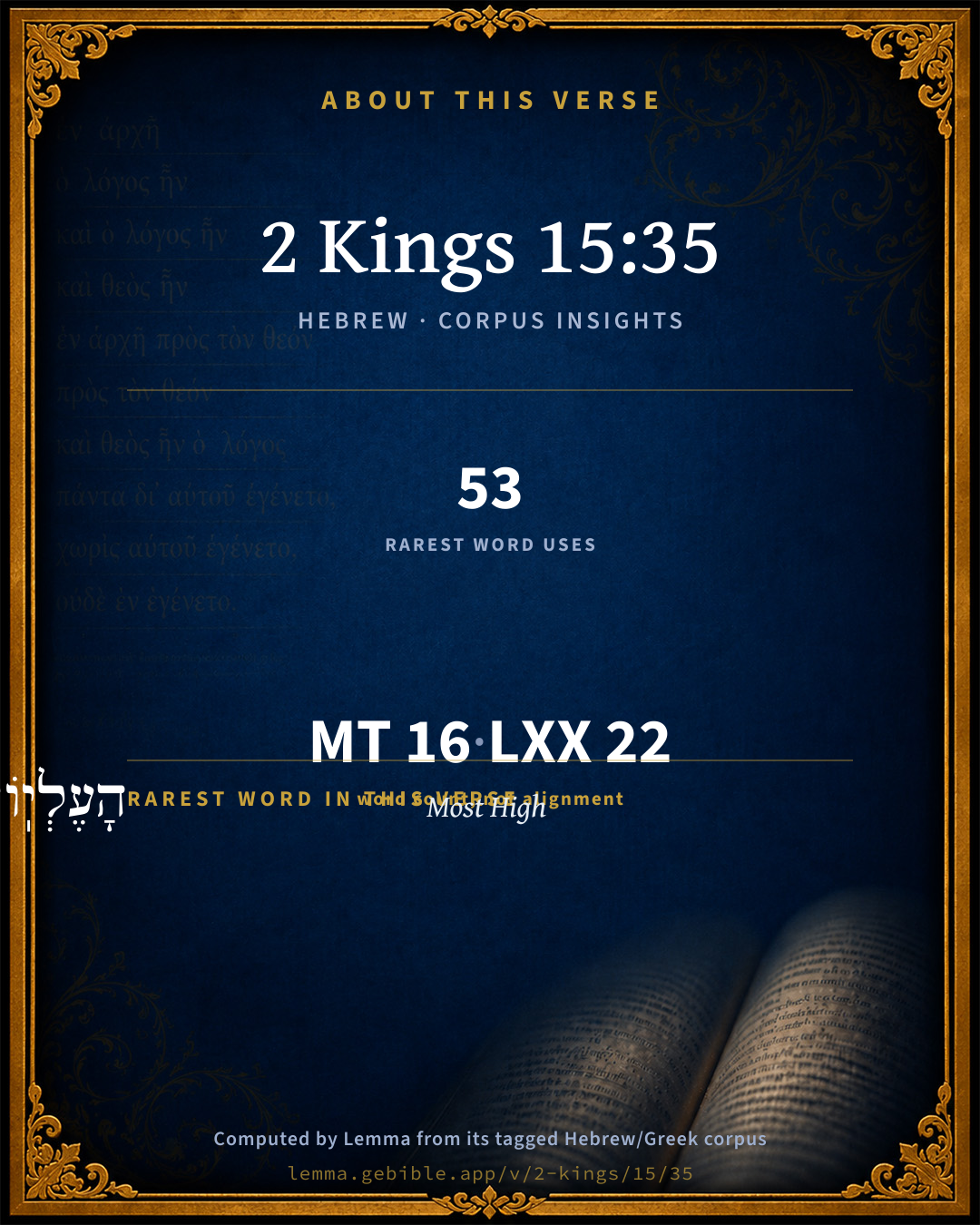
הָעֶלְיֽוֹן Most High H5945 occurs in 53 verses of the Hebrew Bible. Also found in:

Grammatical profile

  • 4 verbs
  • 6 nouns
  • 1 adjective
  • 1 pronoun
  • 1 adverb
  • 3 particles

Verb forms

  • סָ֔רוּ Qal · Perfect
  • מְזַבְּחִ֥ים Piel · Participle Active
  • וּֽמְקַטְּרִ֖ים Piel · Participle Active
  • בָּנָ֛ה Qal · Perfect

Repetition

A word recurs within this verse — often emphatic in Hebrew:

  • הַבָּמוֹת֙ high place H1116 ×2

Hebrew & Septuagint length

In English translation the verse runs 29 words from the Hebrew and 29 from the Septuagint (LXX English) — the same length.

A rough comparison of the two English renderings, which tokenize alike — not a word-level alignment.

Word counts can differ between the Hebrew and the Greek without any difference in meaning — e.g. the Hebrew direct-object marker אֵת has no separate Greek word, and Greek often adds the article ὁ.

In the original languages it is 16 Hebrew tokens and 22 Greek tokens — but the two are counted differently (Hebrew bundles its prefixes and suffixes into one token; the Greek is in lemma form), so that isn’t a like-for-like length.

Cross-references

6

Topical passages linked to 2 Kings 15:35 in the Treasury of Scripture Knowledge — connected by theme and wording, ordered by reader-vote popularity; previews shown in the World English Bible.

  • 2 Kings 12:3 However the high places were not taken away; the people still sacrificed and burnt incense in the high places.
  • 2 Chronicles 23:20 He took the captains of hundreds, and the nobles, and the governors of the people, and all the people of the land, and brought down the king from the house of Yahweh: and they came through the upper gate to the king's house, and set the king on the throne of the kingdom.
  • 2 Kings 15:4 However the high places were not taken away: the people still sacrificed and burnt incense in the high places.
  • 2 Kings 18:4 He removed the high places, and broke the pillars, and cut down the Asherah: and he broke in pieces the brazen serpent that Moses had made; for to those days the children of Israel did burn incense to it; and he called it Nehushtan.
  • 2 Chronicles 27:3–9 He built the upper gate of the house of Yahweh, and on the wall of Ophel he built much.
  • 2 Chronicles 32:12 Has not the same Hezekiah taken away his high places and his altars, and commanded Judah and Jerusalem, saying, You shall worship before one altar, and on it shall you burn incense?

Cross-references courtesy of OpenBible.info (CC BY 4.0).

Hebrew and Greek witnesses Masoretic Hebrew ↔ Greek Septuagint

The same verse in the two great witnesses to the Old Testament, shown verse-for-verse.

These are two independent witnesses, not word-aligned to each other, and the Septuagint is shown in lemma (dictionary) form.

Hebrew 2 Kings 15:35 Masoretic · Westminster Leningrad Codex

רַ֤ק הַבָּמוֹת֙ לֹ֣א סָ֔רוּ ע֗וֹד הָעָ֛ם מְזַבְּחִ֥ים וּֽמְקַטְּרִ֖ים בַּבָּמ֑וֹת ה֗וּא בָּנָ֛ה אֶת שַׁ֥עַר בֵּית יְהוָ֖ה הָעֶלְיֽוֹן

However the high places were not taken away: the people still sacrificed and burned incense in the high places. He built the upper gate of the house of Yahweh.

World English Bible · Public Domain

Greek LXX 2 Kings 15:35 Septuagint · lemma form

πλήν ὁ ὑψηλός οὐ ἐκαἴρω ἔτι ὁ λαός θυσιάζω καί θυμιάζω ἐν ὁ ὑψηλός αὐτός οἰκοδομέω ὁ πύλη οἶκος κύριος ὁ ἐπάνω

Nevertheless he took not away the high places: as yet the people sacrificed and burnt incense on the high places. He built the upper gate of the Lord's house.

LXX2012 (modern English Septuagint) · Public Domain

Hebrew: Westminster Leningrad Codex (CC BY 4.0). Greek: Septuagint (public domain); English from LXX2012 (modern English Septuagint) (Public Domain). How the Septuagint differs from the Hebrew →

Targum (Aramaic paraphrase)

1

The Targum is the ancient Jewish Aramaic paraphrase of the Hebrew Scriptures — an interpretive translation, not the Hebrew text itself. Onkelos (literal) and Pseudo-Jonathan (expansive) render the Torah, and Jonathan the Prophets. Coverage is partial: where no permissively-licensed English translation exists for a verse, only the Aramaic is shown. This is verse-level text, not a word-by-word alignment to the Hebrew.

  1. Targum Jonathan Prophets (Joshua–Malachi)
    לְחוֹד בְּמָתָא לָא עָטָרָא עַד כְּעַן עַמָא מַדְבְּחִין וּמַסְקִין בּוּסְמַיָא עַל בָּמָתָא הוּא בְּנָא יַת תְּרַע בֵּית מַקְדְשָׁא דַייָ עִלָאָה:

    (no public-domain English translation for this verse)

    Targum Jonathan — Aramaic: “Mikraot Gedolot” (public domain). English: “Sefaria Community Translation” (CC0 1.0 (public-domain dedication)); “London "Chaldee Paraphrase," 1871” (public domain). Text via Sefaria.

Commentary

Notes on 2 Kings 15:35 from classic Christian and Jewish commentators (each source and its license shown beneath its notes). The classic Christian expositions comment on the surrounding passage and are grouped to its opening verse, so a note may address several verses; the Jewish commentaries on the Tanakh (Rashi and others) are per-verse, so they appear only where the commentator wrote on this verse.

Lemma curates 59 commentaries, every one of them public domain or Creative Commons licensed, each selected and text-cleaned for this edition rather than reprinted as found. About our sources →

Trapp's Complete Commentary

John Trapp

2Ki 15:35 Howbeit the high places were not removed: the people sacrificed and burned incense still in the high places. He built the higher gate of the house of the LORD.

Ver. 35. He built the higher gate.] Then, when the people doted upon high places; though he disliked their practice.

John Trapp, A Commentary or Exposition upon All the Books of the Old and New Testament (1647–1656) — public domain. Text from a community e-Sword module.

Jamieson, Fausset & Brown

Robert Jamieson, A. R. Fausset & David Brown

the higher gate of the house of the Lord--not the temple itself, but one of its courts; probably that which led into the palace (Ch2 23:20).

Jamieson, Fausset & Brown — Commentary Critical and Explanatory on the Whole Bible (1871) — public domain (CC PDM 1.0). Text via the HelloAO Bible API.

The Cambridge Bible for Schools and Colleges

gen. ed. J. J. S. Perowne

35. Howbeit the high places] In 2 Chronicles it is merely said ‘the people did yet corruptly’.

He built the higher [R.V. upper] gate of the house of the Lord] By ‘build’ is only meant ‘restore’ or ‘beautify’. The gate existed before. The temple stood on a slope, of which the northern side was the highest and the gate on that side was the one of which Jotham made some restoration. The account of his buildings is somewhat fuller in 2 Chronicles. ‘On the wall of Ophel he built much. Moreover he built cities in the hill-country of Judah, and in the forests he built castles and towers’. His success in war, also unnoticed by the compiler of Kings, is dwelt on by the Chronicler. He fought with the Ammonites and conquered them, and the children of Ammon paid him in that year a hundred talents of silver, ten thousand measures of wheat, and the same quantity of barley, and they continued the payment for a second and a third year. ‘So Jotham became mighty because he prepared his ways before the Lord his God’.

The Cambridge Bible for Schools and Colleges (gen. ed. J. J. S. Perowne; Cambridge University Press, 1878–1918) — public domain. Text from a community e-Sword module.

Albert Barnes' Notes on the Bible

He built the higher gate - Jotham followed the example of his father in military, no less than in religious, matters (compare the marginal reference with 2Ch 26:9). The “higher” or “upper gate” of the temple is thought to have been that toward the north; and its fortification would seem to indicate fear of an attack from that quarter.

Albert Barnes' Notes on the Bible (1834–1885) — public domain. Text from a community e-Sword/MySword module.

Haydock's Catholic Bible Commentary

Gate, repairing that on the east. Jeremias (xxvi. 10.) mentions the new gate. Joatham also made great additions to the walls of Jerusalem. (Paralipomenon)

George Leo Haydock (1774–1849), Haydock's Catholic Family Bible and Commentary, 1859 edition — public domain. Excludes Psalms (Douay-Rheims chapter numbering differs from Protestant) and Deuterocanonical books (Catholic canon only).

Matthew Poole's English Annotations

Not of the temple, properly so called; but of one of the courts of the temple, probably that which led to the king’s palace, 2Ch 23:20; called also the new gate, Jer 26:10; 36:10.

Matthew Poole's English Annotations on the Holy Bible (1683–1685) — public domain. Text from a community e-Sword/MySword module.

The Pulpit Commentary

Howbeit the high places were not removed: the people sacrificed and burned incense, still in the high places. He built the higher gate of the house of the Lord. The "higher gate "is thought to be that towards the north, and its fortification implied a fear of attack from that quarter. It must have become amply evident to the kings of Judah, at any rate from the time of the attack on Menahem (ver. 19), that the independence of both kingdoms was menaced by Assyria, and that it was of great importance that their principal fortresses should be placed in a state of efficient defense. Azariah had paid great attention to the fortifying and arming of Jerusalem, (2Ch_26:9, 2Ch_26:15) and his son now followed in his footsteps. From 2Ch_27:3 we learn that he not only built the high gate of the temple, but also "on the wall of Ophel built much," Nor was he content with fortifying the capital. He also "built cities in the mountains of Judah, and in the forests he built castles and towers." Tiglath-pileser had made war on his father ("Eponym Canon," pp. 117, 118). He felt that any day his own turn might come.

The Pulpit Commentary (1880–1919), ed. H.D.M. Spence-Jones & Joseph S. Exell — public domain. Text from a community e-Sword module.

John Wesley's Explanatory Notes

Gate - Not of the temple, but of one of the courts of the temple, probably that which led to the king's palace.

John Wesley, Explanatory Notes Upon the Whole Bible (1754–1765) — public domain. Text via the GEBible commentary corpus.

Lesson kit

Teaching starters — assembled from the data on this page, not authored interpretation. Every prompt links to the verse data it draws on. Edit before teaching.

2 Kings, in the Historical, opens this verse with 16 words (15 distinct Hebrew lemmas). Its most distinctive word is ʻelyôwn (“Most High”). A historical commentator’s framing appears above. Read the whole chapter for the surrounding context.

Discussion questions

  1. The word ʻelyôwn carries the sense “Most High.” How does it shape the verse?
  2. Genesis 14:18 shares the word «Most High» with this verse. How do the two illuminate each other?
  3. “high place” occurs 2× in this one verse. What is the effect of the repetition?
  4. The translations on this page render this verse differently — a whole-verse word diff, not a word-by-word alignment. What might account for the different wordings?
  5. The verb «סָ֔רוּ» is Qal Perfect. How does its form color the action?
  6. Reading how Trapp's Complete Commentary and Jamieson, Fausset & Brown read this verse, where do the two commentators agree and where do they part?

Things to notice

Reading settings

Reading text

Shown beneath each verse's original-language words.

Old Testament
Old Testament edition

Read the OT as the Masoretic Hebrew (MT) or the Greek Septuagint (LXX).

English shown for the Greek Septuagint (in the Hebrew ↔ Greek comparison).

Comparing translations? Open the Compare panel on any verse page to stack up to four side by side.