Judges 5:8

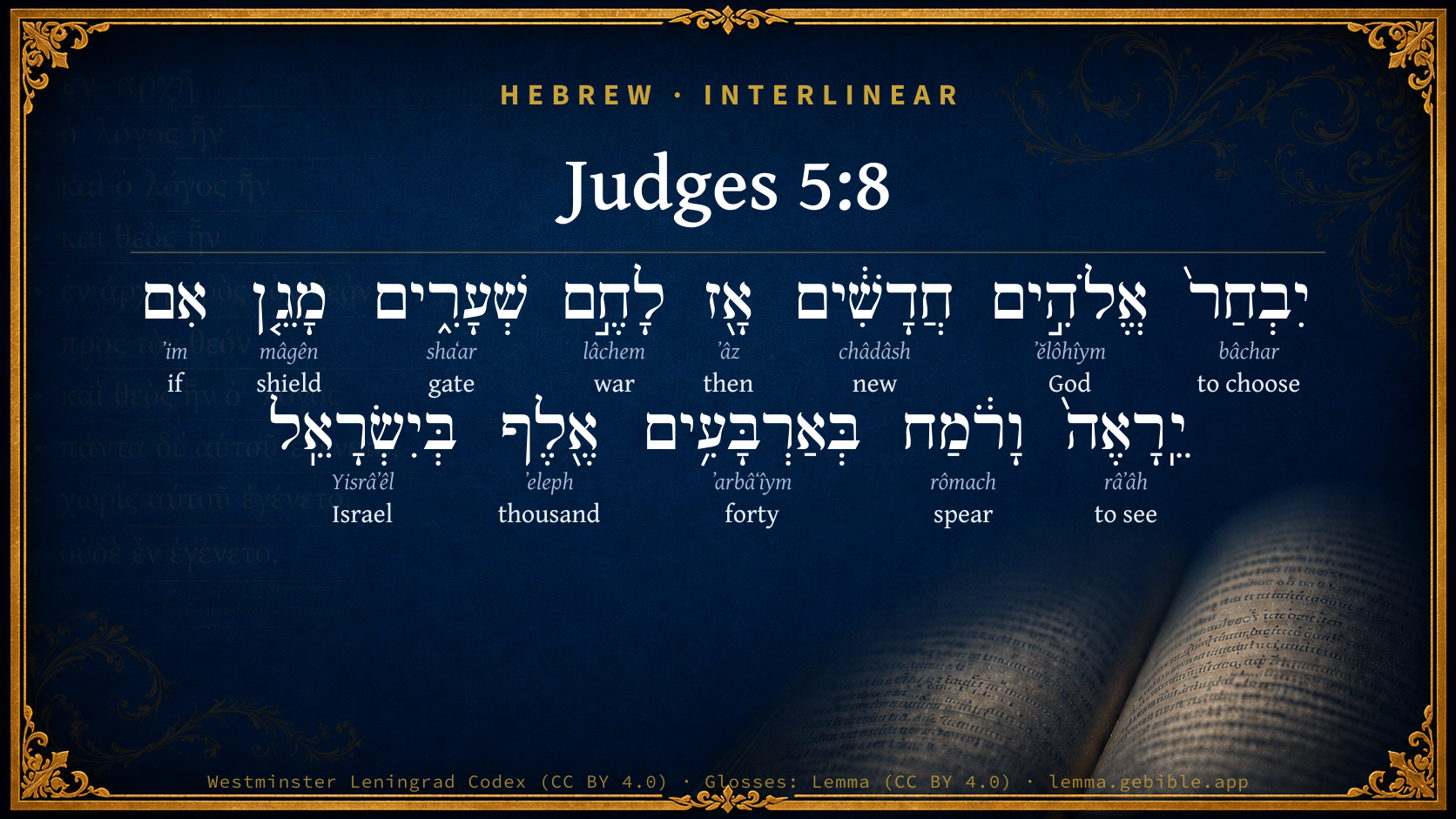
Hebrew (Westminster Leningrad Codex) Judges 5:8 appears in the Hebrew Old Testament. The text above is from the Westminster Leningrad Codex. Each word links to its Strong’s number, a concise gloss, and parsing drawn from the Open Scriptures Hebrew Bible morphology. Click any word for its full Brown-Driver-Briggs (BDB) entry.
Download image
Cite this verse

Judges 5:8 (World English Bible). Public Domain. Lemma interlinear Bible study tool, https://lemma.gebible.app/v/judges/5/8.

Show BibTeX & RIS
BibTeX
RIS
English Translation
They chose new gods; Then was war in the gates: Was there a shield or spear seen Among forty thousand in Israel?
World English Bible · Public Domain
Highlights
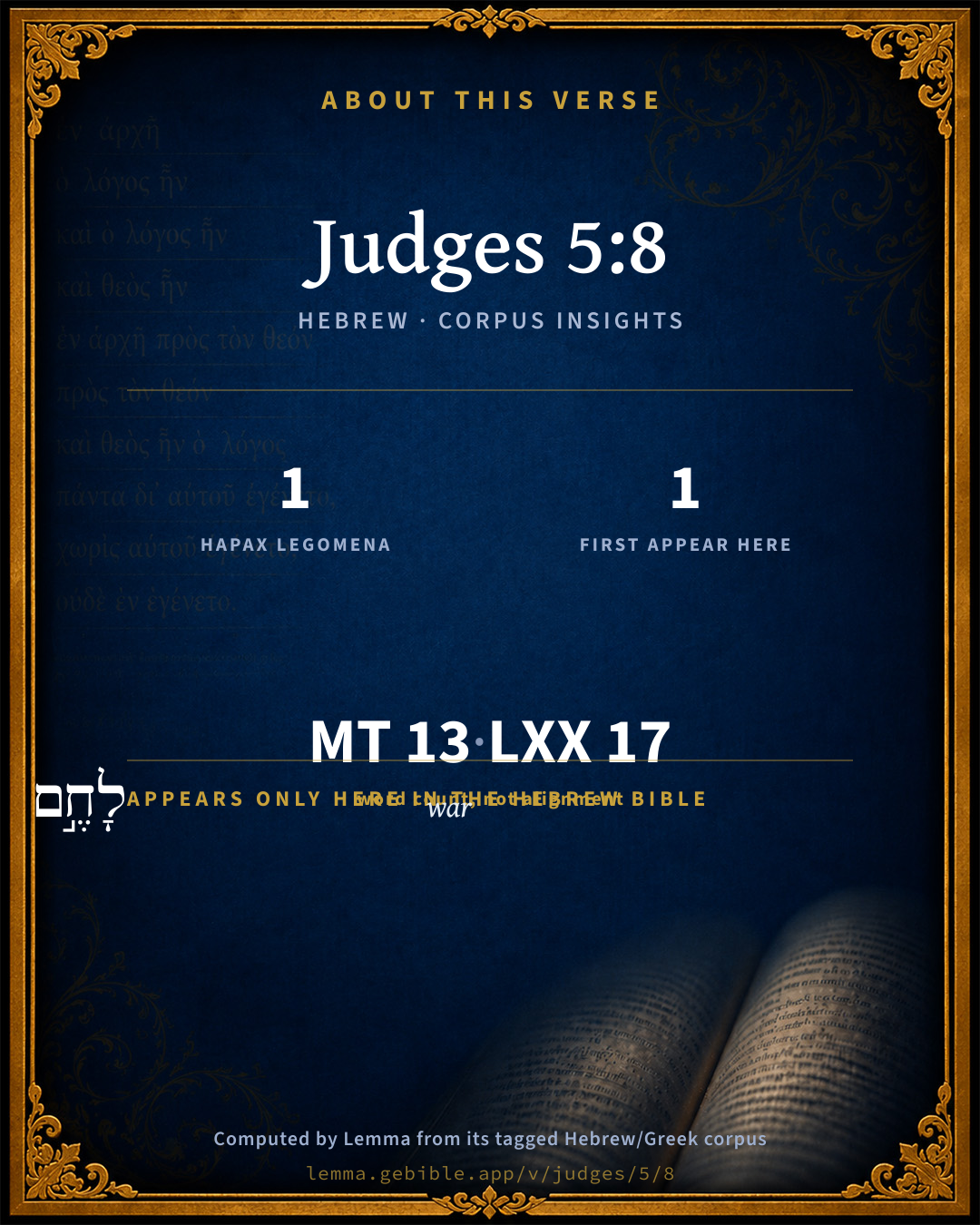
  • 1 hapax legomenon — only here in the Hebrew Bible
  • 1 first appearance in the Hebrew Bible
Full analysis ↓
Download a study sheet

One document with this verse’s original text, its word-by-word gloss line, the meaning frame, cross-references with their text, attributed commentary, and full source and license credits — printable, and it pastes into notes with its structure intact.

This verse Autodidact and up

Study sheet (.html) Plain text (.txt)

A passage Seminary Student

Up to 50 verses in one chapter. A passage sheet keeps up to 6 commentary sources and 12 cross-references per verse, in the order this page ranks them, and says so on the sheet whenever that leaves anything out. Ask for a single verse and you get the Autodidact verse sheet above.

Everything on this page stays free to read, with no account — the sheet is a download of what is already on screen, not access to it.

Want to remove ads? Support Godless Engineer
Compare translations 3

The same verse in 3 English versions, stacked beneath the original-language interlinear above. Click any original word for its lexicon entry.

Each is an independent rendering of the whole verse — the interlinear is not word-aligned to these translations.

Highlighted words mark where these versions differ — a whole-verse word diff, not a word-by-word alignment.

  • World English Bible Public Domain
    They chose new gods; Then was war in the gates: Was there a shield or spear seen Among forty thousand in Israel?
  • King James Version Public Domain
    They chose new gods; then was war in the gates: was there a shield or spear seen among forty thousand in Israel?
  • unfoldingWord Literal Text CC BY-SA 4.0
    He chose new gods, then fighting the gates; was a shield seen, or a spear, among 40,000 in Israel?

unfoldingWord Literal Text — © unfoldingWord, licensed CC BY-SA 4.0. Word-aligned USFM3 via Door43 (git.door43.org/unfoldingWord/en_ult).

Versions to compare (up to 4)

3 of 4 selected

Show all 18 translations

Every available English version of this verse, each an independent rendering of the whole verse.

  • World English Bible Public Domain
    They chose new gods; Then was war in the gates: Was there a shield or spear seen Among forty thousand in Israel?
  • Berean Standard Bible Public Domain
    When they chose new gods, then war came to their gates. Not a shield or spear was found among forty thousand in Israel.
  • Majority Standard Bible Public Domain
    When they chose new gods, then war came to their gates. Not a shield or spear was found among forty thousand in Israel.
  • King James Version Public Domain
    They chose new gods; then was war in the gates: was there a shield or spear seen among forty thousand in Israel?
  • American Standard Version (1901) Public Domain
    They chose new gods; Then was war in the gates: Was there a shield or spear seen Among forty thousand in Israel?
  • Revised Version (1885) Public Domain
    They chose new gods; then was war in the gates: was there a shield or spear seen among forty thousand in Israel?
  • Geneva Bible (1599) Public Domain
    They chose new gods: then was warre in the gates. Was there a shielde or speare seene among fourtie thousand of Israel?
  • Douay-Rheims (1899) Public Domain
    The Lord chose new wars, and he himself overthrew the gates of the enemies: a shield and spear was not seen among forty thousand of Israel.
  • Young's Literal Translation Public Domain
    He chooseth new gods, Then war `is' at the gates! A shield is not seen -- and a spear Among forty thousand in Israel.
  • Literal Standard Version CC BY-SA 4.0
    He chooses new gods, || Then war [is] at the gates! A shield is not seen—and a spear || Among forty thousand in Israel.
  • Unlocked Literal Bible CC BY-SA 4.0
    When they chose new gods, there was fighting at the city gates and yet there were no shields or spears seen among forty thousand in Israel.
  • unfoldingWord Literal Text CC BY-SA 4.0
    He chose new gods, then fighting the gates; was a shield seen, or a spear, among 40,000 in Israel?
  • Darby Bible Public Domain
    When new gods were chosen, then war was in the gates. Was shield or spear to be seen among forty thousand in Israel?
  • World Messianic Bible Public Domain
    They chose new gods. Then war was in the gates. Was there a shield or spear seen among forty thousand in Israel?
  • Webster's Bible Public Domain
    They chose new gods; then was war in the gates: was there a shield or spear seen among forty thousand in Israel?
  • Free Bible Version CC BY-SA 4.0
    When the people chose new gods, then war arrived at their gates. Not even a shield or spear could be found among forty thousand warriors in Israel.
  • Bible in Basic English Public Domain
    They had no one to make arms, there were no more armed men in the towns; was there a body-cover or a spear to be seen among forty thousand in Israel?
  • JPS Tanakh (1917) Public Domain
    They chose new gods; then was war in the gates; was there a shield or spear seen among forty thousand in Israel?

Literal Standard Version (2020), Covenant Press — licensed CC BY-SA 4.0. Text via the HelloAO Bible API (eBible.org). Unlocked Literal Bible (unfoldingWord) — licensed CC BY-SA 4.0. Text via the HelloAO Bible API (eBible.org). unfoldingWord Literal Text — © unfoldingWord, licensed CC BY-SA 4.0. Word-aligned USFM3 via Door43 (git.door43.org/unfoldingWord/en_ult). Free Bible Version, Dr. Jonathan Gallagher — licensed CC BY-SA 4.0. Text via the HelloAO Bible API (eBible.org).

Word by word

More ways to search: Search by grammar → Find every occurrence → Compare this word →

Practice this passage: Drill this verse → Learn its vocabulary →

לָחֶ֣ם
lâchem
H3901
“war”
Noun, Common, Masculine, Singular, Absolute
Part of Speech
Noun
Type
Common
Gender
Masculine
Number
Singular
State
Absolute
Full BDB Definition

Origin: from H3898

TWOT: 1104a

war - meaning uncertain
  1. יִבְחַר֙ bâchar H977 “to choose” Verb, Qal, Imperfect, 3rd Person, Masculine, Singular
  2. אֱלֹהִ֣ים ʼĕlôhîym H430 “God(s)” Noun, Common, Masculine, Plural, Absolute
  3. חֲדָשִׁ֔ים châdâsh H2319 “new” Adjective, Adjective, Masculine, Plural, Absolute
  4. אָ֖ז ʼâz H227 “then” Adverb
  5. שְׁעָרִ֑ים shaʻar H8179 “gates” Noun, Common, Masculine, Plural, Absolute
  6. מָגֵ֤ן mâgên H4043 “shield” Noun, Common, Both, Singular, Absolute
  7. אִם ʼim H518 “if” Conjunction
  8. יֵֽרָאֶה֙ râʼâh H7200 “to see” Verb, Niphal, Imperfect, 3rd Person, Masculine, Singular
  9. וָרֹ֔מַח rômach H7420 “and · spear” Conjunction + Noun, Common, Masculine, Singular, Absolute
  10. בְּאַרְבָּעִ֥ים ʼarbâʻîym H705 “in/at · forty” Preposition + Adjective, Cardinal number, Both, Plural, Absolute
  11. אֶ֖לֶף ʼeleph H505 “thousand” Adjective, Cardinal number, Both, Singular, Absolute
  12. בְּיִשְׂרָאֵֽל Yisrâʼêl H3478 “in/at · Israel” Preposition + Noun, Proper

About this verse

These counts appear in no published source. They are computed here, from the morphology-tagged text and Lemma’s own curated glosses. What Lemma adds →

13
words
13
distinct lemmas
Historical
section

Notable vocabulary

1 hapax legomenon — a word that appears only here in the entire Hebrew Bible:

First appearance in Scripture

This word makes its first canonical appearance in the Hebrew Bible here:

Shared distinctive vocabulary

וָרֹ֔מַח spear H7420 occurs in 15 verses of the Hebrew Bible. Also found in:

Grammatical profile

  • 2 verbs
  • 6 nouns
  • 3 adjectives
  • 1 conjunction
  • 1 adverb

Verb forms

  • יִבְחַר֙ Qal · Imperfect
  • יֵֽרָאֶה֙ Niphal · Imperfect

Hebrew & Septuagint length

In English translation the verse runs 22 words from the Hebrew and 23 from the Septuagint (LXX English) — closely comparable.

A rough comparison of the two English renderings, which tokenize alike — not a word-level alignment.

Word counts can differ between the Hebrew and the Greek without any difference in meaning — e.g. the Hebrew direct-object marker אֵת has no separate Greek word, and Greek often adds the article ὁ.

In the original languages it is 13 Hebrew tokens and 17 Greek tokens — but the two are counted differently (Hebrew bundles its prefixes and suffixes into one token; the Greek is in lemma form), so that isn’t a like-for-like length.

Cross-references

5

Topical passages linked to Judges 5:8 in the Treasury of Scripture Knowledge — connected by theme and wording, ordered by reader-vote popularity; previews shown in the World English Bible.

  • Deuteronomy 32:16–17 They moved him to jealousy with strange [gods]; With abominations provoked they him to anger.
  • Judges 2:12 and they forsook Yahweh, the God of their fathers, who brought them out of the land of Egypt, and followed other gods, of the gods of the peoples who were round about them, and bowed themselves down to them: and they provoked Yahweh to anger.
  • Judges 2:17 Yet they didn't listen to their judges; for they played the prostitute after other gods, and bowed themselves down to them: they turned aside quickly out of the way in which their fathers walked, obeying the commandments of Yahweh; [but] they didn't do so.
  • Judges 4:3 The children of Israel cried to Yahweh: for he had nine hundred chariots of iron; and twenty years he mightily oppressed the children of Israel.
  • 1 Samuel 13:19–22 Now there was no smith found throughout all the land of Israel; for the Philistines said, Lest the Hebrews make them swords or spears:

Cross-references courtesy of OpenBible.info (CC BY 4.0).

Hebrew and Greek witnesses Masoretic Hebrew ↔ Greek Septuagint

The same verse in the two great witnesses to the Old Testament, shown verse-for-verse.

These are two independent witnesses, not word-aligned to each other, and the Septuagint is shown in lemma (dictionary) form.

Hebrew Judges 5:8 Masoretic · Westminster Leningrad Codex

יִבְחַר֙ אֱלֹהִ֣ים חֲדָשִׁ֔ים אָ֖ז לָחֶ֣ם שְׁעָרִ֑ים מָגֵ֤ן אִם יֵֽרָאֶה֙ וָרֹ֔מַח בְּאַרְבָּעִ֥ים אֶ֖לֶף בְּיִשְׂרָאֵֽל

They chose new gods; Then was war in the gates: Was there a shield or spear seen Among forty thousand in Israel?

World English Bible · Public Domain

Greek LXX Judges 5:8 Septuagint · lemma form

ἐκλέγω θεός καινός τότε πολεμέω πόλις ἄρχων θυρεός ἐάν ὁράω καί λόγχη ἐν τεσσαράκοντα χιλιάς ἐν ἰσραήλ

They chose new gods; then the cities of rulers fought; there was not a shield or spear seen among forty thousand in Israel.

LXX2012 (modern English Septuagint) · Public Domain

On this verse, Ellicott's Commentary for English Readers discusses the Septuagint’s reading. Read the note in Commentary ↓

Hebrew: Westminster Leningrad Codex (CC BY 4.0). Greek: Septuagint (public domain); English from LXX2012 (modern English Septuagint) (Public Domain). How the Septuagint differs from the Hebrew →

Targum (Aramaic paraphrase)

1

The Targum is the ancient Jewish Aramaic paraphrase of the Hebrew Scriptures — an interpretive translation, not the Hebrew text itself. Onkelos (literal) and Pseudo-Jonathan (expansive) render the Torah, and Jonathan the Prophets. Coverage is partial: where no permissively-licensed English translation exists for a verse, only the Aramaic is shown. This is verse-level text, not a word-by-word alignment to the Hebrew.

  1. Targum Jonathan Prophets (Joshua–Malachi)
    כַּד אִתְרְעִיאוּ בְנֵי יִשְׂרָאֵל לְמִפְלַח לְטַעֲוָתָא חֲדַתָּן דְמִקָרֵב אִתְעֲבִידָא דְלָא אִיתְעַסְקוּ בְהוֹן אֲבָהַתְהוֹן אֲתוּ עֲלֵיהוֹן עַמְמַיָא וּטְרָדוּנוּן מִקִרְוֵיהוֹן וְכַד תָּבוּ לְמֶעְבַּד אוֹרַיְתָא לָא יְכִילוּ לְהוֹן עַד דְאִתְגַבְּרוּ וּסְלִיק עֲלֵיהוֹן סִיסְרָא סַנְאָה וּמְעִיקָא בְּאַרְבְּעִין אַלְפִין רֵישֵׁי מַשִׁרְיָן בְּחַמְשִׁין אַלְפִין אַחֲדֵי סַיְפִין בְּשִׁתִּין אַלְפִין אַחֲדֵי רוֹמְחִין בְּשִׁבְעִין אַלְפִין אַחֲדֵי תְּרֵיסִין בִּתְמָנָן אַלְפִין מְחַצְצֵי גִירַיָא בַּר מִתְּשַׁע מְאָה רְתִיכִין דְבַרְזְלָא דַהֲווֹ עִמֵיהּ וּרְתִיכוֹהִי כָּל אִלֵין אַלְפַּיָא וְכָל אִלֵין מַשִׁרְיָתָא לָא יָכִילוּ לְמֵיקַם קֳדָם בָרָק וְקָדָם עַשְׂרָא אַלְפִין גַבְרָא דְעִמֵיהּ:

    (no public-domain English translation for this verse)

    Targum Jonathan — Aramaic: “Mikraot Gedolot” (public domain). English: “Sefaria Community Translation” (CC0 1.0 (public-domain dedication)); “London "Chaldee Paraphrase," 1871” (public domain). Text via Sefaria.

Commentary

Notes on Judges 5:8 from classic Christian and Jewish commentators (each source and its license shown beneath its notes). The classic Christian expositions comment on the surrounding passage and are grouped to its opening verse, so a note may address several verses; the Jewish commentaries on the Tanakh (Rashi and others) are per-verse, so they appear only where the commentator wrote on this verse.

Lemma curates 59 commentaries, every one of them public domain or Creative Commons licensed, each selected and text-cleaned for this edition rather than reprinted as found. About our sources →

Trapp's Complete Commentary

John Trapp

Jdg 5:8 They chose new gods; then [was] war in the gates: was there a shield or spear seen among forty thousand in Israel?

Ver. 8. They chose new gods.] τα καινα κενα: Nihil mihi antiquius, id est potius: We should set a jealous eye upon novelties, and say, The old is better. Idolatry is ancient, but not in comparison of God’s true worship. The serpent’s grammar first taught men to decline God plurally, Eritis sicut Dii, ye shall be as gods, saith Damianus.

Then was war in the gates.] Hannibal ad portas; the enemy came up to their very gates, disarming and disabling them for their own defence. Rome, since it became Antichristian, was never besieged, but it was taken. Idolatry is a land desolating sin.

John Trapp, A Commentary or Exposition upon All the Books of the Old and New Testament (1647–1656) — public domain. Text from a community e-Sword module.

Joseph Benson's Commentary

Jdg 5:8. They chose, &c. — That is, the Israelites, after the death of Ehud, forsook the Lord, and served other gods. And they did not only submit to idolatry when they were forced to it by tyrants, but they freely chose it. New gods — New to them, and unknown to their fathers, and new in comparison of the true and everlasting God of Israel, being but of yesterday. There was war in the gates — That is, in their walled cities, which have gates and bars; gates are often put for cities; then their strong holds fell into the hands of their enemies. Was there a shield? &c. — There was not. The meaning is not, that all the Israelites were without arms; but, either they had but few arms among them, being many thousands of them disarmed by the Canaanites and Philistines, or that they generally neglected the use of arms, as being without all hope of recovering their liberty.

Joseph Benson's Commentary on the Old and New Testaments (1811–1818) — public domain. Text from a community e-Sword module.

Keil & Delitzsch

C. F. Keil & F. Delitzsch

Jdg 5:8 describes the cause of the misery into which Israel had fallen. חדשׁים אלהים is the object to יבחר, and the subject is to be found in the previous term Israel. Israel forsook its God and creator, and chose new gods, i.e., gods not worshipped by its fathers (vid., Deu 32:17). Then there was war (לחם, the construct state of לחם, a verbal noun formed from the Piel, and signifying conflict or war) at the gates; i.e., the enemy pressed up to the very gates of the Israelitish towns, and besieged them, and there was not seen a shield or spear among forty thousand in Israel, i.e., there were no warriors found in Israel who ventured to defend the land against the foe. אם indicates a question with a negative reply assumed, as in Kg1 1:27, etc. Shield and spear (or lance) are mentioned particularly as arms of offence and defence, to signify arms of all kinds. The words are not to be explained from Sa1 13:22, as signifying that there were no longer any weapons to be found among the Israelites, because the enemy had taken them away ("not seen" is not equivalent to "not found" in Sa1 13:22); they simply affirm that there were no longer any weapons to be seen, because not one of the 40,000 men in Israel took a weapon in his hand. The number 40,000 is not the number of the men who offered themselves willingly for battle, according to Jdg 5:2 (Bertheau); for apart from the fact that they did not go unarmed into the battle, it is at variance with the statement in Jdg 4:6, Jdg 4:10, that Barak went into the war and smote the enemy with only 10,000 men. It is a round number, i.e., an approximative statement of the number of the warriors who might have smitten the enemy and delivered Israel from bondage, and was probably chosen with a reference to the 40,000 fighting men of the tribes on the east of the Jordan, who went with Joshua to Canaan and helped their brethren to conquer the land (Jos 4:13). Most of the more recent expositors have given a different rendering of Jdg 5:8. Many of them render the first clause according to the Peshito and Vulgate, "God chose something new," taking Elohim as the subject, and chadashim (new) as the object. But to this it has very properly been objected, that, according to the terms of the song, it was not Elohim but Jehovah who effected the deliverance of Israel, and that the Hebrew for new things is not חדשׁים, but חדשׁות (Isa 42:9; Isa 48:6), or חדשׁה (Isa 43:19; Jer 31:22). On these grounds Ewald and Bertheau render Elohim "judges" (they chose new judges), and appeal to Exo 21:6; Exo 22:7-8, where the authorities who administered justice in the name of God are called Elohim. But these passages are not sufficient by themselves to establish the meaning "judges," and still less to establish the rendering "new judges" for Elohim chadashim. Moreover, according to both these explanations, the next clause must be understood as relating to the specially courageous conflict which the Israelites in their enthusiasm carried on with Sisera; whereas the further statement, that among 40,000 warriors who offered themselves willingly for battle there was not a shield or a lance to be seen, is irreconcilably at variance with this. For the explanation suggested, namely, that these warriors did not possess the ordinary weapons for a well-conducted engagement, but had nothing but bows and swords, or instead of weapons of any kind had only the staffs and tools of shepherds and husbandmen, is proved to be untenable by the simple fact that there is nothing at all to indicate any contrast between ordinary and extraordinary weapons, and that such a contrast is altogether foreign to the context. Moreover, the fact appealed to, that אז points to a victorious conflict in Jdg 5:13, Jdg 5:19, Jdg 5:22, as well as in Jdg 5:11, is not strong enough to support the view in question, as אז is employed in Jdg 5:19 in connection with the battle of the kings of Canaan, which was not a successful one, but terminated in a defeat.

The singer now turns from the contemplation of the deep degradation of Israel to the glorious change which took place as soon as she appeared: -

Keil & Delitzsch — Biblical Commentary on the Old Testament (1861–1891) — public domain (CC PDM 1.0). Text via the HelloAO Bible API. (Old Testament only.)

Geneva Bible (1599)

Geneva Bible translators

They had no heart to resist their enemies.

Geneva Bible (1599) marginal notes — public domain. Text via Bolls.life.

Adam Clarke's Commentary

Verse 8. They chose new gods] This was the cause of all their calamities; they forsook Jehovah, and served other gods; and then was war in their gates-they were hemmed up in every place, and besieged in all their fortified cities; and they were defenseless, they had no means of resisting their adversaries; for even among forty thousand men, there was neither spear nor shield to be seen.

The Vulgate gives a strange and curious turn to this verse: Nova bella elegit Dominus, et portas hostium ipse subvertit; "The Lord chose a new species of war, and himself subverted the gates of the enemy." Now, what was this new species of war? A woman signifies her orders to Barak; he takes 10,000 men, wholly unarmed, and retires to Mount Tabor, where they are immediately besieged by a powerful and well-appointed army. On a sudden Barak and his men rush upon them, terror and dismay are spread through the whole Cannanitish army, and the rout is instantaneous and complete. The Israelites immediately arm themselves with the arms of their enemies, and slay all before them; they run, and are pursued in all directions. Sisera, their general, is no longer safe in his chariot; either his horses fail, or the unevenness of the road obliges him to desert it, and fly away on foot; in the end, the whole army is destroyed, and the leader ingloriously slain. This was a new species of war, and was most evidently the Lord's doings. Whatever may be said of the version of the Vulgate, (and the Syriac and Arabic are something like it,) the above are all facts, and show the wondrous working of the Lord.

Adam Clarke's Commentary on the Bible (1810–1826) — public domain. Text from a community e-Sword/MySword module.

Ellicott's Commentary for English Readers

(8) They chose new gods.—The Chaldee and the LXX. agree in this interpretation, which is strongly supported by Deu_32:16-17. The Syriac and Vulgate render it “God chose new things,” or “wars” (nova bella elegit Dominus, Vulg.); but this gives a poorer sense, and is open to the objection that Jehovah, not Elohim, is used throughout the rest of the song. It alludes to the idolatry (Jer_2:11) which brought the retribution described in the next clause. Ewald and his pupil, Bertheau, render “gods” (Elohim) by “judges;” but this is very doubtful, though the word has that meaning in Exo_21:6; Exo_22:7-8.

Then was war in the gates.—The Canaanites drove the Israelites from the city gates, where judgments were given, and expelled them from their towns; so the Targum explains it to mean, “the storming of gates,” and so too Rabbi Tanchum. One MS. of the LXX. and the Syriac and Arabic versions have the strange rendering, “they chose new gods like barley bread,” which Theodoret explains to mean, “as though after eating wheaten bread, men would voluntarily descend to coarse barley bread”; but this is only due to an inferior reading.

Was there a shield or spear.—This is usually, and not unnaturally, explained to mean that there had been a general disarmament (comp. Jdg_3:31; 1Sa_13:19); we must then assume that the Israelites had only bows, slings, and swords. But (1) there is no indication whatever (but rather the reverse, Jdg_4:15) that Barak’s army—which, moreover, consisted of 10,000, not 40,000—was unarmed; and (2) the context seems to favour the meaning that, in spite of these degradations, there was not a warrior in all Israel who dared to put on his armour.

Among forty thousand.—Even if the number is meant as a round or general number, it is remarkable. It is true that though Barak only had 10,000 men with him, the contingents of Ephraim, Benjamin, and Manasseh are not counted; but even then the number shows that Israel was weakened and disunited, for the Transjordanic tribes alone had sent 40,000 men to help Joshua in the conquest of Canaan (Jos_4:13).

A Bible Commentary for English Readers, edited by Charles John Ellicott (1878–1897) — public domain. Text from a community e-Sword module.

The Cambridge Bible for Schools and Colleges

gen. ed. J. J. S. Perowne

8. It is still the period of the oppression, though Jdg_5:7 has for a moment anticipated matters by alluding to the ‘rise’ of Deborah. The first half of the verse yields no certain meaning. They chose new gods, lit. it (Israel) chooses etc., implies that Israel had been guilty of apostasy, and so was punished by an invasion; this is an idea quite foreign to the poem. Of the other renderings, God chose new things, nova bella elegit Dominus, Vulgate, is ungrammatical in Hebr. and open to the objection that Jehovah, not Elohim, is the Name in the poem; he chooses new judges (Ewald) is based upon an erroneous interpretation of Elohim in Exo_21:6 etc. There was war in the gates seems to point to some occasion (then) in the unsettled times before Deborah; in Jdg_5:11 the gates are those of the enemy; but the word for war is wholly anomalous. Disregarding the vowels, the consonants might be translated then there was barley bread, similarly LXX. A, Lucian; but no good sense can be extracted from this. The corruption is too deep-seated for emendation; probably an early attempt was made to correct the passage from Deu_32:17.

Was there a shield or spear seen] When the war broke out the able-bodied men in Israel had no proper weapons with which to meet the well-armed Canaanites; they were compelled to use such rude implements as they could find. 40,000 is a round number, not to be pressed; contrast the 301,000 men above twenty assigned in Numbers 26 (P) to the six tribes who here take part in the war.

The Cambridge Bible for Schools and Colleges (gen. ed. J. J. S. Perowne; Cambridge University Press, 1878–1918) — public domain. Text from a community e-Sword module.

John Gill's Exposition

They chose new gods,.... That is, Israel, as most of the Jewish commentators interpret it; for the verb is singular, and Israel agrees well with it: this they did after the death of Joshua; it refers to their first idolatry, begun by Micah, Jdg 17:1 they chose other gods than the true God; Baalim and Ashtaroth they are said to serve, Jdg 2:11, and besides the gods of the Canaanites and Phoenicians, they sought after and introduced new ones from other places, or the same may be meant; since all besides the true God, the eternal Jehovah, the Ancient of days, and everlasting King, are new gods that lately sprung up: the Arabic and Syriac versions are,"God chose a new king;''so Ben Gersom; to perfect this wonder; for not only Sisera and his army were drawn to the gates of Israel to a proper place to fall in, but the victory was not obtained by Israel by their own force and strength; for they had no weapons of war, not a shield nor a spear, but for a very few men, but it was the Lord that fought for them in a new way; the former sense seems best, and agrees with what follows:

then was war in the gates; when they fell into idolatry, then God suffered the judgment of war to come upon them, even into the gates of their fortified cities, which were the security of them, and where were their courts of judicature, but by war disturbed and made to cease:

was there a shield or spear seen among forty thousand in Israel? though the number of the Israelites were several hundred thousands, yet there were not to be seen among them shields and spears sufficient for 40,000; or not one among 40,000 was armed; which was owing either to their negligence and sloth in not providing themselves with arms, or not taking care of them in a time of peace; so that when war came into their gates, they had nothing to defend themselves with, or annoy their enemies; or to their cowardice, not daring to take up a shield or spear in their own defence; or to the enemy, Jabin king of Canaan, having disarmed them, that they might not be able to make a revolt, from him, and recover their liberties. Ben Gersom refers it to the times of Joshua, when there was no need of a shield and spear among the 40,000 of the children of Reuben, Gad, and Manasseh, that came over Jordan with them, since God fought for them; and the Targum seems to understand it of Sisera's army, that came against Israel with shields, spears, and swords; and makes the number of them to be in all 300,000, which is just the number of foot soldiers Josephus makes his army to consist of; and yet, though so numerous and so well armed, could not stand before Barak with 10,000 men only; See Gill on Jdg 4:17, the words rather refer to the cival war of the Benjamites with the Israelites, when 40,000 of the latter were killed, which was before the times of Deborah, Jdg 20:21.

John Gill's Exposition of the Whole Bible (1746–1763) — public domain (CC PDM 1.0). Text via the HelloAO Bible API.

Albert Barnes' Notes on the Bible

The “war in the gates” describes the hostile attacks of the Canaanites, which were the punishment of the idolatry of the Israelites (compare the marginal references), and the reduction of Israel to an unarmed and unresisting state under the Philistine dominion. See Jdg 3:31 note.

Albert Barnes' Notes on the Bible (1834–1885) — public domain. Text from a community e-Sword/MySword module.

Haydock's Catholic Bible Commentary

Israel. What could be more astonishing and new, than this method of warfare, in which a few unarmed Israelites gain the victory over an immense army, and oblige the general, to leap from his chariot, that he may escape observation? A woman calls to battle. Hebrew is rather different, "They chose new gods:" some copies of the Septuagint have "vain gods, (Calmet) as barley bread." Others agree with the Hebrew, "Then war was in the gates." Jabin would not allow any arms in the country, and hence Samgar was forced to use the implements of husbandry. So the Philistines afterwards would not suffer the Hebrews to have a smith among them, lest they should make arms, 1 Kings xiii. 19, 22.

George Leo Haydock (1774–1849), Haydock's Catholic Family Bible and Commentary, 1859 edition — public domain. Excludes Psalms (Douay-Rheims chapter numbering differs from Protestant) and Deuterocanonical books (Catholic canon only).

Matthew Poole's English Annotations

They did not only submit to idolatry when they were forced to it by tyrants, but they freely chose new gods; new to them, and unknown to their fathers, and new in comparison of the true and everlasting God of Israel, being but upstarts, and of yesterday.

In the gates, i.e. in their walled cities, which have gates and bars; gates are oft put for cities, as Gen 22:17; Deu 17:2; Oba 1:11. Then their strongest holds fell into the hands of their enemies.

Was there, i.e. there was not; the meaning is not that all the Israelites had no arms, for here is mention made only of shields or spears; so they might have swords, and bows, and arrows to offend their enemies; but either that they had but few arms among them, being many thousands of them disarmed by the Canaanites; or that they generally neglected the use of arms, as being utterly dispirited, and without all hope of recovering their lost liberty, and being necessitated to other employments for subsistence.

Matthew Poole's English Annotations on the Holy Bible (1683–1685) — public domain. Text from a community e-Sword/MySword module.

Whedon's Commentary on the Bible

Daniel D. Whedon

8. He chose gods that were new — Israel chose new gods; that is, worshipped false gods, the idols of the heathen. See Jdg_2:12-13.

Then… war — War followed Israel’s idolatry, as a penal consequence.

Forty thousand in Israel — This is not to be taken as an exact specification of the whole number of warriors in Israel at this time, but a round number, purposely large, among whom no arms could be found; and the question is a poetical intimation of the great destitution of warlike weapons in Israel. Their oppressors had probably robbed them of their arms, (comp. 1Sa_13:19-22,) and they had become too indifferent, or too dejected, to seek for new ones.

Daniel D. Whedon (gen. ed.), Commentary on the Old and New Testaments (1874–1909) — public domain. Text from a community e-Sword module.

The Pulpit Commentary

The cause of this misery was not far to seek; it was the idolatry of the people which provoked God to anger. Then their enemies were let loose upon them, and they dared make no resistance.

The peril of national irreligion.

The conscience of Israel is here addressed. The coincidence of new idolatries with "war in the gates" was strikingly suggestive. It could not be accidental. There was nothing in which Israel had had more continued experience than in the connection of idolatry with national weakness and misery.

I DECLINE COMMENCES WITH THE FIRST DEPARTURE FROM THE WORSHIP OF JEHOVAH. It was as they trusted in Jehovah and acquainted themselves with him that they were able to drive out their enemies. The weakening of this religious principle undermined the moral character and strengthened the force of sensuous influences. It is only as the soul anchors itself on the Eternal that it is able rightly to regard the outward and temporary affairs of life.

II THE ADOPTION OF OTHER GODS IS PUNISHED AS A CULMINATING AFFRONT. In this we see not so much the indirect results of idolatrous practice as the immediate chastisement of Jehovah"s own hand. The apostasy is deliberate; punishment must be proportionately stern and extreme. Those who have known his character and will, and yet deliberately despise them, deserve the more condign punishment. We see this principle at work in many a life. There are sins which seem to invite a terrible vengeance. Do we provoke God"s anger? Let us remember that he can be a consuming fire. Deliberate rejection of God is a direct invitation and challenge to his wrath.

III THE FINAL RESULT OF IDOLATRY IS EFFEMINACY AND ABJECT HELPLESSNESS. This is proved by an appeal to history. The Israelites had an instance of it in their own experience. There may have been weapons in Israel, but the idol worshipper had lost the courage to wield them. Idolatry, as a degraded conception of God, degrades its votaries. It has ever been linked with licentiousness and vice. The conscience is gradually destroyed, and with it all moral strength disappears. M.

The Pulpit Commentary (1880–1919), ed. H.D.M. Spence-Jones & Joseph S. Exell — public domain. Text from a community e-Sword module.

John Wesley's Explanatory Notes

Chose - They did not only submit to idolatry when they were forced to it by tyrants, but they freely chose it. New gods - New to them, and unknown to their fathers, and new in comparison of the true and everlasting God of Israel, being but of yesterday. The gates - That is, in their walled cities, which have gates and bars; gates are often put for cities; then their strong holds fell into the hands of their enemies. Was there a shield - There was not, the meaning is not, that all the Israelites had no arms, but, either they had but few arms among them, being many thousands of them disarmed by the Canaanites and Philistines, or that they generally neglected the use of arms, as being without all hope of recovering their liberty.

John Wesley, Explanatory Notes Upon the Whole Bible (1754–1765) — public domain. Text via the GEBible commentary corpus.

Rashi

Rabbi Shlomo Yitzchaki (Rashi)

When they chose new gods—there was war in the cities. When the Yisroelites preferred modern Deities, then they needed to engage in battle in their cities. But, take note, now, when they volunteered, was a shield or battle ax in sight among the Yisroelites when they needed to do battle with the forty thousand field marshals the idolators flung against them? The Omnipresent overwhelmed them all with celestial warfare, and the Kishon stream swept them away.

Cities. As in, "If there should be found in your midst, in one of your cities".

Rashi on the Tanakh — English translations: “The Judaica Press complete Tanach with Rashi, translated by A. J. Rosenberg” (CC BY 4.0); “Pentateuch with Rashi's commentary by M. Rosenbaum and A.M. Silbermann, 1929-1934” (public domain); “The Metsudah Tanach series, Lakewood, N.J” (CC BY 4.0); and “The Book of Joshua, Metsudah Publications, 1997” (CC BY 4.0). Text via Sefaria.

Radak

Rabbi David Kimhi (Radak)

They chose When Israel chooses new gods, then war comes to their gates and they are not able to show a shield or a spear to fight with their enemies. And even though the Israelites were very numerous - forty thousand and more, and that is the total of the count - nevertheless, they would flee from before their enemies and seal themselves up in their cities, and their enemies would pursue them until the gates. But some explain, "no shield was seen," as positive. Meaning, when Israel would do the will of the Creator, may He be exalted, and did not follow other gods - and that was in the days of Yehoshua - they did not need a shield nor a spear for the forty thousand Children of Gad and Children of Reuven. And even though they were the army's vanguard, they did not need to show a shield nor a spear, since the Lord fought for them. So they went [to war] with their brothers, and returned in peace. There was no adversary and no bad incident, since they were doing the will of the Creator. And Yonatan translated (in the Targum), "When they became evil, etc." And the word, lachem, is unusual in its vocalization, as it is vocalized with a segol for the [letter], chet. And it is a noun, like war. And it is in the form of [the words,] chametz, akev, chatzer; except that this is with a segol, which is not customary.

Radak on the Tanakh — English translations: “Sefaria Community Translation” (CC0 1.0 (public-domain dedication)); “Eliyahu Munk, HaChut Hameshulash” (CC BY 4.0); “Rabbi Mike Feuer, Jerusalem Anthology” (CC BY 4.0); and “R. David Kimhi on the first book of Psalms, Translated by R.G. Finch, London, 1919” (public domain). Text via Sefaria.

Lesson kit

Teaching starters — assembled from the data on this page, not authored interpretation. Every prompt links to the verse data it draws on. Edit before teaching.

Judges, in the Historical, opens this verse with 13 words (13 distinct Hebrew lemmas). Its most distinctive word is lâchem (“war”). A historical commentator’s framing appears above. Read the whole chapter for the surrounding context.

Discussion questions

  1. What does “war” (lâchem) contribute to the verse as a whole?
  2. 1 word here appears nowhere else in the Hebrew Bible. Why might the author reach for such rare wording?
  3. This is the first place “war” appears in Scripture (first appears here). What does its debut here establish?
  4. How does Numbers 25:7, which shares the word «spear», read alongside this verse?
  5. The translations on this page render this verse differently — a whole-verse word diff, not a word-by-word alignment. What might account for the different wordings?
  6. «יִבְחַר֙» is a Qal Imperfect verb. How does that grammatical form shape the action described?
  7. Compare how Trapp's Complete Commentary and Joseph Benson's Commentary read this verse. Where do they agree or differ?

Things to notice

Reading settings

Reading text

Shown beneath each verse's original-language words.

Old Testament
Old Testament edition

Read the OT as the Masoretic Hebrew (MT) or the Greek Septuagint (LXX).

English shown for the Greek Septuagint (in the Hebrew ↔ Greek comparison).

Comparing translations? Open the Compare panel on any verse page to stack up to four side by side.