
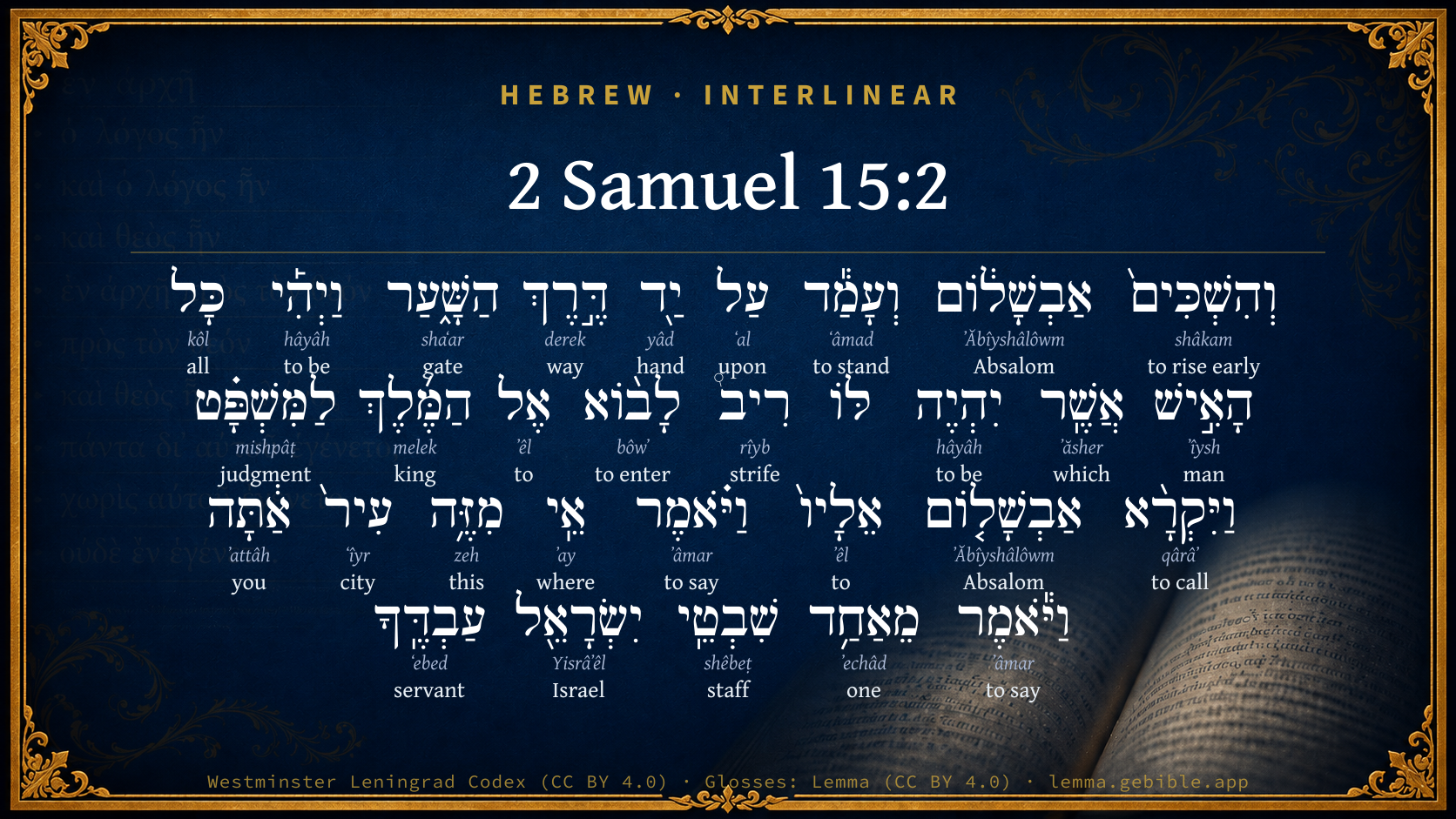
2 Samuel 15:2

Hebrew (Westminster Leningrad Codex) 2 Samuel 15:2 appears in the Hebrew Old Testament. The text above is from the Westminster Leningrad Codex. Each word links to its Strong’s number, a concise gloss, and parsing drawn from the Open Scriptures Hebrew Bible morphology. Click any word for its full Brown-Driver-Briggs (BDB) entry.
Download image
Cite this verse

2 Samuel 15:2 (World English Bible). Public Domain. Lemma interlinear Bible study tool, https://lemma.gebible.app/v/2-samuel/15/2.

Show BibTeX & RIS
BibTeX
RIS
English Translation
Absalom rose up early, and stood beside the way of the gate: and it was so, that when any man had a suit which should come to the king for judgment, then Absalom called to him, and said, Of what city are you? He said, Your servant is of one of the tribes of Israel.
World English Bible · Public Domain
Download a study sheet

One document with this verse’s original text, its word-by-word gloss line, the meaning frame, cross-references with their text, attributed commentary, and full source and license credits — printable, and it pastes into notes with its structure intact.

This verse Autodidact and up

Study sheet (.html) Plain text (.txt)

A passage Seminary Student

Up to 50 verses in one chapter. A passage sheet keeps up to 6 commentary sources and 12 cross-references per verse, in the order this page ranks them, and says so on the sheet whenever that leaves anything out. Ask for a single verse and you get the Autodidact verse sheet above.

Everything on this page stays free to read, with no account — the sheet is a download of what is already on screen, not access to it.

Want to remove ads? Support Godless Engineer
Compare translations 3

The same verse in 3 English versions, stacked beneath the original-language interlinear above. Click any original word for its lexicon entry.

Each is an independent rendering of the whole verse — the interlinear is not word-aligned to these translations.

Highlighted words mark where these versions differ — a whole-verse word diff, not a word-by-word alignment.

  • World English Bible Public Domain
    Absalom rose up early, and stood beside the way of the gate: and it was so, that when any man had a suit which should come to the king for judgment, then Absalom called to him, and said, Of what city are you? He said, Your servant is of one of the tribes of Israel.
  • King James Version Public Domain
    And Absalom rose up early, and stood beside the way of the gate: and it was so, that when any man that had a controversy came to the king for judgment, then Absalom called unto him, and said, Of what city art thou? And he said, Thy servant is of one of the tribes of Israel.
  • unfoldingWord Literal Text CC BY-SA 4.0
    And Absalom would arise early, and he would stand at the hand of the way of the gate. And it happened, any man to whom was a dispute came to the king for judgment, then Absalom would call to him, and he would say, “Where from this city you?” And he would say, “Your servant from one of the tribes of Israel.”

unfoldingWord Literal Text — © unfoldingWord, licensed CC BY-SA 4.0. Word-aligned USFM3 via Door43 (git.door43.org/unfoldingWord/en_ult).

Versions to compare (up to 4)

3 of 4 selected

Show all 18 translations

Every available English version of this verse, each an independent rendering of the whole verse.

  • World English Bible Public Domain
    Absalom rose up early, and stood beside the way of the gate: and it was so, that when any man had a suit which should come to the king for judgment, then Absalom called to him, and said, Of what city are you? He said, Your servant is of one of the tribes of Israel.
  • Berean Standard Bible Public Domain
    He would get up early and stand beside the road leading to the city gate. Whenever anyone had a grievance to bring before the king for a decision, Absalom would call out and ask, “What city are you from?” And if he replied, “Your servant is from one of the tribes of Israel,”
  • Majority Standard Bible Public Domain
    He would get up early and stand beside the road leading to the city gate. Whenever anyone had a grievance to bring before the king for a decision, Absalom would call out and ask, “What city are you from?” And if he replied, “Your servant is from one of the tribes of Israel,”
  • King James Version Public Domain
    And Absalom rose up early, and stood beside the way of the gate: and it was so, that when any man that had a controversy came to the king for judgment, then Absalom called unto him, and said, Of what city art thou? And he said, Thy servant is of one of the tribes of Israel.
  • American Standard Version (1901) Public Domain
    And Absalom rose up early, and stood beside the way of the gate: and it was so, that, when any man had a suit which should come to the king for judgment, then Absalom called unto him, and said, Of what city art thou? And he said, Thy servant is of one of the tribes of Israel.
  • Revised Version (1885) Public Domain
    And Absalom rose up early, and stood beside the way of the gate: and it was so, that when any man had a suit which should come to the king for judgment, then Absalom called unto him, and said, Of what city art thou? And he said, Thy servant is of one of the tribes of Israel.
  • Geneva Bible (1599) Public Domain
    And Absalom rose vp early, and stoode hard by the entring in of the gate: and euery man that had any matter, and came to the King for iudgement, him did Absalom call vnto him, and sayde, Of what citie art thou? And he answered, Thy seruant is of one of the tribes of Israel.
  • Douay-Rheims (1899) Public Domain
    And Absalom rising up early stood by the entrance of the gate, and when any man had business to come to the king's judgment, Absalom called him to him, and said: Of what city art thou? He answered, and said: Thy servant is of such a tribe of Israel.
  • Young's Literal Translation Public Domain
    and Absalom hath risen early, and stood by the side of the way of the gate, and it cometh to pass, every man who hath a pleading to come unto the king for judgment, that Absalom calleth unto him, and saith, `Of what city `art' thou?' and he saith, `Of one of the tribes of Israel `is' thy servant.'
  • Literal Standard Version CC BY-SA 4.0
    and Absalom has risen early, and stood by the side of the way of the gate, and it comes to pass, every man who has a pleading to come to the king for judgment, that Absalom calls to him and says, “Of what city [are] you?” And he says, “Your servant [is] of one of the tribes of Israel.”
  • Unlocked Literal Bible CC BY-SA 4.0
    Absalom would get up early and stand beside the road leading to the city gate. When any man had a dispute to come to the king for judgment, Absalom called to him and said, “From what city have you come?” Then the man would answer, “Your servant is from one of the tribes of Israel.”
  • unfoldingWord Literal Text CC BY-SA 4.0
    And Absalom would arise early, and he would stand at the hand of the way of the gate. And it happened, any man to whom was a dispute came to the king for judgment, then Absalom would call to him, and he would say, “Where from this city you?” And he would say, “Your servant from one of the tribes of Israel.”
  • Darby Bible Public Domain
    And Absalom rose early, and stood beside the way of the gate; and it was so, that when any man who had a controversy had to come to the king for judgment, then Absalom called him, and said, Of what city art thou? And he said, Thy servant is of one of the tribes of Israel.
  • World Messianic Bible Public Domain
    Absalom rose up early, and stood beside the way of the gate. When any man had a suit which should come to the king for judgment, then Absalom called to him, and said, “What city are you from?” He said, “Your servant is of one of the tribes of Israel.”
  • Webster's Bible Public Domain
    And Absalom rose early, and stood beside the way of the gate: and it was so, that when any man that had a controversy came to the king for judgment, then Absalom called to him, and said, Of what city art thou? And he said, Thy servant is one of the tribes of Israel.
  • Free Bible Version CC BY-SA 4.0
    He used to get up early and stand by the main road that led to the city gate. When people brought a case to the king for his decision, Absalom would call out and ask them, “What town are you from?” If they replied, “Your servant is from this particular tribe of Israel,”
  • Bible in Basic English Public Domain
    And Absalom got up early, morning after morning, and took his place at the side of the public meeting-place: and when any man had a cause which had to come to the king to be judged, then Absalom, crying out to him, said, What is your town? and he would say, Your servant is of one of the tribes of Israel.
  • JPS Tanakh (1917) Public Domain
    And Absalom used to rise up early, and stand beside the way of the gate; and it was so, that when any man had a suit which should come to the king for judgment, then Absalom called unto him, and said: 'Of what city art thou?' And he said: 'Thy servant is of one of the tribes of Israel.'

Literal Standard Version (2020), Covenant Press — licensed CC BY-SA 4.0. Text via the HelloAO Bible API (eBible.org). Unlocked Literal Bible (unfoldingWord) — licensed CC BY-SA 4.0. Text via the HelloAO Bible API (eBible.org). unfoldingWord Literal Text — © unfoldingWord, licensed CC BY-SA 4.0. Word-aligned USFM3 via Door43 (git.door43.org/unfoldingWord/en_ult). Free Bible Version, Dr. Jonathan Gallagher — licensed CC BY-SA 4.0. Text via the HelloAO Bible API (eBible.org).

Word by word

More ways to search: Search by grammar → Find every occurrence → Compare this word →

Practice this passage: Drill this verse → Learn its vocabulary →

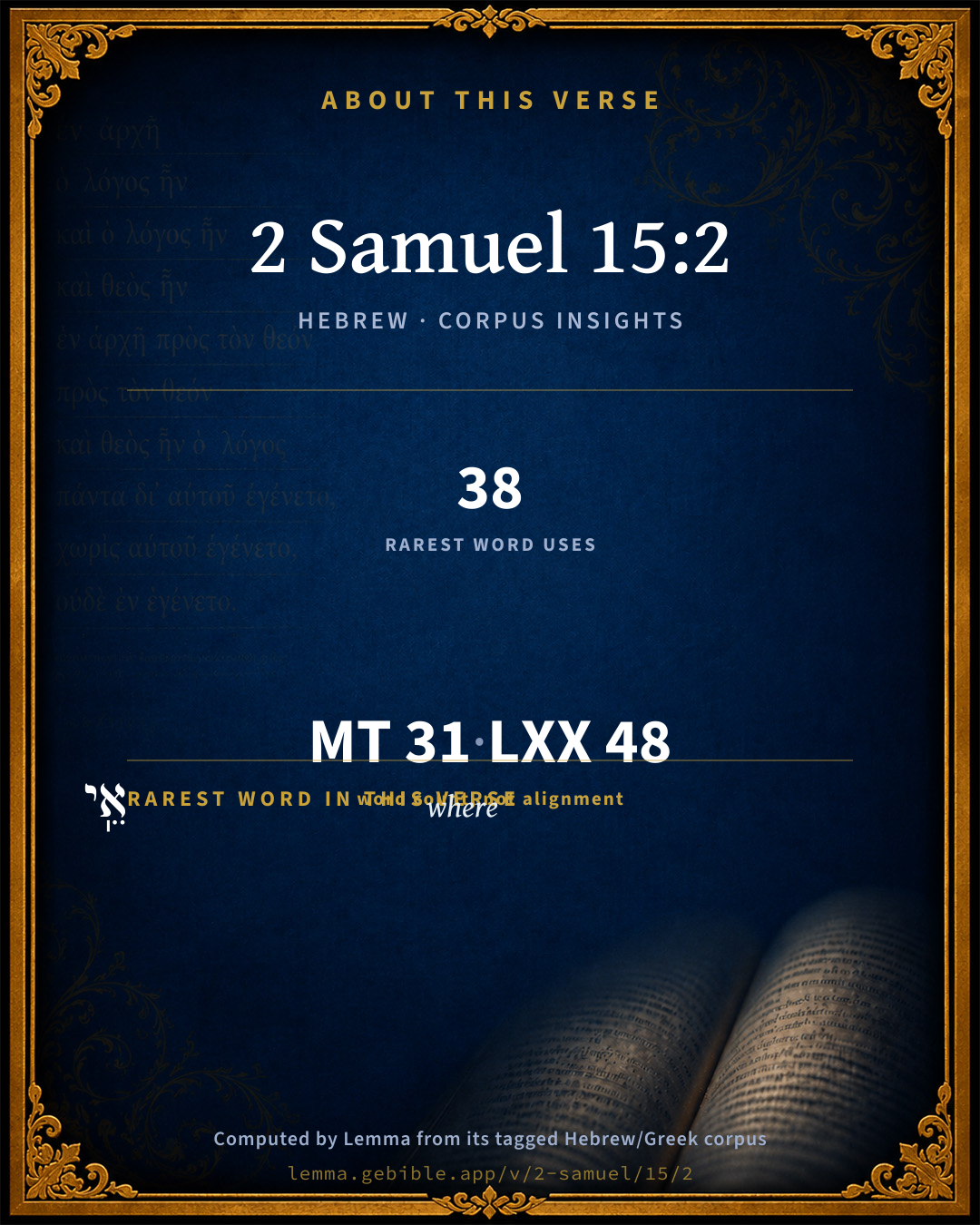
אֵֽי
ʼay
H335
“where”
Particle, Interrogative
Part of Speech
Particle
Type
Interrogative
Full BDB Definition

Origin: perhaps from H370

TWOT: 75

where?, whence? - which?, how? (in prefix with other adverb)
  1. וְהִשְׁכִּים֙ shâkam H7925 “and · to rise early” Conjunction + Verb, Hiphil, Sequential Perfect, 3rd Person, Masculine, Singular
  2. אַבְשָׁל֔וֹם ʼĂbîyshâlôwm H53 “Absalom” Noun, Proper
  3. וְעָמַ֕ד ʻâmad H5975 “and · to stand” Conjunction + Verb, Qal, Sequential Perfect, 3rd Person, Masculine, Singular
  4. עַל ʻal H5921 “upon” Preposition
  5. יַ֖ד yâd H3027 “hand of” Noun, Common, Both, Singular, Construct
  6. דֶּ֣רֶךְ derek H1870 “way of” Noun, Common, Both, Singular, Construct
  7. הַשָּׁ֑עַר shaʻar H8179 “the · gate” Particle, Definite Article + Noun, Common, Masculine, Singular, Absolute
  8. וַיְהִ֡י hâyâh H1961 “and · to be” Conjunction + Verb, Qal, Sequential Imperfect, 3rd Person, Masculine, Singular
  9. כָּל kôl H3605 “all of” Noun, Common, Masculine, Singular, Construct
  10. הָאִ֣ישׁ ʼîysh H376 “the · man” Particle, Definite Article + Noun, Common, Masculine, Singular, Absolute
  11. אֲשֶֽׁר ʼăsher H834 “which” Particle, Relative
  12. יִהְיֶה hâyâh H1961 “to be” Verb, Qal, Imperfect, 3rd Person, Masculine, Singular
  13. רִיב֩ rîyb H7379 “strife” Noun, Common, Both, Singular, Absolute
  14. לָב֨וֹא bôwʼ H935 “to enter” Preposition + Verb, Qal, Infinitive Construct
  15. אֶל ʼêl H413 “to” Preposition
  16. הַמֶּ֜לֶךְ melek H4428 “the · king” Particle, Definite Article + Noun, Common, Masculine, Singular, Absolute
  17. לַמִּשְׁפָּ֗ט mishpâṭ H4941 “to/for the · judgment” Preposition, Determined + Noun, Common, Masculine, Singular, Absolute
  18. וַיִּקְרָ֨א qârâʼ H7121 “and · to call” Conjunction + Verb, Qal, Sequential Imperfect, 3rd Person, Masculine, Singular
  19. אַבְשָׁל֤וֹם ʼĂbîyshâlôwm H53 “Absalom” Noun, Proper
  20. אֵלָיו֙ ʼêl H413 “to · him” Preposition + Suffix, Personal, 3rd Person, Masculine, Singular
  21. וַיֹּ֗אמֶר ʼâmar H559 “and · to say” Conjunction + Verb, Qal, Sequential Imperfect, 3rd Person, Masculine, Singular
  22. מִזֶּ֥ה zeh H2088 “from · this” Preposition + Pronoun, Demonstrative, Masculine, Singular
  23. עִיר֙ ʻîyr H5892 “city” Noun, Common, Feminine, Singular, Absolute
  24. אַ֔תָּה ʼattâh H859 “you” Pronoun, Personal, 2nd Person, Masculine, Singular
  25. וַיֹּ֕אמֶר ʼâmar H559 “and · to say” Conjunction + Verb, Qal, Sequential Imperfect, 3rd Person, Masculine, Singular
  26. מֵאַחַ֥ד ʼechâd H259 “from · one” Preposition + Adjective, Cardinal number, Masculine, Singular, Construct
  27. שִׁבְטֵֽי shêbeṭ H7626 “staffs of” Noun, Common, Masculine, Plural, Construct
  28. יִשְׂרָאֵ֖ל Yisrâʼêl H3478 “Israel” Noun, Proper
  29. עַבְדֶּֽךָ ʻebed H5650 “servant · your” Noun, Common, Masculine, Singular, Construct + Suffix, Personal, 2nd Person, Masculine, Singular

About this verse

These counts appear in no published source. They are computed here, from the morphology-tagged text and Lemma’s own curated glosses. What Lemma adds →

31
words
26
distinct lemmas
Historical
section

Shared distinctive vocabulary

אֵֽי where H335 occurs in 36 verses of the Hebrew Bible. Also found in:

Grammatical profile

  • 8 verbs
  • 14 nouns
  • 1 adjective
  • 2 pronouns
  • 4 prepositions
  • 2 particles

Verb forms

  • וְהִשְׁכִּים֙ Hiphil · Sequential Perfect
  • וְעָמַ֕ד Qal · Sequential Perfect
  • וַיְהִ֡י Qal · Sequential Imperfect
  • יִהְיֶה Qal · Imperfect
  • לָב֨וֹא Qal · Infinitive Construct
  • וַיִּקְרָ֨א Qal · Sequential Imperfect
  • וַיֹּ֗אמֶר Qal · Sequential Imperfect
  • וַיֹּ֕אמֶר Qal · Sequential Imperfect

Repetition

Words recur within this verse — often emphatic in Hebrew:

  • אַבְשָׁל֔וֹם Absalom H53 ×2
  • וַיְהִ֡י to be H1961 ×2
  • וַיֹּ֗אמֶר to say H559 ×2
  • אֶל to H413 ×2

Hebrew & Septuagint length

In English translation the verse runs 55 words from the Hebrew and 60 from the Septuagint (LXX English) — closely comparable.

A rough comparison of the two English renderings, which tokenize alike — not a word-level alignment.

Word counts can differ between the Hebrew and the Greek without any difference in meaning — e.g. the Hebrew direct-object marker אֵת has no separate Greek word, and Greek often adds the article ὁ.

In the original languages it is 31 Hebrew tokens and 48 Greek tokens — but the two are counted differently (Hebrew bundles its prefixes and suffixes into one token; the Greek is in lemma form), so that isn’t a like-for-like length.

Cross-references

9

Topical passages linked to 2 Samuel 15:2 in the Treasury of Scripture Knowledge — connected by theme and wording, ordered by reader-vote popularity; previews shown in the World English Bible.

  • Exodus 18:14 When Moses' father-in-law saw all that he did to the people, he said, "What is this thing that you do for the people? Why do you sit alone, and all the people stand around you from morning to evening?"
  • Exodus 18:16 When they have a matter, they come to me, and I judge between a man and his neighbor, and I make them know the statutes of God, and his laws."
  • Exodus 18:26 They judged the people at all times. They brought the hard causes to Moses, but every small matter they judged themselves.
  • Ruth 4:1 Now Boaz went up to the gate, and sat him down there: and, behold, the near kinsman of whom Boaz spoke came by; to whom he said, Ho, such a one! turn aside, sit down here. He turned aside, and sat down.
  • 2 Samuel 19:8 Then the king arose, and sat in the gate. They told to all the people, saying, Behold, the king is sitting in the gate: and all the people came before the king. Now Israel had fled every man to his tent.
  • 1 Kings 3:16–28 Then there came two women who were prostitutes, to the king, and stood before him.
  • Job 24:14 The murderer rises with the light. He kills the poor and needy. In the night he is like a thief.
  • Proverbs 4:16 For they don't sleep, unless they do evil. Their sleep is taken away, unless they make someone fall.
  • Matthew 27:1 Now when morning had come, all the chief priests and the elders of the people took counsel against Jesus to put him to death:

Cross-references courtesy of OpenBible.info (CC BY 4.0).

Hebrew and Greek witnesses Masoretic Hebrew ↔ Greek Septuagint

The same verse in the two great witnesses to the Old Testament, shown verse-for-verse.

These are two independent witnesses, not word-aligned to each other, and the Septuagint is shown in lemma (dictionary) form.

Hebrew 2 Samuel 15:2 Masoretic · Westminster Leningrad Codex

וְהִשְׁכִּים֙ אַבְשָׁל֔וֹם וְעָמַ֕ד עַל יַ֖ד דֶּ֣רֶךְ הַשָּׁ֑עַר וַיְהִ֡י כָּל הָאִ֣ישׁ אֲשֶֽׁר יִהְיֶה לּוֹ רִיב֩ לָב֨וֹא אֶל הַמֶּ֜לֶךְ לַמִּשְׁפָּ֗ט וַיִּקְרָ֨א אַבְשָׁל֤וֹם אֵלָיו֙ וַיֹּ֗אמֶר אֵֽי מִזֶּ֥ה עִיר֙ אַ֔תָּה וַיֹּ֕אמֶר מֵאַחַ֥ד שִׁבְטֵֽי יִשְׂרָאֵ֖ל עַבְדֶּֽךָ

Absalom rose up early, and stood beside the way of the gate: and it was so, that when any man had a suit which should come to the king for judgment, then Absalom called to him, and said, Of what city are you? He said, Your servant is of one of the tribes of Israel.

World English Bible · Public Domain

Greek LXX 2 Samuel 15:2 Septuagint · lemma form

καί ὀρθρίζω αβεσσαλωμ καί ἵστημι ἀνά χείρ ὁ ὁδός ὁ πύλη καί γίγνομαι πᾶς ἀνήρ ὅς γίγνομαι κρίσις ἔρχομαι πρός ὁ βασιλεύς εἰς κρίσις καί βοάω πρός αὐτός αβεσσαλωμ καί λέγω αὐτός ἐκ ποῖος πόλις σύ εἰμί καί εἶπον ὁ ἀνήρ ἐκ εἷς φυλή ἰσραήλ ὁ δοῦλος σύ

And Abessalom rose early, and stood by the side of the way of the gate: and it came to pass that every man who had a cause, came to the king for judgment, and Abessalom cried to him, and said to him, Of what city are you? And he said, Your servant is of one of the tribes of Israel.

LXX2012 (modern English Septuagint) · Public Domain

Hebrew: Westminster Leningrad Codex (CC BY 4.0). Greek: Septuagint (public domain); English from LXX2012 (modern English Septuagint) (Public Domain). How the Septuagint differs from the Hebrew →

Targum (Aramaic paraphrase)

1

The Targum is the ancient Jewish Aramaic paraphrase of the Hebrew Scriptures — an interpretive translation, not the Hebrew text itself. Onkelos (literal) and Pseudo-Jonathan (expansive) render the Torah, and Jonathan the Prophets. Coverage is partial: where no permissively-licensed English translation exists for a verse, only the Aramaic is shown. This is verse-level text, not a word-by-word alignment to the Hebrew.

  1. Targum Jonathan Prophets (Joshua–Malachi)
    וּמַקְדִים אַבְשָׁלוֹם וְקָאֵים עַל כֵּיבַשׁ אוֹרַח תַּרְעָא וַהֲוֵי כָּל גַבְרָא דִיהֵי לֵיהּ דִין לְמֵיעַל לָקֳדָם מַלְכָּא לְמֵידַן וּקְרֵי אַבְשָׁלוֹם לֵיהּ וַאֲמַר אֵי מִדָא קַרְתָּא אַתְּ וַאֲמַר מֵחַד שִׁבְטַיָא דְיִשְׂרָאֵל עַבְדָךְ:

    (no public-domain English translation for this verse)

    Targum Jonathan — Aramaic: “Mikraot Gedolot” (public domain). English: “Sefaria Community Translation” (CC0 1.0 (public-domain dedication)); “London "Chaldee Paraphrase," 1871” (public domain). Text via Sefaria.

Commentary

Notes on 2 Samuel 15:2 from classic Christian and Jewish commentators (each source and its license shown beneath its notes). The classic Christian expositions comment on the surrounding passage and are grouped to its opening verse, so a note may address several verses; the Jewish commentaries on the Tanakh (Rashi and others) are per-verse, so they appear only where the commentator wrote on this verse.

Lemma curates 59 commentaries, every one of them public domain or Creative Commons licensed, each selected and text-cleaned for this edition rather than reprinted as found. About our sources →

Trapp's Complete Commentary

John Trapp

2Sa 15:2 And Absalom rose up early, and stood beside the way of the gate: and it was [so], that when any man that had a controversy came to the king for judgment, then Absalom called unto him, and said, Of what city [art] thou? And he said, Thy servant [is] of one of the tribes of Israel.

Ver. 2. And Absalom rose up early.] As ambition is restless, and like the crocodile, groweth as long as it liveth. Hereby, also, he would make the people believe that he was very solicitous of their good, since up so early for the purpose.

That when any man that had a controversy.] So he showeth himself, as Jerome {a} calleth Crates, Gloriae animal, popularis aurae vile mancipium, basely popular.

{a} Epist. ad Julian. Consolator.

John Trapp, A Commentary or Exposition upon All the Books of the Old and New Testament (1647–1656) — public domain. Text from a community e-Sword module.

The Biblical Illustrator

Joseph S. Exell

2Sa_15:2-6

And Absalom rose up early in the morning.

Courtesy wins hearts

Lady Montague, speaking of gentle manners, remarked: Civility costs nothing, but buys everything. Said Burleigh to Queen Elizabeth: Win hearts, and you have the brains and the purses of all.

Servile flattery

Compare the description of Bolingbrokes behaviour which Shakespeare puts into the mouth of Richard II.:--

Ourself and Bushy, Bagel here and Green,

Observed his courtship to the common people;

How he did seem to dive into their hearts

With humble and familiar courtesy,

What reverence he did throw away on slaves,

Wooing poor craftsmen with the craft of smiles.

King Richard II., Act_1:1-26, Sc. 4.

(A. F. Kirkpatrick, M. A.)

The Biblical Illustrator, edited by Joseph S. Exell (c. 1880s–1900s) — public domain. Text from a community e-Sword module.

Joseph Benson's Commentary

2Sa 15:2. Absalom rose up early — He accustomed himself to rise betimes in the morning, that he might make a show of solicitude for the good of the public, and of every private person. When any man came to the king for judgment — The king, it appears, reserved all weighty causes for his own hearing; and appeals were made to him from the other courts. Absalom called to him — Preventing him with the offers of his assistance. And, as if he were ready to make particular inquiry into the state of his cause, and intended, to take peculiar care of his interest, kindly inquired concerning his city, family, situation in life, and the place of his abode.

Joseph Benson's Commentary on the Old and New Testaments (1811–1818) — public domain. Text from a community e-Sword module.

Geneva Bible (1599)

Geneva Bible translators

That is, noting of what city or place he was.

Or, controversy.

Geneva Bible (1599) marginal notes — public domain. Text via Bolls.life.

Jamieson, Fausset & Brown

Robert Jamieson, A. R. Fausset & David Brown

Absalom rose up early, and stood beside the way of the gate--Public business in the East is always transacted early in the morning--the kings sitting an hour or more to hear causes or receive petitions, in a court held anciently, and in many places still, in the open air at the city gateway; so that, as those whose circumstances led them to wait on King David required to be in attendance on his morning levees, Absalom had to rise up early and stand beside the way of the gate. Through the growing infirmities of age, or the occupation of his government with foreign wars, many private causes had long lain undecided, and a deep feeling of discontent prevailed among the people. This dissatisfaction was artfully fomented by Absalom, who addressed himself to the various suitors; and after briefly hearing their tale, he gratified everyone with a favorable opinion of his case. Studiously concealing his ambitious designs, he expressed a wish to be invested with official power, only that he might accelerate the course of justice and advance the public interests. His professions had an air of extraordinary generosity and disinterestedness, which, together with his fawning arts in lavishing civilities on all, made him a popular favorite. Thus, by forcing a contrast between his own display of public spirit and the dilatory proceedings of the court, he created a growing disgust with his father's government, as weak, careless, or corrupt, and seduced the affections of the multitude, who neither penetrated the motive nor foresaw the tendency of his conduct.

Jamieson, Fausset & Brown — Commentary Critical and Explanatory on the Whole Bible (1871) — public domain (CC PDM 1.0). Text via the HelloAO Bible API.

The Cambridge Bible for Schools and Colleges

gen. ed. J. J. S. Perowne

2. beside the way of the gate] By the side of the road leading to the gate of the king’s palace, where he sat to transact business. Cp. ch. 2Sa_19:8. From this practice the Sultan’s government is still popularly called in Turkey “the Sultan’s gate,” and the Sublime Porte, which is the French equivalent of Bab-i-Humayoon (the high gate), the name of the principal gate of the palace at Constantinople, is used by us as a synonym for the Turkish government.

a controversy] Better, a suit, as in 2Sa_15:4.

of one of the tribes of Israel] Belongs to such and such a tribe or city: naming the particular one in each case.

The Cambridge Bible for Schools and Colleges (gen. ed. J. J. S. Perowne; Cambridge University Press, 1878–1918) — public domain. Text from a community e-Sword module.

John Gill's Exposition

And Absalom rose up early,.... Every morning, to show how diligent and industrious he should be, and closely apply himself to business, was he in any office trader the king, and especially when he should be king himself; this he did to ingratiate himself into the affections of the people:

and stood beside the way of the gate; either of the king's palace, so Josephus (d), or of the city, where courts of judicature are held: the former seems most probable by what follows:

and it was so, that when any man that had a controversy came to the king for judgment; that had a controversy with another man on any account, and came to the king to have it decided according to law, or the rules of justice and equity:

then Absalom called unto him, and said, of what city art thou? which question he asked, only to lead on to some further discourse:

and he said, thy servant is of one of the tribes; that is, of one of the cities of the tribes of Israel, and not of a city of another nation.

(d) Antiqu. l. 7. c. 9. sect. 1.

John Gill's Exposition of the Whole Bible (1746–1763) — public domain (CC PDM 1.0). Text via the HelloAO Bible API.

Albert Barnes' Notes on the Bible

Beside the way of the gate - See Rth 4:1 note.

Albert Barnes' Notes on the Bible (1834–1885) — public domain. Text from a community e-Sword/MySword module.

Haydock's Catholic Bible Commentary

Israel. Absalom rises early for wickedness. He assumes the character of a more zealous and disinterested judge, as if to contrast his conduct with the remissness of some appointed by the king; though the Holy Ghost bears witness to the integrity of David, chap. viii. 15. Who would not be deceived by such appearances, if the arts of hypocrites had not taught us to examine things to the bottom, and to be upon our guard? If thy eye be evil, thy whole body will be darksome. [Matthew vi. 23.] The intention decides all. (Haydock)

George Leo Haydock (1774–1849), Haydock's Catholic Family Bible and Commentary, 1859 edition — public domain. Excludes Psalms (Douay-Rheims chapter numbering differs from Protestant) and Deuterocanonical books (Catholic canon only).

Matthew Poole's English Annotations

Rose up early; thereby making a show of self-denial, and diligence, and solicitude for the good of the public, and of every private person, as he had opportunity.

Beside the way of the gate; either, first, Of the king’s palace. Or rather, secondly, Of the city; for that was the place of judicature or judgment, for which these men came.

Absalom called unto him, preventing him with the offers of his assistance.

Of what city art thou? as if he were ready to make particular inquiry into the state of his cause.

Of one of the tribes of Israel; or rather, of one city (which word is easily understood out of the foregoing question) of the tribes of Israel, i.e. of an Israelitish city, either this or that; of such or such a city.

Matthew Poole's English Annotations on the Holy Bible (1683–1685) — public domain. Text from a community e-Sword/MySword module.

Whedon's Commentary on the Bible

Daniel D. Whedon

2. The way of the gate — The way to the gate of the city, along which persons having complaints were wont to come. The gate of the city was the well known place of the ancient court. Rth_4:1.

Daniel D. Whedon (gen. ed.), Commentary on the Old and New Testaments (1874–1909) — public domain. Text from a community e-Sword module.

The Pulpit Commentary

The way of the gate. The gate would be that of the royal palace, where the king gave audience and administered justice. At the gate of the city the elders were the judges, and, though the higher authority of the king may have weakened the action of this citizen court, yet passages such as Isa_50:2-3 and Jer_5:28 imply, not only its continued existence, but also that it retained much importance. Probably all causes between citizens were tried by it, just as causes in the country were tried by the mishpachah; (see note on 2Sa_14:7) but with an appeal in weighty matters to the king. It is a mistake to suppose that David altogether neglected his judicial functions. On the contrary, the woman of Tekoah obtained an audience, as a matter of course; and Absalom would not have risen up thus early unless David had also taken his seat in the early morning on the royal divan to administer justice. It was the suitors on their way to the king whom Absalom accosted, and made believe that he would be more assiduous in his duties than his father, and that he would have decided every suit in favour of the person to whom he was talking, whereas really one side alone can gain the cause. Still, we may well believe that, guilty himself of adultery and murder, and with his two eider sons stained with such terrible crimes, David"s administration of justice had become half hearted. And thus his sin again found him out, and brought stern punishment. For Absalom used this weakness against his father, and, intercepting the suitors on their way, would ask their city and tribe, and listen to their complaint, and assure them of the goodness of their cause, and lament that, as the king could not hear all causes easily himself, he did not appoint others to aid him in his duties. It was delay and procrastination of which Absalom complained; and as many of the litigants had probably come day after day, and not succeeded in getting a hearing, they were already in ill humour and prepared to find fault. Now, as David possessed great powers of organization, we may well believe that he would have taken measures for the adequate administration of law had it not been for the moral malady which enfeebled his will. In the appointment of Jehoshaphat and Seraiah (2Sa_8:16, 2Sa_8:17) he had made a beginning, but soon his hands grew feeble, and he did no more.

The Pulpit Commentary (1880–1919), ed. H.D.M. Spence-Jones & Joseph S. Exell — public domain. Text from a community e-Sword module.

John Wesley's Explanatory Notes

Early - Thereby making a shew of solicitude for the good of the public, and of every private person. Called him - Preventing him with the offers of his assistance. And as if he were ready to make particular enquiry into the state of his cause.

John Wesley, Explanatory Notes Upon the Whole Bible (1754–1765) — public domain. Text via the GEBible commentary corpus.

Rashi

Rabbi Shlomo Yitzchaki (Rashi)

Avsholom rose early. Every morning.

From one of the tribes of Yisroel. From so and so tribe.

Rashi on the Tanakh — English translations: “The Judaica Press complete Tanach with Rashi, translated by A. J. Rosenberg” (CC BY 4.0); “Pentateuch with Rashi's commentary by M. Rosenbaum and A.M. Silbermann, 1929-1934” (public domain); “The Metsudah Tanach series, Lakewood, N.J” (CC BY 4.0); and “The Book of Joshua, Metsudah Publications, 1997” (CC BY 4.0). Text via Sefaria.

Lesson kit

Teaching starters — assembled from the data on this page, not authored interpretation. Every prompt links to the verse data it draws on. Edit before teaching.

2 Samuel, in the Historical, opens this verse with 31 words (26 distinct Hebrew lemmas). Its most distinctive word is ʼay (“where”). A historical commentator’s framing appears above. Read the whole chapter for the surrounding context.

Discussion questions

  1. The word ʼay carries the sense “where.” How does it shape the verse?
  2. How does Genesis 3:9, which shares the word «where», read alongside this verse?
  3. What does the repetition of “Absalom” (2× in this one verse) do in this verse?
  4. The translations on this page render this verse differently — a whole-verse word diff, not a word-by-word alignment. What might account for the different wordings?
  5. «וְהִשְׁכִּים֙» is a Hiphil Sequential Perfect verb. How does that grammatical form shape the action described?
  6. Compare how Trapp's Complete Commentary and The Biblical Illustrator read this verse. Where do they agree or differ?

Things to notice

Reading settings

Reading text

Shown beneath each verse's original-language words.

Old Testament
Old Testament edition

Read the OT as the Masoretic Hebrew (MT) or the Greek Septuagint (LXX).

English shown for the Greek Septuagint (in the Hebrew ↔ Greek comparison).

Comparing translations? Open the Compare panel on any verse page to stack up to four side by side.