
Psalms 147:13

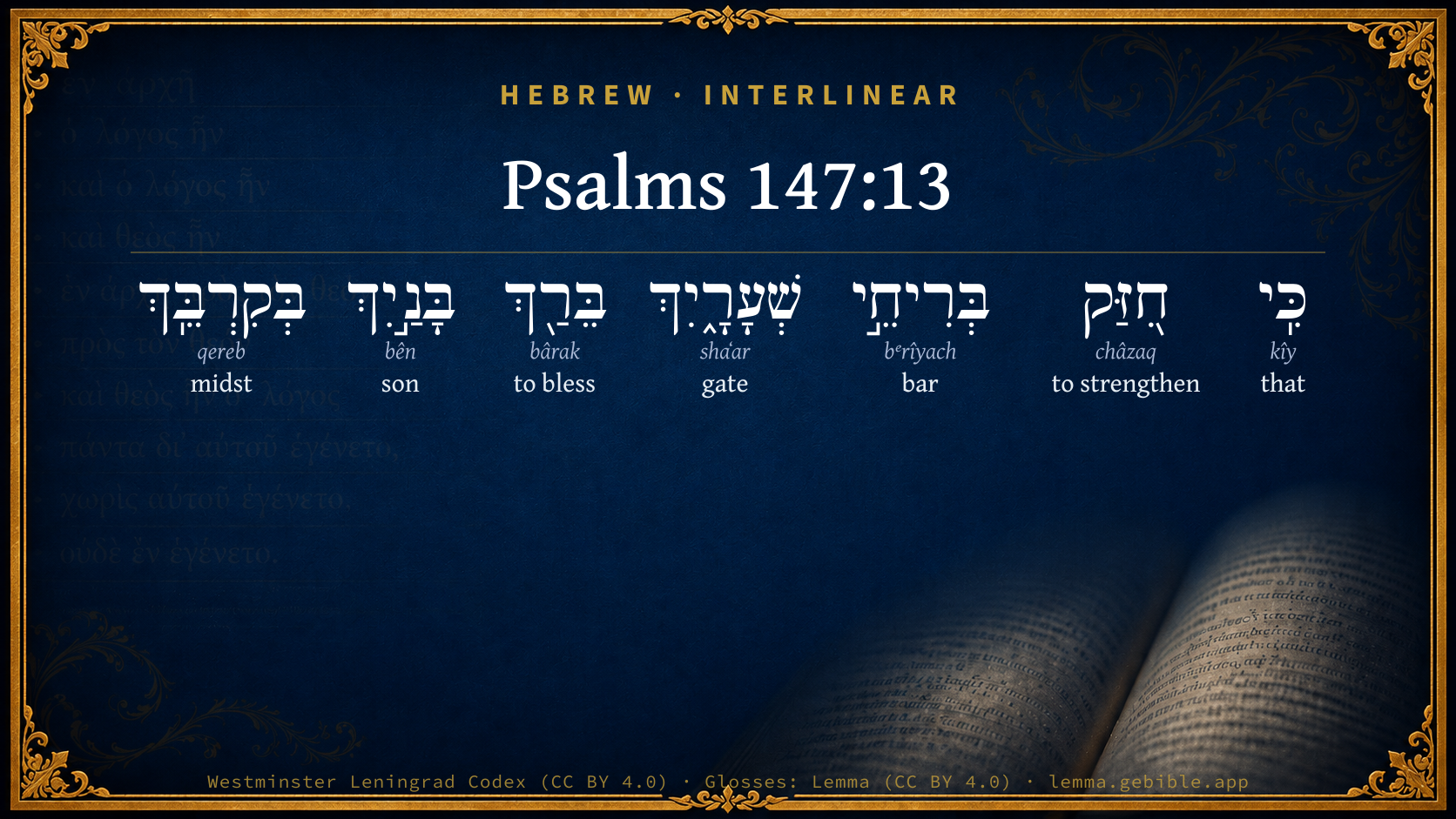
Hebrew (Westminster Leningrad Codex) Psalms 147:13 appears in the Hebrew Old Testament. The text above is from the Westminster Leningrad Codex. Each word links to its Strong’s number, a concise gloss, and parsing drawn from the Open Scriptures Hebrew Bible morphology. Click any word for its full Brown-Driver-Briggs (BDB) entry.
Download image
Cite this verse

Psalms 147:13 (World English Bible). Public Domain. Lemma interlinear Bible study tool, https://lemma.gebible.app/v/psalms/147/13.

Show BibTeX & RIS
BibTeX
RIS
English Translation
For he has strengthened the bars of your gates. He has blessed your children within you.
World English Bible · Public Domain
Download a study sheet

One document with this verse’s original text, its word-by-word gloss line, the meaning frame, cross-references with their text, attributed commentary, and full source and license credits — printable, and it pastes into notes with its structure intact.

This verse Autodidact and up

Study sheet (.html) Plain text (.txt)

A passage Seminary Student

Up to 50 verses in one chapter. A passage sheet keeps up to 6 commentary sources and 12 cross-references per verse, in the order this page ranks them, and says so on the sheet whenever that leaves anything out. Ask for a single verse and you get the Autodidact verse sheet above.

Everything on this page stays free to read, with no account — the sheet is a download of what is already on screen, not access to it.

Want to remove ads? Support Godless Engineer
Compare translations 3

The same verse in 3 English versions, stacked beneath the original-language interlinear above. Click any original word for its lexicon entry.

Each is an independent rendering of the whole verse — the interlinear is not word-aligned to these translations.

Highlighted words mark where these versions differ — a whole-verse word diff, not a word-by-word alignment.

  • World English Bible Public Domain
    For he has strengthened the bars of your gates. He has blessed your children within you.
  • King James Version Public Domain
    For he hath strengthened the bars of thy gates; he hath blessed thy children within thee.
  • unfoldingWord Literal Text CC BY-SA 4.0
    For he strengthens the bars of your gates; he blesses your sons in your midst.

unfoldingWord Literal Text — © unfoldingWord, licensed CC BY-SA 4.0. Word-aligned USFM3 via Door43 (git.door43.org/unfoldingWord/en_ult).

Versions to compare (up to 4)

3 of 4 selected

Show all 17 translations

Every available English version of this verse, each an independent rendering of the whole verse.

  • World English Bible Public Domain
    For he has strengthened the bars of your gates. He has blessed your children within you.
  • Berean Standard Bible Public Domain
    For He strengthens the bars of your gates and blesses the children within you.
  • Majority Standard Bible Public Domain
    For He strengthens the bars of your gates and blesses the children within you.
  • King James Version Public Domain
    For he hath strengthened the bars of thy gates; he hath blessed thy children within thee.
  • American Standard Version (1901) Public Domain
    For he hath strengthened the bars of thy gates; He hath blessed thy children within thee.
  • Revised Version (1885) Public Domain
    For he hath strengthened the bars of thy gates; he hath blessed thy children within thee.
  • Geneva Bible (1599) Public Domain
    For he hath made the barres of thy gates strong, and hath blessed thy children within thee.
  • Young's Literal Translation Public Domain
    For He did strengthen the bars of thy gates, He hath blessed thy sons in thy midst.
  • Literal Standard Version CC BY-SA 4.0
    For He strengthened the bars of your gates, || He has blessed your sons in your midst.
  • Unlocked Literal Bible CC BY-SA 4.0
    For he strengthens the bars of your gates, he blesses your children among you.
  • unfoldingWord Literal Text CC BY-SA 4.0
    For he strengthens the bars of your gates; he blesses your sons in your midst.
  • Darby Bible Public Domain
    For he hath strengthened the bars of thy gates; he hath blessed thy children within thee;
  • World Messianic Bible Public Domain
    For he has strengthened the bars of your gates. He has blessed your children within you.
  • Webster's Bible Public Domain
    For he hath strengthened the bars of thy gates; he hath blessed thy children within thee.
  • Free Bible Version CC BY-SA 4.0
    He makes the bars on your city gates strong, and blesses your children around you.
  • Bible in Basic English Public Domain
    He has made strong the iron bands of your doors; he has sent blessings on your children inside your walls.
  • JPS Tanakh (1917) Public Domain
    For He hath made strong the bars of thy gates; He hath blessed thy children within thee.

Literal Standard Version (2020), Covenant Press — licensed CC BY-SA 4.0. Text via the HelloAO Bible API (eBible.org). Unlocked Literal Bible (unfoldingWord) — licensed CC BY-SA 4.0. Text via the HelloAO Bible API (eBible.org). unfoldingWord Literal Text — © unfoldingWord, licensed CC BY-SA 4.0. Word-aligned USFM3 via Door43 (git.door43.org/unfoldingWord/en_ult). Free Bible Version, Dr. Jonathan Gallagher — licensed CC BY-SA 4.0. Text via the HelloAO Bible API (eBible.org).

Word by word

More ways to search: Search by grammar → Find every occurrence → Compare this word →

Practice this passage: Drill this verse → Learn its vocabulary →

About this verse

These counts appear in no published source. They are computed here, from the morphology-tagged text and Lemma’s own curated glosses. What Lemma adds →

7
words
7
distinct lemmas
Wisdom
section

Shared distinctive vocabulary

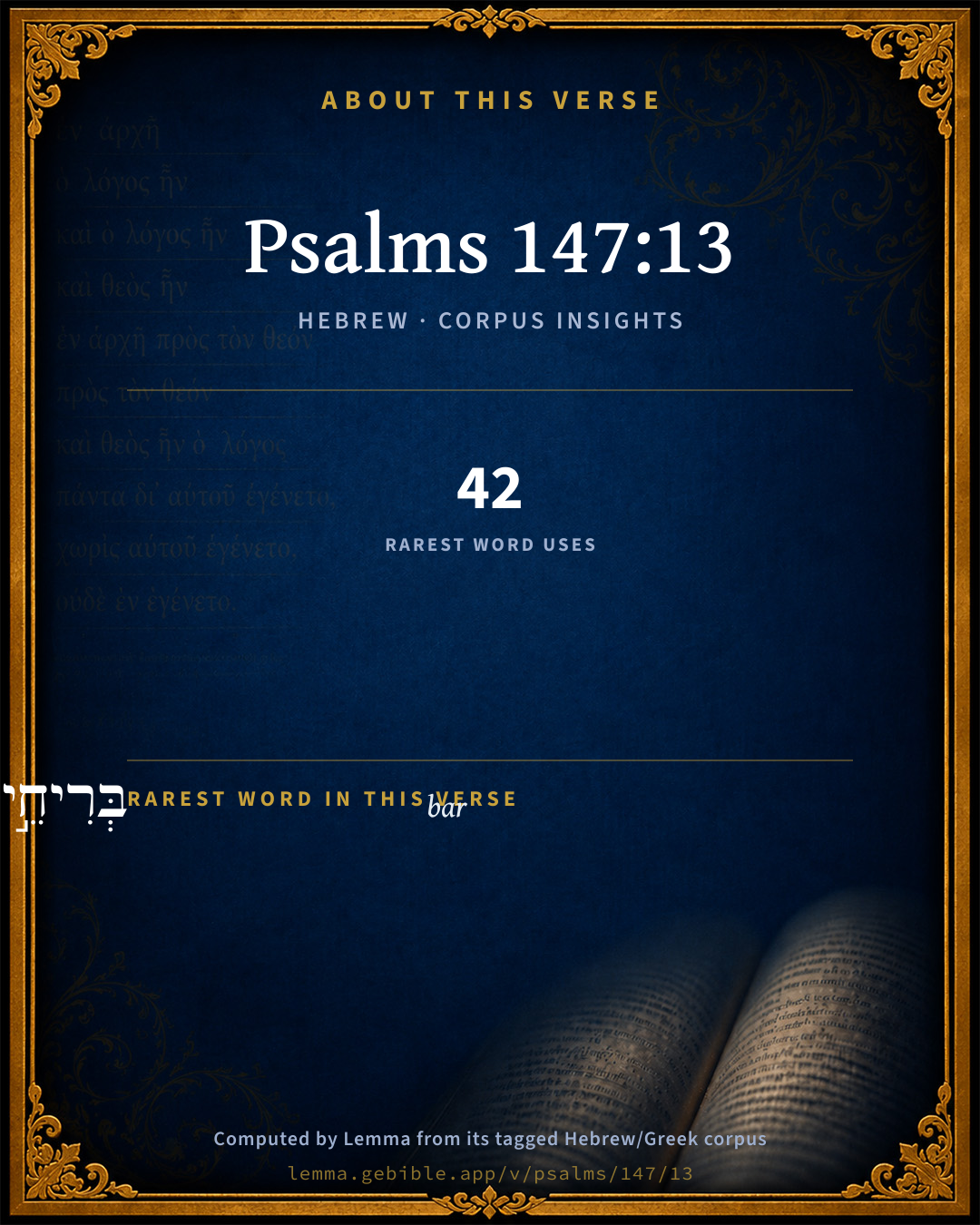
בְּרִיחֵ֣י bar H1280 occurs in 37 verses of the Hebrew Bible. Also found in:

Grammatical profile

  • 2 verbs
  • 4 nouns
  • 1 conjunction

Verb forms

  • חִ֭זַּק Piel · Perfect
  • בֵּרַ֖ךְ Piel · Perfect

Cross-references

18

Topical passages linked to Psalms 147:13 in the Treasury of Scripture Knowledge — connected by theme and wording, ordered by reader-vote popularity; previews shown in the World English Bible.

  • Psalms 128:3–6 Your wife will be as a fruitful vine, In the innermost parts of your house; Your children like olive plants, Around your table.
  • Psalms 115:14–15 May Yahweh increase you more and more, You and your children.
  • Isaiah 44:3–5 For I will pour water on him who is thirsty, and streams on the dry ground; I will pour my Spirit on your seed, and my blessing on your offspring:
  • Jeremiah 30:19–20 Out of them shall proceed thanksgiving and the voice of those who make merry: and I will multiply them, and they shall not be few; I will also glorify them, and they shall not be small.
  • Psalms 144:12 Then our sons will be like well-nurtured plants, Our daughters like pillars carved to adorn a palace.
  • Psalms 125:2 As the mountains surround Jerusalem, So Yahweh surrounds his people from this time forth and forevermore.
  • Nehemiah 12:30 The priests and the Levites purified themselves; and they purified the people, and the gates, and the wall.
  • Lamentations 2:8–9 Yahweh has purposed to destroy the wall of the daughter of Zion; He has stretched out the line, he has not withdrawn his hand from destroying; He has made the rampart and wall to lament; they languish together.
  • Nehemiah 3:1–16 Then Eliashib the high priest rose up with his brothers the priests, and they built the sheep gate; they sanctified it, and set up the doors of it; even to the tower of Hammeah they sanctified it, to the tower of Hananel.
  • Psalms 48:11–14 Let Mount Zion be glad! Let the daughters of Judah rejoice, Because of your judgments.
  • Zechariah 8:3–5 Thus says Yahweh: "I have returned to Zion, and will dwell in the midst of Jerusalem. Jerusalem shall be called 'The City of Truth;' and the mountain of Yahweh of Hosts, 'The Holy Mountain.'"
  • Nehemiah 6:1 Now it happened, when it was reported to Sanballat and Tobiah, and to Geshem the Arabian, and to the rest of our enemies, that I had built the wall, and that there was no breach left therein; (though even to that time I had not set up the doors in the gates;)
  • Nehemiah 7:1 Now it happened, when the wall was built, and I had set up the doors, and the porters and the singers and the Levites were appointed,
  • Psalms 51:18 Do well in your good pleasure to Zion. Build the walls of Jerusalem.
  • Nehemiah 7:3 I said to them, Don't let the gates of Jerusalem be opened until the sun be hot; and while they stand [on guard], let them shut the doors, and bar you them: and appoint watches of the inhabitants of Jerusalem, everyone in his watch, and everyone [to be] over against his house.
  • Lamentations 4:12 The kings of the earth didn't believe, neither all the inhabitants of the world, That the adversary and the enemy would enter into the gates of Jerusalem.
  • Daniel 9:25 Know therefore and discern, that from the going forth of the commandment to restore and to build Jerusalem to the Anointed One, the prince, shall be seven weeks, and sixty-two weeks: it shall be built again, with street and moat, even in troubled times.
  • Luke 19:42–44 saying, "If you, even you, had known today the things which belong to your peace! But now, they are hidden from your eyes.

Cross-references courtesy of OpenBible.info (CC BY 4.0).

Hebrew and Greek witnesses Masoretic Hebrew ↔ Greek Septuagint

The same verse in the two great witnesses to the Old Testament, shown verse-for-verse.

You’re reading Greek Psalm 146 (Hebrew Psalm 147). The Septuagint counts the superscription, so verse numbers can differ from the Hebrew — chapter-level alignment, not verse-by-verse. Numbering follows Rahlfs.

These are two independent witnesses, not word-aligned to each other, and the Septuagint is shown in lemma (dictionary) form.

Hebrew Psalms 147:13 Masoretic · Westminster Leningrad Codex

כִּֽי חִ֭זַּק בְּרִיחֵ֣י שְׁעָרָ֑יִךְ בֵּרַ֖ךְ בָּנַ֣יִךְ בְּקִרְבֵּֽךְ

For he has strengthened the bars of your gates. He has blessed your children within you.

World English Bible · Public Domain

Hebrew: Westminster Leningrad Codex (CC BY 4.0). Greek: Septuagint (public domain); English from a public-domain English Septuagint. How the Septuagint differs from the Hebrew →

Commentary

Notes on Psalms 147:13 from classic Christian and Jewish commentators (each source and its license shown beneath its notes). The classic Christian expositions comment on the surrounding passage and are grouped to its opening verse, so a note may address several verses; the Jewish commentaries on the Tanakh (Rashi and others) are per-verse, so they appear only where the commentator wrote on this verse.

Lemma curates 59 commentaries, every one of them public domain or Creative Commons licensed, each selected and text-cleaned for this edition rather than reprinted as found. About our sources →

Trapp's Complete Commentary

John Trapp

Psa 147:13 For he hath strengthened the bars of thy gates; he hath blessed thy children within thee.

Ver. 13. For he hath strengthened the bars, &c.] So that the gates of hell shall not prevail against them. God hath promised to break in pieces those gates of brass, and cut in sunder those bars of iron (as Samson did the gates of Gaza), Isa 45:2, to perfect, stablish, strengthen, and settle his saints, 1Pe 5:10, to he a wall of fire round about them, &c.

He hath blessed thy children within thee] Making them to be many, Isa 54:1, and all taught of God, Psa 147:13, children that will not lie, Isa 63:8.

John Trapp, A Commentary or Exposition upon All the Books of the Old and New Testament (1647–1656) — public domain. Text from a community e-Sword module.

The Biblical Illustrator

Joseph S. Exell

Psa_147:13-20

He hath strengthened the bars of thy gates.

Piety exulting in Divine goodness

I. In the general prosperity of society. He recognizes the good hand of God--

1. In the rebuilding of the city (verse 13).

2. In the restoration of peace and prosperity (verse 14).

II. In the beneficent mutations of the weather (Psa_147:16-18). Men are in the habit of complaining of the weather as too hot or too cold, too wet or too dry, too stormy or too calm, but in these very changes there is mercy. They are required in order to make the earth fertile and fruitful, and to stimulate humanity to a thousand industries. Whilst men of science ascribe meteorological changes to what they call laws, and the multitudes are ever grumbling with the weather, true philosophy ascribes all not only to the agency of God, but to the benevolence of that agency.

III. In the moral revelations to mankind (verse 19).

1. Gods word not only acts on material nature, originates, fashions, sustains and controls it, but on human souls. In the one case it conveys His resistless energy, in the other His moral reason and influence.

2. He reveals His moral laws to men--

(1) By the retribution of history,

(2) By the intuitions of conscience,

(3) By His written Word, and

(4) By His blessed Son. To some His moral revelations are fuller than to others. (David Thomas, D. D.)

The Biblical Illustrator, edited by Joseph S. Exell (c. 1880s–1900s) — public domain. Text from a community e-Sword module.

Joseph Benson's Commentary

Psa 147:13-14. For he hath strengthened the bars of thy gates — Thy strength consists not in thy walls, and gates, and bars, but in his protection. They had walls and gates, and kept their gates barred in time of danger; but that would not have been an effectual security to them, if God had not strengthened the bars of their gates, and fortified their fortifications. Let us remember, the most probable means we can devise for our defence and preservation will not answer the end, unless God give his blessing with them; we must, therefore, in the careful and diligent use of these means, depend upon him for that blessing, and attribute the undisturbed repose of our land more to the wall of fire than the wall of water round about us, Zec 2:5. He maketh peace in thy borders — In all thy land, even to its utmost borders, which are most liable to the incursion of enemies. He puts an end to the wars that existed, and prevents those that were threatened and feared. And he preserves the country in tranquillity, healing all differences between contending parties, and preventing intestine broils and animosities. And filleth thee with the finest wheat — With wheat, the most valuable grain, the finest of that, and a fulness thereof. Canaan abounded with the best wheat, Deu 32:14; and exported it to the countries abroad, Eze 27:17. It was not enriched with precious stones or spices, but with what was far more valuable, with bread which strengthens man’s heart. That, with abundance of milk and honey, vines and fig-trees, rendered it the glory of all lands.

Joseph Benson's Commentary on the Old and New Testaments (1811–1818) — public domain. Text from a community e-Sword module.

J. A. Alexander on Psalms

Joseph Addison Alexander

13. (Psa 147:13) For he hath strengthened the bars of thy gates ; he hath blessed thy sons in the midst of thee. Although the first clause admits of a general figurative application, it seems to contain an evident allusion to the historical occasion of the psalm, or at least to favour the opinion, that it was designed to celebrate the renewed fortifications of the Holy City.

Joseph Addison Alexander, The Psalms Translated and Explained (1850) — public domain. Text from a community e-Sword module.

Tyndale Open Study Notes

Tyndale Open Resources

147:13 The bars of the city gates symbolize defenses against enemies. • God blessed his people by empowering them with safety, prosperity, peace, and provisions (see 133:3).

Tyndale Open Study Notes — © Tyndale Open Resources, licensed CC BY-SA 4.0. Text via the HelloAO Bible API.

Geneva Bible (1599)

Geneva Bible translators

He doth not only furnish his Church with all things necessary, but preserveth also the same, and maketh it strong against all outward force.

Geneva Bible (1599) marginal notes — public domain. Text via Bolls.life.

Jamieson, Fausset & Brown

Robert Jamieson, A. R. Fausset & David Brown

strengthened . . . gates--or, means of defense against invaders,

Jamieson, Fausset & Brown — Commentary Critical and Explanatory on the Whole Bible (1871) — public domain (CC PDM 1.0). Text via the HelloAO Bible API.

Adam Clarke's Commentary

Verse 13. He hath strengthened the bars of thy gates] He has enabled thee to complete the walls of Jerusalem. From the former part of the Psalm it appears the walls were then in progress; from this part, they appear to be completed, and provisions to be brought into the city, to support its inhabitants. The gates were set up and well secured by bars, so that the grain, &c., was in safety.

Adam Clarke's Commentary on the Bible (1810–1826) — public domain. Text from a community e-Sword/MySword module.

Ellicott's Commentary for English Readers

(13) For he hath strengthened.—An allusion to the new fortifications of the restored city is probable, though the expression is plainly figurative of security and peace.

With the second clause comp. Isa_60:17-18.

A Bible Commentary for English Readers, edited by Charles John Ellicott (1878–1897) — public domain. Text from a community e-Sword module.

The Cambridge Bible for Schools and Colleges

gen. ed. J. J. S. Perowne

13. he hath strengthened] The same word is used in Neh_3:4 ff. of repairing or fortifying the wall and gates. All through Nehemiah’s narrative appears the conviction that “this work was wrought of our God.”

the bars of thy gates] There may be a particular reference to Neh_3:3; Neh_3:6; Neh_3:13-15.

thy children] Zion is regarded as the mother of its inhabitants.

The Cambridge Bible for Schools and Colleges (gen. ed. J. J. S. Perowne; Cambridge University Press, 1878–1918) — public domain. Text from a community e-Sword module.

John Gill's Exposition

For he hath strengthened the bars of thy gates,.... Of Jerusalem, of Zion the church of God. Gates are for the letting in of persons into the city of our God; which are Christ, faith in him, and a profession of it; see Isa 26:1, "bars" are for the security of those that, are in it, and to keep out the enemy: and these, "strengthened", denote the utmost safety of the true members of Christ and his church; who have nothing to fear from their spiritual enemies, sin, law, Satan, the world, death, and hell: God is on their side; Christ is the munition of rocks unto them the Holy Spirit is in them, who is greater than he that is in the world; and angels are guards about them; all which is matter of praise, and a sufficient reason for it;

he hath blessed thy children within thee; multiplied them and made them fruitful, increased the number of them; even the spiritual children of the church, brought forth to Christ by her; born in her, through the ministry of the Gospel; and brought up by her, with the ordinances of it. These in the first times of the Gospel were very numerous, and will be so again in the latter day, like the drops of the morning dew; and are and will be blessed with all spiritual blessings, with pardoning, justifying, adopting, and sanctifying grace, and with eternal life; for which the Lord's name is to be praised.

John Gill's Exposition of the Whole Bible (1746–1763) — public domain (CC PDM 1.0). Text via the HelloAO Bible API.

Albert Barnes' Notes on the Bible

For he hath strengthened the bars of thy gates - He has made thee safe and secure - as if he had given additional strength to the fastenings of the gates of the city. Cities were surrounded by walls. They were entered through gates. Those gates were fastened by bars passed across them, to which the gates were secured. The language here might be applicable to any period, but it is probable that there is particular reference to Jerusalem as made strong in rebuilding it after the return from Babylon.

He hath blessed thy children within thee - The inhabitants, by giving them safety and peace.

Albert Barnes' Notes on the Bible (1834–1885) — public domain. Text from a community e-Sword/MySword module.

Matthew Poole's English Annotations

Thy strength consists not in thy walls, and gates, and bars, but in his protection.

Matthew Poole's English Annotations on the Holy Bible (1683–1685) — public domain. Text from a community e-Sword/MySword module.

The Treasury of David

Charles H. Spurgeon

Ver. 13. For he hath strengthened the bars of thy gates. Her fortifications were finished, even to the fastenings of the gates, and God had made all sound and strong, even to her bolts and bars: thus her security against invading foes was guaranteed. This is no small mercy. Oh, that our churches were thus preserved from all false doctrine and unholy living! This must be the Lord's doing; and where he has wrought it his name is greatly to be praised. Modern libertines would tear down all gates and abolish all bars; but so do not we, because of the fear of the Lord. He hath blessed thy children within thee. Internal happiness is as truly the Lord's gift as external security. When the Lord blesses "thy sons in the midst of thee", thou art, O Zion, filled with a happy, united, zealous, prosperous, holy people, who dwell in communion with God, and enter into the joy of their Lord. When God makes thy walls salvation thy gates must be praise. It would little avail to fortify a wretched, starving city; but when the walls are strengthened, it is a still greater joy to see that the inhabitants are blessed with all good gifts. How much our churches need a present and abiding benediction.

Ver. 13. He hath strengthened the bars of thy gates. Blessed is the city whose gates God barreth up with his power, and openeth again with his mercy. There is nothing can defend where his justice will strike; and there is nothing can offend where his goodness will preserve. Thomas Adams.

Ver. 13-14. The Psalmist recites four arguments from which he would have Zion sing praises. 1. Security and defence. 2. Benediction.

3. Peace. 4. Sustenance or provision.

1. Security. Jerusalem is a city secure, being defended by God: For he hath strengthened the bars of thy gates. Gates and bars do well to a city, but then only is the city secure when God makes them strong. The true munition of a city is God's defence of it. Arms, laws, wealth, etc., are the bars, but God must put strength into them.

2. Benediction. Jerusalem is a happy city, for he hath blessed thy children, within, thee, thy kings, princes, magistrates, etc., with wisdom, piety, etc.

3. Peace. Jerusalem is a peaceable city. He maketh peace in thy borders, the very name intimates so much; for Jerusalem interpreted is visio pacis Vision of peace.

4. Abundance. Jerusalem is a city provided by God with necessary food and provision; for He filleth thee with the finest of the wheat. William Nicholson.

Ver. 13. A Strong Church.

1. The utility and value of a strong church.

2. The marks which distinguish it.

a) Gates well kept.

b) Increase of membership.

c) The converts blessed to others.

3. The important care of a strong church: to trace all blessing to Zion's God. W.B.H.

Psalms 147:14*

Charles H. Spurgeon's The Treasury of David (1869–1885) — public domain. Psalms only. Text from a community e-Sword/MySword module.

The Pulpit Commentary

For he hath strengthened the bars of thy gates. The strength of gates in the ancient world depended wholly upon their bars, which were generally strong beams of wood passed across from side to side of the gateway, about midway up the gate, having their ends inserted into strong iron hooks or clamps, which were let into the stonework of the walls. The "bars" of the gates of Jerusalem are mentioned in Nehemiah repeatedly. (Psa_3:3, 6 7:3) He hath blessed thy children within thee. Under Nehemiah"s govern-meet, when he had firmly established it, Israel enjoyed a period of repose and of great prosperity, which, at the date of the psalm, was probably just commencing.

The Pulpit Commentary (1880–1919), ed. H.D.M. Spence-Jones & Joseph S. Exell — public domain. Text from a community e-Sword module.

John Wesley's Explanatory Notes

Thy gates - Thy strength consists not in thy walls, and gates, and bars, but in his protection.

John Wesley, Explanatory Notes Upon the Whole Bible (1754–1765) — public domain. Text via the GEBible commentary corpus.

Lesson kit

Teaching starters — assembled from the data on this page, not authored interpretation. Every prompt links to the verse data it draws on. Edit before teaching.

Psalms, in the Wisdom, opens this verse with 7 words (7 distinct Hebrew lemmas). Its most distinctive word is bᵉrîyach (“bar”). A historical commentator’s framing appears above. Read the whole chapter for the surrounding context.

Discussion questions

  1. The word bᵉrîyach carries the sense “bar.” How does it shape the verse?
  2. Exodus 26:26 shares the word «bar» with this verse. How do the two illuminate each other?
  3. These translations render this verse differently. What is at stake in choosing one wording over another?
  4. The verb «חִ֭זַּק» is Piel Perfect. How does its form color the action?
  5. Reading how Trapp's Complete Commentary and The Biblical Illustrator read this verse, where do the two commentators agree and where do they part?

Things to notice

Reading settings

Reading text

Shown beneath each verse's original-language words.

Old Testament
Old Testament edition

Read the OT as the Masoretic Hebrew (MT) or the Greek Septuagint (LXX).

English shown for the Greek Septuagint (in the Hebrew ↔ Greek comparison).

Comparing translations? Open the Compare panel on any verse page to stack up to four side by side.