
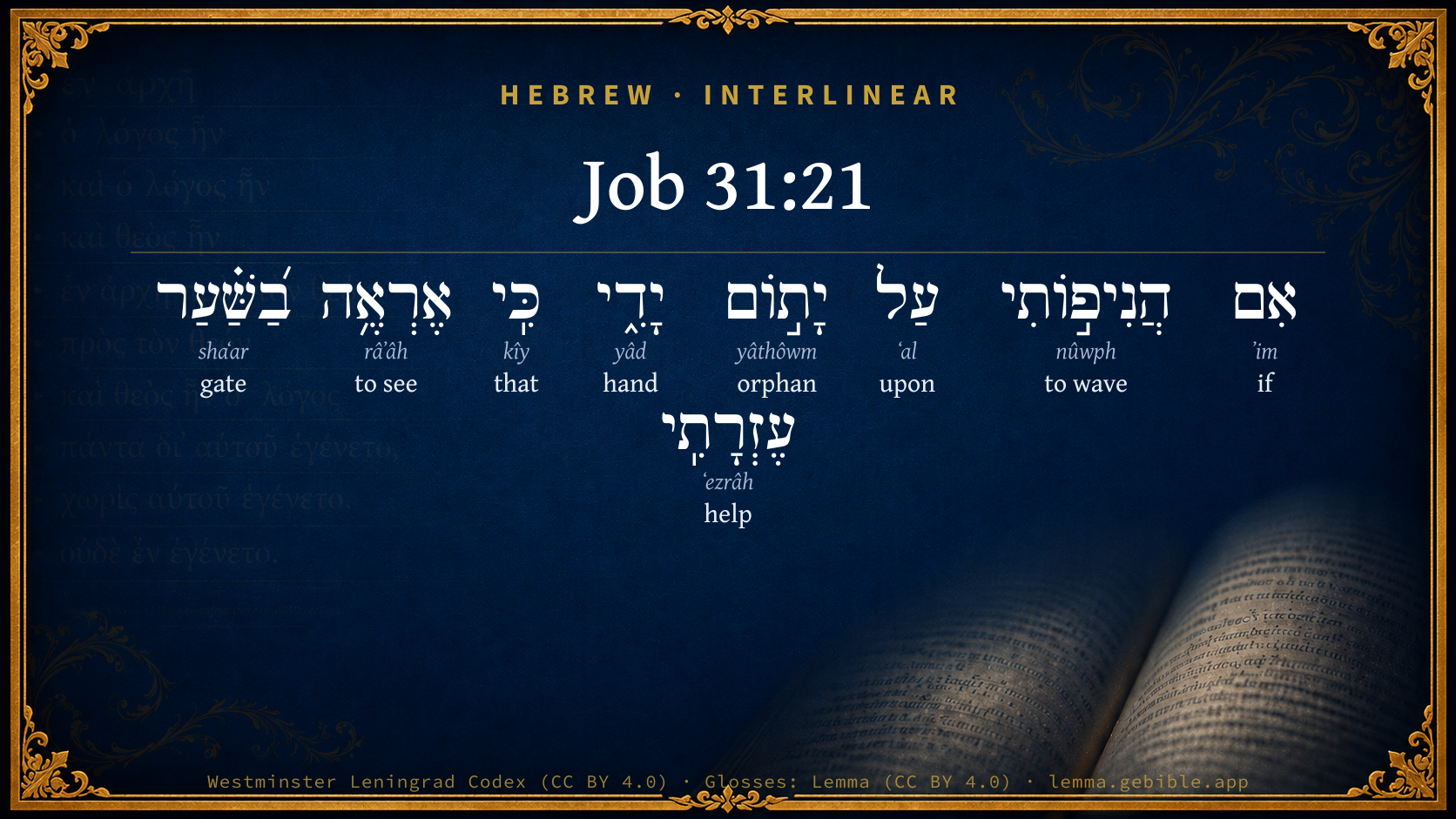
Job 31:21

Hebrew (Westminster Leningrad Codex) Job 31:21 appears in the Hebrew Old Testament. The text above is from the Westminster Leningrad Codex. Each word links to its Strong’s number, a concise gloss, and parsing drawn from the Open Scriptures Hebrew Bible morphology. Click any word for its full Brown-Driver-Briggs (BDB) entry.
Download image
Cite this verse

Job 31:21 (World English Bible). Public Domain. Lemma interlinear Bible study tool, https://lemma.gebible.app/v/job/31/21.

Show BibTeX & RIS
BibTeX
RIS
English Translation
If I have lifted up my hand against the fatherless, Because I saw my help in the gate:
World English Bible · Public Domain
Download a study sheet

One document with this verse’s original text, its word-by-word gloss line, the meaning frame, cross-references with their text, attributed commentary, and full source and license credits — printable, and it pastes into notes with its structure intact.

This verse Autodidact and up

Study sheet (.html) Plain text (.txt)

A passage Seminary Student

Up to 50 verses in one chapter. A passage sheet keeps up to 6 commentary sources and 12 cross-references per verse, in the order this page ranks them, and says so on the sheet whenever that leaves anything out. Ask for a single verse and you get the Autodidact verse sheet above.

Everything on this page stays free to read, with no account — the sheet is a download of what is already on screen, not access to it.

Want to remove ads? Support Godless Engineer
Compare translations 3

The same verse in 3 English versions, stacked beneath the original-language interlinear above. Click any original word for its lexicon entry.

Each is an independent rendering of the whole verse — the interlinear is not word-aligned to these translations.

Highlighted words mark where these versions differ — a whole-verse word diff, not a word-by-word alignment.

  • World English Bible Public Domain
    If I have lifted up my hand against the fatherless, Because I saw my help in the gate:
  • King James Version Public Domain
    If I have lifted up my hand against the fatherless, when I saw my help in the gate:
  • unfoldingWord Literal Text CC BY-SA 4.0
    if I have shaken my hand against the fatherless because I saw my help at the gate,

unfoldingWord Literal Text — © unfoldingWord, licensed CC BY-SA 4.0. Word-aligned USFM3 via Door43 (git.door43.org/unfoldingWord/en_ult).

Versions to compare (up to 4)

3 of 4 selected

Show all 18 translations

Every available English version of this verse, each an independent rendering of the whole verse.

  • World English Bible Public Domain
    If I have lifted up my hand against the fatherless, Because I saw my help in the gate:
  • Berean Standard Bible Public Domain
    if I have lifted up my hand against the fatherless because I saw that I had support in the gate,
  • Majority Standard Bible Public Domain
    if I have lifted up my hand against the fatherless because I saw that I had support in the gate,
  • King James Version Public Domain
    If I have lifted up my hand against the fatherless, when I saw my help in the gate:
  • American Standard Version (1901) Public Domain
    If I have lifted up my hand against the fatherless, Because I saw my help in the gate:
  • Revised Version (1885) Public Domain
    If I have lifted up my hand against the fatherless, because I saw my help in the gate:
  • Geneva Bible (1599) Public Domain
    If I haue lift vp mine hande against the fatherlesse, when I saw that I might helpe him in the gate,
  • Douay-Rheims (1899) Public Domain
    If I have lifted up my hand against the fatherless, even when I saw myself superior in the gate:
  • Young's Literal Translation Public Domain
    If I have waved at the fatherless my hand, When I see in `him' the gate of my court,
  • Literal Standard Version CC BY-SA 4.0
    If I have waved my hand at the fatherless, || When I see [him] in the gate of my court,
  • Unlocked Literal Bible CC BY-SA 4.0
    if I have lifted up my hand against fatherless people because I saw my support in the city gate, then bring charges against me!
  • unfoldingWord Literal Text CC BY-SA 4.0
    if I have shaken my hand against the fatherless because I saw my help at the gate,
  • Darby Bible Public Domain
    If I have lifted up my hand against an orphan, because I saw my help in the gate:
  • World Messianic Bible Public Domain
    if I have lifted up my hand against the fatherless, because I saw my help in the gate;
  • Webster's Bible Public Domain
    If I have lifted up my hand against the fatherless, when I saw my help in the gate:
  • Free Bible Version CC BY-SA 4.0
    If I raised my hand to hit an orphan, confident that if it came to court the judges would be on my side,
  • Bible in Basic English Public Domain
    If my hand had been lifted up against him who had done no wrong, when I saw that I was supported by the judges;
  • JPS Tanakh (1917) Public Domain
    If I have lifted up my hand against the fatherless, because I saw my help in the gate;

Literal Standard Version (2020), Covenant Press — licensed CC BY-SA 4.0. Text via the HelloAO Bible API (eBible.org). Unlocked Literal Bible (unfoldingWord) — licensed CC BY-SA 4.0. Text via the HelloAO Bible API (eBible.org). unfoldingWord Literal Text — © unfoldingWord, licensed CC BY-SA 4.0. Word-aligned USFM3 via Door43 (git.door43.org/unfoldingWord/en_ult). Free Bible Version, Dr. Jonathan Gallagher — licensed CC BY-SA 4.0. Text via the HelloAO Bible API (eBible.org).

Word by word

More ways to search: Search by grammar → Find every occurrence → Compare this word →

Practice this passage: Drill this verse → Learn its vocabulary →

About this verse

These counts appear in no published source. They are computed here, from the morphology-tagged text and Lemma’s own curated glosses. What Lemma adds →

9
words
9
distinct lemmas
Wisdom
section

Shared distinctive vocabulary

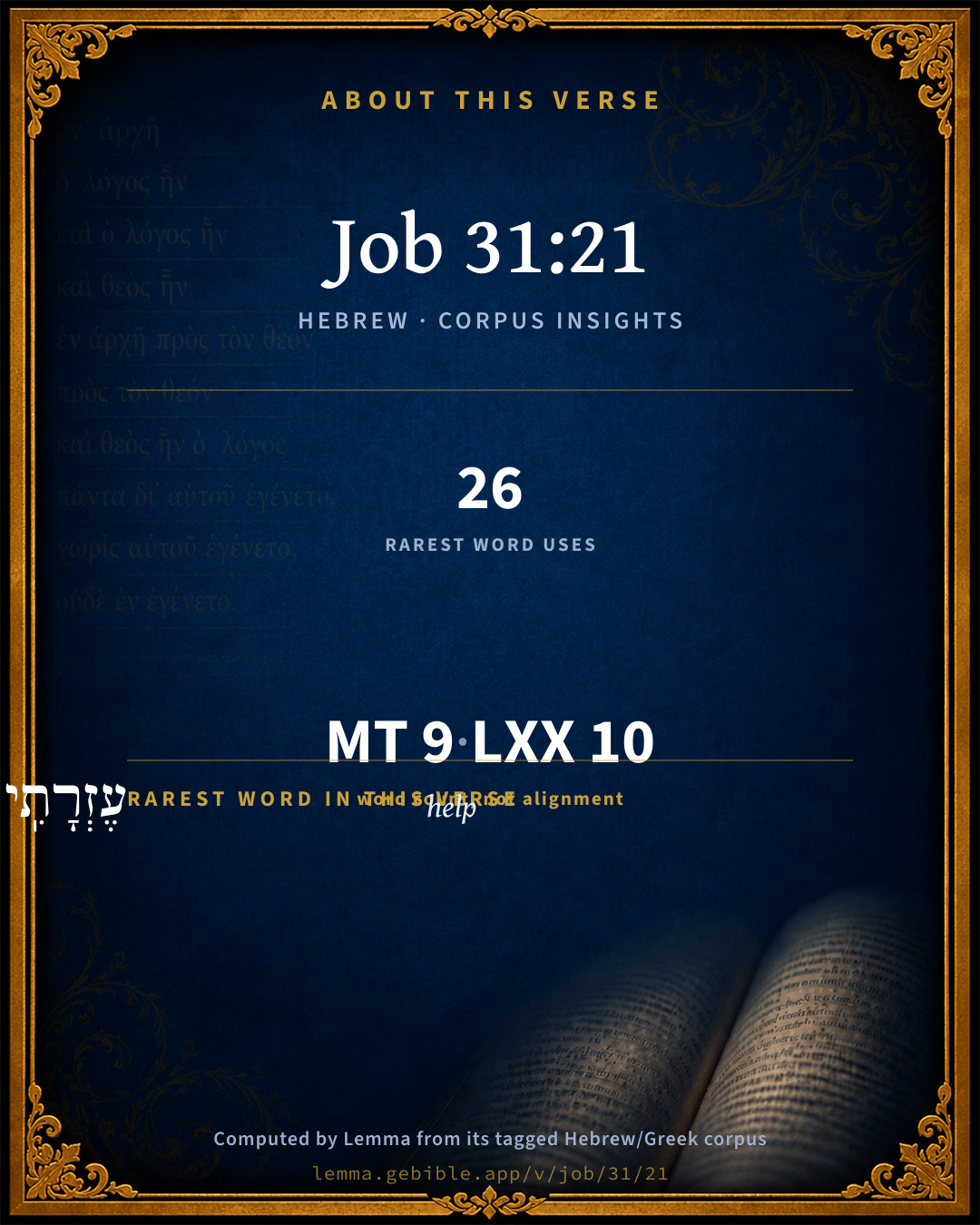
עֶזְרָתִֽי help H5833 occurs in 25 verses of the Hebrew Bible. Also found in:

Grammatical profile

  • 2 verbs
  • 4 nouns
  • 1 preposition
  • 2 conjunctions

Verb forms

  • הֲנִיפ֣וֹתִי Hiphil · Perfect
  • אֶרְאֶ֥ה Qal · Imperfect

Hebrew & Septuagint length

In English translation the verse runs 18 words from the Hebrew and 17 from the Septuagint (LXX English) — closely comparable.

A rough comparison of the two English renderings, which tokenize alike — not a word-level alignment.

Word counts can differ between the Hebrew and the Greek without any difference in meaning — e.g. the Hebrew direct-object marker אֵת has no separate Greek word, and Greek often adds the article ὁ.

In the original languages it is 9 Hebrew tokens and 10 Greek tokens — but the two are counted differently (Hebrew bundles its prefixes and suffixes into one token; the Greek is in lemma form), so that isn’t a like-for-like length.

Cross-references

9

Topical passages linked to Job 31:21 in the Treasury of Scripture Knowledge — connected by theme and wording, ordered by reader-vote popularity; previews shown in the World English Bible.

  • Job 22:9 You have sent widows away empty, And the arms of the fatherless have been broken.
  • Job 29:12 Because I delivered the poor who cried, And the fatherless also, who had none to help him.
  • Job 6:27 Yes, you would even cast lots for the fatherless, And make merchandise of your friend.
  • Job 24:9 There are those who pluck the fatherless from the breast, And take a pledge of the poor,
  • Proverbs 23:10–11 Don't move the ancient boundary stone. Don't encroach on the fields of the fatherless:
  • Jeremiah 5:28 They are grew fat, they shine: yes, they overpass in deeds of wickedness; they don't plead the cause, the cause of the fatherless, that they may prosper; and the right of the needy they don't judge.
  • Ezekiel 22:7 In you have they set light by father and mother; in the midst of you have they dealt by oppression with the foreigner; in you have they wronged the fatherless and the widow.
  • Micah 2:1–2 Woe to those who devise iniquity And work evil on their beds! When the morning is light, they practice it, Because it is in the power of their hand.
  • Micah 7:3 Their hands are on that which is evil to do it diligently. The ruler and judge ask for a bribe; And the powerful man dictates the evil desire of his soul. Thus they conspire together.

Cross-references courtesy of OpenBible.info (CC BY 4.0).

Hebrew and Greek witnesses Masoretic Hebrew ↔ Greek Septuagint

The same verse in the two great witnesses to the Old Testament, shown verse-for-verse.

These are two independent witnesses, not word-aligned to each other, and the Septuagint is shown in lemma (dictionary) form.

Hebrew Job 31:21 Masoretic · Westminster Leningrad Codex

אִם הֲנִיפ֣וֹתִי עַל יָת֣וֹם יָדִ֑י כִּֽי אֶרְאֶ֥ה בַ֝שַּׁ֗עַר עֶזְרָתִֽי

If I have lifted up my hand against the fatherless, Because I saw my help in the gate:

World English Bible · Public Domain

Greek LXX Job 31:21 Septuagint · lemma form

εἰ ἐπιαἴρω ὀρφανός χείρ πείθω ὅτι πολύς ἐγώ βοήθεια περιεἰμί

if I lifted my hand against an orphan, trusting that my strength was far superior to his:

LXX2012 (modern English Septuagint) · Public Domain

Hebrew: Westminster Leningrad Codex (CC BY 4.0). Greek: Septuagint (public domain); English from LXX2012 (modern English Septuagint) (Public Domain). How the Septuagint differs from the Hebrew →

Commentary

Notes on Job 31:21 from classic Christian and Jewish commentators (each source and its license shown beneath its notes). The classic Christian expositions comment on the surrounding passage and are grouped to its opening verse, so a note may address several verses; the Jewish commentaries on the Tanakh (Rashi and others) are per-verse, so they appear only where the commentator wrote on this verse.

Lemma curates 59 commentaries, every one of them public domain or Creative Commons licensed, each selected and text-cleaned for this edition rather than reprinted as found. About our sources →

Trapp's Complete Commentary

John Trapp

Job 31:21 If I have lifted up my hand against the fatherless, when I saw my help in the gate:

Ver. 21. If I have lift up my hand against the fatherless] That is, against any that are destitute of human helps and defences. Such to ill treat and oppress is easy for great ones. See Gen 50:15-21, &c. But where the true fear of God is no such thing will be done. The Tigurines render, Si minitatus sum Orphano, &c., If I have lifted up my hand in threatening first, and then let it fall in striking and punishing, the fatherless or friendless.

When I saw my help in the gate] i.e. When, by my greatness and grace with the people, I might have borne out my worst miscarriages; when I might have had more than enough that would have defended, yea, applauded me, as the Senate of Rome did Nero even for his most malapert misdemeanors and most horrid outrages.

John Trapp, A Commentary or Exposition upon All the Books of the Old and New Testament (1647–1656) — public domain. Text from a community e-Sword module.

Tyndale Open Study Notes

Tyndale Open Resources

31:21 knowing the judges would take my side: Job was respected and regarded as a member of the elite class (29:7-10).

Tyndale Open Study Notes — © Tyndale Open Resources, licensed CC BY-SA 4.0. Text via the HelloAO Bible API.

Geneva Bible (1599)

Geneva Bible translators

To oppress him and to do him injury.

Geneva Bible (1599) marginal notes — public domain. Text via Bolls.life.

Jamieson, Fausset & Brown

Robert Jamieson, A. R. Fausset & David Brown

when--that is, "because."

I saw--that I might calculate on the "help" of a powerful party in the court of justice--("gate"), if I should be summoned by the injured fatherless.

Jamieson, Fausset & Brown — Commentary Critical and Explanatory on the Whole Bible (1871) — public domain (CC PDM 1.0). Text via the HelloAO Bible API.

Adam Clarke's Commentary

Verse 21. If I have lifted up my hand against the fatherless] I have at no time opposed the orphan, nor given, in behalf of the rich and powerful, a decision against the poor, when I saw my help in the gate - when I was sitting chief on the throne of judgment, and could have done it without being called to account.

There are sentiments very like these in the poem of Lebeid, one of the authors of the Moallakhat. I shall quote several verses from the elegant translation of Sir William Jones, in which the character of a charitable and bountiful chief is well described: -

"Oft have I invited a numerous company to the death of a camel bought for slaughter, to be divided with arrows of equal dimensions."

"I invite them to draw lots for a camel without a foal, and for a camel with her young one, whose flesh I distribute to all the neighbours."

"The guest and the stranger admitted to my board seem to have alighted in the sweet vale of Tebaala, luxuriant with vernal blossoms."

"The cords of my tent approaches every needy matron, worn with fatigue, like a camel doomed to die at her master's tomb, whose venture is both scanty and ragged."

"There they crown with meat (while the wintry winds contend with fierce blasts) a dish flowing like a rivulet, into which the famished orphans eagerly plunge."

"He distributes equal shares, he dispenses justice to the tribes, he is indignant when their right is diminished; and, to establish their right, often relinquishes his own."

"He acts with greatness of mind, and nobleness of heart: he sheds the dew of his liberality on those who need his assistance; he scatters around his own gains and precious spoils, the prizes of his valour." - Ver. 73-80.

Adam Clarke's Commentary on the Bible (1810–1826) — public domain. Text from a community e-Sword/MySword module.

The Cambridge Bible for Schools and Colleges

gen. ed. J. J. S. Perowne

21. if I have lift up my hand] i. e. to strike him down. The expression is figurative, meaning to oppress violently.

I saw my help in the gate] i. e. because he saw that if the cause came before the judges (the gate) he could secure from them, by his inference, a verdict favourable to himself.

The Cambridge Bible for Schools and Colleges (gen. ed. J. J. S. Perowne; Cambridge University Press, 1878–1918) — public domain. Text from a community e-Sword module.

John Gill's Exposition

Then let mine arm fall from my shoulder blade,.... With which the upper part of it is connected; let it be disjointed from it, or rot and drop off from it; a dreadful calamity this, to lose an arm and the use of it, to have it full off immediately, as a judgment from God, and in just retaliation for lifting up an hand or arm against the fatherless; as Jeroboam's arm withered when he put it forth from the altar, and ordered hands to be laid upon the prophet for crying against the altar, Kg1 13:4; and mine arm be broken from the bone; from the channel bone, as the margin of our Bibles, or rather from the elbow, the lower part of the arm and so may be rendered, "or mine arm", &c. Eliphaz had brought a charge against Job, that the arms of the fatherless had been broken, and suggests that they had been broken by him, or by his orders, Job 22:9; and Job here wishes, that if that was the case, that his own arm was broken: such imprecations are not to be made in common, or frequently, and only when a man's innocence cannot be vindicated but by an appeal to the omniscient God; an instance somewhat like this, see in Psa 137:5.

.

Job 31:23

job 31:23

job 31:23

job 31:23For destruction from God was a terror to me,.... Though he feared not men, they being at his beck and command, ready to do any thing for him he should order, yet he feared God; and the dread of his resentment, and of destruction from him the lawgiver, who is able to save and to destroy, had such an influence on him as to deter and keep him from all unkindness to the poor, and in justice to the fatherless; he dreaded the destruction of himself, his family, and substance in this world, and everlasting destruction of soul and body in the world to come; which of all things is to be feared, Mat 10:28; and Old Testament saints were much under a spirit of bondage to fear, and were actuated thereby; and, though Job might not be under any dread of eternal damnation, knowing his interest in the living Redeemer; yet he might fear temporal destruction, as it is certain he did; which thing he feared came upon him, though not for any crime or crimes he was guilty of, see Job 30:25; he might fear, as a good man may, the chastisements and corrections of his heavenly Father:

and by reason of his highness I could not endure; God is higher than the highest angels, or men; he is above all gods, so called; he is God over all, blessed for ever; and such is his height, his glory, and his majesty, that it is terrible, and the dread of them makes men afraid; nor can any sinner stand before him, nor withstand him, nor hope to prevail against him, nor flee from his presence, nor escape out of his hand, nor bear his wrath and indignation, and the coming down of his arm; for what hands can be strong, or heart endure, when the almighty God deals with them? or Job's sense may be, that such an awe of the divine Being was always upon him, that he could not do any unkind thing to the poor, or unjust one to the fatherless.

John Gill's Exposition of the Whole Bible (1746–1763) — public domain (CC PDM 1.0). Text via the HelloAO Bible API.

Albert Barnes' Notes on the Bible

If I have lifted up my hand against the fatherless - That is, if I have taken advantage of my rank, influence, and power, to oppress and injure him.

When I saw my help in the gate - The gate of a city was a place of concourse; a place where debates were held, and where justice was administered. Job speaks here of that part of his life when he was clothed with authority as a magistrate, or when he had power and influence as a public man. He says that he had never abused this power to oppress the fatherless. He had never taken advantage of his influence to injure them, because he saw he had a strong party under his control, or because he had power enough to carry his point, or because he had those under him who would sustain him in an oppressive measure. This is spoken with reference to the usually feeble and defenseless condition of the orphan, as one who is deprived of his natural protector and who is, therefore, liable to be wronged by those in power.

Albert Barnes' Notes on the Bible (1834–1885) — public domain. Text from a community e-Sword/MySword module.

Haydock's Catholic Bible Commentary

Gate, in judgment, (Calmet) where I was the supreme judge, (Haydock) and none could resist me.

George Leo Haydock (1774–1849), Haydock's Catholic Family Bible and Commentary, 1859 edition — public domain. Excludes Psalms (Douay-Rheims chapter numbering differs from Protestant) and Deuterocanonical books (Catholic canon only).

Matthew Poole's English Annotations

To smite him with the fist of wickedness, as the phrase is, Isa 58:4; to bring him to the judgment-seat, that under colour of justice I might take away his right, as powerful oppressors use to do, or any ways to threaten, injure, or crush him.

When I saw my help in the gate; when I understood my advantage against him, and that I could influence the judges to do what I pleased.

Matthew Poole's English Annotations on the Holy Bible (1683–1685) — public domain. Text from a community e-Sword/MySword module.

Whedon's Commentary on the Bible

Daniel D. Whedon

21. Help in the gate — Patrons and friends, ready to defend him in case of mal-administration of justice. The gate is the forum in Eastern towns, where all kinds of important business are transacted. See note, Job_29:7.

Daniel D. Whedon (gen. ed.), Commentary on the Old and New Testaments (1874–1909) — public domain. Text from a community e-Sword module.

The Pulpit Commentary

If I have lifted up my hand against the fatherless; i.e. if I have in any way oppressed him. When I saw my help in the gate; i.e.. when I had the power to do so when I saw my friends and hangers-on mustered in force at the gate where causes were being tried. The wrong and robbery which the poor suffer in the East have always been camel, to a large extent, by failure of justice in the courts, where might, and not right, carries the day.

The Pulpit Commentary (1880–1919), ed. H.D.M. Spence-Jones & Joseph S. Exell — public domain. Text from a community e-Sword module.

John Wesley's Explanatory Notes

When - When I saw I could influence the Judges to do what I pleased.

John Wesley, Explanatory Notes Upon the Whole Bible (1754–1765) — public domain. Text via the GEBible commentary corpus.

Lesson kit

Teaching starters — assembled from the data on this page, not authored interpretation. Every prompt links to the verse data it draws on. Edit before teaching.

Job, in the Wisdom, opens this verse with 9 words (9 distinct Hebrew lemmas). Its most distinctive word is ʻezrâh (“help”). A historical commentator’s framing appears above. Read the whole chapter for the surrounding context.

Discussion questions

  1. What does “help” (ʻezrâh) contribute to the verse as a whole?
  2. Judges 5:23 shares the word «help» with this verse. How do the two illuminate each other?
  3. These translations render this verse differently; the difference is in the English rendering, not the original. What questions does that raise?
  4. The verb «הֲנִיפ֣וֹתִי» is Hiphil Perfect. How does its form color the action?
  5. Reading how Trapp's Complete Commentary and Tyndale Open Study Notes read this verse, where do the two commentators agree and where do they part?

Things to notice

Reading settings

Reading text

Shown beneath each verse's original-language words.

Old Testament
Old Testament edition

Read the OT as the Masoretic Hebrew (MT) or the Greek Septuagint (LXX).

English shown for the Greek Septuagint (in the Hebrew ↔ Greek comparison).

Comparing translations? Open the Compare panel on any verse page to stack up to four side by side.