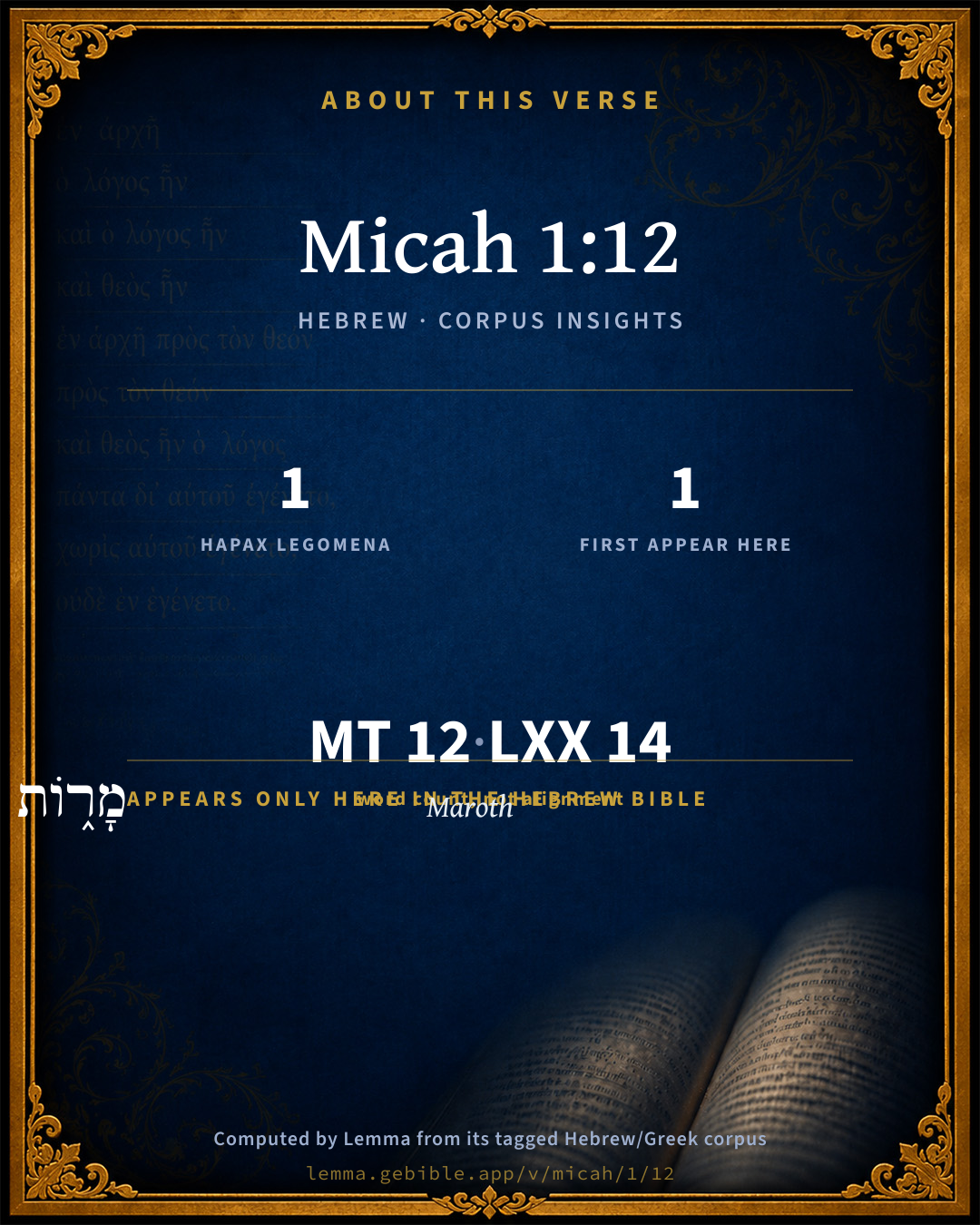
Micah 1:12

Hebrew (Westminster Leningrad Codex) Micah 1:12 appears in the Hebrew Old Testament. The text above is from the Westminster Leningrad Codex. Each word links to its Strong’s number, a concise gloss, and parsing drawn from the Open Scriptures Hebrew Bible morphology. Click any word for its full Brown-Driver-Briggs (BDB) entry.
Download image
Cite this verse

Micah 1:12 (World English Bible). Public Domain. Lemma interlinear Bible study tool, https://lemma.gebible.app/v/micah/1/12.

Show BibTeX & RIS
BibTeX
RIS
English Translation
For the inhabitant of Maroth waits anxiously for good, Because evil has come down from Yahweh to the gate of Jerusalem.
World English Bible · Public Domain
Highlights
  • 1 hapax legomenon — only here in the Hebrew Bible
  • 1 first appearance in the Hebrew Bible
Full analysis ↓
Download a study sheet

One document with this verse’s original text, its word-by-word gloss line, the meaning frame, cross-references with their text, attributed commentary, and full source and license credits — printable, and it pastes into notes with its structure intact.

This verse Autodidact and up

Study sheet (.html) Plain text (.txt)

A passage Seminary Student

Up to 50 verses in one chapter. A passage sheet keeps up to 6 commentary sources and 12 cross-references per verse, in the order this page ranks them, and says so on the sheet whenever that leaves anything out. Ask for a single verse and you get the Autodidact verse sheet above.

Everything on this page stays free to read, with no account — the sheet is a download of what is already on screen, not access to it.

Want to remove ads? Support Godless Engineer
Compare translations 3

The same verse in 3 English versions, stacked beneath the original-language interlinear above. Click any original word for its lexicon entry.

Each is an independent rendering of the whole verse — the interlinear is not word-aligned to these translations.

Highlighted words mark where these versions differ — a whole-verse word diff, not a word-by-word alignment.

  • World English Bible Public Domain
    For the inhabitant of Maroth waits anxiously for good, Because evil has come down from Yahweh to the gate of Jerusalem.
  • King James Version Public Domain
    For the inhabitant of Maroth waited carefully for good: but evil came down from the LORD unto the gate of Jerusalem.
  • unfoldingWord Literal Text CC BY-SA 4.0
    Surely the dweller of Maroth writhes for good, but evil has come down from Yahweh to the gate of Jerusalem.

unfoldingWord Literal Text — © unfoldingWord, licensed CC BY-SA 4.0. Word-aligned USFM3 via Door43 (git.door43.org/unfoldingWord/en_ult).

Versions to compare (up to 4)

3 of 4 selected

Show all 18 translations

Every available English version of this verse, each an independent rendering of the whole verse.

  • World English Bible Public Domain
    For the inhabitant of Maroth waits anxiously for good, Because evil has come down from Yahweh to the gate of Jerusalem.
  • Berean Standard Bible Public Domain
    For the dwellers of Maroth pined for good, but calamity came down from the LORD, even to the gate of Jerusalem.
  • Majority Standard Bible Public Domain
    For the dwellers of Maroth pined for good, but calamity came down from the LORD, even to the gate of Jerusalem.
  • King James Version Public Domain
    For the inhabitant of Maroth waited carefully for good: but evil came down from the LORD unto the gate of Jerusalem.
  • American Standard Version (1901) Public Domain
    For the inhabitant of Maroth waiteth anxiously for good, because evil is come down from Jehovah unto the gate of Jerusalem.
  • Revised Version (1885) Public Domain
    For the inhabitant of Maroth waiteth anxiously for good: because evil is come down from the LORD unto the gate of Jerusalem.
  • Geneva Bible (1599) Public Domain
    For the inhabitant of Maroth wayted for good, but euill came from the Lord vnto the gate of Ierusalem.
  • Douay-Rheims (1899) Public Domain
    For she is become weak unto good that dwelleth in bitterness: for evil is come down from the Lord into the gate of Jerusalem.
  • Young's Literal Translation Public Domain
    For stayed for good hath the inhabitant of Maroth, For evil hath come down from Jehovah to the gate of Jerusalem.
  • Literal Standard Version CC BY-SA 4.0
    For the inhabitant of Maroth has stayed for good, || For calamity has come down from YHWH to the gate of Jerusalem.
  • Unlocked Literal Bible CC BY-SA 4.0
    For the inhabitants of Maroth wait anxiously for good news, because disaster has come down from Yahweh to the gates of Jerusalem.
  • unfoldingWord Literal Text CC BY-SA 4.0
    Surely the dweller of Maroth writhes for good, but evil has come down from Yahweh to the gate of Jerusalem.
  • Darby Bible Public Domain
    For the inhabitress of Maroth waited anxiously for good; but evil hath come down from Jehovah unto the gate of Jerusalem.
  • World Messianic Bible Public Domain
    For the inhabitant of Maroth waits anxiously for good, because evil has come down from the LORD to the gate of Jerusalem.
  • Webster's Bible Public Domain
    For the inhabitant of Maroth waited anxiously for good: but evil came down from the LORD to the gate of Jerusalem.
  • Free Bible Version CC BY-SA 4.0
    The people of Maroth wait anxiously for relief, but disaster has come down from the Lord on the gate of Jerusalem.
  • Bible in Basic English Public Domain
    For the one living in Maroth is waiting for good: for evil has come down from the Lord to the doorways of Jerusalem.
  • JPS Tanakh (1917) Public Domain
    For the inhabitant of Maroth waiteth anxiously for good; because evil is come down from the LORD unto the gate of Jerusalem.

Literal Standard Version (2020), Covenant Press — licensed CC BY-SA 4.0. Text via the HelloAO Bible API (eBible.org). Unlocked Literal Bible (unfoldingWord) — licensed CC BY-SA 4.0. Text via the HelloAO Bible API (eBible.org). unfoldingWord Literal Text — © unfoldingWord, licensed CC BY-SA 4.0. Word-aligned USFM3 via Door43 (git.door43.org/unfoldingWord/en_ult). Free Bible Version, Dr. Jonathan Gallagher — licensed CC BY-SA 4.0. Text via the HelloAO Bible API (eBible.org).

Word by word

More ways to search: Search by grammar → Find every occurrence → Compare this word →

Practice this passage: Drill this verse → Learn its vocabulary →

About this verse

These counts appear in no published source. They are computed here, from the morphology-tagged text and Lemma’s own curated glosses. What Lemma adds →

12
words
11
distinct lemmas
Prophets
section

Notable vocabulary

1 hapax legomenon — a word that appears only here in the entire Hebrew Bible:

  • מָר֑וֹת Maroth H4796

First appearance in Scripture

This word makes its first canonical appearance in the Hebrew Bible here:

  • מָר֑וֹת Maroth H4796

Grammatical profile

  • 3 verbs
  • 4 nouns
  • 2 adjectives
  • 1 preposition
  • 2 conjunctions

Verb forms

  • חָ֥לָֽה Qal · Perfect
  • יוֹשֶׁ֣בֶת Qal · Participle Active
  • יָ֤רַד Qal · Perfect

Repetition

A word recurs within this verse — often emphatic in Hebrew:

  • כִּֽי that H3588 ×2

Hebrew & Septuagint length

In English translation the verse runs 21 words from the Hebrew and 26 from the Septuagint (LXX English) — closely comparable.

A rough comparison of the two English renderings, which tokenize alike — not a word-level alignment.

Word counts can differ between the Hebrew and the Greek without any difference in meaning — e.g. the Hebrew direct-object marker אֵת has no separate Greek word, and Greek often adds the article ὁ.

In the original languages it is 12 Hebrew tokens and 14 Greek tokens — but the two are counted differently (Hebrew bundles its prefixes and suffixes into one token; the Greek is in lemma form), so that isn’t a like-for-like length.

Cross-references

9

Topical passages linked to Micah 1:12 in the Treasury of Scripture Knowledge — connected by theme and wording, ordered by reader-vote popularity; previews shown in the World English Bible.

  • Jeremiah 14:19 Have you utterly rejected Judah? has your soul loathed Zion? why have you struck us, and there is no healing for us? We looked for peace, but no good came; and for a time of healing, and, behold, dismay!
  • Amos 3:6 Does the trumpet alarm sound in a city, Without the people being afraid? Does evil happen to a city, And Yahweh hasn't done it?
  • Micah 1:9 For her wounds are incurable; For it has come even to Judah. It reaches to the gate of my people, Even to Jerusalem.
  • Job 30:26 When I looked for good, then evil came; When I waited for light, there came darkness.
  • Isaiah 45:7 I form the light, and create darkness; I make peace, and create evil. I am Yahweh, who does all these things.
  • Isaiah 59:9–11 Therefore is justice far from us, neither does righteousness overtake us: we look for light, but, behold, darkness; for brightness, but we walk in obscurity.
  • Jeremiah 8:15 We looked for peace, but no good came; [and] for a time of healing, and, behold, dismay!
  • Ruth 1:20 She said to them, "Don't call me Naomi, call me Mara; for the Almighty has dealt very bitterly with me.
  • 1 Samuel 4:13 When he came, behold, Eli was sitting on his seat by the road watching; for his heart trembled for the ark of God. When the man came into the city, and told it, all the city cried out.

Cross-references courtesy of OpenBible.info (CC BY 4.0).

Hebrew and Greek witnesses Masoretic Hebrew ↔ Greek Septuagint

The same verse in the two great witnesses to the Old Testament, shown verse-for-verse.

These are two independent witnesses, not word-aligned to each other, and the Septuagint is shown in lemma (dictionary) form.

Hebrew Micah 1:12 Masoretic · Westminster Leningrad Codex

כִּֽי חָ֥לָֽה לְט֖וֹב יוֹשֶׁ֣בֶת מָר֑וֹת כִּֽי יָ֤רַד רָע֙ מֵאֵ֣ת יְהוָ֔ה לְשַׁ֖עַר יְרוּשָׁלִָֽם

For the inhabitant of Maroth waits anxiously for good, Because evil has come down from Yahweh to the gate of Jerusalem.

World English Bible · Public Domain

Greek LXX Micah 1:12 Septuagint · lemma form

τίς ἄρχω εἰς ἀγαθός καταοἰκέω ὀδύνη ὅτι καταβαίνω κακός παρά κύριος ἐπί πύλη ἰερουσαλήμ

Who has begun to act for good to her that dwells in sorrow? for calamities have come down from the Lord upon the gates of Jerusalem,

LXX2012 (modern English Septuagint) · Public Domain

Hebrew: Westminster Leningrad Codex (CC BY 4.0). Greek: Septuagint (public domain); English from LXX2012 (modern English Septuagint) (Public Domain). How the Septuagint differs from the Hebrew →

Targum (Aramaic paraphrase)

1

The Targum is the ancient Jewish Aramaic paraphrase of the Hebrew Scriptures — an interpretive translation, not the Hebrew text itself. Onkelos (literal) and Pseudo-Jonathan (expansive) render the Torah, and Jonathan the Prophets. Coverage is partial: where no permissively-licensed English translation exists for a verse, only the Aramaic is shown. This is verse-level text, not a word-by-word alignment to the Hebrew.

  1. Targum Jonathan Prophets (Joshua–Malachi)
    אֲרֵי דַהֲוַת יַתְבָא עַל שְׁפַר אַרְעָא וּמְסַבְּרָא לְטַב וּמְסַבְּרָא לְמֵיסַב לְאוֹרַיְתָא מַה תַעַבְּדוּן אֲרֵי נַחֲתַת בִּישְׁתָּא מִן קֳדָם יְיָ לְמֵיעַל בְּתַרְעֵי יְרוּשְׁלֵם:

    (no public-domain English translation for this verse)

    Targum Jonathan — Aramaic: “Mikraot Gedolot” (public domain). English: “Sefaria Community Translation” (CC0 1.0 (public-domain dedication)); “London "Chaldee Paraphrase," 1871” (public domain). Text via Sefaria.

Commentary

Notes on Micah 1:12 from classic Christian and Jewish commentators (each source and its license shown beneath its notes). The classic Christian expositions comment on the surrounding passage and are grouped to its opening verse, so a note may address several verses; the Jewish commentaries on the Tanakh (Rashi and others) are per-verse, so they appear only where the commentator wrote on this verse.

Lemma curates 59 commentaries, every one of them public domain or Creative Commons licensed, each selected and text-cleaned for this edition rather than reprinted as found. About our sources →

Trapp's Complete Commentary

John Trapp

Mic 1:12 For the inhabitant of Maroth waited carefully for good: but evil came down from the LORD unto the gate of Jerusalem.

Ver. 12. For the inhabitant of Maroth waited carefully for good] Or, shall grieve for the good, viz. that he hath lost in the common calamity; grieve till he be heart sick, as Amo 6:6, or wait till he faint, for "hope deferred maketh the heart sick," Pro 13:12. The name of this city is Maroth, that is, bitternesses; and bitter things shall befall her, see Rth 1:20, because together with the good of piety, which she ought to have waited upon, she hath lost the good of prosperity, which in vain she hath waited for. "The expectation of the wicked is wrath," Pro 11:23.

But evil came down from the Lord] It is he that sends and sets the enemy to work; as Titus acknowledged, at the last destruction of Jerusalem, that he only lent his hands to the Divine justice. It was God that stirred up enemies to revolted Solomon. And Job descried God’s hand on the arms of the Sabean robbers.

John Trapp, A Commentary or Exposition upon All the Books of the Old and New Testament (1647–1656) — public domain. Text from a community e-Sword module.

Whedon's Commentary on the Bible

Daniel D. Whedon

12. Maroth — Means Bitternesses. The place is entirely unknown; the context suggests that it was near Jerusalem.

Waiteth carefully — R.V., “anxiously.” The derivation of the verb form is uncertain; the margin, tracing it to another root, translates, “is in travail for,” that is, is in pain and distress like a woman in childbirth. If the meaning “wait” is preferred a slight change in the form may be necessary.

For good — Deliverance from distress, liberty; or, perhaps, the possessions which they have lost or are about to lose. The expression is somewhat peculiar, and the text may be in disorder; but Marti’s emendation, “How can Maroth expect anything good?” is no improvement.

Mic_1:12 b does not connect with Mic_1:12 a, as if it gave the cause of Maroth’s feelings, but with Mic_1:8, giving another reason for the prophet’s lamentation — in fact, the chief reason; the “evil,” that is, the calamity sent by Jehovah, will threaten the holy city itself. However, it is possible to read “yea” instead of “for” in the beginning of 12a and of 12b; then Mic_1:12 would be a continuation of the preceding verses, containing additional statements concerning the calamity about to fail.

Daniel D. Whedon (gen. ed.), Commentary on the Old and New Testaments (1874–1909) — public domain. Text from a community e-Sword module.

Tyndale Open Study Notes

Tyndale Open Resources

1:12 even to . . . Jerusalem: God’s judgment reaches wherever corruption has taken hold (cp. 1:9).

Tyndale Open Study Notes — © Tyndale Open Resources, licensed CC BY-SA 4.0. Text via the HelloAO Bible API.

Geneva Bible (1599)

Geneva Bible translators

For Rabshakeh had shut up Jerusalem, that they could not send to succor them.

Geneva Bible (1599) marginal notes — public domain. Text via Bolls.life.

Jamieson, Fausset & Brown

Robert Jamieson, A. R. Fausset & David Brown

Maroth--possibly the same as Maarath (Jos 15:59). Perhaps a different town, lying between the previously mentioned towns and the capital, and one of those plundered by Rab-shakeh on his way to it.

waited carefully for good--that is, for better fortune, but in vain [CALVIN]. GESENIUS translates, "is grieved for her goods," "taken away" from her. This accords with the meaning of Maroth, "bitterness," to which allusion is made in "is grieved." But the antithesis favors English Version, "waited carefully (that is, anxiously) for good, but evil came down."

from the Lord--not from chance.

unto the gate of Jerusalem--after the other cities of Judah have been taken.

Jamieson, Fausset & Brown — Commentary Critical and Explanatory on the Whole Bible (1871) — public domain (CC PDM 1.0). Text via the HelloAO Bible API.

Adam Clarke's Commentary

Verse 12. The inhabitant of Maroth] There was a city of a similar name in the tribe of Judah, Jos 15:59.

Adam Clarke's Commentary on the Bible (1810–1826) — public domain. Text from a community e-Sword/MySword module.

John Calvin's Commentaries

The Prophet joins here another city even Maroth, and others also in the following verses. But in this verse he says, that Maroth would be in sorrow for a lost good. The verb חול, chul, means to grieve; and it has this sense here; for the Marothites, that is, the inhabitants of that city, would have to grieve for losing their property and their former happy condition. But as the verb means also to expect, some approve of a different exposition, that is, — that the inhabitants of the city Maroth would in vain depend on an empty and fallacious expectation, for they were doomed to utter destruction. In vain then will the inhabitant of Maroth expect or entertain hope; for an evil descends from Jehovah to the gate of the city. This view is very suitable, that is, that its hope will disappoint Maroth, since even the city of Jerusalem shall not be exempted. For though God had then by a miracle delivered the chief city, and its siege was raised through the intervention of an angel, when a dreadful slaughter, as sacred history records, took place; yet the city Maroth was not then able to escape vengeance. We now see the reason why this circumstance was added. Some give a harsher explanation, — that the citizens of Maroth were to be debilitated, or, as it were, demented. As this metaphor is too strained, I embrace the other, — that the citizens of Maroth would grieve for the loss of good, or that they would vainly expect or hope, since they were already doomed to utter ruin, without any hope of deliverance.

But we must notice, that evil was nigh at hand from Jehovah, for he reminds them, that though the whole country would be desolated by the Assyrians, yet God would be the chief leader, since he would employ the work of all those who would afflict the people of Israel. That the Jews then, as well as the Israelites might know, that they had to do, not with men only, but also with God, the celestial Judge, the Prophet distinctly expresses that all this would proceed from Jehovah. He afterwards adds —

John Calvin's Commentaries (1540-1563) — public domain. Text from the Calvin Translation Society English edition (1840s-50s) via the Christian Classics Ethereal Library (ccel.org). Calvin's coverage is partial (roughly two-thirds of the Bible); uncommented books and verses are honest gaps, never fabricated. The 19th-century editor's footnotes and remarks are omitted so the notes are faithfully Calvin's own voice.

Ellicott's Commentary for English Readers

(12) Waited carefully.—There are various ways of arriving at the interpretation of the words, but the result is the same. The people of Maroth were in distress; they were grieved at the spoiling of their property; they longed for good, but evil was the Lord’s decree against Jerusalem.

A Bible Commentary for English Readers, edited by Charles John Ellicott (1878–1897) — public domain. Text from a community e-Sword module.

The Cambridge Bible for Schools and Colleges

gen. ed. J. J. S. Perowne

12. Maroth] The name might mean Bitternesses, i.e. ‘perfect grief.’ Comp. Rth_1:20, ‘Call me Mara, for the Lord hath made it bitter unto me,’ i.e. hath grieved me.

waited carefully] Rather, hath been in pain.

for good] i.e. for the good of liberty which it has lost.

but evil came down] Rather, for evil is come down.

unto the gate of Jerusalem] It is the ‘great gate’ spoken of thus by Sennacherib in his boastful inscription, ‘the exit of the great gate of his city I caused (them) to break through’ (Taylor’s cylinder, Colossians 3. lines 22, 23). Sargon, however, is probably the Assyrian king referred to by the prophet, as also by Isaiah in a parallel passage (Isa_22:7), “the horsemen [of the enemy] set themselves in array towards the gate” (this is the correct rendering).

The Cambridge Bible for Schools and Colleges (gen. ed. J. J. S. Perowne; Cambridge University Press, 1878–1918) — public domain. Text from a community e-Sword module.

John Gill's Exposition

For the inhabitant of Maroth waited carefully for good,.... Or, "though they waited for good" (r); expected to have it, yet the reverse befell them: or "verily they were grieved for good" (s); for the good things they had lost, or were likely to lose; and which they had no more hope of, when they saw Jerusalem in distress. Grotius thinks, by transposition of letters, Ramoth is intended by Maroth, or the many Ramahs which were in Judah and Benjamin; but Hillerus (t) is of opinion that Jarmuth is meant, a city of Judah, Jos 15:35; the word Maroth signifies "bitterness"; see Rut 1:20; and, according to others, "rough places"; and may design the inhabitants of such places that were in great bitterness and trouble because of the invasion of the enemy, who before that had promised themselves good things, and lived in the expectation of them:

but evil came down from the Lord unto the gate of Jerusalem; meaning the Assyrian army under Sennacherib, which came into the land of Judea by the order, direction, and providence of God, like an overflowing flood; which spread itself over the land, and reached to the very gates of Jerusalem, which was besieged by it, and threatened with destruction: or "because evil came down", &c. that is, "because" of that, the inhabitants of Maroth grieved, or were in pain, as a woman in travail.

(r) "quamvis". (s) "certe doluit propter bonum", Vatablus; "siquidem doluit", Pagninus, Montanus; "quia doluit propter bonum", Burkius. (t) Onomast. p. 87, 951.

John Gill's Exposition of the Whole Bible (1746–1763) — public domain (CC PDM 1.0). Text via the HelloAO Bible API.

Albert Barnes' Notes on the Bible

For the inhabitant of Maroth - (bitterness) waited carefully for good She waited carefully for the good which God gives, not for the Good which God is. She looked, longed for, good, as men do; but therewith her longing ended. She longed for it, amid her own evil, which brought God’s judgments upon her. Maroth is mentioned here only in Holy Scripture, and has not been identified. It too was probably selected for its meaning. The inhabitant of bitternesses, she, to whom bitternesses, or, it may be, rebellions, were as the home in which she dwelt, which ever encircled her, in which she reposed, wherein she spent her life, waited for good! Strange contradiction! yet a contradiction, which the whole un-Christian world is continually en acting; nay, from which Christians have often to be awakened, to look for good to themselves, nay, to pray for temporal good, while living in bitternesses, bitter ways, displeasing to God. The words are calculated to be a religious proverb. “Living in sin,” as we say, dwelling in bitternesses, she looked for good! Bitternesses! for it is Jer 2:19 an evil thing and bitter, that thou hast forsaken the Lord thy God, and that My fear is not in thee.

But evil came down from the Lord unto the gate of Jerusalem - It came, like the sulphur and fire which God rained upon Sodom and Gomorrah, but as yet to the gate of Jerusalem, not upon itself. : “Evil came down upon them from the Lord, that is, I was grieved, I chastened, I brought the Assyrian upon them, and from My anger came this affliction upon them. But it was removed, My Hand prevailing and marvelously rescuing those who worshiped My Majesty. For the trouble shall come to the gate. But we know that Rabshakeh, with many horsemen, came to Jerusalem and all-but touched the gates. But he took it not. For in one night the Assyrian was consumed.” The two for’s are seemingly coordinate, and assign the reasons of the foreannounced evils, Mic 1:3-11 on man’s part and on God’s part. On man’s part, in that he looked for what could not so come, good: on God’s part, in that evil, which alone could be looked for, which, amid man’s evil, could alone be good for man, came from Him. Losing the true Good, man lost all other good, and dwelling in the bitterness of sin and provocation, he dwelt indeed in bitterness of trouble.

Albert Barnes' Notes on the Bible (1834–1885) — public domain. Text from a community e-Sword/MySword module.

Haydock's Catholic Bible Commentary

Weak, &c. Jerusalem is become weak unto any good; because she dwells in the bitterness of sin. (Challoner) --- Protestants, "the inhabitant of Maroth waited carefully for good." (Haydock) --- We know not of any place called Maroth. Grotius would substitute Ramoth. (Calmet) --- Bitterness. St. Jerome, "Maroth." Symmachus, "provoking to bitterness." They are unable to defend their possessions. (Haydock)

George Leo Haydock (1774–1849), Haydock's Catholic Family Bible and Commentary, 1859 edition — public domain. Excludes Psalms (Douay-Rheims chapter numbering differs from Protestant) and Deuterocanonical books (Catholic canon only).

Matthew Poole's English Annotations

For; yet, or certainly, as the Hebrew particle is often to be rendered.

The inhabitant; one put for all, because all should fare alike.

Maroth: some say it is by transposing the letters put for Ramoth; others say it is, as the word imports, the grieving, imbittered cities; others take it for the proper name of some lesser place in Judah.

Waited carefully; long, earnestly, and patiently.

For good; for peace, prosperity, and what might make them happy.

Evil; of trouble, sword, famine, and pestilence, all sorts of evil comprised in this one:

Came down, in mighty tempests, or as a sweeping rain.

From the Lord; by his special command and charge, and as a punishment inflicted on them from heaven.

Unto the gate of Jerusalem; the flood of affliction by the Assyrian swallowed up other towns and cities, and swelled high to the head city Jerusalem, as partly by Sennacherib’s invasion, but more fully by Nebuchadnezzar’s besieging and taking Jerusalem, and carrying the citizens captive to Babylon.

Matthew Poole's English Annotations on the Holy Bible (1683–1685) — public domain. Text from a community e-Sword/MySword module.

The Pulpit Commentary

Maroth; bitterness. Its site is unknown; but it was in the immediate neighbourhood of Jerusalem. Ewald suggests that it is the same as Maarath, (Jos_15:59) hod. Beit Ummar, six miles north of Hebron. Waited carefully for good; waited, expecting succour. But the better translation is, writhed in anguish on account of good, which they have lost, whether property or liberty. But evil came; for (or, because) evil is Come. unto the gate of Jerusalem (comp. ver. 9). The prophet refers to the invasion of the Assyrian kings, Sargon or Sennacherib, also mentioned by Isaiah, (Isa_22:7) and the haughty message. (Isa_36:2)

The Pulpit Commentary (1880–1919), ed. H.D.M. Spence-Jones & Joseph S. Exell — public domain. Text from a community e-Sword module.

John Wesley's Explanatory Notes

Maroth - A town in Judea. But evil - The flood of affliction by the Assyrian, swallowed up other cities, and swelled even to the head city, Jerusalem.

John Wesley, Explanatory Notes Upon the Whole Bible (1754–1765) — public domain. Text via the GEBible commentary corpus.

Rashi

Rabbi Shlomo Yitzchaki (Rashi)

For the one dwelling in disobedience hoped for good—For the one dwelling in tranquility and disobeying the word of the prophets hoped for good.

but evil descended Heb. כִּי. This instance of כִּי serves as an expression of “but.” She hoped for good, but, because of her disobedience, evil descended to her.

Rashi on the Tanakh — English translations: “The Judaica Press complete Tanach with Rashi, translated by A. J. Rosenberg” (CC BY 4.0); “Pentateuch with Rashi's commentary by M. Rosenbaum and A.M. Silbermann, 1929-1934” (public domain); “The Metsudah Tanach series, Lakewood, N.J” (CC BY 4.0); and “The Book of Joshua, Metsudah Publications, 1997” (CC BY 4.0). Text via Sefaria.

Lesson kit

Teaching starters — assembled from the data on this page, not authored interpretation. Every prompt links to the verse data it draws on. Edit before teaching.

Micah, in the Prophets, opens this verse with 12 words (11 distinct Hebrew lemmas). Its most distinctive word is Mârôwth (“Maroth”). A historical commentator’s framing appears above. Read the whole chapter for the surrounding context.

Discussion questions

  1. What does “Maroth” (Mârôwth) contribute to the verse as a whole?
  2. This verse holds 1 word here found nowhere else in the Hebrew Bible. What might the rare word draw attention to?
  3. The word “Maroth” first appears here in Scripture. What is being introduced at this debut?
  4. Jeremiah 14:19 shares this passage’s theme. How do the two illuminate each other?
  5. “that” occurs 2× in this one verse. What is the effect of the repetition?
  6. The translations on this page render this verse differently — a whole-verse word diff, not a word-by-word alignment. What might account for the different wordings?
  7. The verb «חָ֥לָֽה» is Qal Perfect. How does its form color the action?
  8. Reading how Trapp's Complete Commentary and Whedon's Commentary on the Bible read this verse, where do the two commentators agree and where do they part?

Things to notice

  • 1 word in this verse appears nowhere else in the Hebrew Bible.
  • 1 word makes its first canonical appearance in Scripture here.
  • This verse counts 12 Hebrew ↔ 14 Greek words.
  • These translations choose different wording for 14 words in this verse.
  • “that” occurs 2× in this single verse.

Reading settings

Reading text

Shown beneath each verse's original-language words.

Old Testament
Old Testament edition

Read the OT as the Masoretic Hebrew (MT) or the Greek Septuagint (LXX).

English shown for the Greek Septuagint (in the Hebrew ↔ Greek comparison).

Comparing translations? Open the Compare panel on any verse page to stack up to four side by side.