
Psalms 118:20

Hebrew (Westminster Leningrad Codex) Psalms 118:20 appears in the Hebrew Old Testament. The text above is from the Westminster Leningrad Codex. Each word links to its Strong’s number, a concise gloss, and parsing drawn from the Open Scriptures Hebrew Bible morphology. Click any word for its full Brown-Driver-Briggs (BDB) entry.
Download image
Cite this verse

Psalms 118:20 (World English Bible). Public Domain. Lemma interlinear Bible study tool, https://lemma.gebible.app/v/psalms/118/20.

Show BibTeX & RIS
BibTeX
RIS
English Translation
This is the gate of Yahweh; The righteous will enter into it.
World English Bible · Public Domain
Download a study sheet

One document with this verse’s original text, its word-by-word gloss line, the meaning frame, cross-references with their text, attributed commentary, and full source and license credits — printable, and it pastes into notes with its structure intact.

This verse Autodidact and up

Study sheet (.html) Plain text (.txt)

A passage Seminary Student

Up to 50 verses in one chapter. A passage sheet keeps up to 6 commentary sources and 12 cross-references per verse, in the order this page ranks them, and says so on the sheet whenever that leaves anything out. Ask for a single verse and you get the Autodidact verse sheet above.

Everything on this page stays free to read, with no account — the sheet is a download of what is already on screen, not access to it.

Want to remove ads? Support Godless Engineer
Compare translations 3

The same verse in 3 English versions, stacked beneath the original-language interlinear above. Click any original word for its lexicon entry.

Each is an independent rendering of the whole verse — the interlinear is not word-aligned to these translations.

Highlighted words mark where these versions differ — a whole-verse word diff, not a word-by-word alignment.

  • World English Bible Public Domain
    This is the gate of Yahweh; The righteous will enter into it.
  • King James Version Public Domain
    This gate of the LORD, into which the righteous shall enter.
  • unfoldingWord Literal Text CC BY-SA 4.0
    This the gate of Yahweh; the righteous may enter through it.

unfoldingWord Literal Text — © unfoldingWord, licensed CC BY-SA 4.0. Word-aligned USFM3 via Door43 (git.door43.org/unfoldingWord/en_ult).

Versions to compare (up to 4)

3 of 4 selected

Show all 18 translations

Every available English version of this verse, each an independent rendering of the whole verse.

  • World English Bible Public Domain
    This is the gate of Yahweh; The righteous will enter into it.
  • Berean Standard Bible Public Domain
    This is the gate of the LORD; the righteous shall enter through it.
  • Majority Standard Bible Public Domain
    This is the gate of the LORD; the righteous shall enter through it.
  • King James Version Public Domain
    This gate of the LORD, into which the righteous shall enter.
  • American Standard Version (1901) Public Domain
    This is the gate of Jehovah; The righteous shall enter into it.
  • Revised Version (1885) Public Domain
    This is the gate of the LORD; the righteous shall enter into it.
  • Geneva Bible (1599) Public Domain
    This is the gate of the Lord: the righteous shall enter into it.
  • Douay-Rheims (1899) Public Domain
    This is the gate of the Lord, the just shall enter into it.
  • Young's Literal Translation Public Domain
    This `is' the gate to Jehovah, The righteous enter into it.
  • Literal Standard Version CC BY-SA 4.0
    This [is] the gate to YHWH, || The righteous enter into it.
  • Unlocked Literal Bible CC BY-SA 4.0
    This is the gate of Yahweh; the righteous enter through it.
  • unfoldingWord Literal Text CC BY-SA 4.0
    This the gate of Yahweh; the righteous may enter through it.
  • Darby Bible Public Domain
    This is the gate of Jehovah: the righteous shall enter therein.
  • World Messianic Bible Public Domain
    This is the gate of the LORD; the righteous will enter into it.
  • Webster's Bible Public Domain
    This gate of the LORD, into which the righteous shall enter.
  • Free Bible Version CC BY-SA 4.0
    These are the gates of the Lord where God's faithful people enter.
  • Bible in Basic English Public Domain
    This is the door of the Lord's house; the workers of righteousness will go in through it.
  • JPS Tanakh (1917) Public Domain
    This is the gate of the LORD; the righteous shall enter into it.

Literal Standard Version (2020), Covenant Press — licensed CC BY-SA 4.0. Text via the HelloAO Bible API (eBible.org). Unlocked Literal Bible (unfoldingWord) — licensed CC BY-SA 4.0. Text via the HelloAO Bible API (eBible.org). unfoldingWord Literal Text — © unfoldingWord, licensed CC BY-SA 4.0. Word-aligned USFM3 via Door43 (git.door43.org/unfoldingWord/en_ult). Free Bible Version, Dr. Jonathan Gallagher — licensed CC BY-SA 4.0. Text via the HelloAO Bible API (eBible.org).

Word by word

More ways to search: Search by grammar → Find every occurrence → Compare this word →

Practice this passage: Drill this verse → Learn its vocabulary →

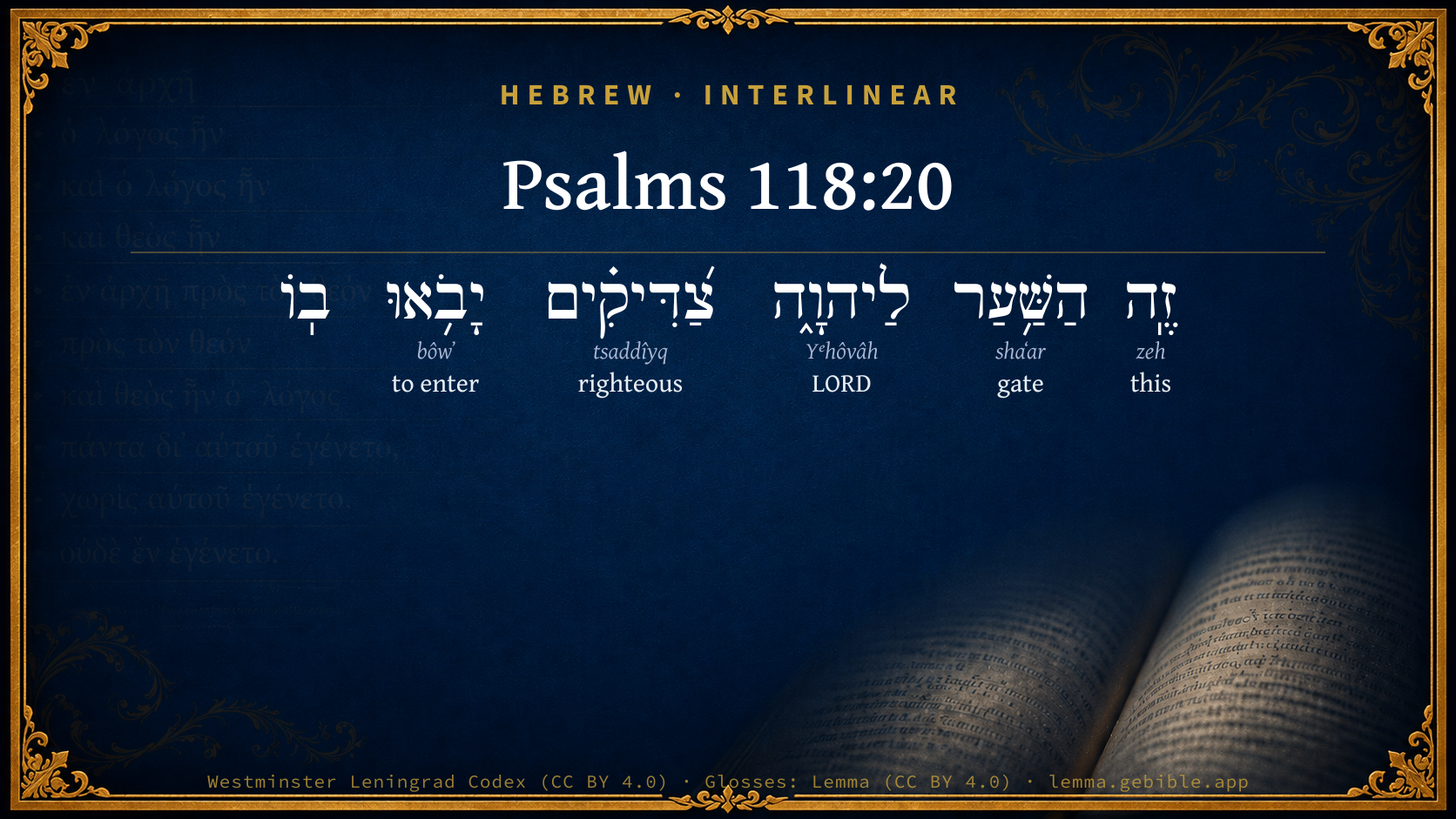
צַ֝דִּיקִ֗ים
tsaddîyq
H6662
“righteous”
Adjective, Adjective, Masculine, Plural, Absolute
Part of Speech
Adjective
Type
Adjective
Gender
Masculine
Number
Plural
State
Absolute
Full BDB Definition

Origin: from H6663

TWOT: 1879c

just, lawful, righteous - just, righteous (in government) - just, right (in one's cause) - just, righteous (in conduct and character) - righteous (as justified and vindicated by God) - right, correct, lawful
  1. זֶֽה zeh H2088 “this” Pronoun, Demonstrative, Masculine, Singular
  2. הַשַּׁ֥עַר shaʻar H8179 “the · gate” Particle, Definite Article + Noun, Common, Masculine, Singular, Absolute
  3. לַיהוָ֑ה Yᵉhôvâh H3068 “to/for · LORD” Preposition + Noun, Proper
  4. יָבֹ֥אוּ bôwʼ H935 “to enter” Verb, Qal, Imperfect, 3rd Person, Masculine, Plural

About this verse

These counts appear in no published source. They are computed here, from the morphology-tagged text and Lemma’s own curated glosses. What Lemma adds →

6
words
5
distinct lemmas
Wisdom
section

Grammatical profile

  • 1 verb
  • 2 nouns
  • 1 adjective
  • 1 pronoun
  • 1 preposition

Verb forms

  • יָבֹ֥אוּ Qal · Imperfect

Hebrew & Septuagint length

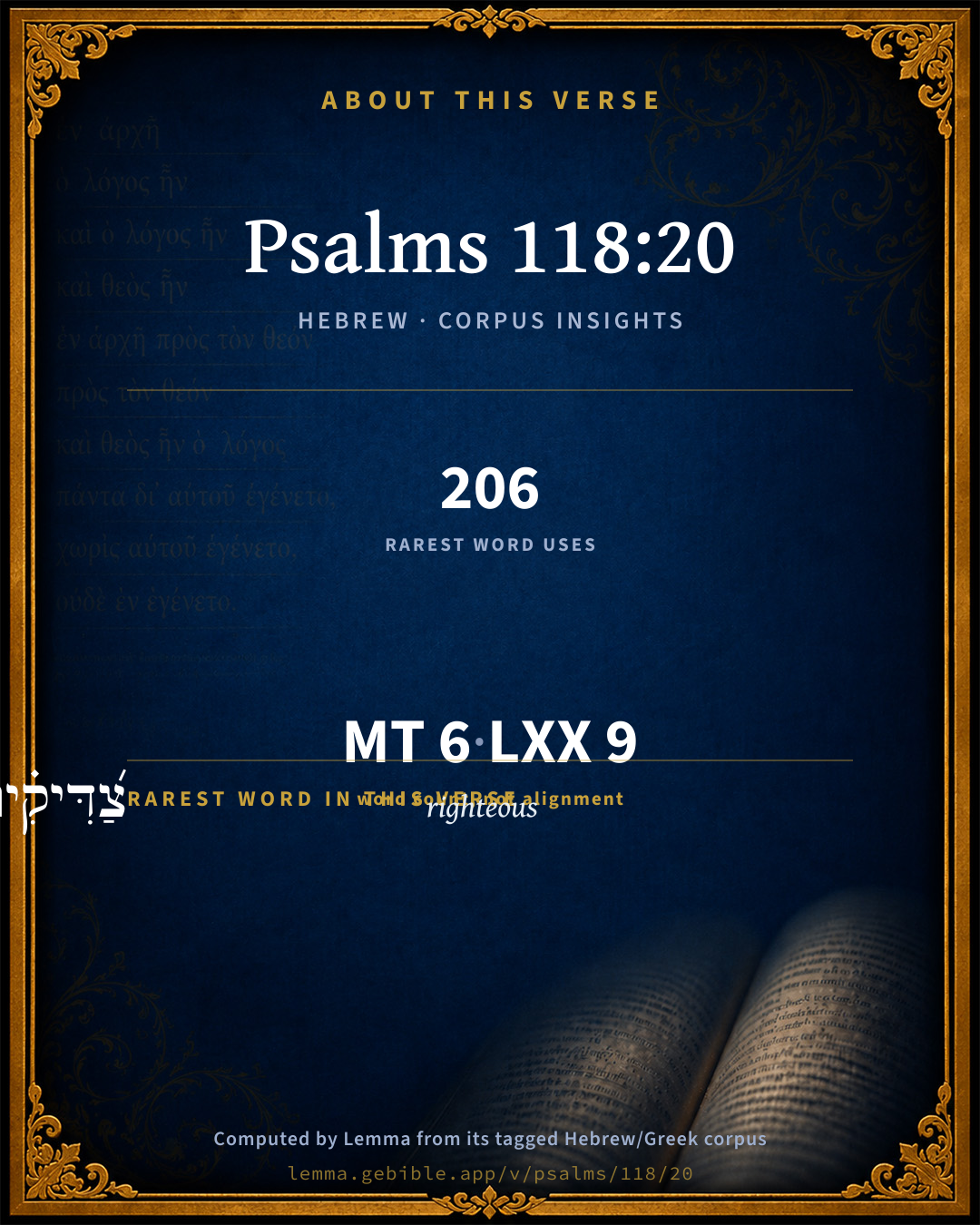
In English translation the verse runs 12 words from the Hebrew and 13 from the Septuagint (LXX English) — closely comparable.

A rough comparison of the two English renderings, which tokenize alike — not a word-level alignment.

Word counts can differ between the Hebrew and the Greek without any difference in meaning — e.g. the Hebrew direct-object marker אֵת has no separate Greek word, and Greek often adds the article ὁ.

In the original languages it is 6 Hebrew tokens and 9 Greek tokens — but the two are counted differently (Hebrew bundles its prefixes and suffixes into one token; the Greek is in lemma form), so that isn’t a like-for-like length.

Cross-references

7

Topical passages linked to Psalms 118:20 in the Treasury of Scripture Knowledge — connected by theme and wording, ordered by reader-vote popularity; previews shown in the World English Bible.

  • Revelation 21:24–27 The nations will walk in its light. The kings of the earth bring the glory and honor of the nations into it.
  • Isaiah 26:2 Open you the gates, that the righteous nation which keeps faith may enter in.
  • Psalms 24:7 Lift up your heads, you gates; Be lifted up, you everlasting doors: The King of glory will come in.
  • Psalms 24:3–4 Who may ascend to Yahweh's hill? Who may stand in his holy place?
  • Psalms 24:9 Lift up your heads, you gates; Yes, lift them up, you everlasting doors: The King of glory will come in.
  • Isaiah 35:8–10 A highway shall be there, and a way, and it shall be called The way of holiness. The unclean shall not pass over it, but is shall be for for him who walks in the Way. Wicked fools will not go there.
  • Revelation 22:14–15 Blessed are those who do his commandments, that they may have the right to the tree of life, and may enter in by the gates into the city.

Cross-references courtesy of OpenBible.info (CC BY 4.0).

Hebrew and Greek witnesses Masoretic Hebrew ↔ Greek Septuagint

The same verse in the two great witnesses to the Old Testament, shown verse-for-verse.

You’re reading Greek Psalm 117 (Hebrew Psalm 118). The Septuagint counts the superscription, so verse numbers can differ from the Hebrew — chapter-level alignment, not verse-by-verse. Numbering follows Rahlfs.

These are two independent witnesses, not word-aligned to each other, and the Septuagint is shown in lemma (dictionary) form.

Hebrew Psalms 118:20 Masoretic · Westminster Leningrad Codex

זֶֽה הַשַּׁ֥עַר לַיהוָ֑ה צַ֝דִּיקִ֗ים יָבֹ֥אוּ בֽוֹ

This is the gate of Yahweh; The righteous will enter into it.

World English Bible · Public Domain

Greek LXX Greek Psalm 117:20 Septuagint · lemma form

οὗτος ὁ πύλη ὁ κύριος δίκαιος εἰςἔρχομαι ἐν αὐτός

This is the gate of the Lord: the righteous shall enter by it.

LXX2012 (modern English Septuagint) · Public Domain

Hebrew: Westminster Leningrad Codex (CC BY 4.0). Greek: Septuagint (public domain); English from LXX2012 (modern English Septuagint) (Public Domain). How the Septuagint differs from the Hebrew →

Commentary

Notes on Psalms 118:20 from classic Christian and Jewish commentators (each source and its license shown beneath its notes). The classic Christian expositions comment on the surrounding passage and are grouped to its opening verse, so a note may address several verses; the Jewish commentaries on the Tanakh (Rashi and others) are per-verse, so they appear only where the commentator wrote on this verse.

Lemma curates 59 commentaries, every one of them public domain or Creative Commons licensed, each selected and text-cleaned for this edition rather than reprinted as found. About our sources →

Trapp's Complete Commentary

John Trapp

Psa 118:20 This gate of the LORD, into which the righteous shall enter.

Ver. 20. This gate of the Lord] Some make the former verse the request of the people, and this to be God’s answer thereunto. Others make that to be David’s speech to the Levites, and this their answer: q.d. This beautiful gate is fit to be opened to the Lord alone; if others enter, they must be righteous ones only, and that to praise him.

Into which the righteous shall enter] sc. With God’s good leave and liking. Others may haply thrust into the Church, but then God will say, Friend, how camest thou in hither? who required these things at your hands? who sent for you? O generation of vipers, who hath forewarned you to flee from the wrath to come? "The sacrifice of the wicked is abomination: how much more, when he bringeth it with a wicked mind?" Pro 21:27.

John Trapp, A Commentary or Exposition upon All the Books of the Old and New Testament (1647–1656) — public domain. Text from a community e-Sword module.

Joseph Benson's Commentary

Psa 118:20. This is the gate of the Lord — These may be considered as the words of the Levites, the porters, returning this answer to the foregoing demand. This is the gate of the Lord, which thou seekest, and which shall be opened to thee, according to thy desire and thy just privilege; for thou art one of those righteous ones to whom this of right belongs.

Joseph Benson's Commentary on the Old and New Testaments (1811–1818) — public domain. Text from a community e-Sword module.

J. A. Alexander on Psalms

Joseph Addison Alexander

20. (Psa 118:20) This (is) the gate (that belongs) to Jehovah; the righteous shall come in by it. Or the meaning may be, since this is the Lord's gate, let the righteous (and no others) enter at it. Many interpreters find obvious indications here of double or responsive choirs, by which the psalm was to be sung. But this, though possible, is not a necessary supposition, nor is there any certain trace of such a usage or arrangement elsewhere in the book of Psalms.

Joseph Addison Alexander, The Psalms Translated and Explained (1850) — public domain. Text from a community e-Sword module.

Adam Clarke's Commentary

Verse 20. This gate of the Lord] Supposed to be the answer of the Levites to the request of the king.

Adam Clarke's Commentary on the Bible (1810–1826) — public domain. Text from a community e-Sword/MySword module.

The Cambridge Bible for Schools and Colleges

gen. ed. J. J. S. Perowne

20. This is the gate that belongs to Jehovah;

The righteous may enter into it.

The emphasis is on righteous. Those who would enter must be righteous like Him Who dwells there. Cp. Psa_15:1 ff.; Psa_24:3 ff.; Isa_26:2.

The Cambridge Bible for Schools and Colleges (gen. ed. J. J. S. Perowne; Cambridge University Press, 1878–1918) — public domain. Text from a community e-Sword module.

John Gill's Exposition

This is the Lord's doing,.... This stone is from the Lord, Gen 49:24; it is of his choosing, appointing, and laying: the rejection of it by the builders is through his permission and will; they did no other things than what his hand and counsel determined should be done, Act 2:23; and the exaltation of it, or the making it the head of the corner, was of him; he highly exalted him at his right hand, above every name, creature, and thing;

it is marvellous in our eyes; the stone itself is wonderful to look at, for its beauty, strength, and usefulness; the wisdom, love, care, and power of God, in laying it, are astonishing; the distinguishing grace of God in selecting some stones out of the common quarry, making them lively stones, and building them on this foundation stone, is exceeding marvellous: and so are both the rejection and exaltation of it; that so precious a stone should be refused, and, when treated with so much neglect and contempt, should be exalted. The Targum is,

"from the Lord was this, said the builders; this is marvellous in our sight, said the sons of Jesse.''

John Gill's Exposition of the Whole Bible (1746–1763) — public domain (CC PDM 1.0). Text via the HelloAO Bible API.

Albert Barnes' Notes on the Bible

This gate of the Lord - This gate dedicated to the service of the Lord; that belongs to the house of the Lord.

Into which the righteous shall enter - Through which the righteous pass. That is, It is for such persons, and all who come with a purpose to serve and worship God should be permitted to pass through them; I claim the privilege, therefore, of so passing through these gates into the house of God, for I come to praise him. All who are truly righteous, all who desire to worship God, all who wish and purpose to be holy, have a right thus to enter the house of God - to be recognized as his friends - to be permitted to join in all the devotions of his people; all such will have a right to enter the temple above. None have a right to exclude them here; none in heaven will be disposed to exclude them there.

Albert Barnes' Notes on the Bible (1834–1885) — public domain. Text from a community e-Sword/MySword module.

Matthew Poole's English Annotations

These may be the words either,

1. Of the Levites, the porters returning this answer to the foregoing question: This is the gate of the Lord which thou seekest, and which shall be opened to thee according to thy desire, and thy just privilege, for then art one of those righteous ones to whom this of right belongs. Or,

2. Of David himself, who stands as it were pausing and contemplating before he makes his entrance: This, this is that holy and blessed gate, which I so long and earnestly thirsted for in my banishment, and which is now very beautiful in my sight, into which I will enter, and all other righteous persons by my example and encouragement. But as David was a type of Christ and the temple of heaven, so this place hath a further prospect than David, and relates to Christ’s ascending into heaven, and opening the gates of that blessed temple, both for himself, and for all righteous men or believers.

Matthew Poole's English Annotations on the Holy Bible (1683–1685) — public domain. Text from a community e-Sword/MySword module.

The Treasury of David

Charles H. Spurgeon

Ver. 20. This gate of the LORD, into which the righteous shall enter. Psalmist loves the house of God so well that he admires the very gate thereof, and pauses beneath its arch to express his affection for it. He loved it because it was the gate of the Lord, he loved it because it was the gate of righteousness, because so many godly people had already entered it, and because in all future ages such persons will continue to pass through its portals. If the gate of the Lord's house on earth is so pleasant to us, how greatly shall we rejoice when we pass that gate of pearl, to which none but the righteous shall ever approach, but through which all the just shall in due time enter to eternal felicity. The Lord Jesus has passed that way, and not only set the gate wide open, but secured an entrance for all those who are made righteous in his righteousness: all the righteous must and shall enter there, whoever may oppose them. Under another aspect our Lord is himself that gate, and through him, as the new and living Way, all the righteous delight to approach unto the Lord. Whenever we draw near to praise the Lord we must come by this gate; acceptable praise never climbs over the wall, or enters by any other way, but comes to God in Christ Jesus; as it is written, "no man cometh unto the Father but by me." Blessed, for ever blessed, be this wondrous gate of the person of our Lord.

Psalms 118:21*

Charles H. Spurgeon's The Treasury of David (1869–1885) — public domain. Psalms only. Text from a community e-Sword/MySword module.

Whedon's Commentary on the Bible

Daniel D. Whedon

20-27. These verses contain the response (Delitzsch) of the singers within the court, who receive the festal procession.

The stone—A proverbial expression, denoting that that which was despised and cast away as worthless has become the symbol of honour and strength. It may point to the dispirited ones, (Ezr_3:12,) or, more certainly, to the contempt with which the nations had regarded Israel, who had now risen to honour; but, most of all, to Christ. See Mat_21:42; Act_4:11; 1Pe_2:4; 1Pe_2:7; Isa_28:16. Psa_118:22; Psa_118:25-26, are Messianic prophecies, to which the Holy Spirit had exalted the perceptions of the poet through the typical light of Israel’s history.

Daniel D. Whedon (gen. ed.), Commentary on the Old and New Testaments (1874–1909) — public domain. Text from a community e-Sword module.

The Pulpit Commentary

This gate of the Lord, into which the righteous shall enter; rather, this is the gate of the Lord: the righteous and they alone shall enter by it. "This verse seems to stand apart a solo, chanted by a voice out of the temple gate" (Kay). Though sinners doubtless sometimes entered, (2Ki_11:13 2Ch_26:16-20 Joh_2:14) none but the righteous had any right to enter.

The Pulpit Commentary (1880–1919), ed. H.D.M. Spence-Jones & Joseph S. Exell — public domain. Text from a community e-Sword module.

John Wesley's Explanatory Notes

The righteous - As David was a type of Christ and the temple of heaven, so this place hath a farther prospect than David, and relates to Christ's ascending into heaven, and opening the gates of that blessed temple, both for himself and for all believers.

John Wesley, Explanatory Notes Upon the Whole Bible (1754–1765) — public domain. Text via the GEBible commentary corpus.

Rashi

Rabbi Shlomo Yitzchaki (Rashi)

This is the...gate of the Temple, which is the Lord’s, and the righteous will enter therein and there... I shall thank You because You answered me from the exile.

Rashi on the Tanakh — English translations: “The Judaica Press complete Tanach with Rashi, translated by A. J. Rosenberg” (CC BY 4.0); “Pentateuch with Rashi's commentary by M. Rosenbaum and A.M. Silbermann, 1929-1934” (public domain); “The Metsudah Tanach series, Lakewood, N.J” (CC BY 4.0); and “The Book of Joshua, Metsudah Publications, 1997” (CC BY 4.0). Text via Sefaria.

Lesson kit

Teaching starters — assembled from the data on this page, not authored interpretation. Every prompt links to the verse data it draws on. Edit before teaching.

Psalms, in the Wisdom, opens this verse with 6 words (5 distinct Hebrew lemmas). Its most distinctive word is tsaddîyq (“righteous”). A historical commentator’s framing appears above. Read the whole chapter for the surrounding context.

Discussion questions

  1. What does “righteous” (tsaddîyq) contribute to the verse as a whole?
  2. Revelation 21:24–27 shares this passage’s theme. How do the two illuminate each other?
  3. These translations render this verse differently. What is at stake in choosing one wording over another?
  4. The verb «יָבֹ֥אוּ» is Qal Imperfect. How does its form color the action?
  5. Reading how Trapp's Complete Commentary and Joseph Benson's Commentary read this verse, where do the two commentators agree and where do they part?

Things to notice

Reading settings

Reading text

Shown beneath each verse's original-language words.

Old Testament
Old Testament edition

Read the OT as the Masoretic Hebrew (MT) or the Greek Septuagint (LXX).

English shown for the Greek Septuagint (in the Hebrew ↔ Greek comparison).

Comparing translations? Open the Compare panel on any verse page to stack up to four side by side.