
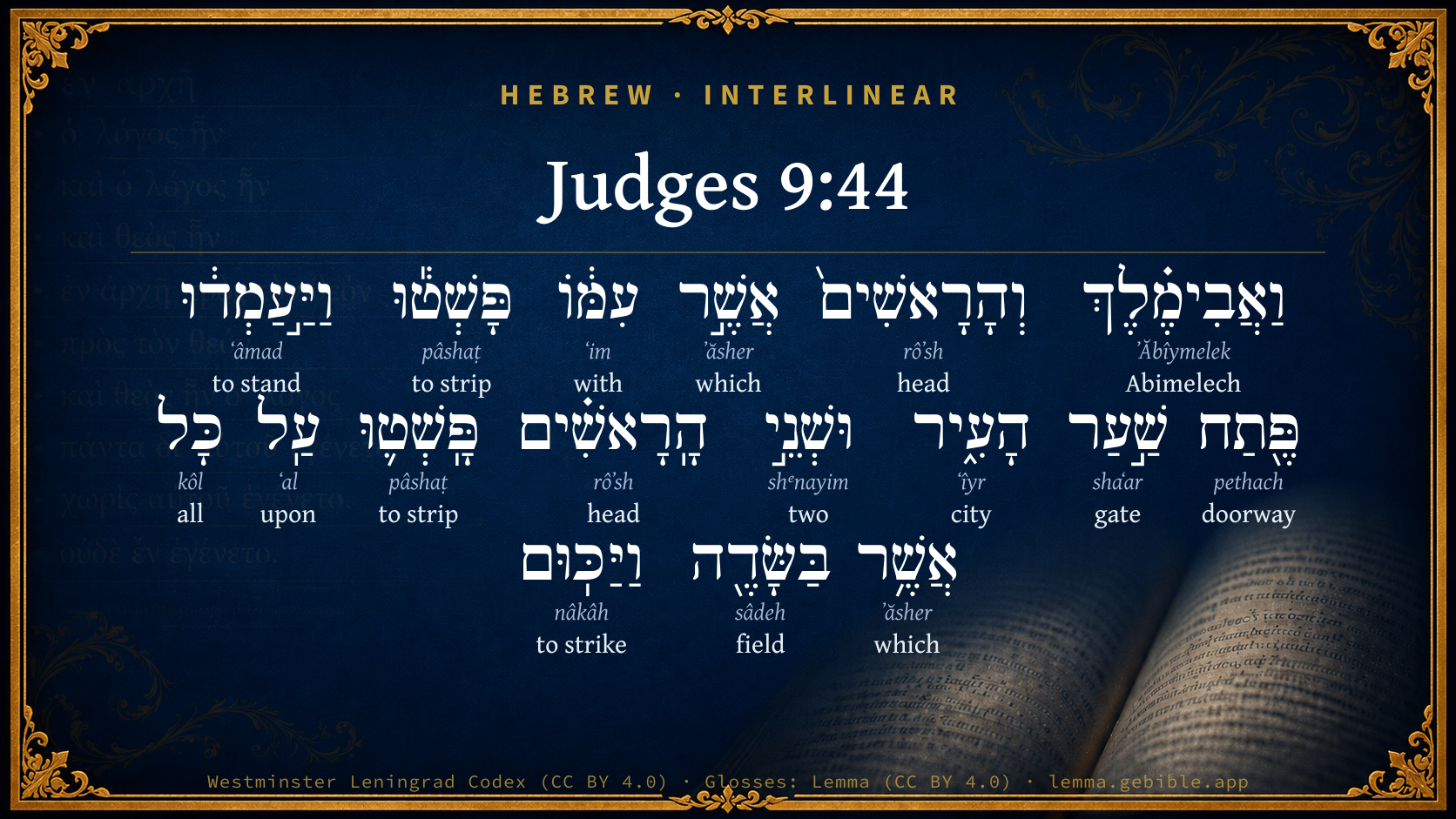
Judges 9:44

Hebrew (Westminster Leningrad Codex) Judges 9:44 appears in the Hebrew Old Testament. The text above is from the Westminster Leningrad Codex. Each word links to its Strong’s number, a concise gloss, and parsing drawn from the Open Scriptures Hebrew Bible morphology. Click any word for its full Brown-Driver-Briggs (BDB) entry.
Download image
Cite this verse

Judges 9:44 (World English Bible). Public Domain. Lemma interlinear Bible study tool, https://lemma.gebible.app/v/judges/9/44.

Show BibTeX & RIS
BibTeX
RIS
English Translation
Abimelech, and the companies that were with him, rushed forward, and stood in the entrance of the gate of the city: and the two companies rushed on all who were in the field, and struck them.
World English Bible · Public Domain
Download a study sheet

One document with this verse’s original text, its word-by-word gloss line, the meaning frame, cross-references with their text, attributed commentary, and full source and license credits — printable, and it pastes into notes with its structure intact.

This verse Autodidact and up

Study sheet (.html) Plain text (.txt)

A passage Seminary Student

Up to 50 verses in one chapter. A passage sheet keeps up to 6 commentary sources and 12 cross-references per verse, in the order this page ranks them, and says so on the sheet whenever that leaves anything out. Ask for a single verse and you get the Autodidact verse sheet above.

Everything on this page stays free to read, with no account — the sheet is a download of what is already on screen, not access to it.

Want to remove ads? Support Godless Engineer
Compare translations 3

The same verse in 3 English versions, stacked beneath the original-language interlinear above. Click any original word for its lexicon entry.

Each is an independent rendering of the whole verse — the interlinear is not word-aligned to these translations.

Highlighted words mark where these versions differ — a whole-verse word diff, not a word-by-word alignment.

  • World English Bible Public Domain
    Abimelech, and the companies that were with him, rushed forward, and stood in the entrance of the gate of the city: and the two companies rushed on all who were in the field, and struck them.
  • King James Version Public Domain
    And Abimelech, and the company that was with him, rushed forward, and stood in the entering of the gate of the city: and the two other companies ran upon all the people that were in the fields, and slew them.
  • unfoldingWord Literal Text CC BY-SA 4.0
    For Abimelech and the companies that with him rushed out. And they stood the entrance of the gate of the city, while two of the companies rushed against all who in the field and killed them.

unfoldingWord Literal Text — © unfoldingWord, licensed CC BY-SA 4.0. Word-aligned USFM3 via Door43 (git.door43.org/unfoldingWord/en_ult).

Versions to compare (up to 4)

3 of 4 selected

Show all 18 translations

Every available English version of this verse, each an independent rendering of the whole verse.

  • World English Bible Public Domain
    Abimelech, and the companies that were with him, rushed forward, and stood in the entrance of the gate of the city: and the two companies rushed on all who were in the field, and struck them.
  • Berean Standard Bible Public Domain
    Then Abimelech and the companies with him rushed forward and took their stand at the entrance of the city gate. The other two companies rushed against all who were in the fields and struck them down.
  • Majority Standard Bible Public Domain
    Then Abimelech and the companies with him rushed forward and took their stand at the entrance of the city gate. The other two companies rushed against all who were in the fields and struck them down.
  • King James Version Public Domain
    And Abimelech, and the company that was with him, rushed forward, and stood in the entering of the gate of the city: and the two other companies ran upon all the people that were in the fields, and slew them.
  • American Standard Version (1901) Public Domain
    And Abimelech, and the companies that were with him, rushed forward, and stood in the entrance of the gate of the city: and the two companies rushed upon all that were in the field, and smote them.
  • Revised Version (1885) Public Domain
    And Abimelech, and the companies that were with him, rushed forward, and stood in the entering of the gate of the city: and the two companies rushed upon all that were in the field, and smote them.
  • Geneva Bible (1599) Public Domain
    And Abimelech, and the bandes that were with him, russhed forwarde, and stoode in the entring of the gate of the citie: and the two other bandes ran vpon all the people that were in the fielde and slewe them.
  • Douay-Rheims (1899) Public Domain
    With his own company, assaulting and besieging the city: whilst the two other companies chased the enemies that were scattered about the field.
  • Young's Literal Translation Public Domain
    And Abimelech and the detachments who `are' with him have pushed on, and stand at the opening of the gate of the city, and the two detachments have pushed against all who are in the field, and smite them,
  • Literal Standard Version CC BY-SA 4.0
    And Abimelech and the detachments who [are] with him have pushed on, and stand at the opening of the gate of the city, and the two detachments have pushed against all who are in the field, and strike them,
  • Unlocked Literal Bible CC BY-SA 4.0
    Abimelech and the units that were with him attacked and blocked the entrance to the city gate. The other two units attacked all who were in the field and killed them.
  • unfoldingWord Literal Text CC BY-SA 4.0
    For Abimelech and the companies that with him rushed out. And they stood the entrance of the gate of the city, while two of the companies rushed against all who in the field and killed them.
  • Darby Bible Public Domain
    Abim'elech and the company that was with him rushed forward and stood at the entrance of the gate of the city, while the two companies rushed upon all who were in the fields and slew them.
  • World Messianic Bible Public Domain
    Abimelech and the companies that were with him rushed forward and stood in the entrance of the gate of the city; and the two companies rushed on all who were in the field and struck them.
  • Webster's Bible Public Domain
    And Abimelech, and the company that was with him, rushed forward, and stood in the entrance of the gate of the city: and the two other companies ran upon all the people that were in the fields, and slew them.
  • Free Bible Version CC BY-SA 4.0
    Abimelech and his company raced to occupy the town's entrance gate, while the two companies raced to attack everyone in the fields and kill them.
  • Bible in Basic English Public Domain
    And Abimelech with his band made a rush, and took up their position at the doorway into the town; and the other two bands made a rush on all those who were in the fields, and overcame them.
  • JPS Tanakh (1917) Public Domain
    And Abimelech, and the companies that were with him, rushed forward, and stood in the entrance of the gate of the city; and the two companies rushed upon all that were in the field, and smote them.

Literal Standard Version (2020), Covenant Press — licensed CC BY-SA 4.0. Text via the HelloAO Bible API (eBible.org). Unlocked Literal Bible (unfoldingWord) — licensed CC BY-SA 4.0. Text via the HelloAO Bible API (eBible.org). unfoldingWord Literal Text — © unfoldingWord, licensed CC BY-SA 4.0. Word-aligned USFM3 via Door43 (git.door43.org/unfoldingWord/en_ult). Free Bible Version, Dr. Jonathan Gallagher — licensed CC BY-SA 4.0. Text via the HelloAO Bible API (eBible.org).

Word by word

More ways to search: Search by grammar → Find every occurrence → Compare this word →

Practice this passage: Drill this verse → Learn its vocabulary →

פָּשְׁט֕וּ
pâshaṭ
H6584
“to strip”
Verb, Qal, Perfect, 3rd Person, Common, Plural
Part of Speech
Verb
Stem
Qal
Form
Perfect
Person
3rd Person
Gender
Common
Number
Plural
Full BDB Definition

Origin: a primitive root

TWOT: 1845

to strip, invade, strip off, make a dash, raid, spread out - (Qal) - to strip off, put off - to put off (one's shelter), make a dash - (Piel) to strip - (Hiphil) - to strip of - to strip off - to flay - (Hithpael) to strip oneself of
  1. וַאֲבִימֶ֗לֶךְ ʼĂbîymelek H40 “and · Abimelech” Conjunction + Noun, Proper
  2. וְהָרָאשִׁים֙ rôʼsh H7218 “and · the · heads” Conjunction + Particle, Definite Article + Noun, Common, Masculine, Plural, Absolute
  3. אֲשֶׁ֣ר ʼăsher H834 “which” Particle, Relative
  4. עִמּ֔וֹ ʻim H5973 “with · him” Preposition + Suffix, Personal, 3rd Person, Masculine, Singular
  5. וַיַּ֣עַמְד֔וּ ʻâmad H5975 “and · to stand” Conjunction + Verb, Qal, Sequential Imperfect, 3rd Person, Masculine, Plural
  6. פֶּ֖תַח pethach H6607 “doorway of” Noun, Common, Masculine, Singular, Construct
  7. שַׁ֣עַר shaʻar H8179 “gate of” Noun, Common, Masculine, Singular, Construct
  8. הָעִ֑יר ʻîyr H5892 “the · city” Particle, Definite Article + Noun, Common, Feminine, Singular, Absolute
  9. וּשְׁנֵ֣י shᵉnayim H8147 “and · two” Conjunction + Adjective, Cardinal number, Masculine, Dual, Construct
  10. הָֽרָאשִׁ֗ים rôʼsh H7218 “the · heads” Particle, Definite Article + Noun, Common, Masculine, Plural, Absolute
  11. פָּֽשְׁט֛וּ pâshaṭ H6584 “to strip” Verb, Qal, Perfect, 3rd Person, Common, Plural
  12. עַֽל ʻal H5921 “upon” Preposition
  13. כָּל kôl H3605 “all of” Noun, Common, Masculine, Singular, Construct
  14. אֲשֶׁ֥ר ʼăsher H834 “which” Particle, Relative
  15. בַּשָּׂדֶ֖ה sâdeh H7704 “in/at the · field” Preposition, Determined + Noun, Common, Masculine, Singular, Absolute
  16. וַיַּכּֽוּם nâkâh H5221 “and · to strike · them” Conjunction + Verb, Hiphil, Sequential Imperfect, 3rd Person, Masculine, Plural + Suffix, Personal, 3rd Person, Masculine, Plural

About this verse

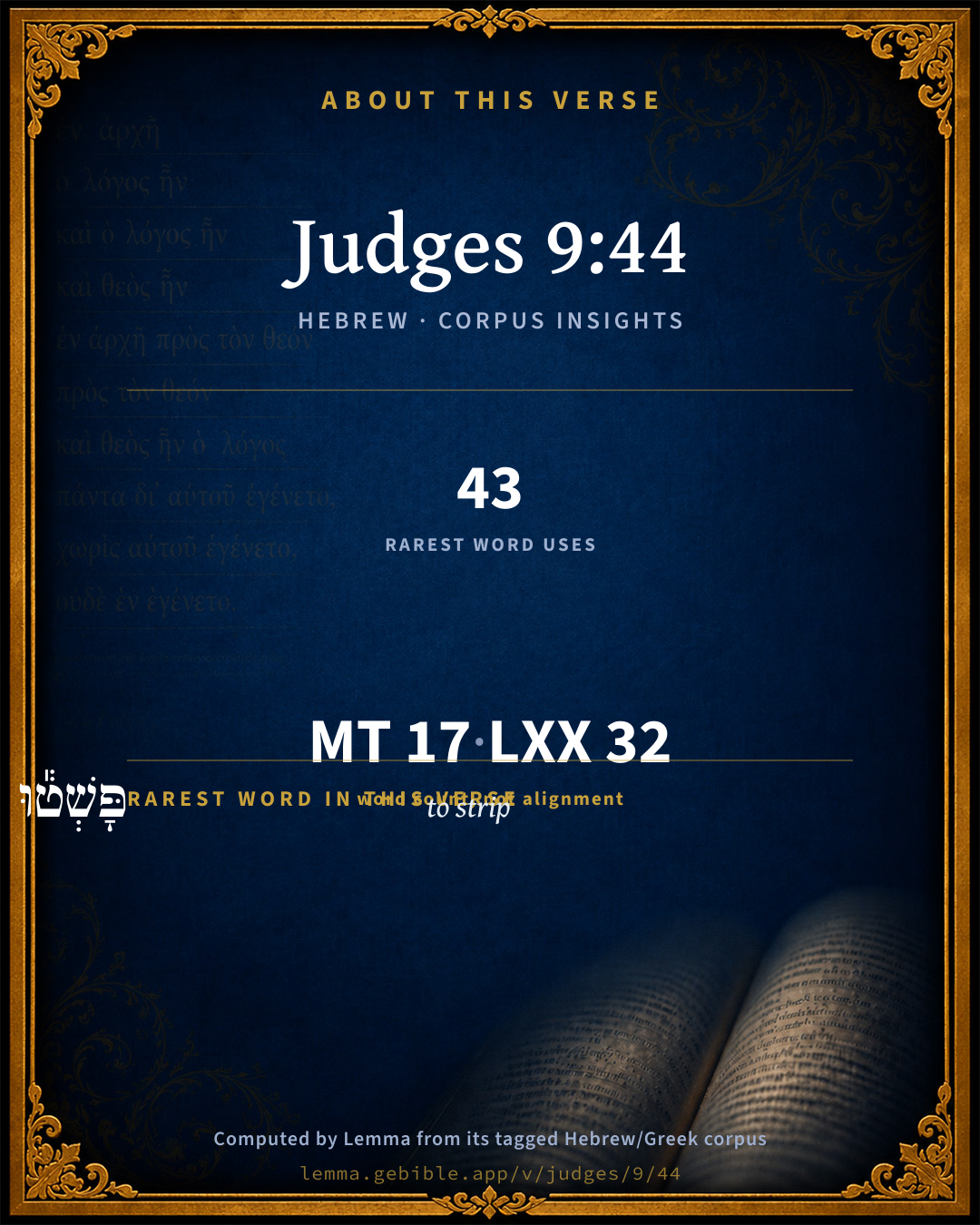
These counts appear in no published source. They are computed here, from the morphology-tagged text and Lemma’s own curated glosses. What Lemma adds →

17
words
14
distinct lemmas
Historical
section

Shared distinctive vocabulary

פָּשְׁט֕וּ to strip H6584 occurs in 42 verses of the Hebrew Bible. Also found in:

Grammatical profile

  • 4 verbs
  • 8 nouns
  • 1 adjective
  • 2 prepositions
  • 2 particles

Verb forms

  • פָּשְׁט֕וּ Qal · Perfect
  • וַיַּ֣עַמְד֔וּ Qal · Sequential Imperfect
  • פָּֽשְׁט֛וּ Qal · Perfect
  • וַיַּכּֽוּם Hiphil · Sequential Imperfect

Repetition

Words recur within this verse — often emphatic in Hebrew:

  • וְהָרָאשִׁים֙ head H7218 ×2
  • פָּשְׁט֕וּ to strip H6584 ×2
  • אֲשֶׁ֣ר which H834 ×2

Hebrew & Septuagint length

In English translation the verse runs 36 words from the Hebrew and 41 from the Septuagint (LXX English) — closely comparable.

A rough comparison of the two English renderings, which tokenize alike — not a word-level alignment.

Word counts can differ between the Hebrew and the Greek without any difference in meaning — e.g. the Hebrew direct-object marker אֵת has no separate Greek word, and Greek often adds the article ὁ.

In the original languages it is 17 Hebrew tokens and 32 Greek tokens — but the two are counted differently (Hebrew bundles its prefixes and suffixes into one token; the Greek is in lemma form), so that isn’t a like-for-like length.

Cross-references

3

Topical passages linked to Judges 9:44 in the Treasury of Scripture Knowledge — connected by theme and wording, ordered by reader-vote popularity; previews shown in the World English Bible.

  • Galatians 5:15 But if you bite and devour one another, be careful that you don't consume one another.
  • Judges 9:15 The bramble said to the trees, If in truth you anoint me king over you, then come and take refuge in my shade; and if not, let fire come out of the bramble, and devour the cedars of Lebanon.
  • Judges 9:20 but if not, let fire come out from Abimelech, and devour the men of Shechem, and the house of Millo; and let fire come out from the men of Shechem, and from the house of Millo, and devour Abimelech.

Cross-references courtesy of OpenBible.info (CC BY 4.0).

Hebrew and Greek witnesses Masoretic Hebrew ↔ Greek Septuagint

The same verse in the two great witnesses to the Old Testament, shown verse-for-verse.

These are two independent witnesses, not word-aligned to each other, and the Septuagint is shown in lemma (dictionary) form.

Hebrew Judges 9:44 Masoretic · Westminster Leningrad Codex

וַאֲבִימֶ֗לֶךְ וְהָרָאשִׁים֙ אֲשֶׁ֣ר עִמּ֔וֹ פָּשְׁט֕וּ וַיַּ֣עַמְד֔וּ פֶּ֖תַח שַׁ֣עַר הָעִ֑יר וּשְׁנֵ֣י הָֽרָאשִׁ֗ים פָּֽשְׁט֛וּ עַֽל כָּל אֲשֶׁ֥ר בַּשָּׂדֶ֖ה וַיַּכּֽוּם

Abimelech, and the companies that were with him, rushed forward, and stood in the entrance of the gate of the city: and the two companies rushed on all who were in the field, and struck them.

World English Bible · Public Domain

Greek LXX Judges 9:44 Septuagint · lemma form

καί αβιμελεχ καί ὁ ἀρχηγός ὁ μετά αὐτός ἐκτείνω καί ἵστημι παρά ὁ θύρα ὁ πύλη ὁ πόλις καί ὁ δύο ἀρχή ἐκτείνω ἐπί πᾶς ὁ ἐν ὁ ἀγρός καί πατάσσω αὐτός

And Abimelech and the chiefs of companies that were with him rushed forward, and stood by the door of the gate of the city; and the two other companies rushed forward upon all that were in the field, and struck them.

LXX2012 (modern English Septuagint) · Public Domain

On this verse, The Cambridge Bible for Schools and Colleges discusses the Septuagint’s reading. Read the note in Commentary ↓

Hebrew: Westminster Leningrad Codex (CC BY 4.0). Greek: Septuagint (public domain); English from LXX2012 (modern English Septuagint) (Public Domain). How the Septuagint differs from the Hebrew →

Targum (Aramaic paraphrase)

1

The Targum is the ancient Jewish Aramaic paraphrase of the Hebrew Scriptures — an interpretive translation, not the Hebrew text itself. Onkelos (literal) and Pseudo-Jonathan (expansive) render the Torah, and Jonathan the Prophets. Coverage is partial: where no permissively-licensed English translation exists for a verse, only the Aramaic is shown. This is verse-level text, not a word-by-word alignment to the Hebrew.

  1. Targum Jonathan Prophets (Joshua–Malachi)
    וַאֲבִימֶלֶךְ וְכָל מַשִׁרְיָן דְעִמֵיהּ אִתְנְגִידוּ וְקָמוּ בְּמַעֲלָנָא דִתְרַע קַרְתָּא וְתַרְתֵּין מַשִׁרְיָן אִתְנְגִידוּ עַל כָּל דִי בְחַקְלָא וְקַטְלוּנוּן:

    (no public-domain English translation for this verse)

    Targum Jonathan — Aramaic: “Mikraot Gedolot” (public domain). English: “Sefaria Community Translation” (CC0 1.0 (public-domain dedication)); “London "Chaldee Paraphrase," 1871” (public domain). Text via Sefaria.

Commentary

Notes on Judges 9:44 from classic Christian and Jewish commentators (each source and its license shown beneath its notes). The classic Christian expositions comment on the surrounding passage and are grouped to its opening verse, so a note may address several verses; the Jewish commentaries on the Tanakh (Rashi and others) are per-verse, so they appear only where the commentator wrote on this verse.

Lemma curates 59 commentaries, every one of them public domain or Creative Commons licensed, each selected and text-cleaned for this edition rather than reprinted as found. About our sources →

Trapp's Complete Commentary

John Trapp

Jdg 9:44 And Abimelech, and the company that [was] with him, rushed forward, and stood in the entering of the gate of the city: and the two [other] companies ran upon all [the people] that [were] in the fields, and slew them.

Ver. 44. Ran upon all the people.] Omnia sunt misera in bellis civilibus, saith Cicero. Civil war is a woe which no words, how wide soever, are able to express.

John Trapp, A Commentary or Exposition upon All the Books of the Old and New Testament (1647–1656) — public domain. Text from a community e-Sword module.

Ellicott's Commentary for English Readers

(44) In the entering of the gate of the city.—This time he was able to intercept the people before they could get back, and he had reserved the post of honour and peril for himself.

A Bible Commentary for English Readers, edited by Charles John Ellicott (1878–1897) — public domain. Text from a community e-Sword module.

The Cambridge Bible for Schools and Colleges

gen. ed. J. J. S. Perowne

44. the companies that were] Read the company that was, with Vulgate and some mss. of LXX; rushed forward, as the same word in Jdg_9:33 is to be rendered.

The Cambridge Bible for Schools and Colleges (gen. ed. J. J. S. Perowne; Cambridge University Press, 1878–1918) — public domain. Text from a community e-Sword module.

John Gill's Exposition

And Abimelech fought against the city all that day,.... By throwing stones or arrows into it:

and he took the city; it was surrendered to him, not being able to stand out against his forces:

and slew the people that was therein; all but those that were of his own family and his friends; all that had taken up arms against him, or had shown their dislike of his government, and were his enemies:

and beat down the city; the houses in it, and walls of it, though it was his native place:

and sowed it with salt; not to make it barren, for he would rather then have sowed the field, though this would not have had any effect of that kind, for any time at least; but to show his detestation of it, because of the ill usage he had met with, and as a token of its perpetual destruction, to which he devoted it, determining that if it was in his power it should never be rebuilt; but it was hereafter, and became again a very flourishing city in Jeroboam's time. Thus the Emperor Frederic Barbarossa, in the year 1162, when he took Milan, not only ploughed it up, but sowed it with salt; and in memory of it there is a street in it, now called "la contrada della Sala" (n): besides, Abimelech did this to deter other cities from rebelling against him; for if he so used his own city, more severely, if possible, would he use others.

(n) Sigonius de regn. Ital. l. 13, & 14.

John Gill's Exposition of the Whole Bible (1746–1763) — public domain (CC PDM 1.0). Text via the HelloAO Bible API.

Albert Barnes' Notes on the Bible

This verse explains the purpose of both the present and the former division of Abimelech’s forces into several companies, namely, that while some of the companies attacked the men of Shechem in the field, another company, starting from their ambush, might occupy the approach to the city gate, and so cut off their retreat.

Albert Barnes' Notes on the Bible (1834–1885) — public domain. Text from a community e-Sword/MySword module.

Matthew Poole's English Annotations

Stood in the entering of the gate of the city, to prevent their retreat into the city, and give the other two companies opportunity to cut them off.

Matthew Poole's English Annotations on the Holy Bible (1683–1685) — public domain. Text from a community e-Sword/MySword module.

The Pulpit Commentary

The company. The Hebrew has companies, but the sense requires the singular.

The Pulpit Commentary (1880–1919), ed. H.D.M. Spence-Jones & Joseph S. Exell — public domain. Text from a community e-Sword module.

John Wesley's Explanatory Notes

Entering of the gate - To prevent their retreat into the city, and give the other two companies opportunity to cut them off.

John Wesley, Explanatory Notes Upon the Whole Bible (1754–1765) — public domain. Text via the GEBible commentary corpus.

Keil & Delitzsch

C. F. Keil & F. Delitzsch

That is to say, Abimelech and the companies with him spread themselves out and took their station by the city gate to cut off the retreat of the Shechemites into the city, whilst the other two companies fell upon all who were in the field, and slew them.

Keil & Delitzsch — Biblical Commentary on the Old Testament (1861–1891) — public domain (CC PDM 1.0). Text via the HelloAO Bible API. (Old Testament only.)

unfoldingWord translationNotes

Door43 World Missions Community

the units

"the groups of soldiers"

other two

"other 2" (See: Numbers)

Abimelech fought ... He tore down

Here "Abimelech" represents himself and his soldiers. AT: "Abimelech and his soldiers fought ... They tore down" (See: Synecdoche)

against the city

Here "city" represents the people. AT: "against the people of Shechem" (See: Metonymy)

tore down

"demolished"

spread salt over it

"spread salt over the land." Spreading salt over land keeps anything from growing there. (See: Assumed Knowledge and Implicit Information)

translationWords

Abimelech

gate

unfoldingWord translationNotes — © Distant Shores Media and the Door43 World Missions Community, licensed CC BY-SA 4.0. Source: git.door43.org/Door43/en_tn.

Rashi

Rabbi Shlomo Yitzchaki (Rashi)

At the entrance to the gateway of the city to block their entry.

Rashi on the Tanakh — English translations: “The Judaica Press complete Tanach with Rashi, translated by A. J. Rosenberg” (CC BY 4.0); “Pentateuch with Rashi's commentary by M. Rosenbaum and A.M. Silbermann, 1929-1934” (public domain); “The Metsudah Tanach series, Lakewood, N.J” (CC BY 4.0); and “The Book of Joshua, Metsudah Publications, 1997” (CC BY 4.0). Text via Sefaria.

Lesson kit

Teaching starters — assembled from the data on this page, not authored interpretation. Every prompt links to the verse data it draws on. Edit before teaching.

Judges, in the Historical, opens this verse with 17 words (14 distinct Hebrew lemmas). Its most distinctive word is pâshaṭ (“to strip”). A historical commentator’s framing appears above. Read the whole chapter for the surrounding context.

Discussion questions

  1. How does “to strip” (pâshaṭ) shape what this verse is saying?
  2. How does Genesis 37:23, which shares the word «to strip», read alongside this verse?
  3. What does the repetition of “head” (2× in this one verse) do in this verse?
  4. These translations render this verse differently. What is at stake in choosing one wording over another?
  5. «פָּשְׁט֕וּ» is a Qal Perfect verb. How does that grammatical form shape the action described?
  6. Compare how Trapp's Complete Commentary and Ellicott's Commentary for English Readers read this verse. Where do they agree or differ?

Things to notice

Reading settings

Reading text

Shown beneath each verse's original-language words.

Old Testament
Old Testament edition

Read the OT as the Masoretic Hebrew (MT) or the Greek Septuagint (LXX).

English shown for the Greek Septuagint (in the Hebrew ↔ Greek comparison).

Comparing translations? Open the Compare panel on any verse page to stack up to four side by side.