2 Kings 11:6

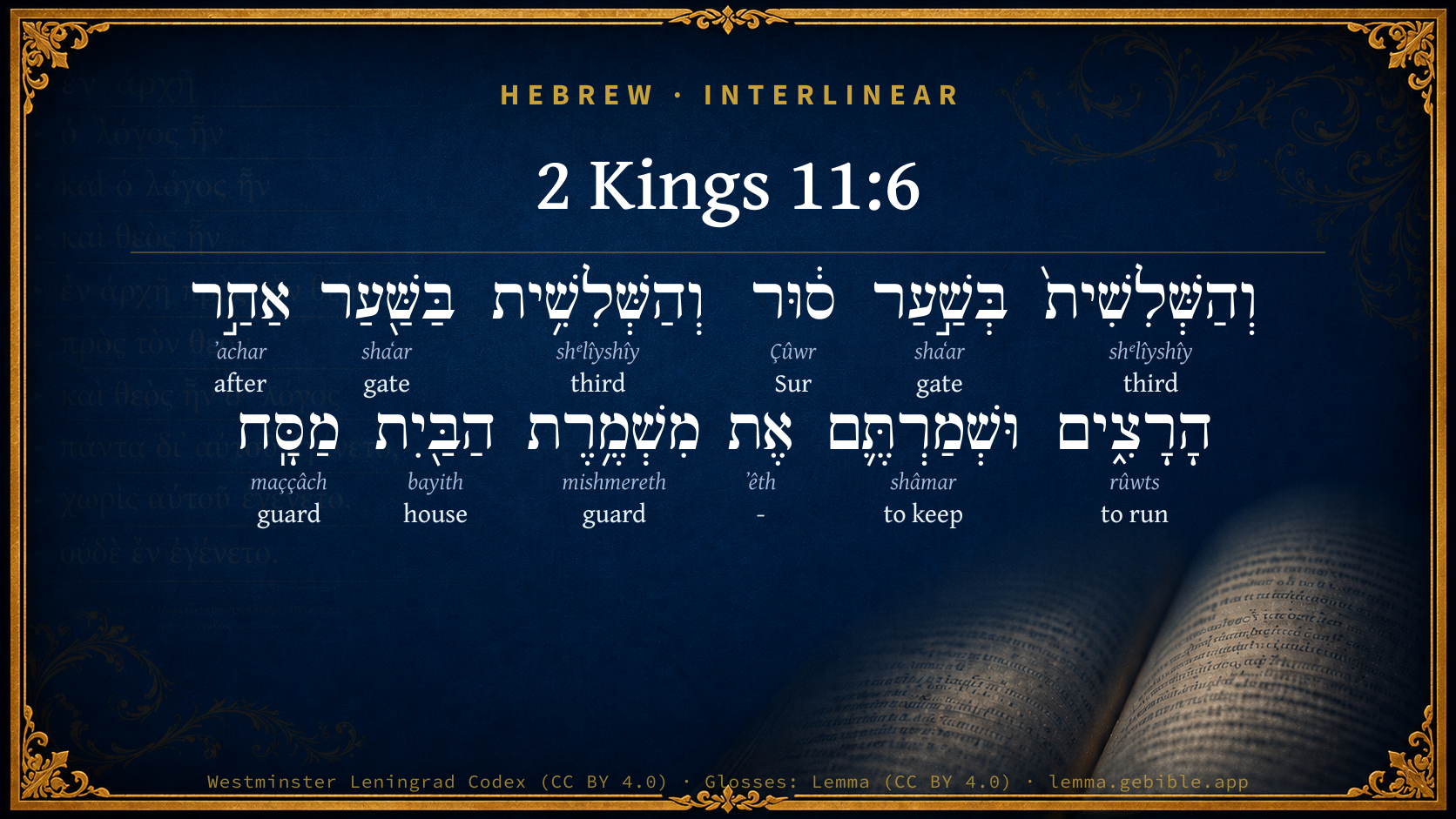
Hebrew (Westminster Leningrad Codex) 2 Kings 11:6 appears in the Hebrew Old Testament. The text above is from the Westminster Leningrad Codex. Each word links to its Strong’s number, a concise gloss, and parsing drawn from the Open Scriptures Hebrew Bible morphology. Click any word for its full Brown-Driver-Briggs (BDB) entry.
Download image
Cite this verse

2 Kings 11:6 (World English Bible). Public Domain. Lemma interlinear Bible study tool, https://lemma.gebible.app/v/2-kings/11/6.

Show BibTeX & RIS
BibTeX
RIS
English Translation
A third part shall be at the gate Sur; and a third part at the gate behind the guard: so shall you keep the watch of the house, and be a barrier.
World English Bible · Public Domain
Highlights Full analysis ↓
Download a study sheet

One document with this verse’s original text, its word-by-word gloss line, the meaning frame, cross-references with their text, attributed commentary, and full source and license credits — printable, and it pastes into notes with its structure intact.

This verse Autodidact and up

Study sheet (.html) Plain text (.txt)

A passage Seminary Student

Up to 50 verses in one chapter. A passage sheet keeps up to 6 commentary sources and 12 cross-references per verse, in the order this page ranks them, and says so on the sheet whenever that leaves anything out. Ask for a single verse and you get the Autodidact verse sheet above.

Everything on this page stays free to read, with no account — the sheet is a download of what is already on screen, not access to it.

Want to remove ads? Support Godless Engineer
Compare translations 3

The same verse in 3 English versions, stacked beneath the original-language interlinear above. Click any original word for its lexicon entry.

Each is an independent rendering of the whole verse — the interlinear is not word-aligned to these translations.

Highlighted words mark where these versions differ — a whole-verse word diff, not a word-by-word alignment.

  • World English Bible Public Domain
    A third part shall be at the gate Sur; and a third part at the gate behind the guard: so shall you keep the watch of the house, and be a barrier.
  • King James Version Public Domain
    And a third part shall be at the gate of Sur; and a third part at the gate behind the guard: so shall ye keep the watch of the house, that it be not broken down.
  • unfoldingWord Literal Text CC BY-SA 4.0
    and a third at the gate of Sur, and a third at the gate behind the runners. And you shall keep the keeping of the house, as a barrier.

unfoldingWord Literal Text — © unfoldingWord, licensed CC BY-SA 4.0. Word-aligned USFM3 via Door43 (git.door43.org/unfoldingWord/en_ult).

Versions to compare (up to 4)

3 of 4 selected

Show all 18 translations

Every available English version of this verse, each an independent rendering of the whole verse.

  • World English Bible Public Domain
    A third part shall be at the gate Sur; and a third part at the gate behind the guard: so shall you keep the watch of the house, and be a barrier.
  • Berean Standard Bible Public Domain
    a third shall be at the gate of Sur, and a third at the gate behind the guards. You are to take turns guarding the temple—
  • Majority Standard Bible Public Domain
    a third shall be at the gate of Sur, and a third at the gate behind the guards. You are to take turns guarding the temple—
  • King James Version Public Domain
    And a third part shall be at the gate of Sur; and a third part at the gate behind the guard: so shall ye keep the watch of the house, that it be not broken down.
  • American Standard Version (1901) Public Domain
    And a third part shall be at the gate Sur; and a third part at the gate behind the guard: so shall ye keep the watch of the house, and be a barrier.
  • Revised Version (1885) Public Domain
    And a third part shall be at the gate Sur; and a third part at the gate behind the guard: so shall ye keep the watch of the house, and be a barrier.
  • Geneva Bible (1599) Public Domain
    And another third part in the gate of Sur: and another thirde part in the gate behinde them of the garde: and ye shall keepe watche in the house of Massah.
  • Douay-Rheims (1899) Public Domain
    Let a third part of you go in on the sabbath, and keep the watch of the king's house. And let a third part be at the gate of Sur: and let a third part be at the gate behind the dwelling of the shieldbearers: and you shall keep the watch of the house of Messa.
  • Young's Literal Translation Public Domain
    and the third `is' at the gate of Sur, and the third at the gate behind the runners, and ye have kept the charge of the house pulled down;
  • Literal Standard Version CC BY-SA 4.0
    and the third [is] at the Gate of Sur, and the third at the gate behind the runners, and you have kept the charge of the house pulled down;
  • Unlocked Literal Bible CC BY-SA 4.0
    and a third will be at the Sur Gate, and a third at the gate behind the guardhouse.”
  • unfoldingWord Literal Text CC BY-SA 4.0
    and a third at the gate of Sur, and a third at the gate behind the runners. And you shall keep the keeping of the house, as a barrier.
  • Darby Bible Public Domain
    and a third part shall be at the gate of Sur; and a third part at the gate behind the couriers; and ye shall keep the watch of the house for a defence.
  • World Messianic Bible Public Domain
    a third of you shall be at the gate Sur; and a third of you at the gate behind the guard. So you shall keep the watch of the house, and be a barrier.
  • Webster's Bible Public Domain
    And a third part shall be at the gate of Sur; and a third part at the gate behind the guard: so shall ye keep the watch of the house, that it be not broken down.
  • Free Bible Version CC BY-SA 4.0
    One third will be at the Sur Gate, and one third at the gate behind the guards. You will alternate in guarding the palace.
  • Bible in Basic English Public Domain
    ...
  • JPS Tanakh (1917) Public Domain
    now another third part was at the gate Sur, and another third part at the gate behind the guard — shall keep the watch of the house, and be a barrier.

Literal Standard Version (2020), Covenant Press — licensed CC BY-SA 4.0. Text via the HelloAO Bible API (eBible.org). Unlocked Literal Bible (unfoldingWord) — licensed CC BY-SA 4.0. Text via the HelloAO Bible API (eBible.org). unfoldingWord Literal Text — © unfoldingWord, licensed CC BY-SA 4.0. Word-aligned USFM3 via Door43 (git.door43.org/unfoldingWord/en_ult). Free Bible Version, Dr. Jonathan Gallagher — licensed CC BY-SA 4.0. Text via the HelloAO Bible API (eBible.org).

Word by word

More ways to search: Search by grammar → Find every occurrence → Compare this word →

Practice this passage: Drill this verse → Learn its vocabulary →

ס֔וּר
Çûwr
H5495
“Sur”
Noun, Proper
Part of Speech
Noun
Type
Proper
Full BDB Definition

Origin: the same as H5494

TWOT: None

Sur = "turning aside" - a temple gate
  1. וְהַשְּׁלִשִׁית֙ shᵉlîyshîy H7992 “and · the · third” Conjunction + Particle, Definite Article + Noun, Common, Feminine, Singular, Absolute
  2. בְּשַׁ֣עַר shaʻar H8179 “in/at · gate of” Preposition + Noun, Common, Masculine, Singular, Construct
  3. וְהַשְּׁלִשִׁ֥ית shᵉlîyshîy H7992 “and · the · third” Conjunction + Particle, Definite Article + Noun, Common, Feminine, Singular, Absolute
  4. בַּשַּׁ֖עַר shaʻar H8179 “in/at the · gate” Preposition, Determined + Noun, Common, Masculine, Singular, Absolute
  5. אַחַ֣ר ʼachar H310 “after” Preposition
  6. הָרָצִ֑ים rûwts H7323 “the · running” Particle, Definite Article + Verb, Qal, Participle Active, Masculine, Plural, Absolute
  7. וּשְׁמַרְתֶּ֛ם shâmar H8104 “and · to keep” Conjunction + Verb, Qal, Sequential Perfect, 2nd Person, Masculine, Plural
  8. אֶת ʼêth H853 “-” Particle, Direct Object
  9. מִשְׁמֶ֥רֶת mishmereth H4931 “guard of” Noun, Common, Feminine, Singular, Construct
  10. הַבַּ֖יִת bayith H1004 “the · house” Particle, Definite Article + Noun, Common, Masculine, Singular, Absolute
  11. מַסָּֽח maççâch H4535 “guard” Adverb

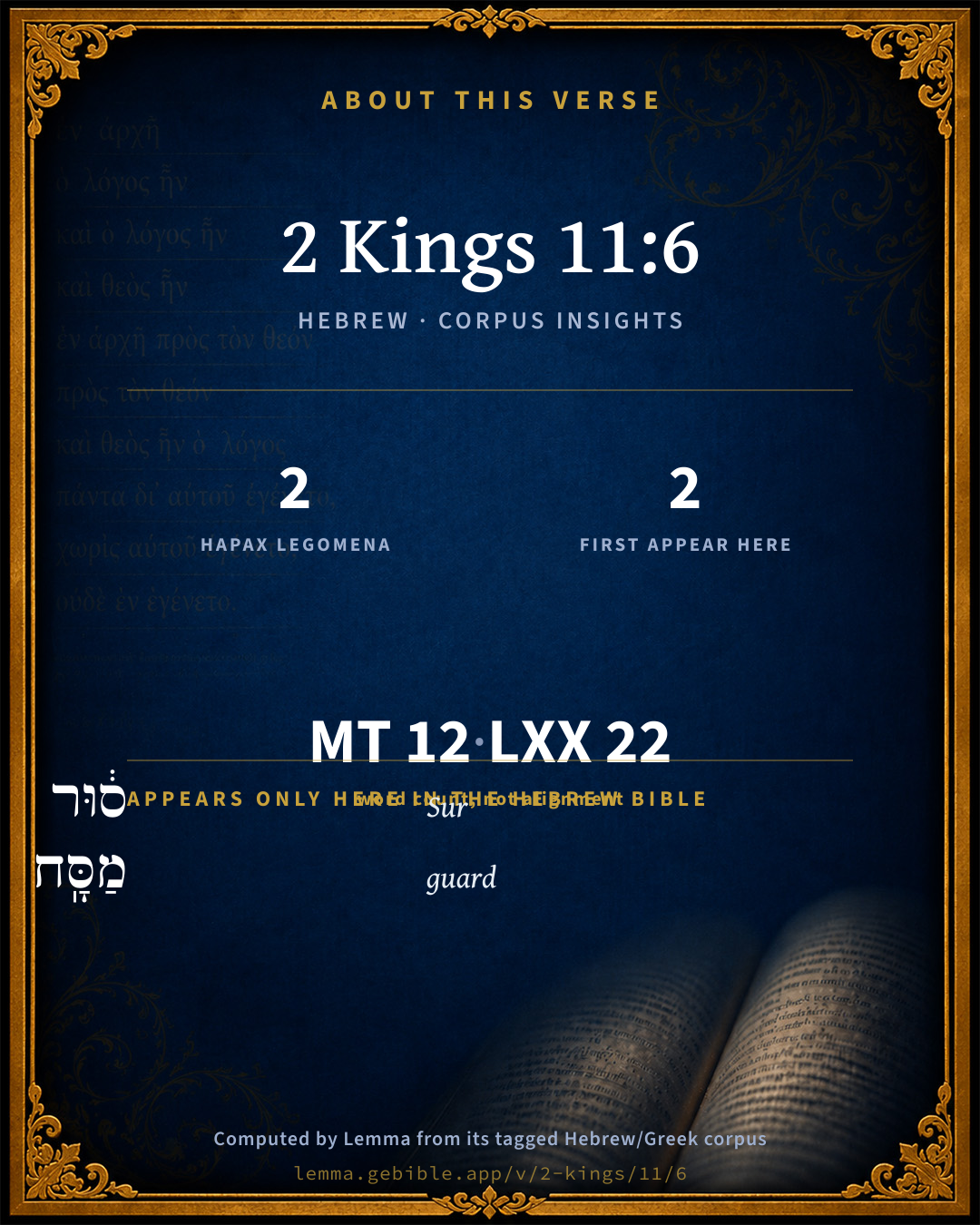
About this verse

These counts appear in no published source. They are computed here, from the morphology-tagged text and Lemma’s own curated glosses. What Lemma adds →

12
words
10
distinct lemmas
Historical
section

Notable vocabulary

2 hapax legomena — words that appear only here in the entire Hebrew Bible:

First appearance in Scripture

These words make their first canonical appearance in the Hebrew Bible here:

Grammatical profile

  • 2 verbs
  • 7 nouns
  • 1 preposition
  • 1 adverb
  • 1 particle

Verb forms

  • הָרָצִ֑ים Qal · Participle Active
  • וּשְׁמַרְתֶּ֛ם Qal · Sequential Perfect

Repetition

Words recur within this verse — often emphatic in Hebrew:

  • וְהַשְּׁלִשִׁית֙ third H7992 ×2
  • בְּשַׁ֣עַר gate H8179 ×2

Hebrew & Septuagint length

In English translation the verse runs 32 words from the Hebrew and 50 from the Septuagint (LXX English) — the Septuagint runs noticeably longer here. See the side-by-side →

A rough comparison of the two English renderings, which tokenize alike — not a word-level alignment.

Word counts can differ between the Hebrew and the Greek without any difference in meaning — e.g. the Hebrew direct-object marker אֵת has no separate Greek word, and Greek often adds the article ὁ.

In the original languages it is 12 Hebrew tokens and 22 Greek tokens — but the two are counted differently (Hebrew bundles its prefixes and suffixes into one token; the Greek is in lemma form), so that isn’t a like-for-like length.

Cross-references

2

Topical passages linked to 2 Kings 11:6 in the Treasury of Scripture Knowledge — connected by theme and wording, ordered by reader-vote popularity; previews shown in the World English Bible.

  • 1 Chronicles 26:13–19 They cast lots, the small as well as the great, according to their fathers' houses, for every gate.
  • 2 Chronicles 23:4–5 This is the thing that you shall do: a third part of you, who come in on the Sabbath, of the priests and of the Levites, shall be porters of the thresholds;

Cross-references courtesy of OpenBible.info (CC BY 4.0).

Hebrew and Greek witnesses Masoretic Hebrew ↔ Greek Septuagint

The same verse in the two great witnesses to the Old Testament, shown verse-for-verse.

Here the Septuagint runs noticeably longer than the Hebrew — LXX2012 (modern English Septuagint) 50 words vs World English Bible 32. A rough length comparison of the two English translations, not a word-level alignment — read both below.

These are two independent witnesses, not word-aligned to each other, and the Septuagint is shown in lemma (dictionary) form.

Hebrew 2 Kings 11:6 Masoretic · Westminster Leningrad Codex

וְהַשְּׁלִשִׁית֙ בְּשַׁ֣עַר ס֔וּר וְהַשְּׁלִשִׁ֥ית בַּשַּׁ֖עַר אַחַ֣ר הָרָצִ֑ים וּשְׁמַרְתֶּ֛ם אֶת מִשְׁמֶ֥רֶת הַבַּ֖יִת מַסָּֽח

A third part shall be at the gate Sur; and a third part at the gate behind the guard: so shall you keep the watch of the house, and be a barrier.

World English Bible · Public Domain

Greek LXX 2 Kings 11:6 Septuagint · lemma form

καί ὁ τρίτος ἐν ὁ πύλη ὁ ὁδός καί ὁ τρίτος ὁ πύλη ὀπίσω ὁ παρατρέχω καί φυλάσσω ὁ φυλακή ὁ οἶκος

Let a third part of you go in on the sabbath-day, and keep you⌃ the watch of the king's house in the porch; and another third in the gate of the high way, and a third at the gate behind the footmen; and keep you⌃ the guard of the house.

LXX2012 (modern English Septuagint) · Public Domain

On this verse, The Cambridge Bible for Schools and Colleges discusses the Septuagint’s reading. Read the note in Commentary ↓

Hebrew: Westminster Leningrad Codex (CC BY 4.0). Greek: Septuagint (public domain); English from LXX2012 (modern English Septuagint) (Public Domain). How the Septuagint differs from the Hebrew →

Targum (Aramaic paraphrase)

1

The Targum is the ancient Jewish Aramaic paraphrase of the Hebrew Scriptures — an interpretive translation, not the Hebrew text itself. Onkelos (literal) and Pseudo-Jonathan (expansive) render the Torah, and Jonathan the Prophets. Coverage is partial: where no permissively-licensed English translation exists for a verse, only the Aramaic is shown. This is verse-level text, not a word-by-word alignment to the Hebrew.

  1. Targum Jonathan Prophets (Joshua–Malachi)
    וְתִלְתָּא בִּתְרַע גִבָּרַיָא וְתִלְתָּא בְּתַרְעָא דְבַתְרוֹהִי תְּרַע רָהֲטַיָא וְתִטְרוּן יַת מַטְרַת בֵּיתָא מִדְאִשְׁתְּלֵי:

    (no public-domain English translation for this verse)

    Targum Jonathan — Aramaic: “Mikraot Gedolot” (public domain). English: “Sefaria Community Translation” (CC0 1.0 (public-domain dedication)); “London "Chaldee Paraphrase," 1871” (public domain). Text via Sefaria.

Commentary

Notes on 2 Kings 11:6 from classic Christian and Jewish commentators (each source and its license shown beneath its notes). The classic Christian expositions comment on the surrounding passage and are grouped to its opening verse, so a note may address several verses; the Jewish commentaries on the Tanakh (Rashi and others) are per-verse, so they appear only where the commentator wrote on this verse.

Lemma curates 59 commentaries, every one of them public domain or Creative Commons licensed, each selected and text-cleaned for this edition rather than reprinted as found. About our sources →

Trapp's Complete Commentary

John Trapp

2Ki 11:6 And a third part [shall be] at the gate of Sur; and a third part at the gate behind the guard: so shall ye keep the watch of the house, that it be not broken down.

Ver. 6. At the gate of Sur.] So called, saith Martyr, from declining or departing; because the door keepers made the unclean decline from it.

John Trapp, A Commentary or Exposition upon All the Books of the Old and New Testament (1647–1656) — public domain. Text from a community e-Sword module.

Geneva Bible (1599)

Geneva Bible translators

Or, that none break his order.

Called the East gate of the Temple, 2 Chron. 23:5.

Geneva Bible (1599) marginal notes — public domain. Text via Bolls.life.

Ellicott's Commentary for English Readers

(6) And a third part shall be at the gate of Sur.—Or, and the third (shall be on guard) at the gate of Sur, Instead of Sûr (“turning aside”) Chronicles has Jesôd (“foundation”). The gate Sur was apparently a side exit from the court of the palace, such as may be seen in the old Egyptian palaces at Medinat-Abû and Karnak. “Jesod” is another name for the same side-door, or, as is far more likely, a textual corruption of “Sur.”

And a third part at the gate behind the guard.—Literally, and the third at the gate behind the Couriers. In 2Ki_11:19 “the gate of the Couriers” is mentioned, apparently as the principal entrance to the palace enclosure. That gate and this one are probably the same. It is here called “the gate behind the Couriers” because a guard was usually stationed in front of it. Perhaps the word “behind” has originated in a mere echo of the word “gate” (‘ahar, sha’ar), and should be omitted as an error of transcription.

So shall ye keep the watch of the house.—Thus shall ye—the three divisions of the guards, entering on duty on the Sabbath—guard the entrances and exits of the royal palace.

That it be not broken down.—The Hebrew is only the one word massâh, which occurs nowhere else. It appears to mean “repulse,” “warding off,” and is probably a marginal gloss on “watch” (mishmèreth), explaining its nature—viz., that the guards were to keep back any one who tried to enter the palace buildings. Gesenius paraphrases, “ad depellendum populum” (zum Abwehren). Thenius suggests the reading “and repel”! scil., “all comers” (ûnesôah for massâh). He should have written wenâsôah.

A Bible Commentary for English Readers, edited by Charles John Ellicott (1878–1897) — public domain. Text from a community e-Sword module.

The Cambridge Bible for Schools and Colleges

gen. ed. J. J. S. Perowne

6. at the gate of Sur] R.V. omits ‘of’. This gate is nowhere else named. The similarity between the original words סור, Sur and יסור given in Chronicles, and rendered ‘foundation’, makes it not unlikely that the ‘gate Sur’ here, and ‘the gate of the foundation’ (2Ch_23:5) are the same place, though it is impossible, if this be so, to decide which is the correct reading, for ‘the gate of the foundation’ is spoken of nowhere else. The LXX. has here ἐν τῇ πύλῃ τῶν ὁδῶν, ‘in the gate of the ways’ and in Chronicles ἐν τῇ πύλῃ τῇ μέσῃ ‘at the middle gate’.

at the gate behind the guard] The guard here spoken of are the ‘runners’ who formed a part of the royal body-guard. Nothing is more likely than that such a body would have special quarters assigned to them in the neighbourhood of the palace, and if they were at this time thought to be favourable to Athaliah, the necessity would be apparent of putting a body of well-affected men close to them to keep them in check.

so shall ye keep the watch of the house] The ‘house’ is the palace, which was thus to be strongly guarded at three places.

that it be not broken down] R.V. and be a barrier. The word is a noun in apposition with ‘watch’ and defines its character. The word is unrepresented in the LXX.

The Cambridge Bible for Schools and Colleges (gen. ed. J. J. S. Perowne; Cambridge University Press, 1878–1918) — public domain. Text from a community e-Sword module.

John Gill's Exposition

And a third part shall be at the gate of Sur,.... Generally thought by the Jews to be the eastern gate, so called, as they say, because such as were defiled were bid to depart, or go back, as this word signifies, and not enter the temple; it is called "the gate of the foundation", Ch2 23:5 because, according to Ben Gersom, here the foundation of the sanctuary was first laid; it is said (b) to have five other names besides these:

and a third part at the gate behind the guard; the temple guard, which had a captain of them, Act 4:1 this gate is supposed to be the same with "sippim", or the threshold gate, Ch2 23:4 and to be the southern one:

so shall ye keep the watch of the house, that it be not broken down; guard the temple, that none break or rush into it, of Athaliah's party.

(b) T. Hieros. Yoma apud Beckium in Targ. in 2 Chron. xxiii. 5.

John Gill's Exposition of the Whole Bible (1746–1763) — public domain (CC PDM 1.0). Text via the HelloAO Bible API.

Haydock's Catholic Bible Commentary

Sabbath. On this day the Levites replaced each other; so that many might assemble without suspicion. They guarded the king’s apartments in the temple. --- The gate of Sur, or of the foundation, (2 Paralipomenon xxiii. 5.) and the western gate leading to the palace. (Calmet) --- Sur, or "the gate of the lords," (Chaldean) is generally supposed to be on the opposite side. (Menochius) --- But this is uncertain, as well as the situation of Messa, which is perhaps the Musach, chap. xvi. 18. This was probably some building or covert adjoining the temple, (Calmet) either belonging to some private person, (Menochius) or designed to contain the ashes, &c., taken from the temple; (Villalpand ii. 32.) or a tribune for the king in the temple. (Haydock) -- The Chaldean seems to have explained it as an adverb, sollicite, "with diligence," (Menochius) as well as the Septuagint, (Du Hamel) which is consonant to Vatable; you shall guard the house "from desertion." Let no one quit his post. (Menochius)

George Leo Haydock (1774–1849), Haydock's Catholic Family Bible and Commentary, 1859 edition — public domain. Excludes Psalms (Douay-Rheims chapter numbering differs from Protestant) and Deuterocanonical books (Catholic canon only).

Matthew Poole's English Annotations

At the gate of Sur; the chief gate of the temple, called the high gate, 2Ki 15:35, and the foundation gate, 2Ch 23:5, and the eastgate, Jer 19:2, and the middle gate, Jer 39:3, and the gate of the entrance, Eze 40:15.

Behind the guard; either,

1. The king’s guard; or,

2. The guard of the temple; for such a guard there was, and a captain of the guard, called the captain of the temple, Act 4:1; 5:24. This gate was in the south side; and, as some think, is that which is called sippim, or the threshold gate, 2Ch 23:4.

So shall ye keep the watch of the house, that it be not broken down, i.e. so you shall guard all the gates or entrances into the house or temple of God, that neither Athaliah nor any of her soldiers may break into the temple, and defile it, or destroy it; as she will doubtless endeavour to do. Or, and ye shall keep the watch of the house Massach, as the LXX. and other interpreters render it; who think this was the name of a house not far from the temple; in which, or against which, they were to keep a guard.

Matthew Poole's English Annotations on the Holy Bible (1683–1685) — public domain. Text from a community e-Sword/MySword module.

Whedon's Commentary on the Bible

Daniel D. Whedon

6. Gate of Sur — The same, doubtless, as the gate of the foundation, or gate of Yesod, in Chronicles. The exact locality of this gate cannot be decided, for it is nowhere mentioned again; but the most plausible supposition is, that it was the main entrance into the inner court of the temple.

The gate behind the guard — To this corresponds porters of the doors, in Chronicles. The guard, according to 2Ki_11:11, stood round about the king, and extended from the right to the left side of the temple, by the altar and temple, and the gate behind the guard would seem to be some well-known side or rear entrance into the court of the temple, from which an attack or annoyance might be expected. It is also likely that some of these might stand as porters of the doors of the temple, gate-keepers of the Lord’s house, whose position would naturally be behind the guard that encompassed the king.

So shall ye keep the watch of the house — That is, all the three divisions just mentioned, by being stationed as described, shall guard all the approaches to the house of the Lord.

That it be not broken down — The Hebrew for this sentence is all in one word, מסח, a defence; a driving off. This body of Levites were to serve as a defensive watch — a company of sentinels set to drive away all that might presume to interfere with the plans of the high priest Jehoiada.

Daniel D. Whedon (gen. ed.), Commentary on the Old and New Testaments (1874–1909) — public domain. Text from a community e-Sword module.

The Pulpit Commentary

And a third part shall be at the gate of Sur. The "gate of Sur" is not elsewhere mentioned. It seems to be called in Chronicles (2Ch_23:5) "the gate of the foundation" (dwOsy rc) instead of "the gate of Sur" (rWs rv), as here the one reading having evidently arisen out of the other by a corruption. We must understand one of the palace gates, but which of them is uncertain. And a third part at the gate behind the guard; called in ver. 19 "the gate of the guard," and shown there to have been on the cast side of the palace, where it faced the temple, and abutted on the Tyropoeon. So shall ye keep the watch of the housei.e. , of the "king"s house," or palace, which is contrasted with the "house of the Lord" of the next versethat it be not broken down. This rendering is scarcely accepted at the present time by any writers. Ewald renders, "according to custom;" Keil, "for defense;" Furst, "alternately;" our Revisers, "and be a barrier." The Hebrew word used occurs nowhere else, and it seems impossible to determine its sense. The LXX simply omit it.

The Pulpit Commentary (1880–1919), ed. H.D.M. Spence-Jones & Joseph S. Exell — public domain. Text from a community e-Sword module.

John Wesley's Explanatory Notes

Sur - The chief gate of the temple. The guard - Either,

1. the king's guard. Or,

2. the guard of the temple; this gate was in the south-side. So, &c. - So you shall guard all the gates or entrances into the temple that neither Athaliah nor any of her soldiers may break in.

John Wesley, Explanatory Notes Upon the Whole Bible (1754–1765) — public domain. Text via the GEBible commentary corpus.

Rashi

Rabbi Shlomo Yitzchaki (Rashi)

one third in the Sur Gate, the eastern gate of the Temple court, the Hasirah Gate. [6.] And one third [will be] at the gate behind the runners. That too was one of the gates of the Temple court. [Targum] Yonoson rendered, “בְּתַרְעָא דְּבַתְרוֹהִי תַּרְעָא רָהֲטַיָּא, [=the gate which was behind the Gate of the Runners].” Through the Gate of the Runners one would go from the royal palace to the Beis Hamikdosh, as it is stated at the end of this matter. And that gate of the Temple court, about which it is stated at the gate behind the runners, was called in Divrei Hayomim, “the Gate of the Sippim.”

And you shall keep the watch of the palace without taking your mind off it. This watch he commanded the first group, concerning whom he said, “will keep watch of the king’s palace.”

Without taking your mind off it. Guard it very diligently, that you do not take your mind off it, an expression of “despair [=ננוֹאָשׁ],” that there should be no despair in this matter. The ‘מ’ of מַסָּח is part of the root.

Rashi on the Tanakh — English translations: “The Judaica Press complete Tanach with Rashi, translated by A. J. Rosenberg” (CC BY 4.0); “Pentateuch with Rashi's commentary by M. Rosenbaum and A.M. Silbermann, 1929-1934” (public domain); “The Metsudah Tanach series, Lakewood, N.J” (CC BY 4.0); and “The Book of Joshua, Metsudah Publications, 1997” (CC BY 4.0). Text via Sefaria.

Lesson kit

Teaching starters — assembled from the data on this page, not authored interpretation. Every prompt links to the verse data it draws on. Edit before teaching.

2 Kings, in the Historical, opens this verse with 12 words (10 distinct Hebrew lemmas). Its most distinctive word is Çûwr (“Sur”). The Greek Septuagint runs longer here. A historical commentator’s framing appears above. Read the whole chapter for the surrounding context.

Discussion questions

  1. The word Çûwr carries the sense “Sur.” How does it shape the verse?
  2. This verse holds 2 words here found nowhere else in the Hebrew Bible. What might the rare words draw attention to?
  3. 2 words here appear for the first time in Scripture. What is being introduced at this debut?
  4. 1 Chronicles 26:13–19 shares this passage’s theme. How do the two illuminate each other?
  5. “third” occurs 2× in this one verse. What is the effect of the repetition?
  6. Compared with the Hebrew, the Septuagint runs longer here. What questions does that raise?
  7. The translations on this page render this verse differently — a whole-verse word diff, not a word-by-word alignment. What might account for the different wordings?
  8. The verb «הָרָצִ֑ים» is Qal Participle Active. How does its form color the action?

Things to notice

  • 2 words in this verse appear nowhere else in the Hebrew Bible.
  • 2 words make their first canonical appearance in Scripture here.
  • This verse counts 12 Hebrew ↔ 22 Greek words.
  • These translations choose different wording for 9 words in this verse.
  • “third” occurs 2× in this single verse.

Reading settings

Reading text

Shown beneath each verse's original-language words.

Old Testament
Old Testament edition

Read the OT as the Masoretic Hebrew (MT) or the Greek Septuagint (LXX).

English shown for the Greek Septuagint (in the Hebrew ↔ Greek comparison).

Comparing translations? Open the Compare panel on any verse page to stack up to four side by side.