
Psalms 107:18

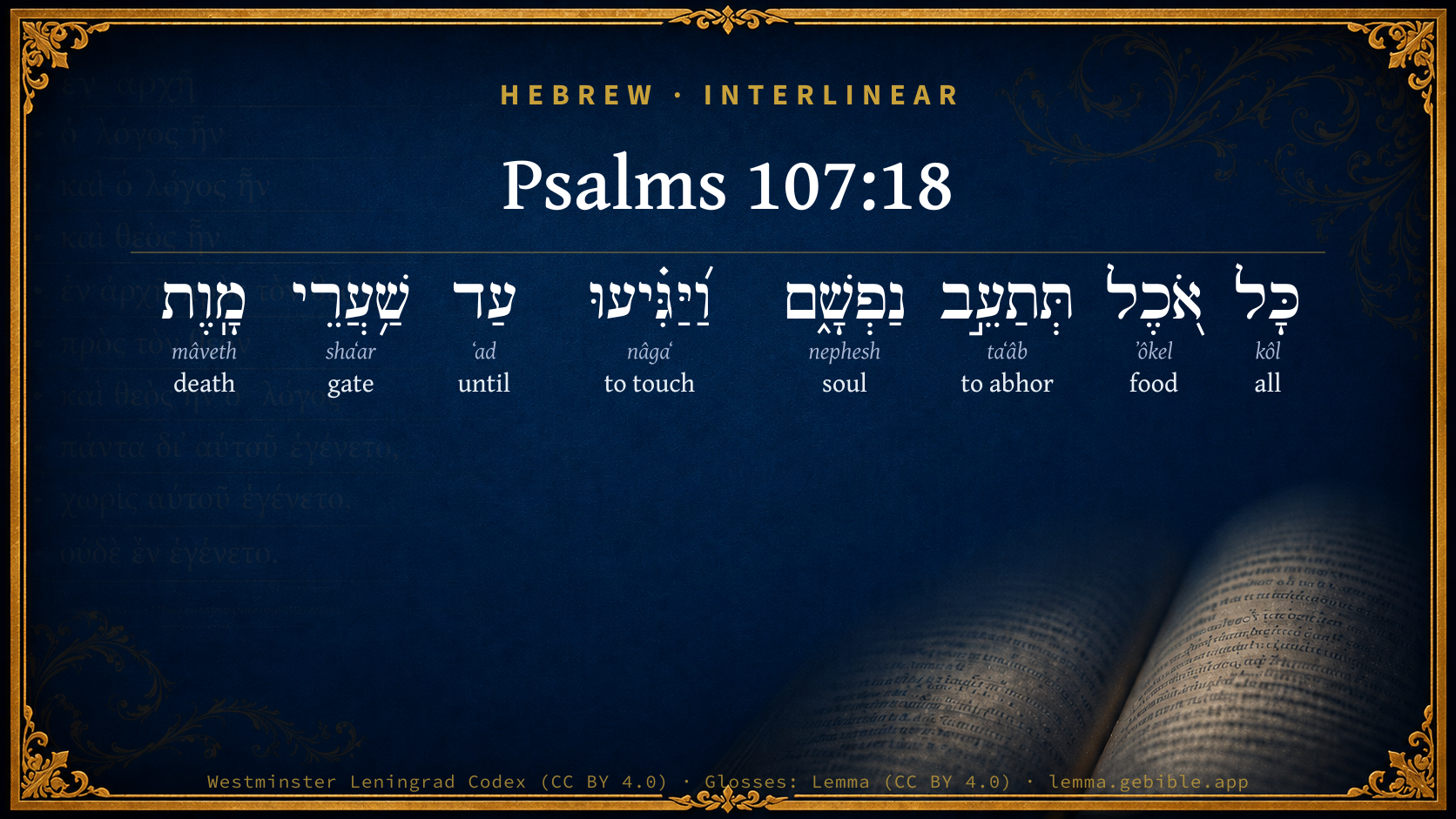
Hebrew (Westminster Leningrad Codex) Psalms 107:18 appears in the Hebrew Old Testament. The text above is from the Westminster Leningrad Codex. Each word links to its Strong’s number, a concise gloss, and parsing drawn from the Open Scriptures Hebrew Bible morphology. Click any word for its full Brown-Driver-Briggs (BDB) entry.
Download image
Cite this verse

Psalms 107:18 (World English Bible). Public Domain. Lemma interlinear Bible study tool, https://lemma.gebible.app/v/psalms/107/18.

Show BibTeX & RIS
BibTeX
RIS
English Translation
Their soul abhors all kinds of food. They draw near to the gates of death.
World English Bible · Public Domain
Download a study sheet

One document with this verse’s original text, its word-by-word gloss line, the meaning frame, cross-references with their text, attributed commentary, and full source and license credits — printable, and it pastes into notes with its structure intact.

This verse Autodidact and up

Study sheet (.html) Plain text (.txt)

A passage Seminary Student

Up to 50 verses in one chapter. A passage sheet keeps up to 6 commentary sources and 12 cross-references per verse, in the order this page ranks them, and says so on the sheet whenever that leaves anything out. Ask for a single verse and you get the Autodidact verse sheet above.

Everything on this page stays free to read, with no account — the sheet is a download of what is already on screen, not access to it.

Want to remove ads? Support Godless Engineer
Compare translations 3

The same verse in 3 English versions, stacked beneath the original-language interlinear above. Click any original word for its lexicon entry.

Each is an independent rendering of the whole verse — the interlinear is not word-aligned to these translations.

Highlighted words mark where these versions differ — a whole-verse word diff, not a word-by-word alignment.

  • World English Bible Public Domain
    Their soul abhors all kinds of food. They draw near to the gates of death.
  • King James Version Public Domain
    Their soul abhorreth all manner of meat; and they draw near unto the gates of death.
  • unfoldingWord Literal Text CC BY-SA 4.0
    their soul detested all food, and they touched the gates of death.

unfoldingWord Literal Text — © unfoldingWord, licensed CC BY-SA 4.0. Word-aligned USFM3 via Door43 (git.door43.org/unfoldingWord/en_ult).

Versions to compare (up to 4)

3 of 4 selected

Show all 18 translations

Every available English version of this verse, each an independent rendering of the whole verse.

  • World English Bible Public Domain
    Their soul abhors all kinds of food. They draw near to the gates of death.
  • Berean Standard Bible Public Domain
    They loathed all food and drew near to the gates of death.
  • Majority Standard Bible Public Domain
    They loathed all food and drew near to the gates of death.
  • King James Version Public Domain
    Their soul abhorreth all manner of meat; and they draw near unto the gates of death.
  • American Standard Version (1901) Public Domain
    Their soul abhorreth all manner of food; And they draw near unto the gates of death.
  • Revised Version (1885) Public Domain
    Their soul abhorreth all manner of meat; and they draw near unto the gates of death.
  • Geneva Bible (1599) Public Domain
    Their soule abhorreth al meat, and they are brought to deaths doore.
  • Douay-Rheims (1899) Public Domain
    Their soul abhorred all manner of meat: and they drew nigh even to the gates of death.
  • Young's Literal Translation Public Domain
    All food doth their soul abominate, And they come nigh unto the gates of death,
  • Literal Standard Version CC BY-SA 4.0
    Their soul detests all food, || And they come near to the gates of death,
  • Unlocked Literal Bible CC BY-SA 4.0
    They lost their desire to eat any food, and they came close to the gates of death.
  • unfoldingWord Literal Text CC BY-SA 4.0
    their soul detested all food, and they touched the gates of death.
  • Darby Bible Public Domain
    Their soul abhorreth all manner of food, and they draw near unto the gates of death:
  • World Messianic Bible Public Domain
    Their soul abhors all kinds of food. They draw near to the gates of death.
  • Webster's Bible Public Domain
    Their soul abhorreth all manner of food; and they draw near to the gates of death.
  • Free Bible Version CC BY-SA 4.0
    They didn't want to eat; they were at death's door.
  • Bible in Basic English Public Domain
    They are disgusted by all food, and they come near to the doors of death.
  • JPS Tanakh (1917) Public Domain
    Their soul abhorred all manner of food, and they drew near unto the gates of death —

Literal Standard Version (2020), Covenant Press — licensed CC BY-SA 4.0. Text via the HelloAO Bible API (eBible.org). Unlocked Literal Bible (unfoldingWord) — licensed CC BY-SA 4.0. Text via the HelloAO Bible API (eBible.org). unfoldingWord Literal Text — © unfoldingWord, licensed CC BY-SA 4.0. Word-aligned USFM3 via Door43 (git.door43.org/unfoldingWord/en_ult). Free Bible Version, Dr. Jonathan Gallagher — licensed CC BY-SA 4.0. Text via the HelloAO Bible API (eBible.org).

Word by word

More ways to search: Search by grammar → Find every occurrence → Compare this word →

Practice this passage: Drill this verse → Learn its vocabulary →

תְּתַעֵ֣ב
taʻâb
H8581
“to abhor”
Verb, Piel, Imperfect, 3rd Person, Feminine, Singular
Part of Speech
Verb
Stem
Piel
Form
Imperfect
Person
3rd Person
Gender
Feminine
Number
Singular
Full BDB Definition

Origin: a primitive root

TWOT: 2530

to abhor, be abominable, do abominably - (Niphal) to be abhorred, be detested - in the ritual sense - in the ethical sense - (Piel) - to loathe, abhor, regard as an abomination - in the ritual sense - in the ethical sense - to cause to be an abomination - (Hiphil) to make abominable, do abominably - in the ritual sense - in the ethical sense
  1. כָּל kôl H3605 “all of” Noun, Common, Masculine, Singular, Construct
  2. אֹ֭כֶל ʼôkel H400 “food” Noun, Common, Masculine, Singular, Absolute
  3. נַפְשָׁ֑ם nephesh H5315 “soul · their” Noun, Common, Both, Singular, Construct + Suffix, Personal, 3rd Person, Masculine, Plural
  4. וַ֝יַּגִּ֗יעוּ nâgaʻ H5060 “and · to touch” Conjunction + Verb, Hiphil, Sequential Imperfect, 3rd Person, Masculine, Plural
  5. עַד ʻad H5704 “until” Preposition
  6. שַׁ֥עֲרֵי shaʻar H8179 “gates of” Noun, Common, Masculine, Plural, Construct
  7. מָֽוֶת mâveth H4194 “death” Noun, Common, Masculine, Singular, Absolute

About this verse

These counts appear in no published source. They are computed here, from the morphology-tagged text and Lemma’s own curated glosses. What Lemma adds →

8
words
8
distinct lemmas
Wisdom
section

Notable vocabulary

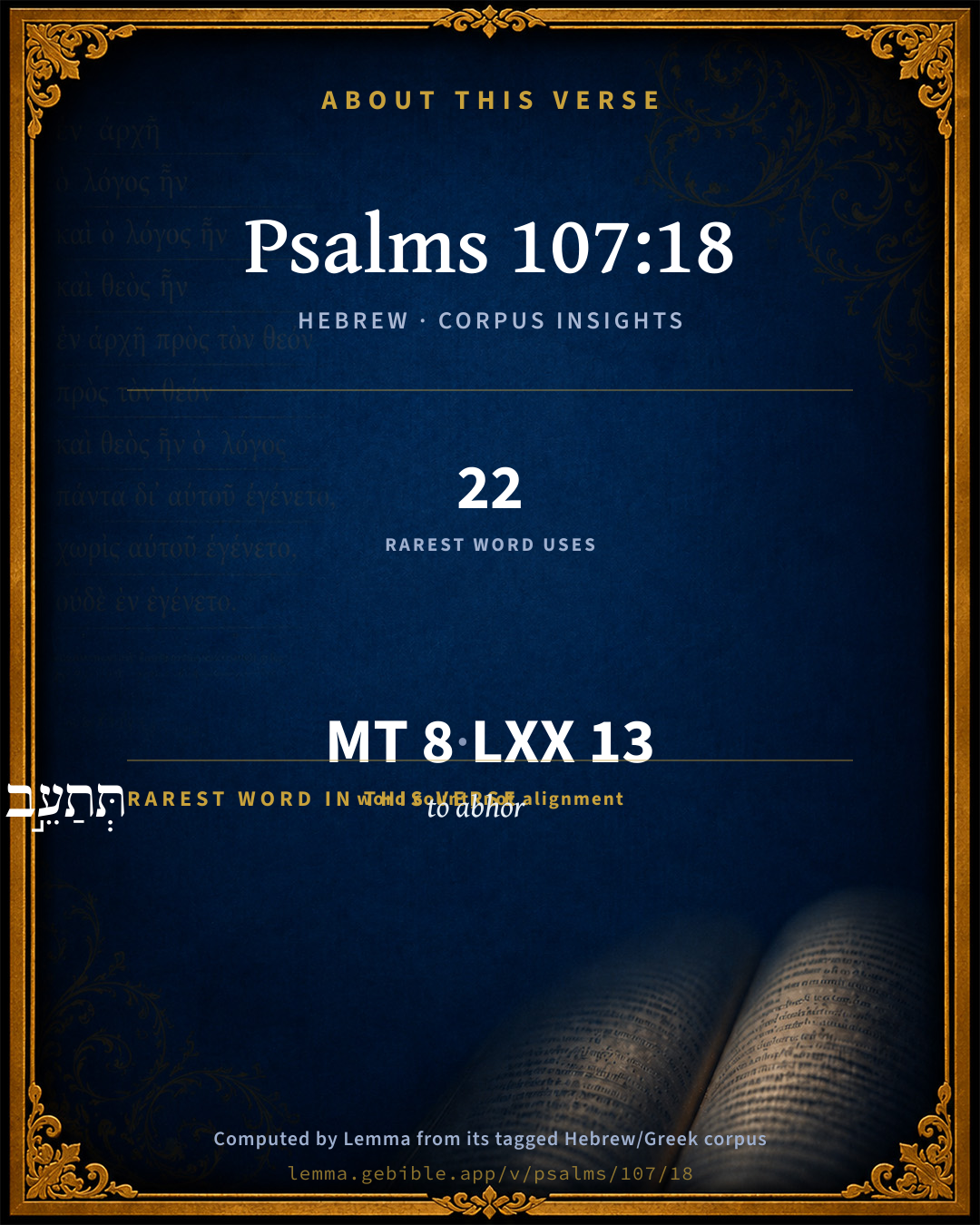
The rarest word here is תְּתַעֵ֣ב to abhor H8581 — appearing just 22 times in the whole Hebrew Bible.

Shared distinctive vocabulary

תְּתַעֵ֣ב to abhor H8581 occurs in 20 verses of the Hebrew Bible. Also found in:

Grammatical profile

  • 2 verbs
  • 5 nouns
  • 1 preposition

Verb forms

  • תְּתַעֵ֣ב Piel · Imperfect
  • וַ֝יַּגִּ֗יעוּ Hiphil · Sequential Imperfect

Hebrew & Septuagint length

In English translation the verse runs 15 words from the Hebrew and 14 from the Septuagint (LXX English) — closely comparable.

A rough comparison of the two English renderings, which tokenize alike — not a word-level alignment.

Word counts can differ between the Hebrew and the Greek without any difference in meaning — e.g. the Hebrew direct-object marker אֵת has no separate Greek word, and Greek often adds the article ὁ.

In the original languages it is 8 Hebrew tokens and 13 Greek tokens — but the two are counted differently (Hebrew bundles its prefixes and suffixes into one token; the Greek is in lemma form), so that isn’t a like-for-like length.

Cross-references

5

Topical passages linked to Psalms 107:18 in the Treasury of Scripture Knowledge — connected by theme and wording, ordered by reader-vote popularity; previews shown in the World English Bible.

  • Psalms 9:13 Have mercy on me, Yahweh. See my affliction by those who hate me, And lift me up from the gates of death;
  • Psalms 88:3 For my soul is full of troubles. My life draws near to Sheol.
  • Job 33:19–22 He is chastened also with pain on his bed, With continual strife in his bones;
  • Isaiah 38:10 I said, In the noontide of my days I shall go into the gates of Sheol: I am deprived of the residue of my years.
  • Job 38:17 Have the gates of death been revealed to you? Or have you seen the gates of the shadow of death?

Cross-references courtesy of OpenBible.info (CC BY 4.0).

Hebrew and Greek witnesses Masoretic Hebrew ↔ Greek Septuagint

The same verse in the two great witnesses to the Old Testament, shown verse-for-verse.

You’re reading Greek Psalm 106 (Hebrew Psalm 107). The Septuagint counts the superscription, so verse numbers can differ from the Hebrew — chapter-level alignment, not verse-by-verse. Numbering follows Rahlfs.

These are two independent witnesses, not word-aligned to each other, and the Septuagint is shown in lemma (dictionary) form.

Hebrew Psalms 107:18 Masoretic · Westminster Leningrad Codex

כָּל אֹ֭כֶל תְּתַעֵ֣ב נַפְשָׁ֑ם וַ֝יַּגִּ֗יעוּ עַד שַׁ֥עֲרֵי מָֽוֶת

Their soul abhors all kinds of food. They draw near to the gates of death.

World English Bible · Public Domain

Greek LXX Greek Psalm 106:18 Septuagint · lemma form

πᾶς βρῶμα βδελύσσω ὁ ψυχή αὐτός καί ἐγγίζω ἕως ὁ πύλη ὁ θάνατος

Their soul abhorred all meat; and they drew near to the gates of death.

LXX2012 (modern English Septuagint) · Public Domain

Hebrew: Westminster Leningrad Codex (CC BY 4.0). Greek: Septuagint (public domain); English from LXX2012 (modern English Septuagint) (Public Domain). How the Septuagint differs from the Hebrew →

Commentary

Notes on Psalms 107:18 from classic Christian and Jewish commentators (each source and its license shown beneath its notes). The classic Christian expositions comment on the surrounding passage and are grouped to its opening verse, so a note may address several verses; the Jewish commentaries on the Tanakh (Rashi and others) are per-verse, so they appear only where the commentator wrote on this verse.

Lemma curates 59 commentaries, every one of them public domain or Creative Commons licensed, each selected and text-cleaned for this edition rather than reprinted as found. About our sources →

Trapp's Complete Commentary

John Trapp

Psa 107:18 Their soul abhorreth all manner of meat; and they draw near unto the gates of death.

Ver. 18. Their soul abhorreth] That is, their stomach loatheth it as unsavoury, though it be never so dainty: an appetite to our meat is an inconconceivable mercy, and, as we say, a sign of health.

And they draw near unto the gates of death] Iam ipsum mortis limen pulsant; as till then little sense of sin or fear of the wrath to come. See Job 30:19-23. {See Trapp on "Job 30:19"} {See Trapp on "Job 30:20"} {See Trapp on "Job 30:21"} {See Trapp on "Job 30:22"} {See Trapp on "Job 30:23"}

John Trapp, A Commentary or Exposition upon All the Books of the Old and New Testament (1647–1656) — public domain. Text from a community e-Sword module.

J. A. Alexander on Psalms

Joseph Addison Alexander

18. (Psa 107:18) All food their soul abhors, and they draw near to the very gates of death. This verse abruptly brings before us the same persons whom we lately beheld wandering in the desert, and then chained in a dark dungeon, now suffering from disease, such as not only mars their pleasures, but threatens to abbreviate their lives. Compare Psa 102:3, Job 33:20. The expression very gates, in the translation of the last clause, is intended to convey the full force of the Hebrew preposition which is stronger than to. See above, on Psa 57:10. With the last clause compare Psa 9:14; Psa 88:3, Job 33:22, Isa 38:9.

Joseph Addison Alexander, The Psalms Translated and Explained (1850) — public domain. Text from a community e-Sword module.

Adam Clarke's Commentary

Verse 18. Their soul abhorreth all manner of meat] A natural description of a sick man: appetite is gone, and all desire for food fails; nutriment is no longer necessary, for death has seized upon the whole frame. See a similar image, Job 33:20.

Adam Clarke's Commentary on the Bible (1810–1826) — public domain. Text from a community e-Sword/MySword module.

Ellicott's Commentary for English Readers

(18) Soul.—The Hebrew word for soul is very commonly used for strong appetite (see Psa_107:9), so that we might paraphrase,” their appetite is turned to loathing.” Comp. this verse with Job_33:20.

A Bible Commentary for English Readers, edited by Charles John Ellicott (1878–1897) — public domain. Text from a community e-Sword module.

The Cambridge Bible for Schools and Colleges

gen. ed. J. J. S. Perowne

18. Their soul loatheth all manner of food,

And they draw nigh unto the gates of death.

Cp. Psa_9:13; Psa_88:3.

For the archaism of P.B.V. ‘hard at death’s door,’ cp. note on Psa_63:8.

The Cambridge Bible for Schools and Colleges (gen. ed. J. J. S. Perowne; Cambridge University Press, 1878–1918) — public domain. Text from a community e-Sword module.

John Gill's Exposition

Oh that men would praise the Lord for his goodness,.... Both in restoring to bodily health, which is an instance of divine goodness; and in healing the diseases of the soul, or in the pardon of sin, which is according to the multitude of his mercies, and the riches of his grace.

And for his wonderful works to the children of men; bodily health is sometimes restored in a wonderful manner, when all means used are without success, and the prescriptions of doctors fail; and pardon of sin is a wonder of grace now, and will be to all eternity; and for these things praise ought to be given to the Lord, and they should be declared to men for his glory.

John Gill's Exposition of the Whole Bible (1746–1763) — public domain (CC PDM 1.0). Text via the HelloAO Bible API.

Albert Barnes' Notes on the Bible

Their soul abhorreth all manner of meat - All food; all that is to be eaten. The word rendered “abhorreth” is a word which is used with reference to anything that is abominable or loathsome; that from which we turn away with disgust. The language is expressive of sickness, when we loathe all food.

And they draw near unto the gates of death - They are sick, and are ready to die. The reference is to the under world - the world where the dead are supposed to dwell. This is represented here as a city which is entered through gates. See the notes at Psa 9:13.

Albert Barnes' Notes on the Bible (1834–1885) — public domain. Text from a community e-Sword/MySword module.

Matthew Poole's English Annotations

Their soul; either themselves with all their soul; or their appetite, as the soul is taken, Job 33:20; Isa 29:8. Abhorreth all manner of meat; which is a Usual effect of great sickness. They draw near unto the gates of death; they are sick well nigh unto death.

Matthew Poole's English Annotations on the Holy Bible (1683–1685) — public domain. Text from a community e-Sword/MySword module.

The Treasury of David

Charles H. Spurgeon

Ver. 18. Their soul abhorreth all manner of meat. Appetite departs from men when they are sick: the best of food is nauseous to them, their stomach turns against it.

And they draw near unto the gates of death. From want of food, and from the destructive power of their malady, they slide gradually down till they lie at the door of the grave; neither does the skill of the physician suffice to stay their downward progress. As they cannot eat there is no support given to the system, and as the disease rages their little strength is spent in pain and misery. Thus it is with souls afflicted with a sense of sin, they cannot find comfort in the choicest promises, but turn away with loathing even from the gospel, so that they gradually decay into the grave of despair. The mercy is that though near the gates of death they are not yet inside the sepulchre.

Ver. 18. Their soul abhorreth all manner of meat. Nor is it without emphasis that it is not the sick man who is said to spurn food, but his soul...The Hebrew word vpn which properly means a breath, hence a panting appetite, is applied to a very vehement appetite for food. When, therefore, the soul is said to abhor food, it is equivalent to saying for the vehement appetite for food abhors food: that is, in the place of an appetite for food, they are oppressed with a loathing; when they ought to be moved with a sharp desire of food, that their exhausted powers might be refreshed, appetite itself becomes a loathing of food, which is a most vivid description of the utmost loathing, and utter prostration of all desire. Venema.

Ver. 18. Their soul abhorreth all manner of meat. The best of creature comforts are but vain comforts. What can dainty meat do a man good, when he is sick and ready to die? Then gold and silver, lands and houses, which are the dainty meat of a covetous man, are loathsome to him. When a man is sick to death, his very riches are sapless and tasteless to him; wife and children, friends and acquaintance, can yield but little comfort in that dark hour, yea, they often prove miserable comforters: when we have most need of comfort, these things administer least or no comfort at all to us. Is it not our wisdom, then, to get a stock of such comforts, as will hold and abide fresh with us, when all worldly comforts either leave us, or become tasteless to us? Is it not good to get a store of that food, which how sick soever we are, our stomachs will never loathe? yea, the sicker we are, our stomachs will the more like, hunger after, and feed the more heartily upon. The flesh of Christ is meat indeed (Joh 6:55). Feed upon him by faith, in health and sickness, ye will never loathe him. His flesh is the true meat of desires, such meat as will fill and fatten us, but never cloy us. A hungry craving appetite after Christ, and sweet satisfaction in him, are inseparable, and still the stronger is our appetite, the greater is our satisfaction. And (which is yet a greater happiness) our souls will have the strongest appetite, the most sharp set stomach after Christ, when, through bodily sickness, our stomachs cannot take down, but loathe the very scent and sight of the most pleasant perishing meat, and delicious earthly dainties. Look, that ye provide somewhat to eat, that will go down upon a sick bed; your sick bed meat is Christ; all other dainty food may be an abhorring to you. Joseph Caryl.

Ver. 18. Their soul abhorreth all manner of meat. The case is then growing desperate, and there seems to be no hope left, when it comes to the last stage here described, viz., to loathe and "abhor all manner of meat." The stomach turns at the sight of it, and the man has this loathing and abhorrence of "all manner of meat." What he most loved, and had the best appetite for, is now become so very offensive, that at the smell of it he grows sick and faints away. Nature cannot support itself long under this disorder. If this loss of appetite, and loathing even the smell of the most simple food continue, it must wear the patient out. Indeed, it is not always a mortal distemper; there may be an entire loathing of food, and even fainting away at the smell of it, and the patient may sometimes recover; but in the present case the distemper had continued so long, and was grown so inveterate that there were no hopes, for they draw nigh, the Psalmist says, to the gates of death. Those gates of brass and bars of iron with which death locks up his prisoners in the grave; and you may judge how great must be the strength of these gates and bars, since only one person was ever able to break through them, and if he had not been more than man, he could never have broken these gates of brass, nor cut these bars of iron in sunder. William Romaine.

Ver. 18. They draw near unto the gates of death. Death is a great commander, a great tyrant, and hath gates to sit in, as judges and magistrates used to `sit in the gates.' There are three things implied in this phrase.

1. First, "They draw near unto the gates of death", that is, they were "near to death"; as he that draws near the gates of a city is near the city, because the gates enter into the city.

2. Secondly, gates are applied to death for authority. They were almost in death's jurisdiction. Death is a great tyrant. He rules over all the men in the world, over kings and potentates, and over mean men; and the greatest men fear death most. He is "the king of fears", as Job calls him, Job 18:14; aye, and the fear of kings ...Therefore it is called "the gate of death." It rules and overrules all mankind. Therefore it is said "to reign", Ro 5:21. Death and sin came in together. Sin was the gate that let in death, and ever since death reigned, and will, till Christ perfectly triumph over it, who is the King of that lord and commander, and hath "the key of hell and death", Re 1:18. To wicked men, I say, he is a tyrant, and hath a gate; and when they go through the "gate of death", they go to a worse, to a lower place, to hell. It is the trap door to hell.

3. Thirdly. By the "gate of death", is meant not only the authority, but the power of death; as in the gospel, "The gates of hell shall not prevail against it", Mt 16:18; that is, the power and strength of hell. So here it implies the strength of death, which is very great, for it subdues all. It is the executioner of God's justice. Richard Sibbes.

Ver. 18. The sin sick soul without appetite for invitations, encouragements, or promises, however presented. Milk too simple, strong meat too heavy, wine too heating, manna too light, etc.

Ver. 18. Teacheth us, that even appetite to our meat is a good gift of the Lord; also that when men are in greatest extremity, then is God most commonly nigh unto them. T. Wilcocks.

Psalms 107:19*

Charles H. Spurgeon's The Treasury of David (1869–1885) — public domain. Psalms only. Text from a community e-Sword/MySword module.

Whedon's Commentary on the Bible

Daniel D. Whedon

18. Abhorreth all manner of meat—This description of sickness is borrowed from Job_33:20; Job_33:22. Sickness was often regarded as a judgment of God for sin. Psa_38:5.

Gates of death—See Psa_9:13

Daniel D. Whedon (gen. ed.), Commentary on the Old and New Testaments (1874–1909) — public domain. Text from a community e-Sword module.

The Pulpit Commentary

Their soul abhorreth all manner of meat. (comp. Job_33:20 Psa_102:4) And they draw near unto the gates of death. See Psa_9:13; and compare Hkw nekrwn keuymwna kai skotou pulav lipwn (Eurip., "Hec.," 1)

The Pulpit Commentary (1880–1919), ed. H.D.M. Spence-Jones & Joseph S. Exell — public domain. Text from a community e-Sword module.

Lesson kit

Teaching starters — assembled from the data on this page, not authored interpretation. Every prompt links to the verse data it draws on. Edit before teaching.

Psalms, in the Wisdom, opens this verse with 8 words (8 distinct Hebrew lemmas). Its most distinctive word is taʻâb (“to abhor”). A historical commentator’s framing appears above. Read the whole chapter for the surrounding context.

Discussion questions

  1. How does “to abhor” (taʻâb) shape what this verse is saying?
  2. How does Deuteronomy 7:26, which shares the word «to abhor», read alongside this verse?
  3. The translations on this page render this verse differently — a whole-verse word diff, not a word-by-word alignment. What might account for the different wordings?
  4. «תְּתַעֵ֣ב» is a Piel Imperfect verb. How does that grammatical form shape the action described?
  5. Compare how Trapp's Complete Commentary and J. A. Alexander on Psalms read this verse. Where do they agree or differ?

Things to notice

Reading settings

Reading text

Shown beneath each verse's original-language words.

Old Testament
Old Testament edition

Read the OT as the Masoretic Hebrew (MT) or the Greek Septuagint (LXX).

English shown for the Greek Septuagint (in the Hebrew ↔ Greek comparison).

Comparing translations? Open the Compare panel on any verse page to stack up to four side by side.