
Deuteronomy 5:14

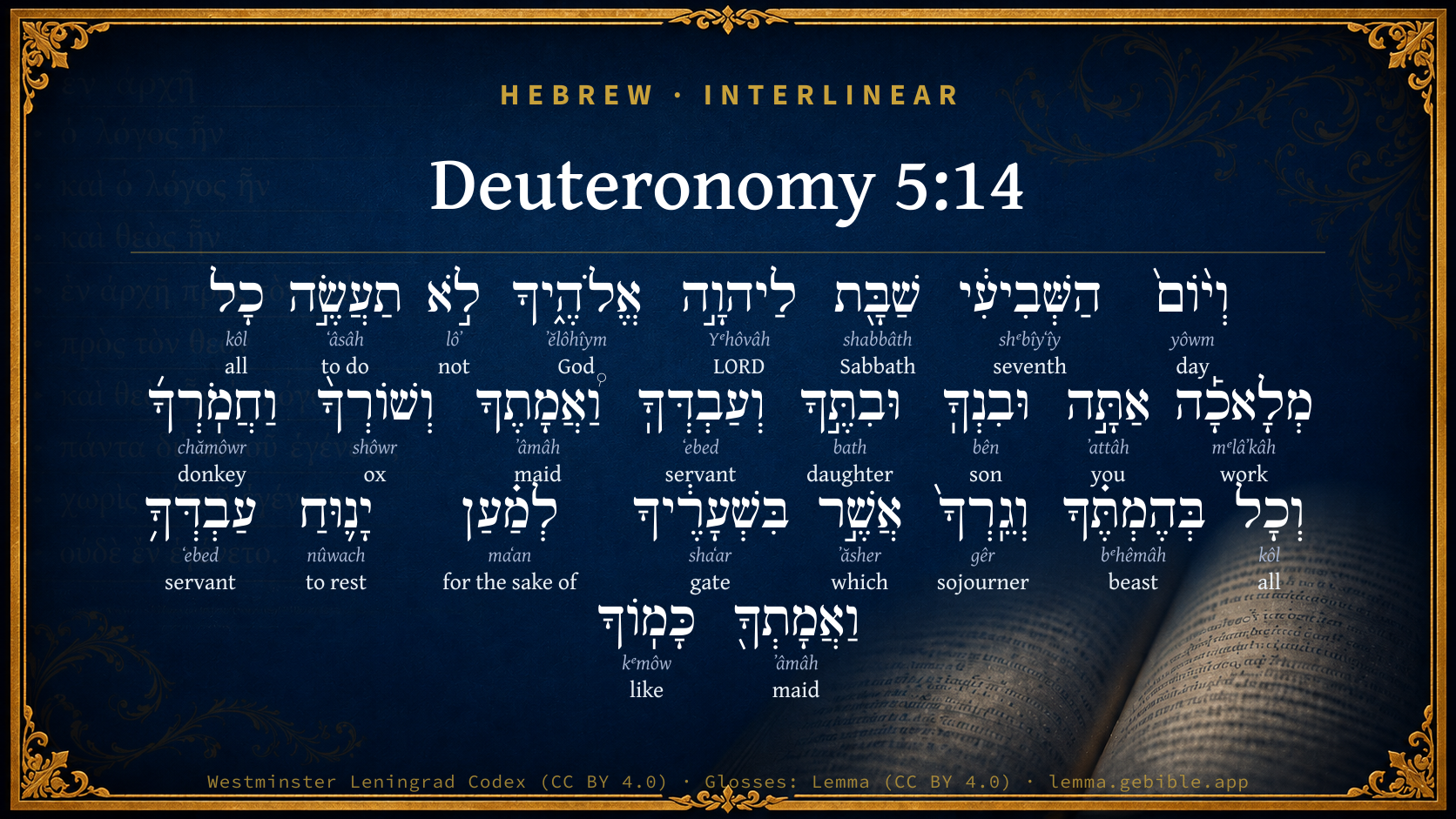
Hebrew (Westminster Leningrad Codex) Deuteronomy 5:14 appears in the Hebrew Old Testament. The text above is from the Westminster Leningrad Codex. Each word links to its Strong’s number, a concise gloss, and parsing drawn from the Open Scriptures Hebrew Bible morphology. Click any word for its full Brown-Driver-Briggs (BDB) entry.
Download image
Cite this verse

Deuteronomy 5:14 (World English Bible). Public Domain. Lemma interlinear Bible study tool, https://lemma.gebible.app/v/deuteronomy/5/14.

Show BibTeX & RIS
BibTeX
RIS
English Translation
but the seventh day is a Sabbath to Yahweh your God: [in it] you shall not do any work, you, nor your son, nor your daughter, nor your man-servant, nor your maid-servant, nor your ox, nor your donkey, nor any of your cattle, nor your stranger who is within your gates; that your man-servant and your maid-servant may rest as well as you.
World English Bible · Public Domain
Download a study sheet

One document with this verse’s original text, its word-by-word gloss line, the meaning frame, cross-references with their text, attributed commentary, and full source and license credits — printable, and it pastes into notes with its structure intact.

This verse Autodidact and up

Study sheet (.html) Plain text (.txt)

A passage Seminary Student

Up to 50 verses in one chapter. A passage sheet keeps up to 6 commentary sources and 12 cross-references per verse, in the order this page ranks them, and says so on the sheet whenever that leaves anything out. Ask for a single verse and you get the Autodidact verse sheet above.

Everything on this page stays free to read, with no account — the sheet is a download of what is already on screen, not access to it.

Want to remove ads? Support Godless Engineer
Compare translations 3

The same verse in 3 English versions, stacked beneath the original-language interlinear above. Click any original word for its lexicon entry.

Each is an independent rendering of the whole verse — the interlinear is not word-aligned to these translations.

Highlighted words mark where these versions differ — a whole-verse word diff, not a word-by-word alignment.

  • World English Bible Public Domain
    but the seventh day is a Sabbath to Yahweh your God: [in it] you shall not do any work, you, nor your son, nor your daughter, nor your man-servant, nor your maid-servant, nor your ox, nor your donkey, nor any of your cattle, nor your stranger who is within your gates; that your man-servant and your maid-servant may rest as well as you.
  • King James Version Public Domain
    But the seventh day is the sabbath of the LORD thy God: in it thou shalt not do any work, thou, nor thy son, nor thy daughter, nor thy manservant, nor thy maidservant, nor thine ox, nor thine ass, nor any of thy cattle, nor thy stranger that is within thy gates; that thy manservant and thy maidservant may rest as well as thou.
  • unfoldingWord Literal Text CC BY-SA 4.0
    But the seventh day a Sabbath for Yahweh your God. Do not do any work—you or your son or your daughter or your male servant or your female servant or your ox or your donkey or any of your cattle or a foreigner who within your gates, so that your male servant and your female servant can rest like you.

unfoldingWord Literal Text — © unfoldingWord, licensed CC BY-SA 4.0. Word-aligned USFM3 via Door43 (git.door43.org/unfoldingWord/en_ult).

Versions to compare (up to 4)

3 of 4 selected

Show all 18 translations

Every available English version of this verse, each an independent rendering of the whole verse.

  • World English Bible Public Domain
    but the seventh day is a Sabbath to Yahweh your God: [in it] you shall not do any work, you, nor your son, nor your daughter, nor your man-servant, nor your maid-servant, nor your ox, nor your donkey, nor any of your cattle, nor your stranger who is within your gates; that your man-servant and your maid-servant may rest as well as you.
  • Berean Standard Bible Public Domain
    but the seventh day is a Sabbath to the LORD your God, on which you must not do any work—neither you, nor your son or daughter, nor your manservant or maidservant, nor your ox or donkey or any of your livestock, nor the foreigner within your gates, so that your manservant and maidservant may rest as you do.
  • Majority Standard Bible Public Domain
    but the seventh day is a Sabbath to the LORD your God, on which you must not do any work—neither you, nor your son or daughter, nor your manservant or maidservant, nor your ox or donkey or any of your livestock, nor the foreigner within your gates, so that your manservant and maidservant may rest as you do.
  • King James Version Public Domain
    But the seventh day is the sabbath of the LORD thy God: in it thou shalt not do any work, thou, nor thy son, nor thy daughter, nor thy manservant, nor thy maidservant, nor thine ox, nor thine ass, nor any of thy cattle, nor thy stranger that is within thy gates; that thy manservant and thy maidservant may rest as well as thou.
  • American Standard Version (1901) Public Domain
    but the seventh day is a sabbath unto Jehovah thy God: `in it' thou shalt not do any work, thou, nor thy son, nor thy daughter, nor thy man-servant, nor thy maid-servant, nor thine ox, nor thine ass, nor any of thy cattle, nor thy stranger that is within thy gates; that thy man-servant and thy maid-servant may rest as well as thou.
  • Revised Version (1885) Public Domain
    but the seventh day is a sabbath unto the LORD thy God: in it thou shalt not do any work, thou, nor thy son, nor thy daughter, nor thy manservant nor thy maidservant, nor thine ox, nor thine ass, nor any of thy cattle, nor thy stranger that is within thy gates; that thy manservant and thy maidservant may rest as well as thou.
  • Geneva Bible (1599) Public Domain
    But the seuenth day is the Sabbath of the Lord thy God: thou shalt not doe any worke therein, thou, nor thy sonne, nor thy daughter, nor thy man seruant, nor thy mayd, nor thine oxe, nor thine asse, neither any of thy cattel, nor the stranger that is within thy gates: that thy man seruant and thy mayde may rest aswell as thou.
  • Douay-Rheims (1899) Public Domain
    The seventh is the day of the sabbath, that is, the rest of the Lord thy God. Thou shalt not do any work therein, thou nor thy son nor thy daughter, nor thy manservant nor thy maidservant, nor thy ox, nor thy ass, nor any of thy beasts, nor the stranger that is within thy gates: that thy manservant and thy maidservant may rest, even as thyself.
  • Young's Literal Translation Public Domain
    and the seventh day `is' a sabbath to Jehovah thy God; thou dost not do any work, thou, and thy son, and thy daughter, and thy man-servant, and thy handmaid, and thine ox, and thine ass, and all thy cattle, and thy sojourner who `is' within thy gates; so that thy man-servant, and thy handmaid doth rest like thyself;
  • Literal Standard Version CC BY-SA 4.0
    and the seventh day [is] a Sabbath to your God YHWH; you do not do any work, you, and your son, and your daughter, and your manservant, and your handmaid, and your ox, and your donkey, and all your livestock, and your sojourner who [is] within your gates, so that your manservant and your handmaid rest like yourself.
  • Unlocked Literal Bible CC BY-SA 4.0
    but the seventh day is a Sabbath to Yahweh your God. On it you will not do any work—not you, nor your son, nor your daughter, nor your male servant, nor your female servant, nor your ox, nor your donkey, nor any of your cattle, nor any foreigner who is within your gates. This is so that your male servant and your female servant may rest as well as you.
  • unfoldingWord Literal Text CC BY-SA 4.0
    But the seventh day a Sabbath for Yahweh your God. Do not do any work—you or your son or your daughter or your male servant or your female servant or your ox or your donkey or any of your cattle or a foreigner who within your gates, so that your male servant and your female servant can rest like you.
  • Darby Bible Public Domain
    but the seventh day is the sabbath of Jehovah thy God: thou shalt not do any work, thou, nor thy son, nor thy daughter, nor thy bondman, nor thy handmaid, nor thine ox, nor thine ass, nor any of thy cattle, nor thy sojourner that is within thy gates; that thy bondman and thy handmaid may rest as well as thou.
  • World Messianic Bible Public Domain
    but the seventh day is a Sabbath to the LORD your God, in which you shall not do any work—neither you, nor your son, nor your daughter, nor your male servant, nor your female servant, nor your ox, nor your donkey, nor any of your livestock, nor your stranger who is within your gates; that your male servant and your female servant may rest as well as you.
  • Webster's Bible Public Domain
    But the seventh day is the sabbath of the LORD thy God: in it thou shalt not do any work, thou, nor thy son, nor thy daughter, nor thy man-servant, nor thy maid-servant, nor thy ox, nor thy ass, nor any of thy cattle, nor thy stranger that is within thy gates; that thy man-servant and thy maid-servant may rest as well as thou.
  • Free Bible Version CC BY-SA 4.0
    but the seventh day is the Sabbath to honor the Lord your God. On this day you must not do any work—not you, not your son or daughter, not your male slave or female slave or your ox or donkey or any of your livestock, and not the foreigner who is staying with you, so that your male slave and female slave can have the same rest as you.
  • Bible in Basic English Public Domain
    But the seventh day is a Sabbath to the Lord your God; on that day do no work, you or your son or your daughter, or your man-servant or your woman-servant, or your ox or your ass or any of your cattle, or the man from a strange country who is living among you; so that your man-servant and your woman-servant may have rest as well as you.
  • JPS Tanakh (1917) Public Domain
    but the seventh day is a sabbath unto the LORD thy God, in it thou shalt not do any manner of work, thou, nor thy son, nor thy daughter, nor thy man-servant, nor thy maid-servant, nor thine ox, nor thine ass, nor any of thy cattle, nor thy stranger that is within thy gates; that thy man-servant and thy maid-servant may rest as well as thou.

Literal Standard Version (2020), Covenant Press — licensed CC BY-SA 4.0. Text via the HelloAO Bible API (eBible.org). Unlocked Literal Bible (unfoldingWord) — licensed CC BY-SA 4.0. Text via the HelloAO Bible API (eBible.org). unfoldingWord Literal Text — © unfoldingWord, licensed CC BY-SA 4.0. Word-aligned USFM3 via Door43 (git.door43.org/unfoldingWord/en_ult). Free Bible Version, Dr. Jonathan Gallagher — licensed CC BY-SA 4.0. Text via the HelloAO Bible API (eBible.org).

Word by word

More ways to search: Search by grammar → Find every occurrence → Compare this word →

Practice this passage: Drill this verse → Learn its vocabulary →

וַ֠אֲמָתֶךָ
ʼâmâh
H519
“and · maid · your”
Conjunction + Noun, Common, Feminine, Singular, Construct + Suffix, Personal, 2nd Person, Masculine, Singular
Part of Speech
Conjunction + Noun
Type
Common
Gender
Feminine
Number
Singular
State
Construct
Full BDB Definition

Origin: apparently a primitive word

TWOT: 112

maid-servant, female slave, maid, handmaid, concubine - of humility (figuratively)
  1. וְי֨וֹם֙ yôwm H3117 “and · day of” Conjunction + Noun, Common, Masculine, Singular, Construct
  2. הַשְּׁבִיעִ֔י shᵉbîyʻîy H7637 “the · seventh” Particle, Definite Article + Adjective, Ordinal number, Masculine, Singular, Absolute
  3. שַׁבָּ֖ת shabbâth H7676 “Sabbath” Noun, Common, Both, Singular, Absolute
  4. לַיהוָ֣ה Yᵉhôvâh H3068 “to/for · LORD” Preposition + Noun, Proper
  5. אֱלֹהֶ֑יךָ ʼĕlôhîym H430 “God(s) · your” Noun, Common, Masculine, Plural, Construct + Suffix, Personal, 2nd Person, Masculine, Singular
  6. לֹ֣א lôʼ H3808 “not” Particle, Negative
  7. תַעֲשֶׂ֣ה ʻâsâh H6213 “to do” Verb, Qal, Imperfect, 2nd Person, Masculine, Singular
  8. כָל kôl H3605 “all of” Noun, Common, Masculine, Singular, Construct
  9. מְלָאכָ֡ה mᵉlâʼkâh H4399 “work” Noun, Common, Feminine, Singular, Absolute
  10. אַתָּ֣ה ʼattâh H859 “you” Pronoun, Personal, 2nd Person, Masculine, Singular
  11. וּבִנְךָֽ bên H1121 “and · son · your” Conjunction + Noun, Common, Masculine, Singular, Construct + Suffix, Personal, 2nd Person, Masculine, Singular
  12. וּבִתֶּ֣ךָ bath H1323 “and · daughter · your” Conjunction + Noun, Common, Feminine, Singular, Construct + Suffix, Personal, 2nd Person, Masculine, Singular
  13. וְעַבְדְּךָֽ ʻebed H5650 “and · servant · your” Conjunction + Noun, Common, Masculine, Singular, Construct + Suffix, Personal, 2nd Person, Masculine, Singular
  14. וְשׁוֹרְךָ֨ shôwr H7794 “and · ox · your” Conjunction + Noun, Common, Masculine, Singular, Construct + Suffix, Personal, 2nd Person, Masculine, Singular
  15. וַחֲמֹֽרְךָ֜ chămôwr H2543 “and · donkey · your” Conjunction + Noun, Common, Both, Singular, Construct + Suffix, Personal, 2nd Person, Masculine, Singular
  16. וְכָל kôl H3605 “and · all of” Conjunction + Noun, Common, Masculine, Singular, Construct
  17. בְּהֶמְתֶּ֗ךָ bᵉhêmâh H929 “beast · your” Noun, Common, Feminine, Singular, Construct + Suffix, Personal, 2nd Person, Masculine, Singular
  18. וְגֵֽרְךָ֙ gêr H1616 “and · sojourner · your” Conjunction + Noun, Common, Masculine, Singular, Construct + Suffix, Personal, 2nd Person, Masculine, Singular
  19. אֲשֶׁ֣ר ʼăsher H834 “which” Particle, Relative
  20. בִּשְׁעָרֶ֔יךָ shaʻar H8179 “in/at · gates · your” Preposition + Noun, Common, Masculine, Plural, Construct + Suffix, Personal, 2nd Person, Masculine, Singular
  21. לְמַ֗עַן maʻan H4616 “for the sake of” Preposition
  22. יָנ֛וּחַ nûwach H5117 “to rest” Verb, Qal, Imperfect, 3rd Person, Masculine, Singular
  23. עַבְדְּךָ֥ ʻebed H5650 “servant · your” Noun, Common, Masculine, Singular, Construct + Suffix, Personal, 2nd Person, Masculine, Singular
  24. וַאֲמָתְךָ֖ ʼâmâh H519 “and · maid · your” Conjunction + Noun, Common, Feminine, Singular, Construct + Suffix, Personal, 2nd Person, Masculine, Singular
  25. כָּמֽוֹךָ kᵉmôw H3644 “like · you” Preposition + Suffix, Personal, 2nd Person, Masculine, Singular

About this verse

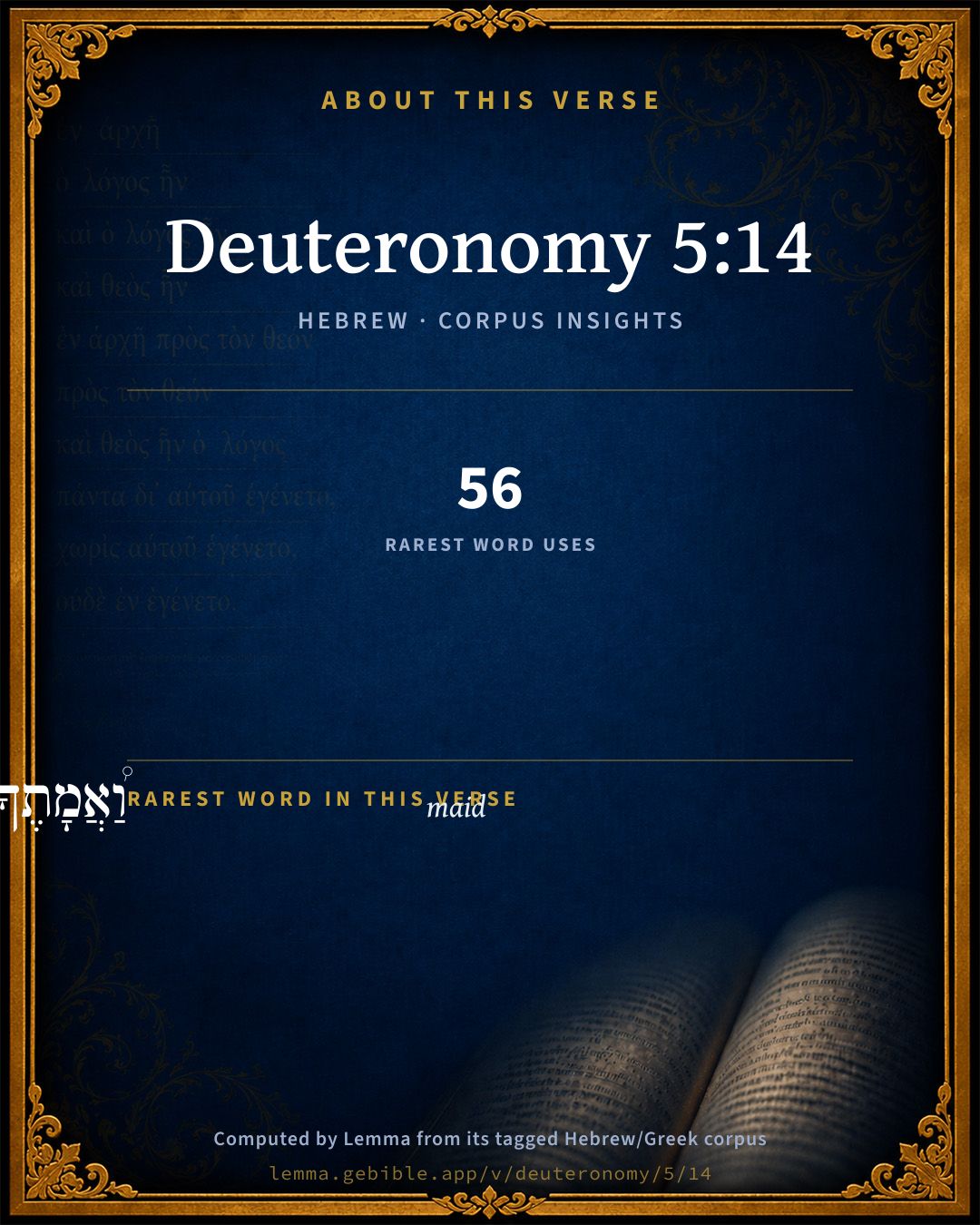
These counts appear in no published source. They are computed here, from the morphology-tagged text and Lemma’s own curated glosses. What Lemma adds →

26
words
23
distinct lemmas
Pentateuch
section

Shared distinctive vocabulary

וַ֠אֲמָתֶךָ maid H519 occurs in 49 verses of the Hebrew Bible. Also found in:

Grammatical profile

  • 2 verbs
  • 18 nouns
  • 1 adjective
  • 1 pronoun
  • 2 prepositions
  • 2 particles

Verb forms

  • תַעֲשֶׂ֣ה Qal · Imperfect
  • יָנ֛וּחַ Qal · Imperfect

Repetition

Words recur within this verse — often emphatic in Hebrew:

  • כָל all H3605 ×2
  • וְעַבְדְּךָֽ servant H5650 ×2
  • וַ֠אֲמָתֶךָ maid H519 ×2

Hebrew & Septuagint length

In English translation the verse runs 63 words from the Hebrew and 66 from the Septuagint (LXX English) — closely comparable.

A rough comparison of the two English renderings, which tokenize alike — not a word-level alignment.

Word counts can differ between the Hebrew and the Greek without any difference in meaning — e.g. the Hebrew direct-object marker אֵת has no separate Greek word, and Greek often adds the article ὁ.

Cross-references

8

Topical passages linked to Deuteronomy 5:14 in the Treasury of Scripture Knowledge — connected by theme and wording, ordered by reader-vote popularity; previews shown in the World English Bible.

  • Hebrews 4:4 For he has said this somewhere about the seventh day, "God rested on the seventh day from all his works;"
  • Genesis 2:2 On the seventh day God finished his work which he had made; and he rested on the seventh day from all his work which he had made.
  • Exodus 16:29–30 Behold, because Yahweh has given you the Sabbath, therefore he gives you on the sixth day the bread of two days. Everyone stay in his place. Let no one go out of his place on the seventh day."
  • Exodus 23:12 "Six days you shall do your work, and on the seventh day you shall rest, that your ox and your donkey may have rest, and the son of your handmaid, and the alien may be refreshed.
  • Nehemiah 5:5 Yet now our flesh is as the flesh of our brothers, our children as their children: and, behold, we bring into bondage our sons and our daughters to be servants, and some of our daughters are brought into bondage [already]: neither is it in our power to help it; for other men have our fields and our vineyards.
  • Nehemiah 13:21 Then I testified against them, and said to them, Why lodge you about the wall? if you do so again, I will lay hands on you. From that time forth came they no more on the Sabbath.
  • Leviticus 25:44–46 "'As for your male and your female slaves, whom you may have; of the nations that are around you, from them you may buy male and female slaves.
  • Nehemiah 13:15 In those days saw I in Judah some men treading wine-presses on the Sabbath, and bringing in sheaves, and lading donkeys [therewith]; as also wine, grapes, and figs, and all manner of burdens, which they brought into Jerusalem on the Sabbath day: and I testified [against them] in the day in which they sold food.

Cross-references courtesy of OpenBible.info (CC BY 4.0).

Hebrew and Greek witnesses Masoretic Hebrew ↔ Greek Septuagint

The same verse in the two great witnesses to the Old Testament, shown verse-for-verse.

These are two independent witnesses, not word-aligned to each other, and the Septuagint is shown in lemma (dictionary) form.

Hebrew Deuteronomy 5:14 Masoretic · Westminster Leningrad Codex

וְי֨וֹם֙ הַשְּׁבִיעִ֔י שַׁבָּ֖ת לַיהוָ֣ה אֱלֹהֶ֑יךָ לֹ֣א תַעֲשֶׂ֣ה כָל מְלָאכָ֡ה אַתָּ֣ה וּבִנְךָֽ וּבִתֶּ֣ךָ וְעַבְדְּךָֽ וַ֠אֲמָתֶךָ וְשׁוֹרְךָ֨ וַחֲמֹֽרְךָ֜ וְכָל בְּהֶמְתֶּ֗ךָ וְגֵֽרְךָ֙ אֲשֶׁ֣ר בִּשְׁעָרֶ֔יךָ לְמַ֗עַן יָנ֛וּחַ עַבְדְּךָ֥ וַאֲמָתְךָ֖ כָּמֽוֹךָ

but the seventh day is a Sabbath to Yahweh your God: [in it] you shall not do any work, you, nor your son, nor your daughter, nor your man-servant, nor your maid-servant, nor your ox, nor your donkey, nor any of your cattle, nor your stranger who is within your gates; that your man-servant and your maid-servant may rest as well as you.

World English Bible · Public Domain

Greek LXX Deuteronomy 5:14 Septuagint · lemma form

ὁ δέ ἡμέρα ὁ ἕβδομος σάββατον κύριος ὁ θεός σύ οὐ ποιέω ἐν αὐτός πᾶς ἔργον σύ καί ὁ υἱός σύ καί ὁ θυγάτηρ σύ ὁ παῖς σύ καί ὁ παιδίσκη σύ ὁ βοῦς σύ καί ὁ ὑποζύγιον σύ καί πᾶς κτῆνος σύ καί ὁ προσήλυτος ὁ παραοἰκέω ἐν σύ ἵνα ἀναπαύω ὁ παῖς σύ καί ὁ παιδίσκη σύ ὥσπερ καί σύ

but on the seventh day is the sabbath of the Lord your God: you shall do in it no work, you, and your son, and your daughter, your man-servant, and your maidservant, your ox, and your ass, and all your cattle, and the stranger that sojourns in the midst of you; that your man-servant may rest, and your maid, and your ox, as well as you.

LXX2012 (modern English Septuagint) · Public Domain

On this verse, The Cambridge Bible for Schools and Colleges discusses the Septuagint’s reading. Read the note in Commentary ↓

Hebrew: Westminster Leningrad Codex (CC BY 4.0). Greek: Septuagint (public domain); English from LXX2012 (modern English Septuagint) (Public Domain). How the Septuagint differs from the Hebrew →

Targum (Aramaic paraphrase)

2

The Targum is the ancient Jewish Aramaic paraphrase of the Hebrew Scriptures — an interpretive translation, not the Hebrew text itself. Onkelos (literal) and Pseudo-Jonathan (expansive) render the Torah, and Jonathan the Prophets. Coverage is partial: where no permissively-licensed English translation exists for a verse, only the Aramaic is shown. This is verse-level text, not a word-by-word alignment to the Hebrew.

  1. Targum Onkelos Torah (Genesis–Deuteronomy)
    וְיוֹמָא שְׁבִיעָאָה שַׁבְּתָא קֳדָם יְיָ אֱלָהָךְ לָא תַעְבֵּד כָּל עֲבִידָא אַתְּ וּבְרָךְ וּבְרַתָּךְ וְעַבְדָךְ וְאַמְתָךְ וְתוֹרָךְ וַחֲמָרָךְ וְכָל בְּעִירָךְ וְגִיוֹרָךְ דִי בְקִרְוָךְ בְּדִיל דִי יְנוּחַ עַבְדָךְ וְאַמְתָךְ כְּוָתָךְ

    (no public-domain English translation for this verse)

    Targum Onkelos — Aramaic: “Onkelos Genesis” (public domain); “Onkelos Exodus” (public domain); “Onkelos Leviticus” (public domain); “Onkelos Numbers” (public domain); “Onkelos Deuteronomy” (public domain). English: “Sefaria Community Translation” (CC0 1.0 (public-domain dedication)); “J.W. Etheridge. The Targums of Onkelos and Jonathan Ben Uzziel on the Pentateuch. London: Longmans, Green, 1862” (public domain). Text via Sefaria.

  2. Targum Pseudo-Jonathan Torah (Genesis–Deuteronomy)
    וְיוֹמָא שְׁבִיעָאָה שַׁב וְנַיַיח קֳדָם יְיָ אֱלָהָכוֹן לָא תַעַבְדוּן כָּל עִיבִידְתָּא אַתּוּן וּבְנֵיכוֹן וּבְנָתֵיכוֹן וְעַבְדֵיכוֹן וְאַמְהָתֵיכוֹן וְתוֹרֵיכוֹן וְחַמְרֵיכוֹן וְכָל בְּעִירֵיכוֹן וְגִיוֹרֵיכוֹן דִּי בְקִרְוֵיכוֹן מִן בִּגְלַל דִּינוּחוּן עַבְדֵיכוֹן וְאַמְהָתֵיכוֹן כְּוַותְכוֹן

    but the seventh day (shall be for) rest and quiet before the Lord your God; ye shall do no work, neither you, nor your sons, nor your daughters, nor your servants, nor your handmaids, nor your oxen, your asses, nor any of your cattle, nor your sojourners who are among you; that your servants and handmaids may have repose as well as you.

    Targum Pseudo-Jonathan — Aramaic: “Targum Jonathan on Genesis” (public domain); “Targum Jonathan on Exodus” (public domain); “Targum Jonathan on Leviticus” (public domain); “Targum Jonathan on Numbers” (public domain); “Targum Jonathan on Deuteronomy” (public domain). English: “The Targum of Jonathan ben Uzziel, trans. J. W. Etheridge, London, 1862” (public domain). Text via Sefaria.

Commentary

Notes on Deuteronomy 5:14 from classic Christian and Jewish commentators (each source and its license shown beneath its notes). The classic Christian expositions comment on the surrounding passage and are grouped to its opening verse, so a note may address several verses; the Jewish commentaries on the Tanakh (Rashi and others) are per-verse, so they appear only where the commentator wrote on this verse.

Lemma curates 59 commentaries, every one of them public domain or Creative Commons licensed, each selected and text-cleaned for this edition rather than reprinted as found. About our sources →

Jamieson, Fausset & Brown

Robert Jamieson, A. R. Fausset & David Brown

that thy man-servant and thy maid-servant may rest as well as thou--This is a different reason for the observance of the Sabbath from what is assigned in Exo 20:8-11, where that day is stated to be an appointed memorial of the creation. But the addition of another motive for the observance does not imply any necessary contrariety to the other; and it has been thought probable that, the commemorative design of the institution being well known, the other reason was specially mentioned on this repetition of the law, to secure the privilege of sabbatic rest to servants, of which, in some Hebrew families, they had been deprived. In this view, the allusion to the period of Egyptian bondage (Deu 5:15), when they themselves were not permitted to observe the Sabbath either as a day of rest or of public devotion, was peculiarly seasonable and significant, well fitted to come home to their business and bosoms.

Jamieson, Fausset & Brown — Commentary Critical and Explanatory on the Whole Bible (1871) — public domain (CC PDM 1.0). Text via the HelloAO Bible API.

The Cambridge Bible for Schools and Colleges

gen. ed. J. J. S. Perowne

14. in it] not in Heb. text either here or in Ex., but supplied in both places by Sam. and LXX; so too in the Nash papyrus (see Driver, Exod. 417).

nor thy bondman] Exo_20:10 omits the conjunction. So too Sam. and LXX here.

nor thine ox, nor thine ass, nor any of thy cattle] another obvious expansion. Ex. has only nor thy cattle.

that thy bondman and thy bondwoman may rest as well as thou] an additional characteristic of the humane spirit of D; cf. in the Laws Deu_12:12, Deu_14:26; Deu_14:29, Deu_15:13 f., Deu_16:11, Deu_24:14-18.

The Cambridge Bible for Schools and Colleges (gen. ed. J. J. S. Perowne; Cambridge University Press, 1878–1918) — public domain. Text from a community e-Sword module.

John Gill's Exposition

Honour thy father and thy mother, as the Lord thy God hath commanded thee,.... And is the first commandment with promise, as the apostle observes, Eph 6:2 with a promise of long life and happiness in the land of Canaan, as follows:

that thy days may be prolonged; see Exo 20:12 here it is added:

and that it may go well with thee; and which the apostle also has in the place referred to:

in the land which the Lord thy God giveth thee; the land of Canaan; which the same apostle explains to a greater latitude:

that thou mayest live long on the earth; applying it to Christians under the Gospel dispensation, whether Jews or Gentiles.

John Gill's Exposition of the Whole Bible (1746–1763) — public domain (CC PDM 1.0). Text via the HelloAO Bible API.

Ramban (Nachmanides)

Rabbi Moshe ben Nachman (Ramban / Nachmanides)

He added here [in the commandment on the Sabbath] stating nor thine ox, nor thine ass to explain that He prohibits working the earth [on the Sabbath] even though it involves the livelihood of man, similar to what He said, in plowing time and in harvest shalt thou rest. He stated here that thy manservant and thy maidservant may rest as well as thou; and thou shalt remember that thou wast a servant in the land of Egypt etc., in order to explain that He commanded concerning the resting of the servant as well as yourself, because, since you were a servant and G-d gave you rest, so you too are to give rest to your servant. Thus the sense of the verses is as follows: “When your manservant and your maidservant will rest as well as you then you will remember that you were a servant etc.”

Ramban (Nachmanides) on the Tanakh — English translation: “Commentary on the Torah by Ramban (Nachmanides). Translated and annotated by Charles B. Chavel. New York, Shilo Pub. House, 1971-1976” (CC BY 4.0). Text via Sefaria.

Lesson kit

Teaching starters — assembled from the data on this page, not authored interpretation. Every prompt links to the verse data it draws on. Edit before teaching.

Deuteronomy, in the Pentateuch, opens this verse with 26 words (23 distinct Hebrew lemmas). Its most distinctive word is ʼâmâh (“maid”). A historical commentator’s framing appears above. Read the whole chapter for the surrounding context.

Discussion questions

  1. The word ʼâmâh carries the sense “maid.” How does it shape the verse?
  2. How does Genesis 20:17, which shares the word «maid», read alongside this verse?
  3. What does the repetition of “all” (2× in this one verse) do in this verse?
  4. The translations on this page render this verse differently — a whole-verse word diff, not a word-by-word alignment. What might account for the different wordings?
  5. «תַעֲשֶׂ֣ה» is a Qal Imperfect verb. How does that grammatical form shape the action described?
  6. Compare how Jamieson, Fausset & Brown and The Cambridge Bible for Schools and Colleges read this verse. Where do they agree or differ?

Things to notice

Reading settings

Reading text

Shown beneath each verse's original-language words.

Old Testament
Old Testament edition

Read the OT as the Masoretic Hebrew (MT) or the Greek Septuagint (LXX).

English shown for the Greek Septuagint (in the Hebrew ↔ Greek comparison).

Comparing translations? Open the Compare panel on any verse page to stack up to four side by side.