
Nehemiah 12:31

Hebrew (Westminster Leningrad Codex) Nehemiah 12:31 appears in the Hebrew Old Testament. The text above is from the Westminster Leningrad Codex. Each word links to its Strong’s number, a concise gloss, and parsing drawn from the Open Scriptures Hebrew Bible morphology. Click any word for its full Brown-Driver-Briggs (BDB) entry.
Download image
Cite this verse

Nehemiah 12:31 (World English Bible). Public Domain. Lemma interlinear Bible study tool, https://lemma.gebible.app/v/nehemiah/12/31.

Show BibTeX & RIS
BibTeX
RIS
English Translation
Then I brought up the princes of Judah on the wall, and appointed two great companies who gave thanks and went in procession. [One went] on the right hand on the wall toward the dung gate;
World English Bible · Public Domain
Highlights
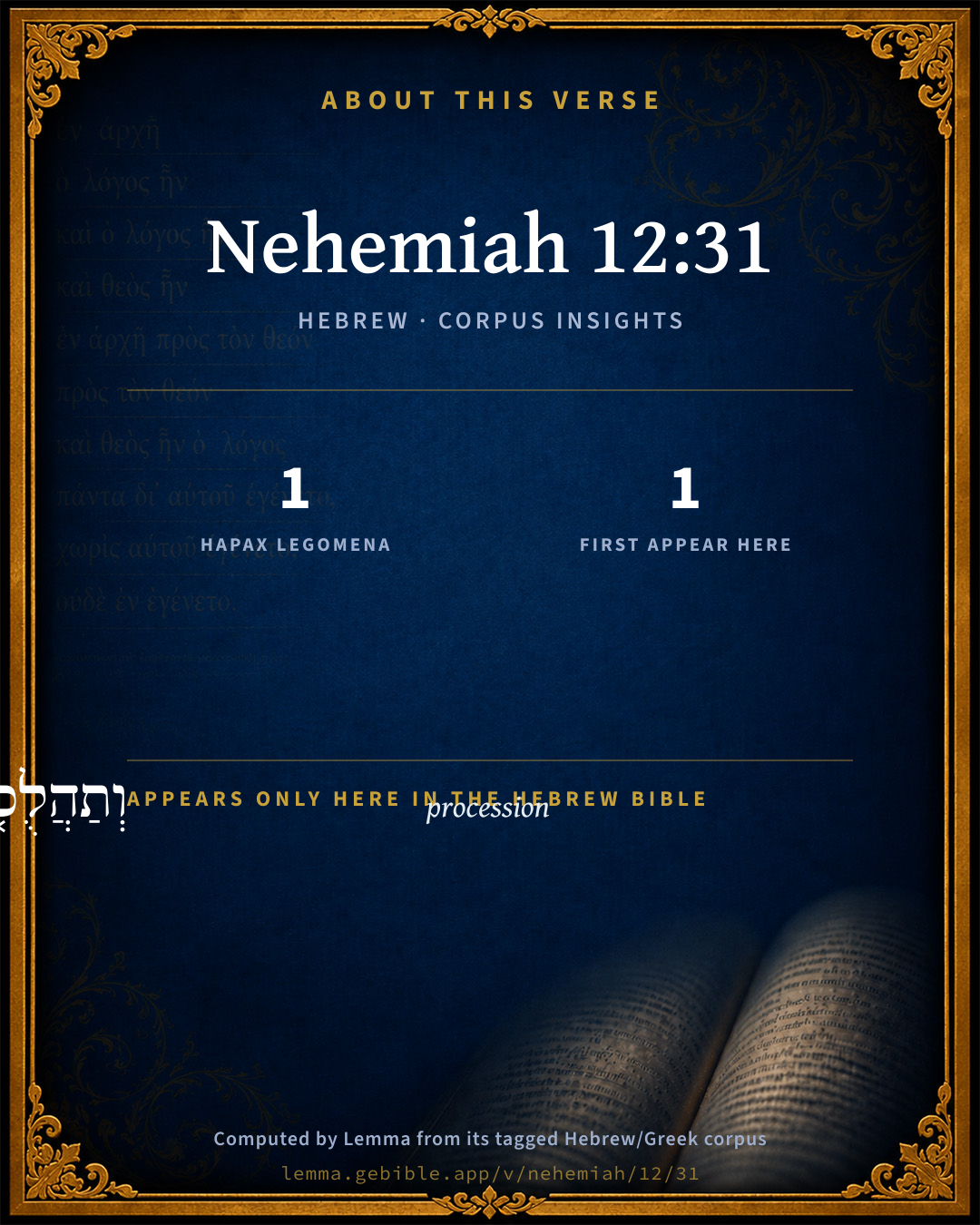
  • 1 hapax legomenon — only here in the Hebrew Bible
  • 1 first appearance in the Hebrew Bible
Full analysis ↓
Download a study sheet

One document with this verse’s original text, its word-by-word gloss line, the meaning frame, cross-references with their text, attributed commentary, and full source and license credits — printable, and it pastes into notes with its structure intact.

This verse Autodidact and up

Study sheet (.html) Plain text (.txt)

A passage Seminary Student

Up to 50 verses in one chapter. A passage sheet keeps up to 6 commentary sources and 12 cross-references per verse, in the order this page ranks them, and says so on the sheet whenever that leaves anything out. Ask for a single verse and you get the Autodidact verse sheet above.

Everything on this page stays free to read, with no account — the sheet is a download of what is already on screen, not access to it.

Want to remove ads? Support Godless Engineer
Compare translations 3

The same verse in 3 English versions, stacked beneath the original-language interlinear above. Click any original word for its lexicon entry.

Each is an independent rendering of the whole verse — the interlinear is not word-aligned to these translations.

Highlighted words mark where these versions differ — a whole-verse word diff, not a word-by-word alignment.

  • World English Bible Public Domain
    Then I brought up the princes of Judah on the wall, and appointed two great companies who gave thanks and went in procession. [One went] on the right hand on the wall toward the dung gate;
  • King James Version Public Domain
    Then I brought up the princes of Judah upon the wall, and appointed two great companies of them that gave thanks, whereof one went on the right hand upon the wall toward the dung gate:
  • unfoldingWord Literal Text CC BY-SA 4.0
    And I caused the officials of Judah to go up on top of the wall. And I caused to stand two great thanksgiving groups, and processions to the right hand on top of the wall toward the gate of dung.

unfoldingWord Literal Text — © unfoldingWord, licensed CC BY-SA 4.0. Word-aligned USFM3 via Door43 (git.door43.org/unfoldingWord/en_ult).

Versions to compare (up to 4)

3 of 4 selected

Show all 18 translations

Every available English version of this verse, each an independent rendering of the whole verse.

  • World English Bible Public Domain
    Then I brought up the princes of Judah on the wall, and appointed two great companies who gave thanks and went in procession. [One went] on the right hand on the wall toward the dung gate;
  • Berean Standard Bible Public Domain
    Then I brought the leaders of Judah up on the wall, and I appointed two great thanksgiving choirs. One was to proceed along the top of the wall to the right, toward the Dung Gate.
  • Majority Standard Bible Public Domain
    Then I brought the leaders of Judah up on the wall, and I appointed two great thanksgiving choirs. One was to proceed along the top of the wall to the right, toward the Dung Gate.
  • King James Version Public Domain
    Then I brought up the princes of Judah upon the wall, and appointed two great companies of them that gave thanks, whereof one went on the right hand upon the wall toward the dung gate:
  • American Standard Version (1901) Public Domain
    Then I brought up the princes of Judah upon the wall, and appointed two great companies that gave thanks and went in procession; `whereof one went' on the right hand upon the wall toward the dung gate:
  • Revised Version (1885) Public Domain
    Then I brought up the princes of Judah upon the wall, and appointed two great companies that gave thanks and went in procession; whereof one went on the right hand upon the wall toward the dung gate:
  • Geneva Bible (1599) Public Domain
    And I brought vp the princes of Iudah vpon the wall, and appointed two great companies to giue thankes, and the one went on the right hand of the wall toward the dung gate.
  • Douay-Rheims (1899) Public Domain
    And I made the princes of Juda go up upon the wall, and I appointed two great choirs to give praise. And they went on the right hand upon the wall toward the dunghill gate.
  • Young's Literal Translation Public Domain
    And I bring up the heads of Judah upon the wall, and appoint two great thanksgiving companies and processions. At the right, on the wall, to the dung-gate;
  • Literal Standard Version CC BY-SA 4.0
    And I bring up the heads of Judah on the wall, and appoint two great thanksgiving companies and processions. At the right, on the wall, to the Refuse Gate;
  • Unlocked Literal Bible CC BY-SA 4.0
    Then I had the leaders of Judah go up to the top of the wall, and I appointed two large choirs who gave thanks. One went to the right on the wall toward the Dung Gate.
  • unfoldingWord Literal Text CC BY-SA 4.0
    And I caused the officials of Judah to go up on top of the wall. And I caused to stand two great thanksgiving groups, and processions to the right hand on top of the wall toward the gate of dung.
  • Darby Bible Public Domain
    And I brought up the princes of Judah upon the wall, and appointed two great choirs and processions, on the right hand upon the wall towards the dung-gate.
  • World Messianic Bible Public Domain
    Then I brought the princes of Judah up on the wall, and appointed two great companies who gave thanks and went in procession. One went on the right hand on the wall toward the dung gate;
  • Webster's Bible Public Domain
    Then I brought up the princes of Judah upon the wall, and appointed two great companies of them that gave thanks, of which one went on the right hand upon the wall towards the dung-gate:
  • Free Bible Version CC BY-SA 4.0
    I had the leaders of Judah go up on the wall, and arranged for two large choirs to give thanks. One group went to right along the wall to the Refuse Gate.
  • Bible in Basic English Public Domain
    Then I made the rulers of Judah come up on the wall, and I put in position two great bands of them who gave praise, walking in ordered lines; one went to the right on the wall, in the direction of the doorway where the waste was put;
  • JPS Tanakh (1917) Public Domain
    Then I brought up the princes of Judah upon the wall, and appointed two great companies that gave thanks and went in procession: on the right hand upon the wall toward the dung gate;

Literal Standard Version (2020), Covenant Press — licensed CC BY-SA 4.0. Text via the HelloAO Bible API (eBible.org). Unlocked Literal Bible (unfoldingWord) — licensed CC BY-SA 4.0. Text via the HelloAO Bible API (eBible.org). unfoldingWord Literal Text — © unfoldingWord, licensed CC BY-SA 4.0. Word-aligned USFM3 via Door43 (git.door43.org/unfoldingWord/en_ult). Free Bible Version, Dr. Jonathan Gallagher — licensed CC BY-SA 4.0. Text via the HelloAO Bible API (eBible.org).

Word by word

More ways to search: Search by grammar → Find every occurrence → Compare this word →

Practice this passage: Drill this verse → Learn its vocabulary →

וְתַהֲלֻכֹ֤ת
tahălukâh
H8418
“and · processions”
Conjunction + Noun, Common, Feminine, Plural, Absolute
Part of Speech
Conjunction + Noun
Type
Common
Gender
Feminine
Number
Plural
State
Absolute
Full BDB Definition

Origin: from H1980

TWOT: 498e

procession
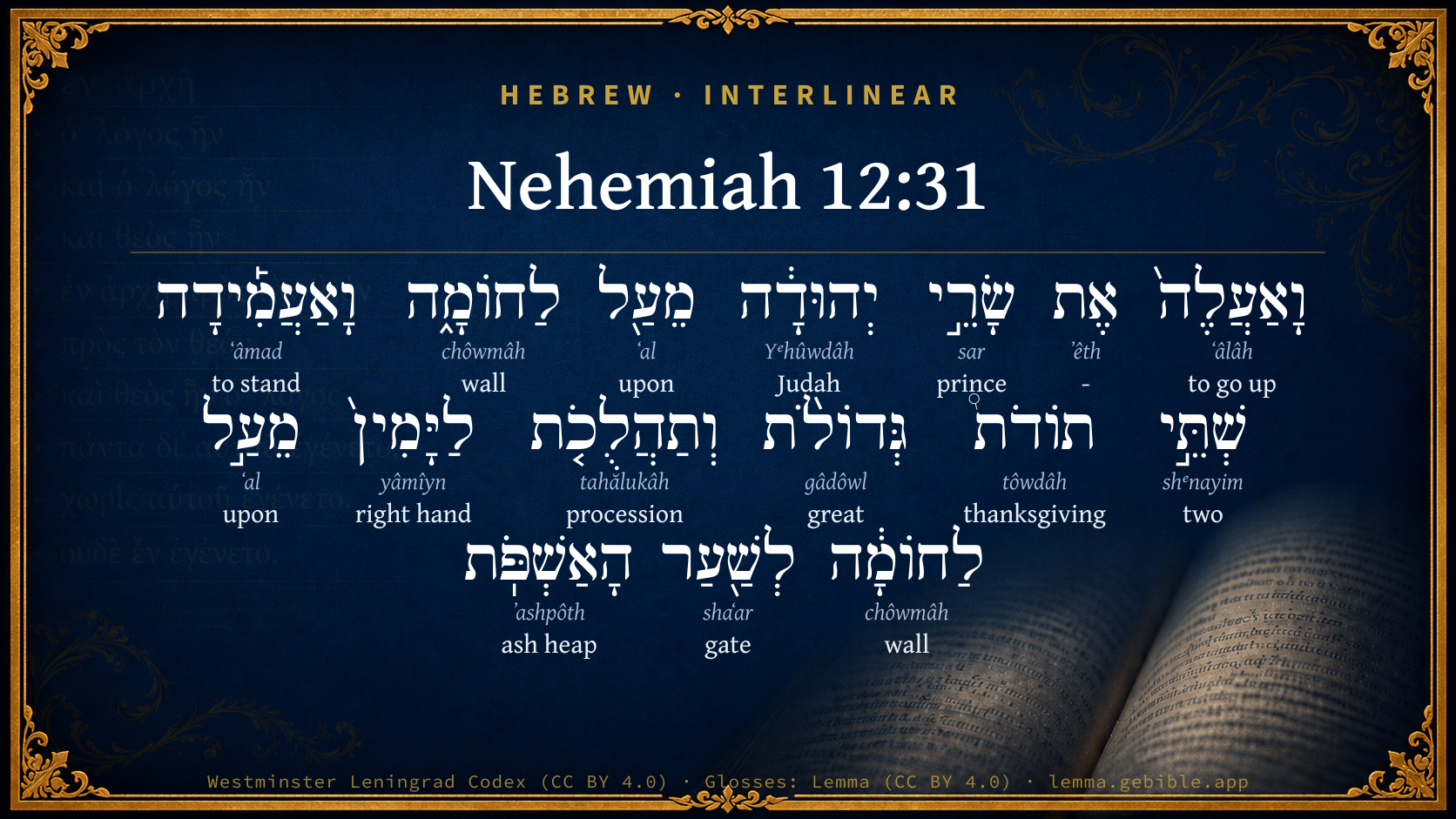
  1. וָאַעֲלֶה֙ ʻâlâh H5927 “and · to go up” Conjunction + Verb, Hiphil, Sequential Imperfect, 1st Person, Common, Singular
  2. אֶת ʼêth H853 “-” Particle, Direct Object
  3. שָׂרֵ֣י sar H8269 “princes of” Noun, Common, Masculine, Plural, Construct
  4. יְהוּדָ֔ה Yᵉhûwdâh H3063 “Judah” Noun, Proper
  5. מֵעַ֖ל ʻal H5921 “from · upon” Preposition + Preposition
  6. לַחוֹמָ֑ה chôwmâh H2346 “to/for the · wall” Preposition, Determined + Noun, Common, Feminine, Singular, Absolute
  7. וָאַעֲמִ֡ידָה ʻâmad H5975 “and · to stand” Conjunction + Verb, Hiphil, Sequential Imperfect, 1st Person, Common, Singular + Suffix, h
  8. שְׁתֵּ֣י shᵉnayim H8147 “two” Adjective, Cardinal number, Feminine, Dual, Construct
  9. תוֹדֹת֩ tôwdâh H8426 “thanksgivings” Noun, Common, Feminine, Plural, Absolute
  10. גְּדוֹלֹ֨ת gâdôwl H1419 “great” Adjective, Adjective, Feminine, Plural, Absolute
  11. לַיָּמִין֙ yâmîyn H3225 “to/for the · right hand” Preposition, Determined + Noun, Common, Feminine, Singular, Absolute
  12. מֵעַ֣ל ʻal H5921 “from · upon” Preposition + Preposition
  13. לַחוֹמָ֔ה chôwmâh H2346 “to/for the · wall” Preposition, Determined + Noun, Common, Feminine, Singular, Absolute
  14. לְשַׁ֖עַר shaʻar H8179 “to/for · gate of” Preposition + Noun, Common, Masculine, Singular, Construct
  15. הָאַשְׁפֹּֽת ʼashpôth H830 “the · ash heap” Particle, Definite Article + Noun, Common, Masculine, Singular, Absolute

About this verse

These counts appear in no published source. They are computed here, from the morphology-tagged text and Lemma’s own curated glosses. What Lemma adds →

16
words
14
distinct lemmas
Historical
section

Notable vocabulary

1 hapax legomenon — a word that appears only here in the entire Hebrew Bible:

  • וְתַהֲלֻכֹ֤ת procession H8418

First appearance in Scripture

This word makes its first canonical appearance in the Hebrew Bible here:

  • וְתַהֲלֻכֹ֤ת procession H8418

Shared distinctive vocabulary

הָאַשְׁפֹּֽת ash heap H830 occurs in 7 verses of the Hebrew Bible. Also found in:

Grammatical profile

  • 2 verbs
  • 9 nouns
  • 2 adjectives
  • 2 prepositions
  • 1 particle

Verb forms

  • וָאַעֲלֶה֙ Hiphil · Sequential Imperfect
  • וָאַעֲמִ֡ידָה Hiphil · Sequential Imperfect

Repetition

Words recur within this verse — often emphatic in Hebrew:

  • מֵעַ֖ל upon H5921 ×2
  • לַחוֹמָ֑ה wall H2346 ×2

Cross-references

7

Topical passages linked to Nehemiah 12:31 in the Treasury of Scripture Knowledge — connected by theme and wording, ordered by reader-vote popularity; previews shown in the World English Bible.

  • Nehemiah 2:13 I went out by night by the valley gate, even toward the jackal's well, and to the dung gate, and viewed the walls of Jerusalem, which were broken down, and the gates of it were consumed with fire.
  • Nehemiah 12:38 The other company of those who gave thanks went to meet them, and I after them, with the half of the people, on the wall, above the tower of the furnaces, even to the broad wall,
  • 1 Chronicles 13:1 David consulted with the captains of thousands and of hundreds, even with every leader.
  • 1 Chronicles 28:1 David assembled all the princes of Israel, the princes of the tribes, and the captains of the companies who served the king by division, and the captains of thousands, and the captains of hundreds, and the rulers over all the substance and possessions of the king and of his sons, with the officers, and the mighty men, even all the mighty men of valor, to Jerusalem.
  • 2 Chronicles 5:2 Then Solomon assembled the elders of Israel, and all the heads of the tribes, the princes of the fathers' [houses] of the children of Israel, to Jerusalem, to bring up the ark of the covenant of Yahweh out of the city of David, which is Zion.
  • Nehemiah 3:13–14 The valley gate repaired Hanun, and the inhabitants of Zanoah; they built it, and set up the doors of it, the bolts of it, and the bars of it, and one thousand cubits of the wall to the dung gate.
  • Nehemiah 12:40 So stood the two companies of those who gave thanks in the house of God, and I, and the half of the rulers with me;

Cross-references courtesy of OpenBible.info (CC BY 4.0).

Hebrew and Greek witnesses Masoretic Hebrew ↔ Greek Septuagint

The same verse in the two great witnesses to the Old Testament, shown verse-for-verse.

These are two independent witnesses, not word-aligned to each other, and the Septuagint is shown in lemma (dictionary) form.

Hebrew Nehemiah 12:31 Masoretic · Westminster Leningrad Codex

וָאַעֲלֶה֙ אֶת שָׂרֵ֣י יְהוּדָ֔ה מֵעַ֖ל לַחוֹמָ֑ה וָאַעֲמִ֡ידָה שְׁתֵּ֣י תוֹדֹת֩ גְּדוֹלֹ֨ת וְתַהֲלֻכֹ֤ת לַיָּמִין֙ מֵעַ֣ל לַחוֹמָ֔ה לְשַׁ֖עַר הָאַשְׁפֹּֽת

Then I brought up the princes of Judah on the wall, and appointed two great companies who gave thanks and went in procession. [One went] on the right hand on the wall toward the dung gate;

World English Bible · Public Domain

Greek LXX Structure differs

The Septuagint has no separate book of Nehemiah. Its Greek text is the second half of Esdras B (2 Esdras), chapters 11–23; Ezra is the first half (1–10).

A verse-for-verse comparison isn’t shown here because the chapters and verses don’t line up. Switch to the LXX edition with the MT / LXX toggle above to read the Greek directly.

On this verse, The Cambridge Bible for Schools and Colleges discusses the Septuagint’s reading. Read the note in Commentary ↓

Hebrew: Westminster Leningrad Codex (CC BY 4.0). Greek: Septuagint (public domain); English from a public-domain English Septuagint. How the Septuagint differs from the Hebrew →

Commentary

Notes on Nehemiah 12:31 from classic Christian and Jewish commentators (each source and its license shown beneath its notes). The classic Christian expositions comment on the surrounding passage and are grouped to its opening verse, so a note may address several verses; the Jewish commentaries on the Tanakh (Rashi and others) are per-verse, so they appear only where the commentator wrote on this verse.

Lemma curates 59 commentaries, every one of them public domain or Creative Commons licensed, each selected and text-cleaned for this edition rather than reprinted as found. About our sources →

Joseph Benson's Commentary

Neh 12:31-33. Then I brought up the princes — And half of the people with them, as it is expressed afterward, Neh 12:38. Upon the wall — For the wall was broad and strong, and so built that men might conveniently walk upon it, as at this day it is in many cities. Whereof one went on the right hand — Toward the south and east. Azariah and Ezra — Not the scribe, as is evident from Neh 12:36, but another Ezra.

Joseph Benson's Commentary on the Old and New Testaments (1811–1818) — public domain. Text from a community e-Sword module.

Tyndale Open Study Notes

Tyndale Open Resources

12:31-37 This impressive march proceeded southward along the top of the wall to the Dung Gate at the southern end of the city (3:13-14). Then the procession continued north on the wall along the east side of the city, past the ruins of the house of David and up to the Water Gate (3:26; 8:1) near the Temple.

Tyndale Open Study Notes — © Tyndale Open Resources, licensed CC BY-SA 4.0. Text via the HelloAO Bible API.

Geneva Bible (1599)

Geneva Bible translators

Meaning, Nehemiah.

Geneva Bible (1599) marginal notes — public domain. Text via Bolls.life.

Adam Clarke's Commentary

Verse 31. Then I brought up the princes] Perhaps this verse should be read thus: "Then I caused the princes of Judah to go upon the wall, and appointed two great choirs, [to sing praises,] and two processions, one on the right hand, c.

The following seems to have been the order of the procession: he divided the priests, the Levites, the magistrates, and the people into two companies each company to go round one half of the wall. They began at the dung gate, one party going to the right and the other to the left, till they met at the great space opposite to the temple, where they all offered many sacrifices to God, and rejoiced with exceeding great joy; shouting so that the noise was heard a great way off.

Adam Clarke's Commentary on the Bible (1810–1826) — public domain. Text from a community e-Sword/MySword module.

Ellicott's Commentary for English Readers

(31) The princes.—The chiefs were assembled somewhere on the south-west wall, and then divided into two companies.

A Bible Commentary for English Readers, edited by Charles John Ellicott (1878–1897) — public domain. Text from a community e-Sword module.

The Cambridge Bible for Schools and Colleges

gen. ed. J. J. S. Perowne

31. the princes of Judah] i.e. all the nobles of the nation.

upon the wall] Much turns upon the meaning of the preposition here used. The words in the Hebrew, ‘from above, with respect to the wall’ have been considered by some to mean ‘beyond, at a little distance from the wall;’ by others ‘over against the wall.’ But a comparison with its use in 2Ch_13:4 (= ‘upon’), Jon_4:6 (= ‘over’) shows that the rendering of the English version may very well be defended.

two great companies of them that gave thanks] R.V. two great companies that gave thanks and went in procession. Literally ‘And I appointed two great thanksgivings and processions.’ The LXX. rendered καὶ ἔστησαν δύο περὶ αἰνέσεως μεγάλους. The Vulg. ‘statui duos magnos choros laudantium’ is clearly the origin of the A.V. rendering. The Hebrew word for ‘procession’ occurs only here in the O.T.

whereof one went on the right hand … dung gate] We have here to supply the words ‘whereof one went,’ which seem to have slipped out of the text. They are needed in order to correspond with ‘the other company’ in Neh_12:38, ‘the right hand;’ facing towards the Temple, the procession moving to the right marched along the southern wall. The starting point seems to have been ‘the valley gate’ of Neh_2:13. ‘Towards the dung gate.’ Cf. Neh_3:14.

31–42. Nehemiah’s description of the dedication of the walls

Two processions headed by the priests and Levites started from near the Valley or Jaffa Gate, and proceeded, the one by the northern, the other by the southern wall, together accomplishing the complete circuit, and meeting one another in the open space on the eastern side of the Temple.

The Cambridge Bible for Schools and Colleges (gen. ed. J. J. S. Perowne; Cambridge University Press, 1878–1918) — public domain. Text from a community e-Sword module.

John Gill's Exposition

Judah and Benjamin,.... Not the tribes, but the names of the two princes, as Jarchi:

and Shemaiah and Jeremiah; who were two others.

John Gill's Exposition of the Whole Bible (1746–1763) — public domain (CC PDM 1.0). Text via the HelloAO Bible API.

Albert Barnes' Notes on the Bible

I brought up - Note the resumption of the first person, which has been laid aside since Neh 7:5, and which is confirmed now to the end of the book. It is generally allowed that we have here once more a memoir by Nehemiah himself.

The two “companies” or choirs, having ascended the wall on its western face, near the modern Jaffa Gate, stood looking eastward toward the city and temple; then the southern choir, being on the right, commenced the circuit of the southern wall, while the choir upon the left proceeded round the northern wall Neh 12:38-39, until both met on the eastern wall, between the water and the prison gates.

Albert Barnes' Notes on the Bible (1834–1885) — public domain. Text from a community e-Sword/MySword module.

Haydock's Catholic Bible Commentary

Choirs. This is not expressed in Hebrew and Septuagint, but must be understood. Protestants, "great companies of them that gave thanks. Whereof one went." (Haydock) --- The princes led the way, then the priests sounded the trumpets, (Numbers x. 8.) the Levites sung, and were followed by the people. All were divided into two equal parts, and went round half the city. (Calmet) --- They set out from the dunghill-gate, on the west, and proceeded to the watch-gate, on the east, ver. 38. (Menochius)

George Leo Haydock (1774–1849), Haydock's Catholic Family Bible and Commentary, 1859 edition — public domain. Excludes Psalms (Douay-Rheims chapter numbering differs from Protestant) and Deuterocanonical books (Catholic canon only).

Matthew Poole's English Annotations

The princes of Judah, and half of the people with them, as it is expressed afterwards, Neh 12:38.

Upon the wall; for the wall was broad and strong, and so ordered that men might conveniently walk upon it, as at this day it is in many cities.

On the right hand; towards the south and east.

Matthew Poole's English Annotations on the Holy Bible (1683–1685) — public domain. Text from a community e-Sword/MySword module.

Whedon's Commentary on the Bible

Daniel D. Whedon

31. The princes of Judah are here, as usual, the political chiefs or representatives of the new community. It was important for all these, as well as for Nehemiah himself, to appear in the great processions which were so prominent a part of the ceremonies of the day.

Two great companies of them that gave thanks — Or, two great choirs. One of these was to go, as a body of musicians, before each of the great processions.

One went on the right… toward the dung gate — The two processions seem to have started near the valley gate, (Neh_2:13,) and this one going southward, passed round the southwestern corner of the city, near which was the dung gate. See on Neh_2:13; and Plan, page 444.

Daniel D. Whedon (gen. ed.), Commentary on the Old and New Testaments (1874–1909) — public domain. Text from a community e-Sword module.

The Pulpit Commentary

I brought up the princes of Judah upon the wall, and appointed two great companies. Nehemiah caused all the chiefs of the nation, both lay and clerical, to mount upon the wall, and there marshalled them into two companies, composed of clergy and laity intermixed, one of which he placed under the direction of Ezra (ver. 36), while of the other he took the command himself (ver. 38). The place of assemblage must have been some portion of the western wall, probably the central portion, near the modern Jaffa gate. From this Ezra"s company proceeded southward, and then eastward, along the southern wall, while Nehemiah"s marched northward, and then eastward, along the northern wall, both processions meeting midway in the eastern wall, between the "water" and the "prison" gates. Toward the dung gate. On the position of this gate, see the comment on Neh_2:13.

The Pulpit Commentary (1880–1919), ed. H.D.M. Spence-Jones & Joseph S. Exell — public domain. Text from a community e-Sword module.

John Wesley's Explanatory Notes

Princes - And half of the people with them. The wall - For the wall was broad and strong, and so ordered that men might conveniently walk upon it. Right hand - Towards the south and east.

John Wesley, Explanatory Notes Upon the Whole Bible (1754–1765) — public domain. Text via the GEBible commentary corpus.

unfoldingWord translationNotes

Door43 World Missions Community

the leaders of Judah

the leaders of the people who lived in the region of Judah

translationWords

kingdom of Judah

appoint

dung

gate

unfoldingWord translationNotes — © Distant Shores Media and the Door43 World Missions Community, licensed CC BY-SA 4.0. Source: git.door43.org/Door43/en_tn.

Rashi

Rabbi Shlomo Yitzchaki (Rashi)

upon the wall meaning that he sanctified the city, the princes, the tribunal, and the Levites with two thanksgiving offerings around the city, as is delineated in Tractate Shebuoth (14a, 15a, b), in order to sanctify the city.

two...thanksgiving offerings two breads of the thanksgiving offerings, each bread being called a thanksgiving offering.

with processions to the right And when they went out of the city in order to encompass it, they went to the right side.

Rashi on the Tanakh — English translations: “The Judaica Press complete Tanach with Rashi, translated by A. J. Rosenberg” (CC BY 4.0); “Pentateuch with Rashi's commentary by M. Rosenbaum and A.M. Silbermann, 1929-1934” (public domain); “The Metsudah Tanach series, Lakewood, N.J” (CC BY 4.0); and “The Book of Joshua, Metsudah Publications, 1997” (CC BY 4.0). Text via Sefaria.

Lesson kit

Teaching starters — assembled from the data on this page, not authored interpretation. Every prompt links to the verse data it draws on. Edit before teaching.

Nehemiah, in the Historical, opens this verse with 16 words (14 distinct Hebrew lemmas). Its most distinctive word is tahălukâh (“procession”). A historical commentator’s framing appears above. Read the whole chapter for the surrounding context.

Discussion questions

  1. How does “procession” (tahălukâh) shape what this verse is saying?
  2. This verse holds 1 word here found nowhere else in the Hebrew Bible. What might the rare word draw attention to?
  3. The word “procession” first appears here in Scripture. What is being introduced at this debut?
  4. 1 Samuel 2:8 shares the word «ash heap» with this verse. How do the two illuminate each other?
  5. “upon” occurs 2× in this one verse. What is the effect of the repetition?
  6. These translations render this verse differently; the difference is in the English rendering, not the original. What questions does that raise?
  7. The verb «וָאַעֲלֶה֙» is Hiphil Sequential Imperfect. How does its form color the action?
  8. Reading how Joseph Benson's Commentary and Tyndale Open Study Notes read this verse, where do the two commentators agree and where do they part?

Things to notice

  • 1 word in this verse appears nowhere else in the Hebrew Bible.
  • 1 word makes its first canonical appearance in Scripture here.
  • These translations choose different wording for 20 words in this verse.
  • “upon” occurs 2× in this single verse.
  • 14 distinct Hebrew lemmas span 16 words in this verse.

Reading settings

Reading text

Shown beneath each verse's original-language words.

Old Testament
Old Testament edition

Read the OT as the Masoretic Hebrew (MT) or the Greek Septuagint (LXX).

English shown for the Greek Septuagint (in the Hebrew ↔ Greek comparison).

Comparing translations? Open the Compare panel on any verse page to stack up to four side by side.