
1 Samuel 21:13

Hebrew (Westminster Leningrad Codex) 1 Samuel 21:13 appears in the Hebrew Old Testament. The text above is from the Westminster Leningrad Codex. Each word links to its Strong’s number, a concise gloss, and parsing drawn from the Open Scriptures Hebrew Bible morphology. Click any word for its full Brown-Driver-Briggs (BDB) entry.
Download image
Cite this verse

1 Samuel 21:13 (World English Bible). Public Domain. Lemma interlinear Bible study tool, https://lemma.gebible.app/v/1-samuel/21/13.

Show BibTeX & RIS
BibTeX
RIS
English Translation
He changed his behavior before them, and feigned himself mad in their hands, and scrabbled on the doors of the gate, and let his spittle fall down on his beard.
World English Bible · Public Domain
Highlights Full analysis ↓
Download a study sheet

One document with this verse’s original text, its word-by-word gloss line, the meaning frame, cross-references with their text, attributed commentary, and full source and license credits — printable, and it pastes into notes with its structure intact.

This verse Autodidact and up

Study sheet (.html) Plain text (.txt)

A passage Seminary Student

Up to 50 verses in one chapter. A passage sheet keeps up to 6 commentary sources and 12 cross-references per verse, in the order this page ranks them, and says so on the sheet whenever that leaves anything out. Ask for a single verse and you get the Autodidact verse sheet above.

Everything on this page stays free to read, with no account — the sheet is a download of what is already on screen, not access to it.

Want to remove ads? Support Godless Engineer
Compare translations 3

The same verse in 3 English versions, stacked beneath the original-language interlinear above. Click any original word for its lexicon entry.

Each is an independent rendering of the whole verse — the interlinear is not word-aligned to these translations.

Highlighted words mark where these versions differ — a whole-verse word diff, not a word-by-word alignment.

  • World English Bible Public Domain
    He changed his behavior before them, and feigned himself mad in their hands, and scrabbled on the doors of the gate, and let his spittle fall down on his beard.
  • King James Version Public Domain
    And he changed his behavior before them, and feigned himself mad in their hands, and scrabbled on the doors of the gate, and let his spittle fall down upon his beard.
  • unfoldingWord Literal Text CC BY-SA 4.0
    So he changed his behavior in their eyes, and he acted insane in their hand. And he made marks on the doors of the gate, and he caused his saliva to go down to his beard.

unfoldingWord Literal Text — © unfoldingWord, licensed CC BY-SA 4.0. Word-aligned USFM3 via Door43 (git.door43.org/unfoldingWord/en_ult).

Versions to compare (up to 4)

3 of 4 selected

Show all 18 translations

Every available English version of this verse, each an independent rendering of the whole verse.

  • World English Bible Public Domain
    He changed his behavior before them, and feigned himself mad in their hands, and scrabbled on the doors of the gate, and let his spittle fall down on his beard.
  • Berean Standard Bible Public Domain
    So he changed his behavior before them and feigned madness in their hands; he scratched on the doors of the gate and let his saliva run down his beard.
  • Majority Standard Bible Public Domain
    So he changed his behavior before them and feigned madness in their hands; he scratched on the doors of the gate and let his saliva run down his beard.
  • King James Version Public Domain
    And he changed his behavior before them, and feigned himself mad in their hands, and scrabbled on the doors of the gate, and let his spittle fall down upon his beard.
  • American Standard Version (1901) Public Domain
    And he changed his behavior before them, and feigned himself mad in their hands, and scrabbled on the doors of the gate, and let his spittle fall down upon his beard.
  • Revised Version (1885) Public Domain
    And he changed his behaviour before them, and feigned himself mad in their hands, and scrabbled on the doors of the gate, and let his spittle fall down upon his beard.
  • Geneva Bible (1599) Public Domain
    And hee changed his behauiour before them, and fayned him selfe mad in their handes, and scrabled on the doores of the gate, and let his spettel fall downe vpon his beard.
  • Douay-Rheims (1899) Public Domain
    And he changed his countenance before them, and slipt down between their hands: and he stumbled against the doors of the gate, and his spittle ran down upon his beard.
  • Young's Literal Translation Public Domain
    and changeth his behaviour before their eyes, and feigneth himself mad in their hand, and scribbleth on the doors of the gate, and letteth down his spittle unto his beard.
  • Literal Standard Version CC BY-SA 4.0
    and changes his behavior before their eyes, and feigns himself mad in their hand, and scribbles on the doors of the gate, and lets down his spittle to his beard.
  • Unlocked Literal Bible CC BY-SA 4.0
    He changed his behavior before them and pretended to be insane in their hands; he made marks on the doors of the gate and let his saliva run down his beard.
  • unfoldingWord Literal Text CC BY-SA 4.0
    So he changed his behavior in their eyes, and he acted insane in their hand. And he made marks on the doors of the gate, and he caused his saliva to go down to his beard.
  • Darby Bible Public Domain
    And he changed his behaviour before them, and feigned himself mad in their hands, and scratched on the doors of the gate, and let his spittle fall down on his beard.
  • World Messianic Bible Public Domain
    He changed his behavior before them and pretended to be insane in their hands, and scribbled on the doors of the gate, and let his spittle fall down on his beard.
  • Webster's Bible Public Domain
    And he changed his behavior before them, and feigned himself mad in their hands, and scrabbled on the doors of the gate, and let his spittle fall down upon his beard.
  • Free Bible Version CC BY-SA 4.0
    So he changed the way he acted toward them and pretended to be crazy. He scratched marks on the town gates and let his spit run down his beard.
  • Bible in Basic English Public Domain
    So changing his behaviour before them, he made it seem as if he was off his head, hammering on the doors of the town, and letting the water from his mouth go down his chin.
  • JPS Tanakh (1917) Public Domain
    (21-14) And he changed his demeanour before them, and feigned himself mad in their hands, and scrabbled on the doors of the gate, and let his spittle fall down upon his beard.

Literal Standard Version (2020), Covenant Press — licensed CC BY-SA 4.0. Text via the HelloAO Bible API (eBible.org). Unlocked Literal Bible (unfoldingWord) — licensed CC BY-SA 4.0. Text via the HelloAO Bible API (eBible.org). unfoldingWord Literal Text — © unfoldingWord, licensed CC BY-SA 4.0. Word-aligned USFM3 via Door43 (git.door43.org/unfoldingWord/en_ult). Free Bible Version, Dr. Jonathan Gallagher — licensed CC BY-SA 4.0. Text via the HelloAO Bible API (eBible.org).

Word by word

More ways to search: Search by grammar → Find every occurrence → Compare this word →

Practice this passage: Drill this verse → Learn its vocabulary →

רִיר֖וֹ
rîyr
H7388
“spittle · his”
Noun, Common, Masculine, Singular, Construct + Suffix, Personal, 3rd Person, Masculine, Singular
Part of Speech
Noun
Type
Common
Gender
Masculine
Number
Singular
State
Construct
Full BDB Definition

Origin: from H7325

TWOT: 2162a

slime juice or liquid, spittle
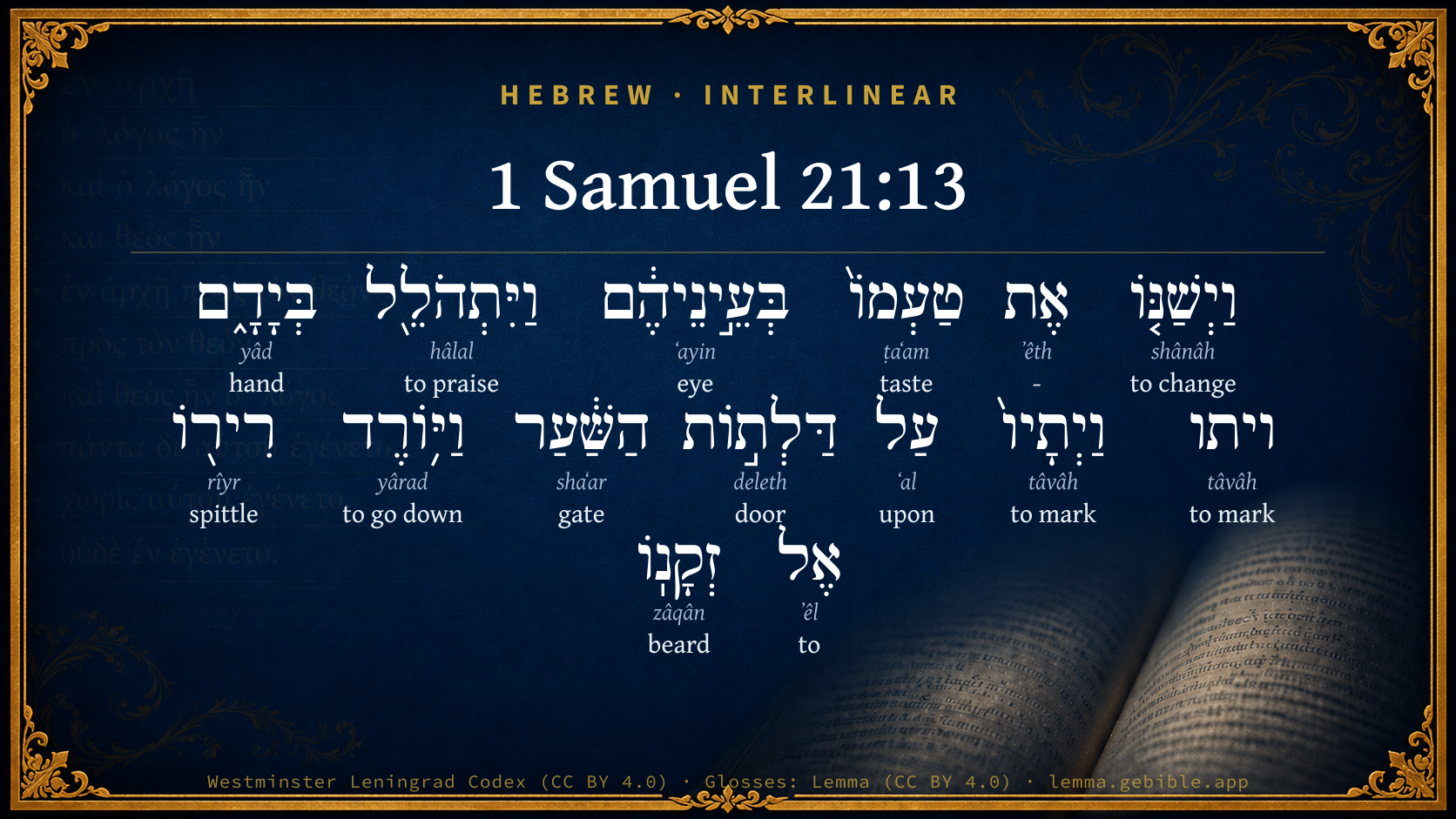
  1. וַיְשַׁנּ֤וֹ shânâh H8138 “and · to change · him” Conjunction + Verb, Piel, Sequential Imperfect, 3rd Person, Masculine, Singular + Suffix, Personal, 3rd Person, Masculine, Singular
  2. אֶת ʼêth H853 “-” Particle, Direct Object
  3. טַעְמוֹ֙ ṭaʻam H2940 “taste · his” Noun, Common, Masculine, Singular, Construct + Suffix, Personal, 3rd Person, Masculine, Singular
  4. בְּעֵ֣ינֵיהֶ֔ם ʻayin H5869 “in/at · eyes · their” Preposition + Noun, Common, Both, Dual, Construct + Suffix, Personal, 3rd Person, Masculine, Plural
  5. וַיִּתְהֹלֵ֖ל hâlal H1984 “and · to praise” Conjunction + Verb, Hithpolel, Sequential Imperfect, 3rd Person, Masculine, Singular
  6. בְּיָדָ֑ם yâd H3027 “in/at · hand · their” Preposition + Noun, Common, Both, Singular, Construct + Suffix, Personal, 3rd Person, Masculine, Plural
  7. ויתו tâvâh H8427 “and · to mark” Conjunction + Verb, Piel, Sequential Imperfect, 3rd Person, Masculine, Singular
  8. וַיְתָיו֙ tâvâh H8427 “and · to mark” Conjunction + Verb, Piel, Sequential Imperfect, 3rd Person, Masculine, Singular
  9. עַל ʻal H5921 “upon” Preposition
  10. דַּלְת֣וֹת deleth H1817 “doors of” Noun, Common, Feminine, Plural, Construct
  11. הַשַּׁ֔עַר shaʻar H8179 “the · gate” Particle, Definite Article + Noun, Common, Masculine, Singular, Absolute
  12. וַיּ֥וֹרֶד yârad H3381 “and · to go down” Conjunction + Verb, Hiphil, Sequential Imperfect, 3rd Person, Masculine, Singular
  13. אֶל ʼêl H413 “to” Preposition
  14. זְקָנֽוֹ zâqân H2206 “beard · his” Noun, Common, Both, Singular, Construct + Suffix, Personal, 3rd Person, Masculine, Singular

About this verse

These counts appear in no published source. They are computed here, from the morphology-tagged text and Lemma’s own curated glosses. What Lemma adds →

15
words
14
distinct lemmas
Historical
section

Notable vocabulary

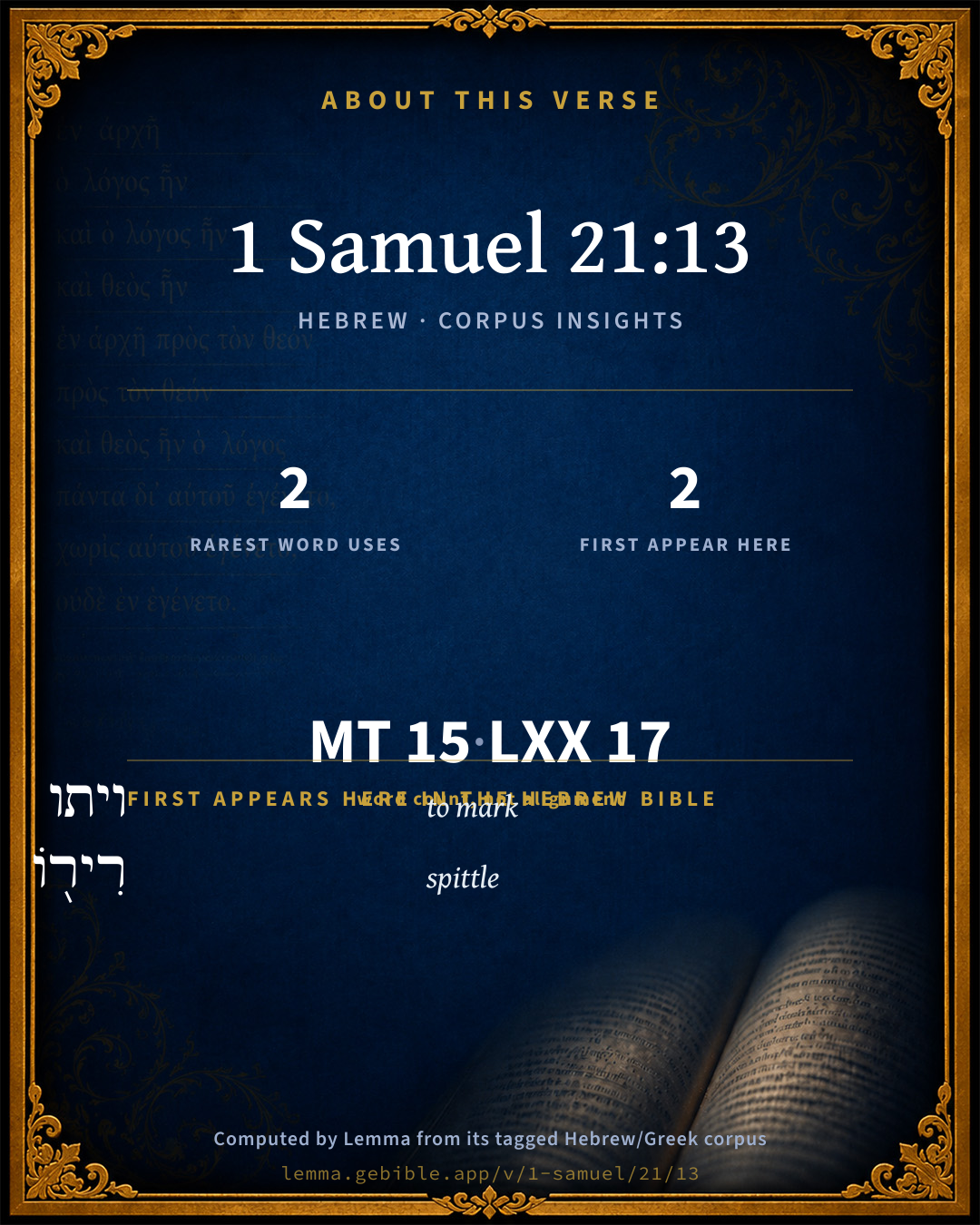
The rarest word here is רִיר֖וֹ spittle H7388 — appearing just 2 times in the whole Hebrew Bible.

First appearance in Scripture

These words make their first canonical appearance in the Hebrew Bible here:

  • ויתו to mark H8427
  • רִיר֖וֹ spittle H7388

Shared distinctive vocabulary

רִיר֖וֹ spittle H7388 occurs in 2 verses of the Hebrew Bible. Also found in:

Grammatical profile

  • 5 verbs
  • 7 nouns
  • 2 prepositions
  • 1 particle

Verb forms

  • וַיְשַׁנּ֤וֹ Piel · Sequential Imperfect
  • וַיִּתְהֹלֵ֖ל Hithpolel · Sequential Imperfect
  • ויתו Piel · Sequential Imperfect
  • וַיְתָיו֙ Piel · Sequential Imperfect
  • וַיּ֥וֹרֶד Hiphil · Sequential Imperfect

Repetition

A word recurs within this verse — often emphatic in Hebrew:

  • ויתו to mark H8427 ×2

Hebrew & Septuagint length

In English translation the verse runs 30 words from the Hebrew and 47 from the Septuagint (LXX English) — the Septuagint runs noticeably longer here. See the side-by-side →

A rough comparison of the two English renderings, which tokenize alike — not a word-level alignment.

Word counts can differ between the Hebrew and the Greek without any difference in meaning — e.g. the Hebrew direct-object marker אֵת has no separate Greek word, and Greek often adds the article ὁ.

In the original languages it is 15 Hebrew tokens and 17 Greek tokens — but the two are counted differently (Hebrew bundles its prefixes and suffixes into one token; the Greek is in lemma form), so that isn’t a like-for-like length.

Cross-references

3

Topical passages linked to 1 Samuel 21:13 in the Treasury of Scripture Knowledge — connected by theme and wording, ordered by reader-vote popularity; previews shown in the World English Bible.

  • Proverbs 29:25 The fear of man proves to be a snare, But whoever puts his trust in Yahweh is kept safe.
  • Ecclesiastes 7:7 Surely extortion makes the wise man foolish; and a bribe destroys the understanding.
  • Psalms 34:1–22 I will bless Yahweh at all times. His praise will always be in my mouth.

Cross-references courtesy of OpenBible.info (CC BY 4.0).

Hebrew and Greek witnesses Masoretic Hebrew ↔ Greek Septuagint

The same verse in the two great witnesses to the Old Testament, shown verse-for-verse.

Here the Septuagint runs noticeably longer than the Hebrew — LXX2012 (modern English Septuagint) 47 words vs World English Bible 30. A rough length comparison of the two English translations, not a word-level alignment — read both below.

These are two independent witnesses, not word-aligned to each other, and the Septuagint is shown in lemma (dictionary) form.

Hebrew 1 Samuel 21:13 Masoretic · Westminster Leningrad Codex

וַיְשַׁנּ֤וֹ אֶת טַעְמוֹ֙ בְּעֵ֣ינֵיהֶ֔ם וַיִּתְהֹלֵ֖ל בְּיָדָ֑ם ויתו וַיְתָיו֙ עַל דַּלְת֣וֹת הַשַּׁ֔עַר וַיּ֥וֹרֶד רִיר֖וֹ אֶל זְקָנֽוֹ

He changed his behavior before them, and feigned himself mad in their hands, and scrabbled on the doors of the gate, and let his spittle fall down on his beard.

World English Bible · Public Domain

Greek LXX 1 Samuel 21:13 Septuagint · lemma form

καί τίθημι δαυίδ ὁ ῥῆμα ἐν ὁ καρδία αὐτός καί φοβέω σφόδρα ἀπό πρόσωπον αγχους βασιλεύς γεθ

And he changed his appearance before him, and feigned himself a false character in that day; and drummed upon the doors of the city, and used extravagant gestures with his hands, and fell against the doors of the gate, and his spittle ran down upon his beard.

LXX2012 (modern English Septuagint) · Public Domain

On this verse, Adam Clarke's Commentary discusses the Septuagint’s reading. Read the note in Commentary ↓

Hebrew: Westminster Leningrad Codex (CC BY 4.0). Greek: Septuagint (public domain); English from LXX2012 (modern English Septuagint) (Public Domain). How the Septuagint differs from the Hebrew →

Targum (Aramaic paraphrase)

1

The Targum is the ancient Jewish Aramaic paraphrase of the Hebrew Scriptures — an interpretive translation, not the Hebrew text itself. Onkelos (literal) and Pseudo-Jonathan (expansive) render the Torah, and Jonathan the Prophets. Coverage is partial: where no permissively-licensed English translation exists for a verse, only the Aramaic is shown. This is verse-level text, not a word-by-word alignment to the Hebrew.

  1. Targum Jonathan Prophets (Joshua–Malachi)
    וְשַׁוֵי דָוִד יַת פִתְגָמַיָא הָאִלֵין בְּלִבֵּיה וּדְחִיל לַחְדָא מִן קֳדָם אָכִישׁ מַלְכָּא דְגָת:

    (no public-domain English translation for this verse)

    Targum Jonathan — Aramaic: “Mikraot Gedolot” (public domain). English: “Sefaria Community Translation” (CC0 1.0 (public-domain dedication)); “London "Chaldee Paraphrase," 1871” (public domain). Text via Sefaria.

Commentary

Notes on 1 Samuel 21:13 from classic Christian and Jewish commentators (each source and its license shown beneath its notes). The classic Christian expositions comment on the surrounding passage and are grouped to its opening verse, so a note may address several verses; the Jewish commentaries on the Tanakh (Rashi and others) are per-verse, so they appear only where the commentator wrote on this verse.

Lemma curates 59 commentaries, every one of them public domain or Creative Commons licensed, each selected and text-cleaned for this edition rather than reprinted as found. About our sources →

Trapp's Complete Commentary

John Trapp

1Sa 21:13 And he changed his behaviour before them, and feigned himself mad in their hands, and scrabbled on the doors of the gate, and let his spittle fall down upon his beard.

Ver. 13. And he changed his behaviour] See the title of Psa 34:1 This was a sorry shift, and can hardly be excused. The chameleon, saith Pliny, is the most fearful of all creatures, and therefore turneth itself into all colours, that it may shift for itself: so fearful men.

John Trapp, A Commentary or Exposition upon All the Books of the Old and New Testament (1647–1656) — public domain. Text from a community e-Sword module.

Joseph Benson's Commentary

1Sa 21:13. He feigned himself mad — That he might escape out of their hands. And herein he showed great sagacity and penetration. How great danger he was in, appears plainly from the 34th and 56th Psalms, which he composed upon this occasion. And he had indeed need to consider it, as he does in the first of those Psalms, as a wonderful deliverance wrought for him by God himself. He now learned by experience what he afterward taught us, Psa 118:9, That it is better to trust in the Lord than to put any confidence in princes.

Joseph Benson's Commentary on the Old and New Testaments (1811–1818) — public domain. Text from a community e-Sword module.

Geneva Bible (1599)

Geneva Bible translators

By making marks and toys.

Geneva Bible (1599) marginal notes — public domain. Text via Bolls.life.

Jamieson, Fausset & Brown

Robert Jamieson, A. R. Fausset & David Brown

feigned himself mad--It is supposed to have been an attack of epilepsy, real or perhaps only pretended. This disease is relieved by foaming at the mouth.

let his spittle fall down upon his beard--No wonder that Achish supposed him insane, as such an indignity, whether done by another, or one's self, to the beard, is considered in the East an intolerable insult.

Next: 1 Samuel Chapter 22

Jamieson, Fausset & Brown — Commentary Critical and Explanatory on the Whole Bible (1871) — public domain (CC PDM 1.0). Text via the HelloAO Bible API.

Adam Clarke's Commentary

Verse 13. And he changed his behaviour] Some imagine David was so terrified at the danger to which he was now exposed, that he was thrown into a kind of frenzy, accompanied with epileptic fits. This opinion is countenanced by the Septuagint, who render the passage thus: Ιδου ιδετε ανδρα επιλητον; "Behold, ye see an epileptic man. Why have ye introduced him to me?" Μη ελαττουμαι επιληπτων εγω; "Have I any need of epileptics, that ye have brought him to have his fits before me, (επιληπτευεσθαι προς με?") It is worthy of remark, that the spittle falling upon the beard, i.e., slavering or frothing at the mouth, is a genuine concomitant of an epileptic fit.

If this translation be allowed, it will set the conduct of David in a clearer point of view than the present translation does. But others think the whole was a feigned conduct, and that he acted the part of a lunatic or madman in order to get out of the hands of Achish and his courtiers. Many vindicate this conduct of David; but if mocking be catching, according to the proverb, he who feigns himself to be mad may, through the just judgment of God, become so. I dare not be the apologist of insincerity or lying. Those who wish to look farther into this subject may consult Dr. Chandler, Mr. Saurin, and Ortlob, in the first volume of Dissertations, at the end of the Dutch edition of the Critici Sacri.

Adam Clarke's Commentary on the Bible (1810–1826) — public domain. Text from a community e-Sword/MySword module.

Ellicott's Commentary for English Readers

(13) He changed his behaviour.—These very words (with the substitution of Abimelech for Achish, a name which, as has been above suggested, seems to have been the “nomen dignitatis” for generations of Philistine kings) are found in the title of Psalms 34. The poem in question is, however, of a general, not of an historical character, and especially celebrates Jehovah’s guardian care of the righteous. Its “acrostic” arrangement, however, suggests a later date than the time of David. If, as is quite possible, the royal psalmist was the original author, and that the deliverance on the present occasion suggested the theme, then it must have been brought into its present form by some later temple musician.

Feigned himself mad.—Literally, he roamed hither and thither, restless and in terror.—Dean Payne Smith. “In their hands,” that is, “in their presence.” Some have supposed that the madness was not “simulated,” but real. Wrought upon by excitement of fear and terrible anxiety, it has been suggested that the mind for a time lost its balance, and that David became temporarily really insane; but the sense of the narrative plainly indicates that the madness was feigned.

Scrabbled on the doors of the gate.—Scratched on them; “scrabble” being probably a diminutive of “scrape” (Richardson, Dictionary). By others it is connected with “scribble.” the root in either case being ultimately the same. The LXX. and Vulg. apparently translate from a slightly different word, and instead of “scrabbled,” render “drummed” (impingebat) on the wings of the doors.

Let his spittle fall.—That is, allowed the foam which comes from the mouth of a madman to hang about his beard. It has been cleverly suggested that David was only too well acquainted with all the signs of madness, from his long and intimate association with King Saul in his darker hours of insanity. There are other well-authenticated examples in history of great heroes, in seasons of sore danger, feigning madness like David, with a view of escaping from their enemies. For instance, according to the Shâhnâmeh, Kai Khosrev feigned idiocy in face of mortal peril.

A Bible Commentary for English Readers, edited by Charles John Ellicott (1878–1897) — public domain. Text from a community e-Sword module.

The Cambridge Bible for Schools and Colleges

gen. ed. J. J. S. Perowne

13. changed his behaviour] Psalms 34. is ascribed by its title to this occasion, but the contents do not bear out the reference. The title of Psalms 56. states that it was written by David “when the Philistines laid hold on him in Gath,” and though it is not expressly said here that he was arrested, the words “feigned himself mad in their hands” together with the mention of his escape in 1Sa_22:1, seem to imply that he was a prisoner.

feigned himself mad] So that they might suppose him harmless. The Philistines moreover may have shared the Oriental feeling which regards madness with a kind of reverence. See Smith’s Dict. of the Bible, Art. Madness.’ “Aghyle Aga, a well-known modern Arab chief, escaped from the governor of Acre in like manner, pretending to be a mad dervish.” Stanley, Lect. II. 52.

scrabled on the doors of the gate] i.e. scratched, or made marks. The word is still used in some provincial dialects. The Sept. however reads “drummed on the doors of the gate,” which is a more suitable gesture for a raving madman. “The doors” meant are probably those of the court of Achish’s palace.

The Cambridge Bible for Schools and Colleges (gen. ed. J. J. S. Perowne; Cambridge University Press, 1878–1918) — public domain. Text from a community e-Sword module.

John Gill's Exposition

And he changed his behaviour before them,.... Behaved like a fool, or a madman: or changed his "taste" (s); which some understand of his reason, acted as if he was deprived of it; and others of his speech, his words and the accent of them, drawled them out, as such persons do:

and feigned himself mad in their hands; for in their hands he was, being taken by them, as the title of the fifty sixth psalm shows, Psa 56:1; and this stratagem he used to get himself out of their hands, acting the part of a madman, delirious, and out of his senses:

and scrabbled on the doors of the gate; as if he was writing something there, and making marks upon them:

and let his spittle fall down upon his beard; slavered, as idiots and madmen do; and however mean this may seem in David to act such a part, it cannot be condemned as wicked, since it was only a stratagem to deliver himself, out of an enemy's hand, and stratagems are always allowed to be used against an enemy; and such a method as this has been taken by men of the greatest sense and wit, as by Brutus (t) and Solon (u); and yet, according to the Vulgate Latin and Septuagint versions, this case of his was real and not feigned; that through the surprise of being known in the court of Achish, he was seized with an epilepsy; that his countenance was changed, and his mouth distorted, as persons in such fits are; that he fell among them as one convulsed, and fell at, and dashed against the doors of the gates, and foamed at the mouth, as such persons do; see Luk 9:39; and so in the following words the Greek version is, ye see the man is an epileptic; I do not want epileptics; but the thirty fourth and fifty sixth psalms, composed by him at this time, show that as he was of a sound mind, so in good health of body, and not subject to such fits as here represented, see Psa 34:1; which would have rendered him unfit for such composures.

(s) "sensum suum", Montanus, Vatablus; "sermonem suum", Pagninus. (t) Liv. Hist. l. 1. c. 56. Aurel. Victor. de Vir. Illustr. c. 13. (u) Justin e Trogo, l. 2. c. 7.

John Gill's Exposition of the Whole Bible (1746–1763) — public domain (CC PDM 1.0). Text via the HelloAO Bible API.

Albert Barnes' Notes on the Bible

Scrabbled - literally, made marks (margin), namely, the mark of the “tau” (t), which in the ancient Hebrew and Phoenician was in the shape of a cross. (See Eze 9:4.)

On the doors of the gate - The gate of Achish’s palace-yard or court, in which the attendants waited. The house itself stood in this court. (Compare Est 2:19, Est 2:21.)

Albert Barnes' Notes on the Bible (1834–1885) — public domain. Text from a community e-Sword/MySword module.

Haydock's Catholic Bible Commentary

Countenance. Hebrew, "sentiment, (Calmet) or, behaviour." (Haydock) --- Chaldean, "reason." He no longer acted as a prudent man, but like a fool. --- Down; not fainting, (Calmet) but like one in an epileptic fit. (Haydock) --- Hebrew, "he feigned himself mad." Chaldean, "stupid." --- Stumbled. Hebrew, "wrote, or made figures upon." Septuagint, "beat the drum upon the gates of the city, and he was carried about, or acted the fool, in his hands, (Greek: parephereto en tais chersin, autou: Amama would have, Greek: auton, their) and he fell against the doors of the gate," &c. They seem to give a double translation. St. Augustine says, "we cannot understand how David could be carried in his own hands. But we understand how it was verified in Christ. For Christ was carried in his own hands at his last supper, when he gave, or commending, his own body, he said, This, &c., for he then carried his own body in his own hands." (In Psalm xxxiii. conc. i.) Ferebat enim illud corpus in manibus suis. Amama may laugh at St. Augustine’s ignorance of Hebrew, but the holy doctor was at least a sincere Catholic. (Haydock) --- Beard. We find some wretched objects doing the same, Mark ix. 17. The spittle was deemed infectious. Et illic isti qui sputatur, morbus interdum venit. (Plautus in Captivis.)

George Leo Haydock (1774–1849), Haydock's Catholic Family Bible and Commentary, 1859 edition — public domain. Excludes Psalms (Douay-Rheims chapter numbering differs from Protestant) and Deuterocanonical books (Catholic canon only).

Matthew Poole's English Annotations

His behaviour; his speech and gesture; and, it may be, his habit also.

Feigned himself mad; which they might the more easily believe, partly because of the disappointment of his great hopes, and his extreme danger and trouble from Saul, which might well make him mad; and partly because he had put himself into their hands, which they supposed none but a fool or a madman would have done. And David counterfeited this madness, that he might procure both their pity and their contempt; that they being freed from jealousies and fears of future mischief from David, and from his wise conduct, of which they had sad experience, might be secure of him, and so spare him.

In their hands, i.e. whilst he was in their power, and before them.

Matthew Poole's English Annotations on the Holy Bible (1683–1685) — public domain. Text from a community e-Sword/MySword module.

Whedon's Commentary on the Bible

Daniel D. Whedon

13. Changed his behaviour — Rather, changed his reason; pretended to lose his mind.

Daniel D. Whedon (gen. ed.), Commentary on the Old and New Testaments (1874–1909) — public domain. Text from a community e-Sword module.

The Pulpit Commentary

He changed his behaviour. The same word is used in the title of Psalm 34. Literally it means "his taste," and, like the Latin word sapientia, is derived from the action of the palate, and so from the faculty of discriminating flavours it came to signify the power of discrimination generally. Thus "to change his taste" means to act as if he had lost the power of distinguishing between objects. Feigned himself mad. Literally, "he roamed hither and thither" restlessly and in terror. In their hands. Ie. before them, in their presence. Scrabbled on the doors of the gate. The Vulgate and Septuagint read drummed upon them. Literally the verb means "to make the mark of a Tau," the last letter of the Hebrew alphabet, and which anciently was in the form of a cross. The gate, on the leaves of which David scrawled, was probably that of the court or waiting room, in which the servants of Achish passed their time when in attendance upon him. Possibly David had witnessed these symptoms of madness in Saul"s case during his fits of insanity. The idea of some of the older commentators, that David really for a time went out of his mind, is opposed to the general sense of the narrative.

The Pulpit Commentary (1880–1919), ed. H.D.M. Spence-Jones & Joseph S. Exell — public domain. Text from a community e-Sword module.

Lesson kit

Teaching starters — assembled from the data on this page, not authored interpretation. Every prompt links to the verse data it draws on. Edit before teaching.

1 Samuel, in the Historical, opens this verse with 15 words (14 distinct Hebrew lemmas). Its most distinctive word is rîyr (“spittle”). The Greek Septuagint runs longer here. A historical commentator’s framing appears above. Read the whole chapter for the surrounding context.

Discussion questions

  1. How does “spittle” (rîyr) shape what this verse is saying?
  2. 2 words make their first appearance in Scripture here. What does this debut establish?
  3. How does Job 6:6, which shares the word «spittle», read alongside this verse?
  4. What does the repetition of “to mark” (2× in this one verse) do in this verse?
  5. The Septuagint runs longer here than the Hebrew. What might account for the difference?
  6. These translations render this verse differently. What is at stake in choosing one wording over another?
  7. «וַיְשַׁנּ֤וֹ» is a Piel Sequential Imperfect verb. How does that grammatical form shape the action described?
  8. Compare how Trapp's Complete Commentary and Joseph Benson's Commentary read this verse. Where do they agree or differ?

Things to notice

Reading settings

Reading text

Shown beneath each verse's original-language words.

Old Testament
Old Testament edition

Read the OT as the Masoretic Hebrew (MT) or the Greek Septuagint (LXX).

English shown for the Greek Septuagint (in the Hebrew ↔ Greek comparison).

Comparing translations? Open the Compare panel on any verse page to stack up to four side by side.