
2 Kings 11:19

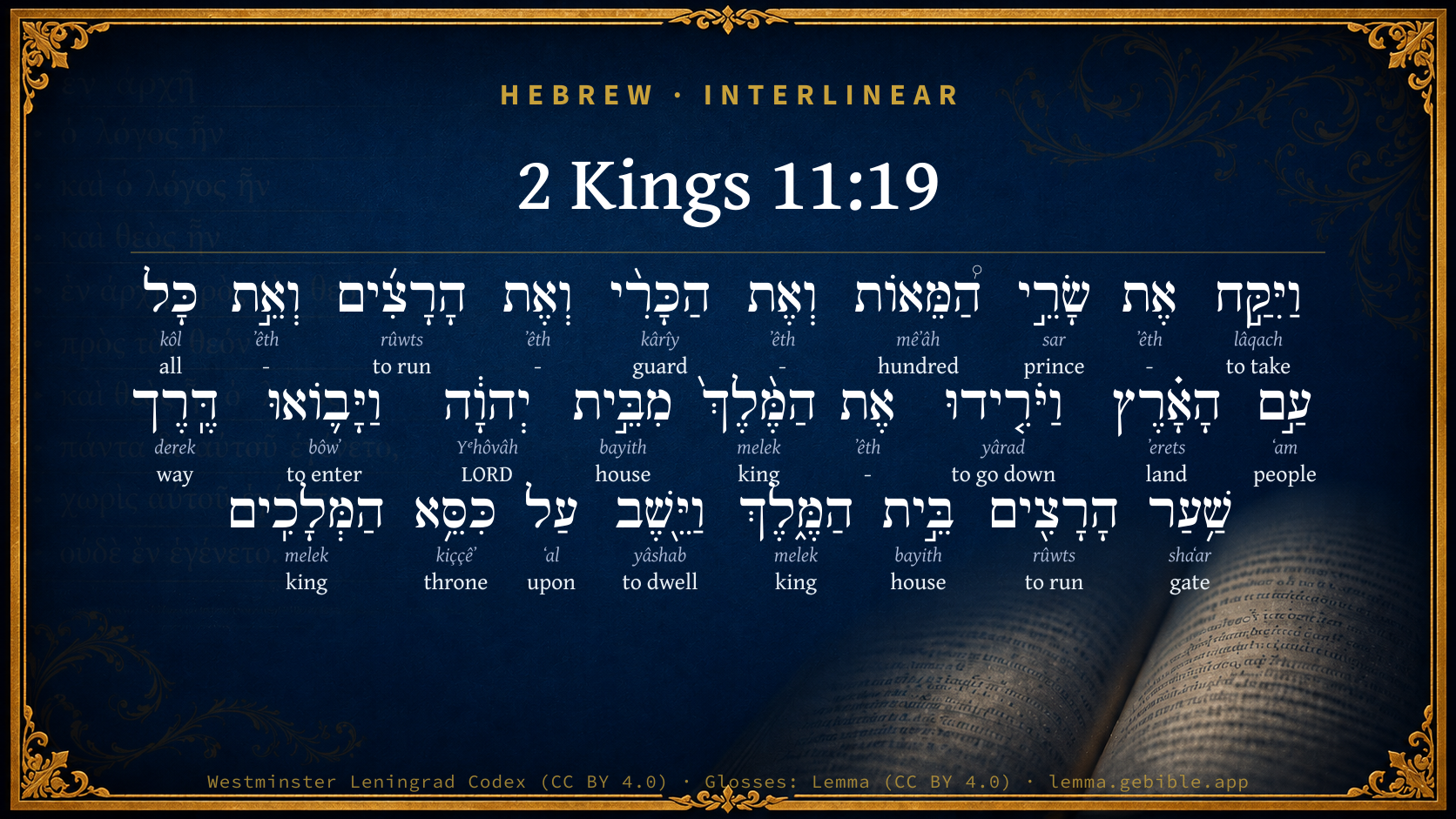
Hebrew (Westminster Leningrad Codex) 2 Kings 11:19 appears in the Hebrew Old Testament. The text above is from the Westminster Leningrad Codex. Each word links to its Strong’s number, a concise gloss, and parsing drawn from the Open Scriptures Hebrew Bible morphology. Click any word for its full Brown-Driver-Briggs (BDB) entry.
Download image
Cite this verse

2 Kings 11:19 (World English Bible). Public Domain. Lemma interlinear Bible study tool, https://lemma.gebible.app/v/2-kings/11/19.

Show BibTeX & RIS
BibTeX
RIS
English Translation
He took the captains over hundreds, and the Carites, and the guard, and all the people of the land; and they brought down the king from the house of Yahweh, and came by the way of the gate of the guard to the king's house. He sat on the throne of the kings.
World English Bible · Public Domain
Download a study sheet

One document with this verse’s original text, its word-by-word gloss line, the meaning frame, cross-references with their text, attributed commentary, and full source and license credits — printable, and it pastes into notes with its structure intact.

This verse Autodidact and up

Study sheet (.html) Plain text (.txt)

A passage Seminary Student

Up to 50 verses in one chapter. A passage sheet keeps up to 6 commentary sources and 12 cross-references per verse, in the order this page ranks them, and says so on the sheet whenever that leaves anything out. Ask for a single verse and you get the Autodidact verse sheet above.

Everything on this page stays free to read, with no account — the sheet is a download of what is already on screen, not access to it.

Want to remove ads? Support Godless Engineer
Compare translations 3

The same verse in 3 English versions, stacked beneath the original-language interlinear above. Click any original word for its lexicon entry.

Each is an independent rendering of the whole verse — the interlinear is not word-aligned to these translations.

Highlighted words mark where these versions differ — a whole-verse word diff, not a word-by-word alignment.

  • World English Bible Public Domain
    He took the captains over hundreds, and the Carites, and the guard, and all the people of the land; and they brought down the king from the house of Yahweh, and came by the way of the gate of the guard to the king's house. He sat on the throne of the kings.
  • King James Version Public Domain
    And he took the rulers over hundreds, and the captains, and the guard, and all the people of the land; and they brought down the king from the house of the LORD, and came by the way of the gate of the guard to the king's house. And he sat on the throne of the kings.
  • unfoldingWord Literal Text CC BY-SA 4.0
    And he took the commanders of the hundreds and the Carite and the runners and all of the people of the land, and they brought the king down from the house of Yahweh, and they entered the way of the gate of the runners the house of the king. And he sat on the throne of the kings.

unfoldingWord Literal Text — © unfoldingWord, licensed CC BY-SA 4.0. Word-aligned USFM3 via Door43 (git.door43.org/unfoldingWord/en_ult).

Versions to compare (up to 4)

3 of 4 selected

Show all 18 translations

Every available English version of this verse, each an independent rendering of the whole verse.

  • World English Bible Public Domain
    He took the captains over hundreds, and the Carites, and the guard, and all the people of the land; and they brought down the king from the house of Yahweh, and came by the way of the gate of the guard to the king's house. He sat on the throne of the kings.
  • Berean Standard Bible Public Domain
    He took with him the commanders of hundreds, the Carites, the guards, and all the people of the land, and they brought the king down from the house of the LORD and entered the royal palace by way of the Gate of the Guards. Then Joash took his seat on the royal throne,
  • Majority Standard Bible Public Domain
    He took with him the commanders of hundreds, the Carites, the guards, and all the people of the land, and they brought the king down from the house of the LORD and entered the royal palace by way of the Gate of the Guards. Then Joash took his seat on the royal throne,
  • King James Version Public Domain
    And he took the rulers over hundreds, and the captains, and the guard, and all the people of the land; and they brought down the king from the house of the LORD, and came by the way of the gate of the guard to the king's house. And he sat on the throne of the kings.
  • American Standard Version (1901) Public Domain
    And he took the captains over hundreds, and the Carites, and the guard, and all the people of the land; and they brought down the king from the house of Jehovah, and came by the way of the gate of the guard unto the king's house. And he sat on the throne of the kings.
  • Revised Version (1885) Public Domain
    And he took the captains over hundreds, and the Carites, and the guard, and all the people of the land; and they brought down the king from the house of the LORD, and came by the way of the gate of the guard unto the king’s house. And he sat on the throne of the kings.
  • Geneva Bible (1599) Public Domain
    Then he tooke the captaines of hudreths, and the other captaines, and the garde, and all the people of the lande: and they brought the King from the house of the Lord, and came by the way of the gate of the garde to the Kings house: and he sate him downe on the throne of the Kings.
  • Douay-Rheims (1899) Public Domain
    And he took the centurions, and the bands of the Cerethi and the Phelethi, and all the people of the land, and they brought the king from the house of the Lord: and they came by the way of the gate of the shieldbearers into the palace. and he sat on the throne of the kings.
  • Young's Literal Translation Public Domain
    and taketh the heads of the hundreds, and the executioners, and the runners, and all the people of the land, and they bring down the king from the house of Jehovah, and come by the way of the gate of the runners, to the house of the king, and he sitteth on the throne of the kings.
  • Literal Standard Version CC BY-SA 4.0
    and takes the heads of the hundreds, and the executioners, and the runners, and all the people of the land, and they bring down the king from the house of YHWH, and come by the way of the gate of the runners, to the house of the king, and he sits on the throne of the kings.
  • Unlocked Literal Bible CC BY-SA 4.0
    Jehoida took with him the commanders of hundreds, the Carites, the guard, and all the people of the land, and together they brought down the king from the house of Yahweh and they went into the king's house, entering by way of the gate of the guards. Joash took his place on the royal throne.
  • unfoldingWord Literal Text CC BY-SA 4.0
    And he took the commanders of the hundreds and the Carite and the runners and all of the people of the land, and they brought the king down from the house of Yahweh, and they entered the way of the gate of the runners the house of the king. And he sat on the throne of the kings.
  • Darby Bible Public Domain
    And he took the captains of the hundreds, and the bodyguard, and the couriers, and all the people of the land; and they brought down the king from the house of Jehovah, and came by the way through the gate of the couriers into the king's house. And he sat upon the throne of the kings.
  • World Messianic Bible Public Domain
    He took the captains over hundreds, and the Carites, and the guard, and all the people of the land; and they brought down the king from the LORD’s house, and came by the way of the gate of the guard to the king’s house. He sat on the throne of the kings.
  • Webster's Bible Public Domain
    And he took the rulers over hundreds, and the captains, and the guard, and all the people of the land; and they brought down the king from the house of the LORD, and came by the way of the gate of the guard to the king's house. And he sat on the throne of the kings.
  • Free Bible Version CC BY-SA 4.0
    Along with the commanders, the nobles, the governors of the people, and all the people, he led the king in a procession down from the Lord's Temple, entering through the upper gate to the royal palace. There they set the king on the royal throne.
  • Bible in Basic English Public Domain
    Then he took the captains of hundreds, and the Carians, and the armed men, and all the people of the land; and they came down with the king from the house of the Lord, through the doorway of the armed men, to the king's house. And he took his place on the seat of the kings.
  • JPS Tanakh (1917) Public Domain
    And he took the captains over hundreds, and the Carites, and the guard, and all the people of the land; and they brought down the king from the house of the LORD, and came by the way of the gate of the guard unto the king's house. And he sat on the throne of the kings.

Literal Standard Version (2020), Covenant Press — licensed CC BY-SA 4.0. Text via the HelloAO Bible API (eBible.org). Unlocked Literal Bible (unfoldingWord) — licensed CC BY-SA 4.0. Text via the HelloAO Bible API (eBible.org). unfoldingWord Literal Text — © unfoldingWord, licensed CC BY-SA 4.0. Word-aligned USFM3 via Door43 (git.door43.org/unfoldingWord/en_ult). Free Bible Version, Dr. Jonathan Gallagher — licensed CC BY-SA 4.0. Text via the HelloAO Bible API (eBible.org).

Word by word

More ways to search: Search by grammar → Find every occurrence → Compare this word →

Practice this passage: Drill this verse → Learn its vocabulary →

הַכָּרִ֨י
kârîy
H3746
“the · guard”
Particle, Definite Article + Noun, Proper
Part of Speech
Particle + Noun
Type
Proper
Full BDB Definition

Origin: perhaps an abridged plural of H3733 in the sense of leader (of the flock)

TWOT: None

a group of foreign mercenary soldiers serving as a bodyguard for king David; also executioners
  1. וַיִּקַּ֣ח lâqach H3947 “and · to take” Conjunction + Verb, Qal, Sequential Imperfect, 3rd Person, Masculine, Singular
  2. אֶת ʼêth H853 “-” Particle, Direct Object
  3. שָׂרֵ֣י sar H8269 “princes of” Noun, Common, Masculine, Plural, Construct
  4. הַ֠מֵּאוֹת mêʼâh H3967 “the · hundred” Particle, Definite Article + Adjective, Cardinal number, Both, Plural, Absolute
  5. וְאֶת ʼêth H853 “and · -” Conjunction + Particle, Direct Object
  6. וְאֶת ʼêth H853 “and · -” Conjunction + Particle, Direct Object
  7. הָרָצִ֜ים rûwts H7323 “the · running” Particle, Definite Article + Verb, Qal, Participle Active, Masculine, Plural, Absolute
  8. וְאֵ֣ת ʼêth H853 “and · -” Conjunction + Particle, Direct Object
  9. כָּל kôl H3605 “all of” Noun, Common, Masculine, Singular, Construct
  10. עַ֣ם ʻam H5971 “people of” Noun, Common, Masculine, Singular, Construct
  11. הָאָ֗רֶץ ʼerets H776 “the · land” Particle, Definite Article + Noun, Common, Both, Singular, Absolute
  12. וַיֹּרִ֤ידוּ yârad H3381 “and · to go down” Conjunction + Verb, Hiphil, Sequential Imperfect, 3rd Person, Masculine, Plural
  13. אֶת ʼêth H853 “-” Particle, Direct Object
  14. הַמֶּ֨לֶךְ֙ melek H4428 “the · king” Particle, Definite Article + Noun, Common, Masculine, Singular, Absolute
  15. מִבֵּ֣ית bayith H1004 “from · house of” Preposition + Noun, Common, Masculine, Singular, Construct
  16. יְהוָ֔ה Yᵉhôvâh H3068 “LORD” Noun, Proper
  17. וַיָּב֛וֹאוּ bôwʼ H935 “and · to enter” Conjunction + Verb, Qal, Sequential Imperfect, 3rd Person, Masculine, Plural
  18. דֶּֽרֶך derek H1870 “way of” Noun, Common, Both, Singular, Construct
  19. שַׁ֥עַר shaʻar H8179 “gate of” Noun, Common, Masculine, Singular, Construct
  20. הָרָצִ֖ים rûwts H7323 “the · running” Particle, Definite Article + Verb, Qal, Participle Active, Masculine, Plural, Absolute
  21. בֵּ֣ית bayith H1004 “house of” Noun, Common, Masculine, Singular, Construct
  22. הַמֶּ֑לֶךְ melek H4428 “the · king” Particle, Definite Article + Noun, Common, Masculine, Singular, Absolute
  23. וַיֵּ֖שֶׁב yâshab H3427 “and · to dwell” Conjunction + Verb, Qal, Sequential Imperfect, 3rd Person, Masculine, Singular
  24. עַל ʻal H5921 “upon” Preposition
  25. כִּסֵּ֥א kiççêʼ H3678 “throne of” Noun, Common, Masculine, Singular, Construct
  26. הַמְּלָכִֽים melek H4428 “the · kings” Particle, Definite Article + Noun, Common, Masculine, Plural, Absolute

About this verse

These counts appear in no published source. They are computed here, from the morphology-tagged text and Lemma’s own curated glosses. What Lemma adds →

27
words
19
distinct lemmas
Historical
section

Notable vocabulary

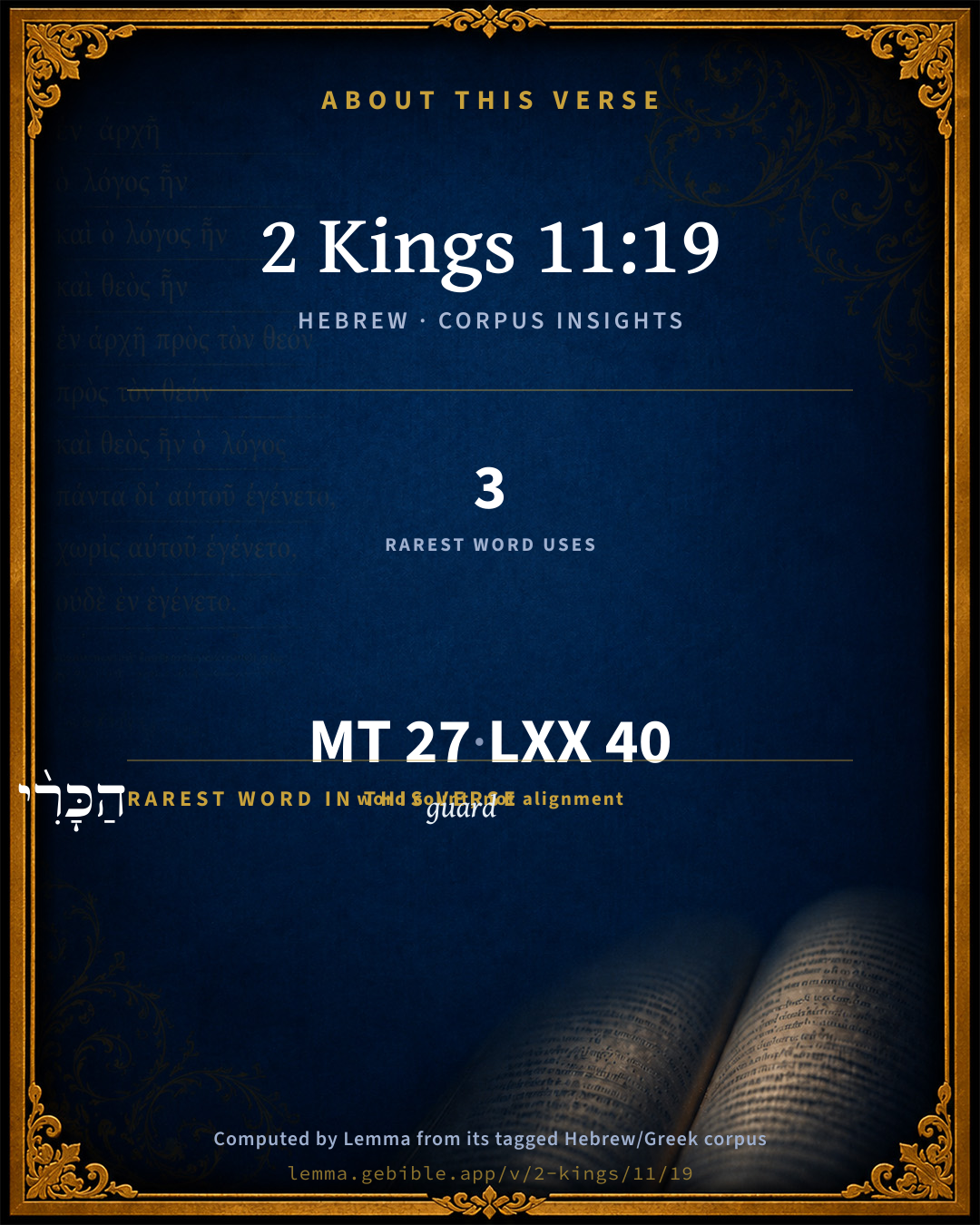
The rarest word here is הַכָּרִ֨י guard H3746 — appearing just 3 times in the whole Hebrew Bible.

Shared distinctive vocabulary

הַכָּרִ֨י guard H3746 occurs in 3 verses of the Hebrew Bible. Also found in:

Grammatical profile

  • 6 verbs
  • 14 nouns
  • 1 adjective
  • 1 preposition
  • 5 particles

Verb forms

  • וַיִּקַּ֣ח Qal · Sequential Imperfect
  • הָרָצִ֜ים Qal · Participle Active
  • וַיֹּרִ֤ידוּ Hiphil · Sequential Imperfect
  • וַיָּב֛וֹאוּ Qal · Sequential Imperfect
  • הָרָצִ֖ים Qal · Participle Active
  • וַיֵּ֖שֶׁב Qal · Sequential Imperfect

Repetition

Words recur within this verse — often emphatic in Hebrew:

  • הַמֶּ֨לֶךְ֙ king H4428 ×3
  • הָרָצִ֜ים to run H7323 ×2
  • מִבֵּ֣ית house H1004 ×2

Hebrew & Septuagint length

In English translation the verse runs 53 words from the Hebrew and 60 from the Septuagint (LXX English) — closely comparable.

A rough comparison of the two English renderings, which tokenize alike — not a word-level alignment.

Word counts can differ between the Hebrew and the Greek without any difference in meaning — e.g. the Hebrew direct-object marker אֵת has no separate Greek word, and Greek often adds the article ὁ.

In the original languages it is 27 Hebrew tokens and 40 Greek tokens — but the two are counted differently (Hebrew bundles its prefixes and suffixes into one token; the Greek is in lemma form), so that isn’t a like-for-like length.

Cross-references

10

Topical passages linked to 2 Kings 11:19 in the Treasury of Scripture Knowledge — connected by theme and wording, ordered by reader-vote popularity; previews shown in the World English Bible.

  • 1 Kings 1:13 Go and get you in to king David, and tell him, Didn't you, my lord, king, swear to your handmaid, saying, Assuredly Solomon your son shall reign after me, and he shall sit on my throne? why then does Adonijah reign?
  • 2 Kings 11:4–6 In the seventh year Jehoiada sent and fetched the captains over hundreds of the Carites and of the guard, and brought them to him into the house of Yahweh; and he made a covenant with them, and took an oath of them in the house of Yahweh, and shown them the king's son.
  • 1 Chronicles 29:23 Then Solomon sat on the throne of Yahweh as king instead of David his father, and prospered; and all Israel obeyed him.
  • 2 Chronicles 23:5 and a third part shall be at the king's house; and a third part at the gate of the foundation: and all the people shall be in the courts of the house of Yahweh.
  • 2 Chronicles 23:19 He set the porters at the gates of the house of Yahweh, that no one who was unclean in anything should enter in.
  • Jeremiah 17:25 then shall there enter in by the gates of this city kings and princes sitting on the throne of David, riding in chariots and on horses, they, and their princes, the men of Judah, and the inhabitants of Jerusalem; and this city shall remain forever.
  • Jeremiah 22:4 For if you do this thing indeed, then shall there enter in by the gates of this house kings sitting on the throne of David, riding in chariots and on horses, he, and his servants, and his people.
  • Jeremiah 22:30 Thus says Yahweh, Write you this man childless, a man who shall not prosper in his days; for no more shall a man of his seed prosper, sitting on the throne of David, and ruling in Judah.
  • Matthew 19:28 Jesus said to them, "Most assuredly I tell you that you who have followed me, in the regeneration when the Son of Man will sit on the throne of his glory, you also will sit on twelve thrones, judging the twelve tribes of Israel.
  • Matthew 25:31 "But when the Son of Man comes in his glory, and all the holy angels with him, then he will sit on the throne of his glory.

Cross-references courtesy of OpenBible.info (CC BY 4.0).

Hebrew and Greek witnesses Masoretic Hebrew ↔ Greek Septuagint

The same verse in the two great witnesses to the Old Testament, shown verse-for-verse.

These are two independent witnesses, not word-aligned to each other, and the Septuagint is shown in lemma (dictionary) form.

Hebrew 2 Kings 11:19 Masoretic · Westminster Leningrad Codex

וַיִּקַּ֣ח אֶת שָׂרֵ֣י הַ֠מֵּאוֹת וְאֶת הַכָּרִ֨י וְאֶת הָרָצִ֜ים וְאֵ֣ת כָּל עַ֣ם הָאָ֗רֶץ וַיֹּרִ֤ידוּ אֶת הַמֶּ֨לֶךְ֙ מִבֵּ֣ית יְהוָ֔ה וַיָּב֛וֹאוּ דֶּֽרֶך שַׁ֥עַר הָרָצִ֖ים בֵּ֣ית הַמֶּ֑לֶךְ וַיֵּ֖שֶׁב עַל כִּסֵּ֥א הַמְּלָכִֽים

He took the captains over hundreds, and the Carites, and the guard, and all the people of the land; and they brought down the king from the house of Yahweh, and came by the way of the gate of the guard to the king's house. He sat on the throne of the kings.

World English Bible · Public Domain

Greek LXX 2 Kings 11:19 Septuagint · lemma form

καί λαμβάνω ὁ ἑκατόνταρχος καί ὁ χορρι καί ὁ ρασιμ καί πᾶς ὁ λαός ὁ γῆ καί καταἄγω ὁ βασιλεύς ἐκ οἶκος κύριος καί εἰςἔρχομαι ὁδός πύλη ὁ παρατρέχω οἶκος ὁ βασιλεύς καί καταἵζω αὐτός ἐπί ὁ θρόνος ὁ βασιλεύς

And he took the captains of the hundreds, and the Chorri, and the Rhasim, and all the people of the land, and brought down the king out of the house of the Lord; and they went in by the way of the gate of the footmen of the king's house, and seated him there on the throne of the kings.

LXX2012 (modern English Septuagint) · Public Domain

On this verse, Ellicott's Commentary for English Readers discusses the Septuagint’s reading. Read the note in Commentary ↓

Hebrew: Westminster Leningrad Codex (CC BY 4.0). Greek: Septuagint (public domain); English from LXX2012 (modern English Septuagint) (Public Domain). How the Septuagint differs from the Hebrew →

Targum (Aramaic paraphrase)

1

The Targum is the ancient Jewish Aramaic paraphrase of the Hebrew Scriptures — an interpretive translation, not the Hebrew text itself. Onkelos (literal) and Pseudo-Jonathan (expansive) render the Torah, and Jonathan the Prophets. Coverage is partial: where no permissively-licensed English translation exists for a verse, only the Aramaic is shown. This is verse-level text, not a word-by-word alignment to the Hebrew.

  1. Targum Jonathan Prophets (Joshua–Malachi)
    וּדְבַר יַת רַבָּנֵי מַאֲוָתָא וְיַת גִבָּרַיָא וְיַת רָהֲטַיָא וְיַת כָּל עַמָא דְאַרְעָא וַאֲחִיתוּ יַת מַלְכָּא מִבֵּית מַקְדְשָׁא דַייָ וְעָלוּ בְּאוֹרַח תְּרַע רָהֲטַיָא דְבֵית מַלְכָּא וִיתֵיב עַל כּוּרְסֵי מַלְכַיָא:

    (no public-domain English translation for this verse)

    Targum Jonathan — Aramaic: “Mikraot Gedolot” (public domain). English: “Sefaria Community Translation” (CC0 1.0 (public-domain dedication)); “London "Chaldee Paraphrase," 1871” (public domain). Text via Sefaria.

Commentary

Notes on 2 Kings 11:19 from classic Christian and Jewish commentators (each source and its license shown beneath its notes). The classic Christian expositions comment on the surrounding passage and are grouped to its opening verse, so a note may address several verses; the Jewish commentaries on the Tanakh (Rashi and others) are per-verse, so they appear only where the commentator wrote on this verse.

Lemma curates 59 commentaries, every one of them public domain or Creative Commons licensed, each selected and text-cleaned for this edition rather than reprinted as found. About our sources →

Trapp's Complete Commentary

John Trapp

2Ki 11:19 And he took the rulers over hundreds, and the captains, and the guard, and all the people of the land; and they brought down the king from the house of the LORD, and came by the way of the gate of the guard to the king’s house. And he sat on the throne of the kings.

Ver. 19. And came by the way of the gate of the guard.] Called the high gate, {2Ch 23:20} by reason of the fairness and height of it; and the new gate. {Jer 36:10}

John Trapp, A Commentary or Exposition upon All the Books of the Old and New Testament (1647–1656) — public domain. Text from a community e-Sword module.

Joseph Benson's Commentary

2Ki 11:19-20. He took the rulers over hundreds, &c. — Brought them out of the temple, that they might conduct the king in state to the royal palace. By the way of the gate of the guard — By the gate of the royal palace, where the king’s guard stood. And he sat on the throne of the kings — Which was the accomplishment of his inauguration. And all the people rejoiced — Josephus says, they kept a feast of joy many days; making good Solomon’s observation: When it goes well with the righteous, the city rejoiceth, and when the wicked perish, there is shouting.

Joseph Benson's Commentary on the Old and New Testaments (1811–1818) — public domain. Text from a community e-Sword module.

Tyndale Open Study Notes

Tyndale Open Resources

11:19-20 The city was peaceful—a mark of the kingdom where God and his law are honored (Isa 35:10; 65:18-24; Jer 33:6-16).

Tyndale Open Study Notes — © Tyndale Open Resources, licensed CC BY-SA 4.0. Text via the HelloAO Bible API.

Ellicott's Commentary for English Readers

(19) And he took the rulers . . . the land.—Jehoiada now arranges a procession to escort the king in triumph from the Temple to the palace.

The rulers . . . guard.—Rather, the captains of the hundreds (the centurions) and the Carians and the Couriers; or, as Thenius prefers, the lictors and the satellites.

They brought down the king from the house of the Lord.—Down from the Temple to the bridge connecting Moriah with Zion.

And came by the way . . . king’s house.—Rather, and entered the king’s house by way of the gate of the Couriers. This gate, therefore, belonged not to the Temple, but to the palace, and was probably the chief entrance thereto.

And he sat on the throne.—The proceedings ended with the solemn enthronement of the king in the palace of his fathers. (The LXX. reads more suitably: “And they seated him on the throne;” so Chronicles.)

A Bible Commentary for English Readers, edited by Charles John Ellicott (1878–1897) — public domain. Text from a community e-Sword module.

The Cambridge Bible for Schools and Colleges

gen. ed. J. J. S. Perowne

19. And he took the rulers [R.V. captains] and the captains] R.V. the Carites. On these words cf. above on verse 4.

and they brought down the king] The movement was a popular one, the people taking part with the soldiers and the priests. In 2 Chron. ‘the nobles and the governors of the people’ are included in the list. The temple was on a lofty height. Hence the phrase ‘brought down’.

by the way of the gate of the guard to [R.V. unto] the king’s house] This gate would be specially ready for the king’s entry, as it was one of those secured by the arrangements described in verse 6.

he sat on the throne of the kings] On this throne, and its position in the palace which Solomon built, cf. note on 1Ki_7:7.

The Cambridge Bible for Schools and Colleges (gen. ed. J. J. S. Perowne; Cambridge University Press, 1878–1918) — public domain. Text from a community e-Sword module.

John Gill's Exposition

And all the people of the land rejoiced,.... That one of the house of David was set upon the throne, which they might fear was extinct, as it very near was; the lamp of David was almost quenched, only this single life left, from whom a line of kings proceeded, and the King Messiah; the promise of God cannot fail see Psa 132:11, this occasioned great joy:

and the city was quiet: was very easy at, yea, pleased with, the dethroning and death of Athaliah; there was no tumult on account thereof, nor such disturbances as she occasioned in her life:

and they slew Athaliah with the sword beside the king's house; as related in Kg2 11:16 where she was buried, or what became of her carcass, is not said; some have thought she was cast into the brook Kidron, because Josephus says (h) Jehoiada ordered her to be had into that valley, and there slain.

(h) Antiqu. l. 9. c. 7. sect. 3.

John Gill's Exposition of the Whole Bible (1746–1763) — public domain (CC PDM 1.0). Text via the HelloAO Bible API.

Albert Barnes' Notes on the Bible

They conducted the king down from the temple hill, across the valley of the Tyropoeum, and up the opposite hill to the royal palace, entering it not by the “horse-gate” 2Ki 11:16, where Athaliah had just been slain, but by the “gate of the guard” 2Ki 11:6, which was probably the main gate of the palace on the eastern side (see 2Ch 23:20).

Albert Barnes' Notes on the Bible (1834–1885) — public domain. Text from a community e-Sword/MySword module.

Haydock's Catholic Bible Commentary

Phelethi. In the Hebrew of the books of Kings we read nothing of these bands after the reign of David. The same expressions occur here as [in] ver. 4., "the centurions, the rams, (or captains) and the runners," (Calmet) or guards. (Protestants) (Haydock) --- Gate, on the west. Athalia had probably entered by the south. --- Kings. It was made of ivory, &c., 3 Kings x. 18. (Calmet)

George Leo Haydock (1774–1849), Haydock's Catholic Family Bible and Commentary, 1859 edition — public domain. Excludes Psalms (Douay-Rheims chapter numbering differs from Protestant) and Deuterocanonical books (Catholic canon only).

Matthew Poole's English Annotations

By the way of the gate of the guard, i.e. by the gate of the royal palace, where the king’s guard stood.

Matthew Poole's English Annotations on the Holy Bible (1683–1685) — public domain. Text from a community e-Sword/MySword module.

Whedon's Commentary on the Bible

Daniel D. Whedon

19. Gate of the guard — Called “the high gate” in Chronicles, but, like the horse gate, difficult to identify with any known locality. It was probably a gate leading toward the palace, and here called “gate of the guard” from being the one guarded by that division of Levites mentioned in 2Ki_11:5.

Daniel D. Whedon (gen. ed.), Commentary on the Old and New Testaments (1874–1909) — public domain. Text from a community e-Sword module.

The Pulpit Commentary

And he took the rulers literally, princesover hundredsi.e. the five centurions of 2Ch 23:2and the captains rather, and the Carites (see the comment on ver. 4)and the guard i.e. the "runners," the other division of the guardand all the people of the land those who had flocked to his standard either originally (2Ch_23:2) or sinceand they brought down the king from the house of the Lord. They escorted Joash from the temple to the palace, first bringing him down into the valley of the Tyropoeon, and then conducting him up the opposite, or western hill, on which the palace stood. And came by the way of the gate of the guard to the king"s house. The "gate of the guard" is probably that called in ver. 6 "the gate behind the guard." We may presume that it was the main entrance to the palace on the eastern side. And he sat on the throne of the kings. Not till he had placed Joash on the royal throne of his ancestors, in the great throne-room of the palace, was Jehoiada content with the work of the day.

The Pulpit Commentary (1880–1919), ed. H.D.M. Spence-Jones & Joseph S. Exell — public domain. Text from a community e-Sword module.

Keil & Delitzsch

C. F. Keil & F. Delitzsch

And he took the captains, and they brought the king down out of the house of Jehovah, etc. The word יקּח is not to be pressed, but simply affirms that Jehoiada entrusted the persons named with the duty of conducting the king into his palace. Beside the captains over a hundred (see at Kg2 11:4) there are mentioned והרצים הכּרי, i.e., the royal halberdiers (the body-guard), who had passed over to the new king immediately after the fall of Athaliah and now followed their captains, and הארץ כּל־עם, all the rest of the people assembled. Instead of the halberdiers there are mentioned in the Chronicles בּעם המּושׁלים האדּירים, the nobles and lords in the nation-a completion implied in the facts themselves, since Jehoiada had drawn the heads of the nation into his plan, and on the other hand the express allusion to the body-guard might be omitted as of inferior importance. We cannot infer from ירידוּ that the bridge between Moriah and Zion was not yet in existence, as Thenius supposes, but simply that the bridge was lower than the temple-courts. Instead of הרצים שׁער, the gate of the runners (i.e., of the halberdiers), we find in the Chronicles העליון שׁער, the upper gate, which appears to have been a gate of the temple, according to Kg2 15:35 and Ch2 27:3. The statement that they came by the way of the runners' gate into the house of the king is not at variance with this, for it may be understood as meaning that it was by the halberdiers' gate of the temple that the entry into the palace was carried out. - In Kg2 11:20 this account is concluded with the general remark that all the people rejoiced, sc. at the coronation of Joash, and the city was quiet, when they slew Athaliah with the sword. This is the way, so far as the sense is concerned, in which the last two clauses are to be connected.

Keil & Delitzsch — Biblical Commentary on the Old Testament (1861–1891) — public domain (CC PDM 1.0). Text via the HelloAO Bible API. (Old Testament only.)

unfoldingWord translationNotes

Door43 World Missions Community

General Information:

They take the new king, Joash, from the temple to the palace.

the commanders of hundreds

The phrase "commander of hundreds" is probably an official title for a military officer. Possible meanings are 1) the word "hundreds" represents the exact amount of soldiers that each of these commanders led. AT: "the commanders of 100 soldiers" or 2) the word translated as "hundreds" does not represent an exact number, but is the name of a military division. AT: "the commanders of military divisions" See how you translated this in 2 Kings 11:4. (See: Numbers)

Carites

This is the name of a particular group of the royal guards.

brought down the king from the house of Yahweh and they went into the king's house

"brought the king from the temple to the palace"

all the people of the land rejoiced

This is a generalization. It is possible that some did not rejoice. AT: "many people in the land rejoiced" (See: Hyperbole and Generalization)

the city was quiet

"the city was calm" or "the city was peaceful"

translationWords

king

throne

joy

unfoldingWord translationNotes — © Distant Shores Media and the Door43 World Missions Community, licensed CC BY-SA 4.0. Source: git.door43.org/Door43/en_tn.

Rashi

Rabbi Shlomo Yitzchaki (Rashi)

They came by way of the Gate of the Runners. To the king’s palace. the king’s palace.” However, Rashi in v. 5 above explained that the Gate of the Runners was one of the gates of the Temple’s court. Therefore Rashi renders the verse as, “by way of the Gate of the Runners to the king’s palace.” Alternatively, the Gate of the Runners was one of the gates of the king’s palace.—Targum

Rashi on the Tanakh — English translations: “The Judaica Press complete Tanach with Rashi, translated by A. J. Rosenberg” (CC BY 4.0); “Pentateuch with Rashi's commentary by M. Rosenbaum and A.M. Silbermann, 1929-1934” (public domain); “The Metsudah Tanach series, Lakewood, N.J” (CC BY 4.0); and “The Book of Joshua, Metsudah Publications, 1997” (CC BY 4.0). Text via Sefaria.

Lesson kit

Teaching starters — assembled from the data on this page, not authored interpretation. Every prompt links to the verse data it draws on. Edit before teaching.

2 Kings, in the Historical, opens this verse with 27 words (19 distinct Hebrew lemmas). Its most distinctive word is kârîy (“guard”). A historical commentator’s framing appears above. Read the whole chapter for the surrounding context.

Discussion questions

  1. The word kârîy carries the sense “guard.” How does it shape the verse?
  2. 2 Samuel 20:23 shares the word «guard» with this verse. How do the two illuminate each other?
  3. “king” occurs 3× in this one verse. What is the effect of the repetition?
  4. The translations on this page render this verse differently — a whole-verse word diff, not a word-by-word alignment. What might account for the different wordings?
  5. The verb «וַיִּקַּ֣ח» is Qal Sequential Imperfect. How does its form color the action?
  6. Reading how Trapp's Complete Commentary and Joseph Benson's Commentary read this verse, where do the two commentators agree and where do they part?

Things to notice

Reading settings

Reading text

Shown beneath each verse's original-language words.

Old Testament
Old Testament edition

Read the OT as the Masoretic Hebrew (MT) or the Greek Septuagint (LXX).

English shown for the Greek Septuagint (in the Hebrew ↔ Greek comparison).

Comparing translations? Open the Compare panel on any verse page to stack up to four side by side.