
2 Samuel 11:23

Hebrew (Westminster Leningrad Codex) 2 Samuel 11:23 appears in the Hebrew Old Testament. The text above is from the Westminster Leningrad Codex. Each word links to its Strong’s number, a concise gloss, and parsing drawn from the Open Scriptures Hebrew Bible morphology. Click any word for its full Brown-Driver-Briggs (BDB) entry.
Download image
Cite this verse

2 Samuel 11:23 (World English Bible). Public Domain. Lemma interlinear Bible study tool, https://lemma.gebible.app/v/2-samuel/11/23.

Show BibTeX & RIS
BibTeX
RIS
English Translation
The messenger said to David, The men prevailed against us, and came out to us into the field, and we were on them even to the entrance of the gate.
World English Bible · Public Domain
Download a study sheet

One document with this verse’s original text, its word-by-word gloss line, the meaning frame, cross-references with their text, attributed commentary, and full source and license credits — printable, and it pastes into notes with its structure intact.

This verse Autodidact and up

Study sheet (.html) Plain text (.txt)

A passage Seminary Student

Up to 50 verses in one chapter. A passage sheet keeps up to 6 commentary sources and 12 cross-references per verse, in the order this page ranks them, and says so on the sheet whenever that leaves anything out. Ask for a single verse and you get the Autodidact verse sheet above.

Everything on this page stays free to read, with no account — the sheet is a download of what is already on screen, not access to it.

Want to remove ads? Support Godless Engineer
Compare translations 3

The same verse in 3 English versions, stacked beneath the original-language interlinear above. Click any original word for its lexicon entry.

Each is an independent rendering of the whole verse — the interlinear is not word-aligned to these translations.

Highlighted words mark where these versions differ — a whole-verse word diff, not a word-by-word alignment.

  • World English Bible Public Domain
    The messenger said to David, The men prevailed against us, and came out to us into the field, and we were on them even to the entrance of the gate.
  • King James Version Public Domain
    And the messenger said unto David, Surely the men prevailed against us, and came out unto us into the field, and we were upon them even unto the entering of the gate.
  • unfoldingWord Literal Text CC BY-SA 4.0
    And the messenger said to David that “the men became strong against us and they came out against us the field, but we were against them to the entrance of the gate.

unfoldingWord Literal Text — © unfoldingWord, licensed CC BY-SA 4.0. Word-aligned USFM3 via Door43 (git.door43.org/unfoldingWord/en_ult).

Versions to compare (up to 4)

3 of 4 selected

Show all 18 translations

Every available English version of this verse, each an independent rendering of the whole verse.

  • World English Bible Public Domain
    The messenger said to David, The men prevailed against us, and came out to us into the field, and we were on them even to the entrance of the gate.
  • Berean Standard Bible Public Domain
    The messenger said to David, “The men overpowered us and came out against us in the field, but we drove them back to the entrance of the gate.
  • Majority Standard Bible Public Domain
    The messenger said to David, “The men overpowered us and came out against us in the field, but we drove them back to the entrance of the gate.
  • King James Version Public Domain
    And the messenger said unto David, Surely the men prevailed against us, and came out unto us into the field, and we were upon them even unto the entering of the gate.
  • American Standard Version (1901) Public Domain
    And the messenger said unto David, The men prevailed against us, and came out unto us into the field, and we were upon them even unto the entrance of the gate.
  • Revised Version (1885) Public Domain
    And the messenger said unto David, The men prevailed against us and came out unto us into the field, and we were upon them even unto the entering of the gate.
  • Geneva Bible (1599) Public Domain
    And the messenger said vnto Dauid, Certainely the men preuailed against vs, and came out vnto vs into the field, but we pursued them vnto the entring of the gate.
  • Douay-Rheims (1899) Public Domain
    And the messenger said to David: The men prevailed against us, and they came out to us into the field: and we vigorously charged and pursued them even to the gate of the city.
  • Young's Literal Translation Public Domain
    and the messenger saith unto David, `Surely the men have been mighty against us, and come out unto us into the field, and we are upon them unto the opening of the gate,
  • Literal Standard Version CC BY-SA 4.0
    and the messenger says to David, “Surely the men have been mighty against us, and come out to us into the field, and we are on them to the opening of the gate,
  • Unlocked Literal Bible CC BY-SA 4.0
    Then the messenger said to David, “The enemy were stronger than we were at first; they came out to us into the field, but we drove them back to the entrance of the gate.
  • unfoldingWord Literal Text CC BY-SA 4.0
    And the messenger said to David that “the men became strong against us and they came out against us the field, but we were against them to the entrance of the gate.
  • Darby Bible Public Domain
    And the messenger said to David, The men prevailed against us, and came out against us into the field, and we were upon them as far as the entrance of the gate.
  • World Messianic Bible Public Domain
    The messenger said to David, “The men prevailed against us, and came out to us into the field; and we were on them even to the entrance of the gate.
  • Webster's Bible Public Domain
    And the messenger said to David, Surely the men prevailed against us, and came out to us into the field, and we were upon them even to the entrance of the gate.
  • Free Bible Version CC BY-SA 4.0
    The messenger explained to David, “The defenders were stronger than us, and they came out at us in the open, but we forced them back to the entrance of the town gate.
  • Bible in Basic English Public Domain
    And the man said to David, Truly the men got the better of us, and came out against us into the open country, but we sent them back to the very doors of the town.
  • JPS Tanakh (1917) Public Domain
    And the messenger said unto David: 'The men prevailed against us, and came out unto us into the field, and we were upon them even unto the entrance of the gate.

Literal Standard Version (2020), Covenant Press — licensed CC BY-SA 4.0. Text via the HelloAO Bible API (eBible.org). Unlocked Literal Bible (unfoldingWord) — licensed CC BY-SA 4.0. Text via the HelloAO Bible API (eBible.org). unfoldingWord Literal Text — © unfoldingWord, licensed CC BY-SA 4.0. Word-aligned USFM3 via Door43 (git.door43.org/unfoldingWord/en_ult). Free Bible Version, Dr. Jonathan Gallagher — licensed CC BY-SA 4.0. Text via the HelloAO Bible API (eBible.org).

Word by word

More ways to search: Search by grammar → Find every occurrence → Compare this word →

Practice this passage: Drill this verse → Learn its vocabulary →

גָבְר֤וּ
gâbar
H1396
“to be strong”
Verb, Qal, Perfect, 3rd Person, Common, Plural
Part of Speech
Verb
Stem
Qal
Form
Perfect
Person
3rd Person
Gender
Common
Number
Plural
Full BDB Definition

Origin: a primitive root

TWOT: 310

to prevail, have strength, be strong, be powerful, be mighty, be great - (Qal) - to be strong, mighty - to prevail - (Piel) to make strong, strengthen - (Hiphil) - to confirm, give strength - to confirm (a covenant) - (Hithpael) - to show oneself mighty - to act proudly (toward God)
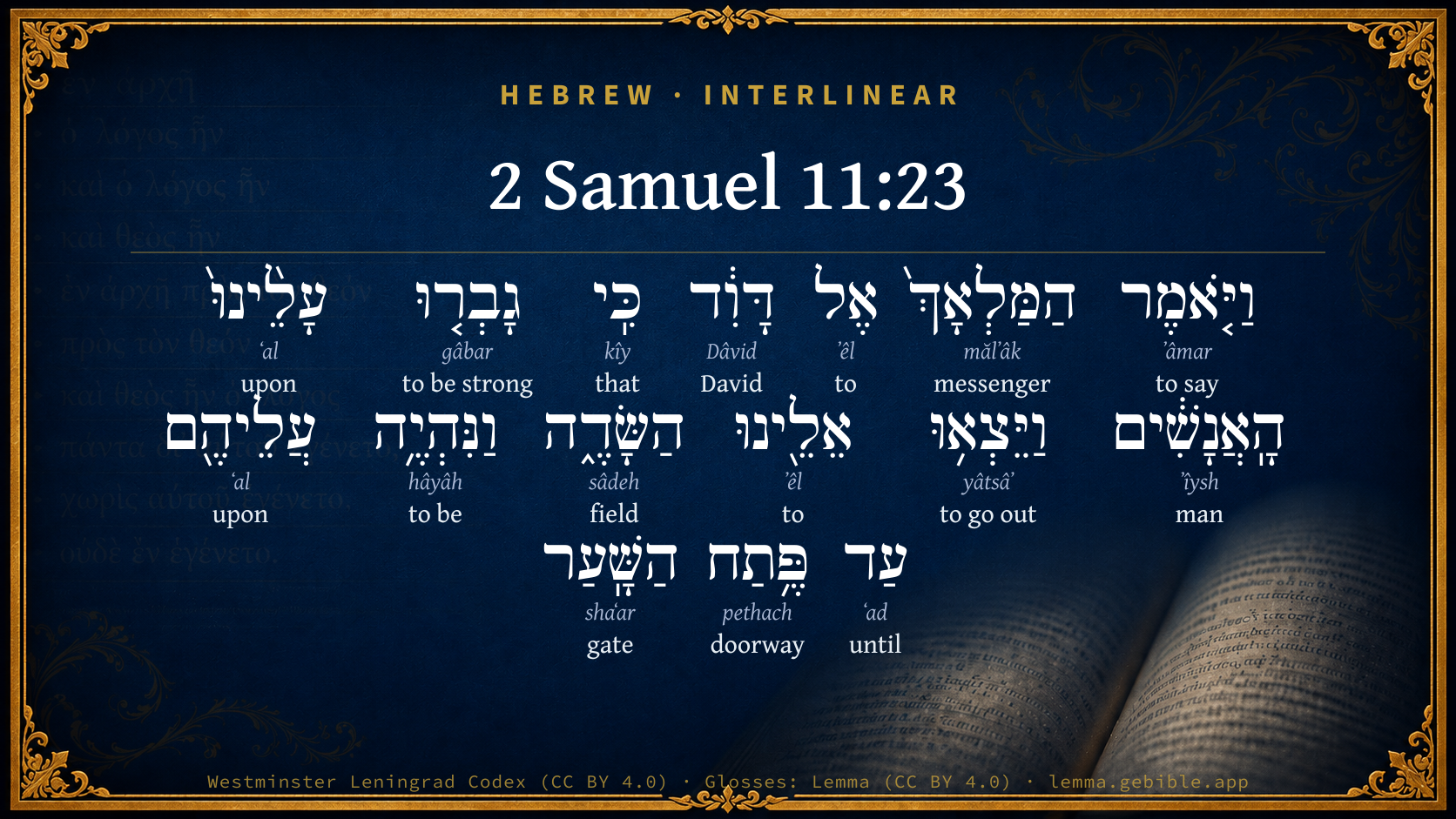
  1. וַיֹּ֤אמֶר ʼâmar H559 “and · to say” Conjunction + Verb, Qal, Sequential Imperfect, 3rd Person, Masculine, Singular
  2. הַמַּלְאָךְ֙ mălʼâk H4397 “the · messenger” Particle, Definite Article + Noun, Common, Masculine, Singular, Absolute
  3. אֶל ʼêl H413 “to” Preposition
  4. דָּוִ֔ד Dâvid H1732 “David” Noun, Proper
  5. כִּֽי kîy H3588 “that” Conjunction
  6. עָלֵ֨ינוּ֙ ʻal H5921 “upon · us” Preposition + Suffix, Personal, 1st Person, Common, Plural
  7. הָֽאֲנָשִׁ֔ים ʼîysh H376 “the · men” Particle, Definite Article + Noun, Common, Masculine, Plural, Absolute
  8. וַיֵּצְא֥וּ yâtsâʼ H3318 “and · to go out” Conjunction + Verb, Qal, Sequential Imperfect, 3rd Person, Masculine, Plural
  9. אֵלֵ֖ינוּ ʼêl H413 “to · us” Preposition + Suffix, Personal, 1st Person, Common, Plural
  10. הַשָּׂדֶ֑ה sâdeh H7704 “the · field” Particle, Definite Article + Noun, Common, Masculine, Singular, Absolute
  11. וַנִּהְיֶ֥ה hâyâh H1961 “and · to be” Conjunction + Verb, Qal, Sequential Imperfect, 1st Person, Common, Plural
  12. עֲלֵיהֶ֖ם ʻal H5921 “upon · them” Preposition + Suffix, Personal, 3rd Person, Masculine, Plural
  13. עַד ʻad H5704 “until” Preposition
  14. פֶּ֥תַח pethach H6607 “doorway of” Noun, Common, Masculine, Singular, Construct
  15. הַשָּֽׁעַר shaʻar H8179 “the · gate” Particle, Definite Article + Noun, Common, Masculine, Singular, Absolute

About this verse

These counts appear in no published source. They are computed here, from the morphology-tagged text and Lemma’s own curated glosses. What Lemma adds →

16
words
14
distinct lemmas
Historical
section

Notable vocabulary

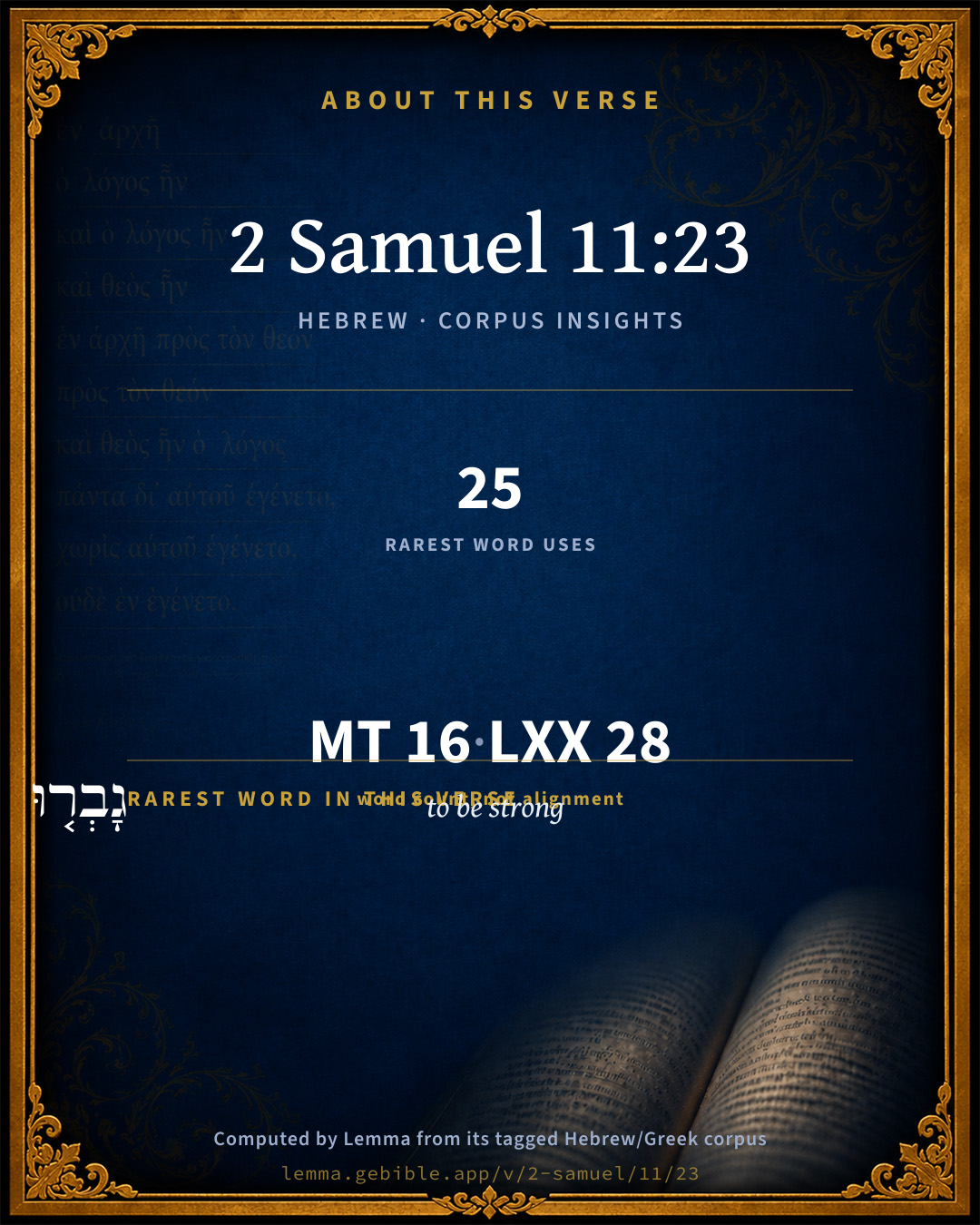
The rarest word here is גָבְר֤וּ to be strong H1396 — appearing just 25 times in the whole Hebrew Bible.

Shared distinctive vocabulary

גָבְר֤וּ to be strong H1396 occurs in 24 verses of the Hebrew Bible. Also found in:

Grammatical profile

  • 4 verbs
  • 6 nouns
  • 5 prepositions
  • 1 conjunction

Verb forms

  • וַיֹּ֤אמֶר Qal · Sequential Imperfect
  • גָבְר֤וּ Qal · Perfect
  • וַיֵּצְא֥וּ Qal · Sequential Imperfect
  • וַנִּהְיֶ֥ה Qal · Sequential Imperfect

Repetition

Words recur within this verse — often emphatic in Hebrew:

  • עָלֵ֨ינוּ֙ upon H5921 ×2
  • אֶל to H413 ×2

Hebrew & Septuagint length

In English translation the verse runs 30 words from the Hebrew and 32 from the Septuagint (LXX English) — closely comparable.

A rough comparison of the two English renderings, which tokenize alike — not a word-level alignment.

Word counts can differ between the Hebrew and the Greek without any difference in meaning — e.g. the Hebrew direct-object marker אֵת has no separate Greek word, and Greek often adds the article ὁ.

In the original languages it is 16 Hebrew tokens and 28 Greek tokens — but the two are counted differently (Hebrew bundles its prefixes and suffixes into one token; the Greek is in lemma form), so that isn’t a like-for-like length.

Hebrew and Greek witnesses Masoretic Hebrew ↔ Greek Septuagint

The same verse in the two great witnesses to the Old Testament, shown verse-for-verse.

These are two independent witnesses, not word-aligned to each other, and the Septuagint is shown in lemma (dictionary) form.

Hebrew 2 Samuel 11:23 Masoretic · Westminster Leningrad Codex

וַיֹּ֤אמֶר הַמַּלְאָךְ֙ אֶל דָּוִ֔ד כִּֽי גָבְר֤וּ עָלֵ֨ינוּ֙ הָֽאֲנָשִׁ֔ים וַיֵּצְא֥וּ אֵלֵ֖ינוּ הַשָּׂדֶ֑ה וַנִּהְיֶ֥ה עֲלֵיהֶ֖ם עַד פֶּ֥תַח הַשָּֽׁעַר

The messenger said to David, The men prevailed against us, and came out to us into the field, and we were on them even to the entrance of the gate.

World English Bible · Public Domain

Greek LXX 2 Samuel 11:23 Septuagint · lemma form

καί εἶπον ὁ ἄγγελος πρός δαυίδ ὅτι κραταιόω ἐπί ἐγώ ὁ ἀνήρ καί ἐκἔρχομαι ἐπί ἐγώ εἰς ὁ ἀγρός καί γίγνομαι ἐπί αὐτός ἕως ὁ θύρα ὁ πύλη

And the messenger said to David, The men prevailed against us, and they came out against us into the field, and we came upon them even to the door of the gate.

LXX2012 (modern English Septuagint) · Public Domain

Hebrew: Westminster Leningrad Codex (CC BY 4.0). Greek: Septuagint (public domain); English from LXX2012 (modern English Septuagint) (Public Domain). How the Septuagint differs from the Hebrew →

Targum (Aramaic paraphrase)

1

The Targum is the ancient Jewish Aramaic paraphrase of the Hebrew Scriptures — an interpretive translation, not the Hebrew text itself. Onkelos (literal) and Pseudo-Jonathan (expansive) render the Torah, and Jonathan the Prophets. Coverage is partial: where no permissively-licensed English translation exists for a verse, only the Aramaic is shown. This is verse-level text, not a word-by-word alignment to the Hebrew.

  1. Targum Jonathan Prophets (Joshua–Malachi)
    וַאֲמַר אִזְגַדָא לְדָוִד אֲרֵי תַקִיפוּ עֲלָנָא גַבְרַיָא וּנְפַקוּ לְוָתָנָא לְחַקְלָא וַהֲוֵינָא טַרְדִין לְהוֹן עַד מַעֲלָנָא דְתַרְעָא:

    (no public-domain English translation for this verse)

    Targum Jonathan — Aramaic: “Mikraot Gedolot” (public domain). English: “Sefaria Community Translation” (CC0 1.0 (public-domain dedication)); “London "Chaldee Paraphrase," 1871” (public domain). Text via Sefaria.

Commentary

Notes on 2 Samuel 11:23 from classic Christian and Jewish commentators (each source and its license shown beneath its notes). The classic Christian expositions comment on the surrounding passage and are grouped to its opening verse, so a note may address several verses; the Jewish commentaries on the Tanakh (Rashi and others) are per-verse, so they appear only where the commentator wrote on this verse.

Lemma curates 59 commentaries, every one of them public domain or Creative Commons licensed, each selected and text-cleaned for this edition rather than reprinted as found. About our sources →

Trapp's Complete Commentary

John Trapp

2Sa 11:23 And the messenger said unto David, Surely the men prevailed against us, and came out unto us into the field, and we were upon them even unto the entering of the gate.

Ver. 23. Surely the men prevailed.] Sallied out upon us, and slew some of us, but we beat them in again, albeit not without loss.

John Trapp, A Commentary or Exposition upon All the Books of the Old and New Testament (1647–1656) — public domain. Text from a community e-Sword module.

Geneva Bible (1599)

Geneva Bible translators

Hebrew, were against them.

Geneva Bible (1599) marginal notes — public domain. Text via Bolls.life.

The Cambridge Bible for Schools and Colleges

gen. ed. J. J. S. Perowne

23. we were upon them] Or, against them: we repulsed the sally, and pursued them to the gate of the city.

The Cambridge Bible for Schools and Colleges (gen. ed. J. J. S. Perowne; Cambridge University Press, 1878–1918) — public domain. Text from a community e-Sword module.

John Gill's Exposition

And the messenger said unto David,.... The particulars of his account follow:

surely the men prevailed against us; the men of the city of Rabbah, the besieged there, in one onset they made upon them:

and came out unto us in the field; the besiegers that lay encamped there; they sallied out upon them:

and we were upon them, even unto the entering of the gate; rallied upon them, and drove them back, and pursued them to the gate of the city.

John Gill's Exposition of the Whole Bible (1746–1763) — public domain (CC PDM 1.0). Text via the HelloAO Bible API.

Matthew Poole's English Annotations

We beat them back, and pursued them even to the gate.

Matthew Poole's English Annotations on the Holy Bible (1683–1685) — public domain. Text from a community e-Sword/MySword module.

The Pulpit Commentary

The men prevailed against us. The real meaning is "the men made a sortie against us in force, and came even to the open field; but we were upon them (and drove them back) unto the entry of the gate, and the archers from off the wall shot at thy servants," etc.

The Pulpit Commentary (1880–1919), ed. H.D.M. Spence-Jones & Joseph S. Exell — public domain. Text from a community e-Sword module.

Lesson kit

Teaching starters — assembled from the data on this page, not authored interpretation. Every prompt links to the verse data it draws on. Edit before teaching.

2 Samuel, in the Historical, opens this verse with 16 words (14 distinct Hebrew lemmas). Its most distinctive word is gâbar (“to be strong”). A historical commentator’s framing appears above. Read the whole chapter for the surrounding context.

Discussion questions

  1. The word gâbar carries the sense “to be strong.” How does it shape the verse?
  2. Genesis 7:18 shares the word «to be strong» with this verse. How do the two illuminate each other?
  3. “upon” occurs 2× in this one verse. What is the effect of the repetition?
  4. The translations on this page render this verse differently — a whole-verse word diff, not a word-by-word alignment. What might account for the different wordings?
  5. The verb «וַיֹּ֤אמֶר» is Qal Sequential Imperfect. How does its form color the action?
  6. Reading how Trapp's Complete Commentary and Geneva Bible (1599) read this verse, where do the two commentators agree and where do they part?

Things to notice

Reading settings

Reading text

Shown beneath each verse's original-language words.

Old Testament
Old Testament edition

Read the OT as the Masoretic Hebrew (MT) or the Greek Septuagint (LXX).

English shown for the Greek Septuagint (in the Hebrew ↔ Greek comparison).

Comparing translations? Open the Compare panel on any verse page to stack up to four side by side.