
2 Kings 10:8

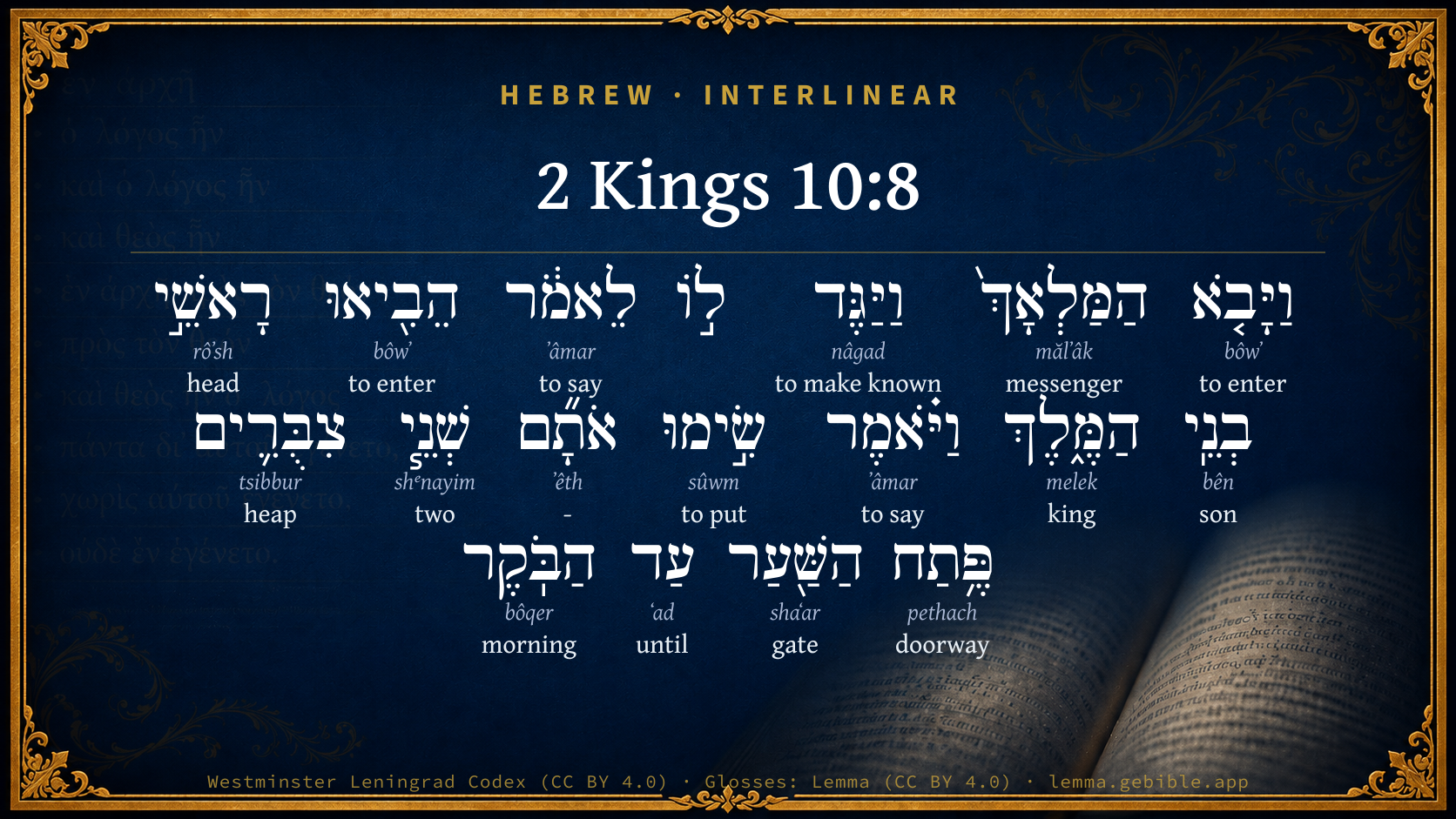
Hebrew (Westminster Leningrad Codex) 2 Kings 10:8 appears in the Hebrew Old Testament. The text above is from the Westminster Leningrad Codex. Each word links to its Strong’s number, a concise gloss, and parsing drawn from the Open Scriptures Hebrew Bible morphology. Click any word for its full Brown-Driver-Briggs (BDB) entry.
Download image
Cite this verse

2 Kings 10:8 (World English Bible). Public Domain. Lemma interlinear Bible study tool, https://lemma.gebible.app/v/2-kings/10/8.

Show BibTeX & RIS
BibTeX
RIS
English Translation
There came a messenger, and told him, saying, They have brought the heads of the king's sons. He said, Lay you them in two heaps at the entrance of the gate until the morning.
World English Bible · Public Domain
Highlights
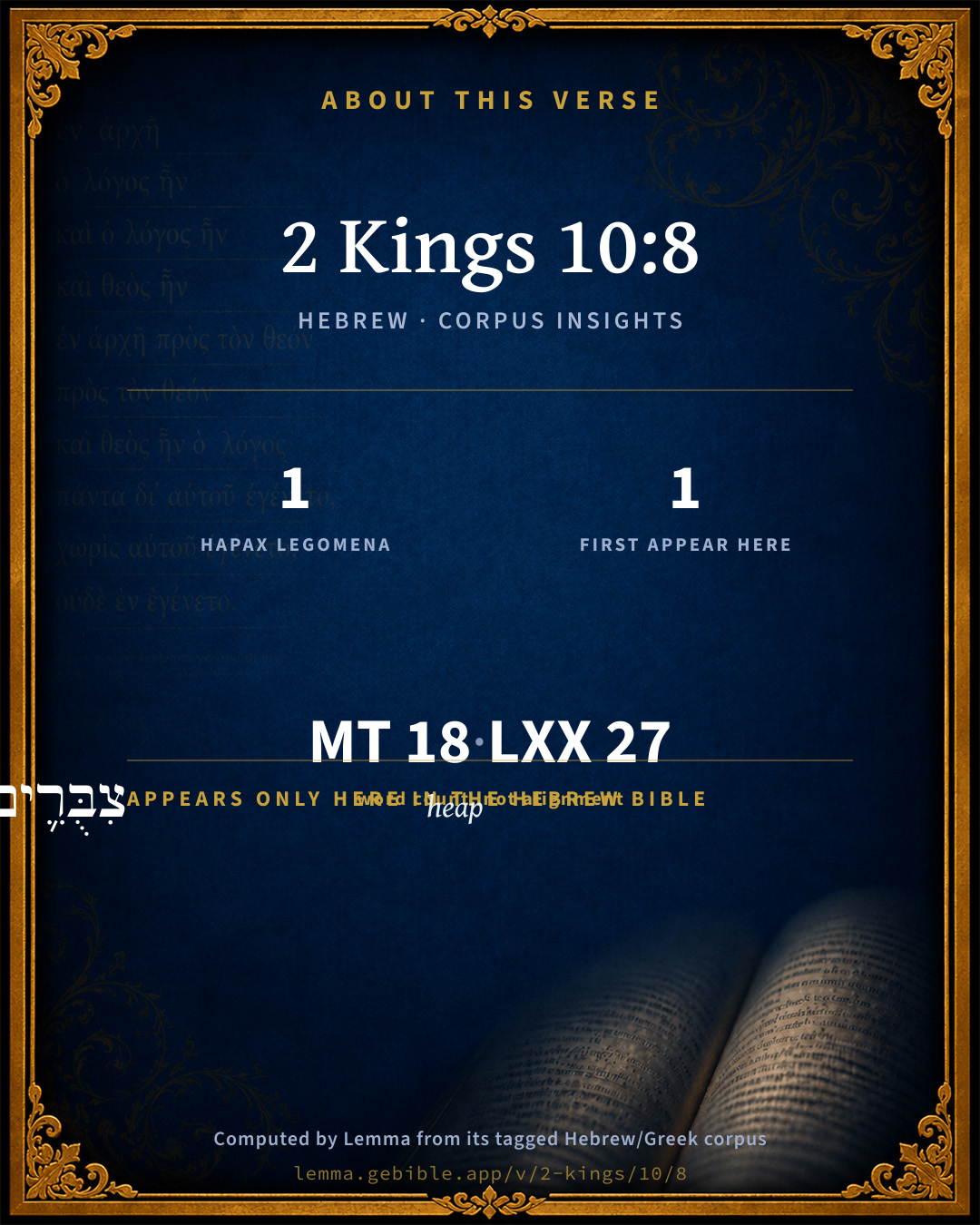
  • 1 hapax legomenon — only here in the Hebrew Bible
  • 1 first appearance in the Hebrew Bible
Full analysis ↓
Download a study sheet

One document with this verse’s original text, its word-by-word gloss line, the meaning frame, cross-references with their text, attributed commentary, and full source and license credits — printable, and it pastes into notes with its structure intact.

This verse Autodidact and up

Study sheet (.html) Plain text (.txt)

A passage Seminary Student

Up to 50 verses in one chapter. A passage sheet keeps up to 6 commentary sources and 12 cross-references per verse, in the order this page ranks them, and says so on the sheet whenever that leaves anything out. Ask for a single verse and you get the Autodidact verse sheet above.

Everything on this page stays free to read, with no account — the sheet is a download of what is already on screen, not access to it.

Want to remove ads? Support Godless Engineer
Compare translations 3

The same verse in 3 English versions, stacked beneath the original-language interlinear above. Click any original word for its lexicon entry.

Each is an independent rendering of the whole verse — the interlinear is not word-aligned to these translations.

Highlighted words mark where these versions differ — a whole-verse word diff, not a word-by-word alignment.

  • World English Bible Public Domain
    There came a messenger, and told him, saying, They have brought the heads of the king's sons. He said, Lay you them in two heaps at the entrance of the gate until the morning.
  • King James Version Public Domain
    And there came a messenger, and told him, saying, They have brought the heads of the king's sons. And he said, Lay ye them in two heaps at the entering in of the gate until the morning.
  • unfoldingWord Literal Text CC BY-SA 4.0
    And a messenger came and declared to him, saying, “They have brought the heads of the sons of the king.” And he said, “Put them two piles the entrance of the gate until morning.”

unfoldingWord Literal Text — © unfoldingWord, licensed CC BY-SA 4.0. Word-aligned USFM3 via Door43 (git.door43.org/unfoldingWord/en_ult).

Versions to compare (up to 4)

3 of 4 selected

Show all 18 translations

Every available English version of this verse, each an independent rendering of the whole verse.

  • World English Bible Public Domain
    There came a messenger, and told him, saying, They have brought the heads of the king's sons. He said, Lay you them in two heaps at the entrance of the gate until the morning.
  • Berean Standard Bible Public Domain
    When the messenger arrived, he told Jehu, “They have brought the heads of the sons of the king.” And Jehu ordered, “Pile them in two heaps at the entrance of the gate until morning.”
  • Majority Standard Bible Public Domain
    When the messenger arrived, he told Jehu, “They have brought the heads of the sons of the king.” And Jehu ordered, “Pile them in two heaps at the entrance of the gate until morning.”
  • King James Version Public Domain
    And there came a messenger, and told him, saying, They have brought the heads of the king's sons. And he said, Lay ye them in two heaps at the entering in of the gate until the morning.
  • American Standard Version (1901) Public Domain
    And there came a messenger, and told him, saying, They have brought the heads of the king's sons. And he said, Lay ye them in two heaps at the entrance of the gate until the morning.
  • Revised Version (1885) Public Domain
    And there came a messenger, and told him, saying, They have brought the heads of the king’s sons. And he said, Lay ye them in two heaps at the entering in of the gate until the morning.
  • Geneva Bible (1599) Public Domain
    Then there came a messenger and tolde him, saying, They haue brought the heads of the Kings sonnes. And he sayd, Let them lay them on two heapes at the entring in of the gate vntil the morning.
  • Douay-Rheims (1899) Public Domain
    And a messenger came, and told him, saying: They have brought the heads of the king's sons. And he said: Lay ye them in two heaps by the entering in of the gate until the morning.
  • Young's Literal Translation Public Domain
    and the messenger cometh in, and declareth to him, saying, `They have brought in the heads of the sons of the king,' and he saith, `Make them two heaps at the opening of the gate till the morning.'
  • Literal Standard Version CC BY-SA 4.0
    and the messenger comes in, and declares [it] to him, saying, “They have brought in the heads of the sons of the king,” and he says, “Make them two heaps at the opening of the gate until the morning.”
  • Unlocked Literal Bible CC BY-SA 4.0
    A messenger came to Jehu, saying, “They have brought the heads of the king's sons.” So he said, “Put them in two heaps at the entrance of the gate until the morning.”
  • unfoldingWord Literal Text CC BY-SA 4.0
    And a messenger came and declared to him, saying, “They have brought the heads of the sons of the king.” And he said, “Put them two piles the entrance of the gate until morning.”
  • Darby Bible Public Domain
    And a messenger came and told him saying, They have brought the heads of the king's sons. And he said, Lay them in two heaps at the entrance of the gate until the morning.
  • World Messianic Bible Public Domain
    A messenger came and told him, “They have brought the heads of the king’s sons.” He said, “Lay them in two heaps at the entrance of the gate until the morning.”
  • Webster's Bible Public Domain
    And there came a messenger, and told him, saying, They have brought the heads of the king's sons. And he said, Lay ye them in two heaps at the entrance of the gate until the morning.
  • Free Bible Version CC BY-SA 4.0
    A messenger came in and told Jehu, “They have brought the heads of the king's sons.” Jehu gave the order, “Put them in two piles at the entrance to the city gate until the morning.”
  • Bible in Basic English Public Domain
    And a man came and said to him, They have come with the heads of the king's sons. And he said, Put them down in two masses at the doorway of the town till the morning.
  • JPS Tanakh (1917) Public Domain
    And there came a messenger, and told him, saying: 'They have brought the heads of the king's sons.' And he said: 'Lay ye them in two heaps at the entrance of the gate until the morning.'

Literal Standard Version (2020), Covenant Press — licensed CC BY-SA 4.0. Text via the HelloAO Bible API (eBible.org). Unlocked Literal Bible (unfoldingWord) — licensed CC BY-SA 4.0. Text via the HelloAO Bible API (eBible.org). unfoldingWord Literal Text — © unfoldingWord, licensed CC BY-SA 4.0. Word-aligned USFM3 via Door43 (git.door43.org/unfoldingWord/en_ult). Free Bible Version, Dr. Jonathan Gallagher — licensed CC BY-SA 4.0. Text via the HelloAO Bible API (eBible.org).

Word by word

More ways to search: Search by grammar → Find every occurrence → Compare this word →

Practice this passage: Drill this verse → Learn its vocabulary →

צִבֻּרִ֛ים
tsibbur
H6652
“heaps”
Noun, Common, Masculine, Plural, Absolute
Part of Speech
Noun
Type
Common
Gender
Masculine
Number
Plural
State
Absolute
Full BDB Definition

Origin: from H6551

TWOT: 1874a

heap, pile
  1. וַיָּבֹ֤א bôwʼ H935 “and · to enter” Conjunction + Verb, Qal, Sequential Imperfect, 3rd Person, Masculine, Singular
  2. הַמַּלְאָךְ֙ mălʼâk H4397 “the · messenger” Particle, Definite Article + Noun, Common, Masculine, Singular, Absolute
  3. וַיַּגֶּד nâgad H5046 “and · to make known” Conjunction + Verb, Hiphil, Sequential Imperfect, 3rd Person, Masculine, Singular
  4. לֵאמֹ֔ר ʼâmar H559 “to say” Preposition + Verb, Qal, Infinitive Construct
  5. הֵבִ֖יאוּ bôwʼ H935 “to enter” Verb, Hiphil, Perfect, 3rd Person, Common, Plural
  6. רָאשֵׁ֣י rôʼsh H7218 “heads of” Noun, Common, Masculine, Plural, Construct
  7. בְנֵֽי bên H1121 “sons of” Noun, Common, Masculine, Plural, Construct
  8. הַמֶּ֑לֶךְ melek H4428 “the · king” Particle, Definite Article + Noun, Common, Masculine, Singular, Absolute
  9. וַיֹּ֗אמֶר ʼâmar H559 “and · to say” Conjunction + Verb, Qal, Sequential Imperfect, 3rd Person, Masculine, Singular
  10. שִׂ֣ימוּ sûwm H7760 “put” Verb, Qal, Imperative, 2nd Person, Masculine, Plural
  11. אֹתָ֞ם ʼêth H853 “- · them” Particle, Direct Object + Suffix, Personal, 3rd Person, Masculine, Plural
  12. שְׁנֵ֧י shᵉnayim H8147 “two” Adjective, Cardinal number, Masculine, Dual, Construct
  13. פֶּ֥תַח pethach H6607 “doorway of” Noun, Common, Masculine, Singular, Construct
  14. הַשַּׁ֖עַר shaʻar H8179 “the · gate” Particle, Definite Article + Noun, Common, Masculine, Singular, Absolute
  15. עַד ʻad H5704 “until” Preposition
  16. הַבֹּֽקֶר bôqer H1242 “the · morning” Particle, Definite Article + Noun, Common, Masculine, Singular, Absolute

About this verse

These counts appear in no published source. They are computed here, from the morphology-tagged text and Lemma’s own curated glosses. What Lemma adds →

18
words
15
distinct lemmas
Historical
section

Notable vocabulary

1 hapax legomenon — a word that appears only here in the entire Hebrew Bible:

  • צִבֻּרִ֛ים heap H6652

First appearance in Scripture

This word makes its first canonical appearance in the Hebrew Bible here:

  • צִבֻּרִ֛ים heap H6652

Grammatical profile

  • 6 verbs
  • 8 nouns
  • 1 adjective
  • 2 prepositions
  • 1 particle

Verb forms

  • וַיָּבֹ֤א Qal · Sequential Imperfect
  • וַיַּגֶּד Hiphil · Sequential Imperfect
  • לֵאמֹ֔ר Qal · Infinitive Construct
  • הֵבִ֖יאוּ Hiphil · Perfect
  • וַיֹּ֗אמֶר Qal · Sequential Imperfect
  • שִׂ֣ימוּ Qal · Imperative

Repetition

Words recur within this verse — often emphatic in Hebrew:

  • וַיָּבֹ֤א to enter H935 ×2
  • לֵאמֹ֔ר to say H559 ×2

Hebrew & Septuagint length

In English translation the verse runs 34 words from the Hebrew and 34 from the Septuagint (LXX English) — the same length.

A rough comparison of the two English renderings, which tokenize alike — not a word-level alignment.

Word counts can differ between the Hebrew and the Greek without any difference in meaning — e.g. the Hebrew direct-object marker אֵת has no separate Greek word, and Greek often adds the article ὁ.

In the original languages it is 18 Hebrew tokens and 27 Greek tokens — but the two are counted differently (Hebrew bundles its prefixes and suffixes into one token; the Greek is in lemma form), so that isn’t a like-for-like length.

Cross-references

4

Topical passages linked to 2 Kings 10:8 in the Treasury of Scripture Knowledge — connected by theme and wording, ordered by reader-vote popularity; previews shown in the World English Bible.

  • Deuteronomy 21:23 his body shall not remain all night on the tree, but you shall surely bury him the same day; for he who is hanged is accursed of God; that you don't defile your land which Yahweh your God gives you for an inheritance.
  • 2 Samuel 11:18–21 Then Joab sent and told David all the things concerning the war;
  • 1 Kings 21:14 Then they sent to Jezebel, saying, Naboth is stoned, and is dead.
  • Mark 6:28 and brought his head on a platter, and gave it to the young lady; and the young lady gave it to her mother.

Cross-references courtesy of OpenBible.info (CC BY 4.0).

Hebrew and Greek witnesses Masoretic Hebrew ↔ Greek Septuagint

The same verse in the two great witnesses to the Old Testament, shown verse-for-verse.

These are two independent witnesses, not word-aligned to each other, and the Septuagint is shown in lemma (dictionary) form.

Hebrew 2 Kings 10:8 Masoretic · Westminster Leningrad Codex

וַיָּבֹ֤א הַמַּלְאָךְ֙ וַיַּגֶּד ל֣וֹ לֵאמֹ֔ר הֵבִ֖יאוּ רָאשֵׁ֣י בְנֵֽי הַמֶּ֑לֶךְ וַיֹּ֗אמֶר שִׂ֣ימוּ אֹתָ֞ם שְׁנֵ֧י צִבֻּרִ֛ים פֶּ֥תַח הַשַּׁ֖עַר עַד הַבֹּֽקֶר

There came a messenger, and told him, saying, They have brought the heads of the king's sons. He said, Lay you them in two heaps at the entrance of the gate until the morning.

World English Bible · Public Domain

Greek LXX 2 Kings 10:8 Septuagint · lemma form

καί ἔρχομαι ὁ ἄγγελος καί ἀποἀγγέλλω λέγω φέρω ὁ κεφαλή ὁ υἱός ὁ βασιλεύς καί εἶπον τίθημι αὐτός βουνός δύο παρά ὁ θύρα ὁ πύλη εἰς πρωΐ

And a messenger came and told him, saying, They have brought the heads of the king's sons. And he said, Lay them in two heaps by the door of the gate until the morning.

LXX2012 (modern English Septuagint) · Public Domain

Hebrew: Westminster Leningrad Codex (CC BY 4.0). Greek: Septuagint (public domain); English from LXX2012 (modern English Septuagint) (Public Domain). How the Septuagint differs from the Hebrew →

Targum (Aramaic paraphrase)

1

The Targum is the ancient Jewish Aramaic paraphrase of the Hebrew Scriptures — an interpretive translation, not the Hebrew text itself. Onkelos (literal) and Pseudo-Jonathan (expansive) render the Torah, and Jonathan the Prophets. Coverage is partial: where no permissively-licensed English translation exists for a verse, only the Aramaic is shown. This is verse-level text, not a word-by-word alignment to the Hebrew.

  1. Targum Jonathan Prophets (Joshua–Malachi)
    וַאֲתָא אִזְגַדָא וְחַוִי לֵיהּ לְמֵימַר אַיְתִיאוּ רֵישֵׁי בְּנֵי מַלְכָּא וַאֲמַר שַׁווּ יַתְהוֹן תְּרֵין דְגוֹרִין בְּמַעֲלָנָא דְתַרְעָא עַד צַפְרָא:

    (no public-domain English translation for this verse)

    Targum Jonathan — Aramaic: “Mikraot Gedolot” (public domain). English: “Sefaria Community Translation” (CC0 1.0 (public-domain dedication)); “London "Chaldee Paraphrase," 1871” (public domain). Text via Sefaria.

Commentary

Notes on 2 Kings 10:8 from classic Christian and Jewish commentators (each source and its license shown beneath its notes). The classic Christian expositions comment on the surrounding passage and are grouped to its opening verse, so a note may address several verses; the Jewish commentaries on the Tanakh (Rashi and others) are per-verse, so they appear only where the commentator wrote on this verse.

Lemma curates 59 commentaries, every one of them public domain or Creative Commons licensed, each selected and text-cleaned for this edition rather than reprinted as found. About our sources →

Trapp's Complete Commentary

John Trapp

2Ki 10:8 And there came a messenger, and told him, saying, They have brought the heads of the king’s sons. And he said, Lay ye them in two heaps at the entering in of the gate until the morning.

Ver. 8. Lay ye them in two heaps.] {a} Here some hard hearted Hannibal would have cried out, O formosum spectaculum! Oh, brave sight! Or, O rem regiam! as another, when he had slain three hundred. I am ready to say as one did on a like occasion -

“ Tu quibus ista legas incertum est, Lector, ocellis:

Ipse quidem siccis scribere vix potui. ”

{a} The world is like this heap of heads, that had never a heart amongst them.

John Trapp, A Commentary or Exposition upon All the Books of the Old and New Testament (1647–1656) — public domain. Text from a community e-Sword module.

Joseph Benson's Commentary

2Ki 10:8. Lay them at the entering in of the gate — The place of judicature, to signify that this was an act of God’s righteous judgment: and this being the place of public concourse for justice and other business, and where people were continually passing and repassing, the laying them there was to expose them to public view, that all might know there was no one left of Ahab’s posterity to reign over them.

Joseph Benson's Commentary on the Old and New Testaments (1811–1818) — public domain. Text from a community e-Sword module.

Jamieson, Fausset & Brown

Robert Jamieson, A. R. Fausset & David Brown

Lay ye them in two heaps at the entering in of the gate, &c.--The exhibition of the heads of enemies is always considered a glorious trophy. Sometimes a pile of heads is erected at the gate of the palace; and a head of peculiarly striking appearance selected to grace the summit of the pyramid.

Jamieson, Fausset & Brown — Commentary Critical and Explanatory on the Whole Bible (1871) — public domain (CC PDM 1.0). Text via the HelloAO Bible API.

Adam Clarke's Commentary

Verse 8. Lay ye them in two heaps] It appears that the heads of these princes had arrived at Jezreel in the night time: Jehu ordered them to be left at the gate of the city, a place of public resort, that all the people might see them, and be struck with terror, and conclude that all resistance to such authority and power would be vain.

Adam Clarke's Commentary on the Bible (1810–1826) — public domain. Text from a community e-Sword/MySword module.

Ellicott's Commentary for English Readers

(8) There came a messenger.—Literally, and the messenger came in. Josephus says Jehu was giving a banquet.

Heaps.—The noun (çibbûr) occurs nowhere else in the Old Testament. In the Talmud it means “congregation,” as we say colloquially “a heap of persons.” The verb (çâbar) means “to heap up.” (See Exo_8:10.)

At the entering in of the gate.—The place of public business, where all the citizens would see them. (Comp. 2Ki_7:3; 1Ki_22:10.) But perhaps not the city gate, but the gate of the palace is to be understood. Parallels to this deed of Jehu are not wanting in the history of modern Persia. (Comp. 1Sa_17:54; 2Ma_15:30; and the comparatively recent custom in our own country of fixing up the heads of traitors on London Bridge.)

A Bible Commentary for English Readers, edited by Charles John Ellicott (1878–1897) — public domain. Text from a community e-Sword module.

The Cambridge Bible for Schools and Colleges

gen. ed. J. J. S. Perowne

8. And there came a messenger, and told him] Josephus (Ant. IX. 6. 5) adds to the picture, and says that the message was received by Jehu, ‘While he was at a meal with his friends’.

Lay ye them in two heaps] Josephus here says ‘one on one side and the other on the other’. No doubt the place was chosen as one of most public resort, and where Jehu meant to come forth as their new king and take his seat next day. As the heads lay there, they would proclaim to the men of Jezreel, how completely Jehu’s conduct was accepted in Samaria. Thus without a further blow he secured the submission of the two chief cities.

until the morning] They had arrived in the evening of the day when they were cut off.

The Cambridge Bible for Schools and Colleges (gen. ed. J. J. S. Perowne; Cambridge University Press, 1878–1918) — public domain. Text from a community e-Sword module.

John Gill's Exposition

And there came a messenger, and told him, saying, they have brought the heads of the king's sons,.... Perhaps this messenger to Jehu came from the great men of Samaria themselves, to let him know that they had obeyed his orders:

and he said, lay ye them in two heaps at the entering in of the gate until the morning; very probably it was towards or at the evening they were brought; and he ordered them to be taken out of the baskets, and laid in two heaps at the entering of the gate of the city, that they might be taken notice of, and publicly viewed by the people that passed and repassed the gate; and where they met in great numbers, either on account of the market there, or court of judicature there held, especially in mornings; and here they were to remain till the morning, though not without a guard, that they might still be more exposed to view; Noldius (p) renders it, "without the door of the gate", for they were brought at night, when the gate was shut.

(p) Ebr. Conc. Part. p. 68. No. 340.

John Gill's Exposition of the Whole Bible (1746–1763) — public domain (CC PDM 1.0). Text via the HelloAO Bible API.

Albert Barnes' Notes on the Bible

Two heaps - Probably placed one on either side of the gateway, to strike terror into the partisans of the late dynasty as they passed in and out of the town.

Albert Barnes' Notes on the Bible (1834–1885) — public domain. Text from a community e-Sword/MySword module.

Haydock's Catholic Bible Commentary

Morning, that all the people might see them. (Calmet) --- Jehu did not choose to admit the Samaritans into the city during the night. (Menochius)

George Leo Haydock (1774–1849), Haydock's Catholic Family Bible and Commentary, 1859 edition — public domain. Excludes Psalms (Douay-Rheims chapter numbering differs from Protestant) and Deuterocanonical books (Catholic canon only).

Matthew Poole's English Annotations

At the entering in of the gate; the place of judicature, to signify that this was an act of justice, and of God’s righteous judgment; and the place of greatest concourse, where people went out of the city, and came into it, and whither they resorted for judgment and other occasions; that all men might behold this dreadful spectacle of Divine vengeance upon Ahab’s family, and thereby might justify Jehu’s cause and proceedings.

Matthew Poole's English Annotations on the Holy Bible (1683–1685) — public domain. Text from a community e-Sword/MySword module.

Whedon's Commentary on the Bible

Daniel D. Whedon

8. Lay ye them in two heaps — “This cutting off of heads in collective masses, and making them into heaps, is or has been frightfully common in the East; and an Oriental, familiar with blood and beheading from his cradle, would read this portion of Scripture with little, if any, of the disgust and horror, and certainly with none of the surprise, with which it inspires us. After a battle, or a massacre, or the rout of a band of robbers, the heads are, as in the present instance, heaped up pyramidally, faces outward, on each side the palace gate; and the builder of this horrid pile, if a man of taste and fancy, usually reserves a head with a fine long beard to form the crown of his handiwork. Nothing so much shocks a European in the East as the frightful cheapness of human life, and with it, of human heads. In Persia it has not seldom been known for the king to express his displeasure at a town or village by demanding from it a pyramid of heads of given dimensions.” — Kitto.

Until the morning — The heads had probably reached Jezreel at night.

Daniel D. Whedon (gen. ed.), Commentary on the Old and New Testaments (1874–1909) — public domain. Text from a community e-Sword module.

The Pulpit Commentary

And there came a messenger, and told him; saying, They have brought the heads of the king"s sons. And he said, Lay ye them in two heaps at the entering in of the gate until the morning. Thus all who entered into the town or quitted it would see them, and, being struck by the ghastly spectacle, would make inquiry and learn the truth. "The gate" was also a general place of assembly for the gossips of the town and others, who would soon spread the news, and bring together a crowd of persons, curious to see so unusual a sight.

Vers. 8-11. The wicked have small regard for their helpers and confederates.

Jehu had made the authorities of Samaria his tools. He had required of them the performance of a wicked and bloody act, such as despotism has rarely exacted from its instruments. Seventy persons to be slain in the course of a few hours for no offence, for no state necessity except to smooth the path of a usurper! And the seventy persons for the most part boys and youths, some probably infants, and these defense-less ones entrusted to the care and protection of those who were now called upon to take their lives! It was a tremendous burden to cast on men not previously his partisans, not bound to him by any interchange of good offices and benefits rather, under the circumstances, his natural opponents and adversaries. Yet they took the burden on themselves; they accepted the miserable task assigned to them they accepted it, and carried it out. No doubt they thought that by so doing they had bound the king to them, made him their debtor, and laid him under an obligation which he would not be slow to acknowledge. But the deed once done, the deaths once accomplished, and immediately the instigator of the crime turns against his accomplices. Ye are righteous," he says to the crowd which has gathered together to gaze at the heads of the victims can discern aright; now judge between me and these murderers. I slew my master I killed one man, political necessity compelling me but who slew all these?" He holds up his friends and allies, without the least compunction, to the popular odium. He entirely conceals the fact that he himself has been at the root of the whole matter, has conceived the massacre, and commanded it (ver. 6). He contrasts the terrible deed of blood, which has horrified all who have heard of it, with his own comparatively small crime, and claims to have his light offence condoned, overshadowed as it is by the heinous deed of the Samaritans. We do not know whether by his speech he provoked any popular outbreak. At the least, he turned the tide of popular disfavor from himself to his confederates, and left them to answer, as best they might, the serious question, "Who slew all these?" It is worth the preacher"s while to impress on men the frequency of such conduct on the part of the persons who conceive evil designs, but must have tools to execute them. There is no solidarity among those who are confederates in wickedness. We hear of "honor among thieves;" but it is often "conspicuous by its absence." Monarchs engaged m plots denounce and disgrace their agents, when the plots fail, even sometimes permitting their execution; ministers are conveniently oblivious of the services rendered by those who win elections by intimidation and bribery; even "head-centers" are apt to look coldly on the work done by "ratteners" or "moonlighters" and, instead of commending and rewarding them, are rather anxious to disclaim all complicity in their actions. If the poor tools knew beforehand how little benefit they would derive from their wicked violence, what small thanks they would get from those who set them on, and how ready these last would be, on any difficulty arising, to leave them in the lurch, they would scarcely lend themselves to the purposes of their instigators. It is one of the weaknesses of the kingdom of evil that its agents do not keep faith one with another. It would weaken the kingdom still more if the conviction were general that this is so, and that the subordinate agents who work out an end have little to look for in the way of reward or encouragement from their employers.

The Pulpit Commentary (1880–1919), ed. H.D.M. Spence-Jones & Joseph S. Exell — public domain. Text from a community e-Sword module.

Keil & Delitzsch

C. F. Keil & F. Delitzsch

When the heads were brought, Jehu had them piled up in two heaps before the city-gate, and spoke the next morning to the assembled people in front of them: "Ye are righteous. Behold I have conspired against my lord, and have slain him, but who has slain all these?" Jehu did not tell the people that the king's sons had been slain by his command, but spake as if this had been done without his interfering by a higher decree, that he might thereby justify his conspiracy in the eyes of the people, and make them believe what he says still further in Kg2 10:10 : "See then that of the word of the Lord nothing falls to the ground (i.e., remains unfulfilled) which Jehovah has spoken concerning the house of Ahab; and Jehovah has done what He spake through His servant Elijah."

Keil & Delitzsch — Biblical Commentary on the Old Testament (1861–1891) — public domain (CC PDM 1.0). Text via the HelloAO Bible API. (Old Testament only.)

unfoldingWord translationNotes

Door43 World Missions Community

of the king's sons

"of Ahab's descendants"

Jehu went out and stood

"Jehu went to the city gate and stood before the people"

You are innocent

It can be stated clearly what they were innocent of. Possible meanings are 1) AT: "You are innocent of what happened to Joram" or 2) this means that they are not held responsible for the deaths of Joram's family. AT: "You are innocent of what happened to Joram and his family" or "You are innocent of this matter" (See: Assumed Knowledge and Implicit Information)

See

Jehu uses this word here to draw the peoples' attention to what he says next. AT: "Listen" or "Hear my words"

but who killed all these?

Jehu uses a rhetorical question to cause the people to think deeply about the situation. This can be written as a statement. Possible meanings are 1) AT: "but the men of Samaria are responsible for killing Ahab's 70 descendants" or 2) AT: "but it was Yahweh's will for these men to die" (See: Rhetorical Question)

translationWords

messenger

Jehu

gate

innocent

unfoldingWord translationNotes — © Distant Shores Media and the Door43 World Missions Community, licensed CC BY-SA 4.0. Source: git.door43.org/Door43/en_tn.

Rashi

Rabbi Shlomo Yitzchaki (Rashi)

Piles. Mounds. [And Targum Yonoson rendered] דְּגוּרִין [=mounds], moncels, in O.F.

Rashi on the Tanakh — English translations: “The Judaica Press complete Tanach with Rashi, translated by A. J. Rosenberg” (CC BY 4.0); “Pentateuch with Rashi's commentary by M. Rosenbaum and A.M. Silbermann, 1929-1934” (public domain); “The Metsudah Tanach series, Lakewood, N.J” (CC BY 4.0); and “The Book of Joshua, Metsudah Publications, 1997” (CC BY 4.0). Text via Sefaria.

Lesson kit

Teaching starters — assembled from the data on this page, not authored interpretation. Every prompt links to the verse data it draws on. Edit before teaching.

2 Kings, in the Historical, opens this verse with 18 words (15 distinct Hebrew lemmas). Its most distinctive word is tsibbur (“heap”). A historical commentator’s framing appears above. Read the whole chapter for the surrounding context.

Discussion questions

  1. What does “heap” (tsibbur) contribute to the verse as a whole?
  2. 1 word here appears nowhere else in the Hebrew Bible. Why might the author reach for such rare wording?
  3. This is the first place “heap” appears in Scripture (first appears here). What does its debut here establish?
  4. How does Deuteronomy 21:23, which shares this passage’s theme, read alongside this verse?
  5. What does the repetition of “to enter” (2× in this one verse) do in this verse?
  6. The translations on this page render this verse differently — a whole-verse word diff, not a word-by-word alignment. What might account for the different wordings?
  7. «וַיָּבֹ֤א» is a Qal Sequential Imperfect verb. How does that grammatical form shape the action described?
  8. Compare how Trapp's Complete Commentary and Joseph Benson's Commentary read this verse. Where do they agree or differ?

Things to notice

  • 1 word in this verse appears nowhere else in the Hebrew Bible.
  • 1 word makes its first canonical appearance in Scripture here.
  • This verse counts 18 Hebrew ↔ 27 Greek words.
  • These translations choose different wording for 12 words in this verse.
  • “to enter” occurs 2× in this single verse.

Reading settings

Reading text

Shown beneath each verse's original-language words.

Old Testament
Old Testament edition

Read the OT as the Masoretic Hebrew (MT) or the Greek Septuagint (LXX).

English shown for the Greek Septuagint (in the Hebrew ↔ Greek comparison).

Comparing translations? Open the Compare panel on any verse page to stack up to four side by side.