

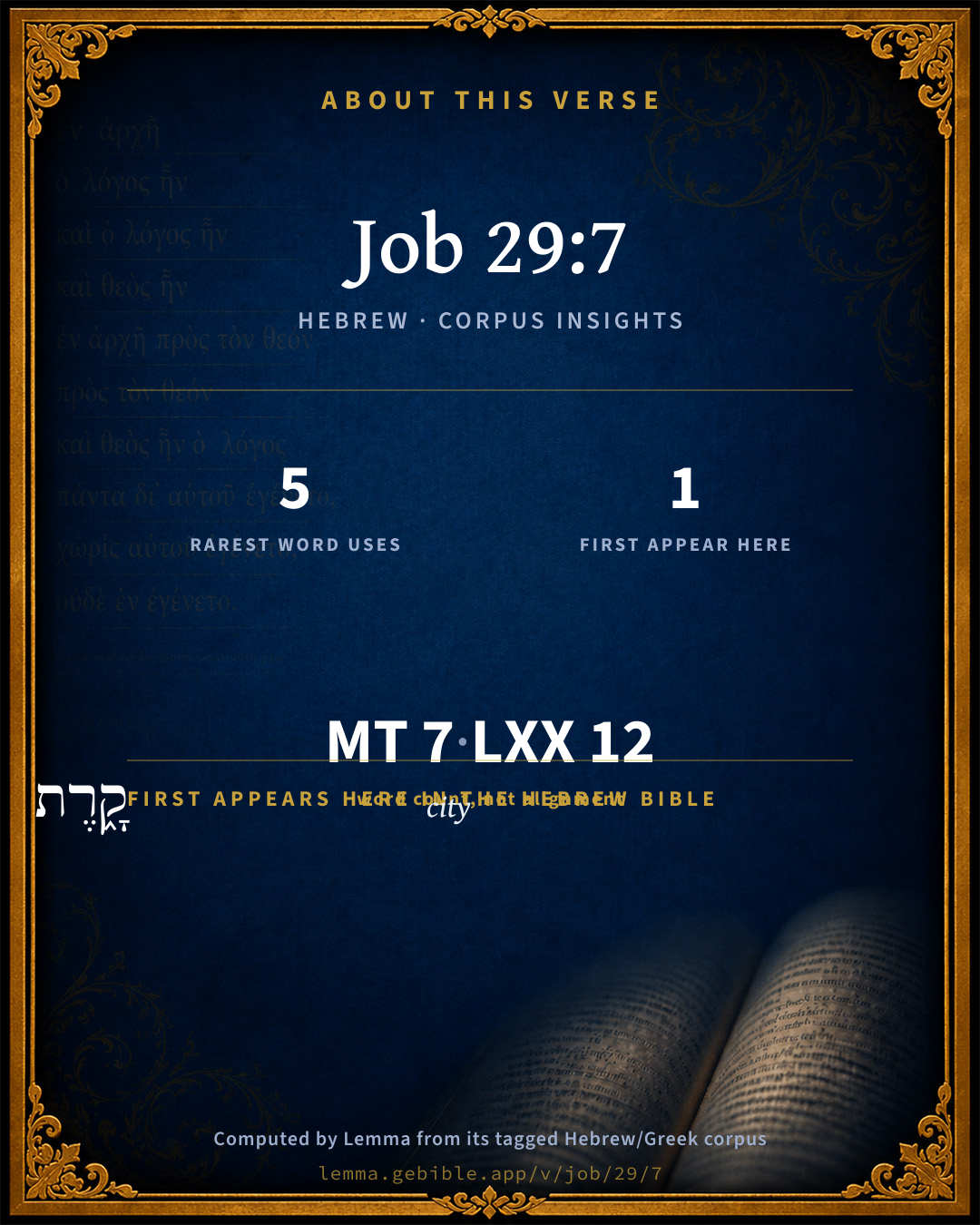
Job 29:7

Hebrew (Westminster Leningrad Codex) Job 29:7 appears in the Hebrew Old Testament. The text above is from the Westminster Leningrad Codex. Each word links to its Strong’s number, a concise gloss, and parsing drawn from the Open Scriptures Hebrew Bible morphology. Click any word for its full Brown-Driver-Briggs (BDB) entry.
Download image
Cite this verse

Job 29:7 (World English Bible). Public Domain. Lemma interlinear Bible study tool, https://lemma.gebible.app/v/job/29/7.

Show BibTeX & RIS
BibTeX
RIS
English Translation
When I went forth to the city gate, When I prepared my seat in the street,
World English Bible · Public Domain
Highlights
  • 1 first appearance in the Hebrew Bible
Full analysis ↓
Download a study sheet

One document with this verse’s original text, its word-by-word gloss line, the meaning frame, cross-references with their text, attributed commentary, and full source and license credits — printable, and it pastes into notes with its structure intact.

This verse Autodidact and up

Study sheet (.html) Plain text (.txt)

A passage Seminary Student

Up to 50 verses in one chapter. A passage sheet keeps up to 6 commentary sources and 12 cross-references per verse, in the order this page ranks them, and says so on the sheet whenever that leaves anything out. Ask for a single verse and you get the Autodidact verse sheet above.

Everything on this page stays free to read, with no account — the sheet is a download of what is already on screen, not access to it.

Want to remove ads? Support Godless Engineer
Compare translations 3

The same verse in 3 English versions, stacked beneath the original-language interlinear above. Click any original word for its lexicon entry.

Each is an independent rendering of the whole verse — the interlinear is not word-aligned to these translations.

Highlighted words mark where these versions differ — a whole-verse word diff, not a word-by-word alignment.

  • World English Bible Public Domain
    When I went forth to the city gate, When I prepared my seat in the street,
  • King James Version Public Domain
    When I went out to the gate through the city, when I prepared my seat in the street!
  • unfoldingWord Literal Text CC BY-SA 4.0
    When I went out to the gate of the city, I took my seat in the square,

unfoldingWord Literal Text — © unfoldingWord, licensed CC BY-SA 4.0. Word-aligned USFM3 via Door43 (git.door43.org/unfoldingWord/en_ult).

Versions to compare (up to 4)

3 of 4 selected

Show all 18 translations

Every available English version of this verse, each an independent rendering of the whole verse.

  • World English Bible Public Domain
    When I went forth to the city gate, When I prepared my seat in the street,
  • Berean Standard Bible Public Domain
    When I went out to the city gate and took my seat in the public square,
  • Majority Standard Bible Public Domain
    When I went out to the city gate and took my seat in the public square,
  • King James Version Public Domain
    When I went out to the gate through the city, when I prepared my seat in the street!
  • American Standard Version (1901) Public Domain
    When I went forth to the gate unto the city, When I prepared my seat in the street,
  • Revised Version (1885) Public Domain
    When I went forth to the gate unto the city, when I prepared my seat in the street,
  • Geneva Bible (1599) Public Domain
    When I went out to the gate, euen to the iudgement seat, and when I caused them to prepare my seate in the streete.
  • Douay-Rheims (1899) Public Domain
    When I went out to the gate of the city, and in the street they prepared me a chair?
  • Young's Literal Translation Public Domain
    When I go out to the gate by the city, In a broad place I prepare my seat.
  • Literal Standard Version CC BY-SA 4.0
    When I go out to the gate by the city, || In a broad place I prepare my seat.
  • Unlocked Literal Bible CC BY-SA 4.0
    When I went out to the city gate, when I sat in my place in the city square,
  • unfoldingWord Literal Text CC BY-SA 4.0
    When I went out to the gate of the city, I took my seat in the square,
  • Darby Bible Public Domain
    When I went out to the gate by the city, when I prepared my seat on the broadway,
  • World Messianic Bible Public Domain
    when I went out to the city gate, when I prepared my seat in the street.
  • Webster's Bible Public Domain
    When I went out to the gate through the city, when I prepared my seat in the street!
  • Free Bible Version CC BY-SA 4.0
    I went out to the city gate and took my seat in the public square.
  • Bible in Basic English Public Domain
    When I went out of my door to go up to the town, and took my seat in the public place,
  • JPS Tanakh (1917) Public Domain
    When I went forth to the gate unto the city, when I prepared my seat in the broad place,

Literal Standard Version (2020), Covenant Press — licensed CC BY-SA 4.0. Text via the HelloAO Bible API (eBible.org). Unlocked Literal Bible (unfoldingWord) — licensed CC BY-SA 4.0. Text via the HelloAO Bible API (eBible.org). unfoldingWord Literal Text — © unfoldingWord, licensed CC BY-SA 4.0. Word-aligned USFM3 via Door43 (git.door43.org/unfoldingWord/en_ult). Free Bible Version, Dr. Jonathan Gallagher — licensed CC BY-SA 4.0. Text via the HelloAO Bible API (eBible.org).

Word by word

More ways to search: Search by grammar → Find every occurrence → Compare this word →

Practice this passage: Drill this verse → Learn its vocabulary →

About this verse

These counts appear in no published source. They are computed here, from the morphology-tagged text and Lemma’s own curated glosses. What Lemma adds →

7
words
7
distinct lemmas
Wisdom
section

Notable vocabulary

The rarest word here is קָ֑רֶת city H7176 — appearing just 5 times in the whole Hebrew Bible.

First appearance in Scripture

This word makes its first canonical appearance in the Hebrew Bible here:

  • קָ֑רֶת city H7176

Shared distinctive vocabulary

קָ֑רֶת city H7176 occurs in 5 verses of the Hebrew Bible. Also found in:

Grammatical profile

  • 2 verbs
  • 4 nouns
  • 1 preposition

Verb forms

  • בְּצֵ֣אתִי Qal · Infinitive Construct
  • אָכִ֥ין Hiphil · Imperfect

Hebrew & Septuagint length

In English translation the verse runs 16 words from the Hebrew and 18 from the Septuagint (LXX English) — closely comparable.

A rough comparison of the two English renderings, which tokenize alike — not a word-level alignment.

Word counts can differ between the Hebrew and the Greek without any difference in meaning — e.g. the Hebrew direct-object marker אֵת has no separate Greek word, and Greek often adds the article ὁ.

In the original languages it is 7 Hebrew tokens and 12 Greek tokens — but the two are counted differently (Hebrew bundles its prefixes and suffixes into one token; the Greek is in lemma form), so that isn’t a like-for-like length.

Cross-references

6

Topical passages linked to Job 29:7 in the Treasury of Scripture Knowledge — connected by theme and wording, ordered by reader-vote popularity; previews shown in the World English Bible.

  • Deuteronomy 16:18 Judges and officers shall you make you in all your gates, which Yahweh your God gives you, according to your tribes; and they shall judge the people with righteous judgment.
  • Ruth 4:1–2 Now Boaz went up to the gate, and sat him down there: and, behold, the near kinsman of whom Boaz spoke came by; to whom he said, Ho, such a one! turn aside, sit down here. He turned aside, and sat down.
  • Zechariah 8:16 These are the things that you shall do: speak every man the truth with his neighbor. Execute the judgment of truth and peace in your gates,
  • Ruth 4:11 All the people who were in the gate, and the elders, said, We are witnesses. Yahweh make the woman who has come into your house like Rachel and like Leah, which two built the house of Israel: and do you worthily in Ephrathah, and be famous in Bethlehem:
  • Deuteronomy 21:19 then shall his father and his mother lay hold on him, and bring him out to the elders of his city, and to the gate of his place;
  • Job 31:21 If I have lifted up my hand against the fatherless, Because I saw my help in the gate:

Cross-references courtesy of OpenBible.info (CC BY 4.0).

Hebrew and Greek witnesses Masoretic Hebrew ↔ Greek Septuagint

The same verse in the two great witnesses to the Old Testament, shown verse-for-verse.

These are two independent witnesses, not word-aligned to each other, and the Septuagint is shown in lemma (dictionary) form.

Hebrew Job 29:7 Masoretic · Westminster Leningrad Codex

בְּצֵ֣אתִי שַׁ֣עַר עֲלֵי קָ֑רֶת בָּ֝רְח֗וֹב אָכִ֥ין מוֹשָׁבִֽי

When I went forth to the city gate, When I prepared my seat in the street,

World English Bible · Public Domain

Greek LXX Job 29:7 Septuagint · lemma form

ὅτε ἐκπορεύομαι ὄρθριος ἐν πόλις ἐν δέ πλατύς τίθημι ἐγώ ὁ δίφρος

When I went forth early in the city, and the seat was placed for me in the streets.

LXX2012 (modern English Septuagint) · Public Domain

On this verse, Haydock's Catholic Bible Commentary discusses the Septuagint’s reading. Read the note in Commentary ↓

Hebrew: Westminster Leningrad Codex (CC BY 4.0). Greek: Septuagint (public domain); English from LXX2012 (modern English Septuagint) (Public Domain). How the Septuagint differs from the Hebrew →

Commentary

Notes on Job 29:7 from classic Christian and Jewish commentators (each source and its license shown beneath its notes). The classic Christian expositions comment on the surrounding passage and are grouped to its opening verse, so a note may address several verses; the Jewish commentaries on the Tanakh (Rashi and others) are per-verse, so they appear only where the commentator wrote on this verse.

Lemma curates 59 commentaries, every one of them public domain or Creative Commons licensed, each selected and text-cleaned for this edition rather than reprinted as found. About our sources →

Matthew Henry's Commentary

We have here Job in a post of honour and power. Though he had comfort enough in his own house, yet he did not confine himself to that. We are not born for ourselves, but for the public. When any business was to be done in the gate, the place of judgment, Job went out to it through the city (Job 29:7), not in an affectation of pomp, but in an affection to justice. Observe, Judgment was administered in the gate, in the street, in the places of concourse, to which every man might have a free access, that every one who would might be a witness to all that was said and done, and that when judgment was given against the guilty others might hear and fear. Job being a prince, a judge, a magistrate, a man in authority, among the children of the east, we are here told,

I. What a profound respect was paid to him by all sorts of people, not only for the dignity of his place, but for his personal merit, his eminent prudence, integrity, and good management. 1. The people honoured him and stood in awe of him, v. 8. The gravity and majesty of his looks and mien, and his known strictness in animadverting upon every thing that was evil and indecent, commanded all about him into due decorum. The young men, who could not keep their countenances, or, it may be, were conscious to themselves of something amiss, hid themselves, and got out of his way; and the aged, though they kept their ground, yet would not keep their seats: they arose and stood up to do homage to him; those who expected honour from others gave honour to him. Virtue and piety challenge respect from all, and usually have it; but those that not only are good, but do good, are worthy of double honour. Modesty becomes those that are young and in subjection as much as majesty becomes those that are aged and in power. Honour and fear are due to magistrates, and must be rendered to them, Rom 13:7. But, if a great and good man was thus reverenced, how is the great and good God to be feared! 2. The princes and nobles paid great deference to him, Job 29:9, Job 29:10. Some think that these were inferior magistrates under him, and that the respect they paid him was due to his place, as their sovereign and supreme. It should rather seem that they were his equals in place, and joined in commission with him, and that the peculiar honour they gave him was gained by his extraordinary abilities and services. It was agreed that he excelled them all in quickness of apprehension, soundness of judgment, closeness of application, clearness and copiousness of expression; and therefore he was among his fellows an oracle of law, and counsel, and justice, and what he said all attended to and acquiesced in. When he came into court, especially when he stood up to speak to any business, the princes refrained talking, the nobles held their peace, that they might the more diligently hearken to what he said and might be sure to understand his meaning. Those that had been forward to speak their own thoughts, loved to hear themselves talk, and cared not much what any body else said, yet, when it came to Job's turn to speak, were as desirous to know his thoughts as ever they had been to vent their own. Those that suspected their own judgment were satisfied in his, and admired with what dexterity he split the hair and untied the knots which puzzled them and which they knew not what to make of. When the princes and nobles wrangled among themselves all agreed to refer the matters in dispute to Job and to abide by his judgment. Happy the men that are blessed with such eminent gifts as these; they have great opportunities of honouring God and doing good, but have great need to watch against pride. Happy the people that are blessed with such eminent men; it is a token for good to them.

II. What a great deal of good he did in his place. He was very serviceable to his country with the power he had; and here we shall see what it was which Job valued himself by in the day of his prosperity. It is natural to men to have some value for themselves, and we may judge something of our own character by observing what that is upon which we value ourselves. Job valued himself, not by the honour of his family, the great estate he had, his large income, his full table, the many servants he had at his command, the ensigns of his dignity, his equipage and retinue, the splendid entertainments he gave, and the court that was made to him, but by his usefulness. Goodness is God's glory, and it will be ours; if we are merciful as God is, we are perfect as he is.

1. He valued himself by the interest he had in the esteem, affections, and prayers, of sober people; not by the studied panegyrics of the wits and poets, but the unconstrained praises of all about him. All that heard what he said, and saw what he did, how he laid out himself for the public good with all the authority and tender affection of a father to his country, blessed him, and gave witness to him, Job 29:11. Many a good word they said of him, and many a good prayer they put up for him. He did not think it an honour to make every body fear him (Oderint dum metuant - Let them hate, provided they also fear) nor to be arbitrary, and to have his own will and way, not caring what people said of him; but, like Mordecai, to be accepted of the multitude of his brethren, Est 10:3. He did not so much value the applauses of those at a distance as the attestations of those that were the witnesses of his conduct, that constantly attended him, saw him, and heard him, and could speak of their own knowledge, especially theirs who had themselves been the better for him and could speak by their own experience: such was the blessing of him who was ready to perish (Job 29:13) and who by Job's means was rescued from perishing. Let great men, and men of estates, thus do good, and they shall have praise of the same; and let those who have good done to them look upon it as a just debt they owe to their protectors and benefactors to bless them and give witness to them, to use their interest on earth for their honour and in heaven for their comfort, to praise them and pray for them. Those are ungrateful indeed who grudge these small returns.

2. He valued himself by the care he took of those that were least able to help themselves, the poor and the needy, the widows and fatherless, the blind and the lame, who could not be supposed either to merit his favour or ever to be in a capacity to recompense it. (1.) If the poor were injured or oppressed, they might cry to Job, and, if he found the allegations of their petitions true, they had not only his ear and his bowels, but his hand too: He delivered the poor that cried (Job 29:12) and would not suffer them to be trampled upon and run down. Nay (Job 29:16), he was a father to the poor, not only a judge to protect them and to see that they were not wronged, but a father to provide for them and to see that they did not want, to counsel and direct them, and to appear and act for them upon all occasions. It is no disparagement to the son of a prince to be a father to the poor. (2.) The fatherless that had none to help them found Job ready to help them, and, if they were in straits, to deliver them. He helped them to make the best of what little they had, helped them to pay what they owed and to get in what was owing to them, helped them out into the world, helped them into business, helped them to it, and helped them in it; thus should the fatherless be helped. (3.) Those that were ready to perish he saved from perishing, relieving those that were hungry and ready to perish for want, taking care of those that were sick, that were outcasts, that were falsely accused, or in danger of being turned out of their estates unjustly, or, upon any other account, were ready to perish. The extremity of the peril, as it quickened Job to appear the more vigorously for them, so it made his seasonable kindness the more affecting and the more obliging, and brought their blessings the more abundantly upon him. (4.) The widows that were sighing for grief, and trembling for fear, he made to sing for joy, so carefully did he protect them and provide for them, and so heartily did he espouse their interest. It is a pleasure to a good man, and should be so to a great man, to give those occasion to rejoice that are most acquainted with grief. (5.) Those that were upon any account at a loss Job gave suitable and seasonable relief to (Job 29:15): I was eyes to the blind, counselling and advising those for the best that knew not what to do, and feet to the lame, assisting those with money and friends that knew what they should do, but knew not how to compass it. Those we best help whom we help out in that very thing wherein they are defective and most need help. We may come to be blind or lame ourselves, and therefore should pity and succour those that are so, Isa 35:3, Isa 35:4; Heb 12:13.

3. He valued himself by the conscience he made of justice and equity in all his proceedings. His friends had unjustly censured him as an oppressor. "So far from that," says he, "I always made it my business to maintain and support right." (1.) He devoted himself to the administration of justice (Job 29:14): I put on righteousness and it clothed me, that is, he had an habitual disposition to execute justice and put on a fixed resolution to do it. It was the girdle of his lions, Isa 11:5. It kept him tight and steady in all his motions. He always appeared in it, as in his clothing, and never without it. Righteousness will clothe those that put it on; it will keep them warm, and be comfortable to them; it will keep them safe, and fence them against the injuries of the season; it will adorn them, and recommend them to the favour both of God and man. (2.) He took pleasure in it, and, as I may say, a holy delight. He looked upon it as his greatest glory to do justice to all and injury to none: My judgment was as a robe and a diadem. Perhaps he did not himself wear a robe and a diadem; he was very indifferent to those ensigns of honour; those were most fond of them who had least intrinsic worth to recommend them. But the settled principles of justice, by which he was governed and did govern, were to him instead of all those ornaments. If a magistrate do the duty of his place, that is an honour to him far beyond his gold or purple, and should be, accordingly, his delight; and truly if he do not make conscience of his duty, and in some measure answer the end of his elevation, his robe and diadem, his gown and cap, his sword and mace, are but a reproach, like the purple robe and crown of thorns with which the Jews studied to ridicule our Saviour; for, as clothes on a dead man will never make him warm, so robes on a base man will never make him honourable. (3.) He took pains in the business of his place (Job 29:16): The cause which I knew not I searched out. He diligently enquired into the matters of fact, patiently and impartially heard both sides, set every thing in its true light, and cleared it from false colours; he laid all circumstances together, that he might find out the truth and the merits of every cause, and then, and not until then, gave judgment upon it. He never answered a matter before he heard it, nor did he judge a man to be righteous, however he seemed, for his being first in his own cause, Pro 18:17.

4. He valued himself by the check he gave to the violence of proud and evil men (Job 29:17): I broke the jaws of the wicked. He does not say that he broke their necks. He did not take away their lives, but he broke their jaws, he took away their power of doing mischief; he humbled them, mortified them, and curbed their insolence, and so plucked the spoil out of their teeth, delivered the persons and estates of honest men from being made a prey of by them. When they had got the spoil between their teeth, and were greedily swallowing it down, he bravely rescued it, as David did the lamb out of the mouth of the lion, not fearing, though they roared and raged like a lion disappointed of his prey. Good magistrates must thus be a terror and restraint to evil-doers and a protection to the innocent, and, in order to this, they have need to arm themselves with zeal, and resolution, and an undaunted courage. A judge upon the bench has as much need to be bold and brave as a commander in the field.

Matthew Henry's Commentary on the Whole Bible (1708–1710) — public domain (CC PDM 1.0). Text via the HelloAO Bible API.

Trapp's Complete Commentary

John Trapp

Job 29:7 When I went out to the gate through the city, [when] I prepared my seat in the street!

Ver. 7. When I went out to the gate] i.e. To the place of judicature, called by Solomon the holy place, Ecc 8:11, because God sitteth in the midst of those gods, Psa 82:1. The Ethiopian judges were wont to keep the chief seat empty for him. It appeareth by this text that Job was a judge: or chief magistrate, not like those whom Isaiah calleth scabs or wounds, Isa 3:7, vid. Pisc. in loc.; but those whom the same prophet calleth healers, or binders up of wounds, Isa 3:7, Here αναξ from ακος, Medela; and Hosea, shields, as Junius translateth, Hos 4:8; and another prophet, heirs or possessors of restraint, Jdg 18:7. It appeareth also that he did justice in his own person; so did David, Solomon, Jehoshaphat, Augustus Caesar, more vigorously than any young man, and more prudent than any old man, as the historian saith of him, Pαντος μεν ανδρος νεανικωπερον, παντος δε γεροντος φρονιμωτερον (Dio). Which while Aurelian the emperor neglected to do, he was even bought and sold by his deputies.

When I prepared my seat in the street/] i.e. My judgment seat, where he sat Sub dio, non attollens inane supercilium, sed exhibens utile ministerium, Not priding himself, but profiting others, while justice, justice, as Moses speaketh, that is, pure justice, was duly administered, Deu 10:20. Over this tribunal might well have been set that distich at Zant,

Hic locus odit, amat, punit, conservat, honorat,

Nequitiam, pacem, crimina, iura, bonos.

John Trapp, A Commentary or Exposition upon All the Books of the Old and New Testament (1647–1656) — public domain. Text from a community e-Sword module.

Joseph Benson's Commentary

Job 29:7. When I went out to the gate — When I went from my dwelling to the gate of the city, the place of judicature, which, as has often been observed, was in the gates. When I prepared my seat in the streets — When I caused the seat of justice to be set for me in that open place, as ברחוב, barechob, signifies, near the gate, where the people assembled for the administration of justice. By this, and several other expressions, it appears that Job was a magistrate or judge in his country.

Joseph Benson's Commentary on the Old and New Testaments (1811–1818) — public domain. Text from a community e-Sword module.

Tyndale Open Study Notes

Tyndale Open Resources

29:7 The city gate was a town’s administrative center (see Ruth 4:1-2, 11).

Tyndale Open Study Notes — © Tyndale Open Resources, licensed CC BY-SA 4.0. Text via the HelloAO Bible API.

Jamieson, Fausset & Brown

Robert Jamieson, A. R. Fausset & David Brown

The great influence Job had over young and old, and noblemen.

through . . . street!--rather, When I went out of my house, in the country (see Job 1:1, prologue) to the gate (ascending), up to the city (which was on elevated ground), and when I prepared my (judicial) seat in the market place. The market place was the place of judgment, at the gate or propylæa of the city, such as is found in the remains of Nineveh and Persepolis (Isa 59:14; Psa 55:11; Psa 127:5).

Jamieson, Fausset & Brown — Commentary Critical and Explanatory on the Whole Bible (1871) — public domain (CC PDM 1.0). Text via the HelloAO Bible API.

Adam Clarke's Commentary

Verse 7. When I went out to the gate] Courts of justice were held at the gates or entrances of the cities of the East; and Job, being an emir, was supreme magistrate: and here he speaks of his going to the gate to administer justice.

I prepared my seat in the street] I administered judgment openly, in the most public manner, and none could say that I, in any case, perverted justice. Mr. Good translates: - "As I went forth the city rejoiced at me, as I took my seat abroad."

Adam Clarke's Commentary on the Bible (1810–1826) — public domain. Text from a community e-Sword/MySword module.

Ellicott's Commentary for English Readers

(7) To the gate.—There business was transacted. (Comp. the expression, which is still used with reference to the Turkish Empire, of “the Sublime Porte,” or the supreme Place of government; Psa_127:5; Jer. 35:20, &c.)

A Bible Commentary for English Readers, edited by Charles John Ellicott (1878–1897) — public domain. Text from a community e-Sword module.

The Cambridge Bible for Schools and Colleges

gen. ed. J. J. S. Perowne

7. The third and chiefest element of his past happiness was the respect of men, and the joy of intercourse with them. This is the main subject of the chapter.

the gate through the city] Or, the gate by the city. Job, a rich landowner, probably did not live in the city but on his estate that adjoined it. He took part, however, in all the life of the city, and sat in the council that guided its affairs. The “gate” is spoken of as the place where the Council or Assembly of the town met. Such a “gate” is usually a building of considerable size, like an arcade, and hence it is spoken of here as an independent edifice by or beside the city. Others render up to the city, supposing that the city, as not unusual, was built on an eminence.

in the street] lit. broad place, i. e. market place, a synonym for “gate.”

The Cambridge Bible for Schools and Colleges (gen. ed. J. J. S. Perowne; Cambridge University Press, 1878–1918) — public domain. Text from a community e-Sword module.

John Gill's Exposition

When I went out to the, gate through the city,.... Job having described his former state of happiness by the personal favours he enjoyed, and by the prosperity of his family, and his abundance of plenty at home, proceeds to give an account of the honour and respect he had from men of every age and rank abroad: though he had an affluence of the things of this world, he did not indulge himself at home in ease and sloth; but went abroad to take care of the public welfare, maintain public peace, and administer public justice among his neighbours; performing the office of a civil magistrate, which is often expressed in Scripture by going in and out before the people: Job went out from his own house to the gate of the city, where a court of judicature was kept, as it was usual in those times and countries to hold them in the gates of the city; see Zac 8:16; and to which he passed through the city, very probably, in great pomp and splendour, suitable to his office and character, which drew the eyes and attention of the people to him; by which it should seem that his house was on one side of the city, and the gate where justice was administered was on the other; though it may be rendered, "over the city" (o), and the sense be, that he passed along as he that was over the city, the chief man in it, and president of the court of justice, see Kg2 10:5;

when I prepared my seat in the street; where he sat, not as a teacher, though he was an instructor, not only of his family, but of his neighbours, as Eliphaz himself testifies, Job 4:3; and it was usual for such to have seats to sit upon, as those had who succeeded Moses, and are said to sit in his chair; and it was usual to call to men and instruct them in open public places; hence Wisdom is said to utter her voice in the streets, in the opening of the gates, at the entry of the city, at the coming in at the doors, Pro 1:20; but Job here speaks of himself as a civil magistrate, as a judge upon the bench, who had a seat or throne erected for him to sit upon, while he was hearing and trying causes; and this was set up in the street under the open air, before the gate of the city, where the whole city might be convened together, and hear and see justice done to their neighbours; in such a street, before the gate of the city, Ezra read the law to Israel; and in such an one Hezekiah got the people of Israel together, and spoke comfortably to them when invaded by Sennacherib; see Neh 8:2; and the Arabs, to this day, hold their courts of justice in an open place under the heavens, as in a field, or in a market place (p); and it is right that courts of justice should be open and accessible to all.

(o) "super civitatem", Pagninus, Montanus, Schmidt; "super urbe", Schultens. (p) Norden's Travels in Egypt and Nubia, vol. 2. p. 140, 141, 158. See Joseph. Antiqu. l. 18. c. 5. sect. 6.

John Gill's Exposition of the Whole Bible (1746–1763) — public domain (CC PDM 1.0). Text via the HelloAO Bible API.

Albert Barnes' Notes on the Bible

When I went out to the gate - The “gate” of a city was a place of public concourse, and where courts were usually held. Job speaks here as a magistrate, and of the time when he went forth to sit as a judge, to try causes.

When I prepared my seat in the street - That is, to sit as a judge. The seat or tribunal was placed in the street, in the open air, before the gate of the city, where great numbers might be convened, and hear and see justice done. The Arabs, to this day, hold their courts of justice in an open place, under the heavens, as in a field or a market-place. Norden’s Travels in Egypt, ii. 140. There has been, however, great variety of opinion in regard to the meaning of this verse. Schultens enumerates no less than ten different interpretations of the passage. Herder translates it:

“When from my house I went to the assembly,

And spread my carpet in the place of meeting.”

Prof. Lee translates it, “When I went forth from the gate to the pulpit, and prepared my seat in the broad place.” He supposes that Job refers to occasions when he addressed the people, and to the respect which was shown him then. Dr. Good renders it, “As I went forth, the city rejoiced at me.” It is probable, however, that our common version has given the true signification. The word rendered “city” (קרת qereth), is a poetic form for (קריה qiryâh) “city,” but does not frequently occur. It is found in Pro 8:3; Pro 9:3, Pro 9:14; Pro 11:11. The phrase “upon the city” - Hebrew עלי־קרת ‛aly-qereth - or, “over the city,” may refer to the fact that the gate was in an elevated place, or that it was the chief place, and, as it were, over or at the head of the city. The meaning is, that as he went out from his house toward the gate that was situated in the most important part of the city, all did him reverence.

Albert Barnes' Notes on the Bible (1834–1885) — public domain. Text from a community e-Sword/MySword module.

Haydock's Catholic Bible Commentary

To the gate. Septuagint, "early." --- Chair, or throne, where Job sat in judgment. (Haydock) --- It appears evident that he was the prince in his city. Idumea had at first several petty kings at the same time, Genesis xxxvi. 15. (Calmet) --- But Job had several princes (ver. 9.; Haydock) under him. (Pineda)

George Leo Haydock (1774–1849), Haydock's Catholic Family Bible and Commentary, 1859 edition — public domain. Excludes Psalms (Douay-Rheims chapter numbering differs from Protestant) and Deuterocanonical books (Catholic canon only).

Matthew Poole's English Annotations

When I went out from my dwelling to the gate, to wit, of the city, as the following words show; to the place of judicature, which was in the gates, as hath been oft observed.

Through the city; through that part of the city which was between my house and the gate. Or, to the city, i.e. the gate belonging to the city. So Job might live in the country adjoining to it.

When I prepared my seat; when I caused the seat of justice to be set for me. By this and divers other expressions it appears that Job was a magistrate or judge in his country. In the street, i.e. in that void and open place within or near the gate, where the people assembled for the administration of justice among them.

Matthew Poole's English Annotations on the Holy Bible (1683–1685) — public domain. Text from a community e-Sword/MySword module.

Whedon's Commentary on the Bible

Daniel D. Whedon

7. Through — Up to the city. Cities, together with their acropolis, were in ancient towns usually built on heights, thus securing better defence, and perhaps greater probability of health. It would seem that Job’s residence was in the country, and that he made stated visits to the city for the transaction of business as Emir. The place of business was either in the gateway of the city, which was vaulted, shady, and cool, (see note, Job_5:4,) or in the STREET, the broad way, probably a kind of market-place, not far from the gate. Thomson speaks of his seeing in certain places — Joppa, for example — the kadi and his court sitting at the entrance of the gate, hearing and adjudicating all sorts of cases in the audience of all that went in and out.

Daniel D. Whedon (gen. ed.), Commentary on the Old and New Testaments (1874–1909) — public domain. Text from a community e-Sword module.

The Pulpit Commentary

When I went out to the gate through the city; rather, by the city, or over against the city. The "gate" was the place where justice was administered, and public business generally dispatched. It would be "over against" the city, separated from it by a large square or place (bwOjr), in which a multitude might assemble. (see Neh_8:1) Hither Job was accustomed to proceed from time to time, to act as judge and administrator. When I prepared my seat in the street. On such occasions a seat would be brought out and "prepared," where the judge would sit to hear causes and deliver sentences. (comp. Neh_3:7)

The Pulpit Commentary (1880–1919), ed. H.D.M. Spence-Jones & Joseph S. Exell — public domain. Text from a community e-Sword module.

John Wesley's Explanatory Notes

Seat - When I caused the seat of justice to be set for me. By this, and several other expressions, it appears that Job was a magistrate. Street - In that open place, near the gate, where the people assembled for the administration of justice.

John Wesley, Explanatory Notes Upon the Whole Bible (1754–1765) — public domain. Text via the GEBible commentary corpus.

Keil & Delitzsch

C. F. Keil & F. Delitzsch

7 When I went forth to the gate of the city,

Prepared my seat in the market,

8 Then the young men hid themselves as soon as they saw me,

And the aged rose up, remained standing.

9 Princes refrained from speaking,

And laid their hand on their mouth.

10 The voice of the nobles was hidden,

And their tongue clave to their palate.

When he left the bounds of his domain, and came into the city, he was everywhere received with the profoundest respect. From the facts of the case, it is inadmissible to translate quum egrederer portam after Gen 34:24, comp. infra, Job 31:34, for the district where Job dwelt is to be thought of as being without a gate. True, he did not dwell with his family in tents, i.e., pavilions of hair, but in houses; he was not a nomad (a wandering herdsman), or what is the same thing, a Beduin, otherwise his children would not have been slain in a stone house, Job 1:19. "The daughter of the duck," says an Arabian proverb, "is a swimmer," and the son of a Beduin never dwells in a stone house. He was, however, also, not a citizen, but a hadarı̂ (חצרי), i.e., a permanent resident, a large landowner and husbandman. Thus therefore שׁער (for which Ew. after the lxx reads שׁחר: "when I went up early in the morning to the city") is locative, for שׁערה (comp. צא השּׂדה, go out into the field, Gen 27:3): when he went forth to the gate above the city; or even, since it is natural to imagine the city as situated on an eminence: up to the city (so that צאת includes in itself by implication the notion of עלות); not, however: to the gate near the city (Stick., Hahn), since the gate of a city is not situated near the city, but is part of the city itself. The gates of cities and large houses in Western Asia are vaulted entrances, with large recesses on either side, where people congregate for business and negotiations.

(Note: Vid., Layard, New Discoveries, p. 57.)

The open space at the gate, which here, as in Neh 8:1, Neh 8:3, Neh 8:16, is called רחוב, i.e., the open space within the gate and by the gate, was the forum (Job 5:4).

Job 29:8

When Job came hither to the meeting of the tribunal, or the council of the elders of the city, within which he had a seat and a voice, the young men hid themselves, conscious of his presence (which εἰρομένῃ λέξει, or, is expressed paratactically instead of as a period), i.e., they retired into the background, since they feared his look of salutation;

(Note: Comp. jer. Schekalim ii. 5 (in Pinner's Compendium des Thalmud, S. 58): "R. Jochanan was walking and leaning upon R. Chija bar-Abba, R. Eliezer perceived him and hid himself from him (ומטמר לח מקמי). Then said R. Jochanan: This Babylonian insulted him (R. Chija) by two things; first that he did not salute him, and then that he hid himself. But R. Jakob bar-Idi answered him, it is the custom with them for the less not to salute the greater, - a custom which confirms Job's words: Young men saw me and his themselves.")

and old men (hoary heads) stood up, remained standing (ἀσυνδέτως, as Job 20:19; Job 28:4). קוּם signifies to stand up, עמד to advance towards any one and remain standing. They rose in order not to seat themselves until he was seated. שׂרים are magnates (proceres) of the city. These עצרוּ בּמלּים, cohibebant verba (עצר with Beth of the obj., as Job 4:2; Job 12:15), and keeping a respectful silence, they laid their hand on their mouth (comp. Job 21:5). All stepped back and desisted from speaking before him: The speech of illustrious men (נגידים from נגד, Arab. njd, to be visible, pleasant to the sight, comp. supra, p. 510) hid itself (not daring to be heard), and the tongue of the same clave (motionless) to their palate. We do not translate: as to the voice illustrious men hid themselves, for it is only the appearance produced by the attractional construction Ges. 148, 1 that has led to the rendering of קול־נגידים as an acc. of closer definition (Schult., Hahn: quod ad vocem eminentium, comprimebantur). The verb is construed with the second member of the genitival expression instead of with the first, as with מספר, Job 15:20; Job 21:21; Job 38:21, and with ראשׁ, Job 22:12; a construction which occurs with קול not merely in such exclamatory sentences as Gen 4:10; Isa 52:8, but also under other conditions, Kg1 1:41, comp. Job 14:6. This may be best called an attraction of the predicate by the second member of the compound subject, like the reverse instance, Isa 2:11; and it is sometimes found even where this second member is not logically the more important. Thus Ew. transl.: "the voice of the nobles hides itself;" whereas Olsh., wrongly denying that the partt. in passages like Gen 4:10; Kg1 1:41, are to be taken as predicative, wishes to read נחבא, which is the more inadmissible, as even the choice of the verb is determined by the attractional construction.

The strophe which follows tells how it came to pass that those in authority among the citizens submitted to him, and that on all sides the people were zealous to show him tokens of respect.

Keil & Delitzsch — Biblical Commentary on the Old Testament (1861–1891) — public domain (CC PDM 1.0). Text via the HelloAO Bible API. (Old Testament only.)

unfoldingWord translationNotes

Door43 World Missions Community

city square

This is an open area in a village or city where two or more streets meet.

rose and stood for me

This is a symbol of respect. It can be stated clearly. AT: "rose and stood respectfully for me" (See: Symbolic Action)

translationWords

gate

unfoldingWord translationNotes — © Distant Shores Media and the Door43 World Missions Community, licensed CC BY-SA 4.0. Source: git.door43.org/Door43/en_tn.

Rashi

Rabbi Shlomo Yitzchaki (Rashi)

the ceiling a high ceiling, prepared for a chair for the elders of the city to sit on.

and when I was in the square, I would prepare my seat.

Rashi on the Tanakh — English translations: “The Judaica Press complete Tanach with Rashi, translated by A. J. Rosenberg” (CC BY 4.0); “Pentateuch with Rashi's commentary by M. Rosenbaum and A.M. Silbermann, 1929-1934” (public domain); “The Metsudah Tanach series, Lakewood, N.J” (CC BY 4.0); and “The Book of Joshua, Metsudah Publications, 1997” (CC BY 4.0). Text via Sefaria.

Lesson kit

Teaching starters — assembled from the data on this page, not authored interpretation. Every prompt links to the verse data it draws on. Edit before teaching.

Job, in the Wisdom, opens this verse with 7 words (7 distinct Hebrew lemmas). Its most distinctive word is qereth (“city”). A historical commentator’s framing appears above. Read the whole chapter for the surrounding context.

Discussion questions

  1. The word qereth carries the sense “city.” How does it shape the verse?
  2. This is the first place “city” appears in Scripture (first appears here). What does its debut here establish?
  3. How does Proverbs 8:3, which shares the word «city», read alongside this verse?
  4. The translations on this page render this verse differently — a whole-verse word diff, not a word-by-word alignment. What might account for the different wordings?
  5. «בְּצֵ֣אתִי» is a Qal Infinitive Construct verb. How does that grammatical form shape the action described?
  6. Compare how Matthew Henry's Commentary and Trapp's Complete Commentary read this verse. Where do they agree or differ?

Things to notice

Reading settings

Reading text

Shown beneath each verse's original-language words.

Old Testament
Old Testament edition

Read the OT as the Masoretic Hebrew (MT) or the Greek Septuagint (LXX).

English shown for the Greek Septuagint (in the Hebrew ↔ Greek comparison).

Comparing translations? Open the Compare panel on any verse page to stack up to four side by side.