Esther 4:2

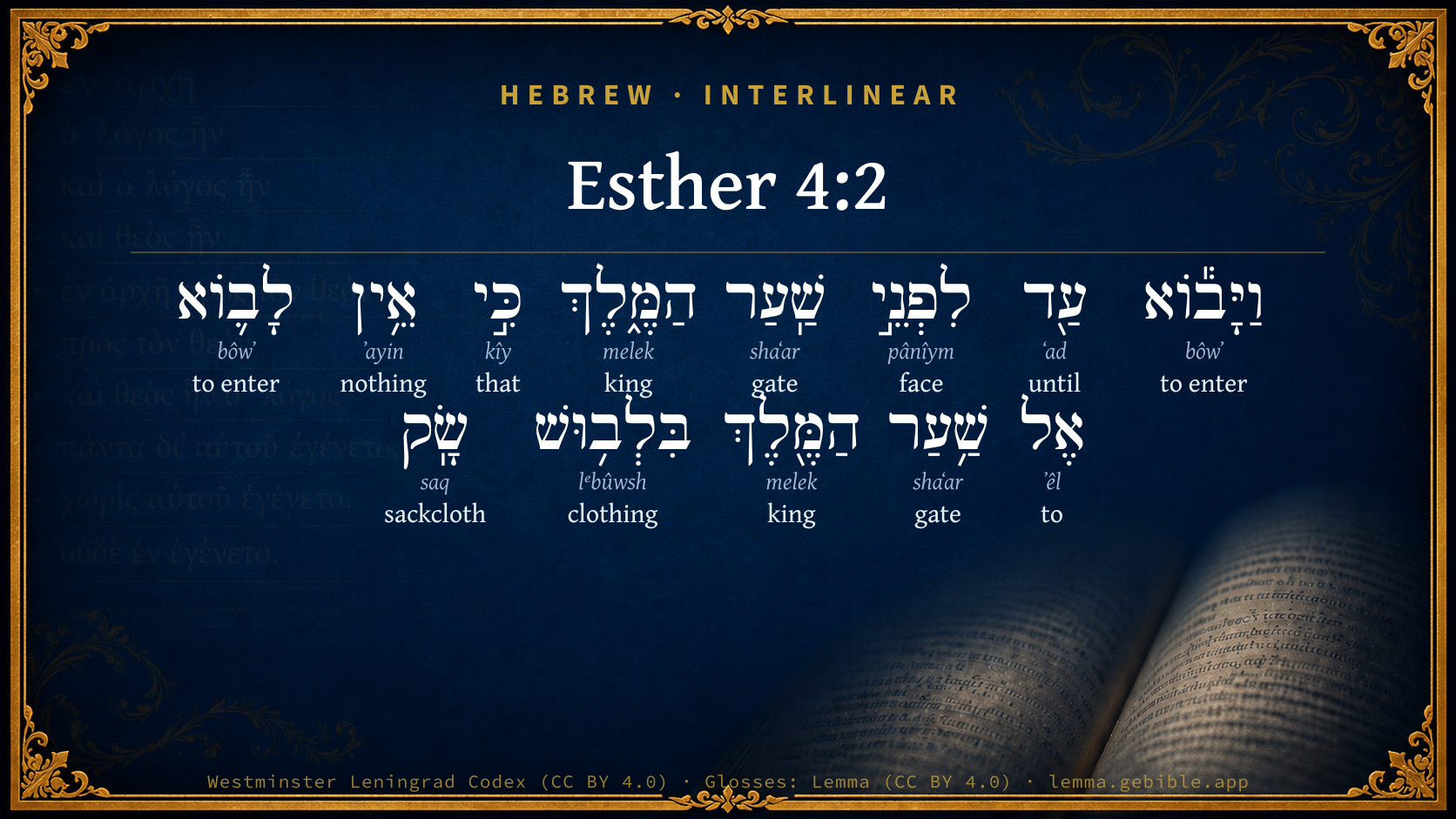
Hebrew (Westminster Leningrad Codex) Esther 4:2 appears in the Hebrew Old Testament. The text above is from the Westminster Leningrad Codex. Each word links to its Strong’s number, a concise gloss, and parsing drawn from the Open Scriptures Hebrew Bible morphology. Click any word for its full Brown-Driver-Briggs (BDB) entry.
Download image
Cite this verse

Esther 4:2 (World English Bible). Public Domain. Lemma interlinear Bible study tool, https://lemma.gebible.app/v/esther/4/2.

Show BibTeX & RIS
BibTeX
RIS
English Translation
and he came even before the king's gate: for none might enter within the king's gate clothed with sackcloth.
World English Bible · Public Domain
Download a study sheet

One document with this verse’s original text, its word-by-word gloss line, the meaning frame, cross-references with their text, attributed commentary, and full source and license credits — printable, and it pastes into notes with its structure intact.

This verse Autodidact and up

Study sheet (.html) Plain text (.txt)

A passage Seminary Student

Up to 50 verses in one chapter. A passage sheet keeps up to 6 commentary sources and 12 cross-references per verse, in the order this page ranks them, and says so on the sheet whenever that leaves anything out. Ask for a single verse and you get the Autodidact verse sheet above.

Everything on this page stays free to read, with no account — the sheet is a download of what is already on screen, not access to it.

Want to remove ads? Support Godless Engineer
Compare translations 3

The same verse in 3 English versions, stacked beneath the original-language interlinear above. Click any original word for its lexicon entry.

Each is an independent rendering of the whole verse — the interlinear is not word-aligned to these translations.

Highlighted words mark where these versions differ — a whole-verse word diff, not a word-by-word alignment.

  • World English Bible Public Domain
    and he came even before the king's gate: for none might enter within the king's gate clothed with sackcloth.
  • King James Version Public Domain
    And came even before the king's gate: for none might enter into the king's gate clothed with sackcloth.
  • unfoldingWord Literal Text CC BY-SA 4.0
    And he came only as far as before the face of the gate of the king because no one was to come into the gate of the king while wearing sackcloth.

unfoldingWord Literal Text — © unfoldingWord, licensed CC BY-SA 4.0. Word-aligned USFM3 via Door43 (git.door43.org/unfoldingWord/en_ult).

Versions to compare (up to 4)

3 of 4 selected

Show all 18 translations

Every available English version of this verse, each an independent rendering of the whole verse.

  • World English Bible Public Domain
    and he came even before the king's gate: for none might enter within the king's gate clothed with sackcloth.
  • Berean Standard Bible Public Domain
    But he went only as far as the king’s gate, because the law prohibited anyone wearing sackcloth from entering that gate.
  • Majority Standard Bible Public Domain
    But he went only as far as the king’s gate, because the law prohibited anyone wearing sackcloth from entering that gate.
  • King James Version Public Domain
    And came even before the king's gate: for none might enter into the king's gate clothed with sackcloth.
  • American Standard Version (1901) Public Domain
    and he came even before the king's gate: for none might enter within the king's gate clothed with sackcloth.
  • Revised Version (1885) Public Domain
    and he came even before the king’s gate: for none might enter within the king’s gate clothed with sackcloth.
  • Geneva Bible (1599) Public Domain
    And he came euen before the Kings gate, but he might not enter within the Kings gate, being clothed with sackecloth.
  • Douay-Rheims (1899) Public Domain
    And he came lamenting in this manner even to the gate of the palace: for no one clothed with sackcloth might enter the king's court.
  • Young's Literal Translation Public Domain
    and he cometh in unto the front of the gate of the king, but none is to come in unto the gate of the king with a sackcloth-garment.
  • Literal Standard Version CC BY-SA 4.0
    and he comes to the front of the gate of the king, but none is to come to the gate of the king with a sackcloth-garment.
  • Unlocked Literal Bible CC BY-SA 4.0
    He went up only as far as the king's gate, because no one was allowed to go through it clothed in sackcloth.
  • unfoldingWord Literal Text CC BY-SA 4.0
    And he came only as far as before the face of the gate of the king because no one was to come into the gate of the king while wearing sackcloth.
  • Darby Bible Public Domain
    and came even before the king's gate; for none might enter into the king's gate clothed with sackcloth.
  • World Messianic Bible Public Domain
    He came even before the king’s gate, for no one is allowed inside the king’s gate clothed with sackcloth.
  • Webster's Bible Public Domain
    And came even before the king's gate: for none might enter into the king's gate clothed with sackcloth.
  • Free Bible Version CC BY-SA 4.0
    He went as far as the palace gate, because no one was allowed to enter the palace gate wearing sackcloth.
  • Bible in Basic English Public Domain
    And he came even before the king's doorway; for no one might come inside the king's door clothed in haircloth.
  • JPS Tanakh (1917) Public Domain
    and he came even before the king's gate; for none might enter within the king's gate clothed with sackcloth.

Literal Standard Version (2020), Covenant Press — licensed CC BY-SA 4.0. Text via the HelloAO Bible API (eBible.org). Unlocked Literal Bible (unfoldingWord) — licensed CC BY-SA 4.0. Text via the HelloAO Bible API (eBible.org). unfoldingWord Literal Text — © unfoldingWord, licensed CC BY-SA 4.0. Word-aligned USFM3 via Door43 (git.door43.org/unfoldingWord/en_ult). Free Bible Version, Dr. Jonathan Gallagher — licensed CC BY-SA 4.0. Text via the HelloAO Bible API (eBible.org).

Word by word

More ways to search: Search by grammar → Find every occurrence → Compare this word →

Practice this passage: Drill this verse → Learn its vocabulary →

בִּלְב֥וּשׁ
lᵉbûwsh
H3830
“in/at · clothing of”
Preposition + Noun, Common, Masculine, Singular, Construct
Part of Speech
Preposition + Noun
Type
Common
Gender
Masculine
Number
Singular
State
Construct
Full BDB Definition

Origin: from H3847

TWOT: 1075a

clothing, garment, apparel, raiment
  1. וַיָּב֕וֹא bôwʼ H935 “and · to enter” Conjunction + Verb, Qal, Sequential Imperfect, 3rd Person, Masculine, Singular
  2. עַ֖ד ʻad H5704 “until” Preposition
  3. לִפְנֵ֣י pânîym H6440 “to/for · face(s) of” Preposition + Noun, Common, Both, Plural, Construct
  4. שַֽׁעַר shaʻar H8179 “gate of” Noun, Common, Masculine, Singular, Construct
  5. הַמֶּ֑לֶךְ melek H4428 “the · king” Particle, Definite Article + Noun, Common, Masculine, Singular, Absolute
  6. כִּ֣י kîy H3588 “that” Conjunction
  7. אֵ֥ין ʼayin H369 “nothing” Particle, Negative
  8. לָב֛וֹא bôwʼ H935 “to enter” Preposition + Verb, Qal, Infinitive Construct
  9. אֶל ʼêl H413 “to” Preposition
  10. שַׁ֥עַר shaʻar H8179 “gate of” Noun, Common, Masculine, Singular, Construct
  11. הַמֶּ֖לֶךְ melek H4428 “the · king” Particle, Definite Article + Noun, Common, Masculine, Singular, Absolute
  12. שָֽׂק saq H8242 “sackcloth” Noun, Common, Masculine, Singular, Absolute

About this verse

These counts appear in no published source. They are computed here, from the morphology-tagged text and Lemma’s own curated glosses. What Lemma adds →

13
words
10
distinct lemmas
Historical
section

Shared distinctive vocabulary

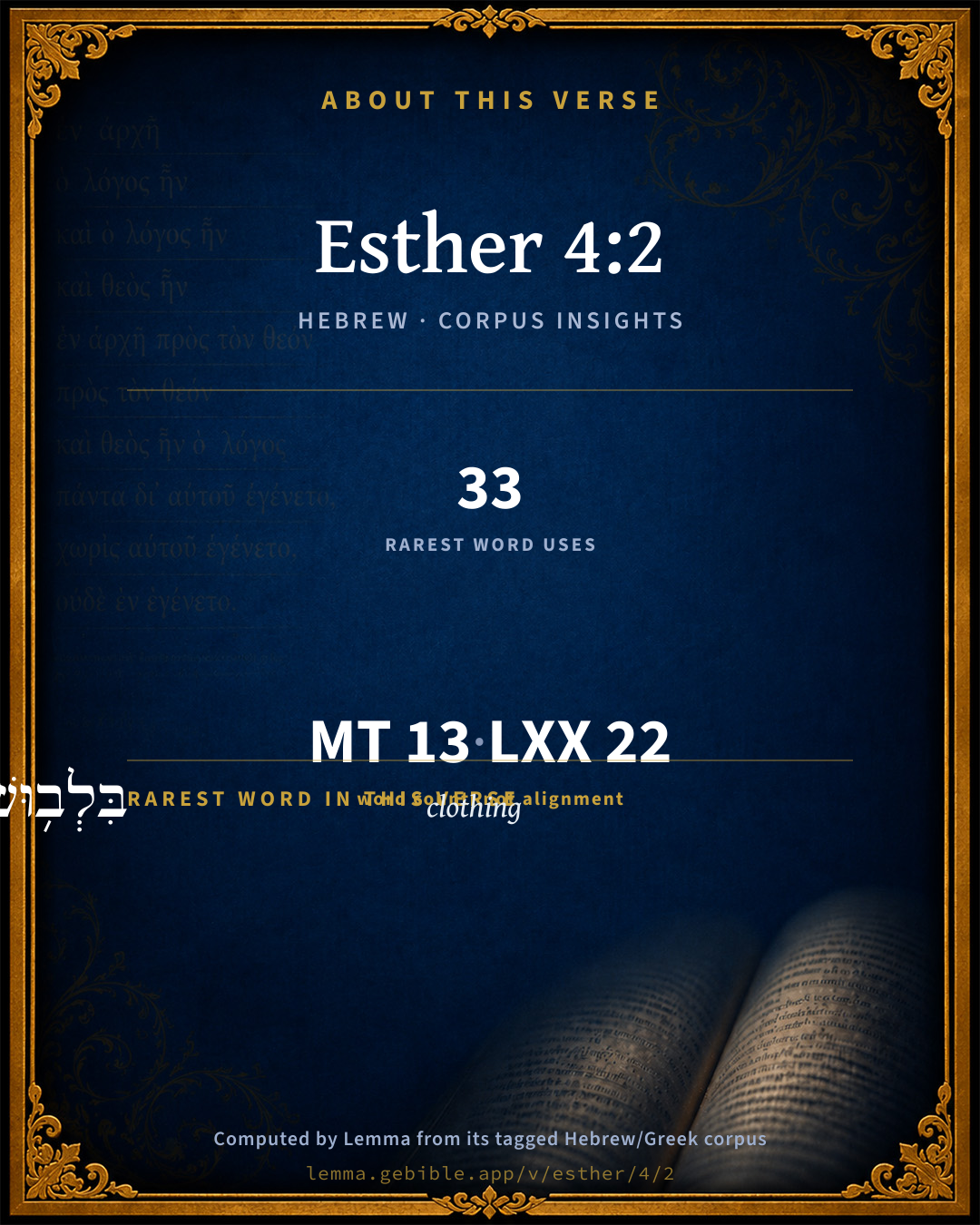
בִּלְב֥וּשׁ clothing H3830 occurs in 33 verses of the Hebrew Bible. Also found in:

Grammatical profile

  • 2 verbs
  • 7 nouns
  • 2 prepositions
  • 1 conjunction
  • 1 particle

Verb forms

  • וַיָּב֕וֹא Qal · Sequential Imperfect
  • לָב֛וֹא Qal · Infinitive Construct

Repetition

Words recur within this verse — often emphatic in Hebrew:

  • וַיָּב֕וֹא to enter H935 ×2
  • שַֽׁעַר gate H8179 ×2
  • הַמֶּ֑לֶךְ king H4428 ×2

Hebrew & Septuagint length

In English translation the verse runs 19 words from the Hebrew and 25 from the Septuagint (LXX English) — closely comparable.

A rough comparison of the two English renderings, which tokenize alike — not a word-level alignment.

Word counts can differ between the Hebrew and the Greek without any difference in meaning — e.g. the Hebrew direct-object marker אֵת has no separate Greek word, and Greek often adds the article ὁ.

In the original languages it is 13 Hebrew tokens and 22 Greek tokens — but the two are counted differently (Hebrew bundles its prefixes and suffixes into one token; the Greek is in lemma form), so that isn’t a like-for-like length.

Hebrew and Greek witnesses Masoretic Hebrew ↔ Greek Septuagint

The same verse in the two great witnesses to the Old Testament, shown verse-for-verse.

These are two independent witnesses, not word-aligned to each other, and the Septuagint is shown in lemma (dictionary) form.

Hebrew Esther 4:2 Masoretic · Westminster Leningrad Codex

וַיָּב֕וֹא עַ֖ד לִפְנֵ֣י שַֽׁעַר הַמֶּ֑לֶךְ כִּ֣י אֵ֥ין לָב֛וֹא אֶל שַׁ֥עַר הַמֶּ֖לֶךְ בִּלְב֥וּשׁ שָֽׂק

and he came even before the king's gate: for none might enter within the king's gate clothed with sackcloth.

World English Bible · Public Domain

Greek LXX Esther 4:2 Septuagint · lemma form

καί ἔρχομαι ἕως ὁ πύλη ὁ βασιλεύς καί ἵστημι οὐ γάρ εἰμί ἐκεἰμί αὐτός εἰςἔρχομαι εἰς ὁ αὐλή σάκκος ἔχω καί σποδός

And he came to the king's gate, and stood; for it was not lawful for him to enter into the palace, wearing sackcloth and ashes.

LXX2012 (modern English Septuagint) · Public Domain

Hebrew: Westminster Leningrad Codex (CC BY 4.0). Greek: Septuagint (public domain); English from LXX2012 (modern English Septuagint) (Public Domain). How the Septuagint differs from the Hebrew →

Commentary

Notes on Esther 4:2 from classic Christian and Jewish commentators (each source and its license shown beneath its notes). The classic Christian expositions comment on the surrounding passage and are grouped to its opening verse, so a note may address several verses; the Jewish commentaries on the Tanakh (Rashi and others) are per-verse, so they appear only where the commentator wrote on this verse.

Lemma curates 59 commentaries, every one of them public domain or Creative Commons licensed, each selected and text-cleaned for this edition rather than reprinted as found. About our sources →

Trapp's Complete Commentary

John Trapp

Est 4:2 And came even before the king’s gate: for none [might] enter into the king’s gate clothed with sackcloth.

Ver. 2. And came even before the king’s gate] Which should have been always open to poor petitioners (as the gate of the Roman Aedilis was), but was now shut against such mourners as Mordecai. A night cap was an ill sight at Court; jolly spirits cannot endure sadness; so great enemies they are to it, that they banish all seriousness; like as the Nicopolites so hated the braying of an ass, that for that cause they would not abide to hear the sound of a trumpet.

For none might enter into the king’s gate clothed with sackcloth] Behold, they that wear softs are in king’s houses, Mat 11:8, and those that are altogether set upon the merry pin. Jannes and Jambres, those magicians, are gracious with Pharaoh when Moses and Aaron are frowned upon. Baal’s prophets are fed at Jezebel’s table when Elias is almost pined in the desert. The dancing damsel trippeth on the toe, Wρχησατο, Mat 14:6, and triumpheth in Herod’s hall, when the rough coated Baptist lieth in cold irons; and Christ’s company there is neither cared for, nor called for, unless it be to show tricks, and do miracles for a pastime, Luk 23:8. The kings and courtiers of Persia must see no sad sight, lest their mirth should be marred, and themselves surprised with heaviness and horror. But if mourners might not be suffered to come to court, why did those proud princes so seclude up themselves, and not appear abroad for the relief of the poor oppressed? How much better the modern kings of Persia, whom I have seen, saith a certain traveller, to alight from their horses, to do justice to a poor body! How much better the Great Turk, who, whensoever he goeth forth by land, doth always ride on horseback, upon the Friday especially, which is their Sabbath, when he goeth to the temple. At which times they that go along by his stirrup have charge to take all petitions that are preferred to his Majesty, and many poor men, who dare not presume by reason of their ragged apparel to approach near, stand afar off with fire upon their heads, holding up their petitions in their hands; the which the Grand Signor seeing, who never despiseth, but rather encourageth the poor, sends immediately to take the petitions, and being returned home into his seraglio, harem and reads them all, and then gives order for redress as he thinks fit. By reason of which complaints, the king ofttimes taketh occasion suddenly to punish his greatest officers, either with death or loss of place, which maketh the bashaws and other great officers that they care not how seldom the Grand Signor stirs abroad in public, for fear lest in that manner their bribery and injustice should come to his ears. It is probable that Haman had got this also to be decreed, that none should enter into the king’s gate clothed in sackcloth; lest passion might be moved thereby in any of the courtiers, or that be a means to make a complaint to the king of his cruelty.

John Trapp, A Commentary or Exposition upon All the Books of the Old and New Testament (1647–1656) — public domain. Text from a community e-Sword module.

The Biblical Illustrator

Joseph S. Exell

Est_4:2

Clothed with sackcloth.

The transfigured sackcloth

The sign of affliction was thus excluded from the Persian court that royalty might not be discomposed. This disposition to place an interdict on disagreeable and painful things still survives. Men of all ranks and conditions hide from themselves the dark facts of life. Revelation, however, lends no sanction to this habit. We wish to show the entire reasonableness of revelation in its frank recognition of the dark facts of existence.

I. we consider first the recognition by revelation of sin. Sackcloth is the outward and visible sign of sin, guilt, and misery. What is popularly called sin, certain philosophers call error, accident, inexperience, imperfection, disharmony, but they will not allow the presence in the human heart of a malign force which asserts itself against God and against the order of His universe. Intellectual masters like Emerson and Renan ignore conscience; they refuse to acknowledge the selfishness, baseness, and cruelty of society. Men generally are willing to dupe themselves touching the fact and power of sin. We do not unshrinkingly acquaint ourselves with the malady of the spirit as we should with any malady hinting itself in the flesh. The sackcloth must not mar our shallow happiness. In the vision of beautiful things we forget the troubles of conscience as the first sinners hid themselves amid the leaves and flowers of paradise; in fashion and splendour we forget our guilty sorrow, as mediaeval mourners sometimes concealed the cerements with raiment of purple and gold; in the noises of the world we become oblivious of the interior discords, as soldiers forget their wounds amid the stir and trumpets of the battle. Nevertheless sin thrusts itself upon our attention. The creeds of all nations declare the fact that men everywhere feel the bitter working and intolerable burden of conscience. The sense of sin has persisted through changing generations. The sackcloth is ours, and it eats our spirits like fire. More than any other teacher, Christ emphasised the actuality and awfulness of sin; more than any other He has intensified the worlds consciousness of sin. He never sought to relieve us of the sackcloth by asserting our comparative innocence; He never attempted to work into that melancholy robe one thread of colour, to relieve it with one solitary spangle of rhetoric. He laid bare its principle and essence. The South Sea Islanders have a singular tradition to account for the existence of the dew. The legend states that in the beginning the earth touched the sky, that being the golden age when all was beautiful and glad; then some dreadful tragedy occurred, the primal unity was broken up, the earth and sky were torn asunder as we see them now, and the dew-drops of the morning are the tears that nature sheds over the sad divorce. This wild fable is a metaphor of the truth, the beginning of all evil lies in the alienation of the spirit of man from God, in the divorce of earth from heaven; here is the final reason why the face of humanity is wet with tears. Instead of shutting out the signs of woe, Christ arrayed Himself in the sackcloth, becoming sin for us who knew no sin, that we might become the righteousness of God in Him. We have redemption through His blood, even the forgiveness of sins; He establishes us in a true relation to the holy God; He restores in us the image of God; He fills us with the peace of God. Not in the spirit of barren cynicism does Christ lay bare the ghastly wound of our nature, but as a noble physician who can purge the mortal virus that destroys` us. We go to Him in sackcloth, but we leave His presence in puritys robe of snow, in the heavenly blue of the holiness of truth.

II. We consider the recognition by revelation of sorrow. Sackcloth is the raiment of sorrow, and as such it was interdicted by the Persian monarch. We still follow the same insane course, minimising, denying suffering. Society sometimes attempts this. Literature sometimes follows the same cue. Goethe made it one of the rules of his life to avoid everything that could suggest painful ideas. Art has yielded to the same temptation. Most of us are inclined to the sorry trick of gliding over painful things. When the physician prescribed blisters to Marie Bashkirtseff to check her consumptive tendency, the vain, cynical girl wrote: I will put on as many blisters as they like. I shall be able to hide the mark by bodices trimmed with flowers and lace and tulle, and a thousand other things that are worn, without being required; it may even look pretty. Ah! I am comforted. The real secret of the power of many of the fashions and diversions of the world is found in the fact that they hide disagreeable things, and render men oblivious for awhile of the mystery and weight of an unintelligible world. There is no screen to shut off permanently the spectacle of suffering. When Marie Antoinette passed to her bridal in Paris, the halt, the lame, and the blind were sedulously kept out of her way, lest their appearance should mar the joyousness of her reception; but ere long the poor queen had a very close view of miserys children, and she drank to the dregs the cup of lifes bitterness. Reason as we may, suffering will find us out, and pierce us to the heart. We will not have the philosophy that ignores suffering; witness the popularity of Schopenhaur. We resent the art that ignores sorrow. The most popular picture in the world to-day is the Angelus of Millet. We will not have the literature that ignores suffering. Classic religions had little or nothing to do with the sorrows of the million; the gods reigned on Mount Olympus, taking little note of the grief of mortals. Christianity boldly recognises the sad element in human nature. Christ makes clear to us the origin of suffering. He shows that its genesis is in the error of the human will; but if suffering originate in the error of the human will, it ceases at once if the erring will be brought into correspondence with the primitive order of the universe. Christ has power to establish this harmony. Dealing with sin, He dries up the stream of sorrow at its fountain. By the authority of that word that speaks the forgiveness of our sin, He wipes away all tears from the face of such as obey Him. Christ gives us the noblest example of suffering. So far from shutting His gate on the sackcloth, once more He adopted it, and showed how it might become a robe of glory. Poison is said to be extracted from the rattlesnake for medicinal purposes; but infinitely more wonderful is the fact that the suffering which comes out of sin counterworks sin, and brings to pass the transfiguration of the sufferer. It is a clumsy mistake to call Christianity a religion of sorrow--it is a religion for sorrow.

III. We consider the recognition by revelation of death. We have, again, adroit ways of shutting the gate upon that sackcloth which is the sign of death. Some would have us believe that through the scientific and philosophic developments of later centuries the sombre way of viewing death has become obsolete. The fact, however, still remains, that death is the crowning evil, the absolute bankruptcy, the final defeat, the endless exile. If we are foolish enough to shut the gate on the thought of death, by no stratagem can we shut the gate upon death itself. Christ displays the fact, the power, the terror of death without reserve or softening. He shows that death is unnatural, that it is the fruit of disobedience, and by giving us purity and peace He gives us eternal life. He demonstrates immortality by raising us from the death of sin to the life of righteousness. Here is the supreme proof of immortality: Verily, verily, I say unto you, He that believeth on Me, the works that I do shall he do also; and greater works than these shall he do, because I go unto the Father. The moral works are the greater works. If Christ has raised us from the death of sin, why should we think it a thing incredible that God should raise the dead? If He has wrought the greater, He will not fail with the less. Christ bringing life and immortality to light has brought about the great change in the point of view from which we regard death, the point of view which is full of consolation and hope. Once more, by boldly adopting the sackcloth Christ has changed it into a robe of light. We cannot escape the evils of life. Wearing wreaths of roses, our heads will still ache. The king sighs as often as the peasant; this proverb anticipates the fact that those who participate in the richest civilisation that will ever flower will sigh as men sigh now. Esther sent raiment to clothe Mordecai, and to take his sackcloth from him, but he received it not. In vain men offer us robes of beauty, chiding us for wearing the robes of night; we must give place to all the sad thoughts of our mortality until we find a salvation that goes to the root of our suffering, that dries up the fount of our tears. Christianity gives such large recognition to the pathetic element of life, because it divines the secret of our mighty misfortune, and brings with it the sovereign antidote. The critics declare Rubens had an absolute delight in representing pain, and they refer us to his picture of the Brazen Serpent. The writhing, gasping crowd is everything, and the supreme instrument of cure, the brazen serpent itself, is small and obscure, no conspicuous feature whatever of the picture. Revelation brings out broadly and impressively the darkness of the world, the malady of life, the terror of death, only that it may evermore make conspicuous the uplifted Cross, which, once seen, is death to every vice, a consolation in every sorrow, a victory over every fear. (W. L. Watkinson.)

Sorrow may be transfigured

Science tells how the bird-music has arisen out of the birds cry of distress in the morning of time; how originally the music of field and forest was nothing more than an exclamation caused by the birds bodily pain and fear, and how through the ages the primal note of anguish has been evolved and differentiated until it has risen into the ecstasy of the lark, melted into the silver note of the dove, swelled into the rapture of the nightingale, unfolded into the vast and varied music of the sky and the summer. So Christ shows that out of the personal sorrow which now rends the believers heart, he shall arise in moral and infinite perfection; that out of the cry of anguish wrung from us by the present distress shall spring the supreme music of the future. (W. L. Watkinson.)

Est_4:2

For none might enter into the kings gate clothed with sackcloth.

Death must be encountered

Since the last enemy must be encountered by the greatest as well as the least of our race, is it not far better to be prepared for meeting him, than to banish him from our thoughts? (G. Lawson.)

Death a visitor that cannot be stopped at the gate

And is Death included in this prohibition? Have you given orders to your porters and guards to stop this visitor at the gate, and to say to him, Hitherto shalt thou come, but no further? Or will they be able to persuade him, and his train of ghastly attendants, gout, fever, consumption, and other diseases, to lay aside their sable dress, together with their darts and spears and scorpions? (T. McCrie.)

We cannot keep trouble from our hearts by banishing the signs of mourning from our dwellings

It is the height of folly, therefore, for us to try to surround ourselves with the appearance of security, and make believe that no change can come upon us. That is to do like the ostrich, which buries its head in the sand, and thinks itself safe from its pursuers because it can no longer see them. Trouble, sorrow, trial, death are inevitable, and the wise course is to prepare to meet them. We cannot shut our homes against these things; but we can open them to Christ, and when He enters He says, My grace is sufficient for thee; My strength is made perfect in weakness. (W. M. Taylor, D. D.)

The Biblical Illustrator, edited by Joseph S. Exell (c. 1880s–1900s) — public domain. Text from a community e-Sword module.

Joseph Benson's Commentary

Est 4:2. And came even before the king’s gate — That his cry might come to the ears of Esther: for none might enter into the king’s gate clothed with sackcloth — He durst not take his place in the gate, nor sit there as he had hitherto done, because none that were in mourning might come thither, lest it should give the king any occasion of grief and trouble. But what availed to keep out the badges of sorrow, unless they could have kept out the causes of sorrow too? To forbid sackcloth to enter, unless they could likewise forbid sickness, and trouble, and death?

Joseph Benson's Commentary on the Old and New Testaments (1811–1818) — public domain. Text from a community e-Sword module.

Tyndale Open Study Notes

Tyndale Open Resources

4:2 no one was allowed: The king did not want to hear all the sorry stories of misfortune and people pleading for mercy.

Tyndale Open Study Notes — © Tyndale Open Resources, licensed CC BY-SA 4.0. Text via the HelloAO Bible API.

Geneva Bible (1599)

Geneva Bible translators

Because he would advertise Esther of this cruel proclamation.

Geneva Bible (1599) marginal notes — public domain. Text via Bolls.life.

Adam Clarke's Commentary

Verse 2. Before the king's gate] He could not enter into the gate, of the place where the officers waited, because he was in the habit of a mourner; for this would have been contrary to law.

Adam Clarke's Commentary on the Bible (1810–1826) — public domain. Text from a community e-Sword/MySword module.

Ellicott's Commentary for English Readers

(2) None might enter . . .—That nothing sad or ill-omened might meet the monarch’s gaze, as though by shutting his eyes, as it were, to the presence of sorrow, or sickness, or death, he might suppose that he was successfully evading them.

A Bible Commentary for English Readers, edited by Charles John Ellicott (1878–1897) — public domain. Text from a community e-Sword module.

The Cambridge Bible for Schools and Colleges

gen. ed. J. J. S. Perowne

2. and he came even before the king’s gate] either as being his usual place of resort, or with the hope that in this time of distress he might have some chance of communication with Esther, even though his garb precluded him from nearer approach.

The Cambridge Bible for Schools and Colleges (gen. ed. J. J. S. Perowne; Cambridge University Press, 1878–1918) — public domain. Text from a community e-Sword module.

John Gill's Exposition

And came even before the king's gate,.... Or court, that Esther might if possible be made acquainted with this dreadful calamity coming upon her people:

for none might enter into the king's gate clothed with sackcloth: or appear in such a dress at court, where nothing was admitted to damp the pleasures of it.

John Gill's Exposition of the Whole Bible (1746–1763) — public domain (CC PDM 1.0). Text via the HelloAO Bible API.

Albert Barnes' Notes on the Bible

None might enter into the king’s gate clothed with sackcloth - This law is not elsewhere mentioned; but its principle - that nothing of evil omen is to be obtruded on the monarch - has been recognized throughout the East in all ages.

Albert Barnes' Notes on the Bible (1834–1885) — public domain. Text from a community e-Sword/MySword module.

Haydock's Catholic Bible Commentary

Sackcloth. Greek adds, "and ashes." Such an appearance was deemed disrespectful. God forbids his priests to act thus, Leviticus xxi.. 1. See Genesis xli. 14. Yet the miserable ought not to be entirely excluded from the king’s presence, as he ought to be their protector.

George Leo Haydock (1774–1849), Haydock's Catholic Family Bible and Commentary, 1859 edition — public domain. Excludes Psalms (Douay-Rheims chapter numbering differs from Protestant) and Deuterocanonical books (Catholic canon only).

Matthew Poole's English Annotations

None might enter into the king’s gate; and therefore he might not sit there, as he had hitherto done.

Clothed with sackcloth, lest it should give the king any occasion of grief or trouble.

Matthew Poole's English Annotations on the Holy Bible (1683–1685) — public domain. Text from a community e-Sword/MySword module.

Whedon's Commentary on the Bible

Daniel D. Whedon

2. None might enter… with sackcloth — For that would bear the semblance of an evil omen to the king.

Daniel D. Whedon (gen. ed.), Commentary on the Old and New Testaments (1874–1909) — public domain. Text from a community e-Sword module.

The Pulpit Commentary

And came even before the king"s gate. After some aimless wandering Mordecai as returned toward the palace, either his proper place, or with some incipient notion of obtaining Esther"s help. He was not allowed, however, to pass the outer gate on account of his garb of woe, and he remained outside (see ver. 6).

The Pulpit Commentary (1880–1919), ed. H.D.M. Spence-Jones & Joseph S. Exell — public domain. Text from a community e-Sword module.

John Wesley's Explanatory Notes

Sackcloth - Lest it should give the king any occasion of grief and trouble. But what availed, to keep out the badges of sorrow unless they could have kept out the causes of sorrow too? To forbid sackcloth to enter unless they could likewise forbid sickness, and trouble, and death?

John Wesley, Explanatory Notes Upon the Whole Bible (1754–1765) — public domain. Text via the GEBible commentary corpus.

Rashi

Rabbi Shlomo Yitzchaki (Rashi)

for one may not enter It is improper to enter the king’s gate dressed in sackcloth.

Rashi on the Tanakh — English translations: “The Judaica Press complete Tanach with Rashi, translated by A. J. Rosenberg” (CC BY 4.0); “Pentateuch with Rashi's commentary by M. Rosenbaum and A.M. Silbermann, 1929-1934” (public domain); “The Metsudah Tanach series, Lakewood, N.J” (CC BY 4.0); and “The Book of Joshua, Metsudah Publications, 1997” (CC BY 4.0). Text via Sefaria.

Lesson kit

Teaching starters — assembled from the data on this page, not authored interpretation. Every prompt links to the verse data it draws on. Edit before teaching.

Esther, in the Historical, opens this verse with 13 words (10 distinct Hebrew lemmas). Its most distinctive word is lᵉbûwsh (“clothing”). A historical commentator’s framing appears above. Read the whole chapter for the surrounding context.

Discussion questions

  1. The word lᵉbûwsh carries the sense “clothing.” How does it shape the verse?
  2. How does Genesis 49:11, which shares the word «clothing», read alongside this verse?
  3. What does the repetition of “to enter” (2× in this one verse) do in this verse?
  4. These translations render this verse differently. What is at stake in choosing one wording over another?
  5. «וַיָּב֕וֹא» is a Qal Sequential Imperfect verb. How does that grammatical form shape the action described?
  6. Compare how Trapp's Complete Commentary and The Biblical Illustrator read this verse. Where do they agree or differ?

Things to notice

Reading settings

Reading text

Shown beneath each verse's original-language words.

Old Testament
Old Testament edition

Read the OT as the Masoretic Hebrew (MT) or the Greek Septuagint (LXX).

English shown for the Greek Septuagint (in the Hebrew ↔ Greek comparison).

Comparing translations? Open the Compare panel on any verse page to stack up to four side by side.