
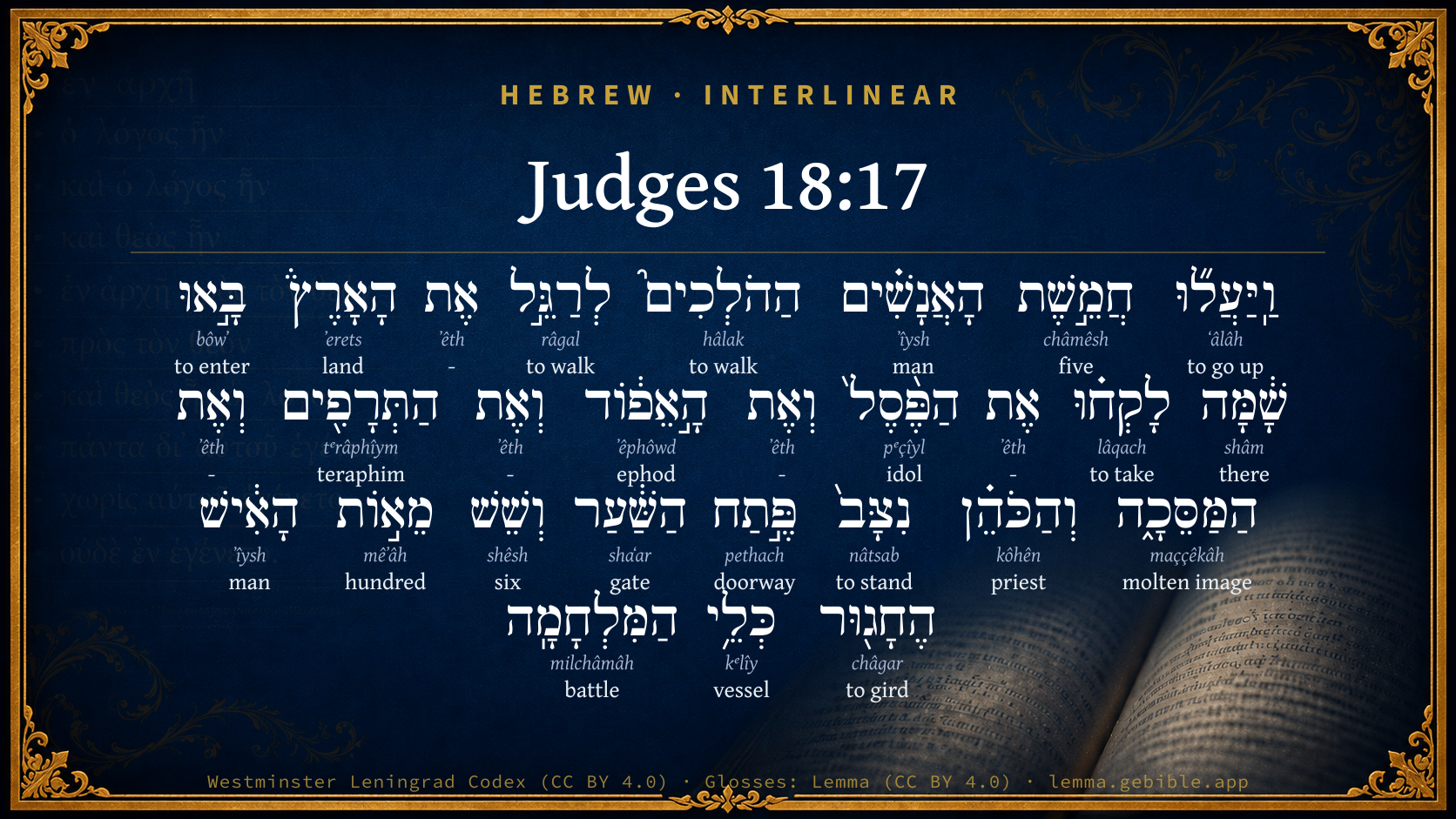
Judges 18:17

Hebrew (Westminster Leningrad Codex) Judges 18:17 appears in the Hebrew Old Testament. The text above is from the Westminster Leningrad Codex. Each word links to its Strong’s number, a concise gloss, and parsing drawn from the Open Scriptures Hebrew Bible morphology. Click any word for its full Brown-Driver-Briggs (BDB) entry.
Download image
Cite this verse

Judges 18:17 (World English Bible). Public Domain. Lemma interlinear Bible study tool, https://lemma.gebible.app/v/judges/18/17.

Show BibTeX & RIS
BibTeX
RIS
English Translation
The five men who went to spy out the land went up, and came in there, and took the engraved image, and the ephod, and the teraphim, and the molten image: and the priest stood by the entrance of the gate with the six hundred men girt with weapons of war.
World English Bible · Public Domain
Download a study sheet

One document with this verse’s original text, its word-by-word gloss line, the meaning frame, cross-references with their text, attributed commentary, and full source and license credits — printable, and it pastes into notes with its structure intact.

This verse Autodidact and up

Study sheet (.html) Plain text (.txt)

A passage Seminary Student

Up to 50 verses in one chapter. A passage sheet keeps up to 6 commentary sources and 12 cross-references per verse, in the order this page ranks them, and says so on the sheet whenever that leaves anything out. Ask for a single verse and you get the Autodidact verse sheet above.

Everything on this page stays free to read, with no account — the sheet is a download of what is already on screen, not access to it.

Want to remove ads? Support Godless Engineer
Compare translations 3

The same verse in 3 English versions, stacked beneath the original-language interlinear above. Click any original word for its lexicon entry.

Each is an independent rendering of the whole verse — the interlinear is not word-aligned to these translations.

Highlighted words mark where these versions differ — a whole-verse word diff, not a word-by-word alignment.

  • World English Bible Public Domain
    The five men who went to spy out the land went up, and came in there, and took the engraved image, and the ephod, and the teraphim, and the molten image: and the priest stood by the entrance of the gate with the six hundred men girt with weapons of war.
  • King James Version Public Domain
    And the five men that went to spy out the land went up, and came in thither, and took the graven image, and the ephod, and the teraphim, and the molten image: and the priest stood in the entering of the gate with the six hundred men that were appointed with weapons of war.
  • unfoldingWord Literal Text CC BY-SA 4.0
    And the five men having gone to spy on the land came up. They entered there. They took the idol and the ephod and the teraphim and the molded image. And the priest stationing himself at the entrance of the gate with the 600 men girded weapons of war.

unfoldingWord Literal Text — © unfoldingWord, licensed CC BY-SA 4.0. Word-aligned USFM3 via Door43 (git.door43.org/unfoldingWord/en_ult).

Versions to compare (up to 4)

3 of 4 selected

Show all 18 translations

Every available English version of this verse, each an independent rendering of the whole verse.

  • World English Bible Public Domain
    The five men who went to spy out the land went up, and came in there, and took the engraved image, and the ephod, and the teraphim, and the molten image: and the priest stood by the entrance of the gate with the six hundred men girt with weapons of war.
  • Berean Standard Bible Public Domain
    And the five men who had gone to spy out the land went inside and took the graven image, the ephod, the household idols, and the molten idol, while the priest stood at the entrance of the gate with the six hundred armed men.
  • Majority Standard Bible Public Domain
    And the five men who had gone to spy out the land went inside and took the graven image, the ephod, the household idols, and the molten idol, while the priest stood at the entrance of the gate with the six hundred armed men.
  • King James Version Public Domain
    And the five men that went to spy out the land went up, and came in thither, and took the graven image, and the ephod, and the teraphim, and the molten image: and the priest stood in the entering of the gate with the six hundred men that were appointed with weapons of war.
  • American Standard Version (1901) Public Domain
    And the five men that went to spy out the land went up, and came in thither, and took the graven image, and the ephod, and the teraphim, and the molten image: and the priest stood by the entrance of the gate with the six hundred men girt with weapons of war.
  • Revised Version (1885) Public Domain
    And the five men that went to spy out the land went up, and came in thither, and took the graven image, and the ephod, and the teraphim, and the molten image: and the priest stood by the entering of the gate with the six hundred men girt with weapons of war.
  • Geneva Bible (1599) Public Domain
    Then the fiue men that went to spie out the land, went in thither, and tooke the grauen image and the Ephod, and the Teraphim, and the molten image: and the Priest stoode in the entring of the gate with the sixe hundreth men, that were appointed with weapons of warre,
  • Douay-Rheims (1899) Public Domain
    But they that were gone into the house of the young man, went about to take away the graven god, and the ephod, and the theraphim, and the molten god, and the priest stood before the door, the six hundred valiant men waiting not far off.
  • Young's Literal Translation Public Domain
    yea, the five men, those going to traverse the land, go up -- they have come in thither -- they have taken the graven image, and the ephod, and the teraphim, and the molten image -- and the priest is standing at the opening of the gate, and the six hundred men who are girded with weapons of war --
  • Literal Standard Version CC BY-SA 4.0
    indeed, the five men, those going to traverse the land, go up—they have come in there—they have taken the carved image, and the ephod, and the teraphim, and the molten image—and the priest is standing at the opening of the gate, and the six hundred men who are girded with weapons of war—
  • Unlocked Literal Bible CC BY-SA 4.0
    The five men who had gone to scout out the land went there and they took the carved figure, the ephod, the household gods, and the cast metal figure, while the priest stood by the opening of the gate with the six hundred men armed with weapons of war.
  • unfoldingWord Literal Text CC BY-SA 4.0
    And the five men having gone to spy on the land came up. They entered there. They took the idol and the ephod and the teraphim and the molded image. And the priest stationing himself at the entrance of the gate with the 600 men girded weapons of war.
  • Darby Bible Public Domain
    and the five men who had gone to spy out the land went up, and entered and took the graven image, the ephod, the teraphim, and the molten image, while the priest stood by the entrance of the gate with the six hundred men armed with weapons of war.
  • World Messianic Bible Public Domain
    The five men who went to spy out the land went up, and came in there, and took the engraved image, the ephod, the teraphim, and the molten image; and the priest stood by the entrance of the gate with the six hundred men armed with weapons of war.
  • Webster's Bible Public Domain
    And the five men that went to explore the land went up, and came in thither, and took the graven image, and the ephod, and the teraphim, and the molten image: and the priest stood in the entrance of the gate with the six hundred men that were appointed with weapons of war.
  • Free Bible Version CC BY-SA 4.0
    The five men went inside and took the carved idol, the ephod, the household idols, and the image made with molten silver. The priest was standing by the gate with the six hundred armed men.
  • Bible in Basic English Public Domain
    Then the five men who had gone to make a search through the land, went in and took the pictured image and the ephod and the family gods and the metal image; and the priest was by the doorway with the six hundred armed men.
  • JPS Tanakh (1917) Public Domain
    And the five men that went to spy out the land went up, and came in thither, and took the graven image, and the ephod, and the teraphim, and the molten image; and the priest stood by the entrance of the gate with the six hundred men girt with weapons of war.

Literal Standard Version (2020), Covenant Press — licensed CC BY-SA 4.0. Text via the HelloAO Bible API (eBible.org). Unlocked Literal Bible (unfoldingWord) — licensed CC BY-SA 4.0. Text via the HelloAO Bible API (eBible.org). unfoldingWord Literal Text — © unfoldingWord, licensed CC BY-SA 4.0. Word-aligned USFM3 via Door43 (git.door43.org/unfoldingWord/en_ult). Free Bible Version, Dr. Jonathan Gallagher — licensed CC BY-SA 4.0. Text via the HelloAO Bible API (eBible.org).

Word by word

More ways to search: Search by grammar → Find every occurrence → Compare this word →

Practice this passage: Drill this verse → Learn its vocabulary →

הַתְּרָפִ֖ים
tᵉrâphîym
H8655
“the · teraphim”
Particle, Definite Article + Noun, Common, Masculine, Plural, Absolute
Part of Speech
Particle + Noun
Type
Common
Gender
Masculine
Number
Plural
State
Absolute
Full BDB Definition

Origin: pl. from H7495

TWOT: 2545

idolatry, idols, image(s), teraphim, family idol - a kind of idol used in household shrine or worship
  1. וַֽיַּעֲל֞וּ ʻâlâh H5927 “and · to go up” Conjunction + Verb, Qal, Sequential Imperfect, 3rd Person, Masculine, Plural
  2. חֲמֵ֣שֶׁת châmêsh H2568 “five” Adjective, Cardinal number, Masculine, Singular, Construct
  3. הָאֲנָשִׁ֗ים ʼîysh H376 “the · men” Particle, Definite Article + Noun, Common, Masculine, Plural, Absolute
  4. הַהֹלְכִים֮ hâlak H1980 “the · walking” Particle, Definite Article + Verb, Qal, Participle Active, Masculine, Plural, Absolute
  5. לְרַגֵּ֣ל râgal H7270 “to walk” Preposition + Verb, Piel, Infinitive Construct
  6. אֶת ʼêth H853 “-” Particle, Direct Object
  7. הָאָרֶץ֒ ʼerets H776 “the · land” Particle, Definite Article + Noun, Common, Both, Singular, Absolute
  8. בָּ֣אוּ bôwʼ H935 “to enter” Verb, Qal, Perfect, 3rd Person, Common, Plural
  9. שָׁ֔מָּה shâm H8033 “there · toward” Adverb + Suffix, Demonstrative
  10. לָקְח֗וּ lâqach H3947 “to take” Verb, Qal, Perfect, 3rd Person, Common, Plural
  11. אֶת ʼêth H853 “-” Particle, Direct Object
  12. הַפֶּ֨סֶל֙ pᵉçîyl H6456 “the · idol” Particle, Definite Article + Noun, Common, Masculine, Singular, Absolute
  13. וְאֶת ʼêth H853 “and · -” Conjunction + Particle, Direct Object
  14. הָ֣אֵפ֔וֹד ʼêphôwd H646 “the · ephod” Particle, Definite Article + Noun, Common, Masculine, Singular, Absolute
  15. וְאֶת ʼêth H853 “and · -” Conjunction + Particle, Direct Object
  16. וְאֶת ʼêth H853 “and · -” Conjunction + Particle, Direct Object
  17. הַמַּסֵּכָ֑ה maççêkâh H4541 “the · molten image” Particle, Definite Article + Noun, Common, Feminine, Singular, Absolute
  18. וְהַכֹּהֵ֗ן kôhên H3548 “and · the · priest” Conjunction + Particle, Definite Article + Noun, Common, Masculine, Singular, Absolute
  19. נִצָּב֙ nâtsab H5324 “standing” Verb, Niphal, Participle Active, Masculine, Singular, Absolute
  20. פֶּ֣תַח pethach H6607 “doorway of” Noun, Common, Masculine, Singular, Construct
  21. הַשַּׁ֔עַר shaʻar H8179 “the · gate” Particle, Definite Article + Noun, Common, Masculine, Singular, Absolute
  22. וְשֵׁשׁ shêsh H8337 “and · six” Conjunction + Adjective, Cardinal number, Feminine, Singular, Absolute
  23. מֵא֣וֹת mêʼâh H3967 “hundred” Adjective, Cardinal number, Both, Plural, Absolute
  24. הָאִ֔ישׁ ʼîysh H376 “the · man” Particle, Definite Article + Noun, Common, Masculine, Singular, Absolute
  25. הֶחָג֖וּר châgar H2296 “the · girded” Particle, Definite Article + Verb, Qal, Participle Passive, Masculine, Singular, Absolute
  26. כְּלֵ֥י kᵉlîy H3627 “vessels of” Noun, Common, Masculine, Plural, Construct
  27. הַמִּלְחָמָֽה milchâmâh H4421 “the · battle” Particle, Definite Article + Noun, Common, Feminine, Singular, Absolute

About this verse

These counts appear in no published source. They are computed here, from the morphology-tagged text and Lemma’s own curated glosses. What Lemma adds →

28
words
23
distinct lemmas
Historical
section

Notable vocabulary

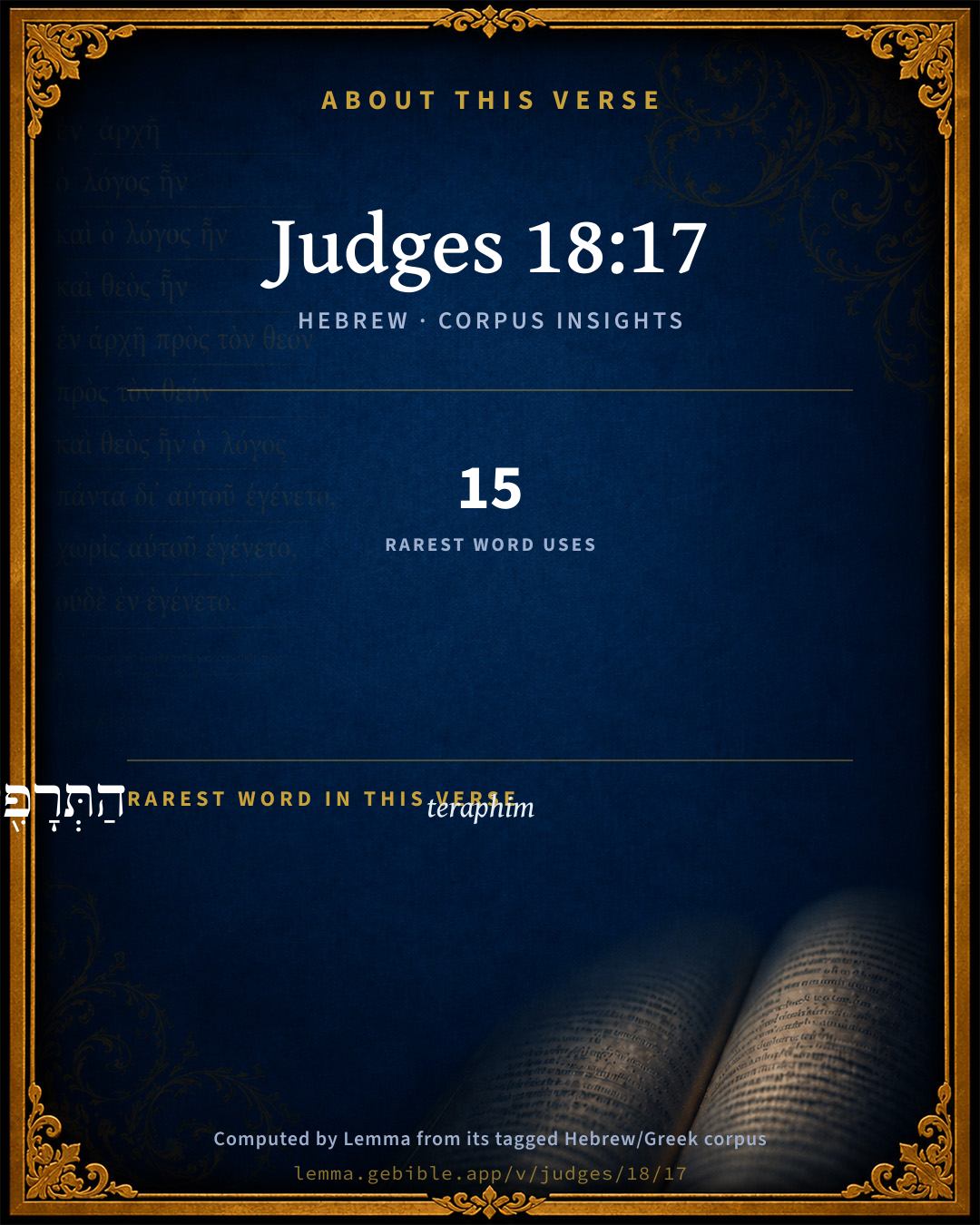
The rarest word here is הַתְּרָפִ֖ים teraphim H8655 — appearing just 15 times in the whole Hebrew Bible.

Shared distinctive vocabulary

הַתְּרָפִ֖ים teraphim H8655 occurs in 15 verses of the Hebrew Bible. Also found in:

Grammatical profile

  • 7 verbs
  • 12 nouns
  • 3 adjectives
  • 1 adverb
  • 5 particles

Verb forms

  • וַֽיַּעֲל֞וּ Qal · Sequential Imperfect
  • הַהֹלְכִים֮ Qal · Participle Active
  • לְרַגֵּ֣ל Piel · Infinitive Construct
  • בָּ֣אוּ Qal · Perfect
  • לָקְח֗וּ Qal · Perfect
  • נִצָּב֙ Niphal · Participle Active
  • הֶחָג֖וּר Qal · Participle Passive

Repetition

A word recurs within this verse — often emphatic in Hebrew:

  • הָאֲנָשִׁ֗ים man H376 ×2

Hebrew & Septuagint length

In English translation the verse runs 51 words from the Hebrew and 24 from the Septuagint (LXX English) — the Septuagint runs noticeably shorter here. See the side-by-side →

A rough comparison of the two English renderings, which tokenize alike — not a word-level alignment.

Word counts can differ between the Hebrew and the Greek without any difference in meaning — e.g. the Hebrew direct-object marker אֵת has no separate Greek word, and Greek often adds the article ὁ.

Cross-references

12

Topical passages linked to Judges 18:17 in the Treasury of Scripture Knowledge — connected by theme and wording, ordered by reader-vote popularity; previews shown in the World English Bible.

  • Judges 18:14 Then the five men who went to spy out the country of Laish answered, and said to their brothers, Do you know that there is in these houses an ephod, and teraphim, and an engraved image, and a molten image? now therefore consider what you have to do.
  • Judges 17:4–5 When he restored the money to his mother, his mother took two hundred [pieces] of silver, and gave them to the founder, who made of it an engraved image and a molten image: and it was in the house of Micah.
  • Judges 18:2 The children of Dan sent of their family five men from their whole number, men of valor, from Zorah, and from Eshtaol, to spy out the land, and to search it; and they said to them, Go, search the land. They came to the hill-country of Ephraim, to the house of Micah, and lodged there.
  • Genesis 31:19 Now Laban had gone to shear his sheep: and Rachel stole the teraphim that were her father's.
  • Exodus 32:20 He took the calf which they had made, and burnt it with fire, ground it to powder, and scattered it on the water, and made the children of Israel drink of it.
  • Judges 6:31 Joash said to all who stood against him, Will you contend for Baal? Or will you save him? he who will contend for him, let him be put to death while [it is yet] morning: if he be a god, let him contend for himself, because one has broken down his altar.
  • 1 Samuel 4:11 The ark of God was taken; and the two sons of Eli, Hophni and Phinehas, were slain.
  • 1 Samuel 6:2–9 The Philistines called for the priests and the diviners, saying, "What shall we do with the ark of Yahweh? Show us with which we shall send it to its place."
  • 2 Kings 19:18–19 and have cast their gods into the fire; for they were no gods, but the work of men's hands, wood and stone; therefore they have destroyed them.
  • Isaiah 46:1–2 Bel bows down, Nebo stoops; their idols are on the animals, and on the cattle: the things that you carried about are made a load, a burden to the weary [animal].
  • Isaiah 46:7 They bear it on the shoulder, they carry it, and set it in its place, and it stands, from its place it shall not move: yes, one may cry to it, yet it can not answer, nor save him out of his trouble.
  • Micah 5:13 I will cut off your engraved images and your pillars out of your midst; And you shall no more worship the work of your hands.

Cross-references courtesy of OpenBible.info (CC BY 4.0).

Hebrew and Greek witnesses Masoretic Hebrew ↔ Greek Septuagint

The same verse in the two great witnesses to the Old Testament, shown verse-for-verse.

Here the Septuagint runs noticeably shorter than the Hebrew — LXX2012 (modern English Septuagint) 24 words vs World English Bible 51. A rough length comparison of the two English translations, not a word-level alignment — read both below.

These are two independent witnesses, not word-aligned to each other, and the Septuagint is shown in lemma (dictionary) form.

Hebrew Judges 18:17 Masoretic · Westminster Leningrad Codex

וַֽיַּעֲל֞וּ חֲמֵ֣שֶׁת הָאֲנָשִׁ֗ים הַהֹלְכִים֮ לְרַגֵּ֣ל אֶת הָאָרֶץ֒ בָּ֣אוּ שָׁ֔מָּה לָקְח֗וּ אֶת הַפֶּ֨סֶל֙ וְאֶת הָ֣אֵפ֔וֹד וְאֶת הַתְּרָפִ֖ים וְאֶת הַמַּסֵּכָ֑ה וְהַכֹּהֵ֗ן נִצָּב֙ פֶּ֣תַח הַשַּׁ֔עַר וְשֵׁשׁ מֵא֣וֹת הָאִ֔ישׁ הֶחָג֖וּר כְּלֵ֥י הַמִּלְחָמָֽה

The five men who went to spy out the land went up, and came in there, and took the engraved image, and the ephod, and the teraphim, and the molten image: and the priest stood by the entrance of the gate with the six hundred men girt with weapons of war.

World English Bible · Public Domain

Greek LXX Judges 18:17 Septuagint · lemma form

καί ἀναβαίνω ὁ πέντε ἀνήρ ὁ πορεύομαι κατασκέπτομαι ὁ γῆ

And the five men who went to spy out the land went up, and entered into the house of Michaias, and the priest stood.

LXX2012 (modern English Septuagint) · Public Domain

On this verse, The Cambridge Bible for Schools and Colleges discusses the Septuagint’s reading. Read the note in Commentary ↓

Hebrew: Westminster Leningrad Codex (CC BY 4.0). Greek: Septuagint (public domain); English from LXX2012 (modern English Septuagint) (Public Domain). How the Septuagint differs from the Hebrew →

Targum (Aramaic paraphrase)

1

The Targum is the ancient Jewish Aramaic paraphrase of the Hebrew Scriptures — an interpretive translation, not the Hebrew text itself. Onkelos (literal) and Pseudo-Jonathan (expansive) render the Torah, and Jonathan the Prophets. Coverage is partial: where no permissively-licensed English translation exists for a verse, only the Aramaic is shown. This is verse-level text, not a word-by-word alignment to the Hebrew.

  1. Targum Jonathan Prophets (Joshua–Malachi)
    וּסְלִיקוּ חַמְשָׁא גַבְרַיָא דַאֲזָלוּ לְאַלָלָא יַת אַרְעָא עָלוּ לְתַמָן וּנְסִיבוּ יַת צַלְמָנָא וְיַת אֵפוֹדָא וְיַת דְמָאִין וְיַת מַתְּכָא וְכַהֲנָא קָאִים בְּמַעֲלָנָא דְתַרְעָא וְשִׁית מְאָה גַבְרֵי דִמְזָרְזֵי בְּמָנֵי קְרָבָא:

    (no public-domain English translation for this verse)

    Targum Jonathan — Aramaic: “Mikraot Gedolot” (public domain). English: “Sefaria Community Translation” (CC0 1.0 (public-domain dedication)); “London "Chaldee Paraphrase," 1871” (public domain). Text via Sefaria.

Commentary

Notes on Judges 18:17 from classic Christian and Jewish commentators (each source and its license shown beneath its notes). The classic Christian expositions comment on the surrounding passage and are grouped to its opening verse, so a note may address several verses; the Jewish commentaries on the Tanakh (Rashi and others) are per-verse, so they appear only where the commentator wrote on this verse.

Lemma curates 59 commentaries, every one of them public domain or Creative Commons licensed, each selected and text-cleaned for this edition rather than reprinted as found. About our sources →

The Cambridge Bible for Schools and Colleges

gen. ed. J. J. S. Perowne

17. and came in … molten image] Again, the clumsy and irregular construction as well as the contents of the clause shew that it is not original; a doublet from Jdg_18:18; lit. they came in thither, they took; the RV. inserts and twice.

and the priest … with the six hundred] The text seems to say that, while the spies went up to Micah’s house, the priest and the 600 armed men stood at the entrance of the village. In Jdg_18:18-19, however, the priest is not at the entrance of the village, but at the door of the house; with the six hundred etc. should rather be and the six hundred men girt with weapons of war …, an unfinished sentence without a verb. It is impossible to recover the original form of the text here. The general sense intended may be this: while the 600 warriors stood at the entrance of the village, the five spies went up to Micah’s house, were confronted by the priest, and, silencing his expostulations, plundered the sanctuary.

by the entering of the gate] Always of the gate of a city (e.g. Jdg_9:35; Jdg_9:44, Jos_8:29; Jos_20:4 etc.), not the door of a house. The use of the expression here implies at least a group of houses, such as a farm, or a village.

The LXX. cod. B has a brief equivalent for Jdg_18:17, ‘and the five men who went to spy out the land went up, (Jdg_18:18) and entered into Micaiah’s house, and the priest was standing [there]; and they fetched’ etc. It is doubtful, however, whether this can be taken to represent the original text.

The Cambridge Bible for Schools and Colleges (gen. ed. J. J. S. Perowne; Cambridge University Press, 1878–1918) — public domain. Text from a community e-Sword module.

Trapp's Complete Commentary

John Trapp

Jdg 18:17 And the five men that went to spy out the land went up, [and] came in thither, [and] took the graven image, and the ephod, and the teraphim, and the molten image: and the priest stood in the entering of the gate with the six hundred men [that were] appointed with weapons of war.

Ver. 17. And took the graven image, &c.] Not out of any hatred of idolatry - as neither did Cambyses when he destroyed the Egyptian idols, nor Dionysius when he spoiled the temple of Jupiter - but to set up those monuments elsewhere, in case they should prosper in their expedition.

John Trapp, A Commentary or Exposition upon All the Books of the Old and New Testament (1647–1656) — public domain. Text from a community e-Sword module.

Joseph Benson's Commentary

Jdg 18:17-19. The five men came in thither — Into the house and that part of it where the things were. The priest stood in the gate — Whither they had drawn him forth, that they might without noise or hinderance take the things away. And these went into Micah’s house — Namely, the five men, to whom when they were fetching out the image, &c., the priest said, What do ye? And they said, Lay thy hand upon thy mouth — That is, be silent. A priest unto a tribe and a family — A tribe or family.

Joseph Benson's Commentary on the Old and New Testaments (1811–1818) — public domain. Text from a community e-Sword module.

Geneva Bible (1599)

Geneva Bible translators

So superstition blinded them that they thought God’s power was in these idols, and that they should have good success by them, though by violence and robbery they did take them away.

Geneva Bible (1599) marginal notes — public domain. Text via Bolls.life.

John Gill's Exposition

And the five men that went out to spy the land went up and came thither,.... They first came to Micah's house, and saluted the young man, and after that salutation told him there was such a number of their brethren at the gate of the city, very probably, who would be glad to see him; and the young man being desirous also of seeing them, and paying his respects to them, went with them thither, and after they had introduced him, left him discoursing with them, and then returned to his apartment:

and took the graven image, and the ephod, and the teraphim, and the molten image; and brought them away with them; and from hence it appears plainly that there were two images, the one graven, and the other molten, since they are so manifestly distinguished, and the ephod and teraphim are spoken of between them:

and the priest stood in the entering of the gate, with the six hundred men that were appointed with the weapons of war; who kept him in talk, while the five men went and stole the above things.

John Gill's Exposition of the Whole Bible (1746–1763) — public domain (CC PDM 1.0). Text via the HelloAO Bible API.

Albert Barnes' Notes on the Bible

The five went back to Micah’s chapel (Micah’s house, Jdg 18:18) and took the ephod, teraphim, etc., and brought them to the gate where the priest was talking to the 600 men.

Albert Barnes' Notes on the Bible (1834–1885) — public domain. Text from a community e-Sword/MySword module.

Haydock's Catholic Bible Commentary

They. Hebrew and Septuagint, "and the five men that went to spy out the land." (Haydock) --- Off. The Levite’s attention was drawn off for a while by the 600 men, till the five, who had formerly become acquainted with him, had ransacked his little temple. (Calmet) --- Perceiving them as they came out, he began to complain, but was soon persuaded to follow the Danites, and to abandon his former protector. So little dependence can be had on those who are faithless to their God! (Haydock)

George Leo Haydock (1774–1849), Haydock's Catholic Family Bible and Commentary, 1859 edition — public domain. Excludes Psalms (Douay-Rheims chapter numbering differs from Protestant) and Deuterocanonical books (Catholic canon only).

Matthew Poole's English Annotations

Come in thither, to wit, into the house, and that part of it where those things were.

In the entering of the gate; whither they had drawn him forth that they might without noise or hinderance take them away.

Matthew Poole's English Annotations on the Holy Bible (1683–1685) — public domain. Text from a community e-Sword/MySword module.

Whedon's Commentary on the Bible

Daniel D. Whedon

17. Went up, and came in thither — That is, in Micah’s sanctuary. The images, etc., seem to have been kept in an upper chamber. Comp. 2Ki_23:12; Jer_19:13.

The priest stood in… the gate — Having saluted him, (Jdg_18:15,) the six hundred detained him at the door while the five spies brought out the sacred images and the ephod.

Daniel D. Whedon (gen. ed.), Commentary on the Old and New Testaments (1874–1909) — public domain. Text from a community e-Sword module.

The Pulpit Commentary

Went up, viz., into the upper chamber, where it appears the chapel wan So we read in 2Ki_23:12 that there were altars on the roof of the upper chamber of Ahaz. (cf. Jer_19:13) And came up, and took. There is no and in the Hebrew, and the tense of the verb is changed. A fuller stop must be put after went up. And then the account proceeds, with a certain solemnity of diction, They came in thither; they took the graven image, and the ephod, and the teraphim, and the molten image (full stop). The narrative goes on, Now the priest was standing in the entering of the gate, etc. But these five went into Micahs house , etc., as just related, and of course brought them out to the gate where the priest was standing with the 600 Danites.

The Pulpit Commentary (1880–1919), ed. H.D.M. Spence-Jones & Joseph S. Exell — public domain. Text from a community e-Sword module.

John Wesley's Explanatory Notes

Thither - Into the house, and that part of it, where those things were. The gate - Whither they had drawn him forth, that they might without noise or hindrance take them away.

John Wesley, Explanatory Notes Upon the Whole Bible (1754–1765) — public domain. Text via the GEBible commentary corpus.

Keil & Delitzsch

C. F. Keil & F. Delitzsch

Then the five spies went up, sc., into Micah's house of God, which must therefore have been in an upper room of the building (see Kg2 23:12; Jer 19:13), and took the image, ephod, etc., whilst the priest stood before the door with the 600 armed men. With the words וגו בּאוּ the narrative passes from the aorist or historical tense ויּעלוּ into the perfect. "The perfects do not denote the coming and taking on the part of the five men as a continuation of the previous account, but place the coming and taking in the same sphere of time as that to which the following clause, 'and the priest stood,' etc., belongs" (Bertheau). But in order to explain what appears very surprising, viz., that the priest should have stood before the gate whilst his house of God was being robbed, the course which the affair took is explained more clearly afterwards in Jdg 18:18, Jdg 18:19, in the form of a circumstantial clause. Consequently the verbs in these verses ought to be rendered as pluperfects, and the different clauses comprised in one period, Jdg 18:18 forming the protasis, and Jdg 18:19 the apodosis. "Namely, when those (five) men had come into Micah's house, and had taken the image of the ephod, etc., and the priest had said to them, What are ye doing? they had said to him, Be silent, lay thy hand upon thy mouth and go with us, and become a father and priest to us (see Jdg 17:10). Is it better to be a priest to the house of a single man, or to a tribe and family in Israel?" The combination האפוד פּסל (the ephod-pesel), i.e., the image belonging to the ephod, may be explained on the ground, that the use of the ephod as a means of ascertaining the will of God presupposes the existence of an image of Jehovah, and does not prove that the ephod served as a covering for the Pesel. The priest put on the ephod when he was about to inquire of God. The או in the second question is different from אם, and signifies "or rather" (see Gen 24:55), indicating an improvement upon the first question (see Ewald, 352, a.). Consequently it is not a sign of a later usage of speech, as Bertheau supposes. The word וּלמשׁפּחה (unto a family) serves as a more minute definition or limitation of לשׁבט (to a tribe).

Keil & Delitzsch — Biblical Commentary on the Old Testament (1861–1891) — public domain (CC PDM 1.0). Text via the HelloAO Bible API. (Old Testament only.)

unfoldingWord translationNotes

Door43 World Missions Community

six hundred men

"600 men" (See: Numbers)

translationWords

ephod

false god

priest

gate

unfoldingWord translationNotes — © Distant Shores Media and the Door43 World Missions Community, licensed CC BY-SA 4.0. Source: git.door43.org/Door43/en_tn.

Lesson kit

Teaching starters — assembled from the data on this page, not authored interpretation. Every prompt links to the verse data it draws on. Edit before teaching.

Judges, in the Historical, opens this verse with 28 words (23 distinct Hebrew lemmas). Its most distinctive word is tᵉrâphîym (“teraphim”). The Greek Septuagint runs shorter here. A historical commentator’s framing appears above. Read the whole chapter for the surrounding context.

Discussion questions

  1. What does “teraphim” (tᵉrâphîym) contribute to the verse as a whole?
  2. How does Genesis 31:19, which shares the word «teraphim», read alongside this verse?
  3. What does the repetition of “man” (2× in this one verse) do in this verse?
  4. The Septuagint runs shorter here than the Hebrew. What might account for the difference?
  5. These translations render this verse differently; the difference is in the English rendering, not the original. What questions does that raise?
  6. «וַֽיַּעֲל֞וּ» is a Qal Sequential Imperfect verb. How does that grammatical form shape the action described?
  7. Compare how The Cambridge Bible for Schools and Colleges and Trapp's Complete Commentary read this verse. Where do they agree or differ?

Things to notice

Reading settings

Reading text

Shown beneath each verse's original-language words.

Old Testament
Old Testament edition

Read the OT as the Masoretic Hebrew (MT) or the Greek Septuagint (LXX).

English shown for the Greek Septuagint (in the Hebrew ↔ Greek comparison).

Comparing translations? Open the Compare panel on any verse page to stack up to four side by side.