
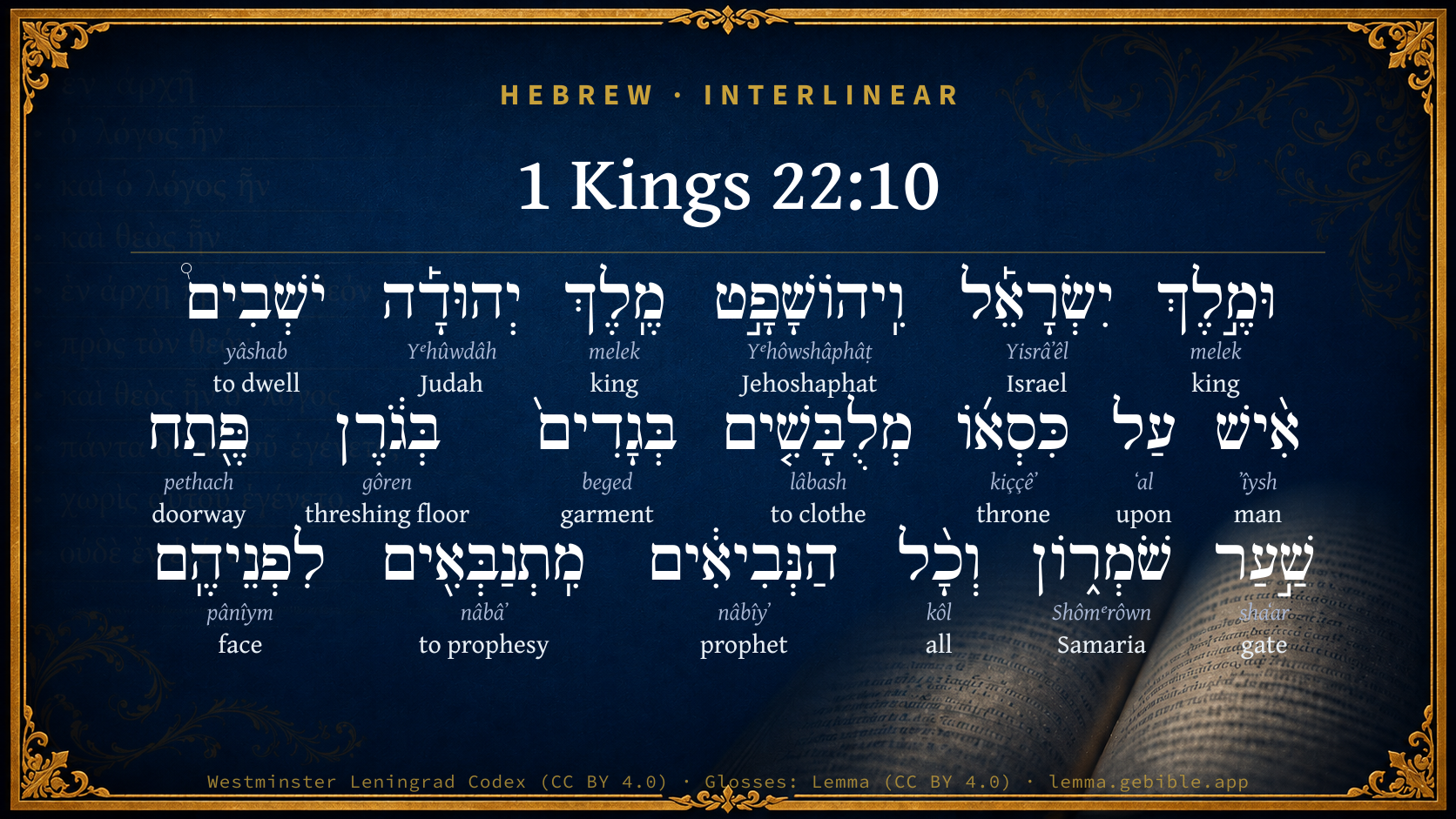
1 Kings 22:10

Hebrew (Westminster Leningrad Codex) 1 Kings 22:10 appears in the Hebrew Old Testament. The text above is from the Westminster Leningrad Codex. Each word links to its Strong’s number, a concise gloss, and parsing drawn from the Open Scriptures Hebrew Bible morphology. Click any word for its full Brown-Driver-Briggs (BDB) entry.
Download image
Cite this verse

1 Kings 22:10 (World English Bible). Public Domain. Lemma interlinear Bible study tool, https://lemma.gebible.app/v/1-kings/22/10.

Show BibTeX & RIS
BibTeX
RIS
English Translation
Now the king of Israel and Jehoshaphat the king of Judah were sitting each on his throne, arrayed in their robes, in an open place at the entrance of the gate of Samaria; and all the prophets were prophesying before them.
World English Bible · Public Domain
Download a study sheet

One document with this verse’s original text, its word-by-word gloss line, the meaning frame, cross-references with their text, attributed commentary, and full source and license credits — printable, and it pastes into notes with its structure intact.

This verse Autodidact and up

Study sheet (.html) Plain text (.txt)

A passage Seminary Student

Up to 50 verses in one chapter. A passage sheet keeps up to 6 commentary sources and 12 cross-references per verse, in the order this page ranks them, and says so on the sheet whenever that leaves anything out. Ask for a single verse and you get the Autodidact verse sheet above.

Everything on this page stays free to read, with no account — the sheet is a download of what is already on screen, not access to it.

Want to remove ads? Support Godless Engineer
Compare translations 3

The same verse in 3 English versions, stacked beneath the original-language interlinear above. Click any original word for its lexicon entry.

Each is an independent rendering of the whole verse — the interlinear is not word-aligned to these translations.

Highlighted words mark where these versions differ — a whole-verse word diff, not a word-by-word alignment.

  • World English Bible Public Domain
    Now the king of Israel and Jehoshaphat the king of Judah were sitting each on his throne, arrayed in their robes, in an open place at the entrance of the gate of Samaria; and all the prophets were prophesying before them.
  • King James Version Public Domain
    And the king of Israel and Jehoshaphat the king of Judah sat each on his throne, having put on their robes, in a void place in the entrance of the gate of Samaria; and all the prophets prophesied before them.
  • unfoldingWord Literal Text CC BY-SA 4.0
    Now the king of Israel and Jehoshaphat, the king of Judah, were sitting, a man on his throne, clothed robes, by the threshing floor at the entrance of the gate of Samaria. And all of the prophets were prophesying to their faces.

unfoldingWord Literal Text — © unfoldingWord, licensed CC BY-SA 4.0. Word-aligned USFM3 via Door43 (git.door43.org/unfoldingWord/en_ult).

Versions to compare (up to 4)

3 of 4 selected

Show all 18 translations

Every available English version of this verse, each an independent rendering of the whole verse.

  • World English Bible Public Domain
    Now the king of Israel and Jehoshaphat the king of Judah were sitting each on his throne, arrayed in their robes, in an open place at the entrance of the gate of Samaria; and all the prophets were prophesying before them.
  • Berean Standard Bible Public Domain
    Dressed in royal attire, the king of Israel and Jehoshaphat king of Judah were sitting on their thrones at the threshing floor by the entrance of the gate of Samaria, with all the prophets prophesying before them.
  • Majority Standard Bible Public Domain
    Dressed in royal attire, the king of Israel and Jehoshaphat king of Judah were sitting on their thrones at the threshing floor by the entrance of the gate of Samaria, with all the prophets prophesying before them.
  • King James Version Public Domain
    And the king of Israel and Jehoshaphat the king of Judah sat each on his throne, having put on their robes, in a void place in the entrance of the gate of Samaria; and all the prophets prophesied before them.
  • American Standard Version (1901) Public Domain
    Now the king of Israel and Jehoshaphat the king of Judah were sitting each on his throne, arrayed in their robes, in an open place at the entrance of the gate of Samaria; and all the prophets were prophesying before them.
  • Revised Version (1885) Public Domain
    Now the king of Israel and Jehoshaphat the king of Judah sat each on his throne, arrayed in their robes, in an open place at the entrance of the gate of Samaria; and all the prophets prophesied before them.
  • Geneva Bible (1599) Public Domain
    And the King of Israel and Iehoshaphat the King of Iudah sate either of them on his throne in their apparell in the voyde place at the entring in of the gate of Samaria, and all the prophets prophecied before them.
  • Douay-Rheims (1899) Public Domain
    Then the king of Israel, and Josaphat king of Juda, sat each on his throne clothed with royal robes, in a court by the entrance of the gate of Samaria, and all the prophets prophesied before them.
  • Young's Literal Translation Public Domain
    And the king of Israel and Jehoshaphat king of Judah are sitting, each on his throne, clothed with garments, in a threshing-floor, at the opening of the gate of Samaria, and all the prophets are prophesying before them.
  • Literal Standard Version CC BY-SA 4.0
    And the king of Israel and Jehoshaphat king of Judah are sitting, each on his throne, clothed with garments, in a threshing-floor, at the opening of the Gate of Samaria, and all the prophets are prophesying before them.
  • Unlocked Literal Bible CC BY-SA 4.0
    Now Ahab the king of Israel and Jehoshaphat the king of Judah were sitting each on a throne, clothed in their robes, in an open place at the entrance of the gate of Samaria, and all the prophets were prophesying before them.
  • unfoldingWord Literal Text CC BY-SA 4.0
    Now the king of Israel and Jehoshaphat, the king of Judah, were sitting, a man on his throne, clothed robes, by the threshing floor at the entrance of the gate of Samaria. And all of the prophets were prophesying to their faces.
  • Darby Bible Public Domain
    And the king of Israel and Jehoshaphat the king of Judah, having put on their robes, sat each on his throne, in the open place at the entrance of the gate of Samaria; and all the prophets prophesied before them.
  • World Messianic Bible Public Domain
    Now the king of Israel and Jehoshaphat the king of Judah were sitting each on his throne, arrayed in their robes, in an open place at the entrance of the gate of Samaria; and all the prophets were prophesying before them.
  • Webster's Bible Public Domain
    And the king of Israel and Jehoshaphat the king of Judah sat each on his throne, having put on their robes, in a void place in the entrance of the gate of Samaria; and all the prophets prophesied before them.
  • Free Bible Version CC BY-SA 4.0
    Dressed in their royal robes, the king of Israel and King Jehoshaphat of Judah, were sitting on their thrones at the threshing floor beside the gate of Samaria, with all of the prophets prophesying in front of them.
  • Bible in Basic English Public Domain
    Now the king of Israel and Jehoshaphat, the king of Judah, were seated on their seats of authority, dressed in their robes, by the doorway into Samaria; and all the prophets were acting as prophets before them.
  • JPS Tanakh (1917) Public Domain
    Now the king of Israel and Jehoshaphat the king of Judah sat each on his throne, arrayed in their robes, in a threshing-floor, at the entrance of the gate of Samaria; and all the prophets prophesied before them.

Literal Standard Version (2020), Covenant Press — licensed CC BY-SA 4.0. Text via the HelloAO Bible API (eBible.org). Unlocked Literal Bible (unfoldingWord) — licensed CC BY-SA 4.0. Text via the HelloAO Bible API (eBible.org). unfoldingWord Literal Text — © unfoldingWord, licensed CC BY-SA 4.0. Word-aligned USFM3 via Door43 (git.door43.org/unfoldingWord/en_ult). Free Bible Version, Dr. Jonathan Gallagher — licensed CC BY-SA 4.0. Text via the HelloAO Bible API (eBible.org).

Word by word

More ways to search: Search by grammar → Find every occurrence → Compare this word →

Practice this passage: Drill this verse → Learn its vocabulary →

בְּגֹ֔רֶן
gôren
H1637
“in/at · threshing floor of”
Preposition + Noun, Common, Both, Singular, Construct
Part of Speech
Preposition + Noun
Type
Common
Gender
Both
Number
Singular
State
Construct
Full BDB Definition

Origin: from an unused root meaning to smooth

TWOT: 383a

threshing-floor - (TWOT) barn, barn floor, corn floor, void place
  1. וּמֶ֣לֶךְ melek H4428 “and · king of” Conjunction + Noun, Common, Masculine, Singular, Construct
  2. יִשְׂרָאֵ֡ל Yisrâʼêl H3478 “Israel” Noun, Proper
  3. וִֽיהוֹשָׁפָ֣ט Yᵉhôwshâphâṭ H3092 “and · Jehoshaphat” Conjunction + Noun, Proper
  4. מֶֽלֶךְ melek H4428 “king of” Noun, Common, Masculine, Singular, Construct
  5. יְהוּדָ֡ה Yᵉhûwdâh H3063 “Judah” Noun, Proper
  6. יֹשְׁבִים֩ yâshab H3427 “dwelling” Verb, Qal, Participle Active, Masculine, Plural, Absolute
  7. אִ֨ישׁ ʼîysh H376 “man” Noun, Common, Masculine, Singular, Absolute
  8. עַל ʻal H5921 “upon” Preposition
  9. כִּסְא֜וֹ kiççêʼ H3678 “throne · his” Noun, Common, Masculine, Singular, Construct + Suffix, Personal, 3rd Person, Masculine, Singular
  10. מְלֻבָּשִׁ֤ים lâbash H3847 “clothed” Verb, Pual, Participle Passive, Masculine, Plural, Absolute
  11. בְּגָדִים֙ beged H899 “garments” Noun, Common, Masculine, Plural, Absolute
  12. פֶּ֖תַח pethach H6607 “doorway of” Noun, Common, Masculine, Singular, Construct
  13. שַׁ֣עַר shaʻar H8179 “gate of” Noun, Common, Masculine, Singular, Construct
  14. שֹׁמְר֑וֹן Shômᵉrôwn H8111 “Samaria” Noun, Proper
  15. וְכָ֨ל kôl H3605 “and · all of” Conjunction + Noun, Common, Masculine, Singular, Construct
  16. הַנְּבִיאִ֔ים nâbîyʼ H5030 “the · prophets” Particle, Definite Article + Noun, Common, Masculine, Plural, Absolute
  17. מִֽתְנַבְּאִ֖ים nâbâʼ H5012 “prophesying” Verb, Hithpael, Participle Active, Masculine, Plural, Absolute
  18. לִפְנֵיהֶֽם pânîym H6440 “to/for · face(s) · their” Preposition + Noun, Common, Both, Plural, Construct + Suffix, Personal, 3rd Person, Masculine, Plural

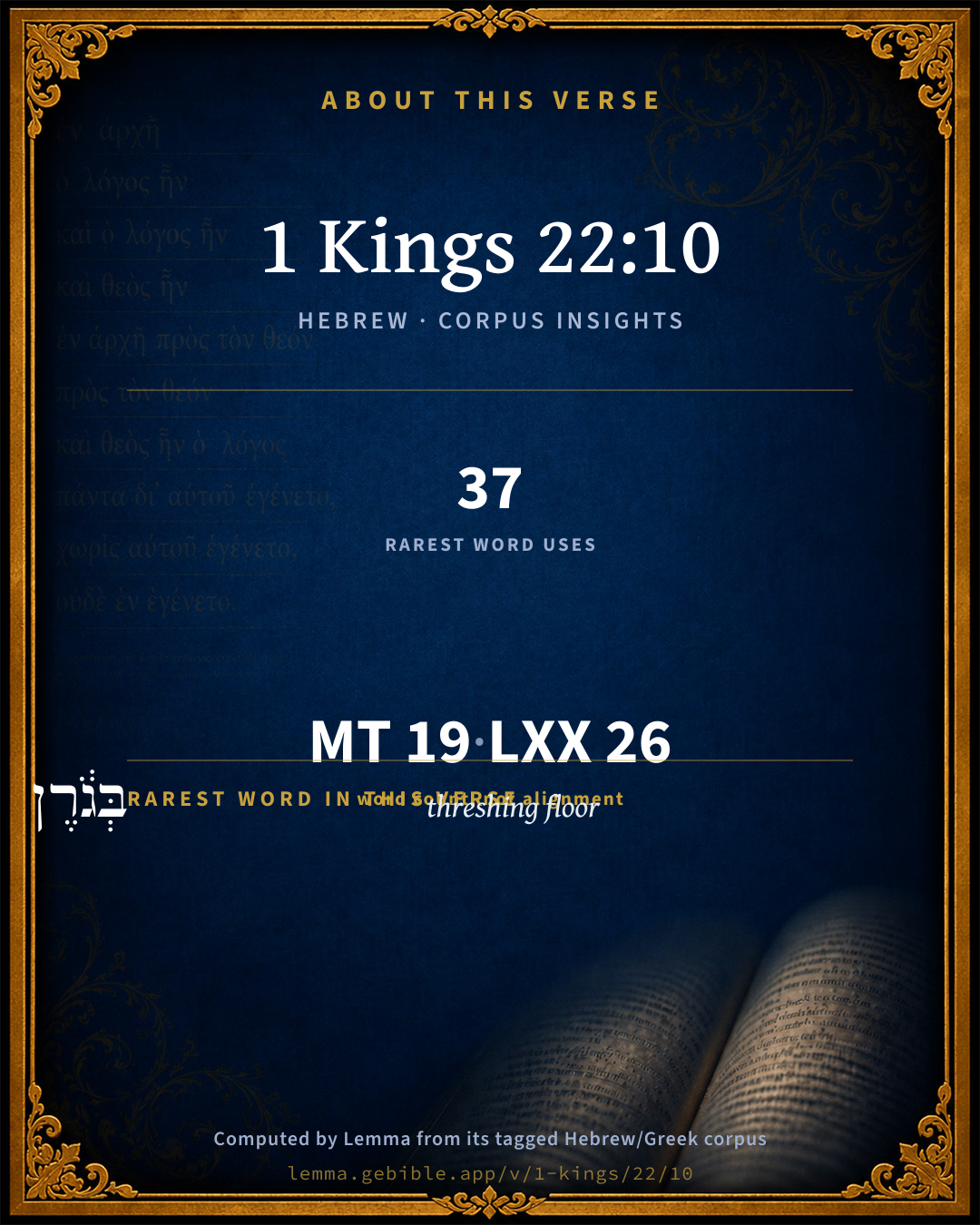
About this verse

These counts appear in no published source. They are computed here, from the morphology-tagged text and Lemma’s own curated glosses. What Lemma adds →

19
words
18
distinct lemmas
Historical
section

Shared distinctive vocabulary

בְּגֹ֔רֶן threshing floor H1637 occurs in 37 verses of the Hebrew Bible. Also found in:

Grammatical profile

  • 3 verbs
  • 15 nouns
  • 1 preposition

Verb forms

  • יֹשְׁבִים֩ Qal · Participle Active
  • מְלֻבָּשִׁ֤ים Pual · Participle Passive
  • מִֽתְנַבְּאִ֖ים Hithpael · Participle Active

Repetition

A word recurs within this verse — often emphatic in Hebrew:

  • וּמֶ֣לֶךְ king H4428 ×2

Hebrew & Septuagint length

In English translation the verse runs 41 words from the Hebrew and 28 from the Septuagint (LXX English) — the Septuagint runs noticeably shorter here. See the side-by-side →

A rough comparison of the two English renderings, which tokenize alike — not a word-level alignment.

Word counts can differ between the Hebrew and the Greek without any difference in meaning — e.g. the Hebrew direct-object marker אֵת has no separate Greek word, and Greek often adds the article ὁ.

In the original languages it is 19 Hebrew tokens and 26 Greek tokens — but the two are counted differently (Hebrew bundles its prefixes and suffixes into one token; the Greek is in lemma form), so that isn’t a like-for-like length.

Cross-references

12

Topical passages linked to 1 Kings 22:10 in the Treasury of Scripture Knowledge — connected by theme and wording, ordered by reader-vote popularity; previews shown in the World English Bible.

  • 1 Kings 18:29 It was so, when midday was past, that they prophesied until the time of the offering of the [evening] offering; but there was neither voice, nor any to answer, nor any who regarded.
  • 1 Kings 22:6 Then the king of Israel gathered the prophets together, about four hundred men, and said to them, Shall I go against Ramoth-gilead to battle, or shall I forbear? They said, Go up; for the Lord will deliver it into the hand of the king.
  • 1 Kings 22:30 The king of Israel said to Jehoshaphat, I will disguise myself, and go into the battle; but put you on your robes. The king of Israel disguised himself, and went into the battle.
  • 2 Chronicles 18:9–11 Now the king of Israel and Jehoshaphat the king of Judah sat each on his throne, arrayed in their robes, and they were sitting in an open place at the entrance of the gate of Samaria; and all the prophets were prophesying before them.
  • Esther 5:1 Now it happened on the third day, that Esther put on her royal clothing, and stood in the inner court of the king's house, over against the king's house: and the king sat on his royal throne in the royal house, over against the entrance of the house.
  • Esther 6:8–9 let royal clothing be brought which the king uses to wear, and the horse that the king rides on, and on the head of which a crown royal is set:
  • Jeremiah 27:14–16 Don't listen to the words of the prophets who speak to you, saying, You shall not serve the king of Babylon; for they prophesy a lie to you.
  • Ezekiel 13:1–9 The word of Yahweh came to me, saying,
  • Matthew 6:20 but lay up for yourselves treasures in heaven, where neither moth nor rust consume, and where thieves don't break through and steal;
  • Matthew 11:8 But what did you go out to see? A man in soft clothing? Behold, those who wear soft clothing are in king's houses.
  • Acts 12:21 On an appointed day, Herod dressed himself in royal clothing, sat on the throne, and gave a speech to them.
  • Acts 25:23 So on the next day, when Agrippa and Bernice had come with great pomp, and they had entered into the place of hearing with the commanding officers and principal men of the city, at the command of Festus, Paul was brought in.

Cross-references courtesy of OpenBible.info (CC BY 4.0).

Hebrew and Greek witnesses Masoretic Hebrew ↔ Greek Septuagint

The same verse in the two great witnesses to the Old Testament, shown verse-for-verse.

Here the Septuagint runs noticeably shorter than the Hebrew — LXX2012 (modern English Septuagint) 28 words vs World English Bible 41. A rough length comparison of the two English translations, not a word-level alignment — read both below.

These are two independent witnesses, not word-aligned to each other, and the Septuagint is shown in lemma (dictionary) form.

Hebrew 1 Kings 22:10 Masoretic · Westminster Leningrad Codex

וּמֶ֣לֶךְ יִשְׂרָאֵ֡ל וִֽיהוֹשָׁפָ֣ט מֶֽלֶךְ יְהוּדָ֡ה יֹשְׁבִים֩ אִ֨ישׁ עַל כִּסְא֜וֹ מְלֻבָּשִׁ֤ים בְּגָדִים֙ בְּגֹ֔רֶן פֶּ֖תַח שַׁ֣עַר שֹׁמְר֑וֹן וְכָ֨ל הַנְּבִיאִ֔ים מִֽתְנַבְּאִ֖ים לִפְנֵיהֶֽם

Now the king of Israel and Jehoshaphat the king of Judah were sitting each on his throne, arrayed in their robes, in an open place at the entrance of the gate of Samaria; and all the prophets were prophesying before them.

World English Bible · Public Domain

Greek LXX 1 Kings 22:10 Septuagint · lemma form

καί ὁ βασιλεύς ἰσραήλ καί ιωσαφατ βασιλεύς ιουδα καταἧμαι ἀνήρ ἐπί ὁ θρόνος αὐτός ἔνοπλος ἐν ὁ πύλη σαμαρεία καί πᾶς ὁ προφήτης προφητεύω ἐνώπιον αὐτός

And the king of Israel and Josaphat king of Juda sat, each on his throne, armed in the gates of Samaria; and all the prophets prophesied before them.

LXX2012 (modern English Septuagint) · Public Domain

On this verse, The Cambridge Bible for Schools and Colleges discusses the Septuagint’s reading. Read the note in Commentary ↓

Hebrew: Westminster Leningrad Codex (CC BY 4.0). Greek: Septuagint (public domain); English from LXX2012 (modern English Septuagint) (Public Domain). How the Septuagint differs from the Hebrew →

Targum (Aramaic paraphrase)

1

The Targum is the ancient Jewish Aramaic paraphrase of the Hebrew Scriptures — an interpretive translation, not the Hebrew text itself. Onkelos (literal) and Pseudo-Jonathan (expansive) render the Torah, and Jonathan the Prophets. Coverage is partial: where no permissively-licensed English translation exists for a verse, only the Aramaic is shown. This is verse-level text, not a word-by-word alignment to the Hebrew.

  1. Targum Jonathan Prophets (Joshua–Malachi)
    וּמַלְכָּא דְיִשְׂרָאֵל וִיהוֹשָׁפָט מַלְכָּא דִיהוּדָה יַתְבִין גְבַר עַל כּוּרְסֵיהּ לְבוּשִׁין לְבִישִׁין וְיַתְבִין בְּאִידְרָא בְּמַעֲלָנָא דִתְרַע שֹׁמְרוֹן וְכָל נְבִיֵי שִׁקְרָא מִתְנַבְּאִין קֳדָמֵיהוֹן:

    (no public-domain English translation for this verse)

    Targum Jonathan — Aramaic: “Mikraot Gedolot” (public domain). English: “Sefaria Community Translation” (CC0 1.0 (public-domain dedication)); “London "Chaldee Paraphrase," 1871” (public domain). Text via Sefaria.

Commentary

Notes on 1 Kings 22:10 from classic Christian and Jewish commentators (each source and its license shown beneath its notes). The classic Christian expositions comment on the surrounding passage and are grouped to its opening verse, so a note may address several verses; the Jewish commentaries on the Tanakh (Rashi and others) are per-verse, so they appear only where the commentator wrote on this verse.

Lemma curates 59 commentaries, every one of them public domain or Creative Commons licensed, each selected and text-cleaned for this edition rather than reprinted as found. About our sources →

Trapp's Complete Commentary

John Trapp

1Ki 22:10 And the king of Israel and Jehoshaphat the king of Judah sat each on his throne, having put on their robes, in a void place in the entrance of the gate of Samaria; and all the prophets prophesied before them.

Ver. 10. Sat each on his throne.] This might have daunted the good prophet, but that he had lately seen the Lord sitting upon his throne with all the host of heaven standing by him, {1Ki 22:19} and hence he so boldly looked in the face these two kings sitting in their majesty; for he beheld them as so many mice, Vel tanquam e palude sua repentes ranunculas. {a}

{a} Bernard.

John Trapp, A Commentary or Exposition upon All the Books of the Old and New Testament (1647–1656) — public domain. Text from a community e-Sword module.

Tyndale Open Study Notes

Tyndale Open Resources

22:10 In the ancient Near East, important business was often conducted at the threshing floor near the city gate. David secured the threshing floor of Araunah and built an altar there (2 Sam 24:18-25; 1 Chr 21:26); it later became the site for the Temple in Jerusalem (2 Chr 3:1).

Tyndale Open Study Notes — © Tyndale Open Resources, licensed CC BY-SA 4.0. Text via the HelloAO Bible API.

Geneva Bible (1599)

Geneva Bible translators

In their kingly apparel.

Geneva Bible (1599) marginal notes — public domain. Text via Bolls.life.

Jamieson, Fausset & Brown

Robert Jamieson, A. R. Fausset & David Brown

a void place--literally, "a threshing-floor," formed at the gate of Samaria.

Jamieson, Fausset & Brown — Commentary Critical and Explanatory on the Whole Bible (1871) — public domain (CC PDM 1.0). Text via the HelloAO Bible API.

Ellicott's Commentary for English Readers

(10) Each on his throne.—The description evidently implies that, having reluctantly consented to send for Micaiah, Ahab seeks to overawe him by display not only of royal pomp, but of prophetic inspiration, professing to come, like his own, from the Lord Jehovah.

A Bible Commentary for English Readers, edited by Charles John Ellicott (1878–1897) — public domain. Text from a community e-Sword module.

The Cambridge Bible for Schools and Colleges

gen. ed. J. J. S. Perowne

10. And [R.V. Now] the king of Israel] The change is justified, as the sentence is not a mere addition to what has gone before but a new feature in the history.

having put on their robes] R.V. arrayed in their robes. The original language indicates a degree of display suited to the meeting of two kings. Moreover the A. V., in connexion with the words immediately following, is open to a misunderstanding. What is described is not what the kings did, but in what state they sat. The LXX. has ἔνοπλοι. Josephus also gives the idea of an armed gathering. He says ‘The two kings having gone out of the city, and having sat down each on his throne, distributed to their own soldiers pay for the campaign (τὸ στρατιωτικόν).’

in a void [R.V. an open] place] The word in the Hebrew is most frequently rendered ‘a threshing-floor.’ This was a large open space in which the oxen could be driven round, to tread out the corn. Such a space is here indicated, where chairs of state could be erected for the two kings, and where the prophets could come about them.

in [R.V. at] the entrance of the gate of Samaria] There appears usually to have been some place set apart near the gate of a city, mostly outside, where important business proceedings, trials, and such matters could be conducted in public and where kings and magistrates could sit and listen to appeals for help or justice. Cf. Gen_23:10; Gen_23:18; Jos_2:7; Jos_9:2-9; 2Ki_23:8, &c.

The Cambridge Bible for Schools and Colleges (gen. ed. J. J. S. Perowne; Cambridge University Press, 1878–1918) — public domain. Text from a community e-Sword module.

John Gill's Exposition

And the messenger that was gone to call Micaiah spake unto him,.... By the way, as they came along together, as Josephus (p) observes:

behold, now, the words of the prophets declare good unto the king with one mouth; they are unanimous that he shall prosper in his undertaking against the Syrians:

let thy word, I pray thee, be like the word of one of them, and speak that which is good; which, as an ignorant man, he might advise to from good will to the prophet, that he might not be branded with singularity, and a spirit of contradiction, and that he might have the favour of the king, and be released from prison, pitying his miserable condition in which he found him.

(p) Antiqu. l. 8. c. 15. sect. 4.

John Gill's Exposition of the Whole Bible (1746–1763) — public domain (CC PDM 1.0). Text via the HelloAO Bible API.

Albert Barnes' Notes on the Bible

Sat each on his throne - Or, “were sitting.” They had removed from the banquet 2Ch 18:2 to the void place, or empty space at the entrance of the gate Rth 4:1; 2Sa 15:2, where Ahab daily sat to hear complaints and decide causes. Each was seated upon his throne, the Oriental kings having portable thrones, which they took with them upon their journeys.

Albert Barnes' Notes on the Bible (1834–1885) — public domain. Text from a community e-Sword/MySword module.

Haydock's Catholic Bible Commentary

Court, or barn floor. They were in or near cities, that they might be so protected from the incursions of enemies, who strove to set the corn on fire, 1 Kings xxiii. 1., and Judges xv. 5.

George Leo Haydock (1774–1849), Haydock's Catholic Family Bible and Commentary, 1859 edition — public domain. Excludes Psalms (Douay-Rheims chapter numbering differs from Protestant) and Deuterocanonical books (Catholic canon only).

Matthew Poole's English Annotations

Their robes; their royal robes, and ensigns of majesty.

In a void place; in the place of judicature, which was in or nigh the gate of the city, and in the front of some void place, where either people stood to hear and see justice administered, or soldiers were placed for the defence of the city in time of war.

Matthew Poole's English Annotations on the Holy Bible (1683–1685) — public domain. Text from a community e-Sword/MySword module.

Whedon's Commentary on the Bible

Daniel D. Whedon

10. Each on his throne — Thrones purposely erected for this august occasion near the gates of the city.

Robes — Royal garments.

A void place — Probably the site of an old threshingfloor; a broad, open space, where a vast assembly might gather.

Daniel D. Whedon (gen. ed.), Commentary on the Old and New Testaments (1874–1909) — public domain. Text from a community e-Sword module.

The Pulpit Commentary

And the king of Israel and Jehoshaphat the king of Judah sat each on his throne "Oriental kings had portable thrones, which they took with them upon their journeys" (Heb 7:212. Layard, "Nineveh and Babylon," p. 150) Rawlinson, having put on their robes As a council of state was to be held, the kings put on their official vestments. simply means "coverings," "clothes," but that the special royal dress is here intended is clear, as Bahr observes, from Lev_21:10. This gathering of prophets and counsellors seems to have followed the banquet. When Jehoshaphat expressed his readiness to go to war, Ahab appears to have forthwith convened this assembly, in order that the matter might be put in train at once. Ewald says a review of the troops was designed, but of this the text knows nothing in a void place Heb. a threshing-floor. See note on 1Ki_21:1. The "floor" implies not only a vacant space, but an exalted position. Ordinarily, it would not be enclosed within the city walls, nor does it appear that this floor was in the entrance The Hebrew has no preposition; simply jtP, which would be more correctly rendered "at the entrance." The town gate was the great place of concourse. (2Ki_7:1) Here, too, justice was dispensed. (See Rth_4:1; 2Sa_15:2 2Sa_19:8; Psa_69:12 Psa_127:5; Deu_21:19; Gen_19:1 Gen_23:10; Amo_5:12, Amo_5:15, etc.) of the gate of Samaria; and all the prophets prophesied before them. They continued their prophesyings even whilst Micah was being summoned. Or the reference may be to the prophesyings of ver. 6.

The Pulpit Commentary (1880–1919), ed. H.D.M. Spence-Jones & Joseph S. Exell — public domain. Text from a community e-Sword module.

unfoldingWord translationNotes

Door43 World Missions Community

made himself horns of iron

"made iron horns for himself"

With these you will push the Arameans until they are consumed

The prophet's actions are a symbolic metaphor that illustrates the way that Ahab would defeat the Arameans. Ahab's army will win with great strength, as a bull attacks another animal. (See: Symbolic Action and Metaphor)

until they are consumed

Destroying an enemy army is spoken of as if it were consuming them. This can be stated in active form. AT: "until you consume them" or "until you destroy them" (See: Metaphor and Active or Passive)

given it into the hand of the king

Here the word "hand" refers to power. AT: "allowed the king to capture it" (See: Metonymy)

translationWords

Ahab

kingdom of Judah

throne

robe

gate

Samaria

horn

Aram

consume

Ramoth

Gilead

hand

unfoldingWord translationNotes — © Distant Shores Media and the Door43 World Missions Community, licensed CC BY-SA 4.0. Source: git.door43.org/Door43/en_tn.

Lesson kit

Teaching starters — assembled from the data on this page, not authored interpretation. Every prompt links to the verse data it draws on. Edit before teaching.

1 Kings, in the Historical, opens this verse with 19 words (18 distinct Hebrew lemmas). Its most distinctive word is gôren (“threshing floor”). The Greek Septuagint runs shorter here. A historical commentator’s framing appears above. Read the whole chapter for the surrounding context.

Discussion questions

  1. How does “threshing floor” (gôren) shape what this verse is saying?
  2. Genesis 50:10 shares the word «threshing floor» with this verse. How do the two illuminate each other?
  3. “king” occurs 2× in this one verse. What is the effect of the repetition?
  4. Compared with the Hebrew, the Septuagint runs shorter here. What questions does that raise?
  5. The translations on this page render this verse differently — a whole-verse word diff, not a word-by-word alignment. What might account for the different wordings?
  6. The verb «יֹשְׁבִים֩» is Qal Participle Active. How does its form color the action?
  7. Reading how Trapp's Complete Commentary and Tyndale Open Study Notes read this verse, where do the two commentators agree and where do they part?

Things to notice

Reading settings

Reading text

Shown beneath each verse's original-language words.

Old Testament
Old Testament edition

Read the OT as the Masoretic Hebrew (MT) or the Greek Septuagint (LXX).

English shown for the Greek Septuagint (in the Hebrew ↔ Greek comparison).

Comparing translations? Open the Compare panel on any verse page to stack up to four side by side.