
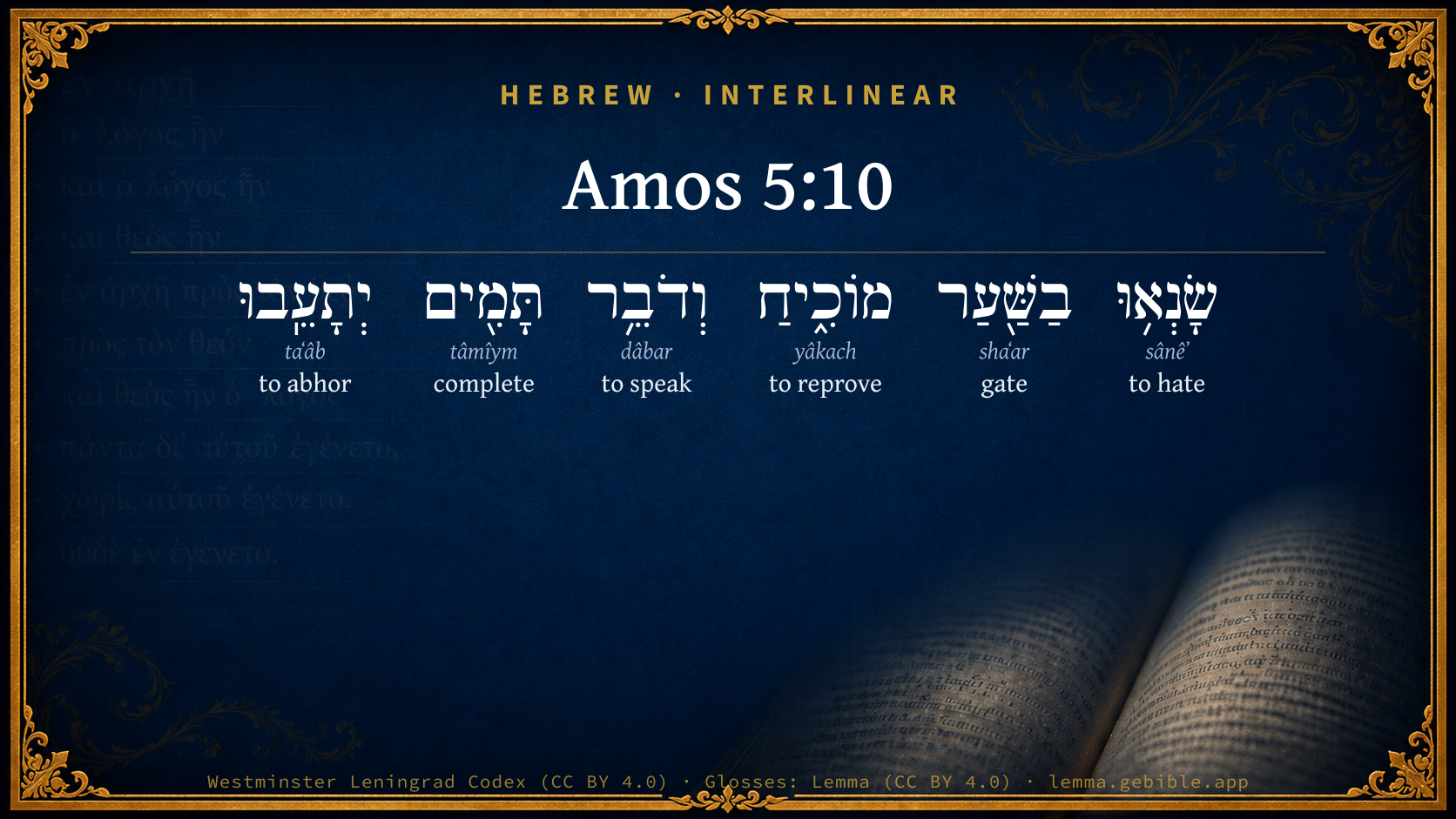
Amos 5:10

Hebrew (Westminster Leningrad Codex) Amos 5:10 appears in the Hebrew Old Testament. The text above is from the Westminster Leningrad Codex. Each word links to its Strong’s number, a concise gloss, and parsing drawn from the Open Scriptures Hebrew Bible morphology. Click any word for its full Brown-Driver-Briggs (BDB) entry.
Download image
Cite this verse

Amos 5:10 (World English Bible). Public Domain. Lemma interlinear Bible study tool, https://lemma.gebible.app/v/amos/5/10.

Show BibTeX & RIS
BibTeX
RIS
English Translation
They hate him who reproves in the gate, And they abhor him who speaks blamelessly.
World English Bible · Public Domain
Download a study sheet

One document with this verse’s original text, its word-by-word gloss line, the meaning frame, cross-references with their text, attributed commentary, and full source and license credits — printable, and it pastes into notes with its structure intact.

This verse Autodidact and up

Study sheet (.html) Plain text (.txt)

A passage Seminary Student

Up to 50 verses in one chapter. A passage sheet keeps up to 6 commentary sources and 12 cross-references per verse, in the order this page ranks them, and says so on the sheet whenever that leaves anything out. Ask for a single verse and you get the Autodidact verse sheet above.

Everything on this page stays free to read, with no account — the sheet is a download of what is already on screen, not access to it.

Want to remove ads? Support Godless Engineer
Compare translations 3

The same verse in 3 English versions, stacked beneath the original-language interlinear above. Click any original word for its lexicon entry.

Each is an independent rendering of the whole verse — the interlinear is not word-aligned to these translations.

Highlighted words mark where these versions differ — a whole-verse word diff, not a word-by-word alignment.

  • World English Bible Public Domain
    They hate him who reproves in the gate, And they abhor him who speaks blamelessly.
  • King James Version Public Domain
    They hate him that rebuketh in the gate, and they abhor him that speaketh uprightly.
  • unfoldingWord Literal Text CC BY-SA 4.0
    They hate anyone who corrects them in the city gate, and they abhor anyone who speaks the truth.

unfoldingWord Literal Text — © unfoldingWord, licensed CC BY-SA 4.0. Word-aligned USFM3 via Door43 (git.door43.org/unfoldingWord/en_ult).

Versions to compare (up to 4)

3 of 4 selected

Show all 18 translations

Every available English version of this verse, each an independent rendering of the whole verse.

  • World English Bible Public Domain
    They hate him who reproves in the gate, And they abhor him who speaks blamelessly.
  • Berean Standard Bible Public Domain
    There are those who hate the one who reproves in the gate and despise him who speaks with integrity.
  • Majority Standard Bible Public Domain
    There are those who hate the one who reproves in the gate and despise him who speaks with integrity.
  • King James Version Public Domain
    They hate him that rebuketh in the gate, and they abhor him that speaketh uprightly.
  • American Standard Version (1901) Public Domain
    They hate him that reproveth in the gate, and they abhor him that speaketh uprightly.
  • Revised Version (1885) Public Domain
    They hate him that reproveth in the gate, and they abhor him that speaketh uprightly.
  • Geneva Bible (1599) Public Domain
    They haue hated him, that rebuked in the gate: and they abhorred him that speaketh vprightly.
  • Douay-Rheims (1899) Public Domain
    They have hated him that rebuketh in the gate: and have abhorred him that speaketh perfectly.
  • Young's Literal Translation Public Domain
    They have hated a reprover in the gate, And a plain speaker they abominate.
  • Literal Standard Version CC BY-SA 4.0
    They have hated a reprover in the gate, || And they detest a plain speaker.
  • Unlocked Literal Bible CC BY-SA 4.0
    They hate anyone who corrects them in the city gate, and they abhor anyone who speaks the truth.
  • unfoldingWord Literal Text CC BY-SA 4.0
    They hate anyone who corrects them in the city gate, and they abhor anyone who speaks the truth.
  • Darby Bible Public Domain
    They hate him that reproveth in the gate, and they abhor him that speaketh uprightly.
  • World Messianic Bible Public Domain
    They hate him who reproves in the gate, and they abhor him who speaks blamelessly.
  • Webster's Bible Public Domain
    They hate him that rebuketh in the gate, and they abhor him that speaketh uprightly.
  • Free Bible Version CC BY-SA 4.0
    You hate anyone who confronts injustice and loathe anyone who speaks honestly.
  • Bible in Basic English Public Domain
    They have hate for him who makes protest against evil in the public place, and he whose words are upright is disgusting to them.
  • JPS Tanakh (1917) Public Domain
    They hate him that reproveth in the gate, and they abhor him that speaketh uprightly.

Literal Standard Version (2020), Covenant Press — licensed CC BY-SA 4.0. Text via the HelloAO Bible API (eBible.org). Unlocked Literal Bible (unfoldingWord) — licensed CC BY-SA 4.0. Text via the HelloAO Bible API (eBible.org). unfoldingWord Literal Text — © unfoldingWord, licensed CC BY-SA 4.0. Word-aligned USFM3 via Door43 (git.door43.org/unfoldingWord/en_ult). Free Bible Version, Dr. Jonathan Gallagher — licensed CC BY-SA 4.0. Text via the HelloAO Bible API (eBible.org).

Word by word

More ways to search: Search by grammar → Find every occurrence → Compare this word →

Practice this passage: Drill this verse → Learn its vocabulary →

יְתָעֵֽבוּ
taʻâb
H8581
“to abhor”
Verb, Piel, Imperfect, 3rd Person, Masculine, Plural
Part of Speech
Verb
Stem
Piel
Form
Imperfect
Person
3rd Person
Gender
Masculine
Number
Plural
Full BDB Definition

Origin: a primitive root

TWOT: 2530

to abhor, be abominable, do abominably - (Niphal) to be abhorred, be detested - in the ritual sense - in the ethical sense - (Piel) - to loathe, abhor, regard as an abomination - in the ritual sense - in the ethical sense - to cause to be an abomination - (Hiphil) to make abominable, do abominably - in the ritual sense - in the ethical sense
  1. שָׂנְא֥וּ sânêʼ H8130 “to hate” Verb, Qal, Perfect, 3rd Person, Common, Plural
  2. בַשַּׁ֖עַר shaʻar H8179 “in/at the · gate” Preposition, Determined + Noun, Common, Masculine, Singular, Absolute
  3. מוֹכִ֑יחַ yâkach H3198 “reproving” Verb, Hiphil, Participle Active, Masculine, Singular, Absolute
  4. וְדֹבֵ֥ר dâbar H1696 “and · speaking” Conjunction + Verb, Qal, Participle Active, Masculine, Singular, Absolute
  5. תָּמִ֖ים tâmîym H8549 “complete” Adjective, Adjective, Masculine, Singular, Absolute

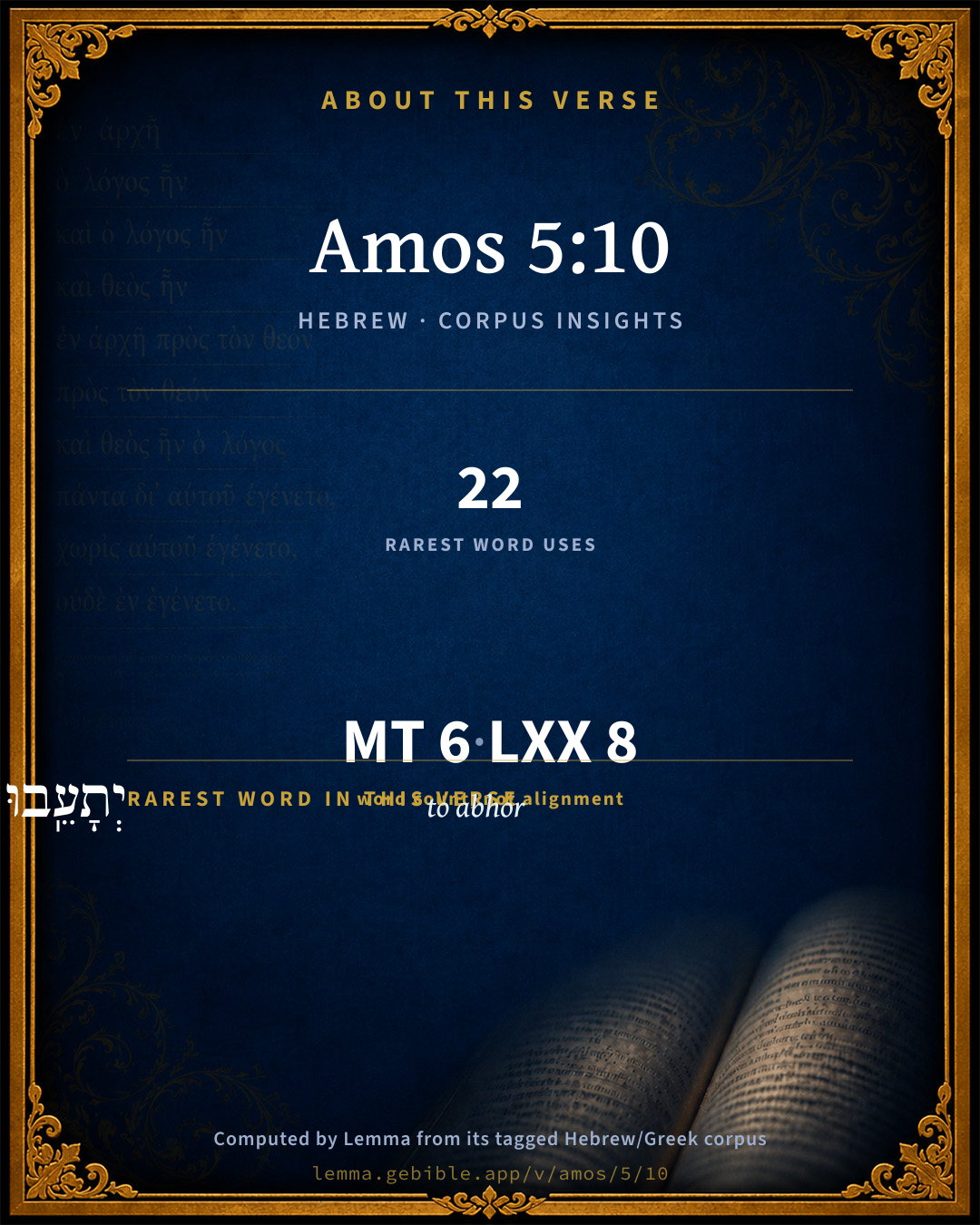
About this verse

These counts appear in no published source. They are computed here, from the morphology-tagged text and Lemma’s own curated glosses. What Lemma adds →

6
words
6
distinct lemmas
Prophets
section

Notable vocabulary

The rarest word here is יְתָעֵֽבוּ to abhor H8581 — appearing just 22 times in the whole Hebrew Bible.

Shared distinctive vocabulary

יְתָעֵֽבוּ to abhor H8581 occurs in 20 verses of the Hebrew Bible. Also found in:

Grammatical profile

  • 4 verbs
  • 1 noun
  • 1 adjective

Verb forms

  • שָׂנְא֥וּ Qal · Perfect
  • מוֹכִ֑יחַ Hiphil · Participle Active
  • וְדֹבֵ֥ר Qal · Participle Active
  • יְתָעֵֽבוּ Piel · Imperfect

Hebrew & Septuagint length

In English translation the verse runs 15 words from the Hebrew and 12 from the Septuagint (LXX English) — closely comparable.

A rough comparison of the two English renderings, which tokenize alike — not a word-level alignment.

Word counts can differ between the Hebrew and the Greek without any difference in meaning — e.g. the Hebrew direct-object marker אֵת has no separate Greek word, and Greek often adds the article ὁ.

In the original languages it is 6 Hebrew tokens and 8 Greek tokens — but the two are counted differently (Hebrew bundles its prefixes and suffixes into one token; the Greek is in lemma form), so that isn’t a like-for-like length.

Cross-references

17

Topical passages linked to Amos 5:10 in the Treasury of Scripture Knowledge — connected by theme and wording, ordered by reader-vote popularity; previews shown in the World English Bible.

  • 1 Kings 22:8 The king of Israel said to Jehoshaphat, there is yet one man by whom we may inquire of Yahweh, Micaiah the son of Imlah: but I hate him; for he does not prophesy good concerning me, but evil. Jehoshaphat said, "Don't let the king say so."
  • Isaiah 29:21 that make a man an offender in [his] cause, and lay a snare for him who reproves in the gate, and turn aside the just with a thing of nothing.
  • John 8:45–47 But because I tell the truth, you don't believe me.
  • Jeremiah 17:16–17 As for me, I have not hurried from being a shepherd after you; neither have I desired the woeful day; you know: that which came out of my lips was before your face.
  • 1 Kings 18:17 It happened, when Ahab saw Elijah, that Ahab said to him, Is it you, you troubler of Israel?
  • 1 Kings 21:20 Ahab said to Elijah, Have you found me, my enemy? He answered, I have found you, because you have sold yourself to do that which is evil in the sight of Yahweh.
  • 2 Chronicles 24:20–22 The Spirit of God came on Zechariah the son of Jehoiada the priest; and he stood above the people, and said to them, Thus says God, Why disobey you the commandments of Yahweh, so that you can't prosper? because you have forsaken Yahweh, he has also forsaken you.
  • 2 Chronicles 25:16 It happened, as he talked with him, that [the king] said to him, Have we made you of the king's counsel? Stop! Why should you be struck down? Then the prophet stopped, and said, I know that God has determined to destroy you, because you have done this, and have not listened to my counsel.
  • 2 Chronicles 36:16 but they mocked the messengers of God, and despised his words, and scoffed at his prophets, until the wrath of Yahweh arose against his people, until there was no remedy.
  • Proverbs 9:7–8 He who corrects a mocker invites insult. He who reproves a wicked man invites abuse.
  • Amos 7:10–17 Then Amaziah the priest of Beth El sent to Jeroboam king of Israel, saying, "Amos has conspired against you in the midst of the house of Israel. The land is not able to bear all his words.
  • John 3:20 For everyone who does evil hates the light, and doesn't come to the light, lest his works would be exposed.
  • John 7:7 The world can't hate you, but it hates me, because I testify about it, that its works are evil.
  • John 15:19 If you were of the world, the world would love its own. But because you are not of the world, since I chose you out of the world, therefore the world hates you.
  • John 15:22–24 If I had not come and spoken to them, they would not have had sin; but now they have no excuse for their sin.
  • Revelation 11:10 Those who dwell on the earth rejoice over them, and they will be glad. They will give gifts to one another, because these two prophets tormented those who dwell on the earth.
  • Jeremiah 20:7–10 Yahweh, you have persuaded me, and I was persuaded; you are stronger than I, and have prevailed: I am become a laughing-stock all the day, every one mocks me.

Cross-references courtesy of OpenBible.info (CC BY 4.0).

Hebrew and Greek witnesses Masoretic Hebrew ↔ Greek Septuagint

The same verse in the two great witnesses to the Old Testament, shown verse-for-verse.

These are two independent witnesses, not word-aligned to each other, and the Septuagint is shown in lemma (dictionary) form.

Hebrew Amos 5:10 Masoretic · Westminster Leningrad Codex

שָׂנְא֥וּ בַשַּׁ֖עַר מוֹכִ֑יחַ וְדֹבֵ֥ר תָּמִ֖ים יְתָעֵֽבוּ

They hate him who reproves in the gate, And they abhor him who speaks blamelessly.

World English Bible · Public Domain

Greek LXX Amos 5:10 Septuagint · lemma form

μισέω ἐν πύλη ἐλέγχω καί λόγος ὅσιος βδελύσσω

They hated him that reproved in the gates, and abhorred holy speech.

LXX2012 (modern English Septuagint) · Public Domain

Hebrew: Westminster Leningrad Codex (CC BY 4.0). Greek: Septuagint (public domain); English from LXX2012 (modern English Septuagint) (Public Domain). How the Septuagint differs from the Hebrew →

Targum (Aramaic paraphrase)

1

The Targum is the ancient Jewish Aramaic paraphrase of the Hebrew Scriptures — an interpretive translation, not the Hebrew text itself. Onkelos (literal) and Pseudo-Jonathan (expansive) render the Torah, and Jonathan the Prophets. Coverage is partial: where no permissively-licensed English translation exists for a verse, only the Aramaic is shown. This is verse-level text, not a word-by-word alignment to the Hebrew.

  1. Targum Jonathan Prophets (Joshua–Malachi)
    סְנָן לִדְמוֹכַח לְהוֹן בְּשַׁעֲרֵי בָתֵּי דִינָא פִּתְגָמֵי אוֹרַיְתָא וְלִדְמַלֵיל כֵּיוַנְתָּא מְעַקְמִין:

    (no public-domain English translation for this verse)

    Targum Jonathan — Aramaic: “Mikraot Gedolot” (public domain). English: “Sefaria Community Translation” (CC0 1.0 (public-domain dedication)); “London "Chaldee Paraphrase," 1871” (public domain). Text via Sefaria.

Commentary

Notes on Amos 5:10 from classic Christian and Jewish commentators (each source and its license shown beneath its notes). The classic Christian expositions comment on the surrounding passage and are grouped to its opening verse, so a note may address several verses; the Jewish commentaries on the Tanakh (Rashi and others) are per-verse, so they appear only where the commentator wrote on this verse.

Lemma curates 59 commentaries, every one of them public domain or Creative Commons licensed, each selected and text-cleaned for this edition rather than reprinted as found. About our sources →

Trapp's Complete Commentary

John Trapp

Amo 5:10 They hate him that rebuketh in the gate, and they abhor him that speaketh uprightly.

Ver. 10. They hate him that rebuketh in the gate] In dome iudicii, saith the Chaldee: for the gate was the place of judgment, Amo 5:12; Amo 5:15 Deu 17:5; Deu 17:12; Deu 17:15. Those, then, that did not approve and applaud the oppressions and wrongdealings of the judges, and rich bribers, but cried out against such, and took the same liberty to rebuke them that they did to commit them, these were hated, cane peius et angue, worse than any toad. Thus Ahab hated Micaiah, the Sodomites Lot, the Jews Jeremiah, their successors Christ, the Baptist, Stephen, Paul. Thus those of Geneva hated Farellus, their faithful minister, tried him for his life, banished him out of their territories. Thus afterwards some of them hated Calvin, calling him Cain; yea, calling their dogs Calvin, in derision and detestation of him. And thus Bishop Ridley, lamenting the state of England, even of thy greatest magistrates, saith he, some (the king’s Highness excepted) evermore unkindly and ungently against those that went about most busily and wholesomely to cure their sore backs, spurned privily, and would not spare to speak evil of them, even to the prince himself; and yet would they toward the same preachers outwardly bear a jolly countenance and fair face. As for Latimer, Lever, Bradford, Knox, their tongues were so sharp, they ripped in so deep in their galled backs, to have purged them, no doubt, of their filthy matter that was festered in their hearts, of insatiable covetousness, of filthy carnality and voluptuousness, of intolerable ambition and pride, of ungodly loathsomeness to hear poor men’s cases, and to hear God’s word. And these men, of all others, these magistrates then could never abide, &c. Thus he, and much more to the same purpose. They were then sick of a Noli me tangere, do not be touched by me, and so, alas, they are still. How few Vespasians to be found, of whom Quintilian testifieth, that he was patientissimus veri, one that would patiently hear the naked truth of things; not toothless truths only, but such as touched to the quick! How few Davids, that loved Nathan the better ever after, for dealing so plainly and faithfully with him, and made him of his cabinet council! How few Queen Elizabeths, who called often for her Deering by whom she was barely told of her faults; though the bishops, those court parasites, would never suffer him to preach more before her! The Queen of Navarre would not hearken to such ministers as disliked that fatal French match (that gave opportunity afterwards to the Parisian Massacre) in regard of the diversity of religions; but inclined rather to those that smoothed her up, and told her that it would lay the foundation of a lasting and most happy peace. And generally of those French Reformed churches it was observed, that for some years before that bloody massacre they affected a frothy, flashy kind of preaching; and cared not for that which came home to the conscience. See my Common Place of Admonition.

And they abhor him that speaketh uprightly] Auget orationem, saith Drusius. The prophet groweth in his expression of their wickedness: for to abhor is more than to hate; see Pro 6:16. Hatred (as they say of the crocodile) groweth as long as it liveth. Sin is of an encroaching nature. If a serpent devour a serpent (saith the proverb) he becometh a dragon, Serpens si serpentem comederit fit draco. Hatred of the truth, as runner, the older it is the stronger; the Pharisees for instance, who did not only inwardly swell and boil with hellish hatred of Christ, his works, and doctrine, but also outwardly belched out against him the basest blasphemies; and in their pertinacious working, constantly persecuted him, even to the most reproachful death of the cross. This is merces mundi, the world’s wages to God’s faithful witnesses. They "make a man an offender for a word" (yea, for speaking uprightly), "and lay a snare for him that reproveth in the gate, and turn aside the just for a thing of nought," Isa 29:21. An expectas ut Quintilianus ametur? said he: Dost thou think that plain dealing Quintilian should be loved? it is not likely. To preach, saith Luther, the truth which is according to godliness, is nothing else but to derive the rage of the whole world upon a man’s self. 30392- Amo 5:11 Ver. 11. Forasmuch therefore as your treading is upon the poor] "Panting after the dust of the earth on the head of the poor," Amo 2:7 Psa 109:16. Some render, Ye fire the poor; others, ye plunder them; so the Chaldee, and Jerome. The Seventy have it, Ye smite them with fists, Kατακονδυλιζειν. But better, Ye foot it upon them, and make them sell their commodities underfoot (as we phrase it), to pay your heavy taxes, and satisfy your greedy covetousness. &&& Poor-Oppression of

And ye take from him burdens of wheat] Heb. the finest wheat, and best winnowed; these ye force him to make money of, for your use; glad to feed upon the rotted wheat himself.

Ye have built houses of hewn stone] Squared and polished, thinking to flourish, and frolic (οικους ξεστους. Domos rasiles et politas. Sept.): but the screech owls of woe crying aloud from the stones out of those walls, shall mar your mirth, Hab 2:11.

But ye shall not dwell in them] For either ye shall be prevented by death, and sent to dwell with devils; or be carried away captive, and a stranger possess your new buildings, Deu 28:30.

Ye have planted pleasant vineyards] As he in the history, that, having a cup of new wine in his hand, expressed out of the grapes of his newly planted vineyard, was set upon and slain by a wild boar, before he could drink it, and gave occasion to that proverb, Multa cadunt inter calicem supremaque labra; Many things fall between the cup and the lip, between the chin and the chalice (Erasm. Adag.). Hereunto agreeth that story in Mr Burroughs upon Hosea (Burr. on Hos. i. p. 379). I had, saith he, certain information, from a reverend minister, that in his own town there was a wretched worldling, who had a great crop of grain. A good honest neighbour of his walking by his field, saith, Neighbour, you have a very fine crop of grain if God bless it. Yea, saith he, I will have a good crop, speaking contemptuously; and before he could come to get it into the barn, it was so blasted, that the grain of the whole crop was not worth sixpence. God hath many ways to defeat the wicked man’s expectation, and the hope of unjust men perisheth, Pro 11:7. Etiam spes valentissima perit, so some render that text, he shall die or miscarry, in the very height of his hopes and expectations.

John Trapp, A Commentary or Exposition upon All the Books of the Old and New Testament (1647–1656) — public domain. Text from a community e-Sword module.

The Biblical Illustrator

Joseph S. Exell

Amo_5:10

They hate him that rebuketh in the gate, and they abhor him that speaketh uprightly.

The hates of sin

Amos has here preserved a characteristic of the society of his time which throws much light on the real character of sin--its hatred of justice and truth.

1. They hate him that rebuketh in the gate. At the gate the princes of the East sat in judgment (Job_29:7; Psa_127:5). No wonder such men as Amos laboured amongst hated the judge. His practised eye pierced their disguise and detected the hypocrisy and sin that lurked for their prey. He was vested with power which could thwart all their purposes. No good man fears justice. It is the friend that frees him from the attack of his enemies, and preserves to him the peace and prosperity of his home.

2. But there is another particular added. They abhor him that speaketh uprightly. They could not even bear to hear the truth. Amaziah (Amo_7:12-13) resorts to stratagem to free the country of words that revealed the true condition of things (also 1Ki_22:8, also Ahab and Jezebels hatred of Elijah). The condemnation of sin is pronounced in this description of it. What can be said in defence of that which makes men hate justice and truth? Yet this spirit is widespread. See the story of the Greek who voted for the condemnation of Aristides because he was tired of hearing him called the just. Christ endured its utmost rancour.

The reasons for these hates of sin.

1. Justice is a reproof of its own course. Such words and deeds make conscience sting (Pro_9:8).

2. Justice snatches away the booty of sin, and truth (him that speaketh uprightly) robs it of the respect that even sin likes to have. Hence the hatred.

3. Warning of future punishment. These censures are warnings of the final judgment which God shall pronounce on sin. Who would cast in his lot with such men? (J. Telford, B. A.)

The Biblical Illustrator, edited by Joseph S. Exell (c. 1880s–1900s) — public domain. Text from a community e-Sword module.

Joseph Benson's Commentary

Amo 5:10. They hate him that rebuketh in the gate — The usual place of administering justice, and of reproving and passing judgment on iniquity. The prophet now, after having descanted upon God’s wondrous power, returns to enumerate the crimes of the Israelites; and begins with telling them, that they in general hated the judges who reproved them for their injurious conduct and acts of fraud or violence, and endeavoured to do justice to the oppressed. And besides this, they hated the prophets and private persons who rebuked ungodliness and unrighteousness, and exhorted men to the practice of piety and virtue.

Joseph Benson's Commentary on the Old and New Testaments (1811–1818) — public domain. Text from a community e-Sword module.

Keil & Delitzsch

C. F. Keil & F. Delitzsch

"They hate the monitor in the gate, and abhor him that speaketh uprightly. Amo 5:11. Therefore, because ye tread upon the poor, and take the distribution of corn from him, ye have built houses of square stones, and will not dwell therein; planted pleasant vineyards, and will not drink their wine. Amo 5:12. For I know how many are your transgressions, and how great your sins; oppressing the righteous, taking atonement money; and ye bow down the poor in the gate." However natural it may seem to take מוכיח and דּבר תּמים in Amo 5:10 as referring to prophets, who charge the ungodly with their acts of unrighteousness, as Jerome does, this explanation is precluded not only by bassha‛ar (in the gate), since the gate was not the meeting-place of the people where the prophets were accustomed to stand, but the place where courts of judgment were held, and all the public affairs of the community discussed (see at Deu 21:19); but also by the first half of Amo 5:11, which presupposes judicial proceedings. Mōkhı̄ăch is not merely the judge who puts down unjust accusers, but any one who lifts up his voice in a court of justice against acts of injustice (as in Isa 29:21). דּבר תּמים, he who says what is blameless, i.e., what is right and true: this is to be taken generally, and not to be restricted to the accused who seeks to defend his innocence. תּעב is a stronger expression than שׂנא. The punishment for this unjust oppression of the poor will be the withdrawal of their possessions. The ἁπ. λεγ. bōshēs is a dialectically different form for בוסס, from בוּס, to trample down (Rashi, Kimchi), analogous to the interchange of שׁריון and סריון, a coat of mail, although as a rule שׁ passes into ס, and not ס into שׁ. For the derivation from בושׁ, according to which בושׁס would stand for בושׁשׁ (Hitzig and Tuch on Genesis p. 85), is opposed both to the construction with על, and also to the circumstance that בּושׁשׁ means to delay (Exo 32:1; Jdg 5:28); and the derivation suggested by Hitzig from an Arabic verb, signifying to carry one's self haughtily towards others, is a mere loophole. Taking a gift of corn from the poor refers to unjust extortion on the part of the judge, who will only do justice to a poor man when he is paid for it. The main clause, which was introduced with lâkhēn, is continued with בּתּי גזית: "thus have ye built houses of square stones, and shall not dwell therein;" for "ye shall not dwell in the houses of square stones which ye have built." The threat is taken from Deu 28:30, Deu 28:39, and sets before them the plundering of the land and the banishment of the people. Houses built of square stones are splendid buildings (see Isa 9:9). The reason for this threat is given in Amo 5:12, where reference is made to the multitude and magnitude of the sins, of which injustice in the administration of justice is again held up as the chief sin. The participles צררי and לקחי are attached to the suffixes of פּשׁעיכם and חטּאתיכם: your sins, who oppress the righteous, attack him, and take atonement money, contrary to the express command of the law in Num 35:31, to take no kōpher for the soul of a murderer. The judges allowed the rich murderer to purchase exemption from capital punishment by the payment of atonement money, whilst they bowed down the right of the poor. Observe the transition from the participle to the third person fem., by which the prophet turns away with disgust from these ungodly judges. Bowing down the poor is a concise expression for bowing down the right of the poor: compare Amo 2:7 and the warnings against this sin (Exo 23:6; Deu 16:19).

Keil & Delitzsch — Biblical Commentary on the Old Testament (1861–1891) — public domain (CC PDM 1.0). Text via the HelloAO Bible API. (Old Testament only.)

Tyndale Open Study Notes

Tyndale Open Resources

5:10 Amos resumes the thought begun in 5:7. Israel’s courts, controlled by the wealthy, depended on corrupt judges and hired witnesses. They had no use for what was true, but only for what was expedient to their own cause (5:12).

Tyndale Open Study Notes — © Tyndale Open Resources, licensed CC BY-SA 4.0. Text via the HelloAO Bible API.

Geneva Bible (1599)

Geneva Bible translators

They hate the Prophets, which reprove them in the open assemblies.

Geneva Bible (1599) marginal notes — public domain. Text via Bolls.life.

Jamieson, Fausset & Brown

Robert Jamieson, A. R. Fausset & David Brown

him that rebuketh in the gate--the judge who condemns their iniquity in the place of judgment (Isa 29:21).

abhor him that speaketh uprightly--the prophet telling them the unwelcome truth: answering in the parallelism to the judge, "that rebuketh in the gate" (compare Kg1 22:8; Pro 9:8; Pro 12:1; Jer 36:23).

Jamieson, Fausset & Brown — Commentary Critical and Explanatory on the Whole Bible (1871) — public domain (CC PDM 1.0). Text via the HelloAO Bible API.

Adam Clarke's Commentary

Verse 10. They hate him that rebuketh in the gate] They cannot bear an upright magistrate, and will not have righteous laws executed.

Adam Clarke's Commentary on the Bible (1810–1826) — public domain. Text from a community e-Sword/MySword module.

John Calvin's Commentaries

It is probable that in this verse also, the judges are reproved by the Prophet, though what is here said may be extended to the whole people: but as nearly the whole discourse is leveled against the judges, I readily subscribe to the opinion, that the Prophet now accuses the judges on this account, — because they could not bear to be reproved for the great license they allowed themselves, but, on the contrary, abhorred all those who reproved them. What then he says as to the reprover being hated in the gate, is to be thus explained: When judges sat in the gate and perverted justice and right, and when any one reminded them of their duty, they haughtily rejected all admonitions, and even hated them. In the gate then, that is, They who ought to rule others, and to correct whatever vice there may be among the people, cannot themselves bear any reprover, when their own vices require strong remedies.

And well would it be, if this disease were healed at this day. We indeed see that kings, and those in authority, wish to be deemed sacred, and they will allow no reproof. Instantly the majesty of God is violated in their person; for they complain and cry out, whenever teachers and God’s servants dare to denude their wicked conduct. This vice then, which the Prophet condemns, is not the vice of one time; for, even in the present day, those who occupy the seats of judgment wish to be exempt from all reproofs, and would claim for themselves a free liberty in sinning, inasmuch as they think not that they belong to the common class of men, and imagine themselves exempt from all reprehension; in short, they wish to rule without any equity, for power with them is nothing but unbridled licentiousness. We now understand the Prophet’s meaning. It now follows —

John Calvin's Commentaries (1540-1563) — public domain. Text from the Calvin Translation Society English edition (1840s-50s) via the Christian Classics Ethereal Library (ccel.org). Calvin's coverage is partial (roughly two-thirds of the Bible); uncommented books and verses are honest gaps, never fabricated. The 19th-century editor's footnotes and remarks are omitted so the notes are faithfully Calvin's own voice.

Ellicott's Commentary for English Readers

(10) Rebuker in the Gate.—The person so described might be the prophet himself. So also he that speaketh uprightly.

A Bible Commentary for English Readers, edited by Charles John Ellicott (1878–1897) — public domain. Text from a community e-Sword module.

The Cambridge Bible for Schools and Colleges

gen. ed. J. J. S. Perowne

10. The prophet reverts to the subject of Amo_5:7, which was interrupted by Amo_5:8-9.

They hate him that reproveth in the gate, &c.] They are heedless (Amo_5:7) of the claims of justice: they will not listen either to the exposure of wrong-doing or to the defence of innocence, in the public place of judgement. The same phrase, ‘the reprover in the gate,’ in a similar connexion, recurs Isa_29:21 : it denotes the person, whether judge or advocate, who indicts, impeaches, seeks to convict, the wrong-doer; cf. Job_13:10; Job_22:4, and the corresponding subst. ‘reproof,’ or ‘indictment’ (R.V. ‘reasoning’), Job_13:6 The ‘gate’—more exactly the ‘gate-way,’ with a depth corresponding to the thickness of the wall, in which it was constructed, and no doubt with seats along each side—is the Oriental forum: and it is often alluded to as the place in which the ‘elders’ sat, and justice was administered (e.g. Amo_5:12; Amo_5:15; Deu_21:19; Deu_22:15; Deu_25:7; Rth_4:1-2; Rth_4:11; Job_31:21; Psa_127:5).

him that speaketh uprightly] sincerely or blamelessly (Jdg_9:16; Psa_15:2); any one who comes forward to speak honestly in defence of the innocent, is the object of their undisguised ‘abhorrence.’ Abhor forms a climax upon hate: cf. Psa_5:5 b, 6b.

The Cambridge Bible for Schools and Colleges (gen. ed. J. J. S. Perowne; Cambridge University Press, 1878–1918) — public domain. Text from a community e-Sword module.

John Gill's Exposition

They hate him that rebuketh in the gate,.... Openly and publicly in the courts of judicature: wicked judges hated the prophets of the Lord, such as Amos, who faithfully reproved them for the perversion of justice, even when they were upon the bench: or the people were so corrupt and degenerate, that they hated those faithful judges who reproved them for their vices in the open courts of justice, when they came before them, The former sense seems best, and more agreeable to the context:

and they abhor him that speaketh uprightly; not only hate him, but abhor him, cannot bear the sight of him, or to hear his name mentioned that speaks out his mind freely and honestly, and tells them of their sins, and advises them to repent of them, and leave them.

John Gill's Exposition of the Whole Bible (1746–1763) — public domain (CC PDM 1.0). Text via the HelloAO Bible API.

Albert Barnes' Notes on the Bible

They hate him that rebuketh - “The gate” is the well-known place of concourse, where just or, in Israel now, unjust judgment was given Deu 25:7; Job 5:4; Job 31:21; 2Sa 15:2; Pro 22:22; Isa 29:21, where all was done which was to be done publicly Rth 4:1, Rth 4:11. Samaria had a large area by its chief gate, where two kings could hold court, and the 400 false prophets and the people, in great numbers, could gather 1Ki 22:10; 2Ch 18:9, and a market could be held 2Ki 7:1. Josiah brake down an idol-shrine, which was in one of the gates of Jerusalem 2Ki 23:8. The prophets seized the opportunity of finding the people together, and preached to them there. So it was even in the days of Solomon. “Wisdom crieth without; she uttereth her voice in the streets; she crieth in the chief place of concourse, in the openings of the gates, in the city she uttereth her words, How long, ye simple ones, will ye love simplicity?...” Pro 1:20-22, and again, “She standeth in the top of high places, by the way, in the meeting of the paths. She crieth at the gates, at the entry of the city, at the coming in at the doors; Unto you, O men, I call, “Pro 8:2-4. Jeremiah mentions two occasions, upon which God bade him reprove the king and people in the gates of Jerusalem Jer 17:19; Jer 19:2. There doubtless Amos and Hosea reproved them, and, for reproving, were “hated.” As Isaiah says, “they lay a snare for him that reproveth in the gate” Isa 29:21. They sinned publicly, and therefore they were to be rebuked publicly. They sinned “in the gate” by injustice and oppression, and therefore were to be “rebuked before all, that others also might fear” 1Ti 5:20.

And they abhor him that speaketh uprightly - Literally, “perfectly.” The prophets spoke “perfectly” , “for they spoke the all-perfect word of God, of which David says, “The law of the Lord is perfect, converting the soul” Psa 19:7. “Carnal eyes hate the light of truth, which they cast aside for execrable lies, closing to themselves the fountain of the divine mercy” . Rup.: “This is the sin which hath no remission; this is the sin of the strong and mighty, who sin not out of ignorance or weakness, but with impenitent heart proudly defend their sin, and ‘hate him that rebuketh arid abhor him who’ dareth to ‘speak perfectly,’ that is, not things which please them, but resisting their evil.” This, like all other good of God and evil of man, met most in and against Christ. Rup.: “Who is he who ‘rebuked in the gate’ or who ‘spake perfectly?’ David rebuked them, and spake much perfectly, and so they hated him and said, ‘what portion have we in David, or what inheritance have we in the son of Jesse?’ 1Ki 12:16, Him also who spake these very words, and the other prophets they hated and abhorred. But as the rest, so this too, is truly and indubitably fulfilled in Christ, rebuking justly and speaking perfectly. He Himself saith in a Psalm, ‘They that sat in the gate spake against Me’ Psa 69:12, wherefore, when He had said, ‘he that hateth Me hateth My Father also’ Joh 15:23-25, and, ‘now they have. both seen and hated both Me and My Father,’ He subjoined, ‘that the word might be fulfilled that is written in their law, they hated Me without a cause.’ Above all then, we understand Christ, whom they hated, ‘rebuking in the gate,’ that is, openly and in public; as He said, ‘I spake openly to the world, and in secret have I said nothing’ Joh 18:20. He alone spake perfectly, ‘Who did no sin, neither was guile found in His mouth.’ 1Pe 2:22. In wisdom also and doctrine, He alone spake perfectly, perfectly. and so wonderfully, that ‘the officers of the chief priests and Pharisees’ who were ‘sent to take, Him, said, Never man spake like this Man.’ Joh 7:45-46.

Jerome: “it is a great sin to hate him who rebuketh, especially if he rebuke thee, not out of dislike, but out of love, if he doth it ‘between thee and him alone Mat 18:15-17, if, taking with’ him a brother, if afterward, in the presence of the Church, so that it may be evident that he does not blame thee out of any love of detraction, but out of zeal for thine amendment.”

Albert Barnes' Notes on the Bible (1834–1885) — public domain. Text from a community e-Sword/MySword module.

Haydock's Catholic Bible Commentary

They, the wicked, could not endure Amos, (chap. vii. 12.) nor those who rebuked them.

George Leo Haydock (1774–1849), Haydock's Catholic Family Bible and Commentary, 1859 edition — public domain. Excludes Psalms (Douay-Rheims chapter numbering differs from Protestant) and Deuterocanonical books (Catholic canon only).

Matthew Poole's English Annotations

Either this is the prophet’s complaint of them without further expecting their compliance with his advice, or he foretells what they will do, judges and people.

They hate him that rebuketh; they both hate them that rebuke; judges hate the prophets, who rebuke corrupt judges; and the people hate impartial judges, if any such be among them.

In the gate; where judges sat, and where the prophets did many times deliver their message.

They abhor him that speaketh uprightly; they cannot brook any one that deals plainly and honestly with them, whether judge, prophet, or private person.

Matthew Poole's English Annotations on the Holy Bible (1683–1685) — public domain. Text from a community e-Sword/MySword module.

The Pulpit Commentary

Vers. 10-12. The prophet gives further instances of the people"s corruption.

Him that rebuketh in the gate. (Isa_29:21) The gate of Eastern cities was the place of public resort, (Pro_1:21) either for business, (Deu_25:7) or the administration of justice, (2Sa_15:2) or for gossip. So "he that rebuketh in the gate" may be a judge, or a chief, or a prophet. (Jer_17:19 Jer_19:2) It seems better to take the words thus than to join "in the gate" to "they hate," with the meaning that those who resort to the gate kings, chiefs, judges hate the prophet"s reproof, for the following verses show that Amos is referring chiefly to judicial proceedings, and not to his own mission. Uprightly; literally, perfectly; Vulgate, perfecte; i.e. without reserve, keeping nothing back.

The Pulpit Commentary (1880–1919), ed. H.D.M. Spence-Jones & Joseph S. Exell — public domain. Text from a community e-Sword module.

John Wesley's Explanatory Notes

They - The Judges and people. In the gate - Where Judges sat, and where the prophets many times delivered their message.

John Wesley, Explanatory Notes Upon the Whole Bible (1754–1765) — public domain. Text via the GEBible commentary corpus.

unfoldingWord translationNotes

Door43 World Missions Community

They hate anyone

"The people of Israel hate anyone"

you trample down the poor and take portions of wheat from him

The word "you" refers to the people of Israel. Here "trample down the poor" represents treating poor people badly. AT: "you greatly oppress poor people and take portions of wheat from them" (See: Metaphor and Nominal Adjectives)

take portions of wheat from him

"make him give you part of his grain"

worked stone

"cut stones" or "stones that people have cut"

you will not drink their wine

The word "their" refers to the vineyards. This may imply that no one will make the wine, or even that there will not be enough good grapes to make wine. AT: "you will not drink the wine that is made from the grapes in your vineyards" (See: Assumed Knowledge and Implicit Information)

translationWords

gate

true

vineyard

wine

unfoldingWord translationNotes — © Distant Shores Media and the Door43 World Missions Community, licensed CC BY-SA 4.0. Source: git.door43.org/Door43/en_tn.

Rashi

Rabbi Shlomo Yitzchaki (Rashi)

They hated him who reproves them in the gate—You do not fear Him or His prophets, and you hated those who reprove you in the gates of the courts.

Rashi on the Tanakh — English translations: “The Judaica Press complete Tanach with Rashi, translated by A. J. Rosenberg” (CC BY 4.0); “Pentateuch with Rashi's commentary by M. Rosenbaum and A.M. Silbermann, 1929-1934” (public domain); “The Metsudah Tanach series, Lakewood, N.J” (CC BY 4.0); and “The Book of Joshua, Metsudah Publications, 1997” (CC BY 4.0). Text via Sefaria.

Lesson kit

Teaching starters — assembled from the data on this page, not authored interpretation. Every prompt links to the verse data it draws on. Edit before teaching.

Amos, in the Prophets, opens this verse with 6 words (6 distinct Hebrew lemmas). Its most distinctive word is taʻâb (“to abhor”). A historical commentator’s framing appears above. Read the whole chapter for the surrounding context.

Discussion questions

  1. How does “to abhor” (taʻâb) shape what this verse is saying?
  2. Deuteronomy 7:26 shares the word «to abhor» with this verse. How do the two illuminate each other?
  3. These translations render this verse differently. What is at stake in choosing one wording over another?
  4. The verb «שָׂנְא֥וּ» is Qal Perfect. How does its form color the action?
  5. Reading how Trapp's Complete Commentary and The Biblical Illustrator read this verse, where do the two commentators agree and where do they part?

Things to notice

Reading settings

Reading text

Shown beneath each verse's original-language words.

Old Testament
Old Testament edition

Read the OT as the Masoretic Hebrew (MT) or the Greek Septuagint (LXX).

English shown for the Greek Septuagint (in the Hebrew ↔ Greek comparison).

Comparing translations? Open the Compare panel on any verse page to stack up to four side by side.