
Exodus 20:10

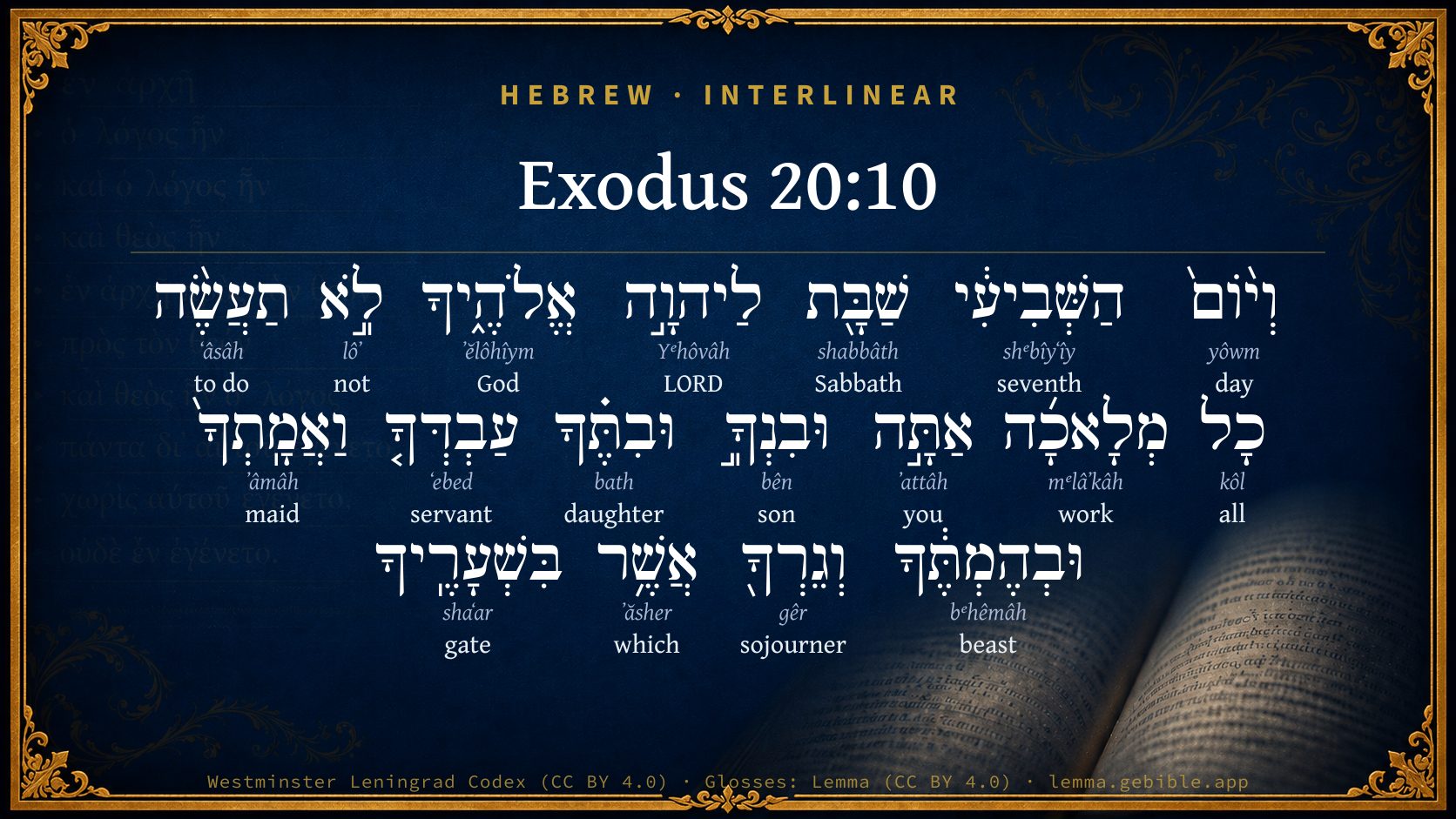
Hebrew (Westminster Leningrad Codex) Exodus 20:10 appears in the Hebrew Old Testament. The text above is from the Westminster Leningrad Codex. Each word links to its Strong’s number, a concise gloss, and parsing drawn from the Open Scriptures Hebrew Bible morphology. Click any word for its full Brown-Driver-Briggs (BDB) entry.
Download image
Cite this verse

Exodus 20:10 (World English Bible). Public Domain. Lemma interlinear Bible study tool, https://lemma.gebible.app/v/exodus/20/10.

Show BibTeX & RIS
BibTeX
RIS
English Translation
but the seventh day is a Sabbath to Yahweh your God. You shall not do any work in it, you, nor your son, nor your daughter, your man-servant, nor your maid-servant, nor your cattle, nor your stranger who is within your gates;
World English Bible · Public Domain
Download a study sheet

One document with this verse’s original text, its word-by-word gloss line, the meaning frame, cross-references with their text, attributed commentary, and full source and license credits — printable, and it pastes into notes with its structure intact.

This verse Autodidact and up

Study sheet (.html) Plain text (.txt)

A passage Seminary Student

Up to 50 verses in one chapter. A passage sheet keeps up to 6 commentary sources and 12 cross-references per verse, in the order this page ranks them, and says so on the sheet whenever that leaves anything out. Ask for a single verse and you get the Autodidact verse sheet above.

Everything on this page stays free to read, with no account — the sheet is a download of what is already on screen, not access to it.

Want to remove ads? Support Godless Engineer
Compare translations 3

The same verse in 3 English versions, stacked beneath the original-language interlinear above. Click any original word for its lexicon entry.

Each is an independent rendering of the whole verse — the interlinear is not word-aligned to these translations.

Highlighted words mark where these versions differ — a whole-verse word diff, not a word-by-word alignment.

  • World English Bible Public Domain
    but the seventh day is a Sabbath to Yahweh your God. You shall not do any work in it, you, nor your son, nor your daughter, your man-servant, nor your maid-servant, nor your cattle, nor your stranger who is within your gates;
  • King James Version Public Domain
    But the seventh day is the sabbath of the LORD thy God: in it thou shalt not do any work, thou, nor thy son, nor thy daughter, thy manservant, nor thy maidservant, nor thy cattle, nor thy stranger that is within thy gates:
  • unfoldingWord Literal Text CC BY-SA 4.0
    but the seventh day is a Sabbath for Yahweh your God. You shall not do any work, you or your son or your daughter, your male servant or your female servant or your cattle or the foreigner who is within your gates.

unfoldingWord Literal Text — © unfoldingWord, licensed CC BY-SA 4.0. Word-aligned USFM3 via Door43 (git.door43.org/unfoldingWord/en_ult).

Versions to compare (up to 4)

3 of 4 selected

Show all 18 translations

Every available English version of this verse, each an independent rendering of the whole verse.

  • World English Bible Public Domain
    but the seventh day is a Sabbath to Yahweh your God. You shall not do any work in it, you, nor your son, nor your daughter, your man-servant, nor your maid-servant, nor your cattle, nor your stranger who is within your gates;
  • Berean Standard Bible Public Domain
    but the seventh day is a Sabbath to the LORD your God, on which you must not do any work—neither you, nor your son or daughter, nor your manservant or maidservant or livestock, nor the foreigner within your gates.
  • Majority Standard Bible Public Domain
    but the seventh day is a Sabbath to the LORD your God, on which you must not do any work—neither you, nor your son or daughter, nor your manservant or maidservant or livestock, nor the foreigner within your gates.
  • King James Version Public Domain
    But the seventh day is the sabbath of the LORD thy God: in it thou shalt not do any work, thou, nor thy son, nor thy daughter, thy manservant, nor thy maidservant, nor thy cattle, nor thy stranger that is within thy gates:
  • American Standard Version (1901) Public Domain
    but the seventh day is a sabbath unto Jehovah thy God: `in it' thou shalt not do any work, thou, nor thy son, nor thy daughter, thy man-servant, nor thy maid-servant, nor thy cattle, nor thy stranger that is within thy gates:
  • Revised Version (1885) Public Domain
    but the seventh day is a sabbath unto the LORD thy God: in it thou shalt not do any work, thou, nor thy son, nor thy daughter, thy manservant, nor thy maidservant, nor thy cattle, nor thy stranger that is within thy gates:
  • Geneva Bible (1599) Public Domain
    But the seuenth day is the Sabbath of the Lord thy God: in it thou shalt not do any worke, thou, nor thy sonne, nor thy daughter, thy man seruant, nor thy mayde, nor thy beast, nor thy stranger that is within thy gates.
  • Douay-Rheims (1899) Public Domain
    But on the seventh day is the sabbath of the Lord thy God: thou shalt do no work on it, thou nor thy son, nor thy daughter, nor thy manservant, nor thy maidservant, nor thy beast, nor the stranger that is within thy gates.
  • Young's Literal Translation Public Domain
    and the seventh day `is' a Sabbath to Jehovah thy God; thou dost not do any work, thou, and thy son, and thy daughter, thy man-servant, and thy handmaid, and thy cattle, and thy sojourner who is within thy gates, --
  • Literal Standard Version CC BY-SA 4.0
    and the seventh day [is] a Sabbath to your God YHWH; you do not do any work, you, and your son, and your daughter, your manservant, and your handmaid, and your livestock, and your sojourner who is within your gates—
  • Unlocked Literal Bible CC BY-SA 4.0
    But the seventh day is a Sabbath for Yahweh your God. On it you must not do any work, you, or your son, or your daughter, or your male servant, or your female servant, or your cattle, or the foreigner who is within your gates.
  • unfoldingWord Literal Text CC BY-SA 4.0
    but the seventh day is a Sabbath for Yahweh your God. You shall not do any work, you or your son or your daughter, your male servant or your female servant or your cattle or the foreigner who is within your gates.
  • Darby Bible Public Domain
    but the seventh day is the sabbath of Jehovah thy God: thou shalt not do any work, thou, nor thy son, nor thy daughter, thy bondman, nor thy handmaid, nor thy cattle, nor thy stranger that is within thy gates.
  • World Messianic Bible Public Domain
    but the seventh day is a Sabbath to the LORD your God. You shall not do any work in it, you, nor your son, nor your daughter, your male servant, nor your female servant, nor your livestock, nor your stranger who is within your gates;
  • Webster's Bible Public Domain
    But the seventh day is the sabbath of the LORD thy God: in it thou shalt not do any work, thou, nor thy son, nor thy daughter, thy man-servant, nor thy maid-servant, nor thy cattle, nor thy stranger that is within thy gates:
  • Free Bible Version CC BY-SA 4.0
    but the seventh day is the Sabbath to honor the Lord your God. On this day you must not do any work—not you, not your son or daughter, not your male slave or female slave or livestock, and not the foreigner who is staying with you.
  • Bible in Basic English Public Domain
    But the seventh day is a Sabbath to the Lord your God; on that day you are to do no work, you or your son or your daughter, your man-servant or your woman-servant, your cattle or the man from a strange country who is living among you:
  • JPS Tanakh (1917) Public Domain
    but the seventh day is a sabbath unto the LORD thy God, in it thou shalt not do any manner of work, thou, nor thy son, nor thy daughter, nor thy man-servant, nor thy maid-servant, nor thy cattle, nor thy stranger that is within thy gates;

Literal Standard Version (2020), Covenant Press — licensed CC BY-SA 4.0. Text via the HelloAO Bible API (eBible.org). Unlocked Literal Bible (unfoldingWord) — licensed CC BY-SA 4.0. Text via the HelloAO Bible API (eBible.org). unfoldingWord Literal Text — © unfoldingWord, licensed CC BY-SA 4.0. Word-aligned USFM3 via Door43 (git.door43.org/unfoldingWord/en_ult). Free Bible Version, Dr. Jonathan Gallagher — licensed CC BY-SA 4.0. Text via the HelloAO Bible API (eBible.org).

Word by word

More ways to search: Search by grammar → Find every occurrence → Compare this word →

Practice this passage: Drill this verse → Learn its vocabulary →

וַאֲמָֽתְךָ֙
ʼâmâh
H519
“and · maid · your”
Conjunction + Noun, Common, Feminine, Singular, Construct + Suffix, Personal, 2nd Person, Masculine, Singular
Part of Speech
Conjunction + Noun
Type
Common
Gender
Feminine
Number
Singular
State
Construct
Full BDB Definition

Origin: apparently a primitive word

TWOT: 112

maid-servant, female slave, maid, handmaid, concubine - of humility (figuratively)
  1. וְי֨וֹם֙ yôwm H3117 “and · day of” Conjunction + Noun, Common, Masculine, Singular, Construct
  2. הַשְּׁבִיעִ֔י shᵉbîyʻîy H7637 “the · seventh” Particle, Definite Article + Adjective, Ordinal number, Masculine, Singular, Absolute
  3. שַׁבָּ֖ת shabbâth H7676 “Sabbath” Noun, Common, Both, Singular, Absolute
  4. לַיהוָ֣ה Yᵉhôvâh H3068 “to/for · LORD” Preposition + Noun, Proper
  5. אֱלֹהֶ֑יךָ ʼĕlôhîym H430 “God(s) · your” Noun, Common, Masculine, Plural, Construct + Suffix, Personal, 2nd Person, Masculine, Singular
  6. לֹֽ֣א lôʼ H3808 “not” Particle, Negative
  7. תַעֲשֶׂ֨ה ʻâsâh H6213 “to do” Verb, Qal, Imperfect, 2nd Person, Masculine, Singular
  8. כָל kôl H3605 “all of” Noun, Common, Masculine, Singular, Construct
  9. מְלָאכָ֜ה mᵉlâʼkâh H4399 “work” Noun, Common, Feminine, Singular, Absolute
  10. אַתָּ֣ה ʼattâh H859 “you” Pronoun, Personal, 2nd Person, Masculine, Singular
  11. וּבִנְךָֽ֣ bên H1121 “and · son · your” Conjunction + Noun, Common, Masculine, Singular, Construct + Suffix, Personal, 2nd Person, Masculine, Singular
  12. וּבִתֶּ֗ךָ bath H1323 “and · daughter · your” Conjunction + Noun, Common, Feminine, Singular, Construct + Suffix, Personal, 2nd Person, Masculine, Singular
  13. עַבְדְּךָ֤ ʻebed H5650 “servant · your” Noun, Common, Masculine, Singular, Construct + Suffix, Personal, 2nd Person, Masculine, Singular
  14. וּבְהֶמְתֶּ֔ךָ bᵉhêmâh H929 “and · beast · your” Conjunction + Noun, Common, Feminine, Singular, Construct + Suffix, Personal, 2nd Person, Masculine, Singular
  15. וְגֵרְךָ֖ gêr H1616 “and · sojourner · your” Conjunction + Noun, Common, Masculine, Singular, Construct + Suffix, Personal, 2nd Person, Masculine, Singular
  16. אֲשֶׁ֥ר ʼăsher H834 “which” Particle, Relative
  17. בִּשְׁעָרֶֽיךָ shaʻar H8179 “in/at · gates · your” Preposition + Noun, Common, Masculine, Plural, Construct + Suffix, Personal, 2nd Person, Masculine, Singular

About this verse

These counts appear in no published source. They are computed here, from the morphology-tagged text and Lemma’s own curated glosses. What Lemma adds →

18
words
18
distinct lemmas
Pentateuch
section

Shared distinctive vocabulary

וַאֲמָֽתְךָ֙ maid H519 occurs in 49 verses of the Hebrew Bible. Also found in:

Grammatical profile

  • 1 verb
  • 13 nouns
  • 1 adjective
  • 1 pronoun
  • 2 particles

Verb forms

  • תַעֲשֶׂ֨ה Qal · Imperfect

Hebrew & Septuagint length

In English translation the verse runs 42 words from the Hebrew and 49 from the Septuagint (LXX English) — closely comparable.

A rough comparison of the two English renderings, which tokenize alike — not a word-level alignment.

Word counts can differ between the Hebrew and the Greek without any difference in meaning — e.g. the Hebrew direct-object marker אֵת has no separate Greek word, and Greek often adds the article ὁ.

Cross-references

12

Topical passages linked to Exodus 20:10 in the Treasury of Scripture Knowledge — connected by theme and wording, ordered by reader-vote popularity; previews shown in the World English Bible.

  • Deuteronomy 5:14–15 but the seventh day is a Sabbath to Yahweh your God: [in it] you shall not do any work, you, nor your son, nor your daughter, nor your man-servant, nor your maid-servant, nor your ox, nor your donkey, nor any of your cattle, nor your stranger who is within your gates; that your man-servant and your maid-servant may rest as well as you.
  • Exodus 34:21 Six days you shall work, but on the seventh day you shall rest: in plowing time and in harvest you shall rest.
  • Exodus 16:27–28 It happened on the seventh day, that some of the people went out to gather, and they found none.
  • Numbers 15:32–36 While the children of Israel were in the wilderness, they found a man gathering sticks on the Sabbath day.
  • Genesis 2:2–3 On the seventh day God finished his work which he had made; and he rested on the seventh day from all his work which he had made.
  • Exodus 23:9–12 "You shall not oppress an alien, for you know the heart of an alien, seeing you were aliens in the land of Egypt.
  • Exodus 31:13 "Speak also to the children of Israel, saying, 'Most assuredly you shall keep my Sabbaths: for it is a sign between me and you throughout your generations; that you may know that I am Yahweh who sanctifies you.
  • Deuteronomy 24:14–22 You shall not oppress a hired servant who is poor and needy, whether he be of your brothers, or of your foreigners who are in your land within your gates:
  • Nehemiah 10:31 and if the peoples of the land bring wares or any grain on the Sabbath day to sell, that we would not buy of them on the Sabbath, or on a holy day; and that we would forego the seventh year, and the exaction of every debt.
  • Nehemiah 13:15–21 In those days saw I in Judah some men treading wine-presses on the Sabbath, and bringing in sheaves, and lading donkeys [therewith]; as also wine, grapes, and figs, and all manner of burdens, which they brought into Jerusalem on the Sabbath day: and I testified [against them] in the day in which they sold food.
  • Luke 23:56 They returned, and prepared spices and ointments. On the Sabbath they rested according to the commandment.
  • Deuteronomy 16:11–12 and you shall rejoice before Yahweh your God, you, and your son, and your daughter, and your man-servant, and your maid-servant, and the Levite who is within your gates, and the foreigner, and the fatherless, and the widow, who are in the midst of you, in the place which Yahweh your God shall choose, to cause his name to dwell there.

Cross-references courtesy of OpenBible.info (CC BY 4.0).

Hebrew and Greek witnesses Masoretic Hebrew ↔ Greek Septuagint

The same verse in the two great witnesses to the Old Testament, shown verse-for-verse.

These are two independent witnesses, not word-aligned to each other, and the Septuagint is shown in lemma (dictionary) form.

Hebrew Exodus 20:10 Masoretic · Westminster Leningrad Codex

וְי֨וֹם֙ הַשְּׁבִיעִ֔י שַׁבָּ֖ת לַיהוָ֣ה אֱלֹהֶ֑יךָ לֹֽ֣א תַעֲשֶׂ֨ה כָל מְלָאכָ֜ה אַתָּ֣ה וּבִנְךָֽ֣ וּבִתֶּ֗ךָ עַבְדְּךָ֤ וַאֲמָֽתְךָ֙ וּבְהֶמְתֶּ֔ךָ וְגֵרְךָ֖ אֲשֶׁ֥ר בִּשְׁעָרֶֽיךָ

but the seventh day is a Sabbath to Yahweh your God. You shall not do any work in it, you, nor your son, nor your daughter, your man-servant, nor your maid-servant, nor your cattle, nor your stranger who is within your gates;

World English Bible · Public Domain

Greek LXX Exodus 20:10 Septuagint · lemma form

ὁ δέ ἡμέρα ὁ ἕβδομος σάββατον κύριος ὁ θεός σύ οὐ ποιέω ἐν αὐτός πᾶς ἔργον σύ καί ὁ υἱός σύ καί ὁ θυγάτηρ σύ ὁ παῖς σύ καί ὁ παιδίσκη σύ ὁ βοῦς σύ καί ὁ ὑποζύγιον σύ καί πᾶς κτῆνος σύ καί ὁ προσήλυτος ὁ παραοἰκέω ἐν σύ

But on the seventh day is the sabbath of the Lord your God; on it you shall do no work, you, nor your son, nor your daughter, your servant nor your maidservant, your ox nor your ass, nor any cattle of yours, nor the stranger that sojourns with you.

LXX2012 (modern English Septuagint) · Public Domain

On this verse, The Cambridge Bible for Schools and Colleges discusses the Septuagint’s reading. Read the note in Commentary ↓

Hebrew: Westminster Leningrad Codex (CC BY 4.0). Greek: Septuagint (public domain); English from LXX2012 (modern English Septuagint) (Public Domain). How the Septuagint differs from the Hebrew →

Targum (Aramaic paraphrase)

2

The Targum is the ancient Jewish Aramaic paraphrase of the Hebrew Scriptures — an interpretive translation, not the Hebrew text itself. Onkelos (literal) and Pseudo-Jonathan (expansive) render the Torah, and Jonathan the Prophets. Coverage is partial: where no permissively-licensed English translation exists for a verse, only the Aramaic is shown. This is verse-level text, not a word-by-word alignment to the Hebrew.

  1. Targum Onkelos Torah (Genesis–Deuteronomy)
    וְיוֹמָא שְׁבִיעָאָה שַׁבְּתָא קֳדָם יְיָ אֱלָהָךְ לָא תַעְבֵּד כָּל עִבִדְתָּא אַתְּ וּבְרָךְ וּבְרַתָּךְ עַבְדָךְ וְאַמְתָךְ וּבְעִירָךְ וְגִיוֹרָךְ דִי בְקִרְוָךְ:

    (no public-domain English translation for this verse)

    Targum Onkelos — Aramaic: “Onkelos Genesis” (public domain); “Onkelos Exodus” (public domain); “Onkelos Leviticus” (public domain); “Onkelos Numbers” (public domain); “Onkelos Deuteronomy” (public domain). English: “Sefaria Community Translation” (CC0 1.0 (public-domain dedication)); “J.W. Etheridge. The Targums of Onkelos and Jonathan Ben Uzziel on the Pentateuch. London: Longmans, Green, 1862” (public domain). Text via Sefaria.

  2. Targum Pseudo-Jonathan Torah (Genesis–Deuteronomy)
    וְיוֹמָא שְׁבִיעָאָה שַׁבָּת וְנַיַּיח קֳדָם יְיָ אֱלָהָכוֹן לָא תַעְבְדוּן כָּל עִבִידְתָּא אַתּוּן וּבְנֵיכוֹן וּבְנָתֵיכוֹן וְעַבְדֵיכוֹן וְאַמְהוֹתֵיכוֹן וְגִיּוֹרֵיכוֹן בְּקִירְוֵיכוֹן

    but the seventh day is (for) rest and quietude before the Lord your God: you shall not perform any work, you, and your sons, and your daughters, and your servants, and your handmaids, and your sojourners who are in your cities.

    Targum Pseudo-Jonathan — Aramaic: “Targum Jonathan on Genesis” (public domain); “Targum Jonathan on Exodus” (public domain); “Targum Jonathan on Leviticus” (public domain); “Targum Jonathan on Numbers” (public domain); “Targum Jonathan on Deuteronomy” (public domain). English: “The Targum of Jonathan ben Uzziel, trans. J. W. Etheridge, London, 1862” (public domain). Text via Sefaria.

Commentary

Notes on Exodus 20:10 from classic Christian and Jewish commentators (each source and its license shown beneath its notes). The classic Christian expositions comment on the surrounding passage and are grouped to its opening verse, so a note may address several verses; the Jewish commentaries on the Tanakh (Rashi and others) are per-verse, so they appear only where the commentator wrote on this verse.

Lemma curates 59 commentaries, every one of them public domain or Creative Commons licensed, each selected and text-cleaned for this edition rather than reprinted as found. About our sources →

Trapp's Complete Commentary

John Trapp

Exo 20:10 But the seventh day [is] the sabbath of the LORD thy God: [in it] thou shalt not do any work, thou, nor thy son, nor thy daughter, thy manservant, nor thy maidservant, nor thy cattle, nor thy stranger that [is] within thy gates:

Ver. 10. But the seventh day.] Or, A seventh day. Not only Hebrews, but also Greeks and Barbarians, did rest from work on the seventh day: witness Josephus, Clemens Alexand., and Eusebius. That which they tell us of the river Sabbatius, its resting, and not running on that day, I look upon as fabulous.

Thou shalt not do any work.] Only works of piety, of charity, and of necessity may bc done on the Sabbath day. He that but gathered sticks was paid home with stones. The first blow given the German Churches was upon the Sabbath day, which they carelessly observed. Prague was lost upon that day. {a}

Thou, nor thy son, &c.] Every mother’s child. The baser sort of people in Sweden do always break the Sabbath, saying, that it is for gentlemen to keep that day. {b}

Thy man servant.] There is an old law of the Saxon king Ina, If a villain work on Sunday by his lord’s command, he shall be free. {c} {See Trapp (for summary of Law) on "Exo 20:17"}

{a} Dike, Of Confession of Sin, p. 276.

{b} David’s Desire, by R. Abbot.

{c} Sir H. Spelman, in Concil.

John Trapp, A Commentary or Exposition upon All the Books of the Old and New Testament (1647–1656) — public domain. Text from a community e-Sword module.

Geneva Bible (1599)

Geneva Bible translators

Or, city.

Geneva Bible (1599) marginal notes — public domain. Text via Bolls.life.

Ellicott's Commentary for English Readers

(10) But the seventh day is the sabbath of the Lord thy God.—Heb., But the seventh day (shall be) a sabbath to the Lord thy God—i.e., it shall be a day of holy rest from things worldly, and of devotion to things heavenly. (See Note 2 on Exo_20:8.)

In it thou shalt not do any work.—This negative aspect of the Sabbath is further emphasised by particular prohibitions :—(1) The prohibition against gathering the manna on the Sabbath (Exo_16:26); (2) the prohibition against lighting a fire (Exo_35:3); (3) against gathering sticks (Num_15:35). Some exceptions were allowed, as the work of the Priests and Levites in the Temple on the Sabbath, attendance on and care of the sick, rescue of a beast that was in peril of its life, &c. (See Mat_12:5; Mat_12:11.) But the tendency was to press the negative aspect to an extreme, and to ignore the positive one. By the time of the Maccabees it had come to be considered unlawful to defend oneself against the attack of an enemy on the Sabbath (1Ma_2:32-38 :2Ma_5:25-26; 2Ma_6:11; 2Ma_15:1); and, though this extravagant view did not maintain its ground, yet at the time of our Lord’s ministry a rigour of observance was in vogue upon other points which exceeded the limits of reasonable exegesis. Our Lord’s practice was pointedly directed against the overstrained theory of Sabbath observance which was current in His day, and was clearly intended to vindicate for His disciples a liberty which ecclesiastical authority was disposed to deny them. There are parts of Christendom in which, even at the present day, a similar spirit prevails, and a similar vindication is needed.

Nor thy son, nor thy daughter.—The whole family was to partake in the Sabbatical rest. Labour was to cease, not to be devolved by the stronger on weaker members.

Thy manservant, nor thy maidservant.—The rest was to extend also to the domestics, who specially required it, since the heavier labours of the household had to be performed by them.

Thy cattle.—Labour can scarcely be exacted from cattle without man being also called upon to work. God, however, “careth for cattle,” even for their own sakes, and wills that the Sabbath rest be extended to them. “His mercy is over all His works,” and embraces the dumb unreasoning animals no less than His human creatures. (Comp. Gen_8:1; Gen_9:9-11; Exo_9:19; Deu_25:4; Jon_4:11.)

A Bible Commentary for English Readers, edited by Charles John Ellicott (1878–1897) — public domain. Text from a community e-Sword module.

The Cambridge Bible for Schools and Colleges

gen. ed. J. J. S. Perowne

10. The rest is to be a general one: no work is to be done either by the Israelite himself, or any member of his household (including his servants), or by his cattle, or by the ‘sojourner’ settled in his cities.

in it] LXX. Pesh. Vulg. express this; Sam. and the Nash papyrus read it.

manservant … maidservant] bondman … bondmaid: the meaning is (as always) male and female slaves. Cf. Exo_21:2; Exo_21:7.

stranger] sojourner, or foreigner settled in Israel (see on Exo_12:48): he also is to enjoy rest from his toil on the sabbath. Cf. the injunction not to oppress him (Exo_22:21, with the note). For the enumeration, cf. Deu_12:12; Deu_12:18; Deu_16:11; Deu_16:14.

thy gates] i.e. thy cities, a distinctively Deut. expression, occurring 26 times in Dt., and only 1Ki_8:37 = 2Ch_6:28 (Deut. compiler) besides; comp. esp. (with ‘within‘) Deu_12:12; Deu_12:18; Deu_14:21; Deu_14:27; Deu_14:29; Deu_16:11; Deu_16:14; Deu_24:14; Deu_31:12. In Deu_5:14 a clause is added, emphasizing the humanitarian purpose of the observance; cf. Deu_12:7; Deu_12:12; Deu_14:29.

The Cambridge Bible for Schools and Colleges (gen. ed. J. J. S. Perowne; Cambridge University Press, 1878–1918) — public domain. Text from a community e-Sword module.

John Gill's Exposition

But the seventh day is the sabbath of the Lord thy God,.... Not which he rested on, and ceased from the works of creation in, though he did rest on the seventh day of the creation, and so on every other day since, as well as that; nor does it appear, nor can it be proved, that this day appointed to the Jews as a sabbath was the seventh day of the week from the creation of the world; but was either the seventh day of the week from their coming out of Egypt, or from the raining of the manna: but this is called the Lord's sabbath, or rest, because enjoined by him to the people of Israel, and not to them until they were separated from other people, and were a distinct body of men under a certain meridian; for it is impossible that one and the same day, be it the seventh, or any other, should be kept to exactness of time by all the inhabitants of the earth; it being night with one part, when it is day with another, and not the same day to them all:

in it thou shall not do any work; of a servile nature, exercise any trade or any hand labour, or any kind of work for pleasure or profit, only works of mercy and necessity. No labour or handicraft was to be exercised, according to the Jewish canons (f), until the going out of it, or the appearance of the stars:

thou, nor thy son, nor thy daughter; neither a man nor his children, male and female, such as were under age, and under the tuition, direction, and care of their parents, who were to instruct them in this kind, and not suffer them to work on this day, and much less oblige them to it; for as for those that were grown up, and no longer under the inspection of parents, and were heads of families themselves, they are included in the word "thou", and are in the first place charged in this command:

thy manservant, nor thy maidservant; this is to be understood, according to the Jews, not of hired servants, concerning whose rest from labour a man was not bound (g), but of such as were born in their house, and bought with their money; and of such menservants as were circumcised, and in all things professed to be proselytes to the Jewish religion, and to conform to it; for as for one that only received the commands of the sons of Noah, and was not circumcised, he might do work for himself on the sabbath day, but not for his master; and no Israelite might bid him work on the sabbath day for the necessity of an Israelite, though he was not his master (h). If a servant does work without the knowledge of his master, and it is known to all that he does it without his knowledge, there is no need to separate him from it, or take him off of it (i): so maidservants, when they did things without the knowledge of their masters and mistresses, and without being bid to do it, they were free to do it: thus, for instance, they say (k),"a cheese which maids make of themselves, of milk that belongs to an Israelite, is lawful when he does not bid them make it:"

nor thy cattle, of any sort whatever that is used to labour, because if the cattle did not rest, servants could not, who are concerned in the care and use of them: in Deu 5:14, the ox and the ass are particularly mentioned, because laborious creatures; the one were used in ploughing, and treading out the corn, and the other to ride upon, and carry burdens; and concerning the latter the Jews have this canon (l),"he who is going in the way, (or on a journey,) and has sanctified for himself the day, and has money with him, and has an ass; and though he has with him an idolater, he may not put his bag upon his ass; because he is commanded concerning its rest; but he may give his bag to the idolater to throw it upon it; and at the going out of the sabbath he may receive it from him, and even may not give him a reward for it;''but not only those, but all sorts of cattle were exempt from labour on this day, as horses, camels, mules, &c. which, according to the Jewish canons, as they were not to be employed in work by the Jews, so they were not to be let or lent out to an idolater (m): nor the stranger that is within thy gates: who was a proselyte of the gate, and not of righteousness; as for the proselyte of righteousness that was circumcised, and professed the Jewish religion, about him there could be no doubt concerning his rest on this day; but the proselyte of the gate, his case was not so clear, and therefore is particularly expressed; and by which description it should seem that he was not obliged by this law, had he not been within their gates, or a sojourner in anyone of their cities; since it was contrary to the laws and usages among whom they dwelt, and might be an offence to some, and a snare to others, and, as Grotius thinks, might be to their detriment, get their work and their gain from them, they are forbid to work; and yet, according to the Jewish writers (n), they might work for themselves, though not for an Israelite, as before observed.

(f) Schulchan Aruch, par. 1. Orach Chayim Hilchot Sabbat, c. 293. sect. 2, 3. (g) Lebush, par. 1. c. 304. sect. 1. (h) Schulchan Aruch, ib. c. 304, sect. 1. (i) Lebush, ib. (k) Schulchan, ib. c. 305. sect. 21. (l) lb. c. 266. sect. 1. (m) Ib. c. 246. sect. 3. (n) Maimon. Hilchot Sabbat, c. 20. sect. 14.

John Gill's Exposition of the Whole Bible (1746–1763) — public domain (CC PDM 1.0). Text via the HelloAO Bible API.

Haydock's Catholic Bible Commentary

Stranger. Of some other nation. Good policy required that all should conform to this regulation, whatever their religion might be. (Grotius) --- Maimonides says, without any probablility, that "a Gentile observing the law, was guilty of death." (Calmet)

George Leo Haydock (1774–1849), Haydock's Catholic Family Bible and Commentary, 1859 edition — public domain. Excludes Psalms (Douay-Rheims chapter numbering differs from Protestant) and Deuterocanonical books (Catholic canon only).

Matthew Poole's English Annotations

The sabbath of the Lord, or, to the Lord, i.e. consecrated to his use, honour, and service. Hence God calls them my sabbaths, Lev 26:2; Isa 56:4, because they are commended by his example, and enjoined by his command. Any work; , i.e. any servile, laborious, common, or worldly work, tending to thy own profit or pleasure. See Exo 34:21; Lev 23:7; Num 28:18; Isa 58:13.

Nor thy son, nor thy daughter, thy man-servant, nor thy maid-servant: this clause is added, not as if children or servants were not immediately obliged by this command, or were excused by God for the breach of this law at their master’s commands, which were to obey men rather than God, contrary to St. Peter’s command and practice, Act 5:29 and which were to limit the foregoing word thou, and the law of the sabbath, only to those that have children and servants, which is an idle, senseless, and absurd, as well as profane opinion; but to restrain hard-hearted, and covetous, or ungodly persons, that they should neither command nor suffer their children or servants to profane the sabbath, so far as they can hinder it; which how far it concerns thousands of governors of families at this day, they shall do well seriously and in time to consider.

Nor thy cattle, partly, to teach us to exercise mercy towards the brute creatures; compare Deu 5:14; partly, because the use of cattle must have drawn along with it the attendance and employment of men; and partly, that by observing the rest of the cattle, they might be more minded and quickened to the observation of this sacred rest.

Nor thy stranger, i.e. the Gentile that sojourneth with thee; lest their example should provoke the Israelites to imitate them; and lest the Gentiles should have opportunity of gaining at that time when, and by that thing whereby, the Israelites were losers, even by the religious observation of the sabbath. That dwells within thy cities, which have walls and gates, or within thy villages or territories. So the word gates is oft taken, as Gen 22:17; 24:60; 2Sa 10:8, compared with 1Ch 19:9.

Matthew Poole's English Annotations on the Holy Bible (1683–1685) — public domain. Text from a community e-Sword/MySword module.

Whedon's Commentary on the Bible

Daniel D. Whedon

10. Thou shalt not do any work — The kinds of work incidentally noticed as coming under this prohibition were gathering manna, (Exo_16:27-29,) plowing, and gathering of harvests, (Exo_34:21,) kindling fires, (Exo_35:3,) collecting wood, (Num_15:32-36,) selling articles of commerce, (Amo_8:5,) bearing burdens, (Jer_17:21,) treading wine-presses, and carrying on traffic. Neh_13:15-22. From this it is evident that the commandment was understood as forbidding all sorts of ordinary work, and was to be applied to all members of the house, and even to the cattle, that is, the beasts of burden. The stranger, that is, the foreigner who settled in any of the cities of Israel, must also observe the sabbath law. The holy day, however, was not to be a day of gloom and sadness, but one filled with all such delights as would bring the heart into closer fellowship with Jehovah. Isa_58:13-14.

Daniel D. Whedon (gen. ed.), Commentary on the Old and New Testaments (1874–1909) — public domain. Text from a community e-Sword module.

The Pulpit Commentary

The seventh day is the sabbath of the Lord thy God. Rather seventh day shall be a sabbath to the Lord thy God;" i.e. , the seventh day shall be a day of holy rest dedicated to religion. All unnecessary labour shall be suspended and put aside the law of rest and ease, so far as bodily toil is concerned, which was the law of man"s existence before the fall, shall supersede for the time that law of heavy toil and continual unrest, which was laid on man as the penalty of his transgression. (Gen_3:17-19) Eden shall be, as it were, restored man shall not "go out to his toil and his labour even the very beasts, pressed into man"s service since the fall, shall rest. In it thou shalt not do any work. On the exceptions to this rule, which even Judaism, with its extreme formality and literalism, saw to be necessary, see Mat_12:5, Mat_12:11. Still in many respects, a superstitious adherence to the precept was maintained by religious Jews, who would not even defend themselves on the sabbath, if attacked by an enemy. (RAPC 1Ma 2:32-38 2Ma 5:25, 26 6:11 15:1) Experience, however, taught them that the law had not been intended to extend so far, and after a time they determined, not to seek battle, but to accept if, and do their best, on the sabbath day. (RAPC 1Ma 2:41) Thou, nor thy son, nor thy daughter. The rest is to extend to the whole family. Work is not to be merely devolved by the parents upon the children. Thy manservant, nor thy maid servant. It is to extend beyond the family proper, to the domestics of the household, who are to enjoy the respite from toil and to have the advantage of the religious refreshment, no less than their masters. Nor thy cattle. God"s care for cattle is a remarkable feature of the Old Testament dispensation. God, at the time of the flood, "remembered Noah and the cattle which were with him in the ark". (Gen_8:1) Soon after, his covenant, not to drown the earth any more, was established "with the fowl, and with the cattle, and with every beast of the earth," no less than with man. (Gen_9:9-11) In the Psalms he de clares that "the cattle upon a thousand hills" are his. (Psa_50:10) In Jonah, we find that Nineveh was spared, in part because there was in it "much cattle". (Jon_4:11) The precept, "Thou shalt not muzzle the ox when he treadeth out the corn" is characteristic of the Mosaic dispensation, and had no parallel in the written codes or in the actual customs of other ancient nations. Animal suffering was generally regarded as of small account in the ancient world; and the idea of protecting animals from ill usage was wholly unknown. On the contrary, as Dr. Dollinger well observes (Jew and Gentile, vol. 2. pp. 346-7): "The law was specially careful about the welfare of animals; they were to be treated with compassion and kindness. Domestic animals were to be well fed, and to enjoy the rest of the sabbath. The Israelites were to help to lift up the ass which had fallen beneath its burden, and to bring back the beast that had gone astray. (Exo_23:5, Exo_23:12; Deu_25:4) The young was not to be taken from its mother before the seventh day From these and similar ordinances such, for instance, as about the least painful method of killing animals it is plain that the law tried to subdue that coarse turn of mind and unfeeling cruelty, which are engendered by the maltreatment of animals." Nor the stranger that is within thy gates. The "strangers within the gates" of Israel are those foreigners who voluntarily sojourned with them in their camps or (afterwards) in their towns. A "mixed multitude" had gone up out of Egypt with them, (Exo_12:38) and accompanied them in their wilderness wanderings. The command that these too should rest, was at once a restriction upon their liberty, requiring them to conform to the habits of those among whom they dwelt, and an admission of them into participation in some portion of the privileges of Israel. The sacred rest of the sabbath prefigured the final peace and happiness of the blest in heaven; and they who were commanded to share in the first, were encouraged to hope that they might also participate in the second.

The Pulpit Commentary (1880–1919), ed. H.D.M. Spence-Jones & Joseph S. Exell — public domain. Text from a community e-Sword module.

Rashi

Rabbi Shlomo Yitzchaki (Rashi)

אתה ובנך ובתך THOU AND THY SON AND THY DAUGHTER — these latter mean the young children. Or perhaps this is not so, but it means your adult children? But you must admit that these have already been placed under this prohibition (by the word “Thou”, because the performance of this command is obligatory upon all adults to whom it was addressed). Therefore these words must be intended only to admonish the adults (implied in the term “Thou”) about the Sabbath rest of their young children (to impose upon the parents the obligation of enforcing the Sabbath rest upon them) (Mekhilta). This is the meaning of what we have learnt in a Mishna, (Shabbat 16:6) “A minor who is about to extinguish a fire — we do not listen to him (do not permit him to do this), because his observance of the Sabbath is a duty imposed upon you”.

Rashi on the Tanakh — English translations: “The Judaica Press complete Tanach with Rashi, translated by A. J. Rosenberg” (CC BY 4.0); “Pentateuch with Rashi's commentary by M. Rosenbaum and A.M. Silbermann, 1929-1934” (public domain); “The Metsudah Tanach series, Lakewood, N.J” (CC BY 4.0); and “The Book of Joshua, Metsudah Publications, 1997” (CC BY 4.0). Text via Sefaria.

Ramban (Nachmanides)

Rabbi Moshe ben Nachman (Ramban / Nachmanides)

NOR THY STRANGER THAT IS WITHIN THY GATES. In line with the plain meaning of Scripture, “the stranger of the gate” is always the geir toshav, are described here in the text. who came to dwell in “the gates of our cities” and has taken upon himself the Seven Laws of the Noachides. It is he who is called “the stranger who eats the unlawfully-slaughtered animal,” of whom Scripture says, thou mayest give it to the stranger that is within thy gates, that he may eat it. Therefore, the commandment [prohibiting work on the Sabbath] was not directed to him so that Scripture would be saying: “Do not do any work on it, the home-born or the stranger.” Instead, it is we who are commanded that he do no work for our benefit, just as [we are commanded about] our minors and the cattle, but this commandment is not incumbent upon him and he may do work for himself on the Sabbath. The verse which states, so that the son of thy handmaid, and the stranger, may rest, speaks of the righteous proselyte who has become Jewish and embraced our Torah, which has commanded him concerning the Sabbath and all the rest of the commandments as well, as He has said, One law and one ordinance shall be both for you, and for the stranger that sojourneth with you; both for the stranger, and for him that is born in the land., 9:14.However, we have found in the words of our Rabbis that they have interpreted it in the opposite manner. Thus they have said that by way of the plain meaning of Scripture, thy stranger that is within thy gates means the righteous proselyte, and ceasing from work [on the Sabbath] is incumbent upon him as it is upon us. The verse, so that the son of thy handmaid, and the stranger, may rest, includes the uncircumcised geir toshav. are described here in the text. The Rabbis’ intent in so explaining the verses is that first, [i.e., right here in the Ten Commandments], “the stranger” warned is the proselyte who has been circumcised, who is obligated in the observance of the Sabbath as we are. The second verse — [further, 23:12] — includes the uncircumcised [geir toshav]. Therefore, he is likened there to the cattle, as the verse says, that thine ox and thine ass may have rest, and the son of thy handmaid, and the stranger, may rest. Thus He commanded us concerning the resting of all of them alike that they should not work for us, but they may do [work] for themselves if they so wish. Similarly, the servant and the stranger mentioned in the Ten Commandments are alike, being obligated in the observance of all laws of the Sabbath as we are, even as He has said, that thy manservant and thy maidservant may rest as well as thou.

Ramban (Nachmanides) on the Tanakh — English translation: “Commentary on the Torah by Ramban (Nachmanides). Translated and annotated by Charles B. Chavel. New York, Shilo Pub. House, 1971-1976” (CC BY 4.0). Text via Sefaria.

Lesson kit

Teaching starters — assembled from the data on this page, not authored interpretation. Every prompt links to the verse data it draws on. Edit before teaching.

Exodus, in the Pentateuch, opens this verse with 18 words (18 distinct Hebrew lemmas). Its most distinctive word is ʼâmâh (“maid”). A historical commentator’s framing appears above. Read the whole chapter for the surrounding context.

Discussion questions

  1. How does “maid” (ʼâmâh) shape what this verse is saying?
  2. How does Genesis 20:17, which shares the word «maid», read alongside this verse?
  3. These translations render this verse differently; the difference is in the English rendering, not the original. What questions does that raise?
  4. «תַעֲשֶׂ֨ה» is a Qal Imperfect verb. How does that grammatical form shape the action described?
  5. Compare how Trapp's Complete Commentary and Geneva Bible (1599) read this verse. Where do they agree or differ?

Things to notice

Reading settings

Reading text

Shown beneath each verse's original-language words.

Old Testament
Old Testament edition

Read the OT as the Masoretic Hebrew (MT) or the Greek Septuagint (LXX).

English shown for the Greek Septuagint (in the Hebrew ↔ Greek comparison).

Comparing translations? Open the Compare panel on any verse page to stack up to four side by side.