
2 Kings 23:8

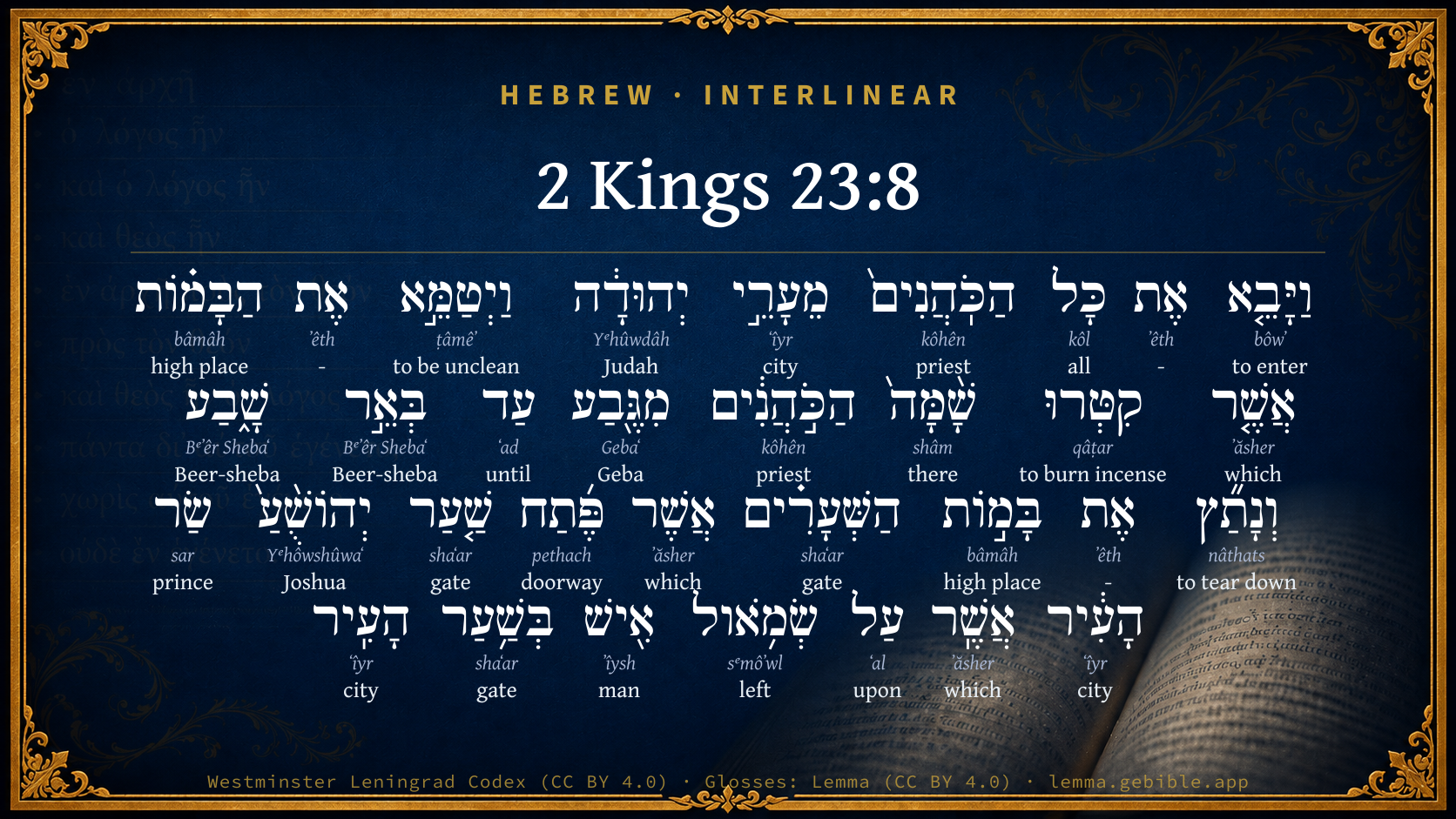
Hebrew (Westminster Leningrad Codex) 2 Kings 23:8 appears in the Hebrew Old Testament. The text above is from the Westminster Leningrad Codex. Each word links to its Strong’s number, a concise gloss, and parsing drawn from the Open Scriptures Hebrew Bible morphology. Click any word for its full Brown-Driver-Briggs (BDB) entry.
Download image
Cite this verse

2 Kings 23:8 (World English Bible). Public Domain. Lemma interlinear Bible study tool, https://lemma.gebible.app/v/2-kings/23/8.

Show BibTeX & RIS
BibTeX
RIS
English Translation
He brought all the priests out of the cities of Judah, and defiled the high places where the priests had burned incense, from Geba to Beersheba; and he broke down the high places of the gates that were at the entrance of the gate of Joshua the governor of the city, which were on a man's left hand at the gate of the city.
World English Bible · Public Domain
Download a study sheet

One document with this verse’s original text, its word-by-word gloss line, the meaning frame, cross-references with their text, attributed commentary, and full source and license credits — printable, and it pastes into notes with its structure intact.

This verse Autodidact and up

Study sheet (.html) Plain text (.txt)

A passage Seminary Student

Up to 50 verses in one chapter. A passage sheet keeps up to 6 commentary sources and 12 cross-references per verse, in the order this page ranks them, and says so on the sheet whenever that leaves anything out. Ask for a single verse and you get the Autodidact verse sheet above.

Everything on this page stays free to read, with no account — the sheet is a download of what is already on screen, not access to it.

Want to remove ads? Support Godless Engineer
Compare translations 3

The same verse in 3 English versions, stacked beneath the original-language interlinear above. Click any original word for its lexicon entry.

Each is an independent rendering of the whole verse — the interlinear is not word-aligned to these translations.

Highlighted words mark where these versions differ — a whole-verse word diff, not a word-by-word alignment.

  • World English Bible Public Domain
    He brought all the priests out of the cities of Judah, and defiled the high places where the priests had burned incense, from Geba to Beersheba; and he broke down the high places of the gates that were at the entrance of the gate of Joshua the governor of the city, which were on a man's left hand at the gate of the city.
  • King James Version Public Domain
    And he brought all the priests out of the cities of Judah, and defiled the high places where the priests had burned incense, from Geba to Beersheba, and brake down the high places of the gates that were in the entering in of the gate of Joshua the governor of the city, which were on a man's left hand at the gate of the city.
  • unfoldingWord Literal Text CC BY-SA 4.0
    And he brought all of the priests from the cities of Judah, and he defiled the high places where the priests had burned incense there, from Geba to Beersheba. And he tore down the high places of the gates that the entrance of the gate of Joshua, the commander of the city, which on the left of a man at the gate of the city.

unfoldingWord Literal Text — © unfoldingWord, licensed CC BY-SA 4.0. Word-aligned USFM3 via Door43 (git.door43.org/unfoldingWord/en_ult).

Versions to compare (up to 4)

3 of 4 selected

Show all 18 translations

Every available English version of this verse, each an independent rendering of the whole verse.

  • World English Bible Public Domain
    He brought all the priests out of the cities of Judah, and defiled the high places where the priests had burned incense, from Geba to Beersheba; and he broke down the high places of the gates that were at the entrance of the gate of Joshua the governor of the city, which were on a man's left hand at the gate of the city.
  • Berean Standard Bible Public Domain
    Then Josiah brought all the priests from the cities of Judah and desecrated the high places, from Geba to Beersheba, where the priests had burned incense. He tore down the high places of the gates at the entrance of the gate of Joshua the governor of the city, which was to the left of the city gate.
  • Majority Standard Bible Public Domain
    Then Josiah brought all the priests from the cities of Judah and desecrated the high places, from Geba to Beersheba, where the priests had burned incense. He tore down the high places of the gates at the entrance of the gate of Joshua the governor of the city, which was to the left of the city gate.
  • King James Version Public Domain
    And he brought all the priests out of the cities of Judah, and defiled the high places where the priests had burned incense, from Geba to Beersheba, and brake down the high places of the gates that were in the entering in of the gate of Joshua the governor of the city, which were on a man's left hand at the gate of the city.
  • American Standard Version (1901) Public Domain
    And he brought all the priests out of the cities of Judah, and defiled the high places where the priests had burned incense, from Geba to Beer-sheba; and he brake down the high places of the gates that were at the entrance of the gate of Joshua the governor of the city, which were on a man's left hand at the gate of the city.
  • Revised Version (1885) Public Domain
    And he brought all the priests out of the cities of Judah, and defiled the high places where the priests had burned incense, from Geba to Beer-sheba; and he brake down the high places of the gates that were at the entering in of the gate of Joshua the governor of the city, which were on a man’s left hand at the gate of the city.
  • Geneva Bible (1599) Public Domain
    Also he brought all the priests out of the cities of Iudah, and defiled the hie places where the Priests had burnt incense, euen from Geba to Beer-sheba, and destroyed the hie places of the gates, that were in the entring in of the gate of Ioshua the gouernour of the citie, which was at the left hand of the gate of the citie.
  • Douay-Rheims (1899) Public Domain
    And he gathered together all the priests out of the cities of Juda: and he defiled the high places, where the priests offered sacrifice, from Gabaa to Bersabee: and he broke down the altars of the gates that were in the entering in of the gate of Josue governor of tile city, which was on the left hand of the gate of the city.
  • Young's Literal Translation Public Domain
    And he bringeth in all the priests out of the cities of Judah, and defileth the high places where the priests have made perfume, from Geba unto Beer-Sheba, and hath broken down the high places of the gates that `are' at the opening of the gate of Joshua, head of the city, that `is' on a man's left hand at the gate of the city;
  • Literal Standard Version CC BY-SA 4.0
    And he brings in all the priests out of the cities of Judah, and defiles the high places where the priests have made incense, from Geba to Beer-Sheba, and has broken down the high places of the gates that [are] at the opening of the Gate of Joshua, head of the city, that [is] on a man’s left hand at the gate of the city;
  • Unlocked Literal Bible CC BY-SA 4.0
    Josiah brought all the priests out of the cities of Judah and defiled the high places where the priests had burned incense, from Geba to Beersheba. He destroyed the high places at the gates that were at the entrance to the gate of Joshua (the city governor), on the left side of the city gate.
  • unfoldingWord Literal Text CC BY-SA 4.0
    And he brought all of the priests from the cities of Judah, and he defiled the high places where the priests had burned incense there, from Geba to Beersheba. And he tore down the high places of the gates that the entrance of the gate of Joshua, the commander of the city, which on the left of a man at the gate of the city.
  • Darby Bible Public Domain
    And he brought all the priests out of the cities of Judah, and defiled the high places where the priests had burned incense, from Geba even to Beer-sheba; and he broke down the high places of the gates, those at the entrance of the gate of Joshua the governor of the city, [and] those on the left hand of any [going in] at the gate of the city.
  • World Messianic Bible Public Domain
    He brought all the priests out of the cities of Judah, and defiled the high places where the priests had burned incense, from Geba to Beersheba; and he broke down the high places of the gates that were at the entrance of the gate of Joshua the governor of the city, which were on a man’s left hand at the gate of the city.
  • Webster's Bible Public Domain
    And he brought all the priests out of the cities of Judah, and defiled the high places where the priests had burnt incense, from Geba to Beer-sheba, and broke down the high places of the gates that were in the entrance of the gate of Joshua the governor of the city, which were on a man's left hand at the gate of the city.
  • Free Bible Version CC BY-SA 4.0
    Josiah brought to Jerusalem all the priests from the towns of Judah and defiled the high places, from Geba to Beersheba, where the priests had sacrificed burnt offerings. He demolished the high places of the gates, near to the entrance of the gate of Joshua, the governor of the city, which was left of the town gate.
  • Bible in Basic English Public Domain
    And he made all the priests from the towns of Judah come into Jerusalem, and he made unclean the high places where the priests had been burning offerings, from Geba to Beer-sheba; and he had the high places of the evil spirits pulled down which were by the doorway of Joshua, the ruler of the town, on the left side of the way into the town.
  • JPS Tanakh (1917) Public Domain
    And he brought all the priests out of the cities of Judah, and defiled the high places where the priests had made offerings, from Geba to Beer-sheba; and he broke down the high places of the gates that were at the entrance of the gate of Joshua the governor of the city, which were on a man's left hand as he entered the gate of the city.

Literal Standard Version (2020), Covenant Press — licensed CC BY-SA 4.0. Text via the HelloAO Bible API (eBible.org). Unlocked Literal Bible (unfoldingWord) — licensed CC BY-SA 4.0. Text via the HelloAO Bible API (eBible.org). unfoldingWord Literal Text — © unfoldingWord, licensed CC BY-SA 4.0. Word-aligned USFM3 via Door43 (git.door43.org/unfoldingWord/en_ult). Free Bible Version, Dr. Jonathan Gallagher — licensed CC BY-SA 4.0. Text via the HelloAO Bible API (eBible.org).

Word by word

More ways to search: Search by grammar → Find every occurrence → Compare this word →

Practice this passage: Drill this verse → Learn its vocabulary →

מִגֶּ֖בַע
Gebaʻ
H1387
“from · Geba”
Preposition + Noun, Proper
Part of Speech
Preposition + Noun
Type
Proper
Full BDB Definition

Origin: from the same as H1375

TWOT: None

Gaba or Geba or Gibeah = "hill" - a city in Benjamin, modern 'Jeba', which stands on the top of a steep terraced hill, six miles or ten kilometres north east of Jerusalem and three miles or five kilometres from Gibeah, on the edge of the Wadi Suweinit looking northward to the opposite village of ancient Michmash, modern 'Mukhmas'
  1. וַיָּבֵ֤א bôwʼ H935 “and · to enter” Conjunction + Verb, Hiphil, Sequential Imperfect, 3rd Person, Masculine, Singular
  2. אֶת ʼêth H853 “-” Particle, Direct Object
  3. כָּל kôl H3605 “all of” Noun, Common, Masculine, Singular, Construct
  4. הַכֹּֽהֲנִים֙ kôhên H3548 “the · priests” Particle, Definite Article + Noun, Common, Masculine, Plural, Absolute
  5. מֵעָרֵ֣י ʻîyr H5892 “from · cities of” Preposition + Noun, Common, Feminine, Plural, Construct
  6. יְהוּדָ֔ה Yᵉhûwdâh H3063 “Judah” Noun, Proper
  7. וַיְטַמֵּ֣א ṭâmêʼ H2930 “and · to be unclean” Conjunction + Verb, Piel, Sequential Imperfect, 3rd Person, Masculine, Singular
  8. אֶת ʼêth H853 “-” Particle, Direct Object
  9. הַבָּמ֗וֹת bâmâh H1116 “the · high places” Particle, Definite Article + Noun, Common, Feminine, Plural, Absolute
  10. אֲשֶׁ֤ר ʼăsher H834 “which” Particle, Relative
  11. קִטְּרוּ qâṭar H6999 “to burn incense” Verb, Piel, Perfect, 3rd Person, Common, Plural
  12. שָׁ֨מָּה֙ shâm H8033 “there · toward” Adverb + Suffix, Demonstrative
  13. הַכֹּ֣הֲנִ֔ים kôhên H3548 “the · priests” Particle, Definite Article + Noun, Common, Masculine, Plural, Absolute
  14. עַד ʻad H5704 “until” Preposition
  15. בְּאֵ֣ר Bᵉʼêr Shebaʻ H884 “Beer-sheba” Noun, Proper
  16. שָׁ֑בַע Bᵉʼêr Shebaʻ H884 “Beer-sheba” Noun, Proper
  17. וְנָתַ֞ץ nâthats H5422 “and · to tear down” Conjunction + Verb, Qal, Perfect, 3rd Person, Masculine, Singular
  18. אֶת ʼêth H853 “-” Particle, Direct Object
  19. בָּמ֣וֹת bâmâh H1116 “high places of” Noun, Common, Feminine, Plural, Construct
  20. הַשְּׁעָרִ֗ים shaʻar H8179 “the · gates” Particle, Definite Article + Noun, Common, Masculine, Plural, Absolute
  21. אֲשֶׁר ʼăsher H834 “which” Particle, Relative
  22. פֶּ֜תַח pethach H6607 “doorway of” Noun, Common, Masculine, Singular, Construct
  23. שַׁ֤עַר shaʻar H8179 “gate of” Noun, Common, Masculine, Singular, Construct
  24. יְהוֹשֻׁ֨עַ֙ Yᵉhôwshûwaʻ H3091 “Joshua” Noun, Proper
  25. שַׂר sar H8269 “prince of” Noun, Common, Masculine, Singular, Construct
  26. הָעִ֔יר ʻîyr H5892 “the · city” Particle, Definite Article + Noun, Common, Feminine, Singular, Absolute
  27. אֲשֶֽׁר ʼăsher H834 “which” Particle, Relative
  28. עַל ʻal H5921 “upon” Preposition
  29. שְׂמֹ֥אול sᵉmôʼwl H8040 “left” Noun, Common, Masculine, Singular, Absolute
  30. אִ֖ישׁ ʼîysh H376 “man” Noun, Common, Masculine, Singular, Absolute
  31. בְּשַׁ֥עַר shaʻar H8179 “in/at · gate of” Preposition + Noun, Common, Masculine, Singular, Construct
  32. הָעִֽיר ʻîyr H5892 “the · city” Particle, Definite Article + Noun, Common, Feminine, Singular, Absolute

About this verse

These counts appear in no published source. They are computed here, from the morphology-tagged text and Lemma’s own curated glosses. What Lemma adds →

33
words
22
distinct lemmas
Historical
section

Notable vocabulary

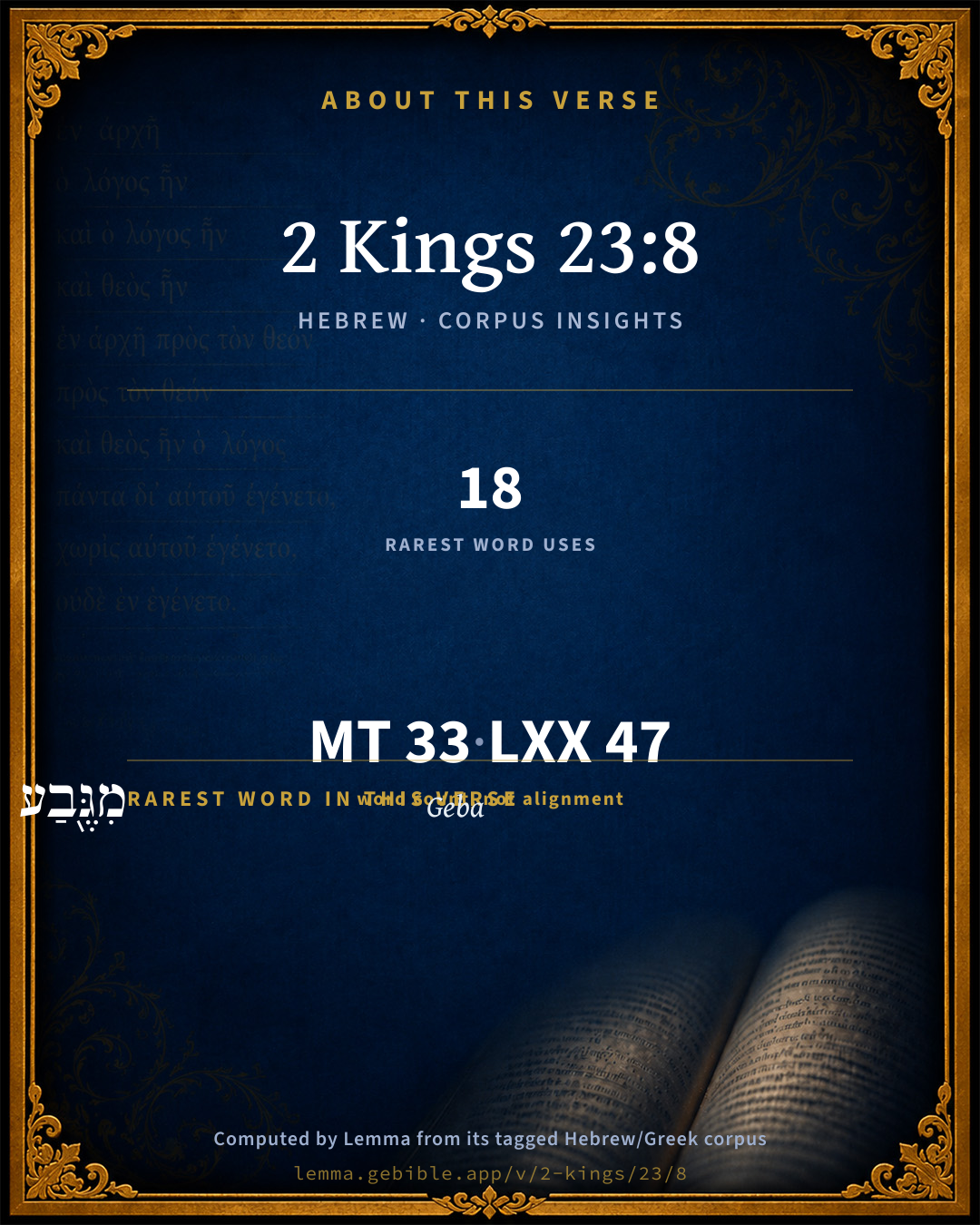
The rarest word here is מִגֶּ֖בַע Geba H1387 — appearing just 18 times in the whole Hebrew Bible.

Shared distinctive vocabulary

מִגֶּ֖בַע Geba H1387 occurs in 18 verses of the Hebrew Bible. Also found in:

Grammatical profile

  • 4 verbs
  • 20 nouns
  • 2 prepositions
  • 1 adverb
  • 6 particles

Verb forms

  • וַיָּבֵ֤א Hiphil · Sequential Imperfect
  • וַיְטַמֵּ֣א Piel · Sequential Imperfect
  • קִטְּרוּ Piel · Perfect
  • וְנָתַ֞ץ Qal · Perfect

Repetition

Words recur within this verse — often emphatic in Hebrew:

  • מֵעָרֵ֣י city H5892 ×3
  • הַשְּׁעָרִ֗ים gate H8179 ×3
  • הַכֹּֽהֲנִים֙ priest H3548 ×2
  • הַבָּמ֗וֹת high place H1116 ×2
  • בְּאֵ֣ר Beer-sheba H884 ×2
  • אֲשֶׁ֤ר which H834 ×3

Hebrew & Septuagint length

In English translation the verse runs 64 words from the Hebrew and 62 from the Septuagint (LXX English) — closely comparable.

A rough comparison of the two English renderings, which tokenize alike — not a word-level alignment.

Word counts can differ between the Hebrew and the Greek without any difference in meaning — e.g. the Hebrew direct-object marker אֵת has no separate Greek word, and Greek often adds the article ὁ.

In the original languages it is 33 Hebrew tokens and 47 Greek tokens — but the two are counted differently (Hebrew bundles its prefixes and suffixes into one token; the Greek is in lemma form), so that isn’t a like-for-like length.

Cross-references

9

Topical passages linked to 2 Kings 23:8 in the Treasury of Scripture Knowledge — connected by theme and wording, ordered by reader-vote popularity; previews shown in the World English Bible.

  • 1 Kings 15:22 Then king Asa made a proclamation to all Judah; none was exempted: and they carried away the stones of Ramah, and the timber of it, with which Baasha had built; and king Asa built therewith Geba of Benjamin, and Mizpah.
  • Joshua 21:17 Out of the tribe of Benjamin, Gibeon with its suburbs, Geba with its suburbs,
  • Genesis 21:31 Therefore he called that place Beersheba, because they both swore there.
  • Genesis 26:23 He went up from there to Beersheba.
  • Judges 20:1 Then all the children of Israel went out, and the congregation was assembled as one man, from Dan even to Beersheba, with the land of Gilead, to Yahweh at Mizpah.
  • 1 Kings 19:3 When he saw that, he arose, and went for his life, and came to Beersheba, which belongs to Judah, and left his servant there.
  • 1 Chronicles 6:60 and out of the tribe of Benjamin, Geba with its suburbs, and Allemeth with its suburbs, and Anathoth with its suburbs. All their cities throughout their families were thirteen cities.
  • Isaiah 10:29 they are gone over the pass; they have taken up their lodging at Geba; Ramah trembles; Gibeah of Saul is fled.
  • Zechariah 14:10 All the land will be made like the Arabah, from Geba to Rimmon south of Jerusalem; and she will be lifted up, and will dwell in her place, from Benjamin's gate to the place of the first gate, to the corner gate, and from the tower of Hananel to the king's wine-presses.

Cross-references courtesy of OpenBible.info (CC BY 4.0).

Hebrew and Greek witnesses Masoretic Hebrew ↔ Greek Septuagint

The same verse in the two great witnesses to the Old Testament, shown verse-for-verse.

These are two independent witnesses, not word-aligned to each other, and the Septuagint is shown in lemma (dictionary) form.

Hebrew 2 Kings 23:8 Masoretic · Westminster Leningrad Codex

וַיָּבֵ֤א אֶת כָּל הַכֹּֽהֲנִים֙ מֵעָרֵ֣י יְהוּדָ֔ה וַיְטַמֵּ֣א אֶת הַבָּמ֗וֹת אֲשֶׁ֤ר קִטְּרוּ שָׁ֨מָּה֙ הַכֹּ֣הֲנִ֔ים מִגֶּ֖בַע עַד בְּאֵ֣ר שָׁ֑בַע וְנָתַ֞ץ אֶת בָּמ֣וֹת הַשְּׁעָרִ֗ים אֲשֶׁר פֶּ֜תַח שַׁ֤עַר יְהוֹשֻׁ֨עַ֙ שַׂר הָעִ֔יר אֲשֶֽׁר עַל שְׂמֹ֥אול אִ֖ישׁ בְּשַׁ֥עַר הָעִֽיר

He brought all the priests out of the cities of Judah, and defiled the high places where the priests had burned incense, from Geba to Beersheba; and he broke down the high places of the gates that were at the entrance of the gate of Joshua the governor of the city, which were on a man's left hand at the gate of the city.

World English Bible · Public Domain

Greek LXX 2 Kings 23:8 Septuagint · lemma form

καί ἀναἄγω πᾶς ὁ ἱερεύς ἐκ πόλις ιουδα καί μιαίνω ὁ ὑψηλός ὅς θυμιάζω ἐκεῖ ὁ ἱερεύς ἀπό γαβαα καί ἕως βηρσαβεε καί κατααἱρέω ὁ οἶκος ὁ πύλη ὁ παρά ὁ θύρα ὁ πύλη ιησους ἄρχων ὁ πόλις ὁ ἐκ ἀριστερός ἀνήρ ἐν ὁ πύλη ὁ πόλις

And he brought up all the priest from the cities of Juda, and defiled the high places where the priests burned incense, from Gaebal even to Bersabee; and he pulled down the house of the gates that was by the door of the gate of Joshua the ruler of the city, on a man's left hand at the gate of the city.

LXX2012 (modern English Septuagint) · Public Domain

Hebrew: Westminster Leningrad Codex (CC BY 4.0). Greek: Septuagint (public domain); English from LXX2012 (modern English Septuagint) (Public Domain). How the Septuagint differs from the Hebrew →

Targum (Aramaic paraphrase)

1

The Targum is the ancient Jewish Aramaic paraphrase of the Hebrew Scriptures — an interpretive translation, not the Hebrew text itself. Onkelos (literal) and Pseudo-Jonathan (expansive) render the Torah, and Jonathan the Prophets. Coverage is partial: where no permissively-licensed English translation exists for a verse, only the Aramaic is shown. This is verse-level text, not a word-by-word alignment to the Hebrew.

  1. Targum Jonathan Prophets (Joshua–Malachi)
    וְאַיְתֵי יַת כָּל כּוּמְרַיָא מִקִירְוַיָא דְבֵית יְהוּדָה וְסָאֵיב יַת בָּמָתָא דְאַסִיקוּ בוּסְמִין תַּמָן כּוּמְרַיָא מִגֶבַע עַד בְּאֵר שָׁבַע וְתָרַע יַת בָּמַת תַּרְעַיָא דִי קֳדָם תְּרַע יְהוֹשֻׁעַ רַב קַרְתָּא דִי עַל שְׂמָאלָא גַבְרָא בְּמֵיעֲלֵיהּ תְּרַע קַרְתָּא:

    (no public-domain English translation for this verse)

    Targum Jonathan — Aramaic: “Mikraot Gedolot” (public domain). English: “Sefaria Community Translation” (CC0 1.0 (public-domain dedication)); “London "Chaldee Paraphrase," 1871” (public domain). Text via Sefaria.

Commentary

Notes on 2 Kings 23:8 from classic Christian and Jewish commentators (each source and its license shown beneath its notes). The classic Christian expositions comment on the surrounding passage and are grouped to its opening verse, so a note may address several verses; the Jewish commentaries on the Tanakh (Rashi and others) are per-verse, so they appear only where the commentator wrote on this verse.

Lemma curates 59 commentaries, every one of them public domain or Creative Commons licensed, each selected and text-cleaned for this edition rather than reprinted as found. About our sources →

Trapp's Complete Commentary

John Trapp

2Ki 23:8 And he brought all the priests out of the cities of Judah, and defiled the high places where the priests had burned incense, from Geba to Beersheba, and brake down the high places of the gates that [were] in the entering in of the gate of Joshua the governor of the city, which [were] on a man’s left hand at the gate of the city.

Ver. 8. The high places of the gates.] Where, in imitation of the heathens, they had set their tutelar and guardian gods, and had their fans profana.

Of Joshua the governor of the city.] A great man, but none of the best. He had a good name; but Josiah might have said to him, as Alexander did to a soldier of his own name, but a coward, Either change thy name, or put on more courage; so, more piety.

John Trapp, A Commentary or Exposition upon All the Books of the Old and New Testament (1647–1656) — public domain. Text from a community e-Sword module.

Joseph Benson's Commentary

2Ki 23:8. He brought all the priests — Belonging to the high places following, whether such as worshipped idols, or such as worshipped God in those forbidden places. Out of the cities of Judah — That they might not continue to corrupt the people. And defiled the high places — Casting dead carcasses there, and other such like unclean things, and thus making them receptacles of impurity, and burning dead men’s bones upon the altars that were there. From Geba — The northern border of the kingdom of Judah. To Beer-sheba — The southern border; that is, throughout the whole country. And brake down the high places of the gates — Dedicated to their tutelary gods, whom their idolatrous kings, after the manner of the heathen, owned for the protectors of their city and habitations. These places seem to have been erected at the gates, in order that all who entered or went out of the city might pay some kind of adoration to them. In the gate of Joshua, the governor of the city — This circumstance is mentioned to show Josiah’s great zeal and impartiality in rooting out all monuments of idolatry, without any respect unto those great persons who were concerned in them.

Joseph Benson's Commentary on the Old and New Testaments (1811–1818) — public domain. Text from a community e-Sword module.

Tyndale Open Study Notes

Tyndale Open Resources

23:8-9 The gate of Joshua is otherwise unknown; it might have been used by the city governor, a title known to refer to a city official in Samaria (1 Kgs 22:26; 2 Chr 18:25) and to Maaseiah in Jerusalem (2 Chr 34:8).

Tyndale Open Study Notes — © Tyndale Open Resources, licensed CC BY-SA 4.0. Text via the HelloAO Bible API.

Jamieson, Fausset & Brown

Robert Jamieson, A. R. Fausset & David Brown

he brought all the priests out of the cities of Judah, and defiled the high places, &c.--Many of the Levitical order, finding in the reigns of Manasseh and Amon the temple-worship abolished and the tithes and other offerings alienated, had been betrayed into the folly of officiating on high places, and presenting such sacrifices as were brought to them. These irregularities, even though the object of that worship was the true God, were prohibited in the law (Deu 12:11). Those who had been guilty of this sin, Josiah brought to Jerusalem. Regarding them as defiled, he debarred them from the service of the temple, but gave them an allowance out of the temple revenues, like the lame and disabled members of the priesthood (Lev 21:21-22).

from Geba to to Beer-sheba--the most northern and the most southern places in Judah--meaning all parts of the kingdom.

the high places . . . which were in the entering in of the gate of Joshua--The governor's house and gate were on the left of the city gate, and close by the entrance of that civic mansion house were public altars, dedicated, it might be, to the true God, but contrary to His own ordinance of worship (Isa 57:8).

Jamieson, Fausset & Brown — Commentary Critical and Explanatory on the Whole Bible (1871) — public domain (CC PDM 1.0). Text via the HelloAO Bible API.

Adam Clarke's Commentary

Verse 8. The gate of Joshua] The place where he, as governor of the city, heard and decided causes. Near this we find there were public altars, where sometimes the true God, at other times false gods, were honoured.

Adam Clarke's Commentary on the Bible (1810–1826) — public domain. Text from a community e-Sword/MySword module.

Ellicott's Commentary for English Readers

(8) And he brought all the priests . . .—Josiah caused all the priests of the local sanctuaries of Jehovah to migrate to Jerusalem, and polluted the high places to which they had been attached, in order to get rid of the illegitimate worship once for all.

From Geba.—The present Jeba, near the ancient Ramah (1Ki_15:22).

To Beer-sheba.—Where was a specially frequented high place (Amo_5:5, Amo_8:14; and Note on 2Ch_34:6).

The high places of the gates.—Altars erected within the gates, that persons entering or leaving the city might make an offering to ensure success in their business.

That were in the entering in . . .—Thenius renders, (the high place) which was at the entry of the gate of Joshua the governor of the city, (as well as) that which was on the left in the city gate. But this assumption of two localities is very precarious. The Authorised Version appears to be correct (a similar repetition of the relative referring to the same antecedent occurs in 2Ki_23:13). Joshua is an unknown personage, and it is not clear whether “the gate of Joshua” was a gate of the city named after him, or the great gate of his residence; nor is it certain that “the gate of the city” was that now called the Jaffa Gate. It is possible that the governor’s residence lay near the principal gate of the city, on the left as one entered. Several “high places” stood in the open space in front of it, between it and the city gate. These would naturally be called “the high places of the gates.”

A Bible Commentary for English Readers, edited by Charles John Ellicott (1878–1897) — public domain. Text from a community e-Sword module.

The Cambridge Bible for Schools and Colleges

gen. ed. J. J. S. Perowne

8. all the priests out of the cities of Judah] These were the priests who had betaken themselves to the various high places throughout the land, and conducted the worship there (2Ch_33:17). These services were offered ‘to the Lord their God only’. But such forbidden places Josiah destroyed and defiled their sites so that they should never be restored. The priests were brought to Jerusalem and were hereafter employed on lower duties as Levites.

from Geba to Beer-sheba] That is, throughout all Judah just as ‘from Dan to Beersheba’ is used (Jdg_20:1; 1Sa_3:20) for the whole land of Canaan. Geba was in the northern border of the tribe of Benjamin. It is probably the same as Gibeah which is spoken of in Jdg_20:31 : Beersheba was in the extreme south of Judah. We know from Amo_8:14 that a ‘manner’ (R.V. way) of idolatrous worship prevailed there.

the high places of the gates] The open spaces kept about the gates of Oriental cities afforded exactly the site which would be chosen for some shrine of the popular worship, especially when the kings, Manasseh and Amon, had given their strong support to idolatry. It would be thought to harmonize with the royal wishes if an altar were erected close to the place where the king’s public judgement-seat was wont to be.

in [R.V. at] the entering in, &c.] As the English of both A.V. and R.V. stands, ‘the gate of Joshua the governor of the city’ must be the same which is called in the next clause ‘the gate of the city’. In that case, as the text speaks of ‘high places’, we must understand that there was more than one ‘high place’ in the same neighbourhood. But as they are called ‘high places of the gates’ it has seemed necessary to some to render the words as if a conjunction were omitted, ‘The high places of the gates, that which was in the entering in of the gate of Joshua … and also that which was … at the gate of the city’. Thus the two localities would be different. As ‘the gate of Joshua’ is mentioned nowhere else, we cannot say where it was, or whether a gate so described could also be called ‘a gate of the city’. It seems more probable that it was some inner gate, near the governor’s official residence.

The Cambridge Bible for Schools and Colleges (gen. ed. J. J. S. Perowne; Cambridge University Press, 1878–1918) — public domain. Text from a community e-Sword module.

John Gill's Exposition

Nevertheless, the priests of the high places came not up to the altar of the Lord at Jerusalem,.... To sacrifice there, as the Targum; though they were removed from the high places, they were not admitted to officiate at the altar of the Lord, having offered in forbidden places:

but they did eat of the unleavened bread with their brethren; the priests that were pure, as the sons of Zadok; though they might not offer sacrifices, they were allowed to partake of the holy things with the priests, as the meat offerings made of flour unleavened, Lev 2:4 which are here meant, and put for all the rest on which the priests lived, see Eze 44:10.

John Gill's Exposition of the Whole Bible (1746–1763) — public domain (CC PDM 1.0). Text via the HelloAO Bible API.

Haydock's Catholic Bible Commentary

Bersabee; to which the Israelites went in pilgrimages, Amos v. 5. This place was situated at the southern extremity of the dominions of Juda, as Gabaa was at the northern. The priests being unable to offer sacrifice in the temple, and desirous to gain a livelihood, had been so weak as to conform to the illegal practices of the country; though they seem to have intended to worship God, Deuteronomy xii. 11. --- Altars. These might also be consecrated to the true God, but they were forbidden. There were others, placed in similar situations, in honour of Trivia, or the moon, Isaias lvii. 8., and lxv. 11. (Calmet) --- City, to a person entering. (Chaldean) Josue was the chief lay-judge, or magistrate. (Menochius)

George Leo Haydock (1774–1849), Haydock's Catholic Family Bible and Commentary, 1859 edition — public domain. Excludes Psalms (Douay-Rheims chapter numbering differs from Protestant) and Deuterocanonical books (Catholic canon only).

Matthew Poole's English Annotations

All the priests, to wit, belonging to the high places there following, whether such as worshipped idols, or rather, such as worshipped God in those forbidden places, Deu 12:11, as may be gathered from the following verse.

Defiled the high places, by burning dead men’s bones upon them, as 2Ki 23:14,16,20, or by putting them to some other unclean or filthy use.

From Geba; the northern border of the kingdom of Judah; of which see Jos 18:24; 1Ki 15:22. To Beer-sheba, which was the southern border; see Gen 21:31; Jdg 20:1; i.e. from one end to the other.

The high places of the gates; which were erected by the gates of the city here mentioned, unto the honour of their tutelary gods, which after the manner of the heathen they owned for the protectors of their city and habitations.

In the entering in of the gate of Joshua the governor of the city: this circumstance is noted to show Josiah’s great zeal and impartiality, in rooting out all monuments of idolatry, without any respect unto those great persons who were concerned in them, or affected to them.

Matthew Poole's English Annotations on the Holy Bible (1683–1685) — public domain. Text from a community e-Sword/MySword module.

Whedon's Commentary on the Bible

Daniel D. Whedon

8. Priests out of the cities of Judah — Levitical priests who had been turned aside to the service of the high places. Josiah ordered them to come to Jerusalem, but, as the next verse shows, they were not allowed to minister at the altar of the Lord.

Geba… Beer-sheba — The northern and southern limit of the territory occupied by Judah. Geba was situated about six miles northeast of Jerusalem, (see note on 1Sa_13:3,) and Beer-sheba fifty miles or more southwest.

High places of the gates — Those located near the gates of the city, either outside or within. The gate of Joshua and the gate of the city cannot now be determined. The latter, from its being called so indefinitely gate of the city, would seem to be the most common entrance; the former was probably so called because Joshua the governor had his residence near it.

Daniel D. Whedon (gen. ed.), Commentary on the Old and New Testaments (1874–1909) — public domain. Text from a community e-Sword module.

The Pulpit Commentary

And he brought all the priests out of the cities of Judah. Here the writer diverges from his proper subject the reforms in and near Jerusalem to speak of changes which were made in other parts of Judaea. The Levitical priests, who in various cities of Judah had conducted the worship at the high places, were summoned to Jerusalem by Josiah, and forced to remain there, that the unauthorized worship which they had conducted might be brought to an end. And defiled the high places where the priests had burned incense. Hezekiah had "removed the high places, and broken the images, and cut down the groves" throughout his dominions, (2Ki_18:4) but he had not in any way "defiled the high places;" and therefore no sooner did a king take a different view of his duties than the worship was at once restored, (2Ki_21:3) and flourished as before. Josiah conceived the idea that, if the high places were "defiled," it would be impossible to renew the worship at them. From Geba to Beersheba. Geba takes here the place of Bethel as the northern limit of Judah. It was situated at a very short distance from Bethel, and was made to supersede it on account of the idolatries by which Bethel had been disgraced. The exact site is probably the modern Jeba, on the southern edge of the Wady Suweinit. And brake down the high places of the gates. The high-place worship had, it would seem, invaded Jerusalem itself. In some of the gates of the city, which were "large open buildings for public meetings and intercourse" (Bahr), altars, or more elaborate places of worship, had been established, and an unauthorized ritual of the high-place type had been set up. That were rather, that which wasin the entering in of the gate of Joshua the governor of the city. This and the succeeding clauses are limitations of the general statement concerning the "high places of the gates," and indicate that two gates only had been polluted by high-place worship, viz. "the gate of Joshua," and the gale known kat ejxochn as "the city gate." Neither of these can be determinately fixed, since they are only mentioned in the present passage. Which were on a man"s left hand at the gate of the city; rather, and also that which was on the left-hand side in the gate of the city. (So Thenius, Keil, and Bahr.)

The Pulpit Commentary (1880–1919), ed. H.D.M. Spence-Jones & Joseph S. Exell — public domain. Text from a community e-Sword module.

John Wesley's Explanatory Notes

Priests - Belonging to the high-places following, whether such as worshipped idols; or such as worshipped God in those forbidden places. Defiled - By burning dead mens bones upon them, or by putting them to some other unclean use. From Geba - The northern border of the kingdom of Judah. Beer-sheba - The southern border, from one end to the other. Gates - Which were erected by the gates of the city here mentioned, to the honour of their tutelary gods, whom after the manner of the heathen they owned for the protectors of their city and habitations. The governor - This circumstance is noted to shew Josiah's great zeal and impartiality, in rooting out all monuments of idolatry, without any respects unto those great persons who were concerned in them.

John Wesley, Explanatory Notes Upon the Whole Bible (1754–1765) — public domain. Text via the GEBible commentary corpus.

unfoldingWord translationNotes

Door43 World Missions Community

Josiah brought ... and defiled ... He destroyed

Josiah would have commanded his workers to do these things. It is likely that Hilkiah and the priests who assisted him did these things. AT: "He commanded them to bring ... and to defile ... He had them destroy" (See: Metonymy)

Geba ... Beersheba

names of places (See: How to Translate Names)

Joshua (the city governor)

"the city ruler named Joshua" or "the city leader named Joshua." This is a different Joshua from the Joshua in the Old Testament Book of Joshua.

their brothers

Here "brothers" refers to their fellow priests who served at the temple.

translationWords

Josiah

priest

kingdom of Judah

defile

Beersheba

gate

servant

altar

unleavened bread

unfoldingWord translationNotes — © Distant Shores Media and the Door43 World Missions Community, licensed CC BY-SA 4.0. Source: git.door43.org/Door43/en_tn.

Lesson kit

Teaching starters — assembled from the data on this page, not authored interpretation. Every prompt links to the verse data it draws on. Edit before teaching.

2 Kings, in the Historical, opens this verse with 33 words (22 distinct Hebrew lemmas). Its most distinctive word is Gebaʻ (“Geba”). A historical commentator’s framing appears above. Read the whole chapter for the surrounding context.

Discussion questions

  1. What does “Geba” (Gebaʻ) contribute to the verse as a whole?
  2. How does Joshua 18:24, which shares the word «Geba», read alongside this verse?
  3. What does the repetition of “city” (3× in this one verse) do in this verse?
  4. These translations render this verse differently. What is at stake in choosing one wording over another?
  5. «וַיָּבֵ֤א» is a Hiphil Sequential Imperfect verb. How does that grammatical form shape the action described?
  6. Compare how Trapp's Complete Commentary and Joseph Benson's Commentary read this verse. Where do they agree or differ?

Things to notice

Reading settings

Reading text

Shown beneath each verse's original-language words.

Old Testament
Old Testament edition

Read the OT as the Masoretic Hebrew (MT) or the Greek Septuagint (LXX).

English shown for the Greek Septuagint (in the Hebrew ↔ Greek comparison).

Comparing translations? Open the Compare panel on any verse page to stack up to four side by side.