
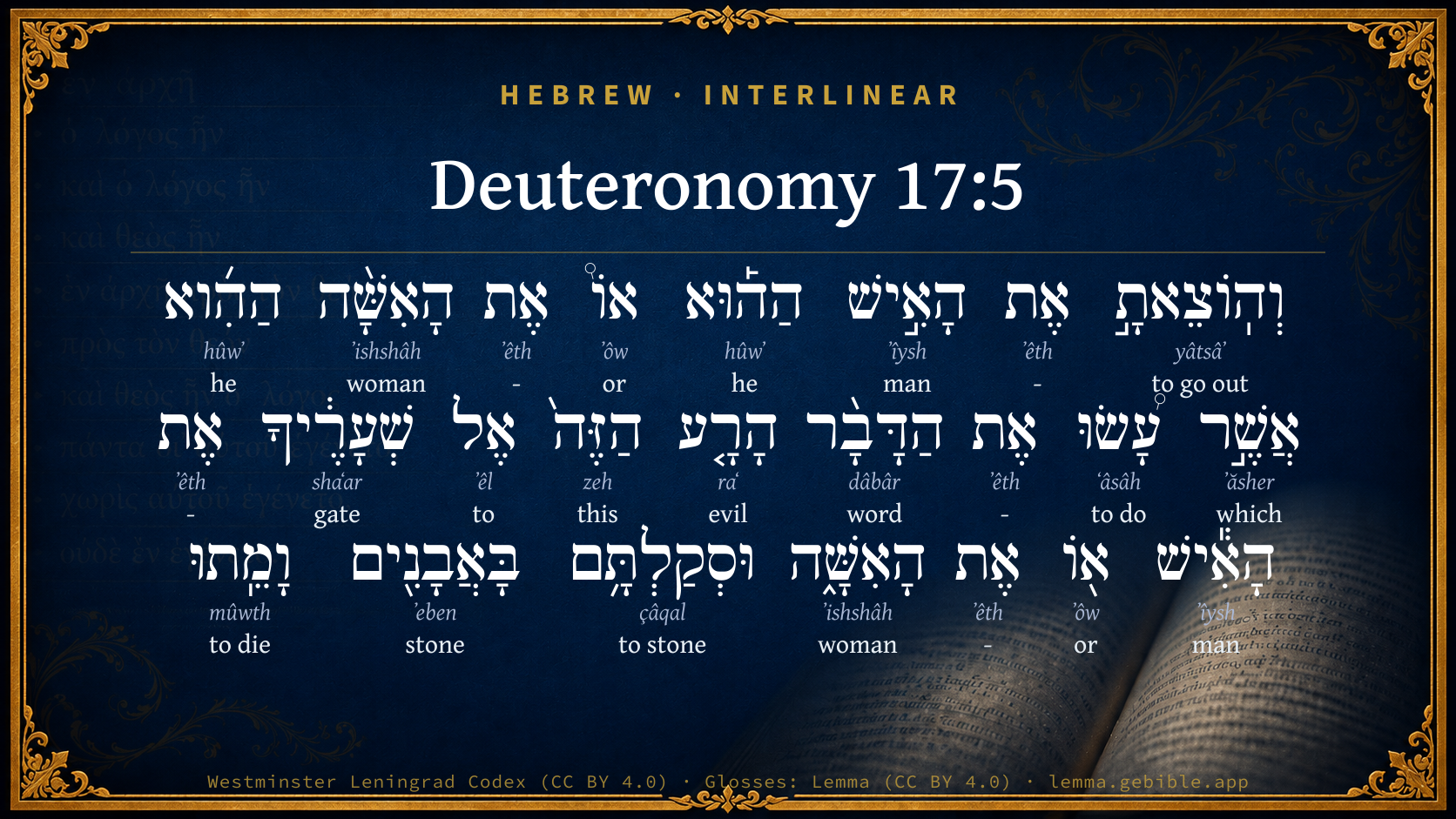
Deuteronomy 17:5

Hebrew (Westminster Leningrad Codex) Deuteronomy 17:5 appears in the Hebrew Old Testament. The text above is from the Westminster Leningrad Codex. Each word links to its Strong’s number, a concise gloss, and parsing drawn from the Open Scriptures Hebrew Bible morphology. Click any word for its full Brown-Driver-Briggs (BDB) entry.
Download image
Cite this verse

Deuteronomy 17:5 (World English Bible). Public Domain. Lemma interlinear Bible study tool, https://lemma.gebible.app/v/deuteronomy/17/5.

Show BibTeX & RIS
BibTeX
RIS
English Translation
then shall you bring forth that man or that woman, who has done this evil thing, to your gates, even the man or the woman; and you shall stone them to death with stones.
World English Bible · Public Domain
Download a study sheet

One document with this verse’s original text, its word-by-word gloss line, the meaning frame, cross-references with their text, attributed commentary, and full source and license credits — printable, and it pastes into notes with its structure intact.

This verse Autodidact and up

Study sheet (.html) Plain text (.txt)

A passage Seminary Student

Up to 50 verses in one chapter. A passage sheet keeps up to 6 commentary sources and 12 cross-references per verse, in the order this page ranks them, and says so on the sheet whenever that leaves anything out. Ask for a single verse and you get the Autodidact verse sheet above.

Everything on this page stays free to read, with no account — the sheet is a download of what is already on screen, not access to it.

Want to remove ads? Support Godless Engineer
Compare translations 3

The same verse in 3 English versions, stacked beneath the original-language interlinear above. Click any original word for its lexicon entry.

Each is an independent rendering of the whole verse — the interlinear is not word-aligned to these translations.

Highlighted words mark where these versions differ — a whole-verse word diff, not a word-by-word alignment.

  • World English Bible Public Domain
    then shall you bring forth that man or that woman, who has done this evil thing, to your gates, even the man or the woman; and you shall stone them to death with stones.
  • King James Version Public Domain
    Then shalt thou bring forth that man or that woman, which have committed that wicked thing, unto thy gates, even that man or that woman, and shalt stone them with stones, till they die.
  • unfoldingWord Literal Text CC BY-SA 4.0
    then you shall bring that man or that woman who has done this evil thing to your gates, the man or the woman, and you shall stone them with stones, and they shall die.

unfoldingWord Literal Text — © unfoldingWord, licensed CC BY-SA 4.0. Word-aligned USFM3 via Door43 (git.door43.org/unfoldingWord/en_ult).

Versions to compare (up to 4)

3 of 4 selected

Show all 18 translations

Every available English version of this verse, each an independent rendering of the whole verse.

  • World English Bible Public Domain
    then shall you bring forth that man or that woman, who has done this evil thing, to your gates, even the man or the woman; and you shall stone them to death with stones.
  • Berean Standard Bible Public Domain
    you must bring out to your gates the man or woman who has done this evil thing, and you must stone that person to death.
  • Majority Standard Bible Public Domain
    you must bring out to your gates the man or woman who has done this evil thing, and you must stone that person to death.
  • King James Version Public Domain
    Then shalt thou bring forth that man or that woman, which have committed that wicked thing, unto thy gates, even that man or that woman, and shalt stone them with stones, till they die.
  • American Standard Version (1901) Public Domain
    then shalt thou bring forth that man or that woman, who hath done this evil thing, unto thy gates, even the man or the woman; and thou shalt stone them to death with stones.
  • Revised Version (1885) Public Domain
    then shalt thou bring forth that man or that woman, which have done this evil thing, unto thy gates, even the man or the woman; and thou shalt stone them with stones, that they die.
  • Geneva Bible (1599) Public Domain
    Then shalt thou bring foorth that man, or that woman (which haue committed that wicked thing) vnto thy gates, whether it be man or woman, and shalt stone them with stones, til they die.
  • Douay-Rheims (1899) Public Domain
    Thou shalt bring forth the man or the woman, who have committed that most wicked thing, to the gates of thy city, and they shall be stoned.
  • Young's Literal Translation Public Domain
    `Then thou hast brought out that man, or that woman, who hath done this evil thing, unto thy gates -- the man or the woman -- and thou hast stoned them with stones, and they have died.
  • Literal Standard Version CC BY-SA 4.0
    then you have brought out that man or that woman who has done this evil thing, to your gates—the man or the woman—and you have stoned them with stones, and they have died.
  • Unlocked Literal Bible CC BY-SA 4.0
    You must bring that man or woman, who has done this evil thing, to your city gates, that very man or woman, and you must stone that person to death.
  • unfoldingWord Literal Text CC BY-SA 4.0
    then you shall bring that man or that woman who has done this evil thing to your gates, the man or the woman, and you shall stone them with stones, and they shall die.
  • Darby Bible Public Domain
    thou shalt bring forth that man or that woman, who committed that wicked thing, unto thy gates, the man or the woman, and shalt stone them with stones, that they die.
  • World Messianic Bible Public Domain
    then you shall bring out that man or that woman who has done this evil thing to your gates, even that same man or woman; and you shall stone them to death with stones.
  • Webster's Bible Public Domain
    Then shalt thou bring forth to thy gates that man or that woman, who have committed that wicked thing, even that man or that woman, and shalt stone them with stones, till they die.
  • Free Bible Version CC BY-SA 4.0
    you must have the man or woman who has committed this terrible act taken outside the town and stoned to death.
  • Bible in Basic English Public Domain
    Then you are to take the man or woman who has done the evil to the public place of your town, and they are to be stoned with stones till they are dead.
  • JPS Tanakh (1917) Public Domain
    then shalt thou bring forth that man or that woman, who have done this evil thing, unto thy gates, even the man or the woman; and thou shalt stone them with stones, that they die.

Literal Standard Version (2020), Covenant Press — licensed CC BY-SA 4.0. Text via the HelloAO Bible API (eBible.org). Unlocked Literal Bible (unfoldingWord) — licensed CC BY-SA 4.0. Text via the HelloAO Bible API (eBible.org). unfoldingWord Literal Text — © unfoldingWord, licensed CC BY-SA 4.0. Word-aligned USFM3 via Door43 (git.door43.org/unfoldingWord/en_ult). Free Bible Version, Dr. Jonathan Gallagher — licensed CC BY-SA 4.0. Text via the HelloAO Bible API (eBible.org).

Word by word

More ways to search: Search by grammar → Find every occurrence → Compare this word →

Practice this passage: Drill this verse → Learn its vocabulary →

וּסְקַלְתָּ֥ם
çâqal
H5619
“and · to stone · them”
Conjunction + Verb, Qal, Sequential Perfect, 2nd Person, Masculine, Singular + Suffix, Personal, 3rd Person, Masculine, Plural
Part of Speech
Conjunction + Verb
Stem
Qal
Form
Sequential Perfect
Person
2nd Person
Gender
Masculine
Number
Singular
Full BDB Definition

Origin: a primitive root

TWOT: 1541

to stone (to death), put to death by stoning - (Qal) to pelt with stones, stone to death - (Niphal) to be stoned to death - (Piel) - to stone, pelt with stones - to free from stones (of vineyard, highway) - (Pual) to be stoned to death
  1. וְהֽוֹצֵאתָ֣ yâtsâʼ H3318 “and · to go out” Conjunction + Verb, Hiphil, Sequential Perfect, 2nd Person, Masculine, Singular
  2. אֶת ʼêth H853 “-” Particle, Direct Object
  3. הָאִ֣ישׁ ʼîysh H376 “the · man” Particle, Definite Article + Noun, Common, Masculine, Singular, Absolute
  4. הַה֡וּא hûwʼ H1931 “the · he” Particle, Definite Article + Pronoun, Personal, 3rd Person, Masculine, Singular
  5. אוֹ֩ ʼôw H176 “or” Conjunction
  6. אֶת ʼêth H853 “-” Particle, Direct Object
  7. הָאִשָּׁ֨ה ʼishshâh H802 “the · woman” Particle, Definite Article + Noun, Common, Feminine, Singular, Absolute
  8. הַהִ֜וא hûwʼ H1931 “the · he” Particle, Definite Article + Pronoun, Personal, 3rd Person, Feminine, Singular
  9. אֲשֶׁ֣ר ʼăsher H834 “which” Particle, Relative
  10. עָ֠שׂוּ ʻâsâh H6213 “to do” Verb, Qal, Perfect, 3rd Person, Common, Plural
  11. אֶת ʼêth H853 “-” Particle, Direct Object
  12. הַדָּבָ֨ר dâbâr H1697 “the · word” Particle, Definite Article + Noun, Common, Masculine, Singular, Absolute
  13. הָרָ֤ע raʻ H7451 “the · evil” Particle, Definite Article + Adjective, Adjective, Masculine, Singular, Absolute
  14. הַזֶּה֙ zeh H2088 “the · this” Particle, Definite Article + Pronoun, Demonstrative, Masculine, Singular
  15. אֶל ʼêl H413 “to” Preposition
  16. שְׁעָרֶ֔יךָ shaʻar H8179 “gates · your” Noun, Common, Masculine, Plural, Construct + Suffix, Personal, 2nd Person, Masculine, Singular
  17. אֶת ʼêth H853 “-” Particle, Direct Object
  18. הָאִ֕ישׁ ʼîysh H376 “the · man” Particle, Definite Article + Noun, Common, Masculine, Singular, Absolute
  19. א֖וֹ ʼôw H176 “or” Conjunction
  20. אֶת ʼêth H853 “-” Particle, Direct Object
  21. הָאִשָּׁ֑ה ʼishshâh H802 “the · woman” Particle, Definite Article + Noun, Common, Feminine, Singular, Absolute
  22. בָּאֲבָנִ֖ים ʼeben H68 “in/at the · stones” Preposition, Determined + Noun, Common, Feminine, Plural, Absolute
  23. וָמֵֽתוּ mûwth H4191 “and · to die” Conjunction + Verb, Qal, Sequential Perfect, 3rd Person, Common, Plural

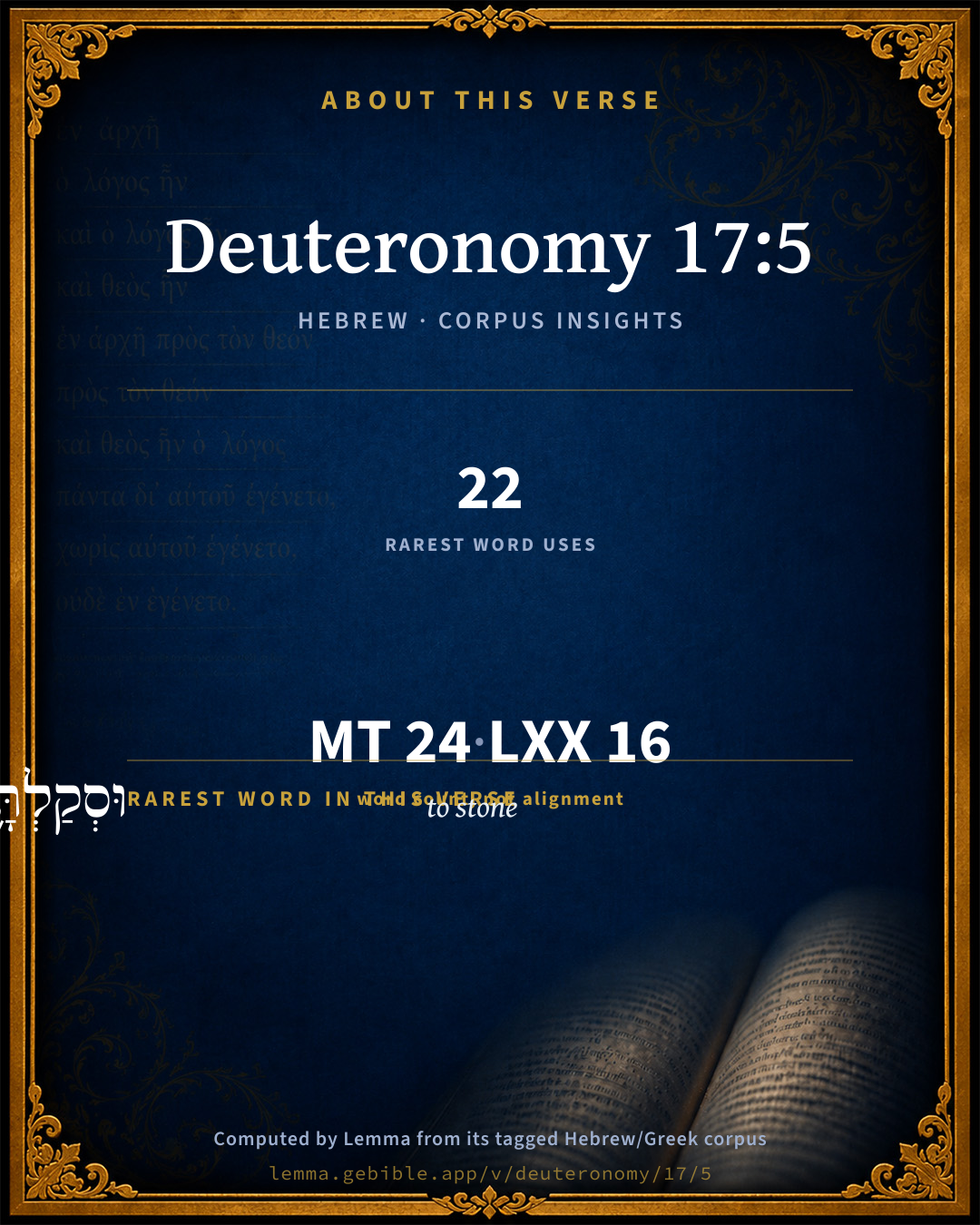
About this verse

These counts appear in no published source. They are computed here, from the morphology-tagged text and Lemma’s own curated glosses. What Lemma adds →

24
words
16
distinct lemmas
Pentateuch
section

Notable vocabulary

The rarest word here is וּסְקַלְתָּ֥ם to stone H5619 — appearing just 22 times in the whole Hebrew Bible.

Shared distinctive vocabulary

וּסְקַלְתָּ֥ם to stone H5619 occurs in 20 verses of the Hebrew Bible. Also found in:

Grammatical profile

  • 4 verbs
  • 7 nouns
  • 1 adjective
  • 3 pronouns
  • 1 preposition
  • 2 conjunctions
  • 6 particles

Verb forms

  • וְהֽוֹצֵאתָ֣ Hiphil · Sequential Perfect
  • עָ֠שׂוּ Qal · Perfect
  • וּסְקַלְתָּ֥ם Qal · Sequential Perfect
  • וָמֵֽתוּ Qal · Sequential Perfect

Repetition

Words recur within this verse — often emphatic in Hebrew:

  • הָאִ֣ישׁ man H376 ×2
  • הָאִשָּׁ֨ה woman H802 ×2
  • הַה֡וּא he H1931 ×2
  • אוֹ֩ or H176 ×2

Hebrew & Septuagint length

In English translation the verse runs 34 words from the Hebrew and 21 from the Septuagint (LXX English) — the Septuagint runs noticeably shorter here. See the side-by-side →

A rough comparison of the two English renderings, which tokenize alike — not a word-level alignment.

Word counts can differ between the Hebrew and the Greek without any difference in meaning — e.g. the Hebrew direct-object marker אֵת has no separate Greek word, and Greek often adds the article ὁ.

In the original languages it is 24 Hebrew tokens and 16 Greek tokens — but the two are counted differently (Hebrew bundles its prefixes and suffixes into one token; the Greek is in lemma form), so that isn’t a like-for-like length.

Cross-references

7

Topical passages linked to Deuteronomy 17:5 in the Treasury of Scripture Knowledge — connected by theme and wording, ordered by reader-vote popularity; previews shown in the World English Bible.

  • Leviticus 24:14 "Bring out of the camp him who cursed; and let all who heard him lay their hands on his head, and let all the congregation stone him.
  • Joshua 7:25 Joshua said, Why have you troubled us? Yahweh shall trouble you this day. All Israel stoned him with stones; and they burned them with fire, and stoned them with stones.
  • Leviticus 24:16 He who blasphemes the name of Yahweh, he shall surely be put to death; all the congregation shall certainly stone him: the foreigner as well as the native-born, when he blasphemes the Name, shall be put to death.
  • Deuteronomy 13:10–11 You shall stone him to death with stones, because he has sought to draw you away from Yahweh your God, who brought you out of the land of Egypt, out of the house of bondage.
  • Deuteronomy 22:21 then they shall bring out the young lady to the door of her father's house, and the men of her city shall stone her to death with stones, because she has done folly in Israel, to play the prostitute in her father's house: so shall you put away the evil from the midst of you.
  • Deuteronomy 22:24 then you shall bring them both out to the gate of that city, and you shall stone them to death with stones; the lady, because she didn't cry, being in the city; and the man, because he has humbled his neighbor's wife: so you shall put away the evil from the midst of you.
  • Deuteronomy 21:21 All the men of his city shall stone him to death with stones: so shall you put away the evil from the midst of you; and all Israel shall hear, and fear.

Cross-references courtesy of OpenBible.info (CC BY 4.0).

Hebrew and Greek witnesses Masoretic Hebrew ↔ Greek Septuagint

The same verse in the two great witnesses to the Old Testament, shown verse-for-verse.

Here the Septuagint runs noticeably shorter than the Hebrew — LXX2012 (modern English Septuagint) 21 words vs World English Bible 34. A rough length comparison of the two English translations, not a word-level alignment — read both below.

These are two independent witnesses, not word-aligned to each other, and the Septuagint is shown in lemma (dictionary) form.

Hebrew Deuteronomy 17:5 Masoretic · Westminster Leningrad Codex

וְהֽוֹצֵאתָ֣ אֶת הָאִ֣ישׁ הַה֡וּא אוֹ֩ אֶת הָאִשָּׁ֨ה הַהִ֜וא אֲשֶׁ֣ר עָ֠שׂוּ אֶת הַדָּבָ֨ר הָרָ֤ע הַזֶּה֙ אֶל שְׁעָרֶ֔יךָ אֶת הָאִ֕ישׁ א֖וֹ אֶת הָאִשָּׁ֑ה וּסְקַלְתָּ֥ם בָּאֲבָנִ֖ים וָמֵֽתוּ

then shall you bring forth that man or that woman, who has done this evil thing, to your gates, even the man or the woman; and you shall stone them to death with stones.

World English Bible · Public Domain

Greek LXX Deuteronomy 17:5 Septuagint · lemma form

καί ἐκἄγω ὁ ἄνθρωπος ἐκεῖνος ἤ ὁ γυνή ἐκεῖνος καί λιθοβολέω αὐτός ἐν λίθος καί τελευτάω

then shall you bring out that man, or that woman, and you⌃ shall stone them with stones, and they shall die.

LXX2012 (modern English Septuagint) · Public Domain

On this verse, The Cambridge Bible for Schools and Colleges discusses the Septuagint’s reading. Read the note in Commentary ↓

Hebrew: Westminster Leningrad Codex (CC BY 4.0). Greek: Septuagint (public domain); English from LXX2012 (modern English Septuagint) (Public Domain). How the Septuagint differs from the Hebrew →

Targum (Aramaic paraphrase)

2

The Targum is the ancient Jewish Aramaic paraphrase of the Hebrew Scriptures — an interpretive translation, not the Hebrew text itself. Onkelos (literal) and Pseudo-Jonathan (expansive) render the Torah, and Jonathan the Prophets. Coverage is partial: where no permissively-licensed English translation exists for a verse, only the Aramaic is shown. This is verse-level text, not a word-by-word alignment to the Hebrew.

  1. Targum Onkelos Torah (Genesis–Deuteronomy)
    וְתַפֵּק יָת גַבְרָא הַהוּא אוֹ יָת אִתְּתָא הַהִיא דִי עֲבָדוּ יָת פִּתְגָמָא בִישָׁא הָדֵין לִתְרַע בֵּית דִינָךְ יָת גַבְרָא אוֹ יָת אִתְּתָא וְתִרְגְמִנוּן בְּאַבְנַיָא וִימוּתוּן

    (no public-domain English translation for this verse)

    Targum Onkelos — Aramaic: “Onkelos Genesis” (public domain); “Onkelos Exodus” (public domain); “Onkelos Leviticus” (public domain); “Onkelos Numbers” (public domain); “Onkelos Deuteronomy” (public domain). English: “Sefaria Community Translation” (CC0 1.0 (public-domain dedication)); “J.W. Etheridge. The Targums of Onkelos and Jonathan Ben Uzziel on the Pentateuch. London: Longmans, Green, 1862” (public domain). Text via Sefaria.

  2. Targum Pseudo-Jonathan Torah (Genesis–Deuteronomy)
    וְתִפְקוּן יַת גַּבְרָא הַהוּא אוֹ יַת אִנְתְּתָא הַהִיא דְּעָבְדוּ יַת פִּתְגָמָא בִּישָׁא הָדֵין לִתְרַע בֵּית דִּינֵיכוֹן יַת גַּבְרָא אוֹ יַת אִינְתְּתָא וּתְאַטְלוּנוּן בְּאַבְנַיָא וִימוּתוּן

    then you shall bring forth that man or woman who hath done this evil thing, unto the gate of your house of judgment, the man or the woman, and you shall stone them that they die.

    Targum Pseudo-Jonathan — Aramaic: “Targum Jonathan on Genesis” (public domain); “Targum Jonathan on Exodus” (public domain); “Targum Jonathan on Leviticus” (public domain); “Targum Jonathan on Numbers” (public domain); “Targum Jonathan on Deuteronomy” (public domain). English: “The Targum of Jonathan ben Uzziel, trans. J. W. Etheridge, London, 1862” (public domain). Text via Sefaria.

Commentary

Notes on Deuteronomy 17:5 from classic Christian and Jewish commentators (each source and its license shown beneath its notes). The classic Christian expositions comment on the surrounding passage and are grouped to its opening verse, so a note may address several verses; the Jewish commentaries on the Tanakh (Rashi and others) are per-verse, so they appear only where the commentator wrote on this verse.

Lemma curates 59 commentaries, every one of them public domain or Creative Commons licensed, each selected and text-cleaned for this edition rather than reprinted as found. About our sources →

Trapp's Complete Commentary

John Trapp

Deu 17:5 Then shalt thou bring forth that man or that woman, which have committed that wicked thing, unto thy gates, [even] that man or that woman, and shalt stone them with stones, till they die.

Ver. 7. Thou shalt put the evil.] Both person and thing. {1Co 5:13}

John Trapp, A Commentary or Exposition upon All the Books of the Old and New Testament (1647–1656) — public domain. Text from a community e-Sword module.

Tyndale Open Study Notes

Tyndale Open Resources

17:5 the gates: A typical town in ancient Israel was small (about 10 acres or less) and crowded. It had few open areas except for a plaza just inside or outside the main gate where public meetings were held, including trials and other judicial proceedings. The place here is clearly outside of the town because stoning to death would not occur inside the walls (22:24; 1 Kgs 21:10) except under unusual circumstances (Deut 22:21).

Tyndale Open Study Notes — © Tyndale Open Resources, licensed CC BY-SA 4.0. Text via the HelloAO Bible API.

The Cambridge Bible for Schools and Colleges

gen. ed. J. J. S. Perowne

5. thou shalt bring forth … unto thy gates] Cp. Deu_22:24 : the usual place for stoning was without the gate, so that the city might not be polluted (cp. Lev_24:14, Num_15:36); where also Stephen was stoned, Act_7:58, under this law. On stoning see on Deu_13:10 (11).

even the man or the woman] Omit with LXX.

The Cambridge Bible for Schools and Colleges (gen. ed. J. J. S. Perowne; Cambridge University Press, 1878–1918) — public domain. Text from a community e-Sword module.

John Gill's Exposition

Thou shall bring forth that man or that woman which have committed the wicked thing,.... Idolatry in any of the above instances: this must be supposed to be done after he or she have been had before a court of judicature, and have been tried and found guilty, and sentence passed on them, then they were to be brought forth to execution:

unto thy gates; the Targum of Jonathan says, unto the gates of your sanhedrim, or court of judicature; but Jarchi observes, that this is a mistake of the paraphrase, for he says, we are taught by tradition that "thy gate" is the gate in which he has served or committed idolatry; and so says Maimonides (d), they do not stone a man but at the gate where he served or worshipped; but if the greatest part of the city are Heathens, they stone him at the door of the sanhedrim; and this is received from tradition, that "to thy gates" is the gate at which he served, and not where his judgment is finished:

even that man or that woman; this is repeated, and the woman as well as the man is expressed, to show that no compassion is to be had on her as is usual, nor to be spared on account of the weakness and tenderness of her sex, but she as well as the man must be brought forth and executed according to her sentence, without any mercy shown; and this is observed to show the resentment of the divine Majesty, and his indignation at this sin:

and shalt stone them with stones until they die; of the manner of stoning men and women; see Gill on Act 7:58.

(d) Hilchot Sanhedrin, c. 15. sect. 2.

John Gill's Exposition of the Whole Bible (1746–1763) — public domain (CC PDM 1.0). Text via the HelloAO Bible API.

Haydock's Catholic Bible Commentary

Stoned, not far from the gates, where they received sentence. Thus the sabbath-breaker was stoned without the camp, (Numbers xv. 35,) and St. Stephen out of the city of Jerusalem, Acts vii. 57. When only a few were concerned, the twenty-three judges passed sentence: but if a whole tribe had been guilty, the cognizance of the affair was left to the Sanhedrim. When a city was infected with this abomination, it was wholly destroyed. But no one was punished, except two witnesses (ver. 6,) attested that formal idolatry, by sacrifice, &c., had been committed. (Selden, Syned. iii. 4.)

George Leo Haydock (1774–1849), Haydock's Catholic Family Bible and Commentary, 1859 edition — public domain. Excludes Psalms (Douay-Rheims chapter numbering differs from Protestant) and Deuterocanonical books (Catholic canon only).

Whedon's Commentary on the Bible

Daniel D. Whedon

5. Unto thy gates — The punishment was to be in public before the whole people. By the gate is to be understood the open space near the gate, where in Eastern cities judicial proceedings take place. Comp. Neh_8:1; Neh_8:3; Job_29:7. The sentence was to be carried into execution outside of the city, as in Act_7:58; Heb_13:12, as in the wilderness it had been outside of the camp: to denote that the criminal was excluded from the congregation.

Daniel D. Whedon (gen. ed.), Commentary on the Old and New Testaments (1874–1909) — public domain. Text from a community e-Sword module.

The Pulpit Commentary

Unto thy gates; judicial proceedings were conducted at the gates of the city, and in some place outside the walls the sentence was executed on the condemned criminal (Neh_8:1, 3Jo 29:7; Deu_22:24; Act_7:58; Heb_13:12) just as, during the journey through the wilderness, it had been outside the camp that transgressors were punished. (Lev_24:14; Num_15:36)

The Pulpit Commentary (1880–1919), ed. H.D.M. Spence-Jones & Joseph S. Exell — public domain. Text from a community e-Sword module.

unfoldingWord translationNotes

Door43 World Missions Community

At the mouth of two witnesses, or three witnesses, will he who must die be put to death

Here "the mouth" represents the testimony of a witness. This can be translated in active form. AT: "If two or three witnesses speak against the person, then you must execute him" (See: Metonymy and Active or Passive and Numbers)

but at the mouth of only one witness he must not be put to death

Here "the mouth" represents the testimony of a witness. This can be translated in active form. AT: "but if only one person speaks against him, then you must not execute him" (See: Metonymy and Active or Passive)

The hand of the witnesses must be the first to put him to death, and afterward the hand of all the people

Here "hand" represents the entire group of witnesses. AT: "The witnesses themselves must be the first ones to throw stones. Then all the people will execute the person by throwing stones at him" (See: Synecdoche)

you will remove the evil from among you

The nominal adjective "the evil" can be stated as an adjective. AT: "you must remove from among the Israelites this person who does this evil thing" or "you must execute this evil person" (See: Nominal Adjectives)

translationWords

evil

gate

stone

die

testimony

hand

people group

unfoldingWord translationNotes — © Distant Shores Media and the Door43 World Missions Community, licensed CC BY-SA 4.0. Source: git.door43.org/Door43/en_tn.

Rashi

Rabbi Shlomo Yitzchaki (Rashi)

והוצאת את האיש ההוא אל שעריך וגו׳ THEN THOU SHALT BRING FORTH THAT MAN [OR THAT WOMAN WHO HAVE DONE THAT EVIL THING] UNTO THY GATES — He who renders אל שעריך in the Targum by לתרע בית דינך, unto the gate of thy court, is in error, for thus we have learned (Sifrei Devarim 148:2; Ketubot 45b): אל שעריך — this means the gate (the city) in which he has worshipped the idol. Or, perhaps this is not so, but it means the gate where he is being judged (the judges sat “at the gate of the city”; cf., e.g., Ruth 4:1 ff.)?! The term שעריך, however, is used below (i.e. here, which is the latter part of this section) and is used above (v. 2), and this suggests an analogy. What is the meaning of שעריך that is mentioned above? Evidently the gate (the city) wherein he served the idol! So, too, does שעריך mentioned below (in our verse) denote the gate in which he served the idol. The correct rendering in the Targum is therefore לקרויך “thou shalt bring him forth unto thy cities” (cf. Rashi on Deuteronomy 16:18).

Rashi on the Tanakh — English translations: “The Judaica Press complete Tanach with Rashi, translated by A. J. Rosenberg” (CC BY 4.0); “Pentateuch with Rashi's commentary by M. Rosenbaum and A.M. Silbermann, 1929-1934” (public domain); “The Metsudah Tanach series, Lakewood, N.J” (CC BY 4.0); and “The Book of Joshua, Metsudah Publications, 1997” (CC BY 4.0). Text via Sefaria.

Lesson kit

Teaching starters — assembled from the data on this page, not authored interpretation. Every prompt links to the verse data it draws on. Edit before teaching.

Deuteronomy, in the Pentateuch, opens this verse with 24 words (16 distinct Hebrew lemmas). Its most distinctive word is çâqal (“to stone”). The Greek Septuagint runs shorter here. A historical commentator’s framing appears above. Read the whole chapter for the surrounding context.

Discussion questions

  1. What does “to stone” (çâqal) contribute to the verse as a whole?
  2. Exodus 8:26 shares the word «to stone» with this verse. How do the two illuminate each other?
  3. “man” occurs 2× in this one verse. What is the effect of the repetition?
  4. Compared with the Hebrew, the Septuagint runs shorter here. What questions does that raise?
  5. These translations render this verse differently. What is at stake in choosing one wording over another?
  6. The verb «וְהֽוֹצֵאתָ֣» is Hiphil Sequential Perfect. How does its form color the action?
  7. Reading how Trapp's Complete Commentary and Tyndale Open Study Notes read this verse, where do the two commentators agree and where do they part?

Things to notice

Reading settings

Reading text

Shown beneath each verse's original-language words.

Old Testament
Old Testament edition

Read the OT as the Masoretic Hebrew (MT) or the Greek Septuagint (LXX).

English shown for the Greek Septuagint (in the Hebrew ↔ Greek comparison).

Comparing translations? Open the Compare panel on any verse page to stack up to four side by side.