
Jeremiah 17:25

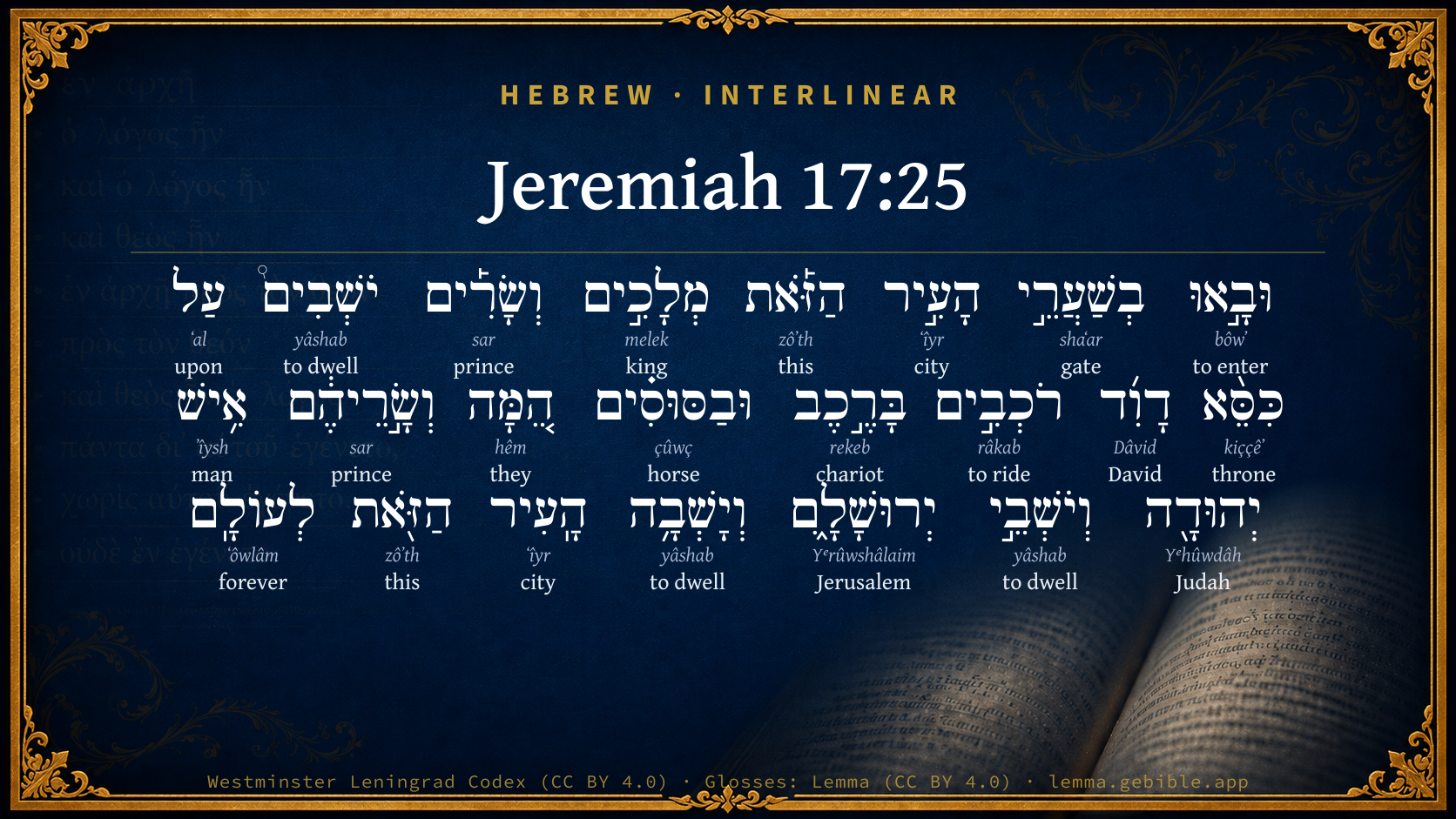
Hebrew (Westminster Leningrad Codex) Jeremiah 17:25 appears in the Hebrew Old Testament. The text above is from the Westminster Leningrad Codex. Each word links to its Strong’s number, a concise gloss, and parsing drawn from the Open Scriptures Hebrew Bible morphology. Click any word for its full Brown-Driver-Briggs (BDB) entry.
Download image
Cite this verse

Jeremiah 17:25 (World English Bible). Public Domain. Lemma interlinear Bible study tool, https://lemma.gebible.app/v/jeremiah/17/25.

Show BibTeX & RIS
BibTeX
RIS
English Translation
then shall there enter in by the gates of this city kings and princes sitting on the throne of David, riding in chariots and on horses, they, and their princes, the men of Judah, and the inhabitants of Jerusalem; and this city shall remain forever.
World English Bible · Public Domain
Download a study sheet

One document with this verse’s original text, its word-by-word gloss line, the meaning frame, cross-references with their text, attributed commentary, and full source and license credits — printable, and it pastes into notes with its structure intact.

This verse Autodidact and up

Study sheet (.html) Plain text (.txt)

A passage Seminary Student

Up to 50 verses in one chapter. A passage sheet keeps up to 6 commentary sources and 12 cross-references per verse, in the order this page ranks them, and says so on the sheet whenever that leaves anything out. Ask for a single verse and you get the Autodidact verse sheet above.

Everything on this page stays free to read, with no account — the sheet is a download of what is already on screen, not access to it.

Want to remove ads? Support Godless Engineer
Compare translations 3

The same verse in 3 English versions, stacked beneath the original-language interlinear above. Click any original word for its lexicon entry.

Each is an independent rendering of the whole verse — the interlinear is not word-aligned to these translations.

Highlighted words mark where these versions differ — a whole-verse word diff, not a word-by-word alignment.

  • World English Bible Public Domain
    then shall there enter in by the gates of this city kings and princes sitting on the throne of David, riding in chariots and on horses, they, and their princes, the men of Judah, and the inhabitants of Jerusalem; and this city shall remain forever.
  • King James Version Public Domain
    Then shall there enter into the gates of this city kings and princes sitting upon the throne of David, riding in chariots and on horses, they, and their princes, the men of Judah, and the inhabitants of Jerusalem: and this city shall remain for ever.
  • unfoldingWord Literal Text CC BY-SA 4.0
    then shall enter the gates of this city, kings and officials, sitting on the throne of David, riding in the chariot and on horses, they and their officials, men of Judah and the ones inhabiting Jerusalem, and they shall inhabit this city forever.

unfoldingWord Literal Text — © unfoldingWord, licensed CC BY-SA 4.0. Word-aligned USFM3 via Door43 (git.door43.org/unfoldingWord/en_ult).

Versions to compare (up to 4)

3 of 4 selected

Show all 18 translations

Every available English version of this verse, each an independent rendering of the whole verse.

  • World English Bible Public Domain
    then shall there enter in by the gates of this city kings and princes sitting on the throne of David, riding in chariots and on horses, they, and their princes, the men of Judah, and the inhabitants of Jerusalem; and this city shall remain forever.
  • Berean Standard Bible Public Domain
    then kings and princes will enter through the gates of this city. They will sit on the throne of David, riding in chariots and on horses with their officials, along with the men of Judah and the residents of Jerusalem, and this city will be inhabited forever.
  • Majority Standard Bible Public Domain
    then kings and princes will enter through the gates of this city. They will sit on the throne of David, riding in chariots and on horses with their officials, along with the men of Judah and the residents of Jerusalem, and this city will be inhabited forever.
  • King James Version Public Domain
    Then shall there enter into the gates of this city kings and princes sitting upon the throne of David, riding in chariots and on horses, they, and their princes, the men of Judah, and the inhabitants of Jerusalem: and this city shall remain for ever.
  • American Standard Version (1901) Public Domain
    then shall there enter in by the gates of this city kings and princes sitting upon the throne of David, riding in chariots and on horses, they, and their princes, the men of Judah, and the inhabitants of Jerusalem; and this city shall remain for ever.
  • Revised Version (1885) Public Domain
    then shall there enter in by the gates of this city kings and princes sitting upon the throne of David, riding in chariots and on horses, they, and their princes, the men of Judah, and the inhabitants of Jerusalem: and this city shall remain for ever.
  • Geneva Bible (1599) Public Domain
    Then shall the Kings and the princes enter in at the gates of this citie, and shall sit vpon the throne of Dauid, and shall ride vpon charets, and vpon horses, both they and their princes, the men of Iudah, and the inhabitants of Ierusalem: and this citie shall remaine for euer.
  • Douay-Rheims (1899) Public Domain
    Then shall there enter in by the gates of this city kings and princes, sitting upon the throne of David, and riding in chariots and on horses, they and their princes, the men of Juda, and the inhabitants of Jerusalem: and this city shall be inhabited forever.
  • Young's Literal Translation Public Domain
    Then entered by the gates of this city have kings and princes, Sitting on the throne of David, Riding in a chariot, and on horses, They, and their princes, the man of Judah, And inhabitants of Jerusalem, And this city hath remained to the age.
  • Literal Standard Version CC BY-SA 4.0
    Then kings and princes have entered by the gates of this city, || Sitting on the throne of David, || Riding in a chariot, and on horses, || They, and their princes, the man of Judah, || And inhabitants of Jerusalem, || And this city has remained for all time.
  • Unlocked Literal Bible CC BY-SA 4.0
    then kings, princes, and those who sit on David's throne will come to the gates of this city in chariots and with horses, they and their leaders, men of Judah and inhabitants of Jerusalem, and this city will be inhabited forever.
  • unfoldingWord Literal Text CC BY-SA 4.0
    then shall enter the gates of this city, kings and officials, sitting on the throne of David, riding in the chariot and on horses, they and their officials, men of Judah and the ones inhabiting Jerusalem, and they shall inhabit this city forever.
  • Darby Bible Public Domain
    then shall there enter in, through the gates of this city, kings and princes sitting upon the throne of David, riding in chariots and on horses, they and their princes, the men of Judah and the inhabitants of Jerusalem: and this city shall be inhabited for ever.
  • World Messianic Bible Public Domain
    then there will enter in by the gates of this city kings and princes sitting on David’s throne, riding in chariots and on horses, they and their princes, the men of Judah and the inhabitants of Jerusalem; and this city will remain forever.
  • Webster's Bible Public Domain
    Then shall there enter into the gates of this city kings and princes sitting upon the throne of David, riding in chariots and on horses, they and their princes, the men of Judah, and the inhabitants of Jerusalem: and this city shall remain for ever.
  • Free Bible Version CC BY-SA 4.0
    Then kings and princes will enter through the gates of this city. They will sit on the throne of David. They will ride in chariots and on horses with their officials, accompanied by the people of Judah and those living in Jerusalem, and this city will be inhabited forever.
  • Bible in Basic English Public Domain
    Then through the doors of this town there will come kings and princes, seated on the seat of David, going in carriages and on horseback, they and their princes, and the men of Judah and the people of Jerusalem: and this town will keep its place for ever.
  • JPS Tanakh (1917) Public Domain
    then shall there enter in by the gates of this city kings and princes sitting upon the throne of David, riding in chariots and on horses, they, and their princes, the men of Judah, and the inhabitants of Jerusalem; and this city shall be inhabited for ever.

Literal Standard Version (2020), Covenant Press — licensed CC BY-SA 4.0. Text via the HelloAO Bible API (eBible.org). Unlocked Literal Bible (unfoldingWord) — licensed CC BY-SA 4.0. Text via the HelloAO Bible API (eBible.org). unfoldingWord Literal Text — © unfoldingWord, licensed CC BY-SA 4.0. Word-aligned USFM3 via Door43 (git.door43.org/unfoldingWord/en_ult). Free Bible Version, Dr. Jonathan Gallagher — licensed CC BY-SA 4.0. Text via the HelloAO Bible API (eBible.org).

Word by word

More ways to search: Search by grammar → Find every occurrence → Compare this word →

Practice this passage: Drill this verse → Learn its vocabulary →

רֹכְבִ֣ים
râkab
H7392
“riding”
Verb, Qal, Participle Active, Masculine, Plural, Absolute
Part of Speech
Verb
Stem
Qal
Form
Participle Active
Gender
Masculine
Number
Plural
State
Absolute
Full BDB Definition

Origin: a primitive root

TWOT: 2163

to mount and ride, ride - (Qal) - to mount, mount and sit or ride - to ride, be riding - rider (substantive) - (Hiphil) - to cause to ride, cause to (mount and) ride - to cause to draw (plough, etc) - to cause to ride upon (figuratively)
  1. וּבָ֣אוּ bôwʼ H935 “and · to enter” Conjunction + Verb, Qal, Sequential Perfect, 3rd Person, Common, Plural
  2. בְשַׁעֲרֵ֣י shaʻar H8179 “in/at · gates of” Preposition + Noun, Common, Masculine, Plural, Construct
  3. הָעִ֣יר ʻîyr H5892 “the · city” Particle, Definite Article + Noun, Common, Feminine, Singular, Absolute
  4. הַזֹּ֡את zôʼth H2063 “the · this” Particle, Definite Article + Pronoun, Demonstrative, Feminine, Singular
  5. מְלָכִ֣ים melek H4428 “kings” Noun, Common, Masculine, Plural, Absolute
  6. וְשָׂרִ֡ים sar H8269 “and · princes” Conjunction + Noun, Common, Masculine, Plural, Absolute
  7. יֹשְׁבִים֩ yâshab H3427 “dwelling” Verb, Qal, Participle Active, Masculine, Plural, Absolute
  8. עַל ʻal H5921 “upon” Preposition
  9. כִּסֵּ֨א kiççêʼ H3678 “throne of” Noun, Common, Masculine, Singular, Construct
  10. דָוִ֜ד Dâvid H1732 “David” Noun, Proper
  11. בָּרֶ֣כֶב rekeb H7393 “in/at the · chariot” Preposition, Determined + Noun, Common, Masculine, Singular, Absolute
  12. וּבַסּוּסִ֗ים çûwç H5483 “and · in/at the · horses” Conjunction + Preposition, Determined + Noun, Common, Masculine, Plural, Absolute
  13. הֵ֚מָּה hêm H1992 “they” Pronoun, Personal, 3rd Person, Masculine, Plural
  14. וְשָׂ֣רֵיהֶ֔ם sar H8269 “and · princes · their” Conjunction + Noun, Common, Masculine, Plural, Construct + Suffix, Personal, 3rd Person, Masculine, Plural
  15. אִ֥ישׁ ʼîysh H376 “man of” Noun, Common, Masculine, Singular, Construct
  16. יְהוּדָ֖ה Yᵉhûwdâh H3063 “Judah” Noun, Proper
  17. וְיֹשְׁבֵ֣י yâshab H3427 “and · dwelling” Conjunction + Verb, Qal, Participle Active, Masculine, Plural, Construct
  18. יְרוּשָׁלִָ֑ם Yᵉrûwshâlaim H3389 “Jerusalem” Noun, Proper
  19. וְיָשְׁבָ֥ה yâshab H3427 “and · to dwell” Conjunction + Verb, Qal, Sequential Perfect, 3rd Person, Feminine, Singular
  20. הָֽעִיר ʻîyr H5892 “the · city” Particle, Definite Article + Noun, Common, Feminine, Singular, Absolute
  21. הַזֹּ֖את zôʼth H2063 “the · this” Particle, Definite Article + Pronoun, Demonstrative, Feminine, Singular
  22. לְעוֹלָֽם ʻôwlâm H5769 “to/for · forever” Preposition + Noun, Common, Masculine, Singular, Absolute

About this verse

These counts appear in no published source. They are computed here, from the morphology-tagged text and Lemma’s own curated glosses. What Lemma adds →

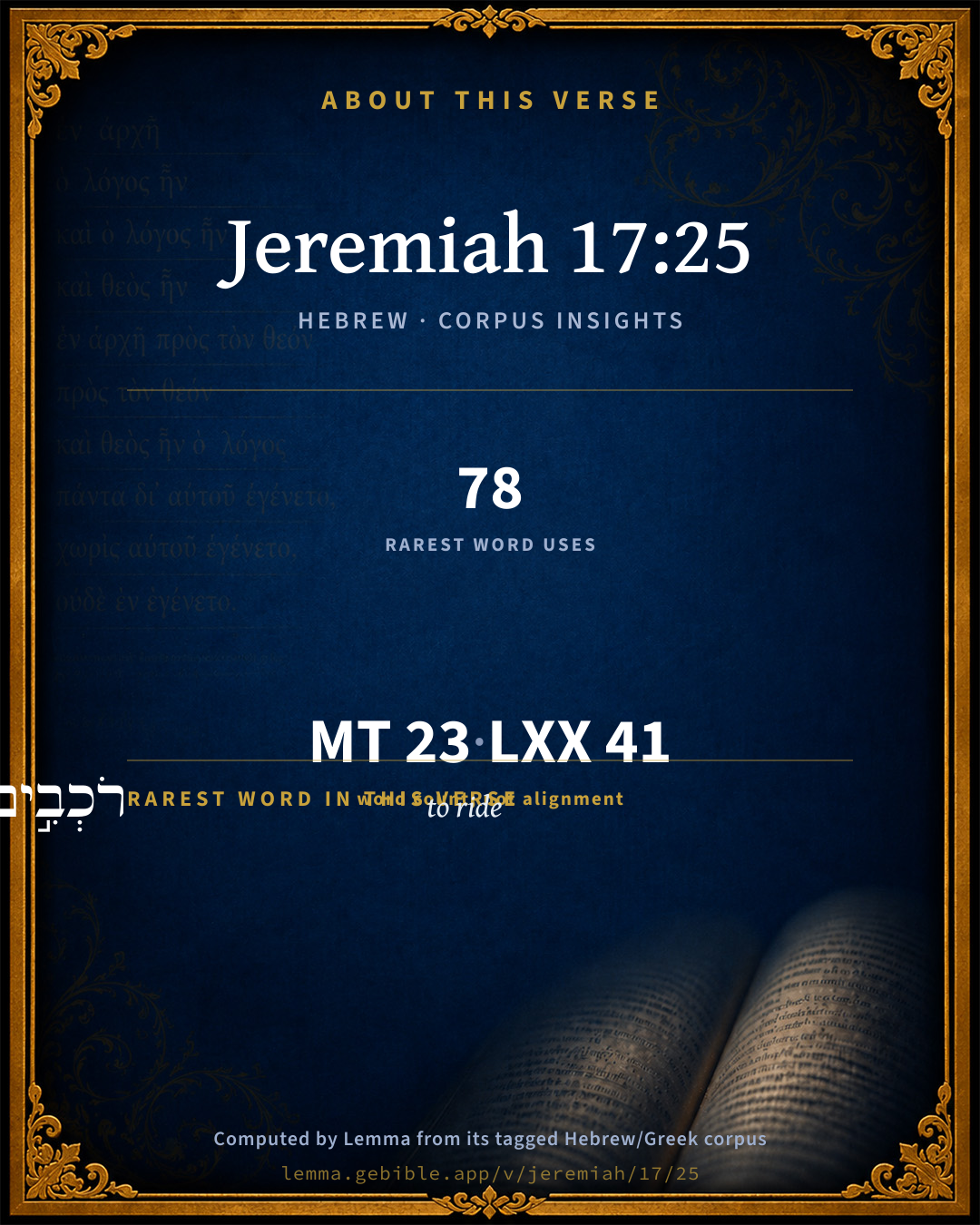
23
words
18
distinct lemmas
Prophets
section

Grammatical profile

  • 5 verbs
  • 14 nouns
  • 3 pronouns
  • 1 preposition

Verb forms

  • וּבָ֣אוּ Qal · Sequential Perfect
  • יֹשְׁבִים֩ Qal · Participle Active
  • רֹכְבִ֣ים Qal · Participle Active
  • וְיֹשְׁבֵ֣י Qal · Participle Active
  • וְיָשְׁבָ֥ה Qal · Sequential Perfect

Repetition

Words recur within this verse — often emphatic in Hebrew:

  • יֹשְׁבִים֩ to dwell H3427 ×3
  • הָעִ֣יר city H5892 ×2
  • וְשָׂרִ֡ים prince H8269 ×2
  • הַזֹּ֡את this H2063 ×2

Hebrew & Septuagint length

In the original languages it is 23 Hebrew tokens and 41 Greek tokens — but the two are counted differently (Hebrew bundles its prefixes and suffixes into one token; the Greek is in lemma form), so that isn’t a like-for-like length.

Cross-references

17

Topical passages linked to Jeremiah 17:25 in the Treasury of Scripture Knowledge — connected by theme and wording, ordered by reader-vote popularity; previews shown in the World English Bible.

  • Jeremiah 22:4 For if you do this thing indeed, then shall there enter in by the gates of this house kings sitting on the throne of David, riding in chariots and on horses, he, and his servants, and his people.
  • Isaiah 9:7 Of the increase of his government and of peace there shall be no end, on the throne of David, and on his kingdom, to establish it, and to uphold it with justice and with righteousness from henceforth even forever. The zeal of Yahweh of Hosts will perform this.
  • 2 Samuel 7:16 Your house and your kingdom shall be made sure for ever before you: your throne shall be established forever.
  • Jeremiah 33:15 In those days, and at that time, will I cause a Branch of righteousness to grow up to David; and he shall execute justice and righteousness in the land.
  • Jeremiah 33:17 For thus says Yahweh: David shall never want a man to sit on the throne of the house of Israel;
  • Jeremiah 33:21 then may also my covenant be broken with David my servant, that he shall not have a son to reign on his throne; and with the Levites the priests, my ministers.
  • Hebrews 12:22 But you have come to Mount Zion, and to the city of the living God, the heavenly Jerusalem, and to innumerable hosts of angels,
  • Exodus 12:14 This day shall be to you for a memorial, and you shall keep it a feast to Yahweh: throughout your generations you shall keep it a feast by an ordinance forever.
  • Deuteronomy 17:16 Only he shall not multiply horses to himself, nor cause the people to return to Egypt, to the end that he may multiply horses; because Yahweh has said to you, You shall henceforth return no more that way.
  • 1 Samuel 8:11 He said, This will be the manner of the king who shall reign over you: he will take your sons, and appoint them to him, for his chariots, and to be his horsemen; and they shall run before his chariots;
  • 2 Samuel 8:4 David took from him one thousand seven hundred horsemen, and twenty thousand footmen: and David hamstrung all the chariot horses, but reserved of them for one hundred chariots.
  • 1 Kings 9:4–5 As for you, if you will walk before me, as David your father walked, in integrity of heart, and in uprightness, to do according to all that I have commanded you, and will keep my statutes and my ordinances;
  • Psalms 89:29–37 I will also make his seed endure forever, And his throne as the days of heaven.
  • Psalms 132:11–14 Yahweh has sworn to David in truth. He will not turn from it: "I will set the fruit of your body on your throne.
  • Jeremiah 13:13 Then shall you tell them, Thus says Yahweh, Behold, I will fill all the inhabitants of this land, even the kings who sit on David's throne, and the priests, and the prophets, and all the inhabitants of Jerusalem, with drunkenness.
  • Jeremiah 22:30 Thus says Yahweh, Write you this man childless, a man who shall not prosper in his days; for no more shall a man of his seed prosper, sitting on the throne of David, and ruling in Judah.
  • Luke 1:32–33 He will be great, and will be called the Son of the Most High. The Lord God will give him the throne of his father, David,

Cross-references courtesy of OpenBible.info (CC BY 4.0).

Hebrew and Greek witnesses Masoretic Hebrew ↔ Greek Septuagint

The same verse in the two great witnesses to the Old Testament, shown verse-for-verse.

These are two independent witnesses, not word-aligned to each other, and the Septuagint is shown in lemma (dictionary) form.

Hebrew Jeremiah 17:25 Masoretic · Westminster Leningrad Codex

וּבָ֣אוּ בְשַׁעֲרֵ֣י הָעִ֣יר הַזֹּ֡את מְלָכִ֣ים וְשָׂרִ֡ים יֹשְׁבִים֩ עַל כִּסֵּ֨א דָוִ֜ד רֹכְבִ֣ים בָּרֶ֣כֶב וּבַסּוּסִ֗ים הֵ֚מָּה וְשָׂ֣רֵיהֶ֔ם אִ֥ישׁ יְהוּדָ֖ה וְיֹשְׁבֵ֣י יְרוּשָׁלִָ֑ם וְיָשְׁבָ֥ה הָֽעִיר הַזֹּ֖את לְעוֹלָֽם

then shall there enter in by the gates of this city kings and princes sitting on the throne of David, riding in chariots and on horses, they, and their princes, the men of Judah, and the inhabitants of Jerusalem; and this city shall remain forever.

World English Bible · Public Domain

Greek LXX Structure differs

In the Septuagint, Jeremiah is about an eighth shorter than the Hebrew and arranges its material differently — the Oracles Against the Nations (Hebrew chapters 46–51) appear in the middle of the Greek book, after 25:13. Because the chapter and verse boundaries do not line up, a verse-for-verse comparison with the Hebrew is not shown.

A verse-for-verse comparison isn’t shown here because the chapters and verses don’t line up. Switch to the LXX edition with the MT / LXX toggle above to read the Greek directly.

Hebrew: Westminster Leningrad Codex (CC BY 4.0). Greek: Septuagint (public domain); English from a public-domain English Septuagint. How the Septuagint differs from the Hebrew →

Targum (Aramaic paraphrase)

1

The Targum is the ancient Jewish Aramaic paraphrase of the Hebrew Scriptures — an interpretive translation, not the Hebrew text itself. Onkelos (literal) and Pseudo-Jonathan (expansive) render the Torah, and Jonathan the Prophets. Coverage is partial: where no permissively-licensed English translation exists for a verse, only the Aramaic is shown. This is verse-level text, not a word-by-word alignment to the Hebrew.

  1. Targum Jonathan Prophets (Joshua–Malachi)
    וְיַעֲלוּן בְּתַרְעֵי קַרְתָּא הָדָא מַלְכִין וְרַבְרְבִין יַתְבִין עַל כּוּרְסֵי דָוִד רְכִיבִין בִּרְתִיכִין וּבְסוּסְוָן אִינוּן וְרַבְרְבָנֵיהוֹן אֱנַשׁ יְהוּדָה וְיַתְבֵי יְרוּשְׁלֵם וְתִתֵּב קַרְתָּא הָדָא לַעֲלָם:

    (no public-domain English translation for this verse)

    Targum Jonathan — Aramaic: “Mikraot Gedolot” (public domain). English: “Sefaria Community Translation” (CC0 1.0 (public-domain dedication)); “London "Chaldee Paraphrase," 1871” (public domain). Text via Sefaria.

Commentary

Notes on Jeremiah 17:25 from classic Christian and Jewish commentators (each source and its license shown beneath its notes). The classic Christian expositions comment on the surrounding passage and are grouped to its opening verse, so a note may address several verses; the Jewish commentaries on the Tanakh (Rashi and others) are per-verse, so they appear only where the commentator wrote on this verse.

Lemma curates 59 commentaries, every one of them public domain or Creative Commons licensed, each selected and text-cleaned for this edition rather than reprinted as found. About our sources →

Trapp's Complete Commentary

John Trapp

Jer 17:25 Then shall there enter into the gates of this city kings and princes sitting upon the throne of David, riding in chariots and on horses, they, and their princes, the men of Judah, and the inhabitants of Jerusalem: and this city shall remain for ever.

Ver. 25. Then shall there enter.] Then shall all go well with you, publicly and privately; ye shall have a confluence of all manner of comforts and contentments.

John Trapp, A Commentary or Exposition upon All the Books of the Old and New Testament (1647–1656) — public domain. Text from a community e-Sword module.

Joseph Benson's Commentary

Jer 17:25-27. Then shall there enter into the gates of this city, &c. — “From hence it appears,” says Lowth, “that the judgments denounced against Jerusalem, at least as far as they threatened the city with utter destruction, were not irreversible. And from Jeremiah’s advice to Zedekiah, Jer 38:17, it may be concluded, that if the king had hearkened to that counsel, the city would not have been destroyed, and he himself might have continued a tributary king under Nebuchadnezzar. It is true, that in several other chapters of this prophecy, God, upon foresight of the Jews’ impenitence, pronounces a peremptory sentence upon them. See note on Jer 4:28.” From the land of Benjamin — See notes on Jer 1:1; Jer 6:1. And from the plain, and from the mountain — “These divisions of the country belonging to the tribe of Judah may be found, Jos 15:21; Jos 15:33; Jos 15:48; and these, together with the tribe of Benjamin, made up the whole kingdom of Judah, when taken separate from the kingdom of Israel, or of the ten tribes. See the same enumeration Jer 32:44.” Bringing burnt-offerings and sacrifices, &c. — The sum of these three verses is, that if they would sanctify the Lord’s sabbath, observing also all the other parts of God’s law, which are doubtless included, they should either continue in, or be restored unto, their ancient, civil, and ecclesiastical state. Their city and temple should be preserved; they should have kings and princes in their former order and splendour, and men should come from all parts of the country bringing their usual sacrifices and offerings to the temple, and those of all sorts. But if you will not hearken unto me — Here the Lord denounces a threatening the reverse of the former promise, which should be executed upon their acting contrary to the duty to which that promise was annexed. God would destroy their city by fire; their highest and noblest structures should be burned down: and though the hand of the enemy should do this, yet God should order them to do it; so that it should be a fire of his kindling, and therefore should not be likely to be quenched till it had effected the purpose for which God appointed it.

Joseph Benson's Commentary on the Old and New Testaments (1811–1818) — public domain. Text from a community e-Sword module.

Jamieson, Fausset & Brown

Robert Jamieson, A. R. Fausset & David Brown

kings . . . in chariots--The kingdom at this time had been brought so low that this promise here was a special favor.

remain--Hebrew, "be inhabited" (Jer 17:6; Isa 13:20).

Jamieson, Fausset & Brown — Commentary Critical and Explanatory on the Whole Bible (1871) — public domain (CC PDM 1.0). Text via the HelloAO Bible API.

John Calvin's Commentaries

But it may be here asked, Was the rest on the seventh day of such a moment, that God should on that account promise to them the perpetuity of the kingdom? The answer has been already given, that is, that the end, which was spiritual, was connected with the outward rite; for God commanded the people to keep holy this day, that they might have a manifest symbol:, as it has been said, of their own sanctification. When therefore the Prophet thus speaks, If ye carry no burden through the gates of this city, that is, If ye observe the sabbath-day, the perpetuity of the kingdom shall be secured to you, — when he thus speaks, he had doubtless, as I have said, a regard to a true observance of the day, which consists not in the naked rite, but included something greater and more excellent, even that they might learn by self-denial to render themselves up to God to be ruled by him; for God will not work in us, unless we first renounce our own reason and the thoughts and feelings of our flesh. In the observance of the Sabbath, therefore, is briefly included the whole of religion: hence he says, Enter in shall kings and princes, sitting on the throne of David.

Noticed also ought to be the state of things at that time: It was a time when the country was nearly in ruins and the kingdom greatly weakened, so that the kings and the whole people were daily exposed to danger. When therefore there were hardly any means to defend the city and to support the kingdom, Jeremiah promised it, as a special favor from God, that the kings and the Princes would be rendered secure. From the family of David, as it is well known, were descended the royal counsellors; and hence he says of the counsellors as well as of the king, that they would sit on the throne of David: and he further says, They shall ride in a chariot and on horses, they the kings and their princes; and he adds, the men of Judah, etc. He extends the promise to the whole body of the people; after having spoken of the chief men, he then adds, that the whole community would be partakers of this blessing and favor of God; for the kingdom was formed, that the whole people might know that they were under God’s care and protection. It was not then without reason that Jeremiah states here that this blessing would be conferred in common on the whole people.

And inhabited, he says, shall be the city perpetually. For the same reason he also adds this; for Jerusalem was then in great danger; nay, there were new terrors daily, and there was a horrible desolation in every part, for the whole country had been visited with many calamities. Jeremiah therefore promised now what in a manner seemed incredible, that is, that the city would be made safe, if they truly and faithfully worshipped God, and testified that by observing the Sabbath. The meaning is, that it would be their own fault, if they found not the aid of God sufficient for them, that even if they were besieged by enemies, yet God would be a sure protector of their safety, provided they became his true and faithful servants. He afterwards adds —

John Calvin's Commentaries (1540-1563) — public domain. Text from the Calvin Translation Society English edition (1840s-50s) via the Christian Classics Ethereal Library (ccel.org). Calvin's coverage is partial (roughly two-thirds of the Bible); uncommented books and verses are honest gaps, never fabricated. The 19th-century editor's footnotes and remarks are omitted so the notes are faithfully Calvin's own voice.

Ellicott's Commentary for English Readers

(25) Kings and princes.—The plural is obviously used to give greater vividness and grandeur to the picture of revived majesty which would be the reward of faithfulness, perhaps also to express the idea that the majesty would be enduring.

A Bible Commentary for English Readers, edited by Charles John Ellicott (1878–1897) — public domain. Text from a community e-Sword module.

The Cambridge Bible for Schools and Colleges

gen. ed. J. J. S. Perowne

25. then shall there enter] Prosperity, permanence, and religious devotion shall be the three characteristic features of the Jewish State, if only they will hallow the Sabbath.

and princes] a virtually certain example of a pre-Septuagintal insertion. Its spuriousness is shewn by the words “their princes,” which follow. The insertion has been suggested doubtless by parallel passages (Jer_2:26, Jer_25:18, Jer_32:32, Jer_44:17; Jer_44:21). Cp. on the other hand (for absence of the addition) Jer_13:13, Jer_22:4.

The Cambridge Bible for Schools and Colleges (gen. ed. J. J. S. Perowne; Cambridge University Press, 1878–1918) — public domain. Text from a community e-Sword module.

John Gill's Exposition

Then shall there enter into the gates of this city,.... In a very public and splendid manner:

kings and princes, sitting upon the throne of David; that is, kings, with the princes of the blood, or with their nobles, who shall be of the house and line of David; and in a continual succession shall sit upon his throne, and possess the kingdom of the house of Judah, and rule over them in great glory, peace, and prosperity:

riding in chariots and on horses, they and their princes, the men of Judah, and the inhabitants of Jerusalem; some riding in chariots, and some on horses; the king, with some of the princes of the blood, in one chariot; his nobles in others, or on horseback; with great numbers of the citizens of Jerusalem, and people from all parts, flocking to see them, and join in the procession, and so make it more grand and august:

and this city shall remain for ever; or, "be inhabited for ever" (h); a long time, and not be destroyed, as has been threatened, or its inhabitants carried captive.

(h) "et inhabitabitur in seculum", Piscator, Cocceius, Schmidt.

John Gill's Exposition of the Whole Bible (1746–1763) — public domain (CC PDM 1.0). Text via the HelloAO Bible API.

Haydock's Catholic Bible Commentary

David. I will observe my covenant, 2 Kings vii. 12. --- Horses: in prosperity, (Menochius) provided this law, as well as all the rest, be observed. (Haydock) --- Such temporal rewards were commonly proposed under the law, as spiritual ones are now. (Worthington)

George Leo Haydock (1774–1849), Haydock's Catholic Family Bible and Commentary, 1859 edition — public domain. Excludes Psalms (Douay-Rheims chapter numbering differs from Protestant) and Deuterocanonical books (Catholic canon only).

Whedon's Commentary on the Bible

Daniel D. Whedon

25. Then shall there enter — A noble picture of national grandeur and prosperity.

Sitting upon the throne of David — Such elevation belongs, in strictness, only to kings, but the term princes is associated, perhaps to give the picture a more popular cast. Riding in chariots and on horses, suggests what, in such case, would be the “undiminished splendour of the rule of David’s race.”

Daniel D. Whedon (gen. ed.), Commentary on the Old and New Testaments (1874–1909) — public domain. Text from a community e-Sword module.

The Pulpit Commentary

Parallel passage, Jer_22:4, where, however, we simply meet with "kings sitting upon the throne o f David," not, as hero, "kings and princes." Has the latter word come in by accident, owing to the frequent combination of kings and princes in Jeremiah? (Jer_1:18 Jer_2:26 Jer_25:18 Jer_32:32 Jer_44:17, Jer_44:21) Shall remain forever; rather, shall be inhabited forever.

The Pulpit Commentary (1880–1919), ed. H.D.M. Spence-Jones & Joseph S. Exell — public domain. Text from a community e-Sword module.

Lesson kit

Teaching starters — assembled from the data on this page, not authored interpretation. Every prompt links to the verse data it draws on. Edit before teaching.

Jeremiah, in the Prophets, opens this verse with 23 words (18 distinct Hebrew lemmas). Its most distinctive word is râkab (“to ride”). A historical commentator’s framing appears above. Read the whole chapter for the surrounding context.

Discussion questions

  1. How does “to ride” (râkab) shape what this verse is saying?
  2. Jeremiah 22:4 shares this passage’s theme. How do the two illuminate each other?
  3. “to dwell” occurs 3× in this one verse. What is the effect of the repetition?
  4. The translations on this page render this verse differently — a whole-verse word diff, not a word-by-word alignment. What might account for the different wordings?
  5. The verb «וּבָ֣אוּ» is Qal Sequential Perfect. How does its form color the action?
  6. Reading how Trapp's Complete Commentary and Joseph Benson's Commentary read this verse, where do the two commentators agree and where do they part?

Things to notice

Reading settings

Reading text

Shown beneath each verse's original-language words.

Old Testament
Old Testament edition

Read the OT as the Masoretic Hebrew (MT) or the Greek Septuagint (LXX).

English shown for the Greek Septuagint (in the Hebrew ↔ Greek comparison).

Comparing translations? Open the Compare panel on any verse page to stack up to four side by side.