Ezekiel 40:9

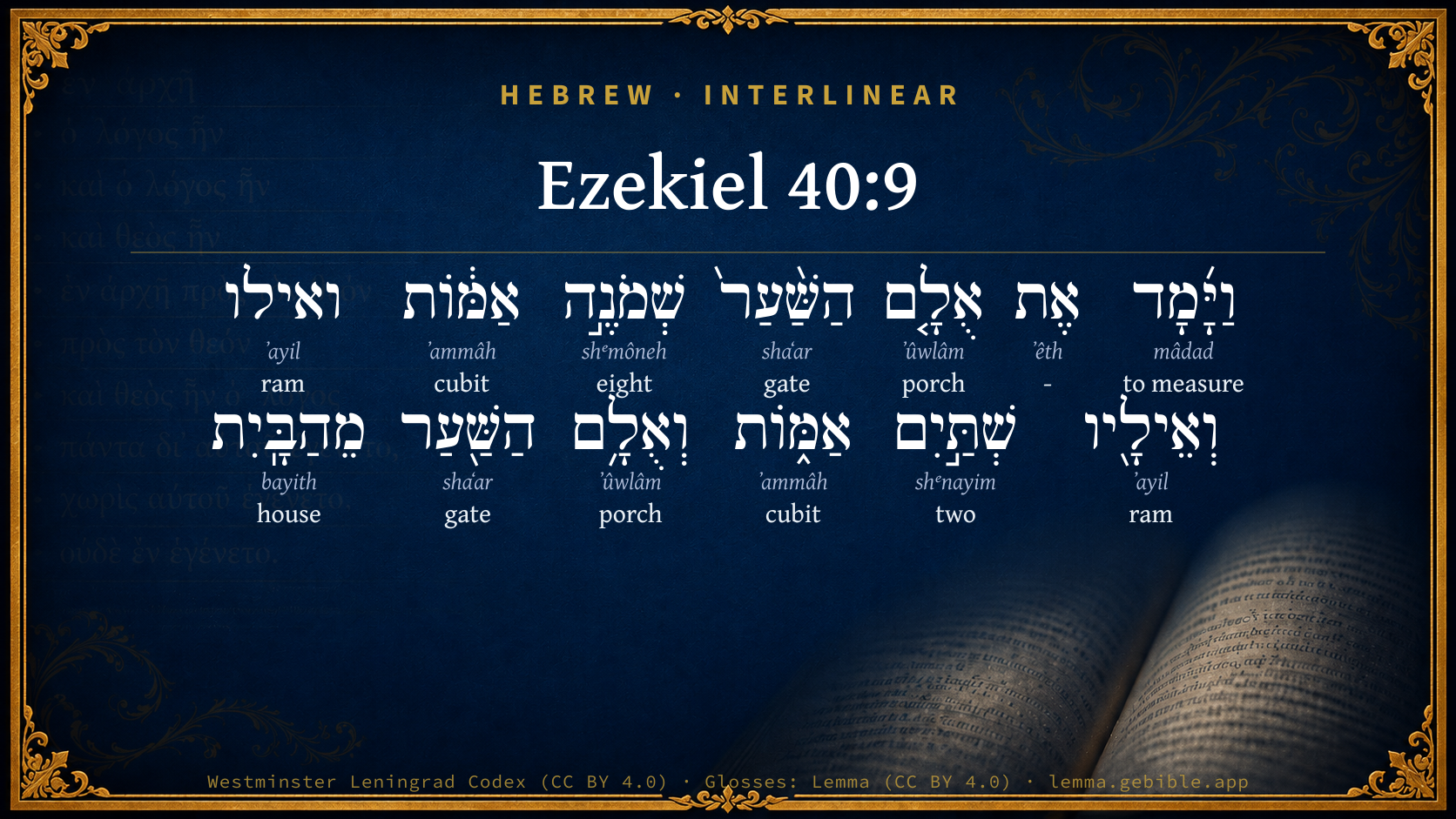
Hebrew (Westminster Leningrad Codex) Ezekiel 40:9 appears in the Hebrew Old Testament. The text above is from the Westminster Leningrad Codex. Each word links to its Strong’s number, a concise gloss, and parsing drawn from the Open Scriptures Hebrew Bible morphology. Click any word for its full Brown-Driver-Briggs (BDB) entry.
Download image
Cite this verse

Ezekiel 40:9 (World English Bible). Public Domain. Lemma interlinear Bible study tool, https://lemma.gebible.app/v/ezekiel/40/9.

Show BibTeX & RIS
BibTeX
RIS
English Translation
Then measured he the porch of the gate, eight cubits; and the posts of it, two cubits; and the porch of the gate was toward the house.
World English Bible · Public Domain
Download a study sheet

One document with this verse’s original text, its word-by-word gloss line, the meaning frame, cross-references with their text, attributed commentary, and full source and license credits — printable, and it pastes into notes with its structure intact.

This verse Autodidact and up

Study sheet (.html) Plain text (.txt)

A passage Seminary Student

Up to 50 verses in one chapter. A passage sheet keeps up to 6 commentary sources and 12 cross-references per verse, in the order this page ranks them, and says so on the sheet whenever that leaves anything out. Ask for a single verse and you get the Autodidact verse sheet above.

Everything on this page stays free to read, with no account — the sheet is a download of what is already on screen, not access to it.

Want to remove ads? Support Godless Engineer
Compare translations 3

The same verse in 3 English versions, stacked beneath the original-language interlinear above. Click any original word for its lexicon entry.

Each is an independent rendering of the whole verse — the interlinear is not word-aligned to these translations.

Highlighted words mark where these versions differ — a whole-verse word diff, not a word-by-word alignment.

  • World English Bible Public Domain
    Then measured he the porch of the gate, eight cubits; and the posts of it, two cubits; and the porch of the gate was toward the house.
  • King James Version Public Domain
    Then measured he the porch of the gate, eight cubits; and the posts thereof, two cubits; and the porch of the gate was inward.
  • unfoldingWord Literal Text CC BY-SA 4.0
    He measured the portico of the gate. It was one stick deep. The doorposts were two cubits in width. This was the portico of the gate facing the temple.

unfoldingWord Literal Text — © unfoldingWord, licensed CC BY-SA 4.0. Word-aligned USFM3 via Door43 (git.door43.org/unfoldingWord/en_ult).

Versions to compare (up to 4)

3 of 4 selected

Show all 18 translations

Every available English version of this verse, each an independent rendering of the whole verse.

  • World English Bible Public Domain
    Then measured he the porch of the gate, eight cubits; and the posts of it, two cubits; and the porch of the gate was toward the house.
  • Berean Standard Bible Public Domain
    it was eight cubits deep, and its jambs were two cubits thick. And the portico of the gateway faced the temple.
  • Majority Standard Bible Public Domain
    it was eight cubits deep, and its jambs were two cubits thick. And the portico of the gateway faced the temple.
  • King James Version Public Domain
    Then measured he the porch of the gate, eight cubits; and the posts thereof, two cubits; and the porch of the gate was inward.
  • American Standard Version (1901) Public Domain
    Then measured he the porch of the gate, eight cubits; and the posts thereof, two cubits; and the porch of the gate was toward the house.
  • Revised Version (1885) Public Domain
    Then measured he the porch of the gate, eight cubits; and the posts thereof, two cubits; and the porch of the gate was toward the house.
  • Geneva Bible (1599) Public Domain
    Then measured he the porch of the gate of eight cubites, and the postes thereof, of two cubites, and the porch of the gate was inward.
  • Douay-Rheims (1899) Public Domain
    And he measured the porch of the gate eight cubits, and the front thereof two cubits: and the porch of the gate was inward.
  • Young's Literal Translation Public Domain
    and he measureth the porch of the gate eight cubits, and its posts two cubits, and the porch of the gates from within,
  • Literal Standard Version CC BY-SA 4.0
    and he measures the porch of the gate—eight cubits, and its posts—two cubits, and the porch of the gates from within,
  • Unlocked Literal Bible CC BY-SA 4.0
    He measured the portico of the gate. It was one stick deep. The doorposts were two cubits in width. This was the portico of the gate facing the temple.
  • unfoldingWord Literal Text CC BY-SA 4.0
    He measured the portico of the gate. It was one stick deep. The doorposts were two cubits in width. This was the portico of the gate facing the temple.
  • Darby Bible Public Domain
    And he measured the porch of the gate, eight cubits; and the posts thereof, two cubits; and the porch of the gate was inward.
  • World Messianic Bible Public Domain
    Then he measured the porch of the gate, eight cubits; and its posts, two cubits; and the porch of the gate was toward the house.
  • Webster's Bible Public Domain
    Then he measured the porch of the gate, eight cubits; and its posts, two cubits; and the porch of the gate was inward.
  • Free Bible Version CC BY-SA 4.0
    It was eight cubits deep, and its posts were two cubits thick. The entrance porch faced the Temple.
  • Bible in Basic English Public Domain
    Eight cubits; and its uprights, two cubits; the covered way of the doorway was inside.
  • JPS Tanakh (1917) Public Domain
    Then measured he the porch of the gate, eight cubits; and the posts thereof, two cubits; and the porch of the gate was inward.

Literal Standard Version (2020), Covenant Press — licensed CC BY-SA 4.0. Text via the HelloAO Bible API (eBible.org). Unlocked Literal Bible (unfoldingWord) — licensed CC BY-SA 4.0. Text via the HelloAO Bible API (eBible.org). unfoldingWord Literal Text — © unfoldingWord, licensed CC BY-SA 4.0. Word-aligned USFM3 via Door43 (git.door43.org/unfoldingWord/en_ult). Free Bible Version, Dr. Jonathan Gallagher — licensed CC BY-SA 4.0. Text via the HelloAO Bible API (eBible.org).

Word by word

More ways to search: Search by grammar → Find every occurrence → Compare this word →

Practice this passage: Drill this verse → Learn its vocabulary →

אֻלָ֤ם
ʼûwlâm
H197
“porch of”
Noun, Common, Masculine, Singular, Construct
Part of Speech
Noun
Type
Common
Gender
Masculine
Number
Singular
State
Construct
Full BDB Definition

Origin: from H481 (in the sense of tying)

TWOT: 45c

porch - in Solomon's temple - in Solomon's palace - in temple of Ezekiel's vision
  1. וַיָּ֜מָד mâdad H4058 “and · to measure” Conjunction + Verb, Qal, Sequential Imperfect, 3rd Person, Masculine, Singular
  2. אֶת ʼêth H853 “-” Particle, Direct Object
  3. הַשַּׁ֨עַר֙ shaʻar H8179 “the · gate” Particle, Definite Article + Noun, Common, Masculine, Singular, Absolute
  4. שְׁמֹנֶ֣ה shᵉmôneh H8083 “eight” Adjective, Cardinal number, Feminine, Singular, Absolute
  5. אַמּ֔וֹת ʼammâh H520 “cubits” Noun, Common, Feminine, Plural, Absolute
  6. ואילו ʼayil H352 “and · ram · his” Conjunction + Noun, Common, Masculine, Singular, Construct + Suffix, Personal, 3rd Person, Masculine, Singular
  7. וְאֵילָ֖יו ʼayil H352 “and · rams · his” Conjunction + Noun, Common, Masculine, Plural, Construct + Suffix, Personal, 3rd Person, Masculine, Singular
  8. שְׁתַּ֣יִם shᵉnayim H8147 “two” Adjective, Cardinal number, Feminine, Dual, Absolute
  9. אַמּ֑וֹת ʼammâh H520 “cubits” Noun, Common, Feminine, Plural, Absolute
  10. וְאֻלָ֥ם ʼûwlâm H197 “and · porch of” Conjunction + Noun, Common, Masculine, Singular, Construct
  11. הַשַּׁ֖עַר shaʻar H8179 “the · gate” Particle, Definite Article + Noun, Common, Masculine, Singular, Absolute
  12. מֵהַבָּֽיִת bayith H1004 “from · the · house” Preposition + Particle, Definite Article + Noun, Common, Masculine, Singular, Absolute

About this verse

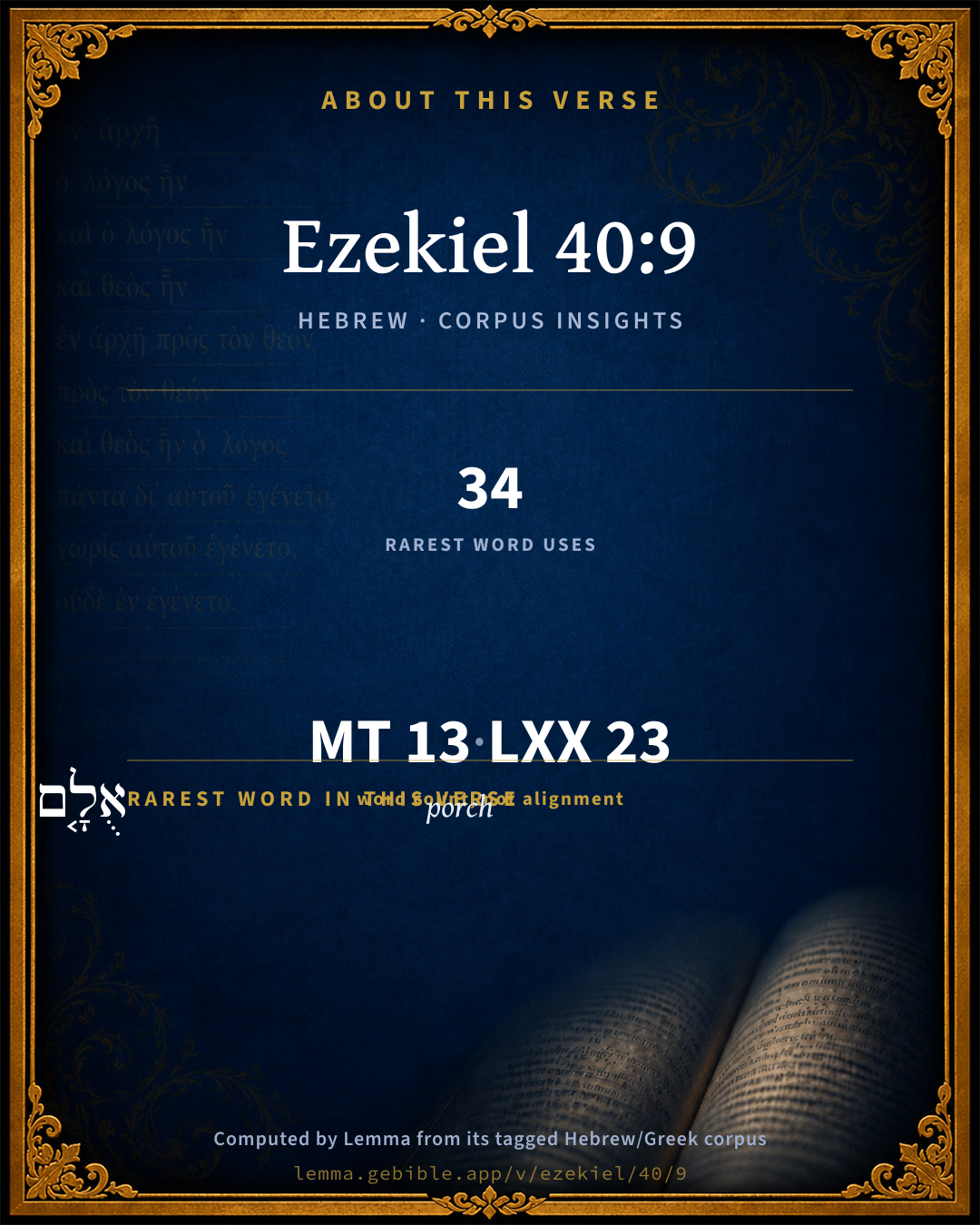
These counts appear in no published source. They are computed here, from the morphology-tagged text and Lemma’s own curated glosses. What Lemma adds →

13
words
9
distinct lemmas
Prophets
section

Shared distinctive vocabulary

אֻלָ֤ם porch H197 occurs in 29 verses of the Hebrew Bible. Also found in:

Grammatical profile

  • 1 verb
  • 9 nouns
  • 2 adjectives
  • 1 particle

Verb forms

  • וַיָּ֜מָד Qal · Sequential Imperfect

Repetition

Words recur within this verse — often emphatic in Hebrew:

  • אֻלָ֤ם porch H197 ×2
  • הַשַּׁ֨עַר֙ gate H8179 ×2
  • אַמּ֔וֹת cubit H520 ×2
  • ואילו ram H352 ×2

Hebrew & Septuagint length

In English translation the verse runs 27 words from the Hebrew and 29 from the Septuagint (LXX English) — closely comparable.

A rough comparison of the two English renderings, which tokenize alike — not a word-level alignment.

Word counts can differ between the Hebrew and the Greek without any difference in meaning — e.g. the Hebrew direct-object marker אֵת has no separate Greek word, and Greek often adds the article ὁ.

In the original languages it is 13 Hebrew tokens and 23 Greek tokens — but the two are counted differently (Hebrew bundles its prefixes and suffixes into one token; the Greek is in lemma form), so that isn’t a like-for-like length.

Cross-references

1

Topical passages linked to Ezekiel 40:9 in the Treasury of Scripture Knowledge — connected by theme and wording, ordered by reader-vote popularity; previews shown in the World English Bible.

  • Ezekiel 45:19 The priest shall take of the blood of the sin-offering, and put it on the door-posts of the house, and on the four corners of the ledge of the altar, and on the posts of the gate of the inner court.

Cross-references courtesy of OpenBible.info (CC BY 4.0).

Hebrew and Greek witnesses Masoretic Hebrew ↔ Greek Septuagint

The same verse in the two great witnesses to the Old Testament, shown verse-for-verse.

These are two independent witnesses, not word-aligned to each other, and the Septuagint is shown in lemma (dictionary) form.

Hebrew Ezekiel 40:9 Masoretic · Westminster Leningrad Codex

וַיָּ֜מָד אֶת אֻלָ֤ם הַשַּׁ֨עַר֙ שְׁמֹנֶ֣ה אַמּ֔וֹת ואילו וְאֵילָ֖יו שְׁתַּ֣יִם אַמּ֑וֹת וְאֻלָ֥ם הַשַּׁ֖עַר מֵהַבָּֽיִת

Then measured he the porch of the gate, eight cubits; and the posts of it, two cubits; and the porch of the gate was toward the house.

World English Bible · Public Domain

Greek LXX Ezekiel 40:9 Septuagint · lemma form

καί ὁ αιλαμ ὁ πυλών πλησίον ὁ αιλαμ ὁ πύλη πηχύς ὀκτώ καί ὁ αιλευ πηχύς δύο καί ὁ αιλαμ ὁ πύλη ἔσωθεν

And the porch of the gateway (near the porch of the gate) eight cubits; and the posts there of two cubits; and the porch of the gate was inward:

LXX2012 (modern English Septuagint) · Public Domain

Hebrew: Westminster Leningrad Codex (CC BY 4.0). Greek: Septuagint (public domain); English from LXX2012 (modern English Septuagint) (Public Domain). How the Septuagint differs from the Hebrew →

Targum (Aramaic paraphrase)

1

The Targum is the ancient Jewish Aramaic paraphrase of the Hebrew Scriptures — an interpretive translation, not the Hebrew text itself. Onkelos (literal) and Pseudo-Jonathan (expansive) render the Torah, and Jonathan the Prophets. Coverage is partial: where no permissively-licensed English translation exists for a verse, only the Aramaic is shown. This is verse-level text, not a word-by-word alignment to the Hebrew.

  1. Targum Jonathan Prophets (Joshua–Malachi)
    וּמְשַׁח יֵת אוּלַמָא דְתַרְעָא תַּמְנֵי אַמִין וְאֵלוֹהִי תַּרְתֵּין אַמִין וְאוּלָמָא דְתַרְעָא מִלְגָיו:

    (no public-domain English translation for this verse)

    Targum Jonathan — Aramaic: “Mikraot Gedolot” (public domain). English: “Sefaria Community Translation” (CC0 1.0 (public-domain dedication)); “London "Chaldee Paraphrase," 1871” (public domain). Text via Sefaria.

Commentary

Notes on Ezekiel 40:9 from classic Christian and Jewish commentators (each source and its license shown beneath its notes). The classic Christian expositions comment on the surrounding passage and are grouped to its opening verse, so a note may address several verses; the Jewish commentaries on the Tanakh (Rashi and others) are per-verse, so they appear only where the commentator wrote on this verse.

Lemma curates 59 commentaries, every one of them public domain or Creative Commons licensed, each selected and text-cleaned for this edition rather than reprinted as found. About our sources →

Trapp's Complete Commentary

John Trapp

Eze 40:9 Then measured he the porch of the gate, eight cubits; and the posts thereof, two cubits; and the porch of the gate [was] inward.

Ver. 9. And the porch of the gate was inward.] Or, This was the porch of the inner gate.

John Trapp, A Commentary or Exposition upon All the Books of the Old and New Testament (1647–1656) — public domain. Text from a community e-Sword module.

Joseph Benson's Commentary

Eze 40:9-12. Then measured he the porch of the gate, eight cubits, &c. — This was a portico beyond the little chambers which looked into the first court. It was eight cubits wide, and the two side-posts were two cubits thick, which made up the ten cubits mentioned Eze 40:11. And the little chambers of the gate eastward were three, &c. — Or the little chambers of the eastern gate, which he has hitherto been describing, and the form of which is here repeated. These rooms were for the use of the porters that took care of the several gates that led to the temple. And the posts had one measure — The side-posts, or fronts of the doors, belonging to each row of chambers, were of the same size. And the length of the gate thirteen cubits — By the length of the gate, Villalpandus understands the height, which he supposes to have been two reeds, or twelve cubits and a half. The space also before the little chambers was one cubit, &c. — There was a border, or a rail, which enclosed a cubit’s space before each chamber.

Joseph Benson's Commentary on the Old and New Testaments (1811–1818) — public domain. Text from a community e-Sword module.

Whedon's Commentary on the Bible

Daniel D. Whedon

9. Keil thinks the difference in the measure of the porch may be explained by supposing that Eze_40:8 states the breadth from east to west and Eze_40:9 from north to south. The posts (R.V., margin, “jambs”) measured two cubits each way (Eze_40:10) unless, as some suppose, the “posts” in Eze_40:10 are not the jambs of Eze_40:9, but are the “wall fronts” between the guardrooms (Davidson), or, “pilasters” (Toy). It is impossible to be certain of the meaning of all these architectural details, but the adjoining plan will assist in understanding the general outline of the structure.

Daniel D. Whedon (gen. ed.), Commentary on the Old and New Testaments (1874–1909) — public domain. Text from a community e-Sword module.

Geneva Bible (1599)

Geneva Bible translators

Or, pentises.

Geneva Bible (1599) marginal notes — public domain. Text via Bolls.life.

Jamieson, Fausset & Brown

Robert Jamieson, A. R. Fausset & David Brown

posts--projecting column-faced fronts of the sides of the doorway, opposite to one another.

Jamieson, Fausset & Brown — Commentary Critical and Explanatory on the Whole Bible (1871) — public domain (CC PDM 1.0). Text via the HelloAO Bible API.

Adam Clarke's Commentary

Verse 9. The porch of the gate] See account of the gates in the plan. Eze 48:35

Adam Clarke's Commentary on the Bible (1810–1826) — public domain. Text from a community e-Sword/MySword module.

John Gill's Exposition

Then measured he the porch of the gate, eight cubits,.... This could not be the length of the porch from gate to gate, or from east to west, as Lipman (z); since there were five cubits between every little chamber; but the breadth of it from north to south, and was four yards and two feet over:

and the posts thereof two cubits; these were columns or pillars placed on each side of the porch, or at the portal of the gate, of two cubits, or a yard and half a foot thick; which, added to the other eight cubits, made the entrance ten cubits, as in Eze 40:11 what these posts, pillars, or columns signify, see on Eze 40:14,

and the porch of the gate was inward; this was the porch of the inward gate; or this was the measure of the porch within the gate.

(z) Ibid. (Lipman. Tzaurath Beth Hamikdash), sect. 6.

John Gill's Exposition of the Whole Bible (1746–1763) — public domain (CC PDM 1.0). Text via the HelloAO Bible API.

Matthew Poole's English Annotations

This, say some, was another porch of another gate, distinct from that Eze 40:6. But others, more likely, refer this measuring to the same gate, but where, as before the breadth, now the length is measured.

The posts: these were half columns, that from the floor to the height of the wall jutted out, as if one half of the column were in the wall, and the other without, which was both for beauty and strength; and the protuberance of this half column was one cubit, the other taken up in the wall.

Matthew Poole's English Annotations on the Holy Bible (1683–1685) — public domain. Text from a community e-Sword/MySword module.

John Wesley's Explanatory Notes

The porch - Probably another porch, or another gate distinct from that, ver. 6. The posts - These were half columns, that from the floor to the height of the wall jetted out, as if one half of the column were in the wall, and the other without, and the protuberance of this half column, was one cubit.

John Wesley, Explanatory Notes Upon the Whole Bible (1754–1765) — public domain. Text via the GEBible commentary corpus.

Rashi

Rabbi Shlomo Yitzchaki (Rashi)

And he measured the hall of the gate eight cubits the length of its protrusion into the Women’s Court.

and its pillars Meselins in Old French, posts, pillars. All the pillars mentioned in this account were sort of round trees made of hewn stone, standing in the entrance, one to the right and one to the left, in place of posts, in place of doorposts, and so did Jonathan render (Isa. 1:4): “And the doorposts (אַמוֹת הַסִפִּים) quaked”: אֵילְמַת סִפּיָא. And they are called אֵילִים because they were round like the terebinth and like the oak (וְכָאַלוֹן כָאֵלָה).

and its pillars two cubits in diameter. They were standing at the end of the hall space, this one attached to the right wall and this one to the left wall. The result is that the [total] protrusion of the hall and its pillars was ten cubits beyond the gate, into the Court interior.

and the hall of the gate from inside Since the hall of the Israelites’ Court Gate protruded and extended outward, as is delineated in this account, he explains concerning the hall of the Women’s Court Gate that it [in contrast] extended inward. The Women’s Court Gates were built in a straight line with the gates of the Israelites’ Court, resulting in one hall facing another hall, which is a beautiful thing.

Rashi on the Tanakh — English translations: “The Judaica Press complete Tanach with Rashi, translated by A. J. Rosenberg” (CC BY 4.0); “Pentateuch with Rashi's commentary by M. Rosenbaum and A.M. Silbermann, 1929-1934” (public domain); “The Metsudah Tanach series, Lakewood, N.J” (CC BY 4.0); and “The Book of Joshua, Metsudah Publications, 1997” (CC BY 4.0). Text via Sefaria.

Lesson kit

Teaching starters — assembled from the data on this page, not authored interpretation. Every prompt links to the verse data it draws on. Edit before teaching.

Ezekiel, in the Prophets, opens this verse with 13 words (9 distinct Hebrew lemmas). Its most distinctive word is ʼûwlâm (“porch”). A historical commentator’s framing appears above. Read the whole chapter for the surrounding context.

Discussion questions

  1. How does “porch” (ʼûwlâm) shape what this verse is saying?
  2. 1 Kings 6:3 shares the word «porch» with this verse. How do the two illuminate each other?
  3. “porch” occurs 2× in this one verse. What is the effect of the repetition?
  4. These translations render this verse differently; the difference is in the English rendering, not the original. What questions does that raise?
  5. The verb «וַיָּ֜מָד» is Qal Sequential Imperfect. How does its form color the action?
  6. Reading how Trapp's Complete Commentary and Joseph Benson's Commentary read this verse, where do the two commentators agree and where do they part?

Things to notice

Reading settings

Reading text

Shown beneath each verse's original-language words.

Old Testament
Old Testament edition

Read the OT as the Masoretic Hebrew (MT) or the Greek Septuagint (LXX).

English shown for the Greek Septuagint (in the Hebrew ↔ Greek comparison).

Comparing translations? Open the Compare panel on any verse page to stack up to four side by side.