
Ruth 4:11

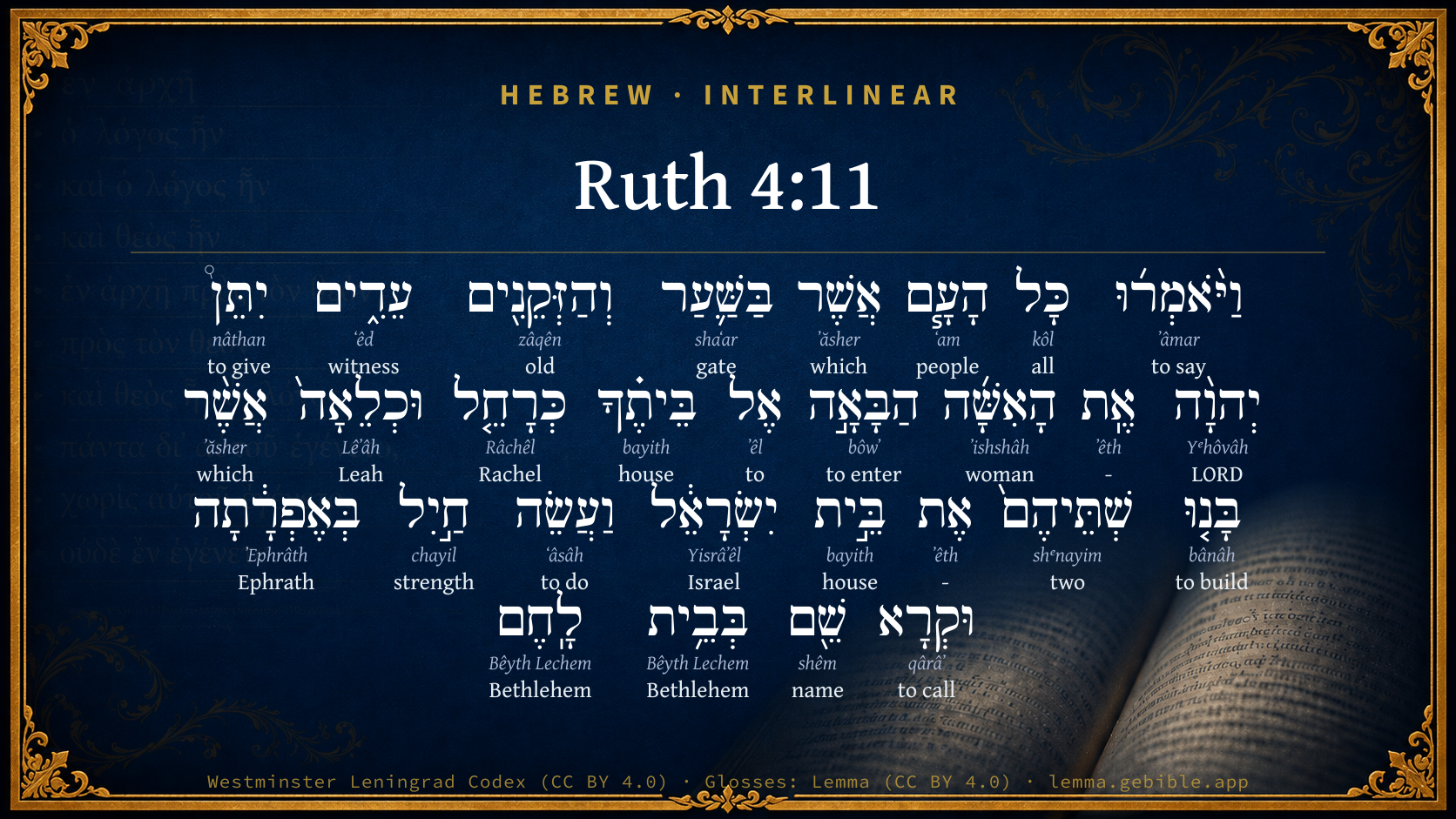
Hebrew (Westminster Leningrad Codex) Ruth 4:11 appears in the Hebrew Old Testament. The text above is from the Westminster Leningrad Codex. Each word links to its Strong’s number, a concise gloss, and parsing drawn from the Open Scriptures Hebrew Bible morphology. Click any word for its full Brown-Driver-Briggs (BDB) entry.
Download image
Cite this verse

Ruth 4:11 (World English Bible). Public Domain. Lemma interlinear Bible study tool, https://lemma.gebible.app/v/ruth/4/11.

Show BibTeX & RIS
BibTeX
RIS
English Translation
All the people who were in the gate, and the elders, said, We are witnesses. Yahweh make the woman who has come into your house like Rachel and like Leah, which two built the house of Israel: and do you worthily in Ephrathah, and be famous in Bethlehem:
World English Bible · Public Domain
Download a study sheet

One document with this verse’s original text, its word-by-word gloss line, the meaning frame, cross-references with their text, attributed commentary, and full source and license credits — printable, and it pastes into notes with its structure intact.

This verse Autodidact and up

Study sheet (.html) Plain text (.txt)

A passage Seminary Student

Up to 50 verses in one chapter. A passage sheet keeps up to 6 commentary sources and 12 cross-references per verse, in the order this page ranks them, and says so on the sheet whenever that leaves anything out. Ask for a single verse and you get the Autodidact verse sheet above.

Everything on this page stays free to read, with no account — the sheet is a download of what is already on screen, not access to it.

Want to remove ads? Support Godless Engineer
Compare translations 3

The same verse in 3 English versions, stacked beneath the original-language interlinear above. Click any original word for its lexicon entry.

Each is an independent rendering of the whole verse — the interlinear is not word-aligned to these translations.

Highlighted words mark where these versions differ — a whole-verse word diff, not a word-by-word alignment.

  • World English Bible Public Domain
    All the people who were in the gate, and the elders, said, We are witnesses. Yahweh make the woman who has come into your house like Rachel and like Leah, which two built the house of Israel: and do you worthily in Ephrathah, and be famous in Bethlehem:
  • King James Version Public Domain
    And all the people that were in the gate, and the elders, said, We are witnesses. The LORD make the woman that is come into thine house like Rachel and like Leah, which two did build the house of Israel: and do thou worthily in Ephratah, and be famous in Bethlehem:
  • unfoldingWord Literal Text CC BY-SA 4.0
    And all the people who were in the gate and the elders said, “ witnesses! May Yahweh make this woman who is coming into your house like Rachel and Leah, the two who built up the house of Israel. Prosper in Ephrathah and be renowned in Bethlehem!

unfoldingWord Literal Text — © unfoldingWord, licensed CC BY-SA 4.0. Word-aligned USFM3 via Door43 (git.door43.org/unfoldingWord/en_ult).

Versions to compare (up to 4)

3 of 4 selected

Show all 18 translations

Every available English version of this verse, each an independent rendering of the whole verse.

  • World English Bible Public Domain
    All the people who were in the gate, and the elders, said, We are witnesses. Yahweh make the woman who has come into your house like Rachel and like Leah, which two built the house of Israel: and do you worthily in Ephrathah, and be famous in Bethlehem:
  • Berean Standard Bible Public Domain
    “We are witnesses,” said the elders and all the people at the gate. “May the LORD make the woman entering your home like Rachel and Leah, who together built up the house of Israel. May you be prosperous in Ephrathah and famous in Bethlehem.
  • Majority Standard Bible Public Domain
    “We are witnesses,” said the elders and all the people at the gate. “May the LORD make the woman entering your home like Rachel and Leah, who together built up the house of Israel. May you be prosperous in Ephrathah and famous in Bethlehem.
  • King James Version Public Domain
    And all the people that were in the gate, and the elders, said, We are witnesses. The LORD make the woman that is come into thine house like Rachel and like Leah, which two did build the house of Israel: and do thou worthily in Ephratah, and be famous in Bethlehem:
  • American Standard Version (1901) Public Domain
    And all the people that were in the gate, and the elders, said, We are witnesses. Jehovah make the woman that is come into thy house like Rachel and like Leah, which two did build the house of Israel: and do thou worthily in Ephrathah, and be famous in Bethlehem:
  • Revised Version (1885) Public Domain
    And all the people that were in the gate, and the elders, said, We are witnesses. The LORD make the woman that is come into thine house like Rachel and like Leah, which two did build the house of Israel: and do thou worthily in Ephrathah, and be famous in Beth-lehem:
  • Geneva Bible (1599) Public Domain
    And all the people that were in the gate, and the Elders sayd, We are witnesses: the Lord make the wife that commeth into thine house, like Rahel and like Leah, which twaine did build the house of Israel: and that thou mayest doe worthily in Ephrathah, and be famous in Beth-lehem,
  • Douay-Rheims (1899) Public Domain
    Then all the people that were in the gate, and the ancients answered: We are witnesses: The Lord make this woman who cometh into thy house, like Rachel, and Lia, who built up the house of Israel: that she may be an example of virtue in Ephrata, and may have a famous name in Bethlehem:
  • Young's Literal Translation Public Domain
    And all the people who `are' in the gate say -- also the elders -- `Witnesses! Jehovah make the woman who is coming in unto thy house as Rachel and as Leah, both of whom built the house of Israel; and do thou virtuously in Ephrathah, and proclaim the Name in Beth-Lehem;
  • Literal Standard Version CC BY-SA 4.0
    And all the people who [are] in the gate say—also the elderly, “Witnesses! YHWH makes the woman who is coming to your house as Rachel and as Leah, both of whom built the house of Israel; and you do virtuously in Ephrathah, and proclaim the name in Beth-Lehem;
  • Unlocked Literal Bible CC BY-SA 4.0
    All the people who were in the gate and the elders said, “We are witnesses. May Yahweh make the woman who has come into your house like Rachel and Leah, the two who built up the house of Israel; and may you prosper in Ephrathah and be renowned in Bethlehem.
  • unfoldingWord Literal Text CC BY-SA 4.0
    And all the people who were in the gate and the elders said, “ witnesses! May Yahweh make this woman who is coming into your house like Rachel and Leah, the two who built up the house of Israel. Prosper in Ephrathah and be renowned in Bethlehem!
  • Darby Bible Public Domain
    And all the people that were in the gate and the elders said, [We are] witnesses. Jehovah make the woman that cometh into thy house like Rachel and like Leah, which two did build the house of Israel; and acquire power in Ephratah, and make thyself a name in Bethlehem;
  • World Messianic Bible Public Domain
    All the people who were in the gate, and the elders, said, “We are witnesses. May the LORD make the woman who has come into your house like Rachel and like Leah, which both built the house of Israel; and treat you worthily in Ephrathah, and be famous in Bethlehem.
  • Webster's Bible Public Domain
    And all the people that were in the gate, and the elders said, We are witnesses. The LORD make the woman that hath come into thy house like Rachel and like Leah, which two did build the house of Israel: and do thou worthily in Ephratah, and be famous in Beth-lehem:
  • Free Bible Version CC BY-SA 4.0
    The elders and all the people present at the town gate said, “Yes, we are witnesses. May the Lord make the woman who is coming to your house like Rachel and Leah who between them gave birth to the people of Israel. May you become prosperous in Ephrathah, and famous in Bethlehem.
  • Bible in Basic English Public Domain
    And all the people who were in the public place, and the responsible men, said, We are witnesses. May the Lord make this woman, who is about to come into your house, like Rachel and Leah, which two were the builders of the house of Israel: and may you have wealth in Ephrathah, and be great in Beth-lehem;
  • JPS Tanakh (1917) Public Domain
    And all the people that were in the gate, and the elders, said: 'We are witnesses. The LORD make the woman that is come into thy house like Rachel and like Leah, which two did build the house of Israel; and do thou worthily in Ephrath, and be famous in Beth-lehem;

Literal Standard Version (2020), Covenant Press — licensed CC BY-SA 4.0. Text via the HelloAO Bible API (eBible.org). Unlocked Literal Bible (unfoldingWord) — licensed CC BY-SA 4.0. Text via the HelloAO Bible API (eBible.org). unfoldingWord Literal Text — © unfoldingWord, licensed CC BY-SA 4.0. Word-aligned USFM3 via Door43 (git.door43.org/unfoldingWord/en_ult). Free Bible Version, Dr. Jonathan Gallagher — licensed CC BY-SA 4.0. Text via the HelloAO Bible API (eBible.org).

Word by word

More ways to search: Search by grammar → Find every occurrence → Compare this word →

Practice this passage: Drill this verse → Learn its vocabulary →

בְּאֶפְרָ֔תָה
ʼEphrâth
H672
“in/at · Ephrath”
Preposition + Noun, Proper
Part of Speech
Preposition + Noun
Type
Proper
Full BDB Definition

Origin: from H6509

TWOT: None

Ephrath or Ephratah = "ash-heap: place of fruitfulness" - a place near Bethel where Rachel died and was buried (noun proper locative) - another name for Bethlehem (noun proper locative) - wife of Caleb (noun proper feminine)
  1. וַיֹּ֨אמְר֜וּ ʼâmar H559 “and · to say” Conjunction + Verb, Qal, Sequential Imperfect, 3rd Person, Masculine, Plural
  2. כָּל kôl H3605 “all of” Noun, Common, Masculine, Singular, Construct
  3. הָעָ֧ם ʻam H5971 “the · people” Particle, Definite Article + Noun, Common, Masculine, Singular, Absolute
  4. אֲשֶׁר ʼăsher H834 “which” Particle, Relative
  5. בַּשַּׁ֛עַר shaʻar H8179 “in/at the · gate” Preposition, Determined + Noun, Common, Masculine, Singular, Absolute
  6. וְהַזְּקֵנִ֖ים zâqên H2205 “and · the · old” Conjunction + Particle, Definite Article + Adjective, Adjective, Masculine, Plural, Absolute
  7. עֵדִ֑ים ʻêd H5707 “witnesses” Noun, Common, Masculine, Plural, Absolute
  8. יִתֵּן֩ nâthan H5414 “to give” Verb, Qal, Imperfect, 3rd Person, Masculine, Singular
  9. יְהוָ֨ה Yᵉhôvâh H3068 “LORD” Noun, Proper
  10. אֶֽת ʼêth H853 “-” Particle, Direct Object
  11. הָאִשָּׁ֜ה ʼishshâh H802 “the · woman” Particle, Definite Article + Noun, Common, Feminine, Singular, Absolute
  12. הַבָּאָ֣ה bôwʼ H935 “the · entering” Particle, Definite Article + Verb, Qal, Participle Active, Feminine, Singular, Absolute
  13. אֶל ʼêl H413 “to” Preposition
  14. בֵּיתֶ֗ךָ bayith H1004 “house · your” Noun, Common, Masculine, Singular, Construct + Suffix, Personal, 2nd Person, Masculine, Singular
  15. כְּרָחֵ֤ל Râchêl H7354 “like/as · Rachel” Preposition + Noun, Proper
  16. וּכְלֵאָה֙ Lêʼâh H3812 “and · like/as · Leah” Conjunction + Preposition + Noun, Proper
  17. אֲשֶׁ֨ר ʼăsher H834 “which” Particle, Relative
  18. בָּנ֤וּ bânâh H1129 “to build” Verb, Qal, Perfect, 3rd Person, Common, Plural
  19. שְׁתֵּיהֶם֙ shᵉnayim H8147 “two · their” Adjective, Cardinal number, Feminine, Dual, Construct + Suffix, Personal, 3rd Person, Masculine, Plural
  20. אֶת ʼêth H853 “-” Particle, Direct Object
  21. בֵּ֣ית bayith H1004 “house of” Noun, Common, Masculine, Singular, Construct
  22. יִשְׂרָאֵ֔ל Yisrâʼêl H3478 “Israel” Noun, Proper
  23. וַעֲשֵׂה ʻâsâh H6213 “and · do” Conjunction + Verb, Qal, Imperative, 2nd Person, Masculine, Singular
  24. חַ֣יִל chayil H2428 “strength” Noun, Common, Masculine, Singular, Absolute
  25. וּקְרָא qârâʼ H7121 “and · call” Conjunction + Verb, Qal, Imperative, 2nd Person, Masculine, Singular
  26. שֵׁ֖ם shêm H8034 “name” Noun, Common, Masculine, Singular, Absolute
  27. בְּבֵ֥ית Bêyth Lechem H1035 “in/at · Bethlehem” Preposition + Noun, Proper
  28. לָֽחֶם Bêyth Lechem H1035 “Bethlehem” Noun, Proper

About this verse

These counts appear in no published source. They are computed here, from the morphology-tagged text and Lemma’s own curated glosses. What Lemma adds →

29
words
25
distinct lemmas
Historical
section

Notable vocabulary

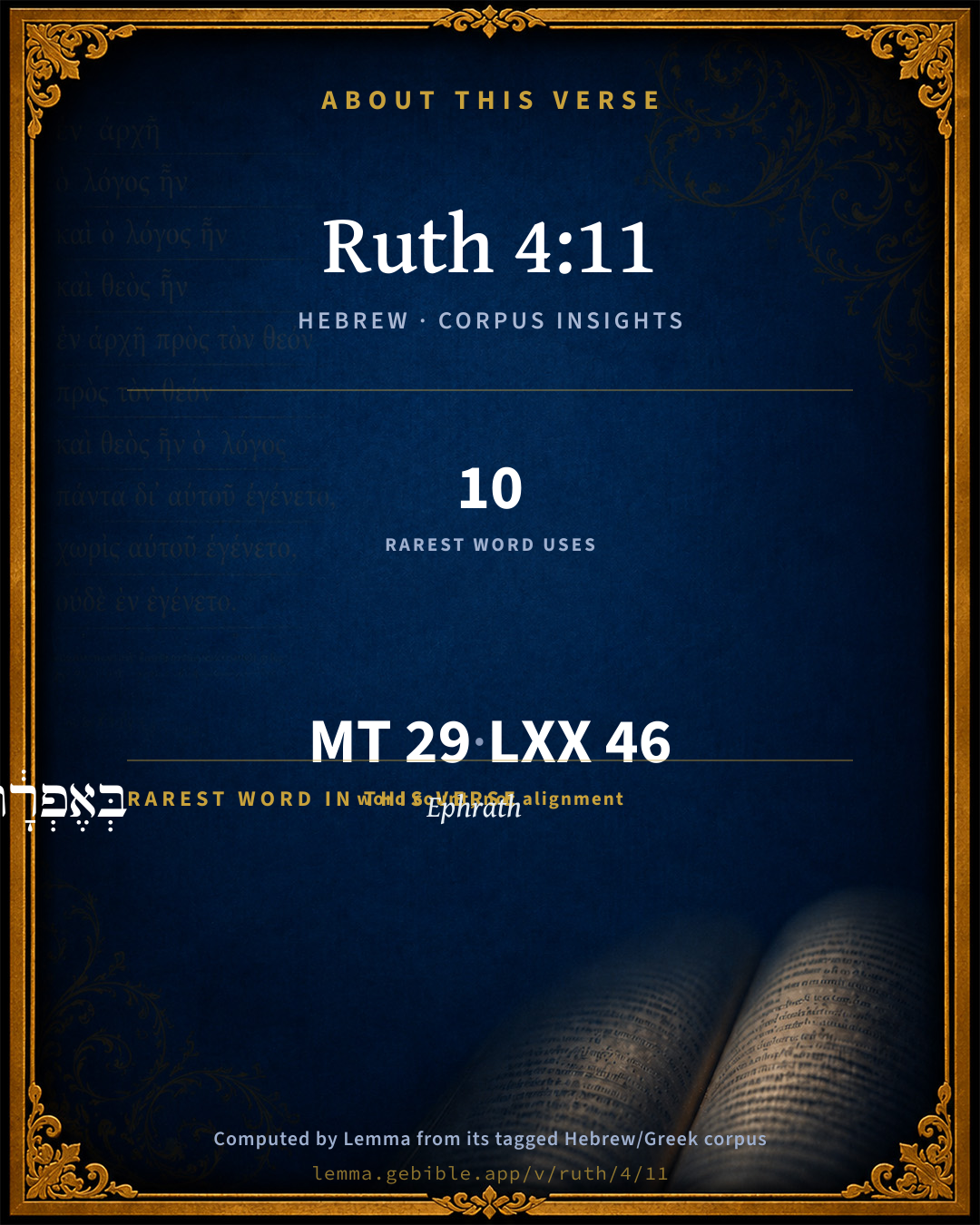
The rarest word here is בְּאֶפְרָ֔תָה Ephrath H672 — appearing just 10 times in the whole Hebrew Bible.

Shared distinctive vocabulary

בְּאֶפְרָ֔תָה Ephrath H672 occurs in 9 verses of the Hebrew Bible. Also found in:

Grammatical profile

  • 6 verbs
  • 16 nouns
  • 2 adjectives
  • 1 preposition
  • 4 particles

Verb forms

  • וַיֹּ֨אמְר֜וּ Qal · Sequential Imperfect
  • יִתֵּן֩ Qal · Imperfect
  • הַבָּאָ֣ה Qal · Participle Active
  • בָּנ֤וּ Qal · Perfect
  • וַעֲשֵׂה Qal · Imperative
  • וּקְרָא Qal · Imperative

Repetition

Words recur within this verse — often emphatic in Hebrew:

  • בֵּיתֶ֗ךָ house H1004 ×2
  • בְּבֵ֥ית Bethlehem H1035 ×2
  • אֲשֶׁר which H834 ×2

Hebrew & Septuagint length

In English translation the verse runs 48 words from the Hebrew and 55 from the Septuagint (LXX English) — closely comparable.

A rough comparison of the two English renderings, which tokenize alike — not a word-level alignment.

Word counts can differ between the Hebrew and the Greek without any difference in meaning — e.g. the Hebrew direct-object marker אֵת has no separate Greek word, and Greek often adds the article ὁ.

In the original languages it is 29 Hebrew tokens and 46 Greek tokens — but the two are counted differently (Hebrew bundles its prefixes and suffixes into one token; the Greek is in lemma form), so that isn’t a like-for-like length.

Cross-references

13

Topical passages linked to Ruth 4:11 in the Treasury of Scripture Knowledge — connected by theme and wording, ordered by reader-vote popularity; previews shown in the World English Bible.

  • Genesis 29:32–30:24 Leah conceived, and bore a son, and she named him Reuben. For she said, "Because Yahweh has looked at my affliction. For now my husband will love me."
  • Micah 5:2 But you, Bethlehem Ephrathah, Being small among the clans of Judah, Out of you one will come forth to me that is to be ruler in Israel; Whose goings forth are from of old, from everlasting.
  • Matthew 2:6 'You Bethlehem, land of Judah, Are in no way least among the princes of Judah: For out of you shall come forth a governor, Who shall shepherd my people, Israel.'"
  • Psalms 127:3–5 Behold, children are a heritage of Yahweh. The fruit of the womb is his reward.
  • Genesis 35:16–20 They traveled from Bethel. There was still some distance to come to Ephrath, and Rachel travailed. She had hard labor.
  • Genesis 46:8–27 These are the names of the children of Israel, who came into Egypt, Jacob and his sons: Reuben, Jacob's firstborn.
  • Numbers 26:1–65 It happened after the plague, that Yahweh spoke to Moses and to Eleazar the son of Aaron the priest, saying,
  • Deuteronomy 25:9 then his brother's wife shall come to him in the presence of the elders, and loose his shoe from off his foot, and spit in his face; and she shall answer and say, So shall it be done to the man who does not build up his brother's house.
  • Ruth 1:2 The name of the man was Elimelech, and the name of his wife Naomi, and the name of his two sons Mahlon and Chilion, Ephrathites of Bethlehem Judah. They came into the country of Moab, and continued there.
  • Psalms 128:3–6 Your wife will be as a fruitful vine, In the innermost parts of your house; Your children like olive plants, Around your table.
  • Psalms 132:6 Behold, we heard of it in Ephrathah. We found it in the field of Jaar:
  • Proverbs 14:1 Every wise woman builds her house, But the foolish one tears it down with her own hands.
  • Genesis 24:60 They blessed Rebekah, and said to her, "Our sister, may you be the mother of thousands of ten thousands, and let your seed possess the gate of those who hate them."

Cross-references courtesy of OpenBible.info (CC BY 4.0).

Hebrew and Greek witnesses Masoretic Hebrew ↔ Greek Septuagint

The same verse in the two great witnesses to the Old Testament, shown verse-for-verse.

These are two independent witnesses, not word-aligned to each other, and the Septuagint is shown in lemma (dictionary) form.

Hebrew Ruth 4:11 Masoretic · Westminster Leningrad Codex

וַיֹּ֨אמְר֜וּ כָּל הָעָ֧ם אֲשֶׁר בַּשַּׁ֛עַר וְהַזְּקֵנִ֖ים עֵדִ֑ים יִתֵּן֩ יְהוָ֨ה אֶֽת הָאִשָּׁ֜ה הַבָּאָ֣ה אֶל בֵּיתֶ֗ךָ כְּרָחֵ֤ל וּכְלֵאָה֙ אֲשֶׁ֨ר בָּנ֤וּ שְׁתֵּיהֶם֙ אֶת בֵּ֣ית יִשְׂרָאֵ֔ל וַעֲשֵׂה חַ֣יִל בְּאֶפְרָ֔תָה וּקְרָא שֵׁ֖ם בְּבֵ֥ית לָֽחֶם

All the people who were in the gate, and the elders, said, We are witnesses. Yahweh make the woman who has come into your house like Rachel and like Leah, which two built the house of Israel: and do you worthily in Ephrathah, and be famous in Bethlehem:

World English Bible · Public Domain

Greek LXX Ruth 4:11 Septuagint · lemma form

καί εἶπον πᾶς ὁ λαός ὁ ἐν ὁ πύλη μάρτυς καί ὁ πρεσβύτερος εἶπον δίδωμι κύριος ὁ γυνή σύ ὁ εἰςπορεύομαι εἰς ὁ οἶκος σύ ὡς ραχηλ καί ὡς λεια ὅς οἰκοδομέω ἀμφότεροι ὁ οἶκος ἰσραήλ καί ποιέω δύναμις ἐν εφραθα καί εἰμί ὄνομα ἐν βαιθλεεμ

And all the people who were in the gate said, We are witnesses: and the elders said, The Lord make your wife who goes into your house, as Rachel and as Lia, who both together built the house of Israel, and wrought mightily in Ephratha, and there shall be a name to you in Bethleem.

LXX2012 (modern English Septuagint) · Public Domain

On this verse, The Cambridge Bible for Schools and Colleges discusses the Septuagint’s reading. Read the note in Commentary ↓

Hebrew: Westminster Leningrad Codex (CC BY 4.0). Greek: Septuagint (public domain); English from LXX2012 (modern English Septuagint) (Public Domain). How the Septuagint differs from the Hebrew →

Commentary

Notes on Ruth 4:11 from classic Christian and Jewish commentators (each source and its license shown beneath its notes). The classic Christian expositions comment on the surrounding passage and are grouped to its opening verse, so a note may address several verses; the Jewish commentaries on the Tanakh (Rashi and others) are per-verse, so they appear only where the commentator wrote on this verse.

Lemma curates 59 commentaries, every one of them public domain or Creative Commons licensed, each selected and text-cleaned for this edition rather than reprinted as found. About our sources →

Trapp's Complete Commentary

John Trapp

Rth 4:11 And all the people that [were] in the gate, and the elders, said, [We are] witnesses. The LORD make the woman that is come into thine house like Rachel and like Leah, which two did build the house of Israel: and do thou worthily in Ephratah, and be famous in Bethlehem:

Ver. 11. We are witnesses.] And will be ready to help the truth in necessity. "A faithful witness will not lie," saith Solomon. Among the Turks, those that bear false witness have their tongues shaved and washed in vinegar.

The Lord make the woman.] Marriage, though no sacrament, as Papists make it, yet is it to be solemnised, as here, and sanctified with prayer; as being a holy ordinance, and an honourable estate.

That is come into thy house.] Or, Shortly is to come, and to share with thee in all. The heathen truly saith, that every man when he marrieth bringeth either a good or an evil spirit into his house; and so maketh it either a heaven or a hell.

Like Rachel and like Leah.] Amiable as Rachel, fruitful as Leah: both are from God, and to be prayed for, as here. Love is the inward cement of married couples: fruitfulness furthereth love betwixt them.

And do thou worthily in Ephratah.] Te fortem et strenuum praebe; show thyself a worthy man, as 1Ki 1:52; do good among thy people, as Eze 18:18; be public spirited, though to private disadvantage, and this way get renown. Some render it, Compara tibi opes, vel potestatem, Get thee riches or power: for marriage requireth maintenance, neither is it a little that the gulf of housekeeping swalloweth up.

And be famous {a} in Bethlehem.] Fame waiteth upon worth. The poets feign that Achilles’s sepulchre in Sigaeum is surrounded with green amaranth. Agesilaus, being asked how ενδοξια, renown, may be attained, answered, Si quis loquatur quae sunt optima, et faciat quae sunt honestissima. If a man set himself to say well and do well; but especially the latter. Cicero worthily preferreth Cato before Socrates, Quoniam huius dicta, illius facta laudantur, because the latter is famous for his sayings, the former for his doings.

{a} Heb., voca nomen. Chald., sis vocans tibi famam.

John Trapp, A Commentary or Exposition upon All the Books of the Old and New Testament (1647–1656) — public domain. Text from a community e-Sword module.

Joseph Benson's Commentary

Rth 4:11. Rachel and Leah — Amiable and fruitful. These two are singled out, because they were of a foreign original, and yet ingrafted into God’s people, as Ruth was; and because of that fertility which God vouchsafed unto them above their predecessors, Sarah and Rebecca. Rachel is placed before Leah, because she was his most lawful and best beloved wife. Which two did build the house of Israel — Were blessed with a numerous posterity. They do not mention the two handmaids, because the former were Jacob’s principal wives, whose servants bare children not for themselves, but their mistresses.

Joseph Benson's Commentary on the Old and New Testaments (1811–1818) — public domain. Text from a community e-Sword module.

The Preacher's Complete Homiletical Commentary

Joseph S. Exell (gen. ed.)

CRITICAL AND EXEGETICAL NOTES.—

Rth_4:11. We are witnesses. The business settled without lawyers or legal casuistry (A. Clarke). The Lord make. The birth of children looked upon as a direct interference of Providence—a contribution to the fulfilment of the great promise whereon their hearts were set (E. Price). Like Rachel and like Leah. The two ancestresses of all true Israelites. Like Ruth they had left home for their husbands. The younger probably mentioned first not only as the favourite wife, but as connected with Bethlehem (Gen_35:19; Jer_31:15). Do thou worthily [manfully]. Lit. make thou strength or power. In Ephratah. Some distinguished Ephratah as the country, Bethlehem as the town (Bernard, Price). And be famous in Bethlehem. Lit. call a name. Get a name (Lange). Meant “act the noble part” (Morison). The real force of the whole phrase is “Be thou influential in the growth of thy wealth, and be well spoken of as far as thy influence may be made to extend” (E. Price). These words are prophetic, for thence came the birth of Him who has made Bethlehem famous in all the world (Theodoret).

Rth_4:12. Like the house of Pharez [Gen_38:29; 1Ch_2:4; Mat_1:3.] The second son of Judah (Num_26:20) and one of the ancestors of Boaz. His family was more illustrious and numerous than that of his brother Zarah. Perez also was a son of Tamar, who, although a very different character than Ruth, resembled her in history in that she suffered injustice in having the rights of marriage withheld from her [see Lange in loco.]

Rth_4:13. The Lord gave her. By a special blessing Boaz advanced in years (Wordsworth). A son. The kinsman’s superstitious fears [see on Rth_4:6] now shown to be groundless.

Rth_4:14. Blessed be the Lord. Another rythmical sentence [cf. Rth_1:16, p. 66; also cp. Luk_1:46-55; Luk_1:68-79, etc.] Not left thee this day without a kinsman [redeemer.] Thy grandson (Wordsworth). So Lange and Morison. Not so, Boaz (Speaker’s Com.). Obed would inherit the estate of Elimelech, and so he is the real goel of Naomi. The grammatical construction also points to Obed, “the restorer, nourisher, &c.,” as well as the phrase “this day.” That his name may be. And may his name be (Lange).

Rth_4:15. And he shall be [may he be] a restorer … nourisher. Trueliterally in her case, true spiritually to all the world by Him who was born at Bethlehem of this seed according to the flesh (Theodoret). Better to thee than seven sons. Cf. 1Sa_1:8; 1Sa_2:5, for similar expressions. The women acknowledge now how far short the legal friendship of Israel towards Naomi has fallen in comparison with the self-sacrifice of the daughter of Moab (Lange). The prospect now presented of her becoming the tribe mother of a numerous and flourishing family (Keit).

Rth_4:17. Her neighbours gave it a name. Besides this he doubtless received a name from his parents (Lange). This of the women continued and inserted in the family genealogy, because seen to be appropriate (ibid). Obed, servant—i.e., of the Lord (Wordsworth, Gesen. Targ.) Because he served to gladden Naomi’s old age (Steele and Terry). Serving or worshipping (Eiliot). Must be understood in the sense of serving as a son [see Lange in loco] Obed in the sense of “one that serves,” harmonises well with the words in Rth_4:15 (Bertheau.)

Rth_4:18. Now these are the generations. The table presents ten names. A round number, suggesting, it may be, that unimportant ones have been omitted. The scribes were accustomed to do this both to ease their own labour of transcription, and to give additional emphasis to the names appearing in the received list (E. Price) [see Introduction, p. 4,

5.]. BOAZ. Not Mahlon, as might have been expected from the Levirate law. David. Why end with this name if the book were written, as Bertheau, Davidson, and others seem to think, long after the time of Solomon? Points possibly to a reason, if he were reigning as king.

Rth_4:11-13

Theme.—PRAYERS FOR POSTERITY AND PROSPERITY

Patience and abnegation of self, and devotion to others,

This was the lesson a life of trial and sorrow had taught her.

So was her love diffused, but, like to some odorous spices,

Suffered no waste nor loss, though filling the air with aroma.—Longfellow.

The Lord make the woman, etc. And let thy home, etc. So Boaz took Ruth, etc.

Good wishes are to be regarded as prayers before God, but those of a people (“all the people”) as the effectual fervent prayer which availeth much (E. Price). Good to keep the heart in readiness, so as to resolve our common emotions of sympathy into benedictions as here. How long did this blessing rest over the house of Boaz?—until Christ came? The best seal to a compact like this found in prayers like these which stretch out towards generations yet unborn.

I. We have the general truth taught here. That the love of posterity may be used of God and sanctified. How the Hebrew idea of “children, a blessing from the Lord” expresses itself in these devout prayers. Note. All natural emotions and tendencies may be worked by the Divine wisdom into the great scheme of Providence and grace (E. Price). The Incarnation, the direct issue and product of preceding conditions. God glorifying what is good in the race, the noble spirit of Boaz, the virtue of Ruth, the prayers of these devout Israelites, all leading upwards, onwards, toward the Christ that is to be.

(1) How wonderful!

(2) How suggestive! Who knows what His purposes may be through our children, if we are faithfully consecrating them to Him? Men make much of a pious ancestry. What if we look in the other direction, and have faith, and use the privilege of prayer aright?

II. The particular truth is taught here: That a Moabitess is thus introduced among the progenitors of our Lord Himself. Cf. Mat_1:5. Boaz begat Obed of Ruth. A memorable fact. A Gentile woman thus rendered a constituent portion of the Redeemer’s genealogy (E. Price). Why?

(1) To indicate the heathen were not quite forgotten under the old dispensation severe and exclusive as it was (Ibid).

(2) To emphasise the fact that God has always appeared to work by what at some times might be regarded as contraries.

(3) To remove the suspicion from the sceptic that the Advent depended upon the mere natural course of events (Ibid).

(4) To keep the devout student lovingly and reverently dependent upon the unerring though mysterious will of the Most High (Ibid).

Theme—CHILDREN THE GIFT OF HEAVEN

E. Price on The seed which the Lord shall give thee.

The Jewish idea may be modified by us, that the number of children measures a man’s felicity. Yet the truth, underlying it, continues with us: viz., that pious descendants are always the greatest blessings which the great Father can bestow upon us.

Do they not bind us to heaven by sanctified affections?

Do they not sweeten home sympathies?

Do they not exemplify the advantages of that saintly education, they are supposed to be susceptible of?

Do they not become the best support of the declining years of a happy parent?

Do they not assure prosperity to a spiritual church? And do they not thus hand down the tradition of the faith unimpaired?

In this sense, then, “blessed is the man who has his quiver full of them.”

“The man has acted both unselfishly and honourably in upholding the family custom of Israel. The public therefore, praise him and wish him good. Such applause is both desirable and profitable. The actions of a good man are fit subjects for praise. It stimulates us to higher deeds when we recognise nobleness in others. It encourages them in acts of generosity and honour. If any around us do wise, thoughtful, open-hearted, unselfish deeds, let us not fear to praise them.”—Braden.

“What fame would be acquired in Israel by the kindness of Boaz to Ruth and Naomi? Was it to be hoped that his goodness and bounties to them would be known and praised among all the tribes? It is natural for men to think that the actions which they admire, should be known and admired by all. The hopes of these good women were, perhaps, more sanguine than the case could justify; and yet they were more than realised. The name of Boaz became famous through all Israel, and will continue famous among the Gentiles also, while the world lasts, because it is mentioned with honour in the Book of God. Both bad and good actions are often published to a greater extent, and continue longer to be known, than the doers or any of their friends expected.”—Lawson.

“The godly are members one of another, therefore must needs have a fellow-feeling … but let this be with them in lawful things, for charity rejoiceth not in iniquity. What joy can it be to a godly man to see his friend rich and in glory by usury, bribery, oppression, deceit and fraud?”—Bernard.

“It is one of the grand aims of divine revelation to produce this state of mind [the habitual recognition of God]; and in the case of this people it evidently had produced it. Religion was an all-pervading life.… It penetrated everywhere, like the sunlight. God was beheld as the Cause of causes; His Hand was visible in every occurrence; He was a felt Presence.”—Dr. A. Thompson.

Rth_4:11

Theme—MANLINESS, ITS FIT AND PROPER SPHERE

“The world waits

For help. Beloved, let us love so well,

Our work shall still be better for our love,

And still our love be sweeter for our work.”—Mrs. Browning.

Do thou worthily [manfully] in Ephratah and be famous [get a name] in Bethlehem.

The world wants men, always has done so; did so even thus early in its history—men who play the worthy, manful part. Such will always

(1) be well spoken of,

(2) desired and longed for,

(3) in the highest sense “make the best of both worlds.” Note.

(1) Honour, the respect and esteem of others, not to be despised as cynics would teach, rather to be sought for in legitimate ways as in the sight of God. [cf. Psalms 1, 112, Job 29, Pro_4:8-9, etc.]

(2) To be truly a man and play the manly part includes all virtues, or should do so. (a) So on the gentler side. To be human is to be humane, and should be thus understood always. Note. Impossible to be noble in character without tenderness, gentleness, compassionateness, etc. (b) So on the sterner side. The root idea of the word virtue is strength. The strong man, self-contained, self-balanced, having the mastery over his passion, is the virtuous man. This seemingly the idea of the text, “Act the part of a true man, a strong man.” A right worthy exhortation for such an occasion.

I. The sphere of this manly part. At home—in Ephratah, Bethlehem. Do good among thy own people [Eze_18:18], be public-spirited, though to private disadvantage (Trapp). So in Christ’s charge to His disciples, these home claims and duties are not forgotten. “Beginning at Jerusalem,” He said. Note. Easy to ignore this aspect of duty—like Jonah, to flee to Tarshish from the Nineveh God has pointed out, but this is the Divine idea, “Begin at home.” “Shine there,” consecrate that. “Return to thine own house and shew how great things God hath done unto thee” (Luk_8:39). Note. A difficult duty this always, as with Eli, Noah, Lot, Judah [cf. Genesis 38; Son_1:6].

II. The results of this manly part. Be famous, etc. The two things linked together, the doing worthily and the fame that follows it. Note. All other ways of making a reputation valueless. Great reputations are to be obtained by great merits, by saying well and doing well, by wise speech and wise actions, by being useful and serviceable in our own day and generation. Note (a) A great name often not so much to be coveted, “but a good name is better than precious ointment” (Lawson). (b) The common and vulgar ideas of fame, glory, martial renown, etc., not encouraged here. It is fame won at home of which the text speaks.

“Home is the most appropriate sphere for Christian usefulness. It is the place where true piety is ever tested, and false piety soonest put to the blush. It has the first claims upon the man of God, whatever his public position may be. And yet how often is this forgotten or ignored. Eli, priest of the Living God, can enter into the Holiest place and stand before the Shekinah glory in the manifested presence of Deity itself, and yet he cannot order his household aright, or protect the sanctuary of the Most High from the pollution of his children. But it is not so with the truly devout and consecrated spirit. As master, or as servant, in the workshop and in the counting house, it is there his Christ-like character shines to best advantage; it is there, by the quiet influence which belongs to every life, the noblest testimony is borne for God. The household is hallowed, the home life consecrated, the private walks sanctified, the neighbourhood blessed by the sweet and gentle aroma of a holy and heavenly life.”—B.

“A name truly good is the aroma from a virtuous character. It is a spontaneous emanation from genuine excellence. It is a reputation for whatsoever things are honest and lovely, and of good report. It is such a name as is not only remembered on earth but written in heaven. Just as a box of spikenard is not only valuable to its possessor, but pre-eminently precious in its diffusion; so, when a name is really good, it is of unspeakable service to all who are capable of feeling its aspiration.”—Hamilton.

“But there are deeds which should not pass away,

And names that must not wither, though the earth

Forgets her empire with a just decay.

The enslavers and the enslaved, their death and birth.

The high, the mountain majesty of worth

Should be, and shall, survivors of its woe,

And from its immortality look forth

In the sun’s face, like yonder Alpine snow,

Imperishably pure beyond all things below.”

—Byron.

Rth_4:14-15

Theme.—CONGRATULATIONS AND GOOD WISHES

The soul of music slumbers in the shell,

Till waked and kindled by the master’s spell;

And feeling hearts, touch them but rightly, pour

A thousand melodies unheard before.—Rogers.

Blessed be the Lord which hath not left thee this day without a kinsman.

The birth of a son and heir an important event always; more especially in an eastern household, and with one of the age and position of Boaz. A memorable day this, too, in the history of Israel. Another link added in the chain Christ-ward. The joy here an earnest of the joy hereafter, the barriers of national pride broken down in part; prophetic of that glory to God in the highest, peace on earth, goodwill towards men (Luk_2:14). Note. First prayer here (Rth_4:11) now praise. Blessed, etc.

In these congratulations there is

I. A glance at the new circumstances surrounding Naomi. As much our duty to rejoice with those who rejoice as to weep with those who weep. (a) We should enter into their plans (b), sympathise in their successes (c), rejoice especially at their unexpected prosperity, as here. Note

(1) We cannot help doing this if we encourage that which is good in ourselves. God made men to sympathise with each other, only that sin has made them selfish and envious.

(2) Man’s duty is to respond to these Divinely implanted instincts. Our good wishes are not worth much unless they find utterance or expression in some way. Here the joy not only felt but avowed. “The women are, as is usual in such times, full of expressive sympathy. That is quite a touch of nature.”—Braden.)

There is

II. A glance heavenward. The Lord, etc. The joy of the godly has this holy and religious expression naturally and always. Especially should we look upward in these moments of family rejoicing. Note. Whatever joy men may give us, praise is due to God, who thus makes them the instruments of his benefits.

Right again that this devout feeling should find expression. Is it that our homes are to be made glad with his gifts, and our hearts with the sunshine of his presence, and no sign be seen of the gladness which is there? A holy and profitable way of gossiping this; God praised and called upon (Trapp). Note. The blessings of the Old Testament generally of a material character (Kitto). Yet they are not the less often the source of spiritual joy (cf. Isaiah 23).

III. A glance toward the future. He shall be unto thee, etc. (Rth_4:15). Why to Naomi especially? Are we not to see in this her reward for all the past? Note. (a) Those are to be comforted most by us who have been most humbled. They need it most, and we should be ready to speak the word of consolation. A poor Christian who has no word of congratulation for a time like this! (b) A joyous prospect may open suddenly even for the sorrowing and the aged. Call me not Naomi, she had said (Rth_1:20). But God can send light at eventide. [See next outline].

E. Price on this:

Theme—A GOOD CHILD

Women do not always babble vain things. How quick are they to apprehend the modifications of our domestic life.

Study, then, the portrait of a good son, which they offer here.

God must have given him.

God adapts him to special needs.

God makes him felt as a comforter (Heb., a Redeemer).

God in him restores exhausted life.

God secures the true honour of the family.

And God thus “nourishes” old age, till it be resolved into heaven. Yes! God is in all!

Let parents pray, labour, and educate for this high end.

Let children see to it that their welcomed presence around the hearth may secure it.

And let “our gossips” even change their idle talk into kind congratulations and earnest prayers.

“It would seem as if there was already a kind of joyous foretaste of the birth and infancy which, in after times, was to be for ever associated with the name of Bethlehem. It was the first appearance on the scene of what may by anticipation be called, even then, the Holy Family, for that child was Obed, the father of Jesse, the father of David. Nor is it a mere genealogical connexion between the two generations. The very licence and independence of the age may be said to have been the means of introducing into the ancestry of David and of the Messiah an element which else would have been, humanly speaking, impossible. ‘An Ammonite or a Moabite shall not enter into the congregation’ (Deu_23:3; Ezr_9:1; Neh_13:1). This was the letter of the law, and, in the greater strietness that prevailed after the return from the captivity, it was rigidly enforced. But in the isolation of Judah from the rest of Israel, in the doing of every man what was right in his own eyes, the more comprehensive spirit of the whole religion overstepped the letter of a particular enactment.”—Stanley.

Rth_4:15-16

Theme—YOUTH AND AGE

“O thou bright thing fresh from the hand of God.

Nearer I seem to God when looking on thee;

’Tis ages since He made His youngest star;

His hand was on thee as ’twere yesterday.”—Alexander Smith.

He shall be to thee a restorer of thy life, etc. And Naomi took the child, etc.

How often the children are messengers of God, bringing new life into the household as here. There is a fountain of love enclosed in the heart of the aged, and it only needs the tiny infant fingers of some dear one’s child to unloose it. Note. The birth of a new spirit may come in the home with the new life. New consecration to God, new sympathy with all around. “Children are a heritage from the Lord.” (a) What sacredness should surround them, (b) what prayers ascend for them, (c) what blessedness be found in them! Note. If a man do not find his joy in the home, he will find his burden there.

Dwell on,

I. What the children expect from us. (a) Care, (b) attention, (c) protection, (d) love, (e) nurture and training. In the text Naomi seen as responding to these demands. Her name still descriptive of her character [cf. on Rth_1:2, p. 14]. Must be doing something. Felt that she had a duty which was no burden but a pleasure. “Took the child,” etc. Note. (a) Whoever was once capable of true love preserves its power for ever after (Lange). And life all the way through finds a sphere for it. Even in old age, when the maternal instinct may have been thought to have almost died out, Naomi becomes a foster-mother. So generally. Grandchildren not loved less, but sometimes more than the children themselves. Note. (b) Love may grow more intense, even as the shadows of death begin to fall around. What a tribute to and foreshadowing of its immortality.

II. What we expect of the children.

(1) They are to be the restorers of life and joy. “He shall be,” etc. Life intended to have this twofold, and reciprocal action and aspect. We do not give more than we get, if the true conception of God’s word and of our nature be carried out. Love brings its own reward.

(2) They are to be the supports of old age. “And a nourisher,” etc. The conditions will be reversed by-and-bye. Weakness coming on with us as strength grows with them. Then this new law is to come into operation. They are to succour and cherish in return for the past, as the trembling infirmities of second childhood claim us as their own. Beautiful, divine idea, which sin and selfishness may mar, but cannot altogether destroy! The old and the feeble never forgotten, but reaping then what they have sowed in the tears and joys, the sorrows and cares, and fond affections lavished upon childhood and infancy.

IMPROVEMENT.—So the Church is to foster young converts. In return they will become sooner or later her strength and support. Note. Spiritual children bring a greater blessing to her than “seven sons” according to the flesh (Lange).

Children should nourish their old parents and supply their wants, ἀντι πελαργων. Storks and mice feed their dams when old; boughs incline and bend down towards the root; and in summer, receiving from the root leaves, flowers, and fruit, they let them fall again in winter to the fattening and nourishing of the root. Unkind and unnatural children are like kites, which, when grown strong expel their dams, and with their bills and wings beat them out of the nest.”—Trapp.

“A certain Duke of Ormond who lost a virtuous son, the Lord Ossory, said that he would rather be the father of the dead Ossory, than of any living nobleman in England.”—Lawson.

“It is one of the many fine points of the story, that its concluding sentences are almost wholly devoted, not to the young and happy wife and mother, but to Naomi, who had suffered so many calamities, and who, by the piety and resignation with which she bore them, had drawn Ruth from the frivolities of Moab. It is Naomi not Ruth, whom, “the women, her neighbours,” congratulate on the birth of Ruth’s son. In him they see Naomi’s goel Ruth already had hers in Boaz; and they pray that, as he grows up, he may restore her to her former happiness, and be the stay and gladness of her old age. But though they speak to Naomi, and pray for her, they do not utterly forget the singular virtue of Ruth. In the words, “Thy daughter-in-law, who loveth thee, who is better to thee than seven sons,” they pronounce on her an eulogy such as few “strange” women could have heard from Hebrew lips. It is because the boy is Ruth’s son, that he is Naomi’s goel; for how can he fail to love and cherish the woman whom his mother has loved with a love even passing the love of women.”—Cox.

“Naomi is everywhere an image of the Church of Christ, which wins, confesses, and fosters through love. Men whose natural hearts are hostile to her, become her obedient children. When there is apostacy and misery in the Church it is for priests and preachers to repent, as Naomi did, and not to excuse themselves.… And how greatly she sins, when she does not rightly foster, those who do come; exhibiting neither love nor wisdom, nor faith in her treatment of them—that too will one day be made manifest. Impatience is not in love; and a little money does not make amends for the coldness of consummate self-righteousness.”—Lange.

“Of Boaz himself no warrior deeds are known, and yet the greatest of Israel’s heroes, the conqueror of Goliath [There is a tradition that Goliath descended from Orpah, as David from Ruth] sprang from him. He conquered himself, and on that account became the ancestor of Him who triumphed over sin and death. Similarly, Ruth had nothing but a heart full of love, and yet to her, once a daughter of Moab, there was given what neither Deborah nor Jael obtained, to become the Mother of Him by whom all the nations are redeemed.”—Ibid.

Rth_4:19-22

Theme—LINKS IN THE CHAIN CHRISTWARD

“How vain are all hereditary honours,

Those poor possessions from another’s deeds,

Unless our own just virtues form our title,

And give a sanction to our fond assumption.”—Shirley.

And they called his name Obed, etc. Now these are the generations, etc.

Not a dry list of names merely useless and cumbersome as the stones of the desert. These men lived, thought, played their part in life as we do now. Think of it. Then again the names themselves, not given haphazard, but from reasons, and with a motive. Obed, for instance, means a servant, and doubtless he was called so because of the part he was to play towards Naomi and towards God.

Suggests

I. The interest men take generally in genealogy.

(1) Natural. Few men insensible or careless with regard to their ancestry, especially if it has been one which has played a noble and dignified part.

(2) Allowed and encouraged by Scripture. The lineage of Israel for many reasons of especial and world-wide importance.

(3) May be useful as a stimulus and inspiration.

II. The interest men take in this particular record.

(1) Because of the men themselves. They were men of fame. Nahshon a prince in Israel; David the king, etc.

(2) Because they are links in the genealogy of Christ. It is interesting to notice the variety of rank and condition in the ancestry of the Saviour. Rahab the harlot. Ruth the gleaner. Boaz, possibly the judge. David the king. “He who was bone of our bone, and flesh of our flesh,” touches our race at every point, and claims kindred with it all. (A.Thomson). Note. How this illustrates the spiritual relationship to which Christ invites us.

(3) Because they are helps in the study, and attestation of prophecy and of character. How much history is condensed in such a list! Expand it, and what lessons are to be enforced! Here, for instance, Obed is called the son of Boaz after all, and not the son of Mahlon as might have been expected. Note. Laws and customs are often borne down by the force of circumstances and of public opinion. Is not this the reward of Boaz—the reward of faith [cf. on Rth_4:6]. His name stands here contrary to the usual custom, stands as it ought to do among the ancestors of Christ himself. [See also Introduction pp. 4, 5; and on Rth_1:2, pp. 14, 15.]

E. Price on this:

Theme—HERALDRY

What a vanity these genealogies really are, although called a science, forsooth! “The pride of life” is never more exemplified than when a bad man is seen poring over the long catalogue of, it may be, worthless predecessors. A relief, then, to study one, drawn out by God Himself, and suggesting the fondest hopes of men!

From Pharez to David—what does the genealogical “tree” really suggest to us?

Why!

1. Our descent is only valuable as it stands related to God’s purpose in Christ Jesus. What would be the real worth of David’s name, if taken away from that of his great successor?

2. That Providence marvellously works up our little lives into the grand whole of His “Counsel.” Some of these names may in themselves be worthless, yet can they not break away from God’s overruling purpose!

And

3. Regarding the descent of David and of Christ the Lord as historical facts, the scheme of the Jewish “Herald” continually reminds us of our relation to, and gratitude for, the great and glorious Redeemer of men—Himself the son of Adam!

Names go for something, when multiplied into that of Him, who is the Alpha and the Omega of all human events!

“Obed a servant. It may be a remembrancer of duty. Just as the motto of the Prince of Wales is ‘Ich Dien,’ I serve. Any way it is beautiful never to despise service. ‘A Christian is to be meet for the Master’s use.’ How many there are who are of no use in the world! Some dislike all service, and prefer the dainty hand that is never soiled, and the life that is never separated from selfishness.”—Statham.

“Orpah, the child of sense, dismayed by the difficulties presented goes back again; Ruth, the child of the Spirit, ‘persuaded’ of better things, presses through all obstacles onward to join the Israel of God, and to find rest at last where rest at first had seemed impossible. So the ‘anonymous kinsman,’ fearing lest his name should be blotted out from Israel, his inheritance marred, his children called after another, misses the one opportunity of life and goes down to a nameless oblivion. Boaz, the man of nobler spirit, and larger faith, and keener insight is deterred by no fear, held back by no difficulty; and, contrary to custom, we find his name here as the father of Obed, in the genealogy of David and of Christ. Is it hard to read the moral of such a story? the moral which works itself out everywhere in the pages of Inspiration, and repeats itself today in the history of a thousand lives; that sense deceives and sight fails, and cunning defeats itself; that the law is fallible and the letter kills, while faith endures and love conquers: and that only in obeying those instincts which are of God, and which spring up in hearts open to His influence, is the safety and solution of human life. This is the victory of faith, which overcomes the world and finds its name written at last in the Lamb’s Book of Life for evermore.”—B.

“O, Moab! out of thee shall come forth the unspotted Lamb which bears the sins of the world, and rules over the whole earth! From the rock of the wilderness, i.e., from Ruth, widowed by the death of her husband, Boaz derived Obed … and from David came Christ.”—Jerome.

“Much of Scripture, and still more of that which is written about Scripture, is but like the valley of dry bones to eyes of sense and sin. But if the Spirit, without whom there is no true understanding breathe upon it, whatever men say, it may live again, and that to the praise and glory of God.”—B.

The Preacher's Complete Homiletical Commentary (gen. ed. Joseph S. Exell; Funk & Wagnalls, c. 1892) — public domain (pre-1929). A full-Bible homiletical/sermon-outline anthology covering 65 of 66 books (2 John is absent from the source module). Text from a community e-Sword module.

Tyndale Open Study Notes

Tyndale Open Resources

4:11 Rachel and Leah, Jacob’s two wives, were the mothers of Israel. • Ephrathah: See study note on 1:2.

Tyndale Open Study Notes — © Tyndale Open Resources, licensed CC BY-SA 4.0. Text via the HelloAO Bible API.

Geneva Bible (1599)

Geneva Bible translators

Ephrathah and Bethlehem are both one.

Geneva Bible (1599) marginal notes — public domain. Text via Bolls.life.

Jamieson, Fausset & Brown

Robert Jamieson, A. R. Fausset & David Brown

all the people and the elders, said, We are witnesses--A multitude, doubtless from curiosity or interest, were present on the occasion. There was no signing of deeds; yet was the transfer made, and complete security given, by the public manner in which the whole matter was carried on and concluded.

the Lord make the woman that is come into thine house like Rachel and like Leah--This was the usual bridal benediction.

Jamieson, Fausset & Brown — Commentary Critical and Explanatory on the Whole Bible (1871) — public domain (CC PDM 1.0). Text via the HelloAO Bible API.

Adam Clarke's Commentary

Verse 11. We are witnesses.] It is not very likely that any writing was drawn up. There was an appeal made to the people then present, whether they had seen and understood the transaction; who answered, We have witnessed it. If any minutes of court were kept, then the transaction was entered probably in some such words as these: "On --- day of ---, Boaz bought the land of Elimelech from Naomi his widow, and took Ruth, her daughter-in-law, to wife; ---, who had the nearest right, refusing to buy the land on the conditions then proposed."

The Lord make this woman - like Rachel and like Leah] May thy family be increased by her means, as the tribes were formed by means of Rachel and Leah, wives of the patriarch Jacob!

Which two did build the house of Israel] We have already seen that בן ben, a son, comes from the root בנה banah, he built; and hence אבן eben, a stone, because as a house is built of stones, so is a family of children. There is a similar figure in PLAUTUS, Mostell. Act i., sec. 2, ver. 37.

___________________Nunc etiam volo

Dicere, ut homines aedium esse similes arbitremini.

Primum dum parentes fabri liberum sunt,

Et fundamentum liberorum substruunt.

"I would also observe, that ye men are similar to houses; ye parents are the fabricators of the children, and they are the foundation of the building."

Adam Clarke's Commentary on the Bible (1810–1826) — public domain. Text from a community e-Sword/MySword module.

Ellicott's Commentary for English Readers

(11) The Lord . . .—In this way is the nuptial blessing invoked.

Is come.—Rather, is coming.

Rachel—though the younger sister and the junior wife—is put first, probably from her death and burial having associated her with Bethlehem (see Gen_35:16; Gen_35:19). In this way, too, we should explain the prophecy of Jeremiah as applied by St. Matthew (Jer_31:15; Mat_2:18).

Build.—From the Hebrew word to build are derived the words for son and daughter, thus a twofold aspect in the word sometimes appears as here. (See also Gen_16:2; Gen_30:3).

Do thou worthily.—The Hebrew phrase (asah khayil) thus rendered, involves the notion of doing a thing with vigour and might. The khayil of a soldier is his valour—of a land, its material resources, and (Pro_31:10) the “virtuous woman” of the English Version is literally, woman of khayil. The good wish for Boaz here is that by his energy he may command continual prosperity.

Be famous.—Literally, proclaim a name.

A Bible Commentary for English Readers, edited by Charles John Ellicott (1878–1897) — public domain. Text from a community e-Sword module.

The Cambridge Bible for Schools and Colleges

gen. ed. J. J. S. Perowne

11. like Rachel and like Leah] Gen_29:31 to Gen_30:24. May Ruth become the ancestress of a famous race! Dante ranks her fourth after Sarah, Rebecca, Judith, in Paradise; Parad. xxxii. 10 ff. For did build the house of Israel cf. Deu_25:9 and Gen_14:2; Gen_30:3 mg.

do thou worthily] lit. ‘achieve might’; the phrase is sometimes rendered ‘do valiantly,’ e.g. Num_24:18, Psa_60:12; Psa_118:15 f.; but here it is used in a moral sense, cf. Rth_3:11. The reference is to Boaz, here and in the next sentence.

and be famous] To obtain this meaning the Hebr. text (lit. ‘proclaim thou a name’) must be slightly altered to ‘and let thy name be proclaimed,’ cf. Rth_4:14. The LXX. favours this correction. How the wish was fulfilled is shewn in Rth_4:17.

The Cambridge Bible for Schools and Colleges (gen. ed. J. J. S. Perowne; Cambridge University Press, 1878–1918) — public domain. Text from a community e-Sword module.

John Gill's Exposition

And all the people that were in the gate, and the elders, said, we are witnesses,.... Both of the purchase of the estate by Boaz being legally made, and of the marriage of Ruth to him, the condition of the bargain:

the Lord make the woman that is come into thine house; not into his house, strictly and literally taken, the place of his habitation; for both he and she were now at the gate of the city, and as yet she was not introduced into his house; but by his marriage of her she was brought into his family, and was become a principal part of it, being his wife. This is a wish, prayer, or benediction of the elders, of one in the name of the rest, congratulating the married couple, and wishing them well; and particularly that the woman Boaz had married before them, as witnesses, might be

like Rachel and like Leah, which two did build the house of Israel: the two wives of Jacob; the Targum adds, with twelve tribes; for though some of the tribes sprung from their maids, which they gave to Jacob, yet the children born of them were reckoned theirs by a moral estimation, as some express it. Rachel is set before Leah, though the youngest, and had the fewest children, because she was his first wife in his intention, and according to the covenant made with her father, though imposed upon and deceived; and she was his more lawful wife, and his most beloved one. By the children of these two, and their maidens, the house or family of Israel was built up, and became a great nation, consisting of twelve tribes, very numerous:

and do thou worthily in Ephratah, and be famous in Bethlehem; two names of one and the same place, Gen 35:19. These words seem to be directed to Boaz, particularly praying that he might continue to do worthy and virtuous actions, as well as increase in wealth and riches, power and authority, and retain his name and fame, and grow in credit and reputation among his fellow citizens.

John Gill's Exposition of the Whole Bible (1746–1763) — public domain (CC PDM 1.0). Text via the HelloAO Bible API.

Albert Barnes' Notes on the Bible

See the margin. There is something of a poetical turn in this speech of the elders, and something prophetic in the blessing pronounced by them. It is unique and obscure. The Greek Version (lxx) is unintelligible. Jerome seems to have had a slightly different reading, since he applies both clauses to Ruth. “May she be a pattern of virtue in Ephratah, and have a name famous in Bethlehem.” The meaning of “be famous” seems to be, Get thyself a name which shall be celebrated in Bethlehem, as the head of a powerful and illustrious house: literally it is, “proclaim a name,” i. e. cause others to proclaim thy name, as in Rth 4:14.

Albert Barnes' Notes on the Bible (1834–1885) — public domain. Text from a community e-Sword/MySword module.

Haydock's Catholic Bible Commentary

Israel, by a numerous posterity. --- That she. Hebrew, "mayst thou acquire riches," &c. (Calmet). --- Protestant, "do thou (Booz) worthily in," &c. (Haydock). --- Ephrata: another name of Bethlehem. (Challoner)

George Leo Haydock (1774–1849), Haydock's Catholic Family Bible and Commentary, 1859 edition — public domain. Excludes Psalms (Douay-Rheims chapter numbering differs from Protestant) and Deuterocanonical books (Catholic canon only).

Matthew Poole's English Annotations

Like Rachel and like Leah, amiable and fruitful. Those two are singled out, partly because they were of a foreign and heathenish original, and yet ingrafted into God’s people, as Ruth also was; and partly because of that singular fertility which God vouchsafed unto them above their predecessors, Sarah and Rebekah.

Rachel is placed before Leah, because she was his most lawful, and only intended, and chosen, and best beloved wife.

Build the house, i.e. increase the posterity. See Gen 16:2; Exo 1:21. Ephratah and Bethlehem, two names of one and the same place; of which See Poole "Rth 1:2".

Matthew Poole's English Annotations on the Holy Bible (1683–1685) — public domain. Text from a community e-Sword/MySword module.

Whedon's Commentary on the Bible

Daniel D. Whedon

11. All the people… and the elders, said, We are witnesses — “And thus,” says Clarke, “the business was settled without lawyers or legal casuistry. A question of this kind in one of our courts of justice, in these enlightened times, would require many days’ previous preparation of the attorney, and several hours’ arguing between Counsellor Botherum and Counsellor Borum, till even an enlightened and conscientious judge would find it extremely difficult to decide whether Naomi might sell her own land, and whether Boaz or Peloni might buy it! O glorious uncertainty of modern law!”

Like Rachel and like Leah — The two wives of Jacob, who were accounted mothers of all the tribes of Israel. Gen_29:30.

Which two did build the house of Israel — That is, bore him offspring to establish his name. “By a common oriental metaphor, house is transferred to a family and children; and whoever begets children is said to build a house. Hence בן, son, comes from the idea of building; that is, of begetting. The same metaphor is elegantly carried out in Plautus, Mostellaria, 1, 2, 37.” — Gesenius. So in modern times great lineal families are designated by this word; as, house of Bourbon, house of Brunswick. The passage in Plautus to which Gesenius here refers is as follows: “Now this I will say, that ye men may be compared to buildings, as long as parents are chiefly builders of children, and the foundation of children they do lay,”

Do thou worthily — Acquire power and influence.

Be famous — Literally, Call out a name. That is, perpetuate thy name by means of a numerous posterity.

Ephratah… Beth-lehem — Different names of the same place, (Gen_35:19,) used here in the way of poetic parallelism.

Daniel D. Whedon (gen. ed.), Commentary on the Old and New Testaments (1874–1909) — public domain. Text from a community e-Sword module.

The Pulpit Commentary

And all the people who were in the gateway, and the elders, said, Witnesses! May Yahveh grant that the wife who has come into thy house may be as Rachel and Leah, who built, the two of them, the house of Israel! The people of the city in general, and the venerable elders in particular, were pleased with every step that Boaz had taken. They felt that he had acted a truly honorable part, at once in reference to Naomi, and to Ruth, and to the nearest kinsman, and likewise in reference to themselves as the representatives of the general population. Blessings rose up within their hearts, ascended into heaven, and came down charged with something Divine as well as something human and humane in showers upon his head, and upon the head of his bride. When they prayed that the woman who was the choice of their fellow-citizen"s heart should be as Rachel and Leah, they simply gave expression to the intensest desire that Israelites could cherish in reference to an esteemed sister. When they spoke of Rachel and Leah the mothers of Israel as "building up the house of Israel, they first of all compared the people to a household, and then they passed over from the idea of a household to the idea of a house as containing the household. They added, more particularly in reference to Boaz himself, Do thou manfully in Ephratah. The expression is somewhat peculiar, ringing changes on the peculiar and remarkable term that occurs both in Rth_2:1 and in Rth_3:11. The expression is lyijAhce. The people meant, "Act thou the part of a strong, substantial, worthy man." They added, in a kind of enthusiastic exclamation, Proclaim thy name in Bethlehem. They had, however, no reference to any verbal proclamation, or tribute of self-applause. The spirit of ideality had seized them. They meant, "Act the noble part the part that will without voice proclaim in Bethlehem its own intrinsic nobleness.

Vers. 11, 12. Good wishes.

When the marriage of Boaz with Ruth was resolved upon, the elders of the city, the bridegroom"s neighbors and friends, expressed with cordiality their congratulations and good wishes. They wished well to himself, to his Wife, to his house or family, to his offspring, his seed.

I KIND WISHES ARE FOUNDED IN A PRINCIPLE DIVINELY PLANTED IN HUMAN NATURE. Sympathy is a principle of human nature. Benevolence is as natural as selfishness, though less powerful over most minds. And we should "rejoice with those who do rejoice.

II IT IS RIGHT THAT KIND WISHES SHOULD BE EXPRESSED IN WORDS. There is no doubt danger lest insincerity should creep into the customary salutations and benedictions of life; many compliments are utterly insincere. Yet even the most scrupulous and veracious may legitimately utter good wishes. It is churlish to withhold such utterances.

III CHRISTIANITY GIVES A RICH, FULL MEANING TO THE KIND WISHES OF FRIENDSHIP. For our religion teaches us to turn every wish into a prayer. It is a sufficient condemnation of a wish that it cannot take this form. With Christians, "God bless you!" should be a hearty and fervent intercession. T.

The Pulpit Commentary (1880–1919), ed. H.D.M. Spence-Jones & Joseph S. Exell — public domain. Text from a community e-Sword module.

John Wesley's Explanatory Notes

Rachel and Leah - Amiable and fruitful. These two are singled out, because they were of a foreign original, and yet ingrafted into God's people, as Ruth was; and because of that fertility which God vouchsafed unto them above their predecessors, Sarah and Rebecca. Rachel is placed before Leah, because she was his most lawful, and best-beloved wife. Did build - That is, increase the posterity. Ephratah and Bethlehem - Two names of one and the same place.

John Wesley, Explanatory Notes Upon the Whole Bible (1754–1765) — public domain. Text via the GEBible commentary corpus.

unfoldingWord translationNotes

Door43 World Missions Community

people who were in the gate

"people who were meeting together near the gate"

come into your house

This has literal and figurative meaning. As Ruth marries Boaz, she will move into his house. House can also refer to becoming part of Boaz's family by being his wife. (See: Metaphor)

like Rachel and Leah

These were the two wives of Jacob, whose name was changed to Israel.

built up the house of Israel

"bore many children who became the nation of Israel"

may you prosper in Ephrathah

Ephrathah is the name of the clan to which Boaz belonged in Bethlehem.

May your house be like

God abundantly blessed Judah through his son Perez. The people were asking God to bless Boaz in a similar way through Ruth's children. (See: Metaphor)

Tamar bore to Judah

Tamar was also a widow. Judah fathered a son with her, which continued the family name.

through the offspring that Yahweh will give you

Yahweh would give Boaz children through Ruth.

translationWords

people group

elder

testimony

Yahweh

Rachel

Leah

Israel

Bethlehem

Judah

unfoldingWord translationNotes — © Distant Shores Media and the Door43 World Missions Community, licensed CC BY-SA 4.0. Source: git.door43.org/Door43/en_tn.

Rashi

Rabbi Shlomo Yitzchaki (Rashi)

like Rachel and like Leah Even though they were of the tribe of Judah and of the descendants of Leah, they admitted that Rachel was the mainstay of the household, and they mentioned Rachel before Leah.

and be famous lit. and call a name, i.e., may your name become great.

Rashi on the Tanakh — English translations: “The Judaica Press complete Tanach with Rashi, translated by A. J. Rosenberg” (CC BY 4.0); “Pentateuch with Rashi's commentary by M. Rosenbaum and A.M. Silbermann, 1929-1934” (public domain); “The Metsudah Tanach series, Lakewood, N.J” (CC BY 4.0); and “The Book of Joshua, Metsudah Publications, 1997” (CC BY 4.0). Text via Sefaria.

Ibn Ezra

Rabbi Abraham ibn Ezra

"Like Raḥel and like Leḥa." They mentioned Rachel first because she was Jacob's wife at the beginning of his intention.

"And be prosperous in Efrata, and be famous in Bet-leĥem." May she do this kindness to me, for you have not taken her for the sake of wealth.

Ibn Ezra on the Tanakh — English translations: “Sefaria Community Translation” (CC0 1.0 (public-domain dedication)); “Yalkut, Sifsei Chachomim Chumash, Metsudah Publications, 2009” (CC BY 4.0); and “Commentary of Ibn Ezra on Isaiah - trans. by M. Friedlander, 1873” (public domain). Text via Sefaria.

Lesson kit

Teaching starters — assembled from the data on this page, not authored interpretation. Every prompt links to the verse data it draws on. Edit before teaching.

Ruth, in the Historical, opens this verse with 29 words (25 distinct Hebrew lemmas). Its most distinctive word is ʼEphrâth (“Ephrath”). A historical commentator’s framing appears above. Read the whole chapter for the surrounding context.

Discussion questions

  1. How does “Ephrath” (ʼEphrâth) shape what this verse is saying?
  2. How does Genesis 35:16, which shares the word «Ephrath», read alongside this verse?
  3. What does the repetition of “house” (2× in this one verse) do in this verse?
  4. The translations on this page render this verse differently — a whole-verse word diff, not a word-by-word alignment. What might account for the different wordings?
  5. «וַיֹּ֨אמְר֜וּ» is a Qal Sequential Imperfect verb. How does that grammatical form shape the action described?
  6. Compare how Trapp's Complete Commentary and Joseph Benson's Commentary read this verse. Where do they agree or differ?

Things to notice

Reading settings

Reading text

Shown beneath each verse's original-language words.

Old Testament
Old Testament edition

Read the OT as the Masoretic Hebrew (MT) or the Greek Septuagint (LXX).

English shown for the Greek Septuagint (in the Hebrew ↔ Greek comparison).

Comparing translations? Open the Compare panel on any verse page to stack up to four side by side.