
Psalms 69:12

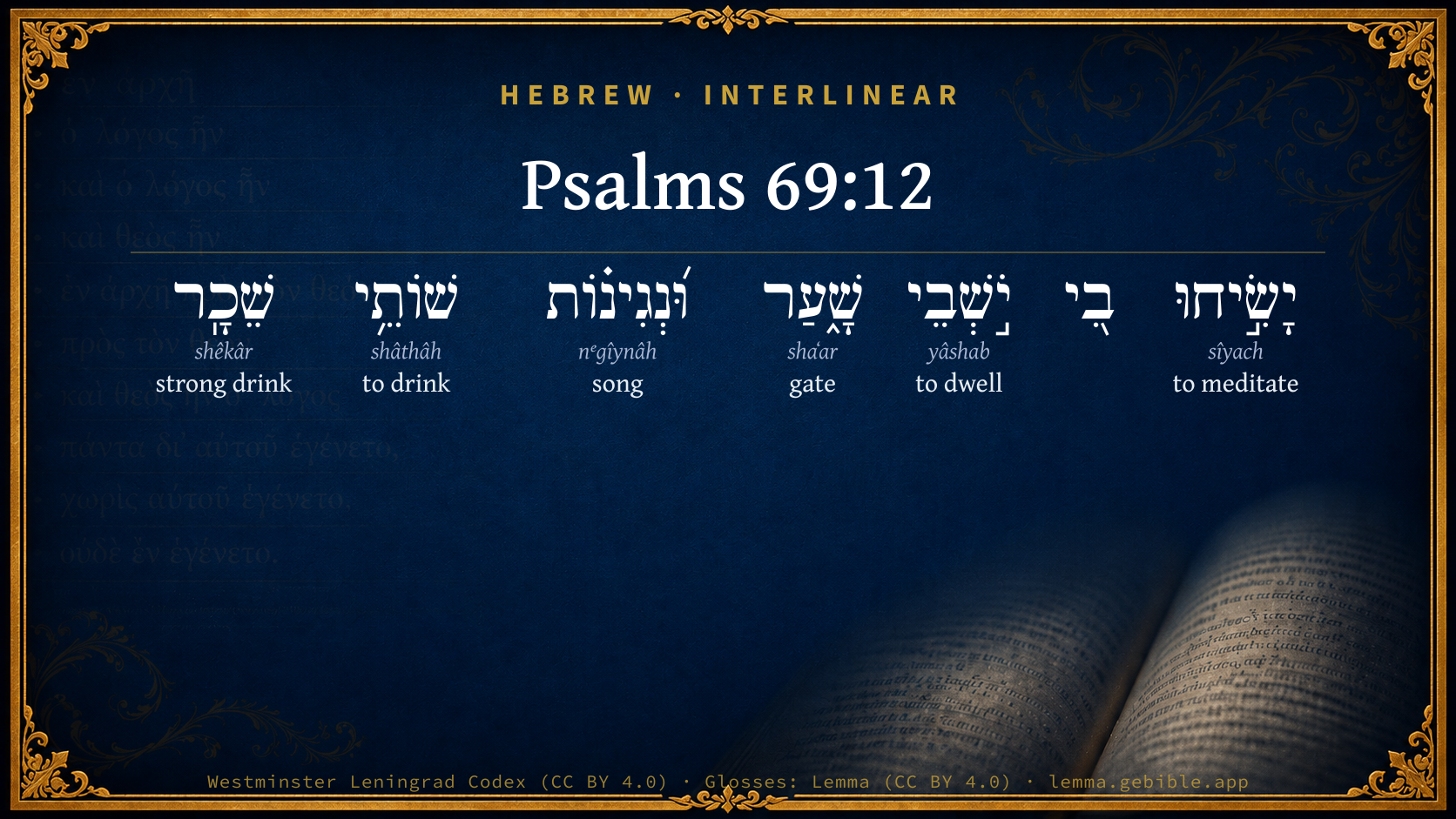
Hebrew (Westminster Leningrad Codex) Psalms 69:12 appears in the Hebrew Old Testament. The text above is from the Westminster Leningrad Codex. Each word links to its Strong’s number, a concise gloss, and parsing drawn from the Open Scriptures Hebrew Bible morphology. Click any word for its full Brown-Driver-Briggs (BDB) entry.
Download image
Cite this verse

Psalms 69:12 (World English Bible). Public Domain. Lemma interlinear Bible study tool, https://lemma.gebible.app/v/psalms/69/12.

Show BibTeX & RIS
BibTeX
RIS
English Translation
Those who sit in the gate talk about me. I am the song of the drunkards.
World English Bible · Public Domain
Download a study sheet

One document with this verse’s original text, its word-by-word gloss line, the meaning frame, cross-references with their text, attributed commentary, and full source and license credits — printable, and it pastes into notes with its structure intact.

This verse Autodidact and up

Study sheet (.html) Plain text (.txt)

A passage Seminary Student

Up to 50 verses in one chapter. A passage sheet keeps up to 6 commentary sources and 12 cross-references per verse, in the order this page ranks them, and says so on the sheet whenever that leaves anything out. Ask for a single verse and you get the Autodidact verse sheet above.

Everything on this page stays free to read, with no account — the sheet is a download of what is already on screen, not access to it.

Want to remove ads? Support Godless Engineer
Compare translations 3

The same verse in 3 English versions, stacked beneath the original-language interlinear above. Click any original word for its lexicon entry.

Each is an independent rendering of the whole verse — the interlinear is not word-aligned to these translations.

Highlighted words mark where these versions differ — a whole-verse word diff, not a word-by-word alignment.

  • World English Bible Public Domain
    Those who sit in the gate talk about me. I am the song of the drunkards.
  • King James Version Public Domain
    They that sit in the gate speak against me; and I was the song of the drunkards.
  • unfoldingWord Literal Text CC BY-SA 4.0
    The sitters at the gate speak about me, and the songs of the drinkers of beer.

unfoldingWord Literal Text — © unfoldingWord, licensed CC BY-SA 4.0. Word-aligned USFM3 via Door43 (git.door43.org/unfoldingWord/en_ult).

Versions to compare (up to 4)

3 of 4 selected

Show all 18 translations

Every available English version of this verse, each an independent rendering of the whole verse.

  • World English Bible Public Domain
    Those who sit in the gate talk about me. I am the song of the drunkards.
  • Berean Standard Bible Public Domain
    Those who sit at the gate mock me, and I am the song of drunkards.
  • Majority Standard Bible Public Domain
    Those who sit at the gate mock me, and I am the song of drunkards.
  • King James Version Public Domain
    They that sit in the gate speak against me; and I was the song of the drunkards.
  • American Standard Version (1901) Public Domain
    They that sit in the gate talk of me; And `I am' the song of the drunkards.
  • Revised Version (1885) Public Domain
    They that sit in the gate talk of me; and I am the song of the drunkards.
  • Geneva Bible (1599) Public Domain
    They that sate in the gate, spake of mee, and the drunkards sang of me.
  • Douay-Rheims (1899) Public Domain
    And I made haircloth my garment: and I became a byword to them.
  • Young's Literal Translation Public Domain
    Those sitting at the gate meditate concerning me, And those drinking strong drink, Play on instruments.
  • Literal Standard Version CC BY-SA 4.0
    Those sitting at the gate meditate concerning me, || And those drinking strong drink, || Play on instruments.
  • Unlocked Literal Bible CC BY-SA 4.0
    Those who sit in the city gate talk about me; I am a song of drunkards.
  • unfoldingWord Literal Text CC BY-SA 4.0
    The sitters at the gate speak about me, and the songs of the drinkers of beer.
  • Darby Bible Public Domain
    They that sit in the gate talk of me, and [I am] the song of the drunkards.
  • World Messianic Bible Public Domain
    Those who sit in the gate talk about me. I am the song of the drunkards.
  • Webster's Bible Public Domain
    \\69:11\\I made sackcloth also my garment; and I became a proverb to them.
  • Free Bible Version CC BY-SA 4.0
    People sitting by the town gate gossip about me. I'm the subject of rude songs sung by drunks.
  • Bible in Basic English Public Domain
    I am a cause of wonder to those in authority; a song to those who are given to strong drink.
  • JPS Tanakh (1917) Public Domain
    (69-13) They that sit in the gate talk of me; and I am the song of the drunkards.

Literal Standard Version (2020), Covenant Press — licensed CC BY-SA 4.0. Text via the HelloAO Bible API (eBible.org). Unlocked Literal Bible (unfoldingWord) — licensed CC BY-SA 4.0. Text via the HelloAO Bible API (eBible.org). unfoldingWord Literal Text — © unfoldingWord, licensed CC BY-SA 4.0. Word-aligned USFM3 via Door43 (git.door43.org/unfoldingWord/en_ult). Free Bible Version, Dr. Jonathan Gallagher — licensed CC BY-SA 4.0. Text via the HelloAO Bible API (eBible.org).

Word by word

More ways to search: Search by grammar → Find every occurrence → Compare this word →

Practice this passage: Drill this verse → Learn its vocabulary →

About this verse

These counts appear in no published source. They are computed here, from the morphology-tagged text and Lemma’s own curated glosses. What Lemma adds →

7
words
6
distinct lemmas
Wisdom
section

Notable vocabulary

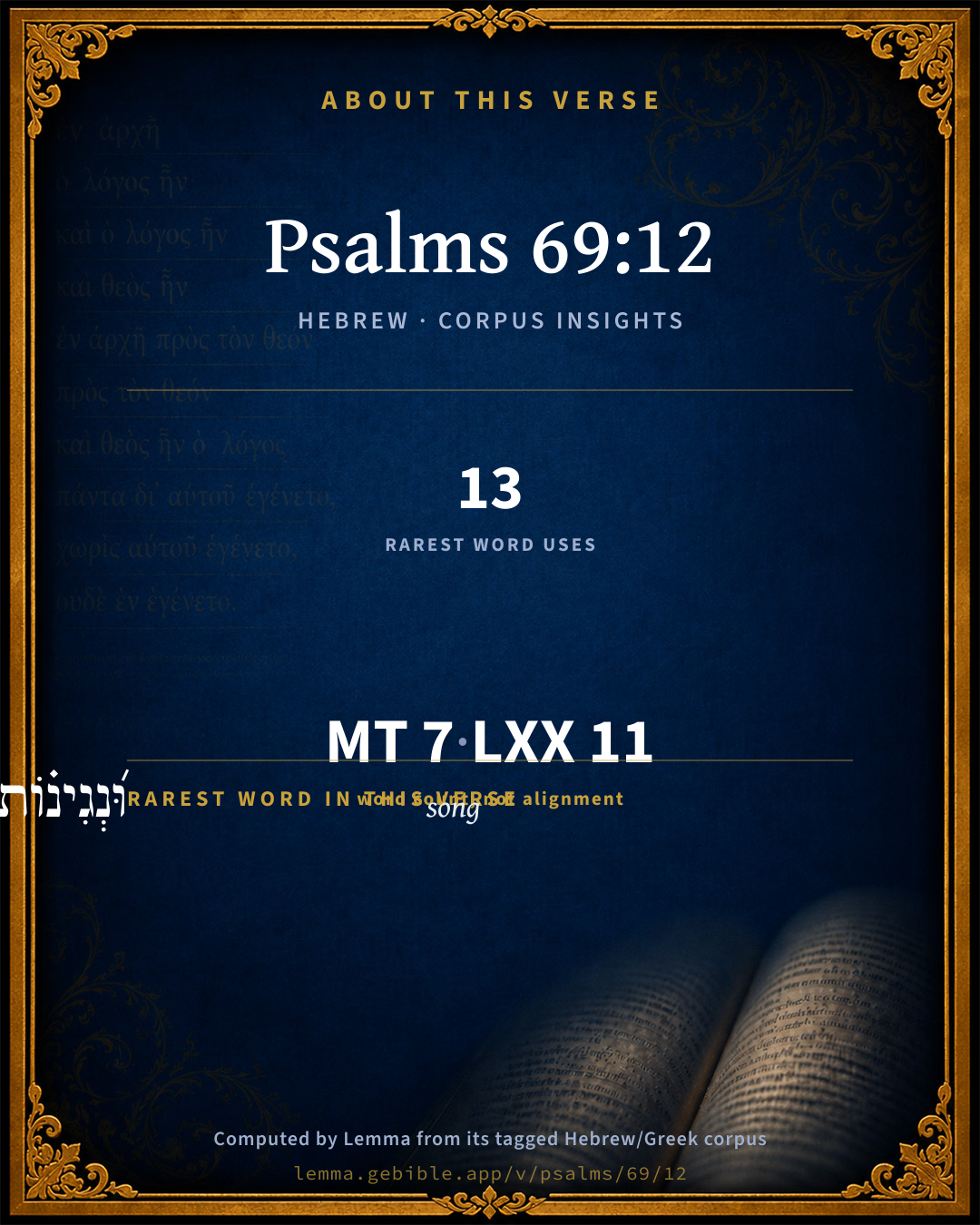
The rarest word here is וּ֝נְגִינ֗וֹת song H5058 — appearing just 13 times in the whole Hebrew Bible.

Shared distinctive vocabulary

וּ֝נְגִינ֗וֹת song H5058 occurs in 13 verses of the Hebrew Bible. Also found in:

Grammatical profile

  • 3 verbs
  • 3 nouns
  • 1 preposition

Verb forms

  • יָשִׂ֣יחוּ Qal · Imperfect
  • יֹ֣שְׁבֵי Qal · Participle Active
  • שׁוֹתֵ֥י Qal · Participle Active

Hebrew & Septuagint length

In English translation the verse runs 16 words from the Hebrew and 17 from the Septuagint (LXX English) — closely comparable.

A rough comparison of the two English renderings, which tokenize alike — not a word-level alignment.

Word counts can differ between the Hebrew and the Greek without any difference in meaning — e.g. the Hebrew direct-object marker אֵת has no separate Greek word, and Greek often adds the article ὁ.

In the original languages it is 7 Hebrew tokens and 11 Greek tokens — but the two are counted differently (Hebrew bundles its prefixes and suffixes into one token; the Greek is in lemma form), so that isn’t a like-for-like length.

Cross-references

13

Topical passages linked to Psalms 69:12 in the Treasury of Scripture Knowledge — connected by theme and wording, ordered by reader-vote popularity; previews shown in the World English Bible.

  • Psalms 35:15–16 But in my adversity, they rejoiced, and gathered themselves together. The attackers gathered themselves together against me, and I didn't know it. They tore at me, and didn't cease.
  • Acts 4:26–27 The kings of the earth take a stand, And the rulers take council together, Against the Lord, and against his Christ.'
  • Matthew 27:41–42 Likewise the chief priests also mocking, with the scribes, the Pharisees, and the elders, said,
  • Genesis 19:1 The two angels came to Sodom at evening. Lot sat in the gate of Sodom. Lot saw them, and rose up to meet them. He bowed himself with his face to the earth,
  • Deuteronomy 16:18 Judges and officers shall you make you in all your gates, which Yahweh your God gives you, according to your tribes; and they shall judge the people with righteous judgment.
  • Job 30:8–9 They are children of fools, yes, children of base men. They were flogged out of the land.
  • Daniel 5:2–4 Belshazzar, while he tasted the wine, commanded to bring the golden and silver vessels which Nebuchadnezzar his father had taken out of the temple which was in Jerusalem; that the king and his lords, his wives and his concubines, might drink from it.
  • Daniel 5:23 but have lifted up yourself against the Lord of heaven; and they have brought the vessels of his house before you, and you and your lords, your wives and your concubines, have drunk wine from them; and you have praised the gods of silver and gold, of brass, iron, wood, and stone, which don't see, nor hear, nor know; and the God in whose hand your breath is, and whose are all your ways, you have not glorified.
  • Matthew 27:12–13 When he was accused by the chief priests and elders, he answered nothing.
  • Matthew 27:20 Now the chief priests and the elders persuaded the multitudes to ask for Barabbas, and destroy Jesus.
  • Matthew 27:62–63 Now on the next day, which was the day after the Preparation Day, the chief priests and the Pharisees were gathered together to Pilate,
  • Mark 15:17–19 They clothed him with purple, and weaving a crown of thorns, they put it on him.
  • Luke 23:2 They began to accuse him, saying, "We found this man perverting the nation, forbidding paying taxes to Caesar, and saying that he himself is Christ, a king."

Cross-references courtesy of OpenBible.info (CC BY 4.0).

Hebrew and Greek witnesses Masoretic Hebrew ↔ Greek Septuagint

The same verse in the two great witnesses to the Old Testament, shown verse-for-verse.

You’re reading Greek Psalm 68 (Hebrew Psalm 69). The Septuagint counts the superscription, so verse numbers can differ from the Hebrew — chapter-level alignment, not verse-by-verse. Numbering follows Rahlfs.

These are two independent witnesses, not word-aligned to each other, and the Septuagint is shown in lemma (dictionary) form.

Hebrew Psalms 69:12 Masoretic · Westminster Leningrad Codex

יָשִׂ֣יחוּ בִ֭י יֹ֣שְׁבֵי שָׁ֑עַר וּ֝נְגִינ֗וֹת שׁוֹתֵ֥י שֵׁכָֽר

Those who sit in the gate talk about me. I am the song of the drunkards.

World English Bible · Public Domain

Greek LXX Greek Psalm 68:12 Septuagint · lemma form

καί τίθημι ὁ ἔνδυμα ἐγώ σάκκος καί γίγνομαι αὐτός εἰς παραβολή

They that sit in the gate talked against me, and they that drank wine sang against me.

LXX2012 (modern English Septuagint) · Public Domain

Hebrew: Westminster Leningrad Codex (CC BY 4.0). Greek: Septuagint (public domain); English from LXX2012 (modern English Septuagint) (Public Domain). How the Septuagint differs from the Hebrew →

Commentary

Notes on Psalms 69:12 from classic Christian and Jewish commentators (each source and its license shown beneath its notes). The classic Christian expositions comment on the surrounding passage and are grouped to its opening verse, so a note may address several verses; the Jewish commentaries on the Tanakh (Rashi and others) are per-verse, so they appear only where the commentator wrote on this verse.

Lemma curates 59 commentaries, every one of them public domain or Creative Commons licensed, each selected and text-cleaned for this edition rather than reprinted as found. About our sources →

Trapp's Complete Commentary

John Trapp

Psa 69:12 They that sit in the gate speak against me; and I [was] the song of the drunkards.

Ver. 12. They that sit in the gate] Men of authority and dignity, who should have showed more grace and gravity. The saints are sure of enemies of all sorts. David was traduced at public and private meetings, seriis et ludicris, sobriis et ebriis.

And I was the song of the drunkards] Heb. of the drinkers of strong drink; the ale stakes made ballads on their ale bench, de macie mea et miseria. These servants tear and toss my name, as curs do carrion.

John Trapp, A Commentary or Exposition upon All the Books of the Old and New Testament (1647–1656) — public domain. Text from a community e-Sword module.

J. A. Alexander on Psalms

Joseph Addison Alexander

13. (Psa 69:12). They think of me, imagine things against me, they who sit in the gate; (they imagine) songs, lampoons or satires, they who drink strong drink. The gate meant is that of the city, where the oriental courts and markets were held. Hence some suppose the sense to be, that even in the place of serious business, they indulged their spiteful mirth at my expense. But it seems more natural to make the sitters in the gate mean simply those frequenting public places. See above, on Psa 4:7, and compare Jos 20:4, Rth 4:2, Lam 5:14.

Joseph Addison Alexander, The Psalms Translated and Explained (1850) — public domain. Text from a community e-Sword module.

Geneva Bible (1599)

Geneva Bible translators

The more he sought to win them to God, the more they were against him both poor and rich.

Geneva Bible (1599) marginal notes — public domain. Text via Bolls.life.

Jamieson, Fausset & Brown

Robert Jamieson, A. R. Fausset & David Brown

sit in the gate--public place (Pro 31:31).

Jamieson, Fausset & Brown — Commentary Critical and Explanatory on the Whole Bible (1871) — public domain (CC PDM 1.0). Text via the HelloAO Bible API.

Adam Clarke's Commentary

Verse 12. They that sit in the gate] At the gates were the courts for public justice; there were complaints lodged, and causes heard. No doubt many vexatious complaints were made against the poor captives; and false accusations, through which they grievously suffered; so that, literally, they were often "obliged to restore that which they had not taken away." See Ps 69:4.

The song of the drunkards.] These poor miserable people were exposed to all sorts of indignities. Though the conduct is base, the exultation over a fallen enemy is frequent. How miserable was this lot! Forsaken by friends, scorned by enemies, insulted by inferiors; the scoff of libertines, and the song of drunkards; besides hard travail of body, miserably lodged and fed; with the burning crown of all, a deep load of guilt upon the conscience. To such a life any death was preferable.

Adam Clarke's Commentary on the Bible (1810–1826) — public domain. Text from a community e-Sword/MySword module.

John Calvin's Commentaries

12. They who sit in the gate defame me Had David been molested only by vulgar buffoons and the refuse of the people, it would have been more easily endured; for it is not surprising that mean persons, who have no regard to what is becoming and honorable, degrade themselves by indulging in defamation without shame. But when the very judges, forgetful of what is demanded by the dignity of their office, abandon themselves to the same audacious conduct, the iniquity and baseness of it is greatly aggravated. Accordingly, David expressly complains that he was made a by-word and a proverb by those in the highest ranks of life. The opinion of some who, by the expression, they who sit in the gate, understand the whole people, is both frigid and inconsistent with the words of the text; for although men of every rank and condition assembled at the gates, yet none but the judges and counsellors sat there. This is confirmed by the second clause of the verse; for by those who drink strong drink, is doubtless meant the rulers who were elevated by their wealth and dignity. It was, indeed, very cruel treatment, that this holy man was not only harassed by the lower classes of the people, but that the very persons who presided in the cause of justice, and the dignitaries of the Church, were in this ringleaders to others. As the same thing happens in our own day, it is not without cause that the Holy Spirit has set this example before our eyes. In the Papacy we find that the higher a man is exalted in honor, he is proportionally the more violent and outrageous in his opposition to the Gospel and its ministers, that he may exhibit himself a more valiant defender of the Catholic faith. Yea, this is a malady with which almost all kings and princes are smitten; which arises from their not regarding true dignity and excellence as consisting in virtue, and from their thinking that they are entitled to act without restraint as they please. And what is the estimation in which they hold the faithful servants of Christ? It is a fact which cannot be denied, that one of the principal things about which they are concerned is, to scoff at and defame them, not only at their tables, but also on their thrones, in order, if possible, to shame them into a renunciation of their faith. In general, also, they sneer at all the people of God, and enjoy themselves in descanting upon their simplicity, as if they were fools in wearying and wasting themselves in the service of God.

John Calvin's Commentaries (1540-1563) — public domain. Text from the Calvin Translation Society English edition (1840s-50s) via the Christian Classics Ethereal Library (ccel.org). Calvin's coverage is partial (roughly two-thirds of the Bible); uncommented books and verses are honest gaps, never fabricated. The 19th-century editor's footnotes and remarks are omitted so the notes are faithfully Calvin's own voice.

Ellicott's Commentary for English Readers

(12) In the gate . . .—The place of public resort where justice was administered. (See Psa_9:14 Note.)

And I was the song.—Literally, and songs of those drinking strong drink, but we must supply the pronoun.

A Bible Commentary for English Readers, edited by Charles John Ellicott (1878–1897) — public domain. Text from a community e-Sword module.

The Cambridge Bible for Schools and Colleges

gen. ed. J. J. S. Perowne

12. They that sit in the gate talk of me,

And the songs of them that drink strong drink (make sport of me).

In the gate where men gather to hear the last gossip as well as to transact business (Psa_9:14; Jer_17:19 f.) he is the talk of the city: his austerities and oddities furnish a subject for the latest comic song of the revellers’ parties. Cp. Lam_3:14; Job_30:9; Isa_5:11-12; Isa_5:22; Amo_6:4 ff.

The Cambridge Bible for Schools and Colleges (gen. ed. J. J. S. Perowne; Cambridge University Press, 1878–1918) — public domain. Text from a community e-Sword module.

John Gill's Exposition

They that sit in the gate speak against me,.... The princes, magistrates, and judges, who sat in the gates of cities, heard and tried causes, and executed judgment there; the elders of the city; see Rut 4:1; the civil rulers among the Jews are meant; and also their ecclesiastical ones, the Scribes and Pharisees that sat in Moses's seat; though some think men of lower characters are designed, idle persons that saunter about, and sit in gateways, and corners of streets, and in marketplaces; spending their time, like the Athenians, in hearing and telling of news, and prating about this and the other person, and their affairs; but the former sense seems best, since these are rather intended in the next clause: now such men of rank and figure spoke against Christ; against his person as the Son of God, against his office as the Messiah, against his doctrines and ordinances, and against his people and followers: or they spake together "of him" (z); they confabulated and consulted together how to seize him, and take away his life, as the chief priests and elders frequently did; and when they had taken him they gave their voice against him, and unanimously condemned him, when they sat in judgment upon him;

and I was the song of the drunkards; or "of them that drink strong drink" (a); be it made of what it will; that is, to excess: these, while they played on their instruments of music, as the word (b) here used signifies, sung songs, and Christ was the subject of them; as Job complains was his case, Job 30:8; very probably the common people that were employed in taking of Jesus might have plenty of liquor given them by the priests and elders, to encourage them; and this being a festival time too, might come at it more easily than usual, and drink more freely; and this might be the case of the Roman soldiers, when they made Christ the subject of their mirth and diversion in Pilate's hall.

(z) "de me", Tigurine version, Junius & Tremellius, Piscator, Cocceius, Gejerus, Michaelis. (a) "sechar", Montanus; siceram, Tigurine version, Cocceius; "potum inebriantem", Junius & Tremellius, Piscator, Michaelis. (b) "cantiones ad instrumenta musica", Vatablus; "pulsationes", Gejerus.

John Gill's Exposition of the Whole Bible (1746–1763) — public domain (CC PDM 1.0). Text via the HelloAO Bible API.

Albert Barnes' Notes on the Bible

They that sit in the gate speak against me - The gates of cities were places of concourse; places where business was transacted; places where courts were frequently held. See the notes at Job 29:7. Compare Isa 14:31; Isa 28:6; Psa 9:14. Calvin supposes that as the gates were the places where the judges sat to administer justice, the meaning here is that magistrates, or those who were high in rank and power, joined in the cry of reproach against him. The more probable interpretation, however, is, that he was subject to the reproach of those who were gathered around these places - the people of business, and the idlers who were assembled there; or, as we should say, that he was the subject of “towntalk.”

And I was the song of the drunkards - Margin, as in the Hebrew, “drinkers of strong drink.” They made ballads or low songs about me. They selected me for an example in their drunken songs. David was not alone in this. It has not been uncommon that the songs of revellers and drunkards have been designed to turn piety and the pious into derision. Compare, alas! some of the songs of Burns. See Job 30:9, note; Psa 35:15-16, notes.

Albert Barnes' Notes on the Bible (1834–1885) — public domain. Text from a community e-Sword/MySword module.

Matthew Poole's English Annotations

They that sit in the gate; either,

1. Vain and idle persons, that spend their time in the gates and markets, in which there used to be a confluence of people. Or rather,

2. The judges and magistrates, who used to sit (which was their posture, Exo 18:14; Pro 20:8, &c.) in the gates of cities, the usual places of judicature; for David oft complains of his hard usage from these men, as Psa 58:1,2; 119:23, and elsewhere; which was the more grievous, because these, who were obliged by their office to protect and right him, did join with others in reproaching and oppressing him.

Of the drunkards; of the scum of the people; of all lewd and debauched persons. Thus both-high and low conspired against him.

Matthew Poole's English Annotations on the Holy Bible (1683–1685) — public domain. Text from a community e-Sword/MySword module.

The Treasury of David

Charles H. Spurgeon

Ver. 12. They that sit in the gate speak against me. The ordinary gossips who meet at the city gates for idle talk make me their theme, the business men who there resort for trade forget their merchandise to slander me, and even the beggars who wait at men's doors for alms contribute their share of insult to the heap of infamy.

And I was the song of the drunkard. The ungodly know no merrier jest than that in which the name of the holy is traduced. The flavour of slander is piquant, and gives a relish to the revellers' wine. The character of the man of Nazareth was so far above the appreciation of the men of strength to mingle strong drink, it was so much out of their way and above their thoughts, that it is no wonder it seemed to them ridiculous, and therefore well adapted to create laughter over their cups. The saints are ever choice subjects for satire. Butler's Hudibras owed more of its popularity to its irreligious banter than to any intrinsic cleverness. To this day the tavern makes rare fun of the tabernacle, and the ale bench is the seat of the scorner. What a wonder of condescension is here that he who is the adoration of angels should stoop to be the song of drunkards! What amazing sin that he whom seraphs worship with veiled faces should be a scornful proverb among the most abandoned of men.

"The byword of the passing throng,

The ruler's scoff, the drunkard's song."

Ver. 12. They that sit in the gate: i.e., as it is generally interpreted, the judges or chief persons of the state; for the gates of cities were the places of judicature. But Hillary interprets this of those who sat to beg at the gates of the city; which seems a more probable interpretation, better to agree with the design of the psalmist, and to suit with the drunkards, mentioned in the next clause. Samuel Burder.

Ver. 12. They that sit in the gate. The magistrates at the gate. Literally, "assessors at the gate; ""judges sitting to determine causes." John Mason Good.

Ver. 12. I was the song of the drunkards. Holy walking is the drunkard's song, as David was; and so preciseness and strictness of walking is ordinarily: the world cannot bear the burning and shining conversations of some of the saints; they are so cuttingly reproved by them, that with those heathens, they curse the sun, that by its shining doth scorch them. It is no new thing; the seed of the serpent did always persecute the seed of the woman; and he that was born after the flesh, persecutes him that was born after the spirit; even so it is now, saith the apostle; and so it is now, may we say. Ishmael mocked Isaac, and is it not so still? Or, if it be not so bold a sin as formerly, it is because the times, not sinner's hearts, are changed; they malign them still, watch for their halting: "report, say they, and we will report it." John Murcot.

Ver. 12. I was the song of the drunkards. When magistrates discountenance true religion, then it becometh a matter of derision to rascals, and to every base villain without control, and a table talk to every tippler. The shame of the cross is more grievous than the rest of the trouble of it: this is the fourth time that the shame of the cross is presented unto God, in these last four verses: I was the song of the drunkards; after complaining of his being reproached and being made a proverb. David Dickson.

Ver. 12. There is a tavern, or profane mirth, in drinking, and roaring, and revelling, and instead of another minstrel, David must be the song of the drunkards; nor can the Philistines be merry unless Samson be made the fool in the play (Jud 16:25): "Unless they scoff and jeer the ways and servants of God" (as Mr. Greenham saith), "the fools cannot tell how to be merry; "and then the Devil is merry with them for company. But what? Not merry without abusing their host? This some must dearly pay for, when a reckoning is called for; or, they rather called to make it. Then they will be off from their merry pins, and will find that this was very far from being the "Comfort of the Holy Ghost, "wherein and whereby that good Spirit and our Comforter was grieved, and holiness scoffed and laughed at. Anthony Tuckney (1599-1670), in "A Good Day Well Improved."

Charles H. Spurgeon's The Treasury of David (1869–1885) — public domain. Psalms only. Text from a community e-Sword/MySword module.

Whedon's Commentary on the Bible

Daniel D. Whedon

12. In the gate—The usual place of courts, trade, and business, and hence of large gatherings of the people.

Speak against me—I am the common theme of talk and criticism, and men freely give utterance to their unfriendly opinions.

Song of the drunkards—Drinkers of שׁכר, (shekar,) strong drink. This is the last and lowest lodgment of a dishonoured name. The drunkard’s song knows nothing below it in the description of the vile.

Daniel D. Whedon (gen. ed.), Commentary on the Old and New Testaments (1874–1909) — public domain. Text from a community e-Sword module.

The Pulpit Commentary

They that sit in the gate speak against me; rather, talk about me (Revised Version)make me their theme (Cheyne). The gates, where the chief business was done, were no doubt also places of gossip. And I was the song of the drunkards; (comp. Job_30:9) literally, of the drinkers of strong drink.

The Pulpit Commentary (1880–1919), ed. H.D.M. Spence-Jones & Joseph S. Exell — public domain. Text from a community e-Sword module.

John Wesley's Explanatory Notes

That sit - Vain and idle persons, that spend their time in the gates and markets.

John Wesley, Explanatory Notes Upon the Whole Bible (1754–1765) — public domain. Text via the GEBible commentary corpus.

Lesson kit

Teaching starters — assembled from the data on this page, not authored interpretation. Every prompt links to the verse data it draws on. Edit before teaching.

Psalms, in the Wisdom, opens this verse with 7 words (6 distinct Hebrew lemmas). Its most distinctive word is nᵉgîynâh (“song”). A historical commentator’s framing appears above. Read the whole chapter for the surrounding context.

Discussion questions

  1. How does “song” (nᵉgîynâh) shape what this verse is saying?
  2. Job 30:9 shares the word «song» with this verse. How do the two illuminate each other?
  3. These translations render this verse differently. What is at stake in choosing one wording over another?
  4. The verb «יָשִׂ֣יחוּ» is Qal Imperfect. How does its form color the action?
  5. Reading how Trapp's Complete Commentary and J. A. Alexander on Psalms read this verse, where do the two commentators agree and where do they part?

Things to notice

Reading settings

Reading text

Shown beneath each verse's original-language words.

Old Testament
Old Testament edition

Read the OT as the Masoretic Hebrew (MT) or the Greek Septuagint (LXX).

English shown for the Greek Septuagint (in the Hebrew ↔ Greek comparison).

Comparing translations? Open the Compare panel on any verse page to stack up to four side by side.