
Joshua 8:29

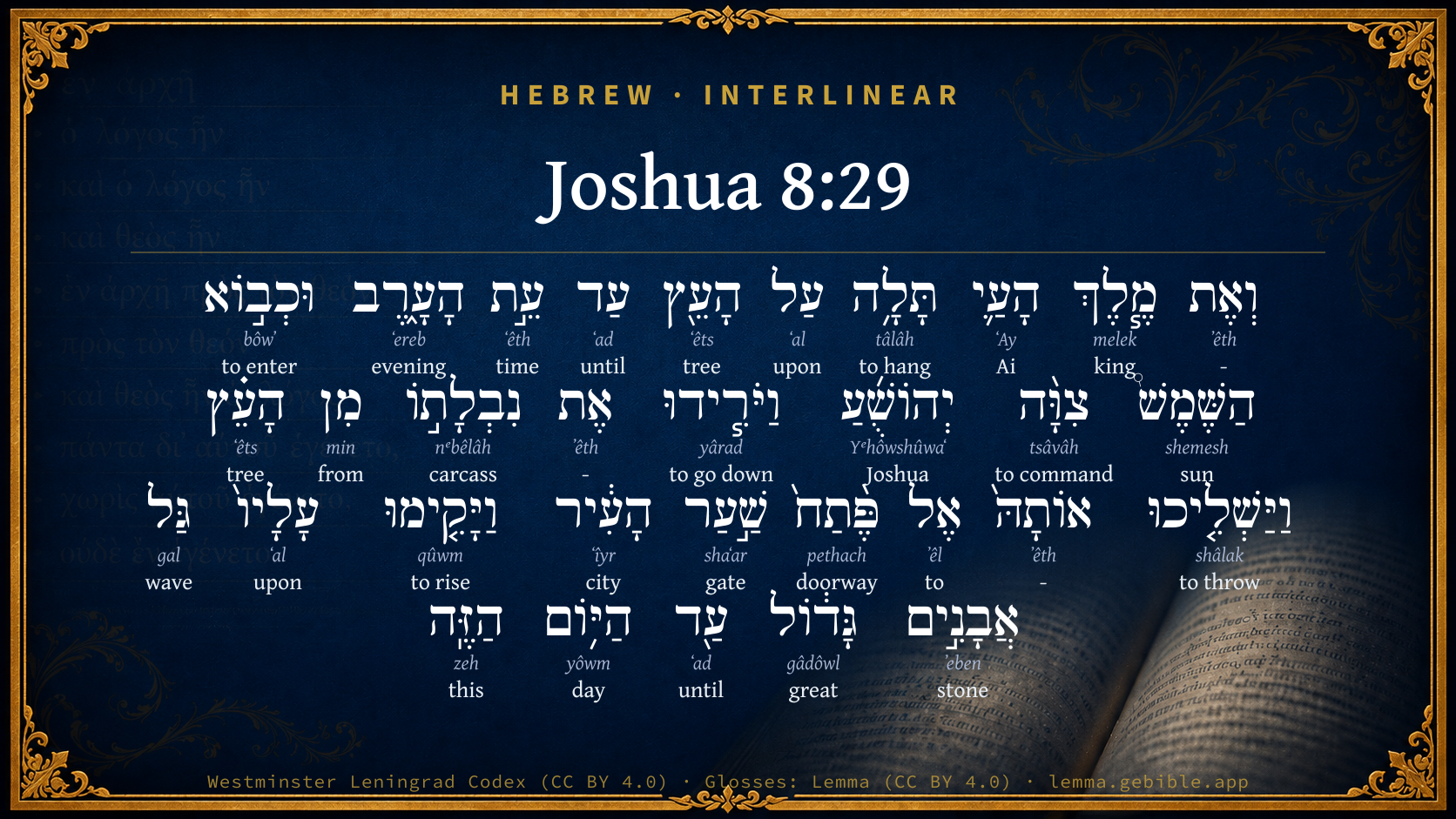
Hebrew (Westminster Leningrad Codex) Joshua 8:29 appears in the Hebrew Old Testament. The text above is from the Westminster Leningrad Codex. Each word links to its Strong’s number, a concise gloss, and parsing drawn from the Open Scriptures Hebrew Bible morphology. Click any word for its full Brown-Driver-Briggs (BDB) entry.
Download image
Cite this verse

Joshua 8:29 (World English Bible). Public Domain. Lemma interlinear Bible study tool, https://lemma.gebible.app/v/joshua/8/29.

Show BibTeX & RIS
BibTeX
RIS
English Translation
The king of Ai he hanged on a tree until the evening: and at the going down of the sun Joshua commanded, and they took his body down from the tree, and cast it at the entrance of the gate of the city, and raised thereon a great heap of stones, to this day.
World English Bible · Public Domain
Download a study sheet

One document with this verse’s original text, its word-by-word gloss line, the meaning frame, cross-references with their text, attributed commentary, and full source and license credits — printable, and it pastes into notes with its structure intact.

This verse Autodidact and up

Study sheet (.html) Plain text (.txt)

A passage Seminary Student

Up to 50 verses in one chapter. A passage sheet keeps up to 6 commentary sources and 12 cross-references per verse, in the order this page ranks them, and says so on the sheet whenever that leaves anything out. Ask for a single verse and you get the Autodidact verse sheet above.

Everything on this page stays free to read, with no account — the sheet is a download of what is already on screen, not access to it.

Want to remove ads? Support Godless Engineer
Compare translations 3

The same verse in 3 English versions, stacked beneath the original-language interlinear above. Click any original word for its lexicon entry.

Each is an independent rendering of the whole verse — the interlinear is not word-aligned to these translations.

Highlighted words mark where these versions differ — a whole-verse word diff, not a word-by-word alignment.

  • World English Bible Public Domain
    The king of Ai he hanged on a tree until the evening: and at the going down of the sun Joshua commanded, and they took his body down from the tree, and cast it at the entrance of the gate of the city, and raised thereon a great heap of stones, to this day.
  • King James Version Public Domain
    And the king of Ai he hanged on a tree until eventide: and as soon as the sun was down, Joshua commanded that they should take his carcass down from the tree, and cast it at the entering of the gate of the city, and raise thereon a great heap of stones, that remaineth unto this day.
  • unfoldingWord Literal Text CC BY-SA 4.0
    And he hanged the king of Ai on a tree until the time of the evening. And as the sun was going, Joshua commanded, and they brought down his corpse from the tree, and they threw it at the opening of the gate of the city, and they raised over it a great pile of stones, to this day.

unfoldingWord Literal Text — © unfoldingWord, licensed CC BY-SA 4.0. Word-aligned USFM3 via Door43 (git.door43.org/unfoldingWord/en_ult).

Versions to compare (up to 4)

3 of 4 selected

Show all 18 translations

Every available English version of this verse, each an independent rendering of the whole verse.

  • World English Bible Public Domain
    The king of Ai he hanged on a tree until the evening: and at the going down of the sun Joshua commanded, and they took his body down from the tree, and cast it at the entrance of the gate of the city, and raised thereon a great heap of stones, to this day.
  • Berean Standard Bible Public Domain
    He hung the king of Ai on a tree until evening, and at sunset Joshua commanded that they take down the body from the tree and throw it down at the entrance of the city gate. And over it they raised a large pile of rocks, which remains to this day.
  • Majority Standard Bible Public Domain
    He hung the king of Ai on a tree until evening, and at sunset Joshua commanded that they take down the body from the tree and throw it down at the entrance of the city gate. And over it they raised a large pile of rocks, which remains to this day.
  • King James Version Public Domain
    And the king of Ai he hanged on a tree until eventide: and as soon as the sun was down, Joshua commanded that they should take his carcass down from the tree, and cast it at the entering of the gate of the city, and raise thereon a great heap of stones, that remaineth unto this day.
  • American Standard Version (1901) Public Domain
    And the king of Ai he hanged on a tree until the eventide: and at the going down of the sun Joshua commanded, and they took his body down from the tree, and cast it at the entrance of the gate of the city, and raised thereon a great heap of stones, unto this day.
  • Revised Version (1885) Public Domain
    And the king of Ai he hanged on a tree until the eventide: and at the going down of the sun Joshua commanded, and they took his carcase down from the tree, and cast it at the entering of the gate of the city, and raised thereon a great heap of stones, unto this day.
  • Geneva Bible (1599) Public Domain
    And the King of Ai hee hanged on a tree, vnto the euening. And as soone as the sunne was down, Ioshua commanded that they should take his carkeis downe from the tree, and cast it at the entring of ye gate of the city, and lay thereon a great heape of stones, that remaineth vnto this day.
  • Douay-Rheims (1899) Public Domain
    And he hung the king thereof on a gibbet until the evening and the going down of the sun. Then Josue commanded, and they took down his carcass from the gibbet: and threw it in the very entrance of the city, heaping upon it a great heap of stones, which remaineth until this present day.
  • Young's Literal Translation Public Domain
    and the king of Ai he hath hanged on the tree till even-time, and at the going in of the sun hath Joshua commanded, and they take down his carcase from the tree, and cast it unto the opening of the gate of the city, and raise over it a great heap of stones till this day.
  • Literal Standard Version CC BY-SA 4.0
    and he has hanged the king of Ai on the tree until evening, and at the going in of the sun Joshua has commanded, and they take down his carcass from the tree, and cast it to the opening of the gate of the city, and raise a great heap of stones over it until this day.
  • Unlocked Literal Bible CC BY-SA 4.0
    He hanged the king of Ai on a tree until evening. When the sun was going down, Joshua gave the command and they took the king's body down from the tree and threw it in front of the city gates. There they set up a great heap of stones on top of it. That heap remains there to this day.
  • unfoldingWord Literal Text CC BY-SA 4.0
    And he hanged the king of Ai on a tree until the time of the evening. And as the sun was going, Joshua commanded, and they brought down his corpse from the tree, and they threw it at the opening of the gate of the city, and they raised over it a great pile of stones, to this day.
  • Darby Bible Public Domain
    And the king of Ai he hanged on a tree until the evening; and at the going down of the sun Joshua commanded, and they took his carcase down from the tree, and threw it down at the entrance of the gate of the city, and raised upon it a great heap of stones, [which remains] to this day.
  • World Messianic Bible Public Domain
    He hanged the king of Ai on a tree until the evening. At sundown, Joshua commanded, and they took his body down from the tree and threw it at the entrance of the gate of the city, and raised a great heap of stones on it that remains to this day.
  • Webster's Bible Public Domain
    And the king of Ai he hanged on a tree until evening: and as soon as the sun was down, Joshua commanded that they should take his carcass down from the tree, and cast it at the entering of the gate of the city, and raise upon it a great heap of stones, that remaineth to this day.
  • Free Bible Version CC BY-SA 4.0
    He killed the king of Ai and hung his body on a tree until evening. When the sun went down Joshua ordered the body taken down. They threw it down in front of the entrance to the town gate and piled a heap of rocks over it which is still there today.
  • Bible in Basic English Public Domain
    And he put the king of Ai to death, hanging him on a tree till evening: and when the sun went down, Joshua gave them orders to take his body down from the tree, and put it in the public place of the town, covering it with a great mass of stones, which is there to this day.
  • JPS Tanakh (1917) Public Domain
    And the king of Ai he hanged on a tree until the eventide; and at the going down of the sun Joshua commanded, and they took his carcass down from the tree, and cast it at the entrance of the gate of the city, and raised thereon a great heap of stones, unto this day.

Literal Standard Version (2020), Covenant Press — licensed CC BY-SA 4.0. Text via the HelloAO Bible API (eBible.org). Unlocked Literal Bible (unfoldingWord) — licensed CC BY-SA 4.0. Text via the HelloAO Bible API (eBible.org). unfoldingWord Literal Text — © unfoldingWord, licensed CC BY-SA 4.0. Word-aligned USFM3 via Door43 (git.door43.org/unfoldingWord/en_ult). Free Bible Version, Dr. Jonathan Gallagher — licensed CC BY-SA 4.0. Text via the HelloAO Bible API (eBible.org).

Word by word

More ways to search: Search by grammar → Find every occurrence → Compare this word →

Practice this passage: Drill this verse → Learn its vocabulary →

תָּלָ֥ה
tâlâh
H8518
“to hang”
Verb, Qal, Perfect, 3rd Person, Masculine, Singular
Part of Speech
Verb
Stem
Qal
Form
Perfect
Person
3rd Person
Gender
Masculine
Number
Singular
Full BDB Definition

Origin: a primitive root

TWOT: 2512

to hang - (Qal) - to hang - to hang up (any object) - to put to death by hanging - (Niphal) to be hanged - (Piel) to hang, hang up (for display)
  1. וְאֶת ʼêth H853 “and · -” Conjunction + Particle, Direct Object
  2. מֶ֧לֶךְ melek H4428 “king of” Noun, Common, Masculine, Singular, Construct
  3. הָעַ֛י ʻAy H5857 “the · Ai” Particle, Definite Article + Noun, Proper
  4. עַל ʻal H5921 “upon” Preposition
  5. הָעֵ֖ץ ʻêts H6086 “the · tree” Particle, Definite Article + Noun, Common, Masculine, Singular, Absolute
  6. עַד ʻad H5704 “until” Preposition
  7. עֵ֣ת ʻêth H6256 “time of” Noun, Common, Both, Singular, Construct
  8. הָעָ֑רֶב ʻereb H6153 “the · evening” Particle, Definite Article + Noun, Common, Masculine, Singular, Absolute
  9. וּכְב֣וֹא bôwʼ H935 “and · like/as · to enter” Conjunction + Preposition + Verb, Qal, Infinitive Construct
  10. הַשֶּׁמֶשׁ֩ shemesh H8121 “the · sun” Particle, Definite Article + Noun, Common, Both, Singular, Absolute
  11. צִוָּ֨ה tsâvâh H6680 “to command” Verb, Piel, Perfect, 3rd Person, Masculine, Singular
  12. יְהוֹשֻׁ֜עַ Yᵉhôwshûwaʻ H3091 “Joshua” Noun, Proper
  13. וַיֹּרִ֧ידוּ yârad H3381 “and · to go down” Conjunction + Verb, Hiphil, Sequential Imperfect, 3rd Person, Masculine, Plural
  14. אֶת ʼêth H853 “-” Particle, Direct Object
  15. נִבְלָת֣וֹ nᵉbêlâh H5038 “carcass · his” Noun, Common, Feminine, Singular, Construct + Suffix, Personal, 3rd Person, Masculine, Singular
  16. מִן min H4480 “from” Preposition
  17. הָעֵ֗ץ ʻêts H6086 “the · tree” Particle, Definite Article + Noun, Common, Masculine, Singular, Absolute
  18. וַיַּשְׁלִ֤יכוּ shâlak H7993 “and · to throw” Conjunction + Verb, Hiphil, Sequential Imperfect, 3rd Person, Masculine, Plural
  19. אוֹתָהּ֙ ʼêth H853 “- · her” Particle, Direct Object + Suffix, Personal, 3rd Person, Feminine, Singular
  20. אֶל ʼêl H413 “to” Preposition
  21. פֶּ֨תַח֙ pethach H6607 “doorway of” Noun, Common, Masculine, Singular, Construct
  22. שַׁ֣עַר shaʻar H8179 “gate of” Noun, Common, Masculine, Singular, Construct
  23. הָעִ֔יר ʻîyr H5892 “the · city” Particle, Definite Article + Noun, Common, Feminine, Singular, Absolute
  24. וַיָּקִ֤ימוּ qûwm H6965 “and · to rise” Conjunction + Verb, Hiphil, Sequential Imperfect, 3rd Person, Masculine, Plural
  25. עָלָיו֙ ʻal H5921 “upon · him” Preposition + Suffix, Personal, 3rd Person, Masculine, Singular
  26. גַּל gal H1530 “wave of” Noun, Common, Masculine, Singular, Construct
  27. אֲבָנִ֣ים ʼeben H68 “stones” Noun, Common, Feminine, Plural, Absolute
  28. גָּד֔וֹל gâdôwl H1419 “great” Adjective, Adjective, Masculine, Singular, Absolute
  29. עַ֖ד ʻad H5704 “until” Preposition
  30. הַיּ֥וֹם yôwm H3117 “the · day” Particle, Definite Article + Noun, Common, Masculine, Singular, Absolute
  31. הַזֶּֽה zeh H2088 “the · this” Particle, Definite Article + Pronoun, Demonstrative, Masculine, Singular

About this verse

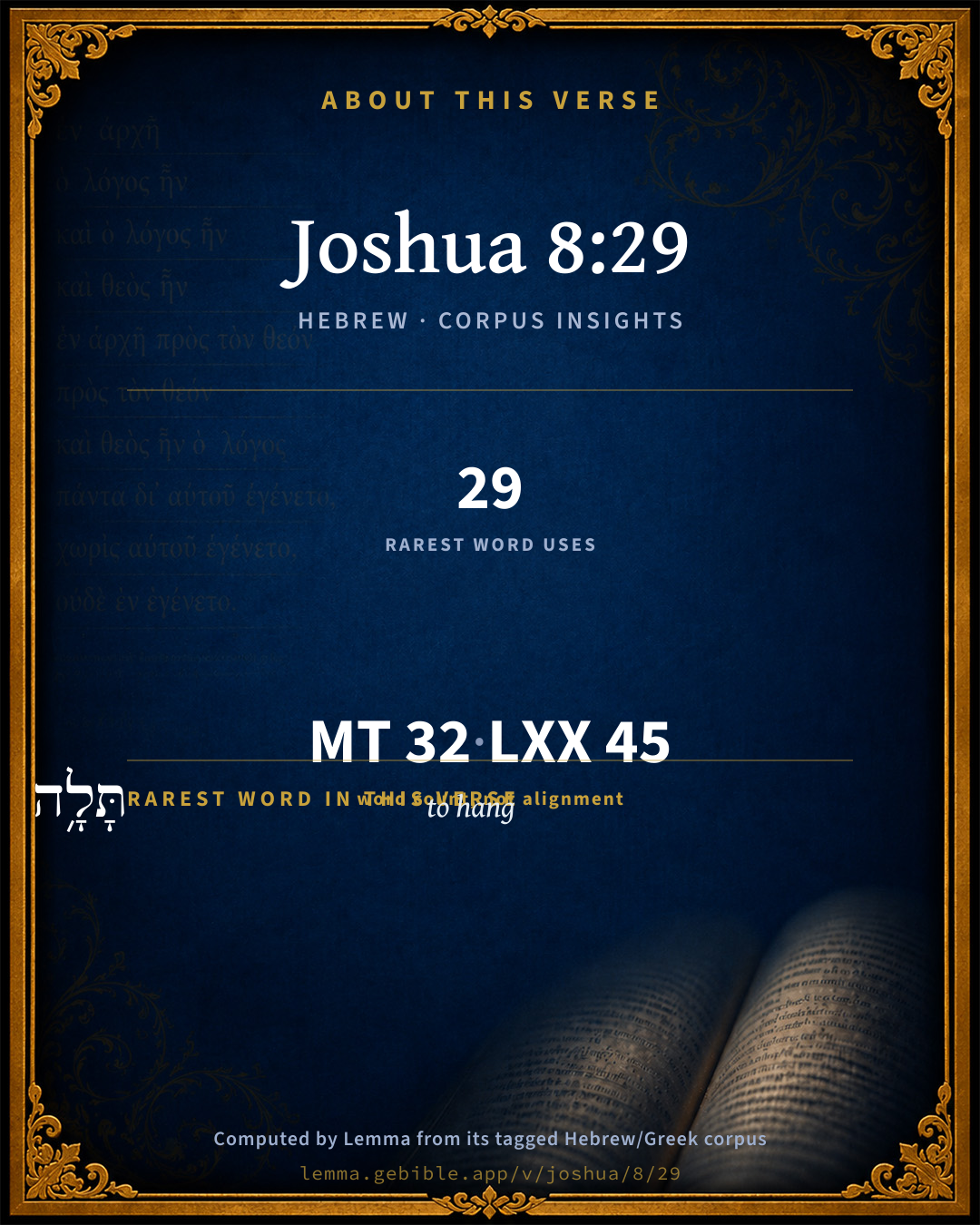
These counts appear in no published source. They are computed here, from the morphology-tagged text and Lemma’s own curated glosses. What Lemma adds →

32
words
27
distinct lemmas
Historical
section

Shared distinctive vocabulary

תָּלָ֥ה to hang H8518 occurs in 27 verses of the Hebrew Bible. Also found in:

Grammatical profile

  • 6 verbs
  • 15 nouns
  • 1 adjective
  • 1 pronoun
  • 6 prepositions
  • 3 particles

Verb forms

  • תָּלָ֥ה Qal · Perfect
  • וּכְב֣וֹא Qal · Infinitive Construct
  • צִוָּ֨ה Piel · Perfect
  • וַיֹּרִ֧ידוּ Hiphil · Sequential Imperfect
  • וַיַּשְׁלִ֤יכוּ Hiphil · Sequential Imperfect
  • וַיָּקִ֤ימוּ Hiphil · Sequential Imperfect

Repetition

Words recur within this verse — often emphatic in Hebrew:

Hebrew & Septuagint length

In English translation the verse runs 54 words from the Hebrew and 54 from the Septuagint (LXX English) — the same length.

A rough comparison of the two English renderings, which tokenize alike — not a word-level alignment.

Word counts can differ between the Hebrew and the Greek without any difference in meaning — e.g. the Hebrew direct-object marker אֵת has no separate Greek word, and Greek often adds the article ὁ.

In the original languages it is 32 Hebrew tokens and 45 Greek tokens — but the two are counted differently (Hebrew bundles its prefixes and suffixes into one token; the Greek is in lemma form), so that isn’t a like-for-like length.

Cross-references

11

Topical passages linked to Joshua 8:29 in the Treasury of Scripture Knowledge — connected by theme and wording, ordered by reader-vote popularity; previews shown in the World English Bible.

  • Deuteronomy 21:22–23 If a man have committed a sin worthy of death, and he be put to death, and you hang him on a tree;
  • Joshua 7:26 They raised over him a great heap of stones, to this day; and Yahweh turned from the fierceness of his anger. Therefore the name of that place was called "The valley of Achor" to this day.
  • 2 Samuel 18:17 They took Absalom, and cast him into the great pit in the forest, and raised over him a very great heap of stones: and all Israel fled everyone to his tent.
  • Joshua 10:26–28 Afterward Joshua struck them, and put them to death, and hanged them on five trees: and they were hanging on the trees until the evening.
  • Joshua 10:30 and Yahweh delivered it also, and the king of it, into the hand of Israel; and he struck it with the edge of the sword, and all the souls who were therein; he left none remaining in it; and he did to the king of it as he had done to the king of Jericho.
  • Joshua 10:33 Then Horam king of Gezer came up to help Lachish; and Joshua struck him and his people, until he had left him none remaining.
  • Esther 7:10 So they hanged Haman on the gallows that he had prepared for Mordecai. Then was the king's wrath pacified.
  • Psalms 107:40 He pours contempt on princes, And causes them to wander in a trackless waste.
  • Psalms 110:5 The Lord is at your right hand. He will crush kings in the day of his wrath.
  • Acts 12:23 Immediately an angel of the Lord struck him, because he didn't give God the glory, and he was eaten by worms and died.
  • Revelation 19:17–18 I saw an angel standing in the sun. He cried with a loud voice, saying to all the birds that fly in the sky, "Come! Be gathered together to the great supper of God,

Cross-references courtesy of OpenBible.info (CC BY 4.0).

Hebrew and Greek witnesses Masoretic Hebrew ↔ Greek Septuagint

The same verse in the two great witnesses to the Old Testament, shown verse-for-verse.

These are two independent witnesses, not word-aligned to each other, and the Septuagint is shown in lemma (dictionary) form.

Hebrew Joshua 8:29 Masoretic · Westminster Leningrad Codex

וְאֶת מֶ֧לֶךְ הָעַ֛י תָּלָ֥ה עַל הָעֵ֖ץ עַד עֵ֣ת הָעָ֑רֶב וּכְב֣וֹא הַשֶּׁמֶשׁ֩ צִוָּ֨ה יְהוֹשֻׁ֜עַ וַיֹּרִ֧ידוּ אֶת נִבְלָת֣וֹ מִן הָעֵ֗ץ וַיַּשְׁלִ֤יכוּ אוֹתָהּ֙ אֶל פֶּ֨תַח֙ שַׁ֣עַר הָעִ֔יר וַיָּקִ֤ימוּ עָלָיו֙ גַּל אֲבָנִ֣ים גָּד֔וֹל עַ֖ד הַיּ֥וֹם הַזֶּֽה

The king of Ai he hanged on a tree until the evening: and at the going down of the sun Joshua commanded, and they took his body down from the tree, and cast it at the entrance of the gate of the city, and raised thereon a great heap of stones, to this day.

World English Bible · Public Domain

Greek LXX Joshua 8:29 Septuagint · lemma form

καί ὁ βασιλεύς ὁ γαι κρεμάζω ἐπί ξύλον δίδυμος καί εἰμί ἐπί ὁ ξύλον ἕως ἑσπέρα καί ἐπιδύω ὁ ἥλιος συντάσσω ἰησοῦς καί κατααἱρέω αὐτός ὁ σῶμα ἀπό ὁ ξύλον καί ῥίπτω αὐτός εἰς ὁ βόθρος καί ἐπιἵστημι αὐτός σωρός λίθος ἕως ὁ ἡμέρα οὗτος

And he hanged the king of Gai on a gallows; and he remained on the tree till evening: and when the sun went down, Joshua gave charge, and they took down his body from the tree, and cast it into a pit, and they set over him a heap of stones until this day.

LXX2012 (modern English Septuagint) · Public Domain

On this verse, Trapp's Complete Commentary discusses the Septuagint’s reading. Read the note in Commentary ↓

Hebrew: Westminster Leningrad Codex (CC BY 4.0). Greek: Septuagint (public domain); English from LXX2012 (modern English Septuagint) (Public Domain). How the Septuagint differs from the Hebrew →

Targum (Aramaic paraphrase)

1

The Targum is the ancient Jewish Aramaic paraphrase of the Hebrew Scriptures — an interpretive translation, not the Hebrew text itself. Onkelos (literal) and Pseudo-Jonathan (expansive) render the Torah, and Jonathan the Prophets. Coverage is partial: where no permissively-licensed English translation exists for a verse, only the Aramaic is shown. This is verse-level text, not a word-by-word alignment to the Hebrew.

  1. Targum Jonathan Prophets (Joshua–Malachi)
    וְיַת מַלְכָּא דְעַי צְלַב עַל צְלִיבָא עַד עִידַן רַמְשָׁא וּכְמֵיעַל שִׁמְשָׁא פַּקֵד יְהוֹשֻׁעַ וַאֲחִיתוּ יַת נִבְלָתֵיהּ מִן צְלִיבָא וּרְמוֹ יָתֵיהּ בְּמַעֲלָנָא תְּרַע קַרְתָּא וְאַקִימוּ עֲלוֹהִי דְגוֹר אַבְנִין רַב עַד יוֹמָא הָדֵין:

    (no public-domain English translation for this verse)

    Targum Jonathan — Aramaic: “Mikraot Gedolot” (public domain). English: “Sefaria Community Translation” (CC0 1.0 (public-domain dedication)); “London "Chaldee Paraphrase," 1871” (public domain). Text via Sefaria.

Commentary

Notes on Joshua 8:29 from classic Christian and Jewish commentators (each source and its license shown beneath its notes). The classic Christian expositions comment on the surrounding passage and are grouped to its opening verse, so a note may address several verses; the Jewish commentaries on the Tanakh (Rashi and others) are per-verse, so they appear only where the commentator wrote on this verse.

Lemma curates 59 commentaries, every one of them public domain or Creative Commons licensed, each selected and text-cleaned for this edition rather than reprinted as found. About our sources →

Jamieson, Fausset & Brown

Robert Jamieson, A. R. Fausset & David Brown

THE KING HANGED. (Jos 8:29)

The king of Ai he hanged on a tree until eventide--that is, gibbeted. In ancient, and particularly Oriental wars, the chiefs, when taken prisoners, were usually executed. The Israelites were obliged, by the divine law, to put them to death. The execution of the king of Ai would tend to facilitate the conquest of the land, by striking terror into the other chiefs, and making it appear a judicial process, in which they were inflicting the vengeance of God upon His enemies.

take his carcass down . . . and raise thereon a great heap of stones--It was taken down at sunset, according to the divine command (Deu 21:23), and cast into a pit dug "at the entering of the gate," because that was the most public place. An immense cairn was raised over his grave--an ancient usage, still existing in the East, whereby is marked the sepulchre of persons whose memory is infamous.

Jamieson, Fausset & Brown — Commentary Critical and Explanatory on the Whole Bible (1871) — public domain (CC PDM 1.0). Text via the HelloAO Bible API.

Trapp's Complete Commentary

John Trapp

Jos 8:29 And the king of Ai he hanged on a tree until eventide: and as soon as the sun was down, Joshua commanded that they should take his carcase down from the tree, and cast it at the entering of the gate of the city, and raise thereon a great heap of stones, [that remaineth] unto this day.

Ver. 29. And the king of Ai he hanged on a tree,] i.e., Either on a gallows, or cross. The Septuagint has it, upon a double tree, {a} intimating the cross, propter dua ligna quae se invicem intersecant, because of the two pieces standing across, as the threads in the woof and warp; whence the Jews at this day, in derision of Christ crucified, call him the woof and warp, {b} because these two make the figure of the cross.

That they should take his carcass down from the tree.] Ab arbore infelici, as the Latins call it. This was according to the law; {Deu 21:23} but it was otherwise in the case of Saul and his sons. {2Sa 21:9-10} God may dispense with his own law as he pleaseth.

{a} επι ξυλου διδυμον.

{b} נעלב שׁηι Stamen et subtegmen.

John Trapp, A Commentary or Exposition upon All the Books of the Old and New Testament (1647–1656) — public domain. Text from a community e-Sword module.

Joseph Benson's Commentary

Jos 8:29. The king of Ai he hanged on a tree — He dealt more severely with the kings of Canaan than with the people, because the abominable wickedness of that people was not restrained and punished, (as it ought to have been,) but countenanced and encouraged by their evil examples; and because they were the principal authors of the destruction of their own people, by engaging them in an obstinate opposition against the Israelites. Down from the tree — According to God’s command in that case, Deu 21:22. The gate of the city — Which place he chose either as most commodious, now especially, when all the city within the gate was already turned into a heap of stones and rubbish; or because this was the usual place of judgment, and therefore proper to bear the monument of God’s just sentence against him, not without reflection upon that injustice which he had been guilty of in that place.

Joseph Benson's Commentary on the Old and New Testaments (1811–1818) — public domain. Text from a community e-Sword module.

Tyndale Open Study Notes

Tyndale Open Resources

8:29 The public executions of the kings (see also 10:26; 11:10, 12) emphasized that Israel was God’s agent in the judgment of the leaders and people of Canaan for their wickedness. • At sunset: See Deut 21:22-23. • that can still be seen today: See Joshua Book Introduction, “Author and Date.”

Tyndale Open Study Notes — © Tyndale Open Resources, licensed CC BY-SA 4.0. Text via the HelloAO Bible API.

Geneva Bible (1599)

Geneva Bible translators

According as it was commanded, Deut. 21:23.

Geneva Bible (1599) marginal notes — public domain. Text via Bolls.life.

Adam Clarke's Commentary

Verse 29. The king of Ai he hanged on a tree] He had gone out at the head of his men, and had been taken prisoner, Jos 8:23; and the battle being over, he was ordered to be hanged, probably after having been strangled, or in some way deprived of life, as in the case mentioned Jos 10:26, for in those times it was not customary to hang people alive.

As soon as the sun was down] It was not lawful to let the bodies remain all night upon the tree. See the note on De 21:23. The Septuagint say the king of Ai was hanged επι ξυλον διδυμον, upon a double tree, which probably means a forked tree, or something in the form of a cross. The tree on which criminals were hanged among the Romans was called arbor infelix, and lignum infelix, the unfortunate, ill-fated, or accursed tree.

Raise thereon a great heap of stones] This was a common custom through all antiquity in every country, as we have already seen in the case of Achan, Jos 7:20.

Adam Clarke's Commentary on the Bible (1810–1826) — public domain. Text from a community e-Sword/MySword module.

John Calvin's Commentaries

29. And the king of Ai he hanged, etc Though he seems to have treated the king with great severity in order to satisfy the hatred of the people, I cannot doubt that he studied faithfully to execute the divine judgment. Conquerors, indeed, are wont to spare captive kings, because their rank seems to carry something venerable along with it, but the condition of kings was different among those nations in which God wished particularly to show how greatly he detested the wickedness which he had so long tolerated. For while all were doomed to destruction, the divine vengeance justly displayed itself with greater sternness and severity on the leaders, with whom the cause of destruction originated.

We may add, that the ignominious punishment inflicted on the king rendered it still less necessary to deal leniently with the common people, and thus prevented the Israelites from indulging an unseasonable mercy, which might have made them more sluggish or careless in executing the work of universal extermination.

God purposely delivered the king alive into the hand of Joshua, that his punishment might be more marked and thus better adapted for an example. Had he fallen in the conflict promiscuously with others, he would have been exempted from this special mark of infamy; but now even after his death, the divine vengeance pursues his corpse. Nay, after being hung, he is thrown forth at the gate of the city where he had sat on his throne in judgment, and a monument is erected for the purpose of perpetuating his ignominy to posterity. His burial, however, is mentioned to let us know that nothing was done through tumultuous impetuosity, as Joshua carefully observed what Moses had prescribed in the Law, (Deuteronomy 21:23) namely, that those hung on gibbets should be taken down before sunset, as a spectacle of the kind was held in abomination. And, certainly, while it is humane to bury the dead under ground, it is inhumanly cruel to cast them forth to be torn by wild beasts or birds. Therefore, that the people might not be accustomed to barbarity, God allowed criminals to be hung, provided they did not hang unburied for more than one day. And that the people might be more attentive to this duty, which otherwise might readily have been neglected, Moses declares that every one who hangs on a tree is accursed; as if he had said, that the earth is contaminated by that kind of death, if the offensive object be not immediately taken away.

John Calvin's Commentaries (1540-1563) — public domain. Text from the Calvin Translation Society English edition (1840s-50s) via the Christian Classics Ethereal Library (ccel.org). Calvin's coverage is partial (roughly two-thirds of the Bible); uncommented books and verses are honest gaps, never fabricated. The 19th-century editor's footnotes and remarks are omitted so the notes are faithfully Calvin's own voice.

Ellicott's Commentary for English Readers

(29) And the king of Ai he hanged on a tree.—(See Note on Deu_21:22-23.) Heb., on the tree. Why “the tree”? It would appear from Jos_8:2; Jos_10:1, that the king of Jericho was also hanged; possibly both were hanged on the same tree, and were exhibited, each in turn, as “the curse of God.” But when we read of this treatment of the enemies of Joshua, we cannot but be reminded of the greater Joshua, who fulfilled the curse of God in His own person, and made a show of the “principalities and powers” by triumphing over them in His cross. (Comp. also Est_9:10; Est_9:13.)

Jericho and Ai are the only cities of Canaan of which the capture by Joshua is recorded in detail. Their capture stands in the narrative, as it was in fact, a specimen of the whole conquest of the Canaanite cities. Two campaigns in like manner are recorded as specimens of Joshua’s battles with the enemy in the open field. In the capture of Jericho and in the southern campaign, the hand of God is more especially manifested. In the capture of Ai and in the northern campaign, the labour of Israel in the conflict is more prominent. The whole work is thus presented to us in a twofold aspect, as the work of Israel and the work of God.

A great heap of stones.—Not only the death, but the burial of the king of Ai is recorded, as also the burial of the five kings in Jos_10:27. The same thing was done to Achan (Jos_7:26), and to Absalom (2Sa_18:17). This kind of burial is another form of the curse, and is a fitting sequel to the hanging of the body upon the tree.

A Bible Commentary for English Readers, edited by Charles John Ellicott (1878–1897) — public domain. Text from a community e-Sword module.

The Cambridge Bible for Schools and Colleges

gen. ed. J. J. S. Perowne

29. he hanged on a tree] “He hongid in a gybet,” Wyclif. Hanging is mentioned as a distinct punishment, Num_25:4. In Deu_21:22 we read that in certain cases the criminal was put to death, and after that, his dead body was hung on a tree till eventide; the king of Ai was probably slain and then hanged on a cross or gallows.

as soon as the sun was down] This was in accordance with the Mosaic Law, which directed, Deu_21:23, that a man’s body should “not remain all night upon the tree.” Comp. also Jos_10:27.

and raise thereon a great heap of stones] Comp. Jos_7:26. Two words are used for “heap” in Jos_8:28-29. The first (Tel) indicates the ruins of the city itself, the second (Gal) the cairn over the king’s grave.

The Cambridge Bible for Schools and Colleges (gen. ed. J. J. S. Perowne; Cambridge University Press, 1878–1918) — public domain. Text from a community e-Sword module.

John Gill's Exposition

And the king of Ai he hanged on a tree until eventide,.... By way of terror to other kings in the land of Canaan, that should refuse to submit unto him:

and as soon as the sun was down, Joshua commanded that they should take his carcass down from the tree; according to the law in Deu 21:23; and that the land might not be defiled:

and cast it at the entering of the gate of the city; this was done, according to Ben Gersom and Abarbinel, that it might be publicly known to the rest of the kings of the nations, that they might be afraid to fight with Israel:

and raise thereon a great heap of stones, that remaineth unto this day; as a sepulchral monument, showing that there was a person lay interred there; whether there was any inscription on the stone, showing who he was, does not appear; it looks as if it was only a rude heap of stones; and such kind of sepulchral monuments were common in former times in other countries.

John Gill's Exposition of the Whole Bible (1746–1763) — public domain (CC PDM 1.0). Text via the HelloAO Bible API.

Albert Barnes' Notes on the Bible

Compare Deu 21:22-23 notes.

Albert Barnes' Notes on the Bible (1834–1885) — public domain. Text from a community e-Sword/MySword module.

Haydock's Catholic Bible Commentary

Gibbet. Septuagint, "a cross." Some say that the king was first killed; but that assertion is destitute of proof. The corpse was taken down before night, Deuteronomy xxi. 22.

George Leo Haydock (1774–1849), Haydock's Catholic Family Bible and Commentary, 1859 edition — public domain. Excludes Psalms (Douay-Rheims chapter numbering differs from Protestant) and Deuterocanonical books (Catholic canon only).

Matthew Poole's English Annotations

He dealt more severely with the kings of Canaan than with the people, partly because the abominable wickedness of that people was not restrained and punished, (as it should have been,) but countenanced and encouraged by their evil examples and administrations; and partly because they were the principal authors of the destruction of their own people, by engaging them in an obstinate opposition against the Israelites.

That they should take his carcass down from the tree, according to God’s command in that case, Deu 21:22,23. He chose

the entering of the gate of the city, either as most commodious, now especially when all the city within the gate was already turned into a heap of stones and rubbish; or because this was the usual place of judgment, and therefore proper to bear the monument of God’s just sentence against him, not without reflection upon that injustice which he had been guilty of in that place.

Matthew Poole's English Annotations on the Holy Bible (1683–1685) — public domain. Text from a community e-Sword/MySword module.

Whedon's Commentary on the Bible

Daniel D. Whedon

29. The king of Ai he hanged — For the reason, see note on Jos_8:23.

On a tree — The Septuagint says, on a double tree, which the Vulgate renders, a fork-shaped gibbet.

Until eventide — This was in accordance with the law, (Deu_21:23,) “that the land be not defiled.” Among the ancient Israelites hanging alive seems not to have been practiced, but, as Deu_21:22, implies, the victim was first slain and then hanged. Comp. Jos_10:26; 2Sa_4:12.

At the entering of the gate — Probably the dead body was cast into a pit. Thus the Septuagint translates this passage.

A great heap of stones — See note on Jos_7:26.

Daniel D. Whedon (gen. ed.), Commentary on the Old and New Testaments (1874–1909) — public domain. Text from a community e-Sword module.

John Wesley's Explanatory Notes

Hanged on a tree - He dealt more severely with the kings of Canaan than with the people, because the abominable wickedness of that people was not restrained and punished (as it should have been) but countenanced and encouraged by their evil examples; and because they were the principal authors of the destruction of their own people, by engaging them in an obstinate opposition against the Israelites. Down from the tree - According to God's command in that case, Deut. xxi, 22. The gate of the city - Which place he chose either as most commodious, now especially when all the city within the gate was already turned in to an heap of stones and rubbish; or because this was the usual place of judgment; and therefore proper to bear the monument of God's just sentence against him, not without reflection upon that injustice which he had been guilty of in that place.

John Wesley, Explanatory Notes Upon the Whole Bible (1754–1765) — public domain. Text via the GEBible commentary corpus.

unfoldingWord translationNotes

Door43 World Missions Community

to this day

"today" or "even now"

translationWords

hang

king

Ai

Joshua

command

gate

unfoldingWord translationNotes — © Distant Shores Media and the Door43 World Missions Community, licensed CC BY-SA 4.0. Source: git.door43.org/Door43/en_tn.

Lesson kit

Teaching starters — assembled from the data on this page, not authored interpretation. Every prompt links to the verse data it draws on. Edit before teaching.

Joshua, in the Historical, opens this verse with 32 words (27 distinct Hebrew lemmas). Its most distinctive word is tâlâh (“to hang”). A historical commentator’s framing appears above. Read the whole chapter for the surrounding context.

Discussion questions

  1. What does “to hang” (tâlâh) contribute to the verse as a whole?
  2. How does Genesis 40:19, which shares the word «to hang», read alongside this verse?
  3. What does the repetition of “upon” (2× in this one verse) do in this verse?
  4. The translations on this page render this verse differently — a whole-verse word diff, not a word-by-word alignment. What might account for the different wordings?
  5. «תָּלָ֥ה» is a Qal Perfect verb. How does that grammatical form shape the action described?
  6. Compare how Jamieson, Fausset & Brown and Trapp's Complete Commentary read this verse. Where do they agree or differ?

Things to notice

Reading settings

Reading text

Shown beneath each verse's original-language words.

Old Testament
Old Testament edition

Read the OT as the Masoretic Hebrew (MT) or the Greek Septuagint (LXX).

English shown for the Greek Septuagint (in the Hebrew ↔ Greek comparison).

Comparing translations? Open the Compare panel on any verse page to stack up to four side by side.