
Psalms 118:19

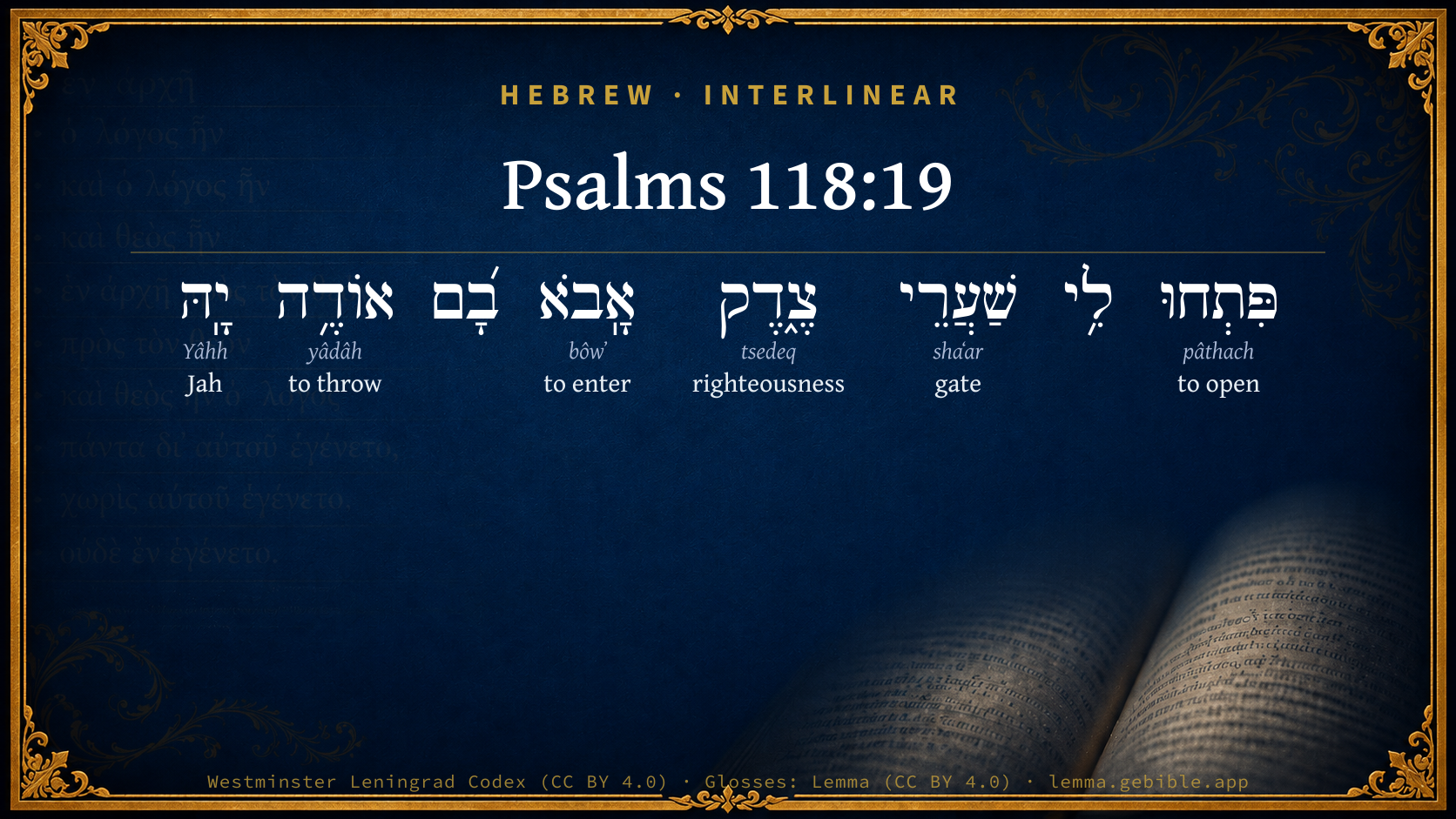
Hebrew (Westminster Leningrad Codex) Psalms 118:19 appears in the Hebrew Old Testament. The text above is from the Westminster Leningrad Codex. Each word links to its Strong’s number, a concise gloss, and parsing drawn from the Open Scriptures Hebrew Bible morphology. Click any word for its full Brown-Driver-Briggs (BDB) entry.
Download image
Cite this verse

Psalms 118:19 (World English Bible). Public Domain. Lemma interlinear Bible study tool, https://lemma.gebible.app/v/psalms/118/19.

Show BibTeX & RIS
BibTeX
RIS
English Translation
Open to me the gates of righteousness. I will enter into them. I will give thanks to Yah.
World English Bible · Public Domain
Download a study sheet

One document with this verse’s original text, its word-by-word gloss line, the meaning frame, cross-references with their text, attributed commentary, and full source and license credits — printable, and it pastes into notes with its structure intact.

This verse Autodidact and up

Study sheet (.html) Plain text (.txt)

A passage Seminary Student

Up to 50 verses in one chapter. A passage sheet keeps up to 6 commentary sources and 12 cross-references per verse, in the order this page ranks them, and says so on the sheet whenever that leaves anything out. Ask for a single verse and you get the Autodidact verse sheet above.

Everything on this page stays free to read, with no account — the sheet is a download of what is already on screen, not access to it.

Want to remove ads? Support Godless Engineer
Compare translations 3

The same verse in 3 English versions, stacked beneath the original-language interlinear above. Click any original word for its lexicon entry.

Each is an independent rendering of the whole verse — the interlinear is not word-aligned to these translations.

Highlighted words mark where these versions differ — a whole-verse word diff, not a word-by-word alignment.

  • World English Bible Public Domain
    Open to me the gates of righteousness. I will enter into them. I will give thanks to Yah.
  • King James Version Public Domain
    Open to me the gates of righteousness: I will go into them, and I will praise the LORD:
  • unfoldingWord Literal Text CC BY-SA 4.0
    Open to me the gates of righteousness; I will enter them; I will thank Yah.

unfoldingWord Literal Text — © unfoldingWord, licensed CC BY-SA 4.0. Word-aligned USFM3 via Door43 (git.door43.org/unfoldingWord/en_ult).

Versions to compare (up to 4)

3 of 4 selected

Show all 18 translations

Every available English version of this verse, each an independent rendering of the whole verse.

  • World English Bible Public Domain
    Open to me the gates of righteousness. I will enter into them. I will give thanks to Yah.
  • Berean Standard Bible Public Domain
    Open to me the gates of righteousness, that I may enter and give thanks to the LORD.
  • Majority Standard Bible Public Domain
    Open to me the gates of righteousness, that I may enter and give thanks to the LORD.
  • King James Version Public Domain
    Open to me the gates of righteousness: I will go into them, and I will praise the LORD:
  • American Standard Version (1901) Public Domain
    Open to me the gates of righteousness: I will enter into them, I will give thanks unto Jehovah.
  • Revised Version (1885) Public Domain
    Open to me the gates of righteousness: I will enter into them, I will give thanks unto the LORD.
  • Geneva Bible (1599) Public Domain
    Open ye vnto me the gates of righteousnes, that I may goe into them, and praise the Lord.
  • Douay-Rheims (1899) Public Domain
    Open ye to me the gates of justice: I will go into them, and give praise to the Lord.
  • Young's Literal Translation Public Domain
    Open ye to me gates of righteousness, I enter into them -- I thank Jah.
  • Literal Standard Version CC BY-SA 4.0
    Open gates of righteousness to me, || I enter into them—I thank YAH.
  • Unlocked Literal Bible CC BY-SA 4.0
    Open to me the gates of righteousness; I will enter them and I will give thanks to Yahweh.
  • unfoldingWord Literal Text CC BY-SA 4.0
    Open to me the gates of righteousness; I will enter them; I will thank Yah.
  • Darby Bible Public Domain
    Open to me the gates of righteousness: I will enter into them; Jah will I praise.
  • World Messianic Bible Public Domain
    Open to me the gates of righteousness. I will enter into them. I will give thanks to the LORD.
  • Webster's Bible Public Domain
    Open to me the gates of righteousness: I will enter them, and I will praise the LORD:
  • Free Bible Version CC BY-SA 4.0
    Open the gates of the faithful for me so I can go in and thank the Lord.
  • Bible in Basic English Public Domain
    Let the doors of righteousness be open to me; I will go in and give praise to the Lord.
  • JPS Tanakh (1917) Public Domain
    Open to me the gates of righteousness; I will enter into them, I will give thanks unto the LORD.

Literal Standard Version (2020), Covenant Press — licensed CC BY-SA 4.0. Text via the HelloAO Bible API (eBible.org). Unlocked Literal Bible (unfoldingWord) — licensed CC BY-SA 4.0. Text via the HelloAO Bible API (eBible.org). unfoldingWord Literal Text — © unfoldingWord, licensed CC BY-SA 4.0. Word-aligned USFM3 via Door43 (git.door43.org/unfoldingWord/en_ult). Free Bible Version, Dr. Jonathan Gallagher — licensed CC BY-SA 4.0. Text via the HelloAO Bible API (eBible.org).

Word by word

More ways to search: Search by grammar → Find every occurrence → Compare this word →

Practice this passage: Drill this verse → Learn its vocabulary →

יָֽהּ
Yâhh
H3050
“Jah”
Noun, Proper
Part of Speech
Noun
Type
Proper
Full BDB Definition

Origin: contraction for H3068 , and meaning the same

TWOT: 484b

Jah (Jehovah in the shortened form) - the proper name of the one true God - used in many compounds - names beginning with the letters 'Je' - names ending with 'iah' or 'jah'
  1. פִּתְחוּ pâthach H6605 “open” Verb, Qal, Imperative, 2nd Person, Masculine, Plural
  2. שַׁעֲרֵי shaʻar H8179 “gates of” Noun, Common, Masculine, Plural, Construct
  3. צֶ֑דֶק tsedeq H6664 “righteousness” Noun, Common, Masculine, Singular, Absolute
  4. אָֽבֹא bôwʼ H935 “to enter” Verb, Qal, Imperfect, 1st Person, Common, Singular
  5. אוֹדֶ֥ה yâdâh H3034 “to throw” Verb, Hiphil, Imperfect, 1st Person, Common, Singular

About this verse

These counts appear in no published source. They are computed here, from the morphology-tagged text and Lemma’s own curated glosses. What Lemma adds →

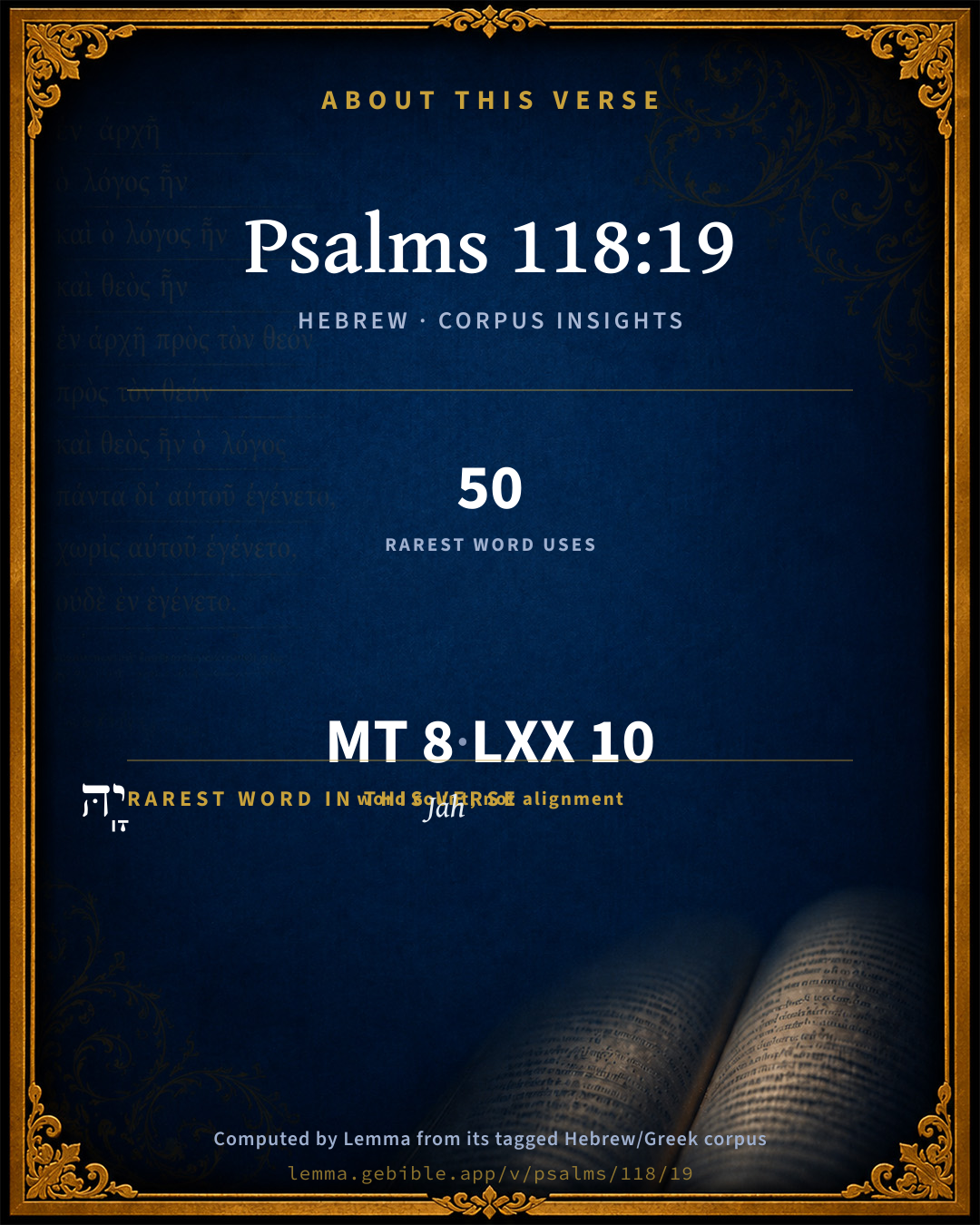
8
words
6
distinct lemmas
Wisdom
section

Shared distinctive vocabulary

יָֽהּ Jah H3050 occurs in 46 verses of the Hebrew Bible. Also found in:

Grammatical profile

  • 3 verbs
  • 3 nouns
  • 2 prepositions

Verb forms

  • פִּתְחוּ Qal · Imperative
  • אָֽבֹא Qal · Imperfect
  • אוֹדֶ֥ה Hiphil · Imperfect

Hebrew & Septuagint length

In English translation the verse runs 18 words from the Hebrew and 18 from the Septuagint (LXX English) — the same length.

A rough comparison of the two English renderings, which tokenize alike — not a word-level alignment.

Word counts can differ between the Hebrew and the Greek without any difference in meaning — e.g. the Hebrew direct-object marker אֵת has no separate Greek word, and Greek often adds the article ὁ.

In the original languages it is 8 Hebrew tokens and 10 Greek tokens — but the two are counted differently (Hebrew bundles its prefixes and suffixes into one token; the Greek is in lemma form), so that isn’t a like-for-like length.

Cross-references

9

Topical passages linked to Psalms 118:19 in the Treasury of Scripture Knowledge — connected by theme and wording, ordered by reader-vote popularity; previews shown in the World English Bible.

  • Isaiah 26:2 Open you the gates, that the righteous nation which keeps faith may enter in.
  • Revelation 22:14 Blessed are those who do his commandments, that they may have the right to the tree of life, and may enter in by the gates into the city.
  • Psalms 9:13–14 Have mercy on me, Yahweh. See my affliction by those who hate me, And lift me up from the gates of death;
  • Psalms 100:4 Enter into his gates with thanksgiving, Into his courts with praise. Give thanks to him, and bless his name.
  • Psalms 66:13–15 I will come into your temple with burnt offerings. I will pay my vows to you,
  • Psalms 95:2 Let's come before his presence with thanksgiving. Let's extol him with songs!
  • Psalms 116:18–19 I will pay my vows to Yahweh, Yes, in the presence of all his people,
  • Isaiah 38:20 Yahweh is [ready] to save me: Therefore we will sing my songs with stringed instruments All the days of our life in the house of Yahweh.
  • Isaiah 38:22 Hezekiah also had said, What is the sign that I shall go up to the house of Yahweh?

Cross-references courtesy of OpenBible.info (CC BY 4.0).

Hebrew and Greek witnesses Masoretic Hebrew ↔ Greek Septuagint

The same verse in the two great witnesses to the Old Testament, shown verse-for-verse.

You’re reading Greek Psalm 117 (Hebrew Psalm 118). The Septuagint counts the superscription, so verse numbers can differ from the Hebrew — chapter-level alignment, not verse-by-verse. Numbering follows Rahlfs.

These are two independent witnesses, not word-aligned to each other, and the Septuagint is shown in lemma (dictionary) form.

Hebrew Psalms 118:19 Masoretic · Westminster Leningrad Codex

פִּתְחוּ לִ֥י שַׁעֲרֵי צֶ֑דֶק אָֽבֹא בָ֝ם אוֹדֶ֥ה יָֽהּ

Open to me the gates of righteousness. I will enter into them. I will give thanks to Yah.

World English Bible · Public Domain

Greek LXX Greek Psalm 117:19 Septuagint · lemma form

ἀναοἴγω ἐγώ πύλη δικαιοσύνη εἰςἔρχομαι ἐν αὐτός ἐκὁμολογέω ὁ κύριος

Open to me the gates of righteousness: I will go into them, and give praise to the Lord.

LXX2012 (modern English Septuagint) · Public Domain

On this verse, Keil & Delitzsch discusses the Septuagint’s reading. Read the note in Commentary ↓

Hebrew: Westminster Leningrad Codex (CC BY 4.0). Greek: Septuagint (public domain); English from LXX2012 (modern English Septuagint) (Public Domain). How the Septuagint differs from the Hebrew →

Commentary

Notes on Psalms 118:19 from classic Christian and Jewish commentators (each source and its license shown beneath its notes). The classic Christian expositions comment on the surrounding passage and are grouped to its opening verse, so a note may address several verses; the Jewish commentaries on the Tanakh (Rashi and others) are per-verse, so they appear only where the commentator wrote on this verse.

Lemma curates 59 commentaries, every one of them public domain or Creative Commons licensed, each selected and text-cleaned for this edition rather than reprinted as found. About our sources →

Matthew Henry's Commentary

We have here an illustrious prophecy of the humiliation and exaltation of our Lord Jesus, his sufferings, and the glory that should follow. Peter thus applies it directly to the chief priests and scribes, and none of them could charge him with misapplying it, Act 4:11. Now observe here,

I. The preface with which this precious prophecy is introduced, Psa 118:19-21. 1. The psalmist desires admission into the sanctuary of God, there to celebrate the glory of him that cometh in the name of the Lord: Open to me the gates of righteousness. So the temple-gates are called, because they were shut against the uncircumcised, and forbade the stranger to come nigh, as the sacrifices there offered are called sacrifices of righteousness. Those that would enter into communion with God in holy ordinances must become humble suitors to God for admission. And when the gates of righteousness are opened to us we must go into them, must enter into the holiest, as far as we have leave, and praise the Lord. Our business within God's gates is to praise God; therefore we should long till the gates of heaven be opened to us, that we may go into them to dwell in God's house above, where we shall be still praising him. 2. He sees admission granted him (Psa 118:20): This is the gate of the Lord, the gate of his appointing, into which the righteous shall enter; as if he had said, "The gate you knocked at is opened, and you are welcome. Knock, and it shall be opened unto you." Some by this gate understand Christ, by whom we are taken into fellowship with God and our praises are accepted; he is the way; there is no coming to the Father but by him (Joh 14:6), he is the door of the sheep (Joh 10:9); he is the gate of the temple, by whom, and by whom only, the righteous, and they only, shall enter, and come into God's righteousness, as the expression is, Psa 69:27. The psalmist triumphs in the discovery that the gate of righteousness, which had been so long shut, and so long knocked at, was now at length opened. 3. He promises to give thanks to God for this favour (Psa 118:21): I will praise thee. Those that saw Christ's day at so great a distance saw cause to praise God for the prospect; for in him they saw that God had heard them, had heard the prayers of the Old Testament saints for the coming of the Messiah, and would be their salvation.

II. The prophecy itself, Psa 118:22, Psa 118:23. This may have some reference to David's preferment; he was the stone which Saul and his courtiers rejected, but was by the wonderful providence of God advanced to be the headstone of the building. But its principal reference is to Christ; and here we have, 1. His humiliation. He is the stone which the builders refused; he is the stone cut out of the mountain without hands, Dan 2:34. He is a stone, not only for strength, and firmness, and duration, but for life, in the building of the spiritual temple; and yet a precious stone (Pe1 2:6), for the foundation of the gospel-church must be sapphires, Isa 54:11. This stone was rejected by the builders, by the rulers and people of the Jews (Act 4:8, Act 4:10, Act 4:11); they refused to own him as the stone, the Messiah promised; they would not build their faith upon him nor join themselves to him; they would make no use of him, but go on in their building without him; they denied him in the presence of Pilate (Act 3:13) when they said, We have no king but Caesar. They trampled upon this stone, threw it among the rubbish out of the city; nay, they stumbled at it. This was a disgrace to Christ, but it proved the ruin of those that thus made light of him. Rejecters of Christ are rejected of God. 2. His exaltation. He has become the headstone of the corner; he is advanced to the highest degree both of honour and usefulness, to be above all, and all in all. He is the chief corner-stone in the foundation, in whom Jew and Gentile are united, that they may be built up one holy house. He is the chief top-stone in the corner, in whom the building is completed, and who must in all things have the pre-eminence, as the author and finisher of our faith. Thus highly has God exalted him, because he humbled himself; and we, in compliance with God's design, must make him the foundation of our hope, the centre of our unity, and the end of our living. To me to live is Christ. 3. The hand of God in all this: This is the Lord's doing; it is from the Lord; it is with the Lord; it is the product of his counsel; it is his contrivance. Both the humiliation and the exaltation of the Lord Jesus were his work, Act 2:23; Act 4:27, Act 4:28. He sent him, sealed him; his hand went with him throughout his whole undertaking, and from first to last he did his Father's will; and this ought to be marvellous in our eyes. Christ's name is Wonderful; and the redemption he wrought out is the most amazing of all God's works of wonder; it is what the angels desire to look into, and will be admiring to eternity; much more ought we to admire it, who owe our all to it. Without controversy, great is the mystery of godliness.

III. The joy wherewith it is entertained and the acclamations which attend this prediction.

1. Let the day be solemnized to the honour of God with great joy (Psa 118:24): This is the day the Lord has made. The whole time of the gospel-dispensation, that accepted time, that day of salvation, is what the Lord has made so; it is a continual feast, which ought to be kept with joy. Or it may very fitly be understood of the Christian sabbath, which we sanctify in remembrance of Christ's resurrection, when the rejected stone began to be exalted; and so, (1.) Here is the doctrine of the Christian sabbath: It is the day which the Lord has made, has made remarkable, made holy, has distinguished from other days; he has made it for man: it is therefore called the Lord's day, for it bears his image and superscription. (2.) The duty of the sabbath, the work of the day that is to be done in his day: We will rejoice and be glad in it, not only in the institution of the day, that there is such a day appointed, but in the occasion of it, Christ's becoming the head of the corner. This we ought to rejoice in both as his honour and our advantage. Sabbath days must be rejoicing days, and then they are to us as the days of heaven. See what a good Master we serve, who, having instituted a day for his service, appoints it to be spent in holy joy.

2. Let the exalted Redeemer be met, and attended, with joyful hosannas, Psa 118:25, Psa 118:26.

(1.) Let him have the acclamations of the people, as is usual at the inauguration of a prince. Let every one of his loyal subjects shout for joy, Save now, I beseech thee, O Lord! This is like Vivat rex - Long live the king, and expresses a hearty joy for his accession to the crown, an entire satisfaction in his government, and a zealous affection to the interests and honour of it. Hosanna signifies, Save now, I beseech thee. [1.] "Lord, save me, I beseech thee; let this Saviour be my Saviour, and, in order to that, my ruler; let me be taken under his protection and owned as one of his willing subjects. His enemies are my enemies; Lord, I beseech thee, save me from them. Send me an interest in that prosperity which his kingdom brings with it to all those that entertain it. Let my soul prosper and be in health, in that peace and righteousness which his government brings, Psa 72:3. Let me have victory over those lusts that war against my soul, and let divine grace go on in my heart conquering and to conquer." [2.] "Lord, preserve him, I beseech thee, even the Saviour himself, and send him prosperity in all his undertakings; give success to his gospel, and let it be mighty, through God, to the pulling down of strong-holds and reducing souls to their allegiance to him. Let his name be sanctified, his kingdom come, his will be done." Thus let prayer be made for him continually, Psa 72:15. On the Lord's day, when we rejoice and are glad in his kingdom, we must pray for the advancement of it more and more, and its establishment upon the ruins of the devil's kingdom. When Christ made his public entry into Jerusalem he was thus met by his well-wishers (Mat 21:9): Hosanna to the Son of David; long live King Jesus; let him reign for ever.

(2.) Let the priests, the Lord's ministers, do their part in this great solemnity, Psa 118:26. [1.] Let them bless the prince with their praises: Blessed is he that cometh in the name of the Lord. Jesus Christ is he that cometh - ho erchomenos, he that was to come and is yet to come again, Rev 1:8. He comes in the name of the Lord, with a commission from him, to act for him, to do his will and to seek his glory; and therefore we must say, Blessed be he that cometh; we must rejoice that he has come; we must speak well of him, admire him, and esteem him highly, as one we are eternally obliged to, call him blessed Jesus, blessed for ever, Psa 45:2. We must bid him welcome into our hearts, saying, "Come in, thou blessed of the Lord; come in by thy grace and Spirit, and take possession of me for thy own." We must bless his faithful ministers that come in his name, and receive them for his sake, Isa 52:7; Joh 13:20. We must pray for the enlargement and edification of his church, for the ripening of things for his second coming, and then that he who has said, Surely I come quickly, would even so come. [2.] Let them bless the people with their prayers: We have blessed you out of the house of the Lord. Christ's ministers are not only warranted, but appointed to pronounce a blessing, in his name, upon all his loyal subjects that love him and his government in sincerity, Eph 6:24. We assure you that in and through Jesus Christ you are blessed; for he came to bless you. "You are blessed out of the house of the Lord, that is, with spiritual blessings in heavenly places (Eph 1:3), and therefore have reason to bless him who has thus blessed you."

3. Let sacrifices of thanksgiving be offered to his honour who offered for us the great atoning sacrifice, Psa 118:27. Here is, (1.) The privilege we enjoy by Jesus Christ: God is the Lord who has shown us light. God is Jehovah, is known by that name, a God performing what he has promised and perfecting what he has begun, Exo 6:3. He has shown us light, that is, he has given us the knowledge of himself and his will. He has shined upon us (so some); he has favoured us, and lifted up upon us the light of his countenance; he has given us occasion for joy and rejoicing, which is light to the soul, by giving us a prospect of everlasting light in heaven. The day which the Lord has made brings light with it, true light. (2.) The duty which this privilege calls for: Bind the sacrifice with cords, that, being killed, the blood of it may be sprinkled upon the horns of the altar, according to the law; or perhaps it was the custom (though we read not of it elsewhere) to bind the sacrifice to the horns of the altar while things were getting ready for the slaying of it. Or this may have a peculiar significancy here; the sacrifice we are to offer to God, in gratitude for redeeming love, is ourselves, not to be slain upon the altar, but living sacrifices (Rom 12:1), to be bound to the altar, spiritual sacrifices of prayer and praise, in which our hearts must be fixed and engaged, as the sacrifice was bound with cords to the horns of the altar, not to start back.

4. The psalmist concludes with his own thankful acknowledgments of divine grace, in which he calls upon others to join with him, Psa 118:28, Psa 118:29. (1.) He will praise God himself, and endeavour to exalt him in his own heart and in the hearts of others, and this because of his covenant-relation to him and interest in him: "Thou art my God, on whom I depend, and to whom I am devoted, who ownest me and art owned by me; and therefore I will praise thee." (2.) He will have all about him to give thanks to God for these glad tidings of great joy to all people, that there is a Redeemer, even Christ the Lord. In him it is that God is good to man and that his mercy endures for ever; in him the covenant of grace is made, and in him it is made sure, made good, and made an everlasting covenant. He concludes this psalm as he began it (Psa 118:1), for God's glory must be the Alpha and Omega, the beginning and the end, of all our addresses to him. Hallowed by thy name, and thine is the glory. And this fitly closes a prophecy of Christ. The angels give thanks for man's redemption. Glory to God in the highest (Luk 2:14), for there is on earth peace, to which we must echo with our hosannas, as they did, Luk 19:38. Peace in heaven to us through Christ, and therefore glory in the highest.

Matthew Henry's Commentary on the Whole Bible (1708–1710) — public domain (CC PDM 1.0). Text via the HelloAO Bible API.

Trapp's Complete Commentary

John Trapp

Psa 118:19 Open to me the gates of righteousness: I will go into them, [and] I will praise the LORD:

Ver. 19. Open to me the gates of righteousness] So the gates of the sanctuary are called, because holiness becometh God’s house for ever; to keep out the profane, porters were appointed, see 2Ch 23:19; and such were the Ostiarii in foras, the primitive Church; their word was, Canes, Dogs out of doors (Prosper.). See Rev 22:15.

John Trapp, A Commentary or Exposition upon All the Books of the Old and New Testament (1647–1656) — public domain. Text from a community e-Sword module.

The Biblical Illustrator

Joseph S. Exell

Psa_118:19-20

Open to me the gates, of righteousness.

The realm of righteousness

I. A felt obstruction to it. Open to me the gates of righteousness. The gates of righteousness are closed to us--closed not by God, but closed by ourselves--closed by ignorance, prejudice, sensuality, worldliness, unbelief, pride. Who does not feel the obstruction?

II. A determination to enter the realms of righteousness. The kingdom of heaven suffereth violence, etc. We must agonize to enter in. We have to wrestle not against flesh and blood, but against powers, principalities and darkness, and crush them on our way to the gates.

III. A welcome into the realms of righteousness (verse 20). If this response is from within the sacred enclosure it may be taken as a welcome. Spiritually all within the realm of righteousness are ready to welcome us. Saints, angels, Christ--all are ready to welcome us. (Homilist.)

The gates of righteousness

Though by the gates of righteousness the psalmist mainly refers to the gates of the sanctuary, the words may be taken in a sense that will suggest truths of the most vital moment, and of universal application.

I. They suggest that a state of righteousness is a most desirable state for man.

1. The want of it is the cause of all the evils that afflict humanity. All physical, social, political, intellectual, and moral evils arise from unrighteousness.

2. The possession of it will secure all good. Let all men be righteous in the principles of action towards God, and man and Eden will bloom again.

II. They suggest that into this most desirable state there is a certain way of entrance. The gates of righteousness. One Scriptural expression will describe the gates:--Repentance towards God, and faith in our Lord Jesus Christ. Those gates are difficult to enter. Strive to enter in, etc. (Mat_7:13). Those gates are exclusive. There are no other ways of entrance.

III. They suggest that men require assistance to enter these gates. Open to me the gates. Whomsoever the psalmist, in the words might appeal to, in order to open the gates of the sanctuary, we know that spiritually no one can open the gates of righteousness but God Himself. He leads the soul unto repentance and faith--

(1) Through the revelation of His Son.

(2) Through the events of His providence.

(3) Through the work of His Spirit.

IV. They suggest that when the entrance is fully obtained the man will be taken up with worship. I will go into them, and I will praise the Lord. Worship is at once the great want and grand end of mans existence. (Homilist.)

The Biblical Illustrator, edited by Joseph S. Exell (c. 1880s–1900s) — public domain. Text from a community e-Sword module.

Joseph Benson's Commentary

Psa 118:19. Open to me the gates of righteousness — O ye porters, appointed by God for this work, open the gates of the Lord’s tabernacle, where the rule of righteousness is kept and taught, and the sacrifices of righteousness are offered: “The faithful, like David and his people of old, demand admission into the courts of the Lord’s house, there to praise him for his great and manifold mercies. But we may extend our ideas much further, and consider the whole company of the redeemed as beholding the angels ready to unbar the gates of heaven, and throw open the doors of the eternal sanctuary, for the true disciples of the risen and glorified Jesus to enter in. Open ye, may believers exclaim, in triumph, to those celestial spirits, who delight to minister to the heirs of salvation; open ye the gates of righteousness, those gates through which nothing unclean can pass, that the righteous nation, which keepeth the truth, may enter in, Isa 26:2, and sing, with your harmonious choirs, the praises of Him who sitteth upon the throne, for he hath overcome the sharpness of death, and opened the kingdom of heaven to all believers.” — Horne.

Joseph Benson's Commentary on the Old and New Testaments (1811–1818) — public domain. Text from a community e-Sword module.

Keil & Delitzsch

C. F. Keil & F. Delitzsch

The gates of the Temple are called gates of righteousness because they are the entrance to the place of the mutual intercourse between God and His church in accordance with the order of salvation. First the "gates" are spoken of, and then the one "gate," the principal entrance. Those entering in must be "righteous ones;" only conformity with a divine loving will gives the right to enter. With reference to the formation of the conclusion Psa 118:19, vid., Ew. 347, b. In the Temple-building Israel has before it a reflection of that which, being freed from the punishment it had had to endure, it is become through the mercy of its God. With the exultation of the multitude over the happy beginning of the rebuilding there was mingled, at the laying of the foundation-stone, the loud weeping of many of the grey-headed priests. Levites, and heads of the tribes who had also seen the first Temple (Ezr 3:12.). It was the troublous character of the present which made them thus sad in spirit; the consideration of the depressing circumstances of the time, the incongruity of which weighed so heavily upon their soul in connection with the remembrance of the former Temple, that memorably glorious monument of the royal power of David and Solomon.

(Note: Kurtz, in combating our interpretation, reduces the number of the weeping ones to "some few," but the narrative says the very opposite.)

And even further on there towered aloft before Zerubbabel, the leader of the building, a great mountain; gigantic difficulties and hindrances arose between the powerlessness of the present position of Zerubbabel and the completion of the building of the Temple, which had it is true been begun, but was impeded. This mountain God has made into a plain, and qualified Zerubbabel to bring forth the top and key-stone (האבן הראשׁה) out of its past concealment, and thus to complete the building, which is now consecrated amidst a loud outburst of incessant shouts of joy (Zac 4:7). Psa 118:22 points back to that disheartened disdain of the small troubles beginning which was at work among the builders (Ezr 3:10) at the laying of the foundation-stone, and then further at the interruption of the buidling. That rejected (disdained) corner-stone is nevertheless become ראשׁ פּנּהּ, i.e., the head-stone of the corner (Job 38:6), which being laid upon the corner, supports and protects the stately edifice - an emblem of the power and dignity to which Israel has attained in the midst of the peoples out of deep humiliation.

In connection with this only indirect reference of the assertion to Israel we avoid the question - perplexing in connection with the direct reference to the people despised by the heathen - how can the heathen be called "the builders?" Kurtz answers: "For the building which the heathen world considers it to be its life's mission and its mission in history to rear, viz., the Babel-tower of worldly power and worldly glory, they have neither been able nor willing to make use of Israel...." But this conjunction of ideas is devoid of scriptural support and without historical reality; for the empire of the world has set just as much value, according to political relations, upon the incorporation of Israel as upon that of every other people. Further, if what is meant is Israel's own despising of the small beginning of a new ear that is dawning, it is then better explained as in connection with the reference of the declaration to Jesus the Christ in Mat 21:42-44; Mar 12:10., Act 4:11 (ὑφ ̓ ὑμῶν τῶν οἰκοδομούντων), Pe1 2:7, the builders are the chiefs and members of Israel itself, and not the heathen. From Pe1 2:6; Rom 9:33, we see how this reference to Christ is brought about, viz., by means of Isa 28:16, where Jahve says: Behold I am He who hath laid in Zion a stone, a stone of trial, a precious corner-stone of well-founded founding - whoever believeth shall not totter. In the light of this Messianic prophecy of Isaiah Psa 118:22 of our Psalm also comes to have a Messianic meaning, which is warranted by the fact, that the history of Israel is recapitulated and culminates in the history of Christ; or, according to Joh 2:19-21 (cf. Zac 6:12.), still more accurately by the fact, that He who in His state of humiliation is the despised and rejected One is become in His state of glorification the eternal glorious Temple in which dwelleth all the fulness of the Godhead bodily, and is united with humanity which has been once for all atoned for. In the joy of the church at the Temple of the body of Christ which arose after the three days of burial, the joy which is here typically expressed in the words: "From with Jahve, i.e., by the might which dwells with Him, is this come to pass, wonderful is it become (has it been carried out) in our eyes," therefore received its fulfilment. It is not נפלאת but נפלאת, like הבאת in Gen 33:11, קראת from קרא = קרה in Deu 31:29; Jer 44:23, קראת from קרא, to call, Isa 7:14. We can hear Isa 25:9 sounding through this passage, as above in Psa 118:19., Isa 26:1. The God of Israel has given this turn, so full of glory for His people, to the history.

(Note: The verse, "This is the day which the Lord hath made," etc., was, according to Chrysostom, an ancient hypophon of the church. It has a glorious history.)

He is able now to plead for more distant salvation and prosperity with all the more fervent confidence. אנּא (six times אנּה) is, as in every other instance (vid., on Psa 116:4), Milra. הושׁיעה is accented regularly on the penult., and draws the following נא towards itself by means of Dag. forte conj.; הצליחה on the other hand is Milra according to the Masora and other ancient testimonies, and נא is not dageshed, without Norzi being able to state any reason for this different accentuation. After this watchword of prayer of the thanksgiving feast, in Psa 118:26 those who receive them bless those who are coming (הבּא with Dech) in the name of Jahve, i.e., bid them welcome in His name.

The expression "from the house of Jahve," like "from the fountain of Israel" in Psa 68:27, is equivalent to, ye who belong to His house and to the church congregated around it. In the mouth of the people welcoming Jesus as the Messiah, Hoosanna' was a "God save the king" (vid., on Ps 20:10); they scattered palm branches at the same time, like the lulabs at the joyous cry of the Feast of Tabernacles, and saluted Him with the cry, "Blessed is He who cometh in the name of the Lord," as being the longed-for guest of the Feast (Mat 21:9). According to the Midrash, in Psa 118:26 it is the people of Jerusalem who thus greet the pilgrims. In the original sense of the Psalm, however, it is the body of Levites and priests above on the Temple-hill who thus receive the congregation that has come up. The many animals for sacrifice which they brought with them are enumerated in Ezr 6:17. On the ground of the fact that Jahve has proved Himself to be אל, the absolutely mighty One, by having granted light to His people, viz., loving-kindness, liberty, and joy, there then issues forth the ejaculation, "Bind the sacrifice," etc. The lxx renders συστήσασθε ἑορτὴν ἐν τοῖς πυκάζουσιν, which is reproduced by the Psalterium Romanum: constituite diem solemnem in confrequentationibus, as Eusebius, Theodoret, and Chrysostom (although the last waveringly) also interpret it; on the other hand, it is rendered by the psalterium Gallicum: in condensis, as Apollinaris and Jerome (in frondosis) also understand it. But much as Luther's version, which follows the latter interpretation, "Adorn the feast with green branches even to the horns of the altar," accords with our German taste, it is still untenable; for אסר cannot signify to encircle with garlands and the like, nor would it be altogether suited to חג in this signification.

(Note: Symmachus has felt this, for instead of συστήσασθε ἑορτὴν ἐν τοῖς πυκάζουσιν (in condensis) of the lxx, he renders it, transposing the notions, συνδήσατε ἐν πανηγύρει πυκάσματα. Chrysostom interprets this: στεφανώματα καὶ κλάδους ἀνάψατε τῷ ναῷ, for Montfaucon, who regards this as the version of the Sexta, is in error.)

Thus then in this instance A. Lobwasser renders it comparatively more correctly, although devoid of taste: "The Lord is great and mighty of strength who lighteneth us all; fasten your bullocks to the horns beside the altar." To the horns?! So even Hitzig and others render it. But such a "binding to" is unheard of. And can אסר עד possibly signify to bind on to anything? And what would be the object of binding them to the horns of the altar? In order that they might not run away?! Hengstenberg and von Lengerke at least disconnect the words "unto the horns of the altar" from any relation to this precautionary measure, by interpreting: until it (the animal for the festal sacrifice) is raised upon the horns of the altar and sacrificed. But how much is then imputed to these words! No indeed, חג denotes the animals for the feast-offering, and there was so vast a number of these (according to Ezra loc. cit. seven hundred and twelve) that the whole space of the court of the priests was full of them, and the binding of them consequently had to go on as far as to the horns of the altar. Ainsworth (1627) correctly renders: "unto the hornes, that is, all the Court over, untill you come even to the hornes of the altar, intending hereby many sacrifices or boughs." The meaning of the call is therefore: Bring your hecatombs and make them ready for sacrifice.

(Note: In the language of the Jewish ritual Isru-chag is become the name of the after-feast day which follows the last day of the feast. Ps 118 is the customary Psalm for the Isru-chag of all מועדים.)

The words "unto (as far as) the horns of the altar" have the principal accent. In v. 28 (cf. Exo 15:2) the festal procession replies in accordance with the character of the feast, and then the Psalm closes, in correspondence with its beginning, with a Hodu in which all voices join.

Keil & Delitzsch — Biblical Commentary on the Old Testament (1861–1891) — public domain (CC PDM 1.0). Text via the HelloAO Bible API. (Old Testament only.)

J. A. Alexander on Psalms

Joseph Addison Alexander

19. (Psa 118:19) Open ye to me the gates of righteousness, I will come in by them, I will thank Jah. This may have been intended to accompany the entrance of the priests and people into the sacred enclosure, for the purpose of laying the foundation of the temple, as when David pitched the tabernacle on Mount Zion. See above, on Psalms 24.

Joseph Addison Alexander, The Psalms Translated and Explained (1850) — public domain. Text from a community e-Sword module.

Geneva Bible (1599)

Geneva Bible translators

He willeth the doors of the Tabernacle to be opened, that he may declare his thankful mind.

Geneva Bible (1599) marginal notes — public domain. Text via Bolls.life.

Adam Clarke's Commentary

Verse 19. Open to me the gates] Throw open the doors of the temple, that I may enter and perform my vows unto the Lord.

Adam Clarke's Commentary on the Bible (1810–1826) — public domain. Text from a community e-Sword/MySword module.

John Calvin's Commentaries

19 Open unto me the gates of righteousness Under the influence of ardent zeal, David here sets himself to testify his gratitude, commanding the temple to be opened to him, as if the oblations were all already prepared. He now confirms what he said formerly, That he would render thanks to God publicly in the properly constituted assembly of the faithful. It was the practice of the priests to open the doors of the temple to the people; it appears, however, that David here alludes to his long exile, which supposition is corroborated by the following verse. Having been for a long period prevented from having access to the sanctuary, and even from coming within sight of it, he now rejoices and exults at being again admitted to offer sacrifice unto God. And he declares that he will not approach as the hypocrites were wont to do, whom God, by the prophet Isaiah, reproaches with treading his courts in vain, but that he will come with the sacrifice of praise, (Isaiah 1:12) Fully persuaded that he drew near in the spirit of genuine devotion, he says it is proper that the doors of the temple, which lately he durst not enter, should be opened to him and such as he. It is, says he, the gate of Jehovah, and, therefore, he will open it for the just. The meaning is, that banished as David had been from the temple and from his country, now that the kingdom is in a better condition, both he and all the true worshippers of God regained their right to approach his sanctuary. Thus he indirectly mourns over the profanation of the temple, in that, while under the tyranny of Saul, it was occupied by the profane contemners of God, as if it had been a kennel for dogs and other unclean animals. This abomination, the temple being for a long time a den of thieves, is here inveighed against; but now that it is patent to the righteous, he declares it to be God’s holy house. What occurred in the days of Saul is visible in these days, God’s bitter enemies most wickedly and shamefully occupying his sanctuary. The Pope would not be Antichrist if he did not sit in the temple of God, (2 Thessalonians 2:4). Having, by his vile pollutions, converted all temples into brothels, let us endeavor as much as we can to purge them, and prepare them for the pure worship of God. And as it has pleased Him to choose his holy habitation among us, let us exert ourselves to remove all the defilements and abominations which disfigure the purity of the Church. David then relates briefly the reason of his offering the sacrifice of praise to God, namely, that he had been preserved by his grace.

John Calvin's Commentaries (1540-1563) — public domain. Text from the Calvin Translation Society English edition (1840s-50s) via the Christian Classics Ethereal Library (ccel.org). Calvin's coverage is partial (roughly two-thirds of the Bible); uncommented books and verses are honest gaps, never fabricated. The 19th-century editor's footnotes and remarks are omitted so the notes are faithfully Calvin's own voice.

Ellicott's Commentary for English Readers

(19) The gates of righteousness.—This is explained by the next verse as the gate of the Temple, where the righteous, i.e., Israel alone, entered. There does not seem the least reason for taking the words here in any but this literal sense, though doubtless they are capable of endless spiritual applications. We must imagine a procession chanting the triumphal song as in Psalms 24, and summoning the gates to open on its approach.

A Bible Commentary for English Readers, edited by Charles John Ellicott (1878–1897) — public domain. Text from a community e-Sword module.

The Cambridge Bible for Schools and Colleges

gen. ed. J. J. S. Perowne

19. The language is robbed of its proper force if it is regarded merely as a general expression of a desire to worship in the Temple, and not rather as a call to the priests within to open the gates for the approaching procession. Cp. Psa_24:7 ff. The gates of the Temple are called “gates of righteousness” because it is the abode of the righteous God (cp. Jer_31:23), from whence (cp. Psa_20:2) He manifests His righteousness in the salvation of His people. See note on Psa_65:5.

I will go &c.] I will enter into them, I will give thanks to Jah.

19–24. The procession has reached the Temple gates, and seeks to enter (19). A voice from within reminds them of the condition of entry (20); and passing into the Temple courts the grateful people renew their praises for the miracle of deliverance which has been wrought for them (21–24).

The Cambridge Bible for Schools and Colleges (gen. ed. J. J. S. Perowne; Cambridge University Press, 1878–1918) — public domain. Text from a community e-Sword module.

John Gill's Exposition

The stone which the builders refused,.... This is not Zerubabel, according to the sense of some Jews, as Theodoret suggests; nor the people of Israel, as Jarchi and Kimchi; nor David, as the Targum, which paraphrases the words,

"the child the builders despised was among the sons of Jesse, and deserved to be appointed a king and a governor.''

He doubtless was a type of Christ, and there was some shadow of what is here said in him: he was refused by all the tribes but Judah; Ishbosheth, the son of Saul, was set upon the throne, though afterwards all Israel and Judah united in making David king, Sa2 2:8. But the Messiah is intended, as some ancient Jewish writers (e) own, and Jarchi himself elsewhere (f) confesses; and which is certain from the quotation and application of this passage to Christ, in Mat 21:42, Act 4:11; who is compared to a stone for his strength and duration; and because of his usefulness in the spiritual building of the church, as a foundation and corner stone; See Gill on Mat 21:42. Him the Jewish builders refused; their political ones, their rulers, that believed not on him; the princes of this world, that rose up against him and crucified him; even those who were the support of their civil state, and the maintainers of it: but more especially their ecclesiastical builders, the chief priests, Scribes, and Pharisees, who built the people, or directed them to build on their carnal privileges, the traditions of the elders, and their own legal righteousness. These refused to receive Jesus as the Messiah, and to believe in him; they refused to own and honour him as King of Zion; they refused his doctrines and ordinances; they refused to hear him preach, or suffer others to hear him; they refused to make use of him in the spiritual building, either to preach him themselves, or allow others to do it; they rejected him with contempt; they set him at nought, and preferred a thief and a robber to him;

is become the head stone of the corner; Christ is the corner stone, that unites elect angels and elect men together, Jews and Gentiles, Old and New Testament saints, saints above and below, saints in all ages and places; and he is the head stone, or chief corner stone, for strength and beauty, and the head of the corner; or of persons most eminent, who are sometimes called the corner, Jdg 20:2. Christ is exalted above all; he is the head of principalities and powers, the angels; he is made higher than the kings of the earth; and is the head of the body, the church, an head both of eminence and influence.

(e) Zohar in Exod. fol. 93. 3. Vid. Tikkune Zohar, Correct. 5. fol. 15. 2. (f) Comment. in Mic. v. 2.

John Gill's Exposition of the Whole Bible (1746–1763) — public domain (CC PDM 1.0). Text via the HelloAO Bible API.

Albert Barnes' Notes on the Bible

Open to me the gates of righteousness ... - The gates of the house devoted to a righteous God; the gates of a house where the principles of righteousness are strengthened, and where the just emotions of the heart may be expressed in the language of praise. Compare the notes at Isa 26:2. The language here may be regarded as addressed to those who had charge of the house of the Lord - the priests - requesting that they would open the doors and permit him to enter to praise God for his mercy. Compare Isa 38:20.

Albert Barnes' Notes on the Bible (1834–1885) — public domain. Text from a community e-Sword/MySword module.

Matthew Poole's English Annotations

Open to me, O ye porters, appointed by God for this work. Or it is a figurative and poetical manner of expression, whereby he speaks to the gates themselves, as if they had sense and understanding. Or by saying open, he implies that they had been long shut against him in Saul’s time. The gates of righteousness, to wit, the gates of the Lord’s tabernacle, the proper and usual place of the solemn performance of the duty here following, which he calleth

the gates of righteousness, partly, in opposition to the gates of death, of which he speaks implicitly Psa 118:18, and expressly Psa 9:13; 107:18, which may be called the gates of sin or unrighteousness, because death is the wages of sin; partly, because there the rule of righteousness was kept and taught, and the sacrifices of righteousness (as they are called, Psa 4:5) were offered, and divers other exercises of righteousness or of God’s service were performed; and partly, because those gates were to be opened to all righteous persons, (such as David had oft professed and proved himself to be, upon which account he claims this as his just privilege,) and only to such, for the unclean and unrighteous were to be shut and kept out by the porters, 2Ch 23:19; compare Isa 26:2.

Matthew Poole's English Annotations on the Holy Bible (1683–1685) — public domain. Text from a community e-Sword/MySword module.

The Treasury of David

Charles H. Spurgeon

Ver. 19. Open to me the gates of righteousness. The gates won by his righteousness, to whom we daily say, "Thou only art holy"; the gates which needed the "Via Dolorossa and the cross, before they could roll back on their hinges. On a certain stormy afternoon, after the sun had been for three hours darkened, the world again heard of that Eden from which, four thousand years before, Adam had been banished. "Verily I say unto thee, this day shalt thou be with me in paradise." O blessed malefactor, who thus entered into the heavenly gardens! O happy thief, that thus stole the kingdom of heaven! And see how valiantly he now enters it. "Open to me the gates of righteousness. Not "God be merciful to me a sinner"; not "Lord, if thou wilt, thou canst make me clean." But this is what is called the suppliant; omnipotence of prayer. "Blessed are they that do his commandments, that they may have right to the tree of life, and may enter in through the gates into the city." John Mason Neale.

Ver. 19.

1. Access to God desired.

2. Humbly requested: "Open to me."

3. Boldly accepted: "I will go into them."

4. Gratefully enjoyed: "And praise the Lord."

Psalms 118:20*

Charles H. Spurgeon's The Treasury of David (1869–1885) — public domain. Psalms only. Text from a community e-Sword/MySword module.

Whedon's Commentary on the Bible

Daniel D. Whedon

19. Open to me the gates—The procession (see the introduction) has now reached the place of sacrifice, and desires to enter the sacred enclosure, when the Levitical singers thus demand entrance, declaring the object for which they would enter.

Daniel D. Whedon (gen. ed.), Commentary on the Old and New Testaments (1874–1909) — public domain. Text from a community e-Sword module.

The Pulpit Commentary

Open to me the gates of righteousness. The great gate of the temple being now reached, admission to the interior is requested. The gates are called "the gates of righteousness,

(1) as gates which none but the righteous ought to enter (see the next verse); and

(2) as gates through which access is gained to the sanctuary of him who alone is truly righteous, and the source of all righteousness in others. I will go into them, and I will praise the Lord. Praise could be given to God any where; but it was most appropriately offered "in the courts of the Lord"s house, even in the midst of thee, O Jerusalem". (Psa_116:19)

"The gates of righteousness.

We can have little doubt that this psalm was composed for the dedication of the new temple built by the exiles after their return from Babylon. (see Ezr 3) The events alluded to in the psalm correspond with the history. They had been compassed about by enemies (see ver. 10, etc.). They were dwelling in tents (ver. 15). Nationally they had been near unto death (ver. 15), and had been chastened sore (ver. 18). There were those that helped them (ver. 7). They were beginning a new work (ver. 25). For all these reasons the psalm has been assigned to the events told of in Ezra 3. They had been in bitter exile, exposed to fierce persecution (see histories in Daniel). But at length the Persian power under Cyrus advances, Babylon is overthrown. It is probable that the Jews sympathized with the Persians because of the similarity between the religions they each professed; and the Persians also with them. At any rate, Cyrus favors them. Under Zerubbabel, Joshua, and Zechariah, a vast throng of them near fifty thousand return to their desolate land. They are exposed to the attacks of their old enemies, Moabites, Ammonites, Amalekites; but the power of Persia helps them. At length they reach Jerusalem. Their first step is to build the altar, (Ezr_3:3) thus declaring their allegiance and confidence towards God. Afterwards the building of the temple is proceeded with, and in connection with that this glorious psalm was written. The priests with a vast multitude approach the temple, and, standing before the gates, they cry, "Open to me the gates of," etc. Now wherefore are these gates and all such gates so called? It is because

I THE TRUE WORSHIPPERS RECOGNIZE WHAT GOD REQUIRES IN THOSE WHO WORSHIP HIM. (Cf. Ps 15 Ps 24) Israel, through what they had suffered, had come to see that righteousness was the one demand of God. Hence now they declare that it is only a righteous nation that can enter them. And so it is in the Church today. We may call ourselves members of the Church; but that we are not, save as we are righteous. And so it will be in the temple of the Lord on high. "Those holy gates for ever bar Pollution, sin, and shame; None can obtain an entrance there But followers of the Lamb.

II WHAT GOD IN HIMSELF IS THE RIGHTEOUS ONE. The temple is his, and therefore the gates; and therefore, because God is righteous, the gates are gates of righteous ness. Zechariah says, "He shall be called, The Lord our Righteousness." The distinction of Israel was that they worshipped a holy God. "The Lord our God is holy." Other gods connived at sin, and set the example of it. But Israel was taught by all the institutions of their Law that God was righteous, and of too pure eyes to behold iniquity. How, then, can any one think that he will tolerate and condone it, that, in fact, he does not mind it? or how can any one pervert the gospel of Christ as thousands do and make his righteousness not the pattern, pledge, and form of their own, as it is, but a substitute for it?

III WHAT GOD WILL GIVE TO HIS PEOPLE RIGHTEOUSNESS. Those gates lead the true worshipper straight to this gift. It is by the way of the altar, telling of the blood which cleanseth from all sin. All the motive forces of holiness repentance, faith, love, hope an gather round the cross of Christ, the place of sacrifice. There we find life, and that life more abundantly.

IV THE TRUE WORSHIPPER PURPOSES THAT THIS IS WHAT HE WILL RENDER TO GOD A LIFE OF RIGHTEOUSNESS. He has heard the call, "Be ye holy," and he has seen whence and how this holiness can be his, and now it is his fixed resolve to lead that righteous life which God desires, deserves, and demands. Hence he says, "Open to me the gates of righteousness. I will go in to them, and I will praise the Lord. S.C.

Public praise for personal deliverance.

The psalm may be taken as expressing individual experiences or sentiments, or the psalmist may be regarded as representing the nation, and expressing national feeling. There is distinct recognition of past trouble and suffering, as God"s well-deserved chastening. The returned exiles looked on their humiliating captivity in Babylon as such a time of chastening. Then our text will associate with the dedication of the new (Ezra) temple; and we may picture the nation in procession, with the governor at the head, advancing to the gates of the temple, and then, in formal Eastern style, making loud public demand for admittance. But it is even more directly practical for us to think of the psalmist as using these public events to help his own private meditations. Certainly we may use the psalm in this way, when we have recovered from some Divine chastisement, which imperiled life, and feel that we want to go into the house of the Lord, to give thanks unto the Name of the Lord.

I OUR DELIVERANCES FROM DANGER SHOULD HAVE PRIVATE RECOGNITION. On this it would be too familiar to insist. He who receives is honorably bound to thank the giver, and feels a natural impulse so to do. But a man may fairly urge that his duty is done when he has thanked the donor personally and privately; and that he is under no obligation to talk about it to everybody, or to send a notice of his thankful ness to the newspapers. On this line men plead when more than the private recognition of God"s goodness to them is demanded. They have thanked God, and that is enough.

II OUR DELIVERANCE FROM DANGER SHOULD HAVE PUBLIC RECOGNITION. Because he from whom we have received the blessing is a public Being, who sustains relations to others as well as ourselves; and whose direct acts in relation to one are designed to inspire confidence in the ethers, and therefore must be made known. If our donor is the sovereign of the land, it is a right feeling that impels us to make known her good ness to us. When the prince was brought back from the gates of death, the right feeling of the nation demanded a national service of thanksgiving, and this psalm may be efficiently illustrated by the great service at St. Paul"s. In this matter Christian sentiment needs to be directed. In communities where the element of worship is not prominent, public acts of praise and thanksgiving are sadly neglected. True feeling says, "I will take the cup of salvation, and call upon the Name of the Lord. R.T.

The Pulpit Commentary (1880–1919), ed. H.D.M. Spence-Jones & Joseph S. Exell — public domain. Text from a community e-Sword module.

John Wesley's Explanatory Notes

Open - O ye porters, appointed by God for this work. The gates - Of the Lord's tabernacle: where the rule of righteousness was kept and taught, and the sacrifices of righteousness were offered.

John Wesley, Explanatory Notes Upon the Whole Bible (1754–1765) — public domain. Text via the GEBible commentary corpus.

unfoldingWord translationNotes

Door43 World Missions Community

Open to me the gates of righteousness

"Open to me the gates through which the righteous people enter." This is a reference to the gates of the temple, and the writer is addressing the gatekeepers. The full meaning of this can be made clear. AT: "Open for me the temple gates" (See: Assumed Knowledge and Implicit Information)

the gate of Yahweh

"the gate that leads to Yahweh's presence" or "Yahweh's gate"

I will give thanks to you

Here the writer begins to speak to Yahweh.

you have become my salvation

The word "salvation" can be translated with a verbal phrase. AT: "you have saved me" (See: Abstract Nouns)

translationWords

gate

save

unfoldingWord translationNotes — © Distant Shores Media and the Door43 World Missions Community, licensed CC BY-SA 4.0. Source: git.door43.org/Door43/en_tn.

Rashi

Rabbi Shlomo Yitzchaki (Rashi)

Open for me the gates of righteousness And these are the gates of righteousness.

Rashi on the Tanakh — English translations: “The Judaica Press complete Tanach with Rashi, translated by A. J. Rosenberg” (CC BY 4.0); “Pentateuch with Rashi's commentary by M. Rosenbaum and A.M. Silbermann, 1929-1934” (public domain); “The Metsudah Tanach series, Lakewood, N.J” (CC BY 4.0); and “The Book of Joshua, Metsudah Publications, 1997” (CC BY 4.0). Text via Sefaria.

Ibn Ezra

Rabbi Abraham ibn Ezra

He who was rescued, he is obligated to thank Him. This is righteousness.

Ibn Ezra on the Tanakh — English translations: “Sefaria Community Translation” (CC0 1.0 (public-domain dedication)); “Yalkut, Sifsei Chachomim Chumash, Metsudah Publications, 2009” (CC BY 4.0); and “Commentary of Ibn Ezra on Isaiah - trans. by M. Friedlander, 1873” (public domain). Text via Sefaria.

Lesson kit

Teaching starters — assembled from the data on this page, not authored interpretation. Every prompt links to the verse data it draws on. Edit before teaching.

Psalms, in the Wisdom, opens this verse with 8 words (6 distinct Hebrew lemmas). Its most distinctive word is Yâhh (“Jah”). A historical commentator’s framing appears above. Read the whole chapter for the surrounding context.

Discussion questions

  1. What does “Jah” (Yâhh) contribute to the verse as a whole?
  2. Exodus 15:2 shares the word «Jah» with this verse. How do the two illuminate each other?
  3. These translations render this verse differently; the difference is in the English rendering, not the original. What questions does that raise?
  4. The verb «פִּתְחוּ» is Qal Imperative. How does its form color the action?
  5. Reading how Matthew Henry's Commentary and Trapp's Complete Commentary read this verse, where do the two commentators agree and where do they part?

Things to notice

Reading settings

Reading text

Shown beneath each verse's original-language words.

Old Testament
Old Testament edition

Read the OT as the Masoretic Hebrew (MT) or the Greek Septuagint (LXX).

English shown for the Greek Septuagint (in the Hebrew ↔ Greek comparison).

Comparing translations? Open the Compare panel on any verse page to stack up to four side by side.