Psalms 9:14

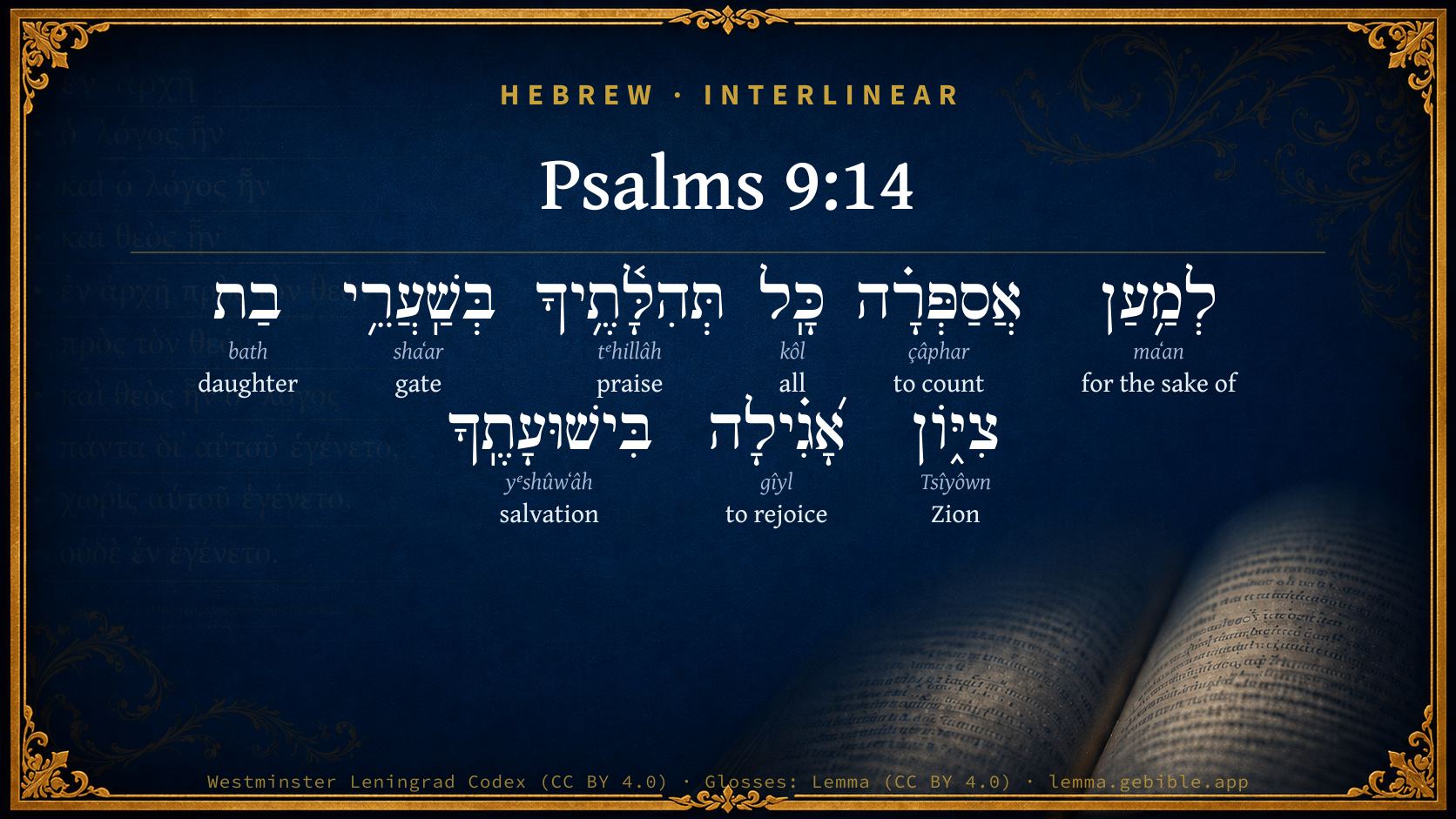
Hebrew (Westminster Leningrad Codex) Psalms 9:14 appears in the Hebrew Old Testament. The text above is from the Westminster Leningrad Codex. Each word links to its Strong’s number, a concise gloss, and parsing drawn from the Open Scriptures Hebrew Bible morphology. Click any word for its full Brown-Driver-Briggs (BDB) entry.
Download image
Cite this verse

Psalms 9:14 (World English Bible). Public Domain. Lemma interlinear Bible study tool, https://lemma.gebible.app/v/psalms/9/14.

Show BibTeX & RIS
BibTeX
RIS
English Translation
That I may show forth all your praise. In the gates of the daughter of Zion, I will rejoice in your salvation.
World English Bible · Public Domain
Download a study sheet

One document with this verse’s original text, its word-by-word gloss line, the meaning frame, cross-references with their text, attributed commentary, and full source and license credits — printable, and it pastes into notes with its structure intact.

This verse Autodidact and up

Study sheet (.html) Plain text (.txt)

A passage Seminary Student

Up to 50 verses in one chapter. A passage sheet keeps up to 6 commentary sources and 12 cross-references per verse, in the order this page ranks them, and says so on the sheet whenever that leaves anything out. Ask for a single verse and you get the Autodidact verse sheet above.

Everything on this page stays free to read, with no account — the sheet is a download of what is already on screen, not access to it.

Want to remove ads? Support Godless Engineer
Compare translations 3

The same verse in 3 English versions, stacked beneath the original-language interlinear above. Click any original word for its lexicon entry.

Each is an independent rendering of the whole verse — the interlinear is not word-aligned to these translations.

Highlighted words mark where these versions differ — a whole-verse word diff, not a word-by-word alignment.

  • World English Bible Public Domain
    That I may show forth all your praise. In the gates of the daughter of Zion, I will rejoice in your salvation.
  • King James Version Public Domain
    That I may shew forth all thy praise in the gates of the daughter of Zion: I will rejoice in thy salvation.
  • unfoldingWord Literal Text CC BY-SA 4.0
    in order that I might recount all your praise in the gates of the daughter of Zion. I will rejoice in your salvation!

unfoldingWord Literal Text — © unfoldingWord, licensed CC BY-SA 4.0. Word-aligned USFM3 via Door43 (git.door43.org/unfoldingWord/en_ult).

Versions to compare (up to 4)

3 of 4 selected

Show all 18 translations

Every available English version of this verse, each an independent rendering of the whole verse.

  • World English Bible Public Domain
    That I may show forth all your praise. In the gates of the daughter of Zion, I will rejoice in your salvation.
  • Berean Standard Bible Public Domain
    that I may declare all Your praises—that within the gates of Daughter Zion I may rejoice in Your salvation.
  • Majority Standard Bible Public Domain
    that I may declare all Your praises—that within the gates of Daughter Zion I may rejoice in Your salvation.
  • King James Version Public Domain
    That I may shew forth all thy praise in the gates of the daughter of Zion: I will rejoice in thy salvation.
  • American Standard Version (1901) Public Domain
    That I may show forth all thy praise. In the gates of the daughter of Zion I will rejoice in thy salvation.
  • Revised Version (1885) Public Domain
    That I may shew forth all thy praise: in the gates of the daughter of Zion, I will rejoice in thy salvation.
  • Geneva Bible (1599) Public Domain
    That I may shewe all thy praises within the gates of the daughter of Zion, and reioyce in thy saluation.
  • Douay-Rheims (1899) Public Domain
    Have mercy on me, O Lord: see my humiliation which I suffer from my enemies.
  • Young's Literal Translation Public Domain
    So that I recount all Thy praise, In the gates of the daughter of Zion. I rejoice on Thy salvation.
  • Literal Standard Version CC BY-SA 4.0
    So that I recount all Your praise, || In the gates of the daughter of Zion. I rejoice on Your salvation.
  • Unlocked Literal Bible CC BY-SA 4.0
    Oh, that I might proclaim all your praise. In the gates of the daughter of Zion I will rejoice in your salvation!
  • unfoldingWord Literal Text CC BY-SA 4.0
    in order that I might recount all your praise in the gates of the daughter of Zion. I will rejoice in your salvation!
  • Darby Bible Public Domain
    That I may declare all thy praise in the gates of the daughter of Zion. I will be joyful in thy salvation.
  • World Messianic Bible Public Domain
    that I may show all of your praise. I will rejoice in your salvation in the gates of the daughter of Zion.
  • Webster's Bible Public Domain
    \\9:13\\Have mercy upon me, O LORD; consider my trouble which I suffer from them that hate me, thou that liftest me up from the gates of death:
  • Free Bible Version CC BY-SA 4.0
    so I can praise you at Zion's gates, happy that you have saved me.
  • Bible in Basic English Public Domain
    So that I may make clear all your praise in the house of the daughter of Zion: I will be glad because of your salvation.
  • JPS Tanakh (1917) Public Domain
    (9-15) That I may tell of all Thy praise in the gates of the daughter of Zion, that I may rejoice in Thy salvation.

Literal Standard Version (2020), Covenant Press — licensed CC BY-SA 4.0. Text via the HelloAO Bible API (eBible.org). Unlocked Literal Bible (unfoldingWord) — licensed CC BY-SA 4.0. Text via the HelloAO Bible API (eBible.org). unfoldingWord Literal Text — © unfoldingWord, licensed CC BY-SA 4.0. Word-aligned USFM3 via Door43 (git.door43.org/unfoldingWord/en_ult). Free Bible Version, Dr. Jonathan Gallagher — licensed CC BY-SA 4.0. Text via the HelloAO Bible API (eBible.org).

Word by word

More ways to search: Search by grammar → Find every occurrence → Compare this word →

Practice this passage: Drill this verse → Learn its vocabulary →

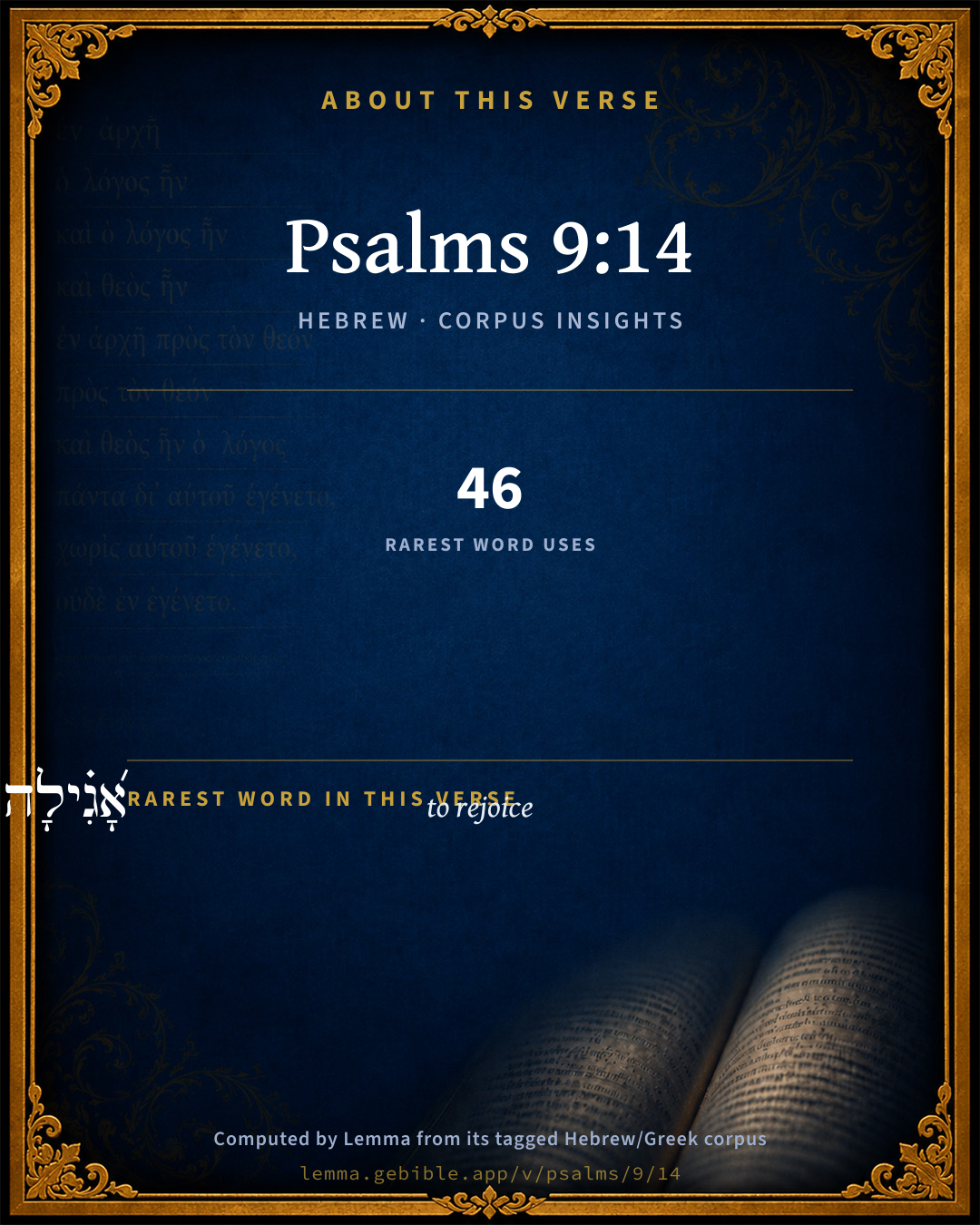
אָ֝גִ֗ילָה
gîyl
H1523
“to rejoice”
Verb, Qal, Cohortative, 1st Person, Common, Singular
Part of Speech
Verb
Stem
Qal
Form
Cohortative
Person
1st Person
Gender
Common
Number
Singular
Full BDB Definition

Origin: a primitive root

TWOT: 346

to rejoice, exult, be glad - (Qal) - to rejoice - to tremble (from fear)
  1. לְמַ֥עַן maʻan H4616 “for the sake of” Preposition
  2. אֲסַפְּרָ֗ה çâphar H5608 “to count” Verb, Piel, Cohortative, 1st Person, Common, Singular
  3. כָּֽל kôl H3605 “all of” Noun, Common, Masculine, Singular, Construct
  4. תְּהִלָּ֫תֶ֥יךָ tᵉhillâh H8416 “praises · your” Noun, Common, Feminine, Plural, Construct + Suffix, Personal, 2nd Person, Masculine, Singular
  5. בְּשַֽׁעֲרֵ֥י shaʻar H8179 “in/at · gates of” Preposition + Noun, Common, Masculine, Plural, Construct
  6. בַת bath H1323 “daughter of” Noun, Common, Feminine, Singular, Construct
  7. צִיּ֑וֹן Tsîyôwn H6726 “Zion” Noun, Proper
  8. בִּישׁוּעָתֶֽךָ yᵉshûwʻâh H3444 “in/at · salvation · your” Preposition + Noun, Common, Feminine, Singular, Construct + Suffix, Personal, 2nd Person, Masculine, Singular

About this verse

These counts appear in no published source. They are computed here, from the morphology-tagged text and Lemma’s own curated glosses. What Lemma adds →

9
words
9
distinct lemmas
Wisdom
section

Shared distinctive vocabulary

אָ֝גִ֗ילָה to rejoice H1523 occurs in 44 verses of the Hebrew Bible. Also found in:

Grammatical profile

  • 2 verbs
  • 6 nouns
  • 1 preposition

Verb forms

  • אֲסַפְּרָ֗ה Piel · Cohortative
  • אָ֝גִ֗ילָה Qal · Cohortative

Hebrew & Septuagint length

In English translation the verse runs 22 words from the Hebrew and 21 from the Septuagint (LXX English) — closely comparable.

A rough comparison of the two English renderings, which tokenize alike — not a word-level alignment.

Word counts can differ between the Hebrew and the Greek without any difference in meaning — e.g. the Hebrew direct-object marker אֵת has no separate Greek word, and Greek often adds the article ὁ.

Cross-references

23

Topical passages linked to Psalms 9:14 in the Treasury of Scripture Knowledge — connected by theme and wording, ordered by reader-vote popularity; previews shown in the World English Bible.

  • Psalms 13:5 But I trust in your loving kindness. My heart rejoices in your salvation.
  • 1 Samuel 2:1 Hannah prayed, and said: My heart exults in Yahweh; My horn is exalted in Yahweh; My mouth is enlarged over my enemies; Because I rejoice in your salvation.
  • Psalms 20:5 We will triumph in your salvation. In the name of our God we will set up our banners: May Yahweh grant all your requests.
  • Psalms 35:9 My soul shall be joyful in Yahweh. It shall rejoice in his salvation.
  • Psalms 51:12 Restore to me the joy of your salvation. Uphold me with a willing spirit.
  • Psalms 106:2 Who can utter the mighty acts of Yahweh, Or fully declare all his praise?
  • Psalms 21:1 The king rejoices in your strength, Yahweh! How greatly he rejoices in your salvation!
  • Isaiah 37:22 this is the word which Yahweh has spoken concerning him: The virgin daughter of Zion has despised you and ridiculed you; the daughter of Jerusalem has shaken her head at you.
  • Habakkuk 3:18 Yet I will rejoice in Yahweh. I will be joyful in the God of my salvation!
  • Psalms 22:22 I will declare your name to my brothers. In the midst of the assembly, I will praise you.
  • Psalms 22:25 Of you comes my praise in the great assembly. I will pay my vows before those who fear him.
  • Psalms 35:18 I will give you thanks in the great assembly. I will praise you among many people.
  • Psalms 42:4 These things I remember, and pour out my soul within me, How I used to go with the crowd, and led them to the house of God, With the voice of joy and praise, a multitude keeping a holy day.
  • Psalms 51:15 Lord, open my lips. My mouth shall declare your praise.
  • Psalms 79:13 So we, your people and sheep of your pasture, Will give you thanks forever. We will praise you forever, to all generations.
  • Psalms 109:30–31 I will give great thanks to Yahweh with my mouth. Yes, I will praise him among the multitude.
  • Psalms 116:18–19 I will pay my vows to Yahweh, Yes, in the presence of all his people,
  • Psalms 118:19–20 Open to me the gates of righteousness. I will enter into them. I will give thanks to Yah.
  • Psalms 149:1–2 Praise Yahweh! Sing to Yahweh a new song, His praise in the assembly of the saints.
  • Isaiah 12:3 Therefore with joy you shall draw water out of the wells of salvation.
  • Isaiah 62:11 Behold, Yahweh has proclaimed to the end of the earth, Say you to the daughter of Zion, Behold, your salvation comes; behold, his reward is with him, and his recompense before him.
  • Micah 4:13 Arise and thresh, daughter of Zion; For I will make your horn iron, And I will make your hoofs brass; And you will beat in pieces many peoples: And I will devote their gain to Yahweh, And their substance to the Lord of the whole earth.
  • Luke 1:47 My spirit has rejoiced in God my Savior,

Cross-references courtesy of OpenBible.info (CC BY 4.0).

Hebrew and Greek witnesses Masoretic Hebrew ↔ Greek Septuagint

The same verse in the two great witnesses to the Old Testament, shown verse-for-verse.

You’re reading Greek Psalm 9 (Hebrew Psalm 9). The Septuagint counts the superscription, so verse numbers can differ from the Hebrew — chapter-level alignment, not verse-by-verse. Numbering follows Rahlfs.

These are two independent witnesses, not word-aligned to each other, and the Septuagint is shown in lemma (dictionary) form.

Hebrew Psalms 9:14 Masoretic · Westminster Leningrad Codex

לְמַ֥עַן אֲסַפְּרָ֗ה כָּֽל תְּהִלָּ֫תֶ֥יךָ בְּשַֽׁעֲרֵ֥י בַת צִיּ֑וֹן אָ֝גִ֗ילָה בִּישׁוּעָתֶֽךָ

That I may show forth all your praise. In the gates of the daughter of Zion, I will rejoice in your salvation.

World English Bible · Public Domain

Greek LXX Greek Psalm 9:14 Septuagint · lemma form

ἐλεέω ἐγώ κύριος ὁράω ὁ ταπείνωσις ἐγώ ἐκ ὁ ἐχθρός ἐγώ ὁ ὑψόω ἐγώ ἐκ ὁ πύλη ὁ θάνατος

that I may declare all your praises in the gates of the daughter of Sion: I will exult in your salvation.

LXX2012 (modern English Septuagint) · Public Domain

Hebrew: Westminster Leningrad Codex (CC BY 4.0). Greek: Septuagint (public domain); English from LXX2012 (modern English Septuagint) (Public Domain). How the Septuagint differs from the Hebrew →

Commentary

Notes on Psalms 9:14 from classic Christian and Jewish commentators (each source and its license shown beneath its notes). The classic Christian expositions comment on the surrounding passage and are grouped to its opening verse, so a note may address several verses; the Jewish commentaries on the Tanakh (Rashi and others) are per-verse, so they appear only where the commentator wrote on this verse.

Lemma curates 59 commentaries, every one of them public domain or Creative Commons licensed, each selected and text-cleaned for this edition rather than reprinted as found. About our sources →

Trapp's Complete Commentary

John Trapp

Psa 9:14 That I may shew forth all thy praise in the gates of the daughter of Zion: I will rejoice in thy salvation.

Ver. 14. That I may show forth all thy praise] i.e. All that I can compass or attain unto. Aliter omnes laudes Dei diei non possunt, quia plures ignorat homo quam novit, saith R. David here; for all the praises of God cannot be shown forth, since those we know not are more than those we know.

In the gates of the daughter of Zion] These are opposed to the gates of death, as Aben Ezra here noteth; and betoken the most public places, and best frequented.

John Trapp, A Commentary or Exposition upon All the Books of the Old and New Testament (1647–1656) — public domain. Text from a community e-Sword module.

J. A. Alexander on Psalms

Joseph Addison Alexander

15. (Psa 9:14). That I may recount all thy praise in the gates of the daughter of Zion, may joy in thy salvation. This is one important end for which he asks to be delivered, namely, that God may have the praise of his deliverance. There is a trace, in the Hebrew text, of an original plural form, praises, which might then denote praiseworthy deeds, actions worthy to be celebrated. But the singular form occurs with all in Psa 106:2 below. The gates here mentioned are contrasted with those of the preceding verse. The God who saves him from the gates of death shall be praised for this deliverance in the gates of the daughter of Zion. This last expression is supposed by some to be a personification of the people inhabiting Zion or Jerusalem, who are then put for Israel at large, as the church or chosen people. Others regard the genitive construction as equivalent to a simple apposition, as in river of Euphrates, or in our familiar phrase, the city of Jerusalem. The personification is then that of the city itself, considered as an ideal virgin, and on that account called daughter, by a usage similar to that of the corresponding word in French. In either case, there is an obvious reference to the ancient church, as the scene or the witness of the Psalmist's praises. The verb in the last clause may be made to depend upon the particle at the beginning of the verse, (that) I may exult; or it may be still more emphatically construed as an independent proposition, I will exult in thy salvation. The form of the verb is the same as in Psa 2:3 above. The second verb itself occurs in ver. 11 of that psalm, and as in that case, may either denote an inward emotion or the outward expression of it, I will shout. In thy salvation, i.e. in the possession or experience of it, and in acknowledgment of having thus experienced or possessed it.

Joseph Addison Alexander, The Psalms Translated and Explained (1850) — public domain. Text from a community e-Sword module.

Geneva Bible (1599)

Geneva Bible translators

In the open assembly of the Church.

Geneva Bible (1599) marginal notes — public domain. Text via Bolls.life.

Jamieson, Fausset & Brown

Robert Jamieson, A. R. Fausset & David Brown

gates . . . Zion--The enclosure of the city (compare Psa 48:12; Isa 23:12), or, church, as denoted by this phrase contrasted with that of death, carries out the idea of exaltation as well as deliverance. Signal favors should lead us to render signal and public thanks.

Jamieson, Fausset & Brown — Commentary Critical and Explanatory on the Whole Bible (1871) — public domain (CC PDM 1.0). Text via the HelloAO Bible API.

John Calvin's Commentaries

14. That I may recount. David’s meaning simply is, that he will celebrate the praises of God in all assemblies, and, wherever there is the greatest concourse of people, (for at that time it was the custom to hold assemblies at the gates of cities;) but, at the same time, there seems to be an allusion to the gates of death, of which he has just spoken, as if he had said, After I am delivered from the grave, I will do my endeavor to bear testimony, in the most public manner, to the goodness of God, manifested in my deliverance. As, however, it is not sufficient to utter the praises of God with our tongues, if they do not proceed from the heart, the Psalmist, in the last clause of the verse, expresses the inward joy with which he would engage in this exercise, And that I may rejoice in thy salvation; as if he had said, I desire to live in this world for no other purpose than to rejoice in having been preserved by the grace of God. Under the name of daughter, as is well known, the Jews meant a people or city, but he here names the city from its principal part, namely, Sion.

John Calvin's Commentaries (1540-1563) — public domain. Text from the Calvin Translation Society English edition (1840s-50s) via the Christian Classics Ethereal Library (ccel.org). Calvin's coverage is partial (roughly two-thirds of the Bible); uncommented books and verses are honest gaps, never fabricated. The 19th-century editor's footnotes and remarks are omitted so the notes are faithfully Calvin's own voice.

The Cambridge Bible for Schools and Colleges

gen. ed. J. J. S. Perowne

14. in the gates] i.e. with the utmost publicity (Psa_116:14); for the city gates were the common place of concourse and business, corresponding to the agora or forum of Greece and Rome. Cp. Job_29:7; Pro_8:3; Jer_17:19-20. The implied contrast between “the cheerful ways of men” and the gloomy entrance to the nether world is obvious.

Ports (P.B.V.) is an obsolete word for gates, from Lat. porta.

the daughter of Zion] A poetical personification of the citizens or the city as an individual. Originally Zion was thought of as the mother, the citizens collectively as her daughter; but as terms for land and people are easily interchanged, the expression came to be applied to the city itself (Isa_1:8; Lam_2:15). ‘Daughter of Zion’ occurs nowhere else in the Psalter (see however ‘daughter of Tyre,’ Psa_45:12; ‘daughter of Babylon,’ Psa_137:8), but together with the cognate phrases ‘daughter of Jerusalem,’ ‘daughter of my people’ &c. frequently in Isaiah, Jeremiah, Micah, Zephaniah, Zechariah, and is specially characteristic of the Lamentations.

salvation] R.V. marg., saving help. See note on Psa_3:8.

The Cambridge Bible for Schools and Colleges (gen. ed. J. J. S. Perowne; Cambridge University Press, 1878–1918) — public domain. Text from a community e-Sword module.

John Gill's Exposition

The Heathen are sunk into the pit that they made,.... The psalmist having determined to praise the Lord, and called upon others to join with him in it, here enters upon it: for, as Jarchi and Aben Ezra observe, this is "the praise" he was desirous to show forth, which is occasioned by the destruction of God's enemies, and the deliverance of his people: by "the Heathen" are meant not the Philistines, as Kimchi interprets it, who thought to cause Israel to fall, and fell themselves; but this is spoken prophetically of the nations of the earth, who have joined in the idolatry of antichrist, the Gentiles, by whom the holy city has been trodden under foot; even the several antichristian states, that will be destroyed by the pouring out of the seven vials, and especially the last, at the battle of Armageddon; and which will be brought on by themselves, with a design to destroy the whole kingdom and interest of Christ, but will issue in their utter ruin, which this phrase is expressive of; see Rev 18:3. The metaphor is taken from hunters, who dig pits for the wild beasts to fall into, that they may the more easily take them, into which they fall themselves; see Psa 7:15. Wicked men are mischievous and crafty, but sometimes they are taken in their own craftiness;

in the net which they laid is their own foot taken; which may signify the same thing as before, that the mischief they design for others falls upon themselves; only as the former phrase denotes their utter destruction like the sinking of a millstone in the sea, by which the irrecoverable ruin of Babylon is expressed, Rev 18:21; this may design the restraint and hinderance of them from doing the evil they would; their feet are entangled, that they cannot run to shed blood; and their hands are held, that they cannot perform their enterprise; and their wrath in restrained and made to praise the Lord. The metaphor is taken from fowlers, who lay nets and snares for birds, and cover them that they may not be seen, but fall into them unawares; see Psa 124:7.

John Gill's Exposition of the Whole Bible (1746–1763) — public domain (CC PDM 1.0). Text via the HelloAO Bible API.

Albert Barnes' Notes on the Bible

That I may show forth all thy praise - That I may praise time in the land of the living; that I may finish the work of praise by rendering to thee all that is due. The idea is, that the dead could not praise God, or that his praise could be uttered only by the living; and he calls on God, therefore, to interpose and save him, that he might yet worship and praise him on the earth. In this sentiment the psalmist utters only what man naturally feels when he looks upon the grave; that it is an end of human plans and pursuits; that it is a land of silence; that the worship of God is not there celebrated. Such language must be retarded as uttered under the impulse of natural feeling, and not as uttered by the deliberate judgment of the mind when calmly contemplating the whole subject. All pious persons baize these feelings at times, and it was proper that these feelings should be expressed in the sacred writings, as illustrating human nature even under the influence of religion. The same sentiment occurs in several places, as is, that he was apparently near to the gates of death, and that the only one who could raise him up was God, and he now invoked His interposition that it might be done. The phrase “gates of death” relates to the prevalent views about the unseen world - the world where the dead abide. That world was represented as beneath; as a dark and gloomy abode; as enclosed Psa 115:17, “The dead praise not the Lord, neither any that go down into silence.” See the notes at Psa 6:5. It is not necessary to say that the sacred writers had brighter views at times than these. But who can keep the mind always from desponding when it looks at the grave? Who can always help feeling that it is a place of darkness and gloom?

In the gates of the daughter of Zion - As contradistinguished from the “gates of death.” Gates in ancient cities were places of concourse, where important transactions were performed; and the “gates” of Jerusalem were regarded as attractive and sacred, because it was through them that the people passed on their way to worship God at the tabernacle or in the temple. Hence, it is said, Psa 87:2, “The Lord loveth the gates of Zion more than all the dwellings of Jacob.” Psa 100:4, “enter into his gates with thanksgiving.” Compare Psa 118:19. The phrase, “daughter of Zion,” means Jerusalem. For the reason of this appellation see the notes at Isa 1:8. The language used here proves that the psalm was composed after Zion or Jerusalem was made the capital of the kingdom and the seat of public worship, and, therefore, that it cannot refer, as is supposed in the Aramaic Paraphrase, to the death of Goliath.

I will rejoice in thy salvation - In the salvation which thou wilt bestow on me; here particularly, in delivering him from his dangers. The language, however, is general, and may be employed with reference to salvation of any kind.

Albert Barnes' Notes on the Bible (1834–1885) — public domain. Text from a community e-Sword/MySword module.

Matthew Poole's English Annotations

In the gates, i.e. in the great assemblies, which were usually in the gates. Compare Pro 31:31; Isa 3:26. These gates he elegantly opposeth to the former, and declareth that if he be brought off them, he will go into these.

Of the daughter of Zion; either,

1. Of Jerusalem, so called also Isa 1:8; Zec 9:9, because at this time it was subject to Zion; which at this time was the seat of the king’s palace, and of the ark. For cities or towns belonging or subject unto any metropolis are commonly called its daughters, as Jos 15:45; 2Ch 13:19; Psa 48:11; as the chief cities are called mothers, as 2Sa 20:19; Gal 4:26. Or,

2. Of the people who live in, or belong to, or meet together for civil and religious matters in Zion. For cities are as it were mothers to their people, giving them birth and breeding, and therefore the people are commonly called their daughters. So the names of the daughters of Egypt, Jer 46:11, and of Edom, Lam 4:21,22, and of Tyre, Psa 45:12, and of Babel, Psa 137:8, and of Jerusalem, Lam 2:13,15; Mic 4:8, are put for the people of those places.

I will rejoice, to wit, with spiritual joy and thanksgiving; else it were no fit motive to be used to God in prayer.

Matthew Poole's English Annotations on the Holy Bible (1683–1685) — public domain. Text from a community e-Sword/MySword module.

The Treasury of David

Charles H. Spurgeon

Ver. 14. We must not overlook David's object in desiring mercy, it is God's glory:

that I may show forth all thy praise. Saints are not so selfish as to look only to self; they desire mercy's diamond that they may let others see it flash and sparkle, and may admire Him who gives such priceless gems to his beloved. The contrast between the gates of death and the gates of the New Jerusalem is very striking; let our songs be excited to the highest and most rapturous pitch by the double consideration of whence we are taken, and to what we have been advanced, and let our prayers for mercy be made more energetic and agonizing by a sense of the grace which such a salvation implies. When David speaks of his showing forth all God's praise, he means that, in his deliverance grace in all its heights and depths would be magnified. Just as our hymn puts it:

"O the length and breadth of love!

Jesus, Saviour, can it be? All thy mercy's height I prove,

All the depth is seen in me."

Here ends the first part of this instructive Psalm, and in pausing awhile we feel bound to confess that our exposition has only flitted over its surface and has not digged into the depths. The verses are singularly full of teaching, and if the Holy Spirit shall bless the reader, he may go over this Psalm, as the writer has done scores of times, and see on each occasion fresh beauties.

Ver. 14. That I may show forth all thy praise, etc. To show forth all God's praise is to enter largely into the work. An occasional "God, I thank thee, "is no fit return for a perpetual stream of rich benefits. William S. Plumer.

Ver. 14. I will rejoice in thy salvation. Especially because it is thine, O God, and therefore honours thee. In its freeness, fulness, suitability, certainty, everlastingness. Who can rejoice in this? Reasons why they should always do so.

Charles H. Spurgeon's The Treasury of David (1869–1885) — public domain. Psalms only. Text from a community e-Sword/MySword module.

The Pulpit Commentary

That I may show forth all thy praise in the gates of the daughter of Zion. The "daughter of Zion" is, of course, Jerusalem. Compare "daughter of Babylon", (Psa_137:8 Isa_47:1 Jer 1 Jer 42 Zec_2:7) "daughter of the Chaldeans", (Isa_47:1, Isa_47:5) "daughter of Edom", (Lam_4:21, Lam_4:22) "daughter of Gallim". (Isa_10:30) Hengstenberg is probably right in understanding "in the gates" as within the gates," since, as he observes, "God"s praise is not to be celebrated in the gates, amid the throng of worldly business, but in the temple." The references in the "Speaker"s Commentary" do not bear out the statement there made, that "public mournings and public thanksgivings were proclaimed in the gates." I will rejoice in thy salvation; or, that I may rejoice (Kay).

A song of thanksgiving for salvation.

I SALVATION IS ASCRIBED TO GOD. All deliverances are of God. There may be human means and instruments. There may be judges and saviours, such as Joshua. (Neh_9:27) But behind all is God. This holds true of all deliverances national and individual of the body, and of the soul. More especially is this true of the deliverance from our enemies, and of our redemption by Jesus Christ.

II MANIFESTS THE RIGHTEOUSNESS OF GOD. God must act in agreement with his character. He cannot deny himself. Therefore in whatsoever deliverances God effects, we may be sure that his righteousness will shine resplendent. So it is of the salvation by Christ. (Rom_1:16, Rom_1:17) How vain to ask for help, if we are not willing to have it in God"s way! How foolish to expect deliverance, save in the form that will glorify God"s Name his righteousness as truly as his mercy, his justice as well as his love!

III FORESHADOWS THE FINAL JUDGMENT OF THE WORLD. Every judgment is a sign and pattern of the last judgment. There is no change with God. All through, and in everything he does, he has acted like himself. His Law will stand, His righteousness will be vindicated in the end as in the beginning. The cross of Christ itself prophesies of the just judgments of God. "If they do these things in a green tree, what shall be done in the dry?". (Luk_23:31) God"s people may await with confidence the result.

IV CALLS FORTH THE HALLELUJAHS OF THE GOOD. There is the joy of trust (ver. 13); of gratitude (ver. 14), of hope (vers. 15-20). By faith we see the King in his beauty, and rejoice in his rejoicing. W.F.

The Pulpit Commentary (1880–1919), ed. H.D.M. Spence-Jones & Joseph S. Exell — public domain. Text from a community e-Sword module.

John Wesley's Explanatory Notes

Gates - In the great assemblies. These gates he elegantly opposes to the former. Of - Of the people who live or meet together in Zion. For cities are as it were mothers to their people, and the people are commonly called their daughters. So the names of the daughters of Egypt, Jer. xlvi, 11, and of Edom, Lam. iv, 21, 22, and of Tyre, chap. xlv, 12, are put for the people of those places.

John Wesley, Explanatory Notes Upon the Whole Bible (1754–1765) — public domain. Text via the GEBible commentary corpus.

Rashi

Rabbi Shlomo Yitzchaki (Rashi)

Be gracious to me, O Lord now in exile.

You Who raise me up with Your redemption.

Rashi on the Tanakh — English translations: “The Judaica Press complete Tanach with Rashi, translated by A. J. Rosenberg” (CC BY 4.0); “Pentateuch with Rashi's commentary by M. Rosenbaum and A.M. Silbermann, 1929-1934” (public domain); “The Metsudah Tanach series, Lakewood, N.J” (CC BY 4.0); and “The Book of Joshua, Metsudah Publications, 1997” (CC BY 4.0). Text via Sefaria.

Radak

Rabbi David Kimhi (Radak)

Have mercy upon me, Lord: – (The word חננני is) pointed with pathah under the heth, shewing that it is from the Piel, though undoubted, as (Gen. 42:21): אלינו בהתחננו

See my affliction at the hands of them that hate me: – as Thou hast seen (me suffer) from this enemy – namely, Goliath.

Thou that liftest me up from the gates of death: – for all were of opinion that I should fall at the hand of Goliath. The (phrase) gates of death means “near to death,” as the gate is to the house.

Radak on the Tanakh — English translations: “Sefaria Community Translation” (CC0 1.0 (public-domain dedication)); “Eliyahu Munk, HaChut Hameshulash” (CC BY 4.0); “Rabbi Mike Feuer, Jerusalem Anthology” (CC BY 4.0); and “R. David Kimhi on the first book of Psalms, Translated by R.G. Finch, London, 1919” (public domain). Text via Sefaria.

Lesson kit

Teaching starters — assembled from the data on this page, not authored interpretation. Every prompt links to the verse data it draws on. Edit before teaching.

Psalms, in the Wisdom, opens this verse with 9 words (9 distinct Hebrew lemmas). Its most distinctive word is gîyl (“to rejoice”). A historical commentator’s framing appears above. Read the whole chapter for the surrounding context.

Discussion questions

  1. The word gîyl carries the sense “to rejoice.” How does it shape the verse?
  2. 1 Chronicles 16:31 shares the word «to rejoice» with this verse. How do the two illuminate each other?
  3. The translations on this page render this verse differently — a whole-verse word diff, not a word-by-word alignment. What might account for the different wordings?
  4. The verb «אֲסַפְּרָ֗ה» is Piel Cohortative. How does its form color the action?
  5. Reading how Trapp's Complete Commentary and J. A. Alexander on Psalms read this verse, where do the two commentators agree and where do they part?

Things to notice

Reading settings

Reading text

Shown beneath each verse's original-language words.

Old Testament
Old Testament edition

Read the OT as the Masoretic Hebrew (MT) or the Greek Septuagint (LXX).

English shown for the Greek Septuagint (in the Hebrew ↔ Greek comparison).

Comparing translations? Open the Compare panel on any verse page to stack up to four side by side.