
2 Samuel 19:8

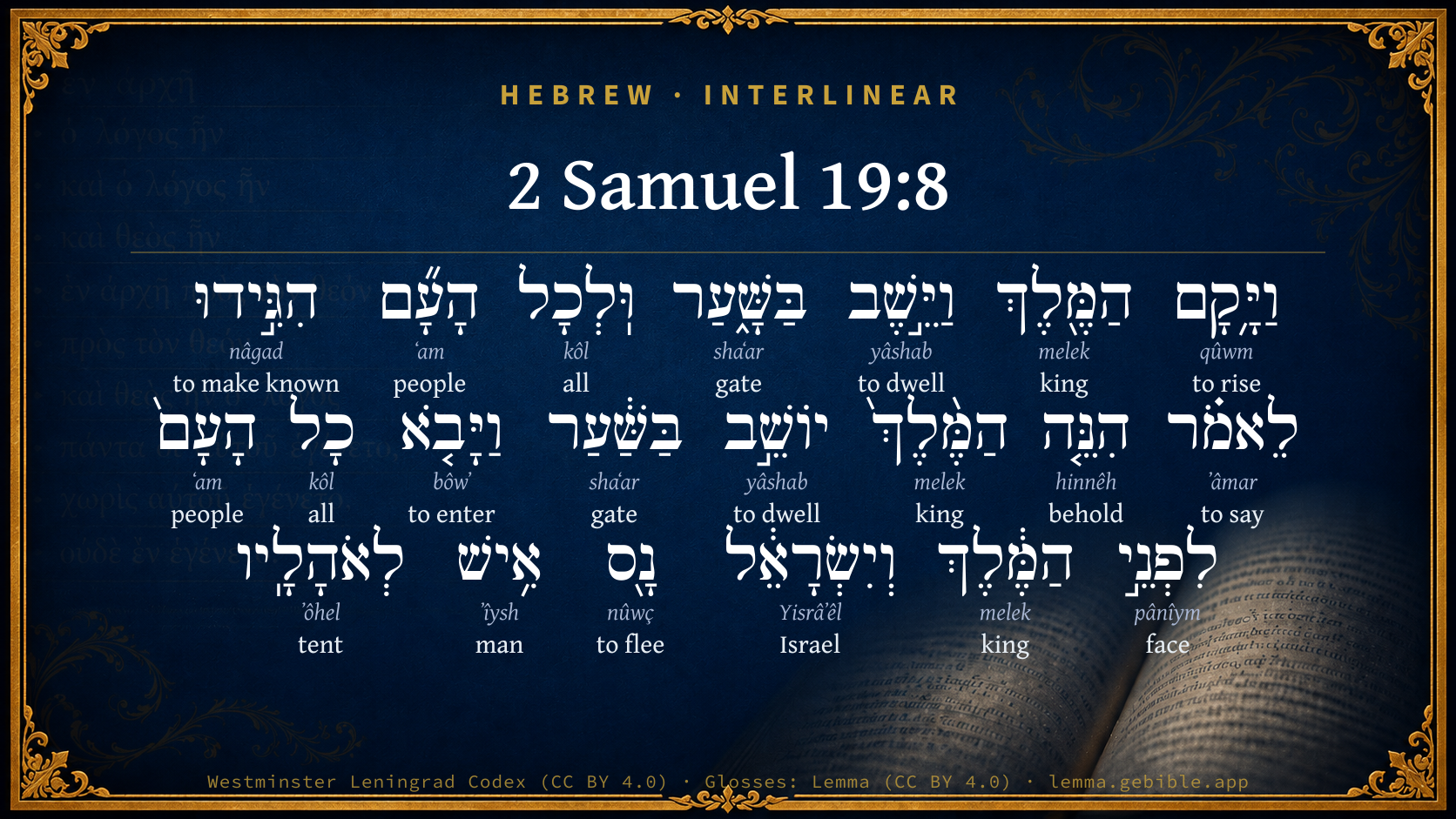
Hebrew (Westminster Leningrad Codex) 2 Samuel 19:8 appears in the Hebrew Old Testament. The text above is from the Westminster Leningrad Codex. Each word links to its Strong’s number, a concise gloss, and parsing drawn from the Open Scriptures Hebrew Bible morphology. Click any word for its full Brown-Driver-Briggs (BDB) entry.
Download image
Cite this verse

2 Samuel 19:8 (World English Bible). Public Domain. Lemma interlinear Bible study tool, https://lemma.gebible.app/v/2-samuel/19/8.

Show BibTeX & RIS
BibTeX
RIS
English Translation
Then the king arose, and sat in the gate. They told to all the people, saying, Behold, the king is sitting in the gate: and all the people came before the king. Now Israel had fled every man to his tent.
World English Bible · Public Domain
Download a study sheet

One document with this verse’s original text, its word-by-word gloss line, the meaning frame, cross-references with their text, attributed commentary, and full source and license credits — printable, and it pastes into notes with its structure intact.

This verse Autodidact and up

Study sheet (.html) Plain text (.txt)

A passage Seminary Student

Up to 50 verses in one chapter. A passage sheet keeps up to 6 commentary sources and 12 cross-references per verse, in the order this page ranks them, and says so on the sheet whenever that leaves anything out. Ask for a single verse and you get the Autodidact verse sheet above.

Everything on this page stays free to read, with no account — the sheet is a download of what is already on screen, not access to it.

Want to remove ads? Support Godless Engineer
Compare translations 3

The same verse in 3 English versions, stacked beneath the original-language interlinear above. Click any original word for its lexicon entry.

Each is an independent rendering of the whole verse — the interlinear is not word-aligned to these translations.

Highlighted words mark where these versions differ — a whole-verse word diff, not a word-by-word alignment.

  • World English Bible Public Domain
    Then the king arose, and sat in the gate. They told to all the people, saying, Behold, the king is sitting in the gate: and all the people came before the king. Now Israel had fled every man to his tent.
  • King James Version Public Domain
    Then the king arose, and sat in the gate. And they told unto all the people, saying, Behold, the king doth sit in the gate. And all the people came before the king: for Israel had fled every man to his tent.
  • unfoldingWord Literal Text CC BY-SA 4.0
    So the king arose and sat in the gate. And they declared to all of the people, saying, “Behold, the king is sitting in the gate.” And all of the people came to the face of the king. But Israel had fled, a man to his tent.

unfoldingWord Literal Text — © unfoldingWord, licensed CC BY-SA 4.0. Word-aligned USFM3 via Door43 (git.door43.org/unfoldingWord/en_ult).

Versions to compare (up to 4)

3 of 4 selected

Show all 18 translations

Every available English version of this verse, each an independent rendering of the whole verse.

  • World English Bible Public Domain
    Then the king arose, and sat in the gate. They told to all the people, saying, Behold, the king is sitting in the gate: and all the people came before the king. Now Israel had fled every man to his tent.
  • Berean Standard Bible Public Domain
    So the king got up and sat in the gate, and all the people were told: “Behold, the king is sitting in the gate.” So they all came before the king. Meanwhile, the Israelites had fled, each man to his home.
  • Majority Standard Bible Public Domain
    So the king got up and sat in the gate, and all the people were told: “Behold, the king is sitting in the gate.” So they all came before the king. Meanwhile, the Israelites had fled, each man to his home.
  • King James Version Public Domain
    Then the king arose, and sat in the gate. And they told unto all the people, saying, Behold, the king doth sit in the gate. And all the people came before the king: for Israel had fled every man to his tent.
  • American Standard Version (1901) Public Domain
    Then the king arose, and sat in the gate. And they told unto all the people, saying, Behold, the king is sitting in the gate: and all the people came before the king. Now Israel had fled every man to his tent.
  • Revised Version (1885) Public Domain
    Then the king arose, and sat in the gate. And they told unto all the people, saying, Behold, the king doth sit in the gate: and all the people came before the king. Now Israel had fled every man to his tent.
  • Geneva Bible (1599) Public Domain
    Then the King arose, and sate in the gate: and they tolde vnto all the people, saying, Beholde, the King doeth sit in the gate: and all the people came before the King: for Israel had fled euery man to his tent.
  • Douay-Rheims (1899) Public Domain
    Then the king arose and sat in the gate: and it was told to all the people that the king sat in the gate: and all the people came before the king, but Israel fled to their own dwellings.
  • Young's Literal Translation Public Domain
    And the king riseth, and sitteth in the gate, and to all the people they have declared, saying, `Lo, the king is sitting in the gate;' and all the people come in before the king, and Israel hath fled, each to his tents.
  • Literal Standard Version CC BY-SA 4.0
    And the king rises, and sits in the gate, and they have declared to all the people, saying, “Behold, the king is sitting in the gate”; and all the people come in before the king, and Israel has fled, each to his tents.
  • Unlocked Literal Bible CC BY-SA 4.0
    So the king got up and sat in the city gate, and all the people were told, “Look, the king is sitting in the gate,” and all the people came before the king. So Israel fled, every man to his home.
  • unfoldingWord Literal Text CC BY-SA 4.0
    So the king arose and sat in the gate. And they declared to all of the people, saying, “Behold, the king is sitting in the gate.” And all of the people came to the face of the king. But Israel had fled, a man to his tent.
  • Darby Bible Public Domain
    Then the king arose, and sat in the gate. And they told all the people, saying, Behold, the king is sitting in the gate. And all the people came before the king. Now Israel had fled every man to his tent.
  • World Messianic Bible Public Domain
    Then the king arose and sat in the gate. The people were all told, “Behold, the king is sitting in the gate.” All the people came before the king. Now Israel had fled every man to his tent.
  • Webster's Bible Public Domain
    Then the king rose, and sat in the gate. And they told to all the people, saying, Behold, the king doth sit in the gate. And all the people came before the king: for Israel had fled every man to his tent.
  • Free Bible Version CC BY-SA 4.0
    So the king got up and went to sit at the town gate. Everybody was told: “Look, the king is sitting at the town gate.” They all came to see the king. In the meantime the Israelites had run away and gone to their homes.
  • Bible in Basic English Public Domain
    Then the king got up and took his seat near the town-door. And word was given to all the people that the king was in the public place: and all the people came before the king. Now all the men of Israel had gone back in flight to their tents.
  • JPS Tanakh (1917) Public Domain
    (19-9) Then the king arose, and sat in the gate. And they told unto all the people, saying: 'Behold, the king doth sit in the gate'; and all the people came before the king. Now Israel had fled every man to his tent.

Literal Standard Version (2020), Covenant Press — licensed CC BY-SA 4.0. Text via the HelloAO Bible API (eBible.org). Unlocked Literal Bible (unfoldingWord) — licensed CC BY-SA 4.0. Text via the HelloAO Bible API (eBible.org). unfoldingWord Literal Text — © unfoldingWord, licensed CC BY-SA 4.0. Word-aligned USFM3 via Door43 (git.door43.org/unfoldingWord/en_ult). Free Bible Version, Dr. Jonathan Gallagher — licensed CC BY-SA 4.0. Text via the HelloAO Bible API (eBible.org).

Word by word

More ways to search: Search by grammar → Find every occurrence → Compare this word →

Practice this passage: Drill this verse → Learn its vocabulary →

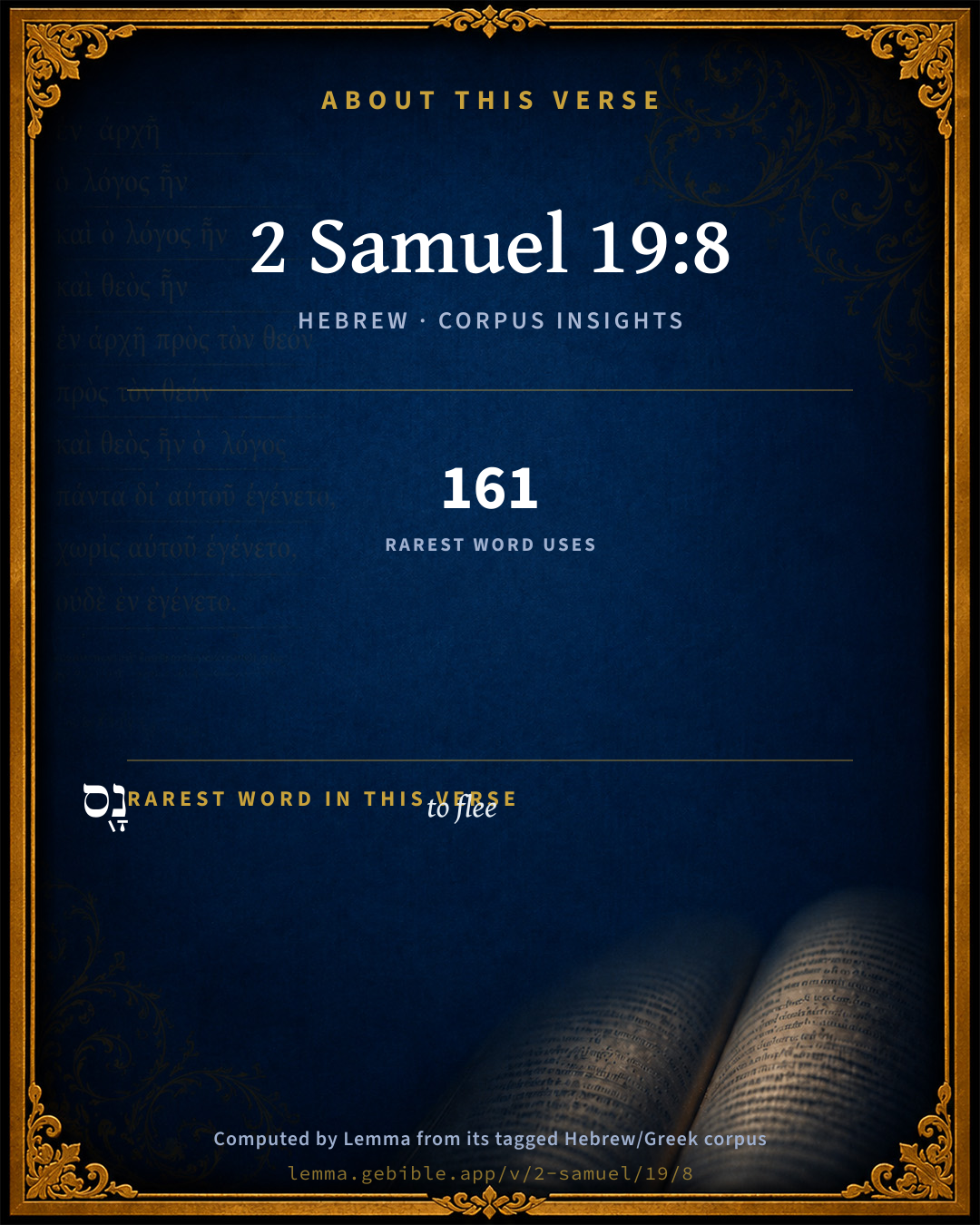
נָ֖ס
nûwç
H5127
“to flee”
Verb, Qal, Perfect, 3rd Person, Masculine, Singular
Part of Speech
Verb
Stem
Qal
Form
Perfect
Person
3rd Person
Gender
Masculine
Number
Singular
Full BDB Definition

Origin: a primitive root

TWOT: 1327

to flee, escape - (Qal) - to flee - to escape - to take flight, depart, disappear - to fly (to the attack) on horseback - (Polel) to drive at - (Hithpolel) to take flight - (Hiphil) - to put to flight - to drive hastily - to cause to disappear, hide
  1. וַיָּ֥קָם qûwm H6965 “and · to rise” Conjunction + Verb, Qal, Sequential Imperfect, 3rd Person, Masculine, Singular
  2. הַמֶּ֖לֶךְ melek H4428 “the · king” Particle, Definite Article + Noun, Common, Masculine, Singular, Absolute
  3. וַיֵּ֣שֶׁב yâshab H3427 “and · to dwell” Conjunction + Verb, Qal, Sequential Imperfect, 3rd Person, Masculine, Singular
  4. בַּשָּׁ֑עַר shaʻar H8179 “in/at the · gate” Preposition, Determined + Noun, Common, Masculine, Singular, Absolute
  5. וּֽלְכָל kôl H3605 “and · to/for · all of” Conjunction + Preposition + Noun, Common, Masculine, Singular, Construct
  6. הָעָ֞ם ʻam H5971 “the · people” Particle, Definite Article + Noun, Common, Masculine, Singular, Absolute
  7. הִגִּ֣ידוּ nâgad H5046 “to make known” Verb, Hiphil, Perfect, 3rd Person, Common, Plural
  8. לֵאמֹ֗ר ʼâmar H559 “to say” Preposition + Verb, Qal, Infinitive Construct
  9. הִנֵּ֤ה hinnêh H2009 “behold” Particle, Demonstrative
  10. הַמֶּ֨לֶךְ֙ melek H4428 “the · king” Particle, Definite Article + Noun, Common, Masculine, Singular, Absolute
  11. יוֹשֵׁ֣ב yâshab H3427 “dwelling” Verb, Qal, Participle Active, Masculine, Singular, Absolute
  12. בַּשַּׁ֔עַר shaʻar H8179 “in/at the · gate” Preposition, Determined + Noun, Common, Masculine, Singular, Absolute
  13. וַיָּבֹ֤א bôwʼ H935 “and · to enter” Conjunction + Verb, Qal, Sequential Imperfect, 3rd Person, Masculine, Singular
  14. כָל kôl H3605 “all of” Noun, Common, Masculine, Singular, Construct
  15. הָעָם֙ ʻam H5971 “the · people” Particle, Definite Article + Noun, Common, Masculine, Singular, Absolute
  16. לִפְנֵ֣י pânîym H6440 “to/for · face(s) of” Preposition + Noun, Common, Both, Plural, Construct
  17. הַמֶּ֔לֶךְ melek H4428 “the · king” Particle, Definite Article + Noun, Common, Masculine, Singular, Absolute
  18. וְיִשְׂרָאֵ֔ל Yisrâʼêl H3478 “and · Israel” Conjunction + Noun, Proper
  19. אִ֥ישׁ ʼîysh H376 “man” Noun, Common, Masculine, Singular, Absolute
  20. לְאֹהָלָֽיו ʼôhel H168 “to/for · tents · his” Preposition + Noun, Common, Masculine, Plural, Construct + Suffix, Personal, 3rd Person, Masculine, Singular

About this verse

These counts appear in no published source. They are computed here, from the morphology-tagged text and Lemma’s own curated glosses. What Lemma adds →

21
words
15
distinct lemmas
Historical
section

Grammatical profile

  • 7 verbs
  • 13 nouns
  • 1 particle

Verb forms

  • וַיָּ֥קָם Qal · Sequential Imperfect
  • וַיֵּ֣שֶׁב Qal · Sequential Imperfect
  • הִגִּ֣ידוּ Hiphil · Perfect
  • לֵאמֹ֗ר Qal · Infinitive Construct
  • יוֹשֵׁ֣ב Qal · Participle Active
  • וַיָּבֹ֤א Qal · Sequential Imperfect
  • נָ֖ס Qal · Perfect

Repetition

Words recur within this verse — often emphatic in Hebrew:

  • הַמֶּ֖לֶךְ king H4428 ×3
  • וַיֵּ֣שֶׁב to dwell H3427 ×2
  • בַּשָּׁ֑עַר gate H8179 ×2
  • וּֽלְכָל all H3605 ×2
  • הָעָ֞ם people H5971 ×2

Hebrew & Septuagint length

In English translation the verse runs 41 words from the Hebrew and 43 from the Septuagint (LXX English) — closely comparable.

A rough comparison of the two English renderings, which tokenize alike — not a word-level alignment.

Word counts can differ between the Hebrew and the Greek without any difference in meaning — e.g. the Hebrew direct-object marker אֵת has no separate Greek word, and Greek often adds the article ὁ.

Cross-references

8

Topical passages linked to 2 Samuel 19:8 in the Treasury of Scripture Knowledge — connected by theme and wording, ordered by reader-vote popularity; previews shown in the World English Bible.

  • 2 Samuel 18:24 Now David was sitting between the two gates: and the watchman went up to the roof of the gate to the wall, and lifted up his eyes, and looked, and, behold, a man running alone.
  • 2 Samuel 18:4 The king said to them, What seems you best I will do. The king stood by the gate-side, and all the people went out by hundreds and by thousands.
  • 2 Samuel 15:2 Absalom rose up early, and stood beside the way of the gate: and it was so, that when any man had a suit which should come to the king for judgment, then Absalom called to him, and said, Of what city are you? He said, Your servant is of one of the tribes of Israel.
  • 2 Samuel 18:6–8 So the people went out into the field against Israel: and the battle was in the forest of Ephraim.
  • 2 Samuel 18:17 They took Absalom, and cast him into the great pit in the forest, and raised over him a very great heap of stones: and all Israel fled everyone to his tent.
  • 2 Samuel 19:3 The people got them by stealth that day into the city, as people who are ashamed steal away when they flee in battle.
  • 1 Kings 22:36 There went a cry throughout the host about the going down of the sun, saying, Every man to his city, and every man to his country.
  • 2 Kings 14:12 Judah was put to the worse before Israel; and they fled every man to his tent.

Cross-references courtesy of OpenBible.info (CC BY 4.0).

Hebrew and Greek witnesses Masoretic Hebrew ↔ Greek Septuagint

The same verse in the two great witnesses to the Old Testament, shown verse-for-verse.

These are two independent witnesses, not word-aligned to each other, and the Septuagint is shown in lemma (dictionary) form.

Hebrew 2 Samuel 19:8 Masoretic · Westminster Leningrad Codex

וַיָּ֥קָם הַמֶּ֖לֶךְ וַיֵּ֣שֶׁב בַּשָּׁ֑עַר וּֽלְכָל הָעָ֞ם הִגִּ֣ידוּ לֵאמֹ֗ר הִנֵּ֤ה הַמֶּ֨לֶךְ֙ יוֹשֵׁ֣ב בַּשַּׁ֔עַר וַיָּבֹ֤א כָל הָעָם֙ לִפְנֵ֣י הַמֶּ֔לֶךְ וְיִשְׂרָאֵ֔ל נָ֖ס אִ֥ישׁ לְאֹהָלָֽיו

Then the king arose, and sat in the gate. They told to all the people, saying, Behold, the king is sitting in the gate: and all the people came before the king. Now Israel had fled every man to his tent.

World English Bible · Public Domain

Greek LXX 2 Samuel 19:8 Septuagint · lemma form

καί νῦν ἀναἵστημι ἐκἔρχομαι καί λαλέω εἰς ὁ καρδία ὁ δοῦλος σύ ὅτι ἐν κύριος ὄμνυμι ὅτι εἰ μή ἐκπορεύομαι σήμερον εἰ αὐλίζω ἀνήρ μετά σύ ὁ νύξ οὗτος καί ἐπιγινώσκω σεαυτοῦ καί κακός σύ οὗτος ὑπέρ πᾶς ὁ κακός ὁ ἐπιἔρχομαι σύ ἐκ νεότης σύ ἕως ὁ νῦν

Then the king arose, and sat in the gate: and all the people reported, saying, Behold, the king sits in the gate. And all the people went in before the king to the gate; for Israel had fled every man to his tent.

LXX2012 (modern English Septuagint) · Public Domain

Hebrew: Westminster Leningrad Codex (CC BY 4.0). Greek: Septuagint (public domain); English from LXX2012 (modern English Septuagint) (Public Domain). How the Septuagint differs from the Hebrew →

Targum (Aramaic paraphrase)

1

The Targum is the ancient Jewish Aramaic paraphrase of the Hebrew Scriptures — an interpretive translation, not the Hebrew text itself. Onkelos (literal) and Pseudo-Jonathan (expansive) render the Torah, and Jonathan the Prophets. Coverage is partial: where no permissively-licensed English translation exists for a verse, only the Aramaic is shown. This is verse-level text, not a word-by-word alignment to the Hebrew.

  1. Targum Jonathan Prophets (Joshua–Malachi)
    וּכְעַן קוּם פּוּק וּמַלֵיל עַל לִבָּא דְעַבְדָךְ אֲרֵי בְּמֵימְרָא דַייָ קַיֵמִית אֲרֵי לֵיתָךְ נָפִיק אִם יְבִית גְבַר עִמָךְ בְּלֵילְיָא וּתְהֵי בִישָׁא לָךְ דָא מִכָּל בִּישְׁתָא דְאָתַת עֲלָךְ מִזְעוּרָךְ עַד כְּעַן:

    (no public-domain English translation for this verse)

    Targum Jonathan — Aramaic: “Mikraot Gedolot” (public domain). English: “Sefaria Community Translation” (CC0 1.0 (public-domain dedication)); “London "Chaldee Paraphrase," 1871” (public domain). Text via Sefaria.

Commentary

Notes on 2 Samuel 19:8 from classic Christian and Jewish commentators (each source and its license shown beneath its notes). The classic Christian expositions comment on the surrounding passage and are grouped to its opening verse, so a note may address several verses; the Jewish commentaries on the Tanakh (Rashi and others) are per-verse, so they appear only where the commentator wrote on this verse.

Lemma curates 59 commentaries, every one of them public domain or Creative Commons licensed, each selected and text-cleaned for this edition rather than reprinted as found. About our sources →

Trapp's Complete Commentary

John Trapp

2Sa 19:8 Then the king arose, and sat in the gate. And they told unto all the people, saying, Behold, the king doth sit in the gate. And all the people came before the king: for Israel had fled every man to his tent.

Ver. 8. Then the king arose, and sat in the gate.] Though thus harshly roused out of his passions and rattled up, as we call it, he showeth himself gentle and persuadable: he sat in the gate and did justice, which was an excellent means to allay his passions: neither henceforth hear we any more of his "O Absalom," &c.

John Trapp, A Commentary or Exposition upon All the Books of the Old and New Testament (1647–1656) — public domain. Text from a community e-Sword module.

The Biblical Illustrator

Joseph S. Exell

2Sa_19:8-30

Then the king arose and sat in the gate.

The restoration of David

David, in his extreme and protracted sorrow for the death of Absalom, forgot to do justice to the attachment, sacrifices, and victorious valour of his friends. At news of this great and inopportune grief--no song of victory! no clear-shining eyes, no erect triumphant bearing!--the people gat them by stealth that day into the city as people, being ashamed, steal away when they flee in battle. A perilous ingratitude this on the part of David. Davids forces had been victorious; in the death of Absalom the head of the rebellion had died, and yet David was in no haste to return to Jerusalem. Though the anointed of the Lord, he had been the elect of the people to the throne of Israel. And now, after this great national upheaval, if be is to reascend the throne it must be at the earnest call of the nation. So he remained still at Mahanaim. Now, therefore, why speak ye not a word of bringing the king back? The king! Now there was but one. Let him, then, with all clue honour be brought back to his own! So spake the people throughout the country. But the men of Judah, Davids own tribe, were ominously silent--committed too strongly, it may have been, to the cause of Absalom to return quickly to their old allegiance. David would quicken their lagging loyalty. The high priests, Zadok and Abiathar, were sent to the elders of Judah with the question which touched at the tribal love of pre-eminence Why are ye the last to bring the king back to his house? with the remainder that they were the kings brethren, his bones and his flesh; and with the promise that Amasa, their captain, should supersede Joab in the command of the kings forces. Thus the king bowed the heart of all the men of Judah, even as the heart of one man. They sent this word unto the king, Return thou, and all thy servants. That was enough for David, unwise David! Not waiting to be escorted by all the tribes, not even by all the tribes that had been staunchest in their attachment to him, and foremost in resolution for his restoration, David, accompanied by Judah alone, and only half of Israel, crossed the Jordan and came to the ancient, camp at Gilgal. Little likely that the Ten Tribes--with such rivalry as prevailed between the tribes--would consent to be thus largely ignored. Much confusion and trouble to spring from this unwisdom of the king; presently, another spurt of rebellion, and further off--but not wholly unconnected with the rankling memories of this--the division of the nation into two never-again-united kingdoms.

I. Sorrow, however poignant, should not hinder us from duty, or prevent the expression of gratitude. Has this unhappy civil war brought only grief to him? Is his son the only one that has perished? Alas! the many mothers in Israel, never to look again on the brave soldier-son! Sorrow, with impartial, unwelcome step, enters palace and cottage. But, however keen and consuming, lifes duties still remain to the living. We are not to be absorbed from recognition of these--gratitude among them, thankfulness for sympathy. It may speak in lowly tokens of remembrance, in courteous health-inquiries. Let it be recognised.

II. The evil resultant from partiality is written here. To the folly of favouritism not only are liable those in high places. It must be watched against by all who exercise any influence over others. The head of any community, however small, owes a debt of justice to each member of it. In the home, where the father and mother are the uncrowned king and queen, this folly needs especially to be avoided.

III. The beauty of a contented spirit appears in mephibosheth. The crippled prince, not lame in soul as upon his feet--a true unselfish son of Jonathan through all--goes home with words of contentment, and glad, thankful loyalty upon his lips. Goes out of our sight and hearing; goes into the silence of a past which has no further word respecting him to speak to us. Went to the narrowed fortune and duties of his narrow life. Went, we doubt not, quiet and contented, and so on to the end. On with eye fixed on a princedom with no crippling hindrances to service, or to a lot in the eternal Canaan which should be his wholly and for ever. Then, son of Jonathan, Go thou thy way till the end be; for thou shalt rest, and stand--never to be removed--in thy lot at the end of the days. Much might be said of the contentment of that man, as exemplary to us, when we are wronged. Well for us if, with our larger light, we have at all times a spirit as patient and thankful as his! I will be a star of glory, a rose of beauty, in the darkness and desert barrenness of life.

IV. Pious forecasts, comely in all and especially in the aged, is sees in Barzillai. Little do we know of him. But how much we seem to know, so vividly does he live to us in this ancient chronicle. Let Chimham go to the great city, take a place at Court, bear his part in the high places of the national life, this was not for Barzillai. His eyes were not so bright as once, nor his ears so alert. He would abide among his own people. He would die in his nest. He would be buried by the grave of his father and his mother. There, in the hallowed, familiar spot, he would have his dust to rest till the great awakening.

V. In David, victorious over rebellion, and restored to his throne, we have suggestion of His Greater Son coming back to his own. Over rebellious hearts, over a rebellious world, Christ is triumphing onward to His universal reign. Not by weapons of war, but by love, he is vanquishing men unto Himself. The rebellious world is His world. The rebels are HIS creatures. He is but coming back to His own. He has the right of Creation to us. He re-enforces it by the winning right of redeeming love. Back to His own! In a sense you are all His. In the full, willing sense--surrendered to Him, be wholly His. Be the usurper dethroned. Be the rightful King acclaimed--obeyed. (G. T. Coster.)

The peaceful return

We talk about submission to the will of God; we speak of the Christians peace, that it should abide with him even in times of deep distress; but preaching and practice are two very different things. Our religion may satisfy us when all is going well, when not suffering under any great misfortune; but when the floods come, when the rain descends, and the winds blow, though the house may not fall, it often totters. A complete and easy victory had been won. But how could the king think of this now? His son, who had stained his soul with grievous sins, had been suddenly cut off, and summoned to his account. Who cannot feel for David at this moment? Never, probably, did he feel so much as now the weight of public business: he would wish he were a private individual; then he might have indulged his grief, and mourned for many days. It certainly is very difficult sometimes to go through our ordinary duties;. the wheels do sometimes go very heavily; still David would soon find the advantage of having much to occupy him; and there can be no doubt that, hard as it is to work when we are sad, yet sorrows are much harder to bear when we are at leisure. David would never forget his unhappy son! And now that Absalom was dead, there was nothing to prevent the kings triumphant entry into Jerusalem: but there was much wisdom, as well as moderation and clemency, in his conduct at this time. The breach between the king and the people had been of their causing, and therefore it was right that they should acknowledge their fault: they had driven him from the capital, and therefore it was right that they should acknowledge their fault: they had driven him from the capital, and therefore they ought now to invite his return: coming back at their request, they would, in fact, choose him a second time for their king. The message sent to Amasa, and the promise that he should be commander-in-chief, would be the clearest proof of the sincerity of the general amnesty now proclaimed. David once more takes the reins of government; and we shall see in his conduct that singular mixture of weakness and decision, of kindness and want of judgment, which we have so often observed before. One of the first persons that he encounters on the banks of the Jordan is Shimei the son of Gera. According to the law, this man deserved to die. But it would not, do to begin by putting any man to death now; such an execution would shake mens confidence as to the former promise of pardon. Accordingly, Shimei is pardoned, although his crime, as we see afterwards, was not forgotten. If Shimeis confession was sincere, it should have been completely pardoned; if he was a hypocrite, he should have been punished. Perhaps some excuse for Davids conduct may be found in the fact that he could not know for certain what was in his heart. But Jesus knows whether we are sincere or not, and when He grants us pardon, it is complete and full; he never qualifies it, He never recalls it; but our sins are cast into the depths of the sea. The next person whose case is mentioned is Mephibosheth the son of Jonathan. Having given him the place of one of his children, David expected that he would have accompanied his household into exile. Annoyed at his absence, gratified by the contributions of Ziba, and too easily believing the story of the servant. But now Mephibosheth tells his own tale. The same motives of policy that induced David to pardon Shimei make him now pass over the offence of Ziba; besides, he cannot forget, perhaps, how opportunely the provisions had been brought to him. Certainly, so far, there is little to admire in Davids conduct; there may be great worldly wisdom, but there is not much grace; he acts as a politic, rather than a religious, man. What we want is that depth of Christian principle which shall influence all our conduct, so that in all the relations of life it shall be plain that we are spiritual men. And now we gladly turn to the most interesting picture in this part of Davids history, the last interview between him and Barzillai. Whatever Davids failings may have been, he can never be said to be wanting in gratitude. What had David learned by all the events that had recently taken place? I think lust this, that it is utter folly to seek for satisfaction here, or to set our affections upon earthly things. And this is the end God has in view in all the various trials of life. Every public position requires grace in him who holds it; and certainly one of Satans devices to keep men from a life of contemplation, from constant prayer, and from a close walk with God, is to give them many secular occupations. Barzillai says wisely, If there is a time to undertake these things, there is a time also when it is well to lay them aside; and the aged should be content with obscurity. (C. Bosanquet, M. A.)

Davids policy on his return to Jerusalem

1. Davids return to Jerusalem. In his account of what followed, as of what preceded the crisis of the rebellion (chaps. 15., 16.), the historian has east the bulk of his narrative into the form of personal interviews with the king.

2. Davids secret overtures to the tribe of Judah. Himself a member of the tribe whose ancient sanctuary had been the locus of the rebellion, David, with his statesmans eye, saw in the new situation a favourable opportunity of binding the southern clans anew to his person. Accordingly, he opens negotiations with Zadok and Abiathar. In thus playing off the South against the North, David was doubtless aware of the risk he ran of increasing the jealousy, already of long standing, between them, but in the circumstances David can scarcely be blamed for seeing in his southern kinsfolk, in the men who, as he says, were his bone and his flesh (2Sa_19:12), the natural support of his dynasty. (The Century Bible.)

The Biblical Illustrator, edited by Joseph S. Exell (c. 1880s–1900s) — public domain. Text from a community e-Sword module.

Geneva Bible (1599)

Geneva Bible translators

Where the most resort of the people haunted.

Geneva Bible (1599) marginal notes — public domain. Text via Bolls.life.

Jamieson, Fausset & Brown

Robert Jamieson, A. R. Fausset & David Brown

the king arose, and sat in the gate--He appeared daily in the usual place for the hearing of causes.

all the people came before the king--that is, the loyal natives who had been faithful to his government, and fought in his cause.

Israel had fled--that is, the adherents of Absalom, who, on his defeat, had dispersed and saved themselves by flight.

Jamieson, Fausset & Brown — Commentary Critical and Explanatory on the Whole Bible (1871) — public domain (CC PDM 1.0). Text via the HelloAO Bible API.

Adam Clarke's Commentary

Verse 8. The king - sat in the gate.] The place where justice was administered to the people.

Adam Clarke's Commentary on the Bible (1810–1826) — public domain. Text from a community e-Sword/MySword module.

Ellicott's Commentary for English Readers

(8) For Israel had fled.—Translate, but Israel fled; “Israel” being used here, as throughout this narrative (see 2Sa_16:15; 2Sa_16:18; 2Sa_17:5; 2Sa_17:14-15; 2Sa_17:24; 2Sa_17:26; 2Sa_18:6-7; 2Sa_18:16-17), for those who had espoused the cause of Absalom.

A Bible Commentary for English Readers, edited by Charles John Ellicott (1878–1897) — public domain. Text from a community e-Sword module.

The Cambridge Bible for Schools and Colleges

gen. ed. J. J. S. Perowne

8. in the gate] Where kings and rulers were accustomed to give audience to their subjects. See note on ch. 2Sa_15:2.

for Israel had fled] The words should begin a new sentence, But Israel had fled, &c. Israel, that part of the nation which had followed Absalom, is contrasted with “the people,” i.e. David’s army. The sentence resumes the narrative from ch. 2Sa_18:17, and prepares the way for the account which follows.

The Cambridge Bible for Schools and Colleges (gen. ed. J. J. S. Perowne; Cambridge University Press, 1878–1918) — public domain. Text from a community e-Sword module.

John Gill's Exposition

Than the king arose, and sat in the gate,.... Of the city, a public place, where the inhabitants met on divers accounts at times, and where there were always people passing and repassing:

and they told unto all the people; or it was reported to the soldiers particularly:

saying, behold the king doth sit in the gate; has laid aside his mourning, appears in public, and receives his friends, and attends to business:

and all the people came before the king; to congratulate him on the victory obtained, to receive his thanks and his favours:

for Israel had fled every man to his tent: or to his city, as the Targum; that is, those that followed Absalom; which is observed not on account of what goes before, but of what follows after; see Sa2 18:17.

John Gill's Exposition of the Whole Bible (1746–1763) — public domain (CC PDM 1.0). Text via the HelloAO Bible API.

Albert Barnes' Notes on the Bible

David saw the justice of what Joab said, and the new danger which threatened him if he did not rouse himself from his grief.

For Israel ... - Not David’s followers, but as before 2Sa 17:26; 2Sa 18:6, 2Sa 18:17, Absalom’s army.

Albert Barnes' Notes on the Bible (1834–1885) — public domain. Text from a community e-Sword/MySword module.

Haydock's Catholic Bible Commentary

Israel, the rebels, as distinguished form Juda, or those who adhered to David; though many of all the tribes sided with Absalom, ver. 11. (Haydock)

George Leo Haydock (1774–1849), Haydock's Catholic Family Bible and Commentary, 1859 edition — public domain. Excludes Psalms (Douay-Rheims chapter numbering differs from Protestant) and Deuterocanonical books (Catholic canon only).

Matthew Poole's English Annotations

The king arose, and sat in the gate; He was come forth out of his retirement, and appeared in public on the seat of judgment, at the gate of the city, to receive the addresses of his people, and mind the affairs of the kingdom.

All the people came before the king, to congratulate him for the victory, and to profess their subjection to him. So Joab’s speech, though very severe and presumptuous, was it seems a word in season, and had that good effect which he designed.

Matthew Poole's English Annotations on the Holy Bible (1683–1685) — public domain. Text from a community e-Sword/MySword module.

Whedon's Commentary on the Bible

Daniel D. Whedon

8. Arose, and sat in the gate — He left that chamber in the tower where he had poured out his grief, (2Sa_18:33,) and sat in the court between the two gates, near where the multitude of the people passed. He obeyed Joab, but never forgot the offence of this reproof. See 2Sa_19:13, and 1Ki_2:5-6.

All the people — This phrase, so common throughout the historical books of the Old Testament, is not to be taken anywhere in its utmost literal sense, but is equivalent to multitudes of the people.

Every man to his tent — To his home or lodging place.

Daniel D. Whedon (gen. ed.), Commentary on the Old and New Testaments (1874–1909) — public domain. Text from a community e-Sword module.

The Pulpit Commentary

All the people came before the king. Probably they passed in review before him, and received his thanks. By thus acting in accordance with Joab"s wise counsel, David probably saved the nation from years of anarchy, and a fresh civil war. For Israel had fled every man to his tent; Hebrew, and Israel, that is, Absalom"s partisans, fled each man to his tent to his home. The Authorized Version confounds Israel with David"ssoldiers, but consistently throughout the narrative "the hearts of the men of Israel are after Absalom". (2Sa_15:13; and see 16:15, 18; 17:14, 15, 24, 26; 18:6, 7, 16, 17)

The Pulpit Commentary (1880–1919), ed. H.D.M. Spence-Jones & Joseph S. Exell — public domain. Text from a community e-Sword module.

Rashi

Rabbi Shlomo Yitzchaki (Rashi)

That [if] you do not go out [to the people]. If you do not go out.

Rashi on the Tanakh — English translations: “The Judaica Press complete Tanach with Rashi, translated by A. J. Rosenberg” (CC BY 4.0); “Pentateuch with Rashi's commentary by M. Rosenbaum and A.M. Silbermann, 1929-1934” (public domain); “The Metsudah Tanach series, Lakewood, N.J” (CC BY 4.0); and “The Book of Joshua, Metsudah Publications, 1997” (CC BY 4.0). Text via Sefaria.

Lesson kit

Teaching starters — assembled from the data on this page, not authored interpretation. Every prompt links to the verse data it draws on. Edit before teaching.

2 Samuel, in the Historical, opens this verse with 21 words (15 distinct Hebrew lemmas). Its most distinctive word is nûwç (“to flee”). A historical commentator’s framing appears above. Read the whole chapter for the surrounding context.

Discussion questions

  1. The word nûwç carries the sense “to flee.” How does it shape the verse?
  2. How does 2 Samuel 18:24, which shares this passage’s theme, read alongside this verse?
  3. What does the repetition of “king” (3× in this one verse) do in this verse?
  4. The translations on this page render this verse differently — a whole-verse word diff, not a word-by-word alignment. What might account for the different wordings?
  5. «וַיָּ֥קָם» is a Qal Sequential Imperfect verb. How does that grammatical form shape the action described?
  6. Compare how Trapp's Complete Commentary and The Biblical Illustrator read this verse. Where do they agree or differ?

Things to notice

Reading settings

Reading text

Shown beneath each verse's original-language words.

Old Testament
Old Testament edition

Read the OT as the Masoretic Hebrew (MT) or the Greek Septuagint (LXX).

English shown for the Greek Septuagint (in the Hebrew ↔ Greek comparison).

Comparing translations? Open the Compare panel on any verse page to stack up to four side by side.