Nehemiah 2:14

Hebrew (Westminster Leningrad Codex) Nehemiah 2:14 appears in the Hebrew Old Testament. The text above is from the Westminster Leningrad Codex. Each word links to its Strong’s number, a concise gloss, and parsing drawn from the Open Scriptures Hebrew Bible morphology. Click any word for its full Brown-Driver-Briggs (BDB) entry.
Download image
Cite this verse

Nehemiah 2:14 (World English Bible). Public Domain. Lemma interlinear Bible study tool, https://lemma.gebible.app/v/nehemiah/2/14.

Show BibTeX & RIS
BibTeX
RIS
English Translation
Then I went on to the spring gate and to the king's pool: but there was no place for the animal that was under me to pass.
World English Bible · Public Domain
Download a study sheet

One document with this verse’s original text, its word-by-word gloss line, the meaning frame, cross-references with their text, attributed commentary, and full source and license credits — printable, and it pastes into notes with its structure intact.

This verse Autodidact and up

Study sheet (.html) Plain text (.txt)

A passage Seminary Student

Up to 50 verses in one chapter. A passage sheet keeps up to 6 commentary sources and 12 cross-references per verse, in the order this page ranks them, and says so on the sheet whenever that leaves anything out. Ask for a single verse and you get the Autodidact verse sheet above.

Everything on this page stays free to read, with no account — the sheet is a download of what is already on screen, not access to it.

Want to remove ads? Support Godless Engineer
Compare translations 3

The same verse in 3 English versions, stacked beneath the original-language interlinear above. Click any original word for its lexicon entry.

Each is an independent rendering of the whole verse — the interlinear is not word-aligned to these translations.

Highlighted words mark where these versions differ — a whole-verse word diff, not a word-by-word alignment.

  • World English Bible Public Domain
    Then I went on to the spring gate and to the king's pool: but there was no place for the animal that was under me to pass.
  • King James Version Public Domain
    Then I went on to the gate of the fountain, and to the king's pool: but there was no place for the beast that was under me to pass.
  • unfoldingWord Literal Text CC BY-SA 4.0
    And I crossed to the gate of the spring and to the pool of the king, but there was no place for the animal under me to pass.

unfoldingWord Literal Text — © unfoldingWord, licensed CC BY-SA 4.0. Word-aligned USFM3 via Door43 (git.door43.org/unfoldingWord/en_ult).

Versions to compare (up to 4)

3 of 4 selected

Show all 18 translations

Every available English version of this verse, each an independent rendering of the whole verse.

  • World English Bible Public Domain
    Then I went on to the spring gate and to the king's pool: but there was no place for the animal that was under me to pass.
  • Berean Standard Bible Public Domain
    Then I went on to the Fountain Gate and the King’s Pool, but there was no room for the animal under me to get through;
  • Majority Standard Bible Public Domain
    Then I went on to the Fountain Gate and the King’s Pool, but there was no room for the animal under me to get through;
  • King James Version Public Domain
    Then I went on to the gate of the fountain, and to the king's pool: but there was no place for the beast that was under me to pass.
  • American Standard Version (1901) Public Domain
    Then I went on to the fountain gate and to the king's pool: but there was no place for the beast that was under me to pass.
  • Revised Version (1885) Public Domain
    Then I went on to the fountain gate and to the king’s pool: but there was no place for the beast that was under me to pass.
  • Geneva Bible (1599) Public Domain
    Then I went foorth vnto the gate of the fountaine, and to the Kings fishpoole, and there was no rowme for the beast that was vnder me to passe.
  • Douay-Rheims (1899) Public Domain
    And I passed to the gate of the fountain, and to the king's aqueduct, and there was no place for the beast on which I rode to pass.
  • Young's Literal Translation Public Domain
    And I pass over unto the gate of the fountain, and unto the pool of the king, and there is no place for the beast under me to pass over,
  • Literal Standard Version CC BY-SA 4.0
    And I pass over to the Fountain Gate, and to the King’s Pool, and there is no place for the beast under me to pass over,
  • Unlocked Literal Bible CC BY-SA 4.0
    Then I went on to the Fountain Gate and to the King's Pool. The place was too narrow for the animal I was riding to pass through.
  • unfoldingWord Literal Text CC BY-SA 4.0
    And I crossed to the gate of the spring and to the pool of the king, but there was no place for the animal under me to pass.
  • Darby Bible Public Domain
    And I went on to the fountain-gate, and to the king's pool; and there was no place for the beast under me to pass.
  • World Messianic Bible Public Domain
    Then I went on to the spring gate and to the king’s pool, but there was no place for the animal that was under me to pass.
  • Webster's Bible Public Domain
    Then I went on to the gate of the fountain, and to the king's pool: but there was no place for the beast that was under me to pass.
  • Free Bible Version CC BY-SA 4.0
    Then I continued on to the Fountain Gate and the King's Pool, but we couldn't get through as there wasn't enough room to pass.
  • Bible in Basic English Public Domain
    Then I went on to the door of the fountain and to the king's pool: but there was no room for my beast to get through.
  • JPS Tanakh (1917) Public Domain
    Then I went on to the fountain gate and to the king's pool; but there was no place for the beast that was under me to pass.

Literal Standard Version (2020), Covenant Press — licensed CC BY-SA 4.0. Text via the HelloAO Bible API (eBible.org). Unlocked Literal Bible (unfoldingWord) — licensed CC BY-SA 4.0. Text via the HelloAO Bible API (eBible.org). unfoldingWord Literal Text — © unfoldingWord, licensed CC BY-SA 4.0. Word-aligned USFM3 via Door43 (git.door43.org/unfoldingWord/en_ult). Free Bible Version, Dr. Jonathan Gallagher — licensed CC BY-SA 4.0. Text via the HelloAO Bible API (eBible.org).

Word by word

More ways to search: Search by grammar → Find every occurrence → Compare this word →

Practice this passage: Drill this verse → Learn its vocabulary →

בְּרֵכַ֖ת
bᵉrêkâh
H1295
“pool of”
Noun, Common, Feminine, Singular, Construct
Part of Speech
Noun
Type
Common
Gender
Feminine
Number
Singular
State
Construct
Full BDB Definition

Origin: from H1288

TWOT: 285c

pool, pond
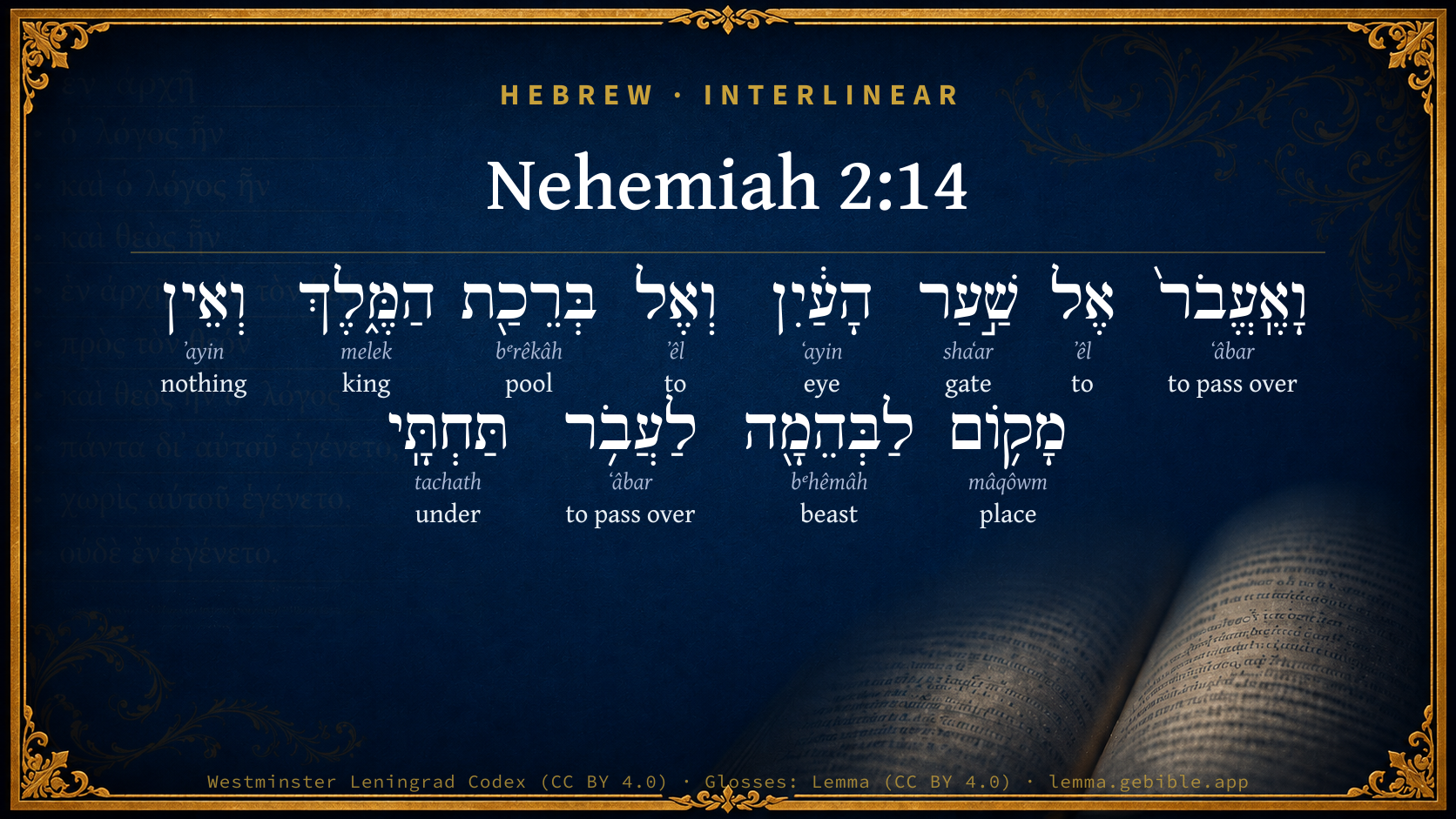
  1. וָאֶֽעֱבֹר֙ ʻâbar H5674 “and · to pass over” Conjunction + Verb, Qal, Sequential Imperfect, 1st Person, Common, Singular
  2. אֶל ʼêl H413 “to” Preposition
  3. שַׁ֣עַר shaʻar H8179 “gate of” Noun, Common, Masculine, Singular, Construct
  4. הָעַ֔יִן ʻayin H5869 “the · eye” Particle, Definite Article + Noun, Common, Both, Singular, Absolute
  5. וְאֶל ʼêl H413 “and · to” Conjunction + Preposition
  6. הַמֶּ֑לֶךְ melek H4428 “the · king” Particle, Definite Article + Noun, Common, Masculine, Singular, Absolute
  7. וְאֵין ʼayin H369 “and · nothing” Conjunction + Particle, Negative
  8. מָק֥וֹם mâqôwm H4725 “place” Noun, Common, Masculine, Singular, Absolute
  9. לַבְּהֵמָ֖ה bᵉhêmâh H929 “to/for the · beast” Preposition, Determined + Noun, Common, Feminine, Singular, Absolute
  10. לַעֲבֹ֥ר ʻâbar H5674 “to pass over” Preposition + Verb, Qal, Infinitive Construct
  11. תַּחְתָּֽי tachath H8478 “under · me” Preposition + Suffix, Personal, 1st Person, Common, Singular

About this verse

These counts appear in no published source. They are computed here, from the morphology-tagged text and Lemma’s own curated glosses. What Lemma adds →

12
words
10
distinct lemmas
Historical
section

Notable vocabulary

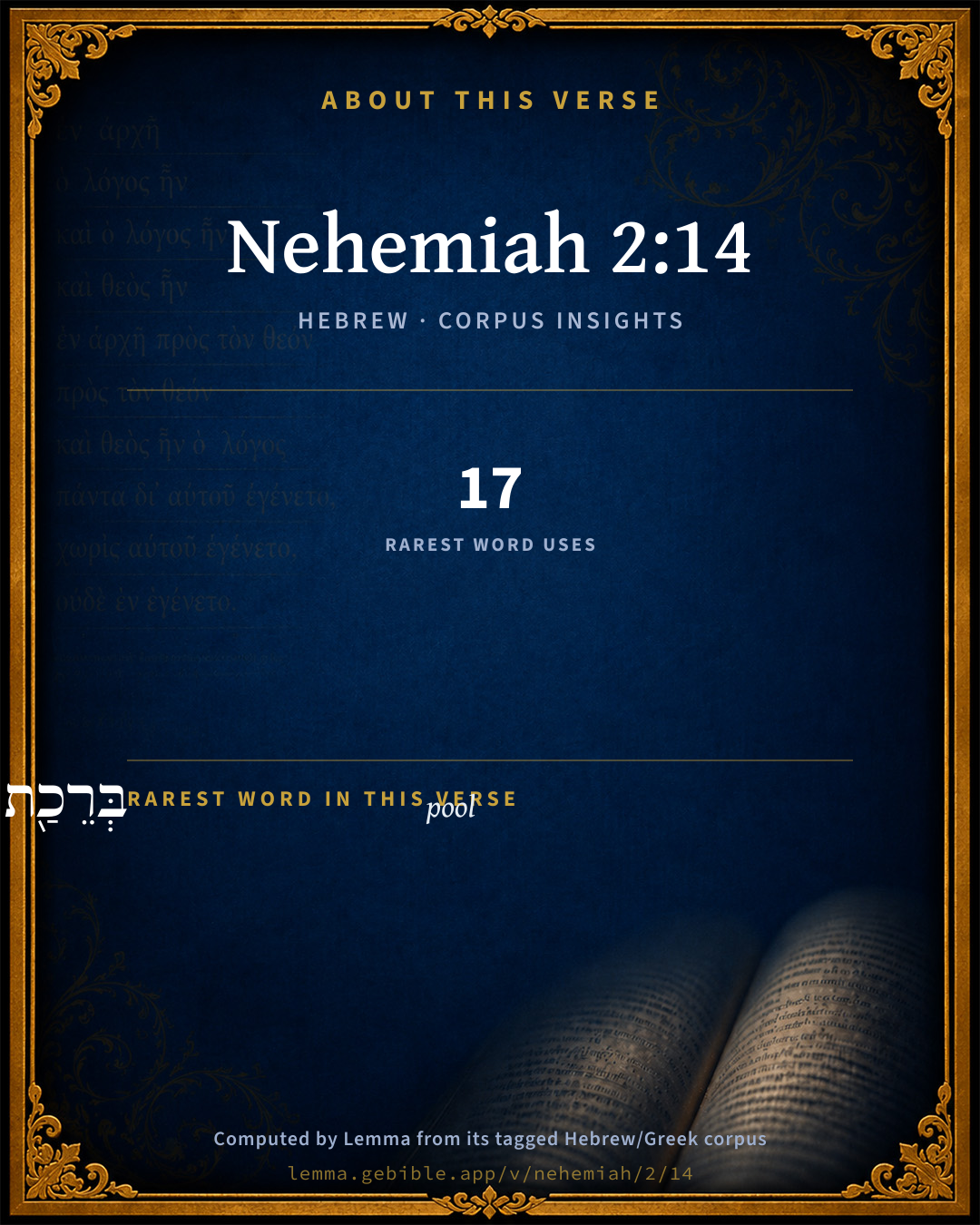
The rarest word here is בְּרֵכַ֖ת pool H1295 — appearing just 17 times in the whole Hebrew Bible.

Shared distinctive vocabulary

בְּרֵכַ֖ת pool H1295 occurs in 15 verses of the Hebrew Bible. Also found in:

Grammatical profile

  • 2 verbs
  • 6 nouns
  • 3 prepositions
  • 1 particle

Verb forms

  • וָאֶֽעֱבֹר֙ Qal · Sequential Imperfect
  • לַעֲבֹ֥ר Qal · Infinitive Construct

Repetition

Words recur within this verse — often emphatic in Hebrew:

  • וָאֶֽעֱבֹר֙ to pass over H5674 ×2
  • אֶל to H413 ×2

Cross-references

4

Topical passages linked to Nehemiah 2:14 in the Treasury of Scripture Knowledge — connected by theme and wording, ordered by reader-vote popularity; previews shown in the World English Bible.

  • Nehemiah 3:15 The spring gate repaired Shallun the son of Colhozeh, the ruler of the district of Mizpah; he built it, and covered it, and set up the doors of it, the bolts of it, and the bars of it, and the wall of the pool of Shelah by the king's garden, even to the stairs that go down from the city of David.
  • 2 Kings 20:20 Now the rest of the acts of Hezekiah, and all his might, and how he made the pool, and the conduit, and brought water into the city, aren't they written in the book of the chronicles of the kings of Judah?
  • 2 Chronicles 32:30 This same Hezekiah also stopped the upper spring of the waters of Gihon, and brought them straight down on the west side of the city of David. Hezekiah prospered in all his works.
  • 2 Kings 18:17 The king of Assyria sent Tartan and Rabsaris and Rabshakeh from Lachish to king Hezekiah with a great army to Jerusalem. They went up and came to Jerusalem. When they were come up, they came and stood by the conduit of the upper pool, which is in the highway of the fuller's field.

Cross-references courtesy of OpenBible.info (CC BY 4.0).

Hebrew and Greek witnesses Masoretic Hebrew ↔ Greek Septuagint

The same verse in the two great witnesses to the Old Testament, shown verse-for-verse.

These are two independent witnesses, not word-aligned to each other, and the Septuagint is shown in lemma (dictionary) form.

Hebrew Nehemiah 2:14 Masoretic · Westminster Leningrad Codex

וָאֶֽעֱבֹר֙ אֶל שַׁ֣עַר הָעַ֔יִן וְאֶל בְּרֵכַ֖ת הַמֶּ֑לֶךְ וְאֵין מָק֥וֹם לַבְּהֵמָ֖ה לַעֲבֹ֥ר תַּחְתָּֽי

Then I went on to the spring gate and to the king's pool: but there was no place for the animal that was under me to pass.

World English Bible · Public Domain

Greek LXX Structure differs

The Septuagint has no separate book of Nehemiah. Its Greek text is the second half of Esdras B (2 Esdras), chapters 11–23; Ezra is the first half (1–10).

A verse-for-verse comparison isn’t shown here because the chapters and verses don’t line up. Switch to the LXX edition with the MT / LXX toggle above to read the Greek directly.

Hebrew: Westminster Leningrad Codex (CC BY 4.0). Greek: Septuagint (public domain); English from a public-domain English Septuagint. How the Septuagint differs from the Hebrew →

Commentary

Notes on Nehemiah 2:14 from classic Christian and Jewish commentators (each source and its license shown beneath its notes). The classic Christian expositions comment on the surrounding passage and are grouped to its opening verse, so a note may address several verses; the Jewish commentaries on the Tanakh (Rashi and others) are per-verse, so they appear only where the commentator wrote on this verse.

Lemma curates 59 commentaries, every one of them public domain or Creative Commons licensed, each selected and text-cleaned for this edition rather than reprinted as found. About our sources →

Trapp's Complete Commentary

John Trapp

Neh 2:14 Then I went on to the gate of the fountain, and to the king’s pool: but [there was] no place for the beast [that was] under me to pass.

Ver. 14. Then I went to the gate of the fountain] Or well-gate; where was great plenty of water ponds, watering places, &c. Junius saith it was that whereby men went out to the pool of Siloah and Rogel.

And to the king’s pool] The water course made, or repaired, at least, by King Hezekiah, 2Ki 20:20.

But there was no place for the beast, &c.] There was so much rubbish, and such ruins. This was the fruit of sin, which makes of a city a heap, as the prophet speaks, and hurls such confusion over the world, that had not Christ, our true Nehemiah, undertaken the shattered condition thereof to uphold it, it had surely fallen about Adam’s ears.

John Trapp, A Commentary or Exposition upon All the Books of the Old and New Testament (1647–1656) — public domain. Text from a community e-Sword module.

Joseph Benson's Commentary

Neh 2:14-16. I went on to the gate of the fountain — That is, which led to the fountain, to wit, of Siloah or Gihon. And to the king’s pool — That which King Hezekiah had made, of which see 2Ch 32:3-30. But there was no place for the beast, &c. — The way being obstructed with heaps of rubbish. Then went I up by the brook — Of Kidron, of which see on 2Sa 15:23. And so returned — Having gone around about the city. Nor to the rest that did the work — Or were to do it, that is, whom he intended to employ in it.

Joseph Benson's Commentary on the Old and New Testaments (1811–1818) — public domain. Text from a community e-Sword module.

Tyndale Open Study Notes

Tyndale Open Resources

2:14 The King’s Pool was either the pool of Siloam or another pool southeast of the city; both were created from the overflow of the Gihon Spring (see 2 Kgs 20:20).

Tyndale Open Study Notes — © Tyndale Open Resources, licensed CC BY-SA 4.0. Text via the HelloAO Bible API.

Geneva Bible (1599)

Geneva Bible translators

Or, conduit.

Geneva Bible (1599) marginal notes — public domain. Text via Bolls.life.

Jamieson, Fausset & Brown

Robert Jamieson, A. R. Fausset & David Brown

Then--that is, after having passed through the gate of the Essenes.

I went on to the gate of the fountain--that is, Siloah, from which turning round the fount of Ophel.

to the king's pool: but there was no place for the beast that was under me to pass--that is, by the sides of this pool (Solomon's) there being water in the pool, and too much rubbish about it to permit the passage of the beast.

Jamieson, Fausset & Brown — Commentary Critical and Explanatory on the Whole Bible (1871) — public domain (CC PDM 1.0). Text via the HelloAO Bible API.

Adam Clarke's Commentary

Verse 14. The gate of the fountain] Of Siloah.

The king's pool] Probably the aqueduct made by Hezekiah, to bring the waters of Gihon to the city of David. See 2Ch 32:30.

Adam Clarke's Commentary on the Bible (1810–1826) — public domain. Text from a community e-Sword/MySword module.

Ellicott's Commentary for English Readers

(14) The gate of the fountain of Siloah (Neh_3:15), called also “the king’s pool.”

A Bible Commentary for English Readers, edited by Charles John Ellicott (1878–1897) — public domain. Text from a community e-Sword module.

The Cambridge Bible for Schools and Colleges

gen. ed. J. J. S. Perowne

14. I went on] Literally ‘I crossed’ or ‘passed over.’

to the gate of the fountain] R.V. to the fountain gate. On the disputed identification of ‘the fountain gate,’ see Neh_3:15, Neh_12:37. It seems to have stood almost at the southernmost part of the city, at the mouth of the narrow valley of the Tyropoeon. It derived its name either from its proximity to the waters of ‘the only real well at Jerusalem,’ now known as Bîr Eyub, ‘the well of Job’ (probably En-Rogel) ‘a little below the junction of the Kidron and Hinnom valleys’ (Wilson’s Jerusalem, p. 104), or from its proximity to Siloam, called by Josephus ‘a fountain’ (πηγή) in Bell. Jud. v. 4. 1.

the king’s pool] Probably to be identified with the Pool of Siloam, and here called ‘the king’s pool’ because it adjoined ‘the king’s garden.’ It consisted of an upper and a lower reservoir (Isa_7:3; Isa_22:9; Isa_22:11; 2Ki_18:17) fed by a subterranean conduit from the waters of Gihon (cf. 2Ki_20:20).

there was no place] Apparently owing to the ruins of the walls and the steepness of the slope Nehemiah could not continue his investigation, following the line of the wall.

The Cambridge Bible for Schools and Colleges (gen. ed. J. J. S. Perowne; Cambridge University Press, 1878–1918) — public domain. Text from a community e-Sword module.

John Gill's Exposition

Then went I up in the night by the brook,.... The brook Kidron:

and viewed the wall; that was on that side:

and turned back; did not go quite round the wall, the way perhaps being obstructed with rubbish, and was unpassable or he had not time to do it:

and entered by the gate of the valley, and so returned; into the city, the same way he went out of it, Neh 2:13.

John Gill's Exposition of the Whole Bible (1746–1763) — public domain (CC PDM 1.0). Text via the HelloAO Bible API.

Albert Barnes' Notes on the Bible

The gate of the fountain - A gate on the eastern side of the Tyropoeon valley, not far from the pool of Siloam (probably “the king’s pool.” (Compare Neh 3:15).

Albert Barnes' Notes on the Bible (1834–1885) — public domain. Text from a community e-Sword/MySword module.

Haydock's Catholic Bible Commentary

Aqueduct, or reservoir, made by Ezechias, 2 Paralipomenon xxxii. 30.

George Leo Haydock (1774–1849), Haydock's Catholic Family Bible and Commentary, 1859 edition — public domain. Excludes Psalms (Douay-Rheims chapter numbering differs from Protestant) and Deuterocanonical books (Catholic canon only).

Matthew Poole's English Annotations

The gate of the fountain, i.e. which led to the fountain, to wit, of Siloah or Gibon.

The king’s pool; that which king Hezekiah had made: of which see 2Ch 32:3,30.

There was no place for the beast to pass; the way being obstructed with heaps of rubbish.

Matthew Poole's English Annotations on the Holy Bible (1683–1685) — public domain. Text from a community e-Sword/MySword module.

Whedon's Commentary on the Bible

Daniel D. Whedon

14. Gate of the fountain — This was doubtless the gate situated at the mouth of the Tyropoeon, and near the fountain, or pool of Siloam. It is to be identified with “the gate between two walls,” (2Ki_25:4,) by which king Zedekiah fled from the city.

The king’s pool — Probably that now commonly known as the fountain of the Virgin, a little north of the pool of Siloam, and connected with it by a subterranean passage. By many this is now believed to be the same as the Bethesda of the New Testament. Joh_5:2.

No place for the beast… to pass — So filled had the narrow valley become with the rubbish of the long desolate city.

Daniel D. Whedon (gen. ed.), Commentary on the Old and New Testaments (1874–1909) — public domain. Text from a community e-Sword module.

The Pulpit Commentary

The gate of the fountain. A gate near the pool of Siloam; (which, though bearing that name in Neh_3:15, seems to be here called "the king"s pool perhaps the "gate between two walls of 2Ki_25:4. There was no place for the beast that was under me to pass. The accumulated rubbish blocked the way. The animal could not proceed. Nehemiah therefore dismounted, and "in the night, dark as it was, pursued his way on foot.

The Pulpit Commentary (1880–1919), ed. H.D.M. Spence-Jones & Joseph S. Exell — public domain. Text from a community e-Sword module.

John Wesley's Explanatory Notes

No place - The way being obstructed with heaps of rubbish.

John Wesley, Explanatory Notes Upon the Whole Bible (1754–1765) — public domain. Text via the GEBible commentary corpus.

Keil & Delitzsch

C. F. Keil & F. Delitzsch

"And I went on to the fountain-gate, and to the king's pool, and there was no room for the beast to come through under me." The very name of the fountain-or well-gate points to the foundation of Siloah (see rem. on Neh 3:15); hence it lay on the eastern declivity of Zion, but not in the district or neighbourhood of the present Bb el Mogharibeh, in which tradition finds the ancient dung-gate, but much farther south, in the neighbourhood of the pool of Siloah; see rem. on Neh 3:15. The King's pool is probably the same which Josephus (bell. Jud. v. 4. 2) calls Σολομῶνος κολυμβήθρα, and places east of the spring of Siloah, and which is supposed by Robinson (Palestine, ii. pp. 149, 159) and Thenius (das vorexil. Jerus., appendix to a commentary on the books of the Kings, p. 20) to be the present Fountain of the Virgin. Bertheau, however, on the other hand, rightly objects that the Fountain of the Virgin lying deep in the rock, and now reached by a descent of thirty steps, could not properly be designated a pool. He tries rather to identify the King's pool with the outlet of a canal investigated by Tobler (Topogr. i. p. 91f.), which the latter regards as a conduit for rain-water, fluid impurities, or even the blood of sacrificed animals; but Bertheau as an aqueduct which, perhaps at the place where its entrance is now found, once filled a pool, of which, indeed, no trace has as yet been discovered. But apart from the difficulty of calling the outlet of a canal a pool (Arnold in Herzog's Realencycl. xviii. p. 656), the circumstance, that Tobler could find in neither of the above-described canals any trace of high antiquity, tells against this conjecture. Much more may be said in favour of the view of E. G. Schultz (Jerusalem, p. 58f.), that the half-choked-up pool near Ain Silwan may be the King's pool and Solomon's pool; for travellers of the sixteenth and seventeenth centuries mention a piscina grandis foras and natatoria Silo at the mouth of the fountain of Siloah (comp. Leyrer in Herzog's Realencycl. xvi. p. 372). See also rem. on Neh 3:15. Here there was no room for the beast to get through, the road being choked up with the ruins of the walls that had been destroyed, so that Nehemiah was obliged to dismount.

Keil & Delitzsch — Biblical Commentary on the Old Testament (1861–1891) — public domain (CC PDM 1.0). Text via the HelloAO Bible API. (Old Testament only.)

Rashi

Rabbi Shlomo Yitzchaki (Rashi)

And I passed to the Fountain Gate And I wished to pass to those places in the wall of the city and in those breaches, and there was no place in those breaches for riders on animals to pass through because they were so small.

Rashi on the Tanakh — English translations: “The Judaica Press complete Tanach with Rashi, translated by A. J. Rosenberg” (CC BY 4.0); “Pentateuch with Rashi's commentary by M. Rosenbaum and A.M. Silbermann, 1929-1934” (public domain); “The Metsudah Tanach series, Lakewood, N.J” (CC BY 4.0); and “The Book of Joshua, Metsudah Publications, 1997” (CC BY 4.0). Text via Sefaria.

Lesson kit

Teaching starters — assembled from the data on this page, not authored interpretation. Every prompt links to the verse data it draws on. Edit before teaching.

Nehemiah, in the Historical, opens this verse with 12 words (10 distinct Hebrew lemmas). Its most distinctive word is bᵉrêkâh (“pool”). A historical commentator’s framing appears above. Read the whole chapter for the surrounding context.

Discussion questions

  1. How does “pool” (bᵉrêkâh) shape what this verse is saying?
  2. 2 Samuel 2:13 shares the word «pool» with this verse. How do the two illuminate each other?
  3. “to pass over” occurs 2× in this one verse. What is the effect of the repetition?
  4. These translations render this verse differently; the difference is in the English rendering, not the original. What questions does that raise?
  5. The verb «וָאֶֽעֱבֹר֙» is Qal Sequential Imperfect. How does its form color the action?
  6. Reading how Trapp's Complete Commentary and Joseph Benson's Commentary read this verse, where do the two commentators agree and where do they part?

Things to notice

  • These translations choose different wording for 8 words in this verse.
  • “to pass over” occurs 2× in this single verse.
  • 10 distinct Hebrew lemmas span 12 words in this verse.

Reading settings

Reading text

Shown beneath each verse's original-language words.

Old Testament
Old Testament edition

Read the OT as the Masoretic Hebrew (MT) or the Greek Septuagint (LXX).

English shown for the Greek Septuagint (in the Hebrew ↔ Greek comparison).

Comparing translations? Open the Compare panel on any verse page to stack up to four side by side.