
Joshua 7:5

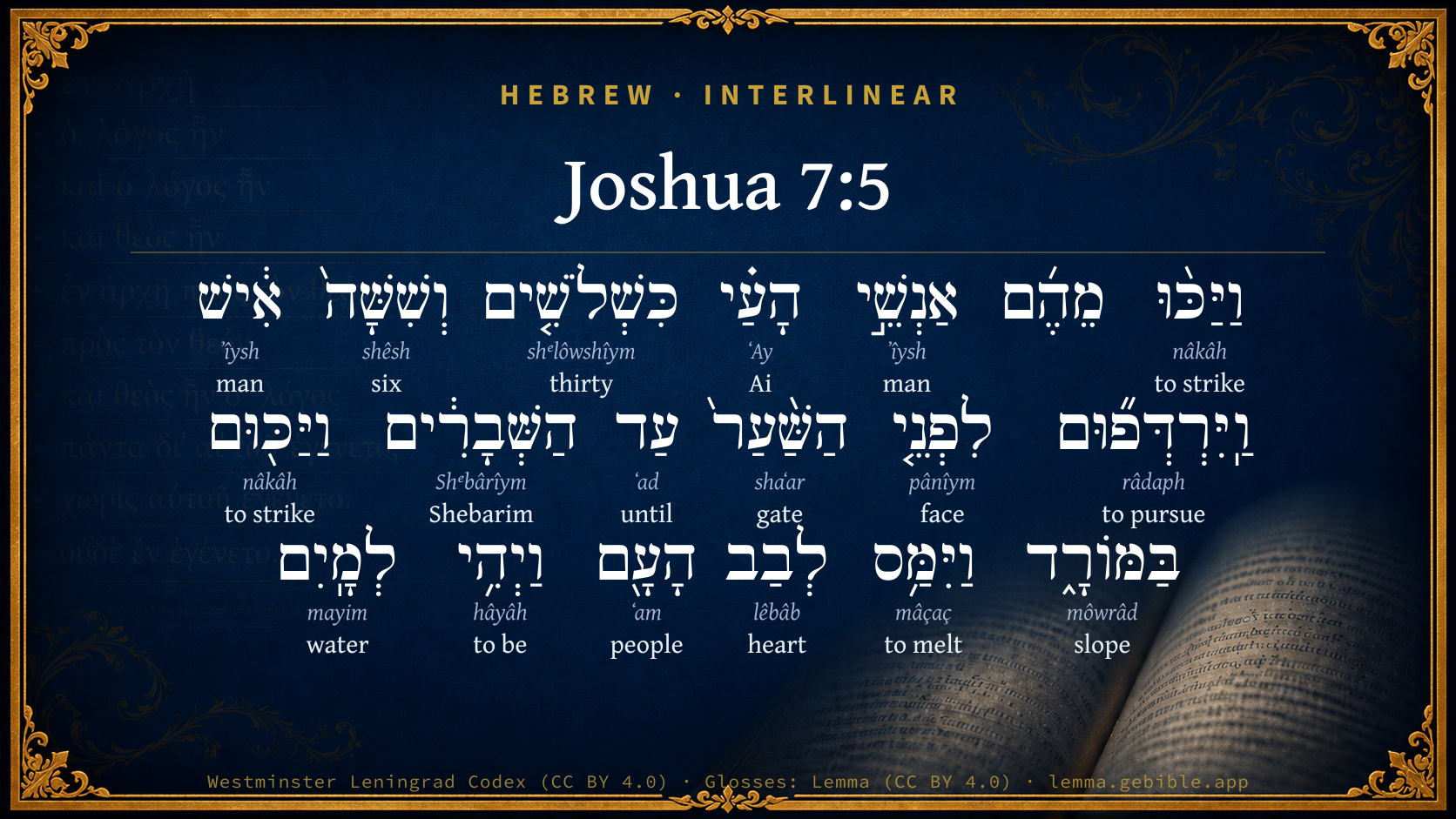
Hebrew (Westminster Leningrad Codex) Joshua 7:5 appears in the Hebrew Old Testament. The text above is from the Westminster Leningrad Codex. Each word links to its Strong’s number, a concise gloss, and parsing drawn from the Open Scriptures Hebrew Bible morphology. Click any word for its full Brown-Driver-Briggs (BDB) entry.
Download image
Cite this verse

Joshua 7:5 (World English Bible). Public Domain. Lemma interlinear Bible study tool, https://lemma.gebible.app/v/joshua/7/5.

Show BibTeX & RIS
BibTeX
RIS
English Translation
The men of Ai struck of them about thirty-six men; and they chased them [from] before the gate even to Shebarim, and struck them at the descent; and the hearts of the people melted, and became as water.
World English Bible · Public Domain
Highlights
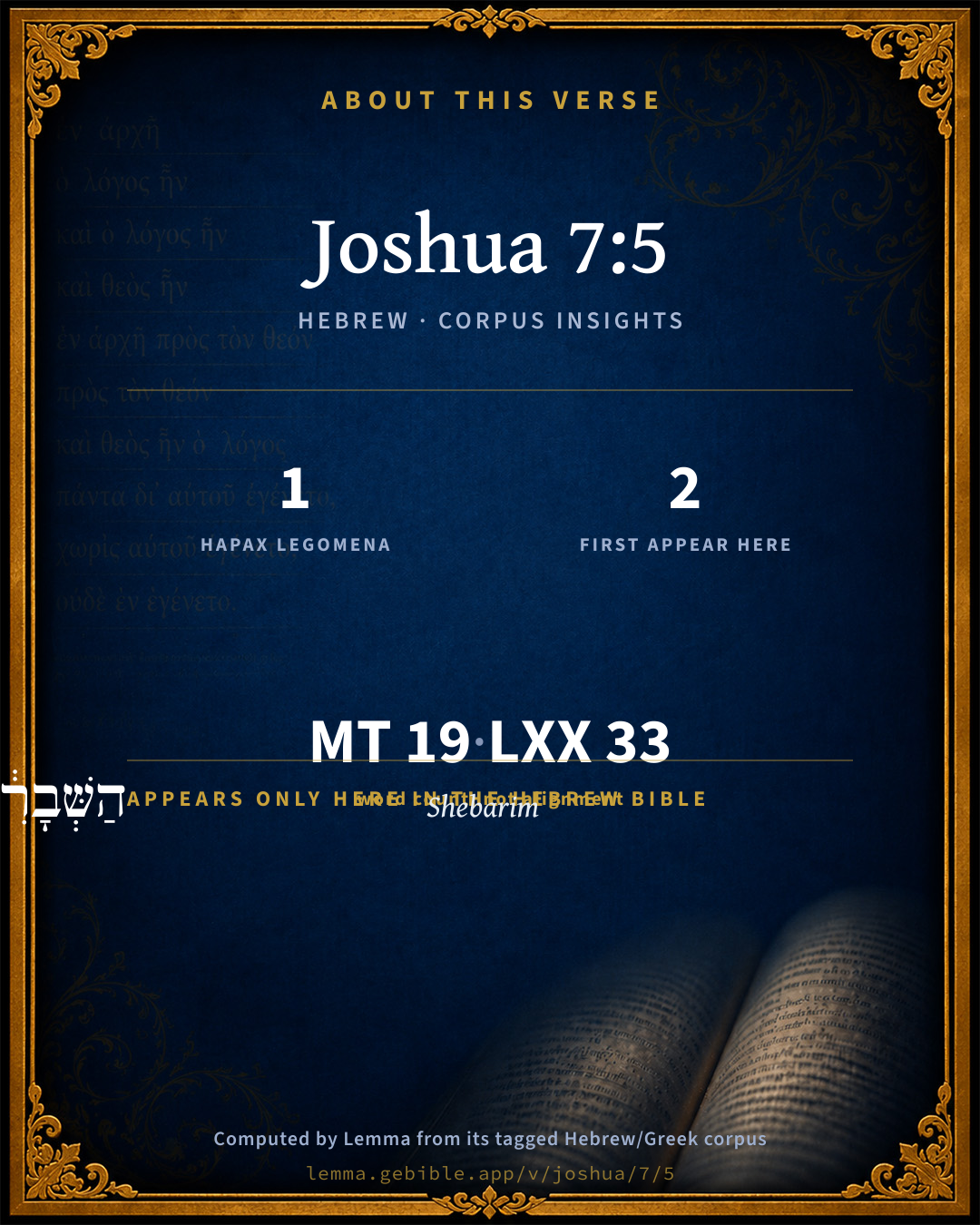
  • 1 hapax legomenon — only here in the Hebrew Bible
  • 2 first appearances in the Hebrew Bible
Full analysis ↓
Download a study sheet

One document with this verse’s original text, its word-by-word gloss line, the meaning frame, cross-references with their text, attributed commentary, and full source and license credits — printable, and it pastes into notes with its structure intact.

This verse Autodidact and up

Study sheet (.html) Plain text (.txt)

A passage Seminary Student

Up to 50 verses in one chapter. A passage sheet keeps up to 6 commentary sources and 12 cross-references per verse, in the order this page ranks them, and says so on the sheet whenever that leaves anything out. Ask for a single verse and you get the Autodidact verse sheet above.

Everything on this page stays free to read, with no account — the sheet is a download of what is already on screen, not access to it.

Want to remove ads? Support Godless Engineer
Compare translations 3

The same verse in 3 English versions, stacked beneath the original-language interlinear above. Click any original word for its lexicon entry.

Each is an independent rendering of the whole verse — the interlinear is not word-aligned to these translations.

Highlighted words mark where these versions differ — a whole-verse word diff, not a word-by-word alignment.

  • World English Bible Public Domain
    The men of Ai struck of them about thirty-six men; and they chased them [from] before the gate even to Shebarim, and struck them at the descent; and the hearts of the people melted, and became as water.
  • King James Version Public Domain
    And the men of Ai smote of them about thirty and six men: for they chased them from before the gate even unto Shebarim, and smote them in the going down: wherefore the hearts of the people melted, and became as water.
  • unfoldingWord Literal Text CC BY-SA 4.0
    And the men of Ai struck down from them about 36 men. And they pursued them from the face of the gate unto the quarries, and they struck them on the slope. And the heart of the people melted and became water.

unfoldingWord Literal Text — © unfoldingWord, licensed CC BY-SA 4.0. Word-aligned USFM3 via Door43 (git.door43.org/unfoldingWord/en_ult).

Versions to compare (up to 4)

3 of 4 selected

Show all 18 translations

Every available English version of this verse, each an independent rendering of the whole verse.

  • World English Bible Public Domain
    The men of Ai struck of them about thirty-six men; and they chased them [from] before the gate even to Shebarim, and struck them at the descent; and the hearts of the people melted, and became as water.
  • Berean Standard Bible Public Domain
    And the men of Ai struck down about thirty-six of them, chasing them from the gate as far as the quarries and striking them down on the slopes. So the hearts of the people melted and became like water.
  • Majority Standard Bible Public Domain
    And the men of Ai struck down about thirty-six of them, chasing them from the gate as far as the quarries and striking them down on the slopes. So the hearts of the people melted and became like water.
  • King James Version Public Domain
    And the men of Ai smote of them about thirty and six men: for they chased them from before the gate even unto Shebarim, and smote them in the going down: wherefore the hearts of the people melted, and became as water.
  • American Standard Version (1901) Public Domain
    And the men of Ai smote of them about thirty and six men; and they chased them `from' before the gate even unto Shebarim, and smote them at the descent; and the hearts of the people melted, and became as water.
  • Revised Version (1885) Public Domain
    And the men of Ai smote of them about thirty and six men: and they chased them from before the gate even unto Shebarim, and smote them at the going down: and the hearts of the people melted, and became as water.
  • Geneva Bible (1599) Public Domain
    And the men of Ai smote of them vpon a thirtie and sixe men: for they chased them from before the gate vnto Shebarim, and smote them in the going downe: wherfore the heartes of the people melted away like water.
  • Douay-Rheims (1899) Public Domain
    And were defeated by the men of the city of Hai, and there fell of them six and thirty men: and the enemies pursued them from the gate as far as Sabarim, and they slew them as they fled by the descent: and the heart of the people was struck with fear, and melted like water.
  • Young's Literal Translation Public Domain
    and the men of Ai smite of them about thirty and six men, and pursue them before the gate unto Shebarim, and they smite them in Morad; and the heart of the people is melted, and becometh water.
  • Literal Standard Version CC BY-SA 4.0
    and the men of Ai strike about thirty-six men from them, and pursue them before the gate to Shebarim, and they strike them in Morad; and the heart of the people is melted, and becomes water.
  • Unlocked Literal Bible CC BY-SA 4.0
    The men of Ai killed about thirty-six men as they pursued them from the city gate as far as to the stone quarries, and they killed them as they were going down a hill. The hearts of the people melted and became like water.
  • unfoldingWord Literal Text CC BY-SA 4.0
    And the men of Ai struck down from them about 36 men. And they pursued them from the face of the gate unto the quarries, and they struck them on the slope. And the heart of the people melted and became water.
  • Darby Bible Public Domain
    And the men of Ai smote of them about thirty-six men; and they pursued them from before the gate to Shebarim, and smote them on the descent. Then the hearts of the people melted, and became as water.
  • World Messianic Bible Public Domain
    The men of Ai struck about thirty-six men of them. They chased them from before the gate even to Shebarim, and struck them at the descent. The hearts of the people melted, and became like water.
  • Webster's Bible Public Domain
    And the men of Ai smote of them about thirty and six men: for they chased them from before the gate even to Shebarim, and smote them in the going down: wherefore the hearts of the people melted, and became as water.
  • Free Bible Version CC BY-SA 4.0
    The men of Ai killed about thirty-six of them, chasing the Israelites from the town gate until they were defeated, killing them on their way down. At this the Israelites became afraid, losing all their courage.
  • Bible in Basic English Public Domain
    The men of Ai put to death about thirty-six of them, driving them from before the town as far as the stoneworks, and overcoming them on the way down: and the hearts of the people became like water.
  • JPS Tanakh (1917) Public Domain
    And the men of Ai smote of them about thirty and six men; and they chased them from before the gate even unto Shebarim, and smote them at the descent; and the hearts of the people melted, and became as water.

Literal Standard Version (2020), Covenant Press — licensed CC BY-SA 4.0. Text via the HelloAO Bible API (eBible.org). Unlocked Literal Bible (unfoldingWord) — licensed CC BY-SA 4.0. Text via the HelloAO Bible API (eBible.org). unfoldingWord Literal Text — © unfoldingWord, licensed CC BY-SA 4.0. Word-aligned USFM3 via Door43 (git.door43.org/unfoldingWord/en_ult). Free Bible Version, Dr. Jonathan Gallagher — licensed CC BY-SA 4.0. Text via the HelloAO Bible API (eBible.org).

Word by word

More ways to search: Search by grammar → Find every occurrence → Compare this word →

Practice this passage: Drill this verse → Learn its vocabulary →

הַשְּׁבָרִ֔ים
Shᵉbârîym
H7671
“the · Shebarim”
Particle, Definite Article + Noun, Proper
Part of Speech
Particle + Noun
Type
Proper
Full BDB Definition

Origin: pl. of H7667

TWOT: None

Shebarim = "the breaches" - one of the points in the flight from Ai
  1. וַיַּכּ֨וּ nâkâh H5221 “and · to strike” Conjunction + Verb, Hiphil, Sequential Imperfect, 3rd Person, Masculine, Plural
  2. אַנְשֵׁ֣י ʼîysh H376 “men of” Noun, Common, Masculine, Plural, Construct
  3. הָעַ֗י ʻAy H5857 “the · Ai” Particle, Definite Article + Noun, Proper
  4. כִּשְׁלֹשִׁ֤ים shᵉlôwshîym H7970 “like/as · thirty” Preposition + Adjective, Cardinal number, Both, Plural, Absolute
  5. וְשִׁשָּׁה֙ shêsh H8337 “and · six” Conjunction + Adjective, Cardinal number, Masculine, Singular, Absolute
  6. אִ֔ישׁ ʼîysh H376 “man” Noun, Common, Masculine, Singular, Absolute
  7. וַֽיִּרְדְּפ֞וּם râdaph H7291 “and · to pursue · them” Conjunction + Verb, Qal, Sequential Imperfect, 3rd Person, Masculine, Plural + Suffix, Personal, 3rd Person, Masculine, Plural
  8. לִפְנֵ֤י pânîym H6440 “to/for · face(s) of” Preposition + Noun, Common, Both, Plural, Construct
  9. הַשַּׁ֨עַר֙ shaʻar H8179 “the · gate” Particle, Definite Article + Noun, Common, Masculine, Singular, Absolute
  10. עַד ʻad H5704 “until” Preposition
  11. וַיַּכּ֖וּם nâkâh H5221 “and · to strike · them” Conjunction + Verb, Hiphil, Sequential Imperfect, 3rd Person, Masculine, Plural + Suffix, Personal, 3rd Person, Masculine, Plural
  12. בַּמּוֹרָ֑ד môwrâd H4174 “in/at the · slope” Preposition, Determined + Noun, Common, Masculine, Singular, Absolute
  13. וַיִּמַּ֥ס mâçaç H4549 “and · to melt” Conjunction + Verb, Niphal, Sequential Imperfect, 3rd Person, Masculine, Singular
  14. לְבַב lêbâb H3824 “heart of” Noun, Common, Masculine, Singular, Construct
  15. הָעָ֖ם ʻam H5971 “the · people” Particle, Definite Article + Noun, Common, Masculine, Singular, Absolute
  16. וַיְהִ֥י hâyâh H1961 “and · to be” Conjunction + Verb, Qal, Sequential Imperfect, 3rd Person, Masculine, Singular
  17. לְמָֽיִם mayim H4325 “to/for · water(s)” Preposition + Noun, Common, Masculine, Plural, Absolute

About this verse

These counts appear in no published source. They are computed here, from the morphology-tagged text and Lemma’s own curated glosses. What Lemma adds →

19
words
16
distinct lemmas
Historical
section

Notable vocabulary

1 hapax legomenon — a word that appears only here in the entire Hebrew Bible:

  • הַשְּׁבָרִ֔ים Shebarim H7671

First appearance in Scripture

These words make their first canonical appearance in the Hebrew Bible here:

  • הַשְּׁבָרִ֔ים Shebarim H7671
  • בַּמּוֹרָ֑ד slope H4174

Shared distinctive vocabulary

בַּמּוֹרָ֑ד slope H4174 occurs in 5 verses of the Hebrew Bible. Also found in:

Grammatical profile

  • 5 verbs
  • 10 nouns
  • 2 adjectives
  • 2 prepositions

Verb forms

  • וַיַּכּ֨וּ Hiphil · Sequential Imperfect
  • וַֽיִּרְדְּפ֞וּם Qal · Sequential Imperfect
  • וַיַּכּ֖וּם Hiphil · Sequential Imperfect
  • וַיִּמַּ֥ס Niphal · Sequential Imperfect
  • וַיְהִ֥י Qal · Sequential Imperfect

Repetition

Words recur within this verse — often emphatic in Hebrew:

  • וַיַּכּ֨וּ to strike H5221 ×2
  • אַנְשֵׁ֣י man H376 ×2

Hebrew & Septuagint length

In English translation the verse runs 38 words from the Hebrew and 40 from the Septuagint (LXX English) — closely comparable.

A rough comparison of the two English renderings, which tokenize alike — not a word-level alignment.

Word counts can differ between the Hebrew and the Greek without any difference in meaning — e.g. the Hebrew direct-object marker אֵת has no separate Greek word, and Greek often adds the article ὁ.

In the original languages it is 19 Hebrew tokens and 33 Greek tokens — but the two are counted differently (Hebrew bundles its prefixes and suffixes into one token; the Greek is in lemma form), so that isn’t a like-for-like length.

Cross-references

9

Topical passages linked to Joshua 7:5 in the Treasury of Scripture Knowledge — connected by theme and wording, ordered by reader-vote popularity; previews shown in the World English Bible.

  • Joshua 2:9 and she said to the men, I know that Yahweh has given you the land, and that the fear of you is fallen on us, and that all the inhabitants of the land melt away before you.
  • Joshua 2:11 As soon as we had heard it, our hearts did melt, neither did there remain any more spirit in any man, because of you: for Yahweh your God, he is God in heaven above, and on earth beneath.
  • Leviticus 26:36 "'As for those of you who are left, I will send a faintness into their hearts in the lands of their enemies: and the sound of a driven leaf will put them to flight; and they shall flee, as one flees from the sword; and they will fall when no one pursues.
  • Deuteronomy 1:44 The Amorites, who lived in that hill-country, came out against you, and chased you, as bees do, and beat you down in Seir, even to Hormah.
  • Joshua 5:1 It happened, when all the kings of the Amorites, who were beyond the Jordan westward, and all the kings of the Canaanites, who were by the sea, heard how that Yahweh had dried up the waters of the Jordan from before the children of Israel, until we were passed over, that their heart melted, neither was there spirit in them any more, because of the children of Israel.
  • Psalms 22:14 I am poured out like water. All my bones are out of joint. My heart is like wax; It is melted within me.
  • Isaiah 13:7 Therefore shall all hands be feeble, and every heart of man shall melt:
  • Ezekiel 21:7 It shall be, when they tell you, Why do you sigh? that you shall say, Because of the news, for it comes; and every heart shall melt, and all hands shall be feeble, and every spirit shall faint, and all knees shall be weak as water: behold, it comes, and it shall be done, says the Lord Yahweh.
  • Nahum 2:10 She is empty, void, and waste. The heart melts, the knees knock together, their bodies and faces have grown pale.

Cross-references courtesy of OpenBible.info (CC BY 4.0).

Hebrew and Greek witnesses Masoretic Hebrew ↔ Greek Septuagint

The same verse in the two great witnesses to the Old Testament, shown verse-for-verse.

These are two independent witnesses, not word-aligned to each other, and the Septuagint is shown in lemma (dictionary) form.

Hebrew Joshua 7:5 Masoretic · Westminster Leningrad Codex

וַיַּכּ֨וּ מֵהֶ֜ם אַנְשֵׁ֣י הָעַ֗י כִּשְׁלֹשִׁ֤ים וְשִׁשָּׁה֙ אִ֔ישׁ וַֽיִּרְדְּפ֞וּם לִפְנֵ֤י הַשַּׁ֨עַר֙ עַד הַשְּׁבָרִ֔ים וַיַּכּ֖וּם בַּמּוֹרָ֑ד וַיִּמַּ֥ס לְבַב הָעָ֖ם וַיְהִ֥י לְמָֽיִם

The men of Ai struck of them about thirty-six men; and they chased them [from] before the gate even to Shebarim, and struck them at the descent; and the hearts of the people melted, and became as water.

World English Bible · Public Domain

Greek LXX Joshua 7:5 Septuagint · lemma form

καί ἀποκτείνω ἀπό αὐτός ἀνήρ γαι εἰς τριάκοντα καί ἕξ ἀνήρ καί καταδιώκω αὐτός ἀπό ὁ πύλη καί συντρίβω αὐτός ἐπί ὁ καταφερής καί πτοέω ὁ καρδία ὁ λαός καί γίγνομαι ὥσπερ ὕδωρ

And the men of Gai killed of them to the number of thirty-six men, and they pursued them from the gate, and destroyed them from the steep hill; and the heart of the people was alarmed and became as water.

LXX2012 (modern English Septuagint) · Public Domain

On this verse, The Cambridge Bible for Schools and Colleges discusses the Septuagint’s reading. Read the note in Commentary ↓

Hebrew: Westminster Leningrad Codex (CC BY 4.0). Greek: Septuagint (public domain); English from LXX2012 (modern English Septuagint) (Public Domain). How the Septuagint differs from the Hebrew →

Targum (Aramaic paraphrase)

1

The Targum is the ancient Jewish Aramaic paraphrase of the Hebrew Scriptures — an interpretive translation, not the Hebrew text itself. Onkelos (literal) and Pseudo-Jonathan (expansive) render the Torah, and Jonathan the Prophets. Coverage is partial: where no permissively-licensed English translation exists for a verse, only the Aramaic is shown. This is verse-level text, not a word-by-word alignment to the Hebrew.

  1. Targum Jonathan Prophets (Joshua–Malachi)
    וּקְטַלוּ מִנְהוֹן אֱנָשֵׁי עַי כִּתְלָתִין וְשִׁתָּא גַבְרָא וּרְדָפוּנוּן קֳדָם תַּרְעָא עַד דְתַבְּרוּנוּן וּמְחוּנוּן בְּמַחֲתָנָא וְאִתְמְסֵי לִבָּא דְעַמָא וַהֲוָה לְמַיָא:

    (no public-domain English translation for this verse)

    Targum Jonathan — Aramaic: “Mikraot Gedolot” (public domain). English: “Sefaria Community Translation” (CC0 1.0 (public-domain dedication)); “London "Chaldee Paraphrase," 1871” (public domain). Text via Sefaria.

Commentary

Notes on Joshua 7:5 from classic Christian and Jewish commentators (each source and its license shown beneath its notes). The classic Christian expositions comment on the surrounding passage and are grouped to its opening verse, so a note may address several verses; the Jewish commentaries on the Tanakh (Rashi and others) are per-verse, so they appear only where the commentator wrote on this verse.

Lemma curates 59 commentaries, every one of them public domain or Creative Commons licensed, each selected and text-cleaned for this edition rather than reprinted as found. About our sources →

Trapp's Complete Commentary

John Trapp

Jos 7:5 And the men of Ai smote of them about thirty and six men: for they chased them [from] before the gate [even] unto Shebarim, and smote them in the going down: wherefore the hearts of the people melted, and became as water.

Ver. 5. And the men of Ai smote of them.] Not in fight, but in flight; for they stood not out the first shock.

“ A cane non magno saepe tenetur aper. ”

Even unto Shebarim,] i.e., A place of breakings or shiverings: this made them "sick at heart," according to Amo 6:6. {See Trapp on "Amo 6:6"}

Wherefore the hearts of the people melted.] They were not more discomfited than discouraged: because they saw that God was displeased, and for the time departed. A little water in a leaden vessel is very heavy: so is a small affliction from an offended Father. "Be not thou a terror to me," saith Jeremiah, {Jer 17:17} and then I care not greatly what befalleth me.

John Trapp, A Commentary or Exposition upon All the Books of the Old and New Testament (1647–1656) — public domain. Text from a community e-Sword module.

Joseph Benson's Commentary

Jos 7:5. The men of Ai smote thirty-six men — A dear-bought victory to them, whereby Israel was awakened and reformed, and they hardened to their own ruin. They smote them in the going down — That is, till they came to the plains of Jericho, Ai standing upon a hill. The hearts of the people melted, and became as water — Soft and weak, and full of fluctuation and trembling. They were undoubtedly struck with this panic from God; for otherwise there was no sufficient reason for it.

Joseph Benson's Commentary on the Old and New Testaments (1811–1818) — public domain. Text from a community e-Sword module.

Tyndale Open Study Notes

Tyndale Open Resources

7:5 Ai’s defenders left through the town gate and attacked Israel’s troops directly (see 8:5). • as far as the quarries: An otherwise unknown place.

Tyndale Open Study Notes — © Tyndale Open Resources, licensed CC BY-SA 4.0. Text via the HelloAO Bible API.

Geneva Bible (1599)

Geneva Bible translators

God would by this overthrow make them more earnest to search out and punish the sin committed.

Geneva Bible (1599) marginal notes — public domain. Text via Bolls.life.

Jamieson, Fausset & Brown

Robert Jamieson, A. R. Fausset & David Brown

chased them from before the gate even unto Shebarim--that is, unto the "breakings" or "fissures" at the opening of the passes.

and smote them in the going down--that is, the declivity or slope of the deep, rugged, adjoining wady.

wherefore the hearts of the people melted, and became as water--It is evident that the troops engaged were a tumultuary, undisciplined band, no better skilled in military affairs than the Bedouin Arabs, who become disheartened and flee on the loss of ten or fifteen men. But the consternation of the Israelites arose from another cause--the evident displeasure of God, who withheld that aid on which they had confidently reckoned.

Jamieson, Fausset & Brown — Commentary Critical and Explanatory on the Whole Bible (1871) — public domain (CC PDM 1.0). Text via the HelloAO Bible API.

Adam Clarke's Commentary

Verse 5. They chased them from before the gate even unto Shebarim] They seem to have presumed that the men of Ai would have immediately opened their gates to them, and therefore they marched up with confidence; but the enemy appearing, they were put to flight, their ranks utterly broken, and thirty-six of them killed. שברים Shebarim signifies breaches or broken places, and may here apply to the ranks of the Israelites, which were broken by the men of Ai; for the people were totally routed, though there were but few slain. They were panic-struck, and fled in the utmost confusion.

The hearts of the people melted] They were utterly discouraged; and by this gave an ample proof that without the supernatural assistance of God they could never have conquered the land.

Adam Clarke's Commentary on the Bible (1810–1826) — public domain. Text from a community e-Sword/MySword module.

Ellicott's Commentary for English Readers

(5) Shebarim—i.e., the crevices, or ravines. A short distance below Ai the road passes the head of steep glens, which open into the plain of Jordan.

In the going down—i.e., until they escaped into these ravines.

A Bible Commentary for English Readers, edited by Charles John Ellicott (1878–1897) — public domain. Text from a community e-Sword module.

The Cambridge Bible for Schools and Colleges

gen. ed. J. J. S. Perowne

5. unto Shebarim] So called, perhaps, from the mines, or stone quarries, which lay in the neighbourhood. The LXX. translates “till they had crushed or annihilated them.”

in the going down] Or, as in the margin, in Morad. If we retain the translation in the text, “the going down” would point to a spot, about a mile distant, “where the wâdies, descending from Ai, take their final plunge eastwards.”

the hearts of the people melted] Comp. Deu_1:28; Jos_2:11. “And the herte of the puple myche dredde, and at the lickenesse of water is molten,” Wyclif.

The Cambridge Bible for Schools and Colleges (gen. ed. J. J. S. Perowne; Cambridge University Press, 1878–1918) — public domain. Text from a community e-Sword module.

John Gill's Exposition

And the men of Ai smote of them about thirty and six men,.... In the pursuit of them, which were but few, but a sufficient rebuke of Providence; their loss was but small, but their shame and disgrace great:

for they chased them from before the gate; the gate of the city of Ai:

even unto Shebarim; not that there was a place of this name before, but it was so called from hence, because there they were broken, as Kimchi observes; and the Targum and Jarchi render it,"until they were broken,''their lines broken, not being able to retreat in order, but were scattered, and fled to their camp as they could: Gussetius (q) thinks it was the; name of a place, but not so called for the above reason, but because there lay broken pieces of the rock scattered about:

and smote them in the going down; the hill from Ai; "Morad", rendered "going down", may taken for the proper name of a place, and which, Kimchi says, was a place before Ai, in which there was a declivity and descent, and in that place they smote them when they fled:

wherefore the hearts of the people melted, and became as water; that is, the whole body of the people, when this little army returned defeated, their spirits failed them, their courage was lost, their nerves were loosed, and they became languid, faint, and feeble; not that their loss was so great, but that they perceived God had forsaken them, and what the issue of this would be they dreaded.

(q) Comment. Ebr. p. 825.

John Gill's Exposition of the Whole Bible (1746–1763) — public domain (CC PDM 1.0). Text via the HelloAO Bible API.

Albert Barnes' Notes on the Bible

Shebarim - Rather, perhaps, “the stone quarries.” The smallness of the slaughter among the Israelites indicates that they fled early, probably without real conflict in battle.

Albert Barnes' Notes on the Bible (1834–1885) — public domain. Text from a community e-Sword/MySword module.

Haydock's Catholic Bible Commentary

Sabarim, which means people "broken and defeated." Septuagint, "they pursued them from the gate, till they had entirely broken them," destroying 36, and putting the rest to flight. (Calmet) --- This small disaster filled the whole camp with dismay, as the Lord generally caused the victories of his people to be complete, and without any loss, as long as they continued in his favour. None were found wanting of those who attacked and destroyed so many of the Madianites, Numbers xxxi. 49. (Haydock)

George Leo Haydock (1774–1849), Haydock's Catholic Family Bible and Commentary, 1859 edition — public domain. Excludes Psalms (Douay-Rheims chapter numbering differs from Protestant) and Deuterocanonical books (Catholic canon only).

Matthew Poole's English Annotations

About thirty and six men; a dear victory to them, whereby Israel was awakened, and reformed, and reconciled to their God and Shield, and they hardened to their own ruin.

In the going down; by which it seems it was a downhill way to Jericho, which was nearer Jordan.

As water, soft and weak, and full of fluctuation and trembling.

Matthew Poole's English Annotations on the Holy Bible (1683–1685) — public domain. Text from a community e-Sword/MySword module.

Whedon's Commentary on the Bible

Daniel D. Whedon

5. About thirty and six men — The disaster, though shameful, was much lighter than might have been expected to attend such a rout.

Even unto Shebarim — That is, the stone quarries or ruins, the situation of which cannot be determined. Captain Wilson suggests that it may be identical with some extensive ruins northeast of Bethel, called Deir Sheba.

In the going down — Or, the declivity. Hebrews, Morad. Perhaps the descent into the wady, (note, Jos_7:2,) which is hemmed in on both sides with precipitous cliffs, is meant. Both the ruins (shebarim) and the declivity (morad) were evidently well known places in the time of the writer of this book but not of sufficient importance to survive in the memory of many generations.

The hearts of the people melted — This dismay was not on account of the magnitude of the disaster to the arms of Israel, but because it betokened the withdrawal of their Great Ally, Jehovah. Well may a nation tremble when it sees itself forsaken of God!

Daniel D. Whedon (gen. ed.), Commentary on the Old and New Testaments (1874–1909) — public domain. Text from a community e-Sword module.

The Pulpit Commentary

Unto Shebarim. LXX, kai ewv sunetriqan autouv , as though we had (or, as Masius suggests, from rbv to break in pieces. So the Syriac and Chaldee versions. But this is quite out of the question. The Israelites were not annihilated, for they only lost about 36 men. Nor is Shebarim a proper name, as the Vulgate renders it. It has the article, and must be rendered either with Keil, the stone quarries (literally, the crushings or breakings), or with Gesenius, the ruins, which, however, is less probable, since Ai (see above)has a similar signification. Munsterus mentions a view that it was so called in consequence of the slaughter of the Israelites. But this is very improbable. In the going down. Ai stood in a strong position on the mountains. The margin "in Morad "is therefore not to be preferred. It means, as the Israelites and their antagonists descended from the gates. The hearts of the people melted and became as water. This was not cowardice, but awe. The people had relied upon the strong hand of the Lord, which had been so wonderfully stretched out for them. From Joshua downwards, every one felt that, for some unknown reason, that support had been withdrawn.

The Pulpit Commentary (1880–1919), ed. H.D.M. Spence-Jones & Joseph S. Exell — public domain. Text from a community e-Sword module.

John Wesley's Explanatory Notes

About thirty and six men - A dear victory to them, whereby Israel was awakened and reformed, and they hardened to their own ruin. The going down - By which it seems it was a down-hill way to Jericho, which was nearer Jordan. As water - Soft and weak, and full of fluctuation and trembling.

John Wesley, Explanatory Notes Upon the Whole Bible (1754–1765) — public domain. Text via the GEBible commentary corpus.

Rashi

Rabbi Shlomo Yitzchaki (Rashi)

Until Shevarim, until they were broken.

Rashi on the Tanakh — English translations: “The Judaica Press complete Tanach with Rashi, translated by A. J. Rosenberg” (CC BY 4.0); “Pentateuch with Rashi's commentary by M. Rosenbaum and A.M. Silbermann, 1929-1934” (public domain); “The Metsudah Tanach series, Lakewood, N.J” (CC BY 4.0); and “The Book of Joshua, Metsudah Publications, 1997” (CC BY 4.0). Text via Sefaria.

Lesson kit

Teaching starters — assembled from the data on this page, not authored interpretation. Every prompt links to the verse data it draws on. Edit before teaching.

Joshua, in the Historical, opens this verse with 19 words (16 distinct Hebrew lemmas). Its most distinctive word is Shᵉbârîym (“Shebarim”). A historical commentator’s framing appears above. Read the whole chapter for the surrounding context.

Discussion questions

  1. How does “Shebarim” (Shᵉbârîym) shape what this verse is saying?
  2. This verse holds 1 word here found nowhere else in the Hebrew Bible. What might the rare word draw attention to?
  3. 2 words here appear for the first time in Scripture. What is being introduced at this debut?
  4. Joshua 10:11 shares the word «slope» with this verse. How do the two illuminate each other?
  5. “to strike” occurs 2× in this one verse. What is the effect of the repetition?
  6. The translations on this page render this verse differently — a whole-verse word diff, not a word-by-word alignment. What might account for the different wordings?
  7. The verb «וַיַּכּ֨וּ» is Hiphil Sequential Imperfect. How does its form color the action?
  8. Reading how Trapp's Complete Commentary and Joseph Benson's Commentary read this verse, where do the two commentators agree and where do they part?

Things to notice

  • 1 word in this verse appears nowhere else in the Hebrew Bible.
  • 2 words make their first canonical appearance in Scripture here.
  • This verse counts 19 Hebrew ↔ 33 Greek words.
  • These translations choose different wording for 20 words in this verse.
  • “to strike” occurs 2× in this single verse.

Reading settings

Reading text

Shown beneath each verse's original-language words.

Old Testament
Old Testament edition

Read the OT as the Masoretic Hebrew (MT) or the Greek Septuagint (LXX).

English shown for the Greek Septuagint (in the Hebrew ↔ Greek comparison).

Comparing translations? Open the Compare panel on any verse page to stack up to four side by side.