Judges 9:35

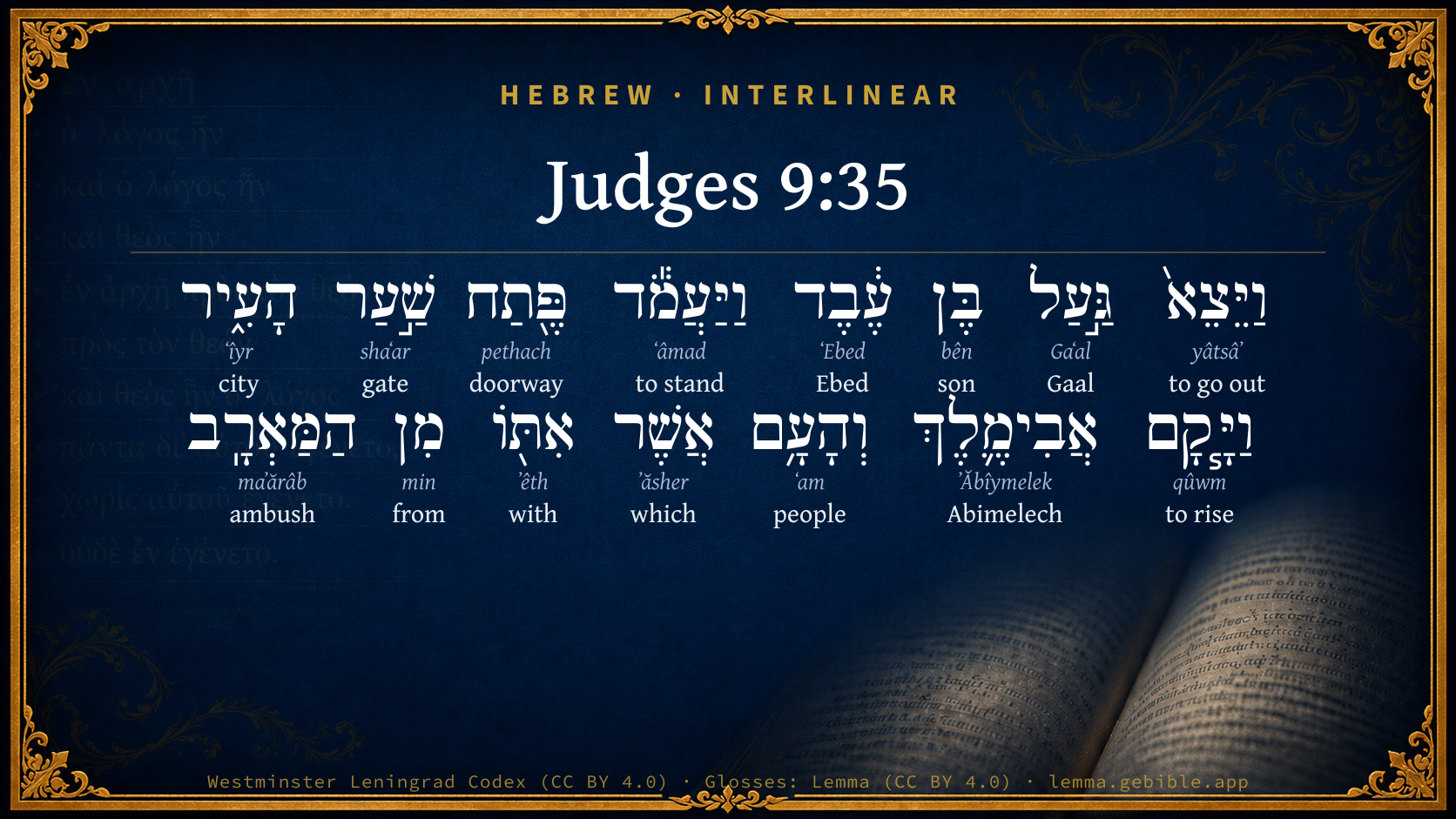
Hebrew (Westminster Leningrad Codex) Judges 9:35 appears in the Hebrew Old Testament. The text above is from the Westminster Leningrad Codex. Each word links to its Strong’s number, a concise gloss, and parsing drawn from the Open Scriptures Hebrew Bible morphology. Click any word for its full Brown-Driver-Briggs (BDB) entry.
Download image
Cite this verse

Judges 9:35 (World English Bible). Public Domain. Lemma interlinear Bible study tool, https://lemma.gebible.app/v/judges/9/35.

Show BibTeX & RIS
BibTeX
RIS
English Translation
Gaal the son of Ebed went out, and stood in the entrance of the gate of the city: and Abimelech rose up, and the people who were with him, from the ambush.
World English Bible · Public Domain
Download a study sheet

One document with this verse’s original text, its word-by-word gloss line, the meaning frame, cross-references with their text, attributed commentary, and full source and license credits — printable, and it pastes into notes with its structure intact.

This verse Autodidact and up

Study sheet (.html) Plain text (.txt)

A passage Seminary Student

Up to 50 verses in one chapter. A passage sheet keeps up to 6 commentary sources and 12 cross-references per verse, in the order this page ranks them, and says so on the sheet whenever that leaves anything out. Ask for a single verse and you get the Autodidact verse sheet above.

Everything on this page stays free to read, with no account — the sheet is a download of what is already on screen, not access to it.

Want to remove ads? Support Godless Engineer
Compare translations 3

The same verse in 3 English versions, stacked beneath the original-language interlinear above. Click any original word for its lexicon entry.

Each is an independent rendering of the whole verse — the interlinear is not word-aligned to these translations.

Highlighted words mark where these versions differ — a whole-verse word diff, not a word-by-word alignment.

  • World English Bible Public Domain
    Gaal the son of Ebed went out, and stood in the entrance of the gate of the city: and Abimelech rose up, and the people who were with him, from the ambush.
  • King James Version Public Domain
    And Gaal the son of Ebed went out, and stood in the entering of the gate of the city: and Abimelech rose up, and the people that were with him, from lying in wait.
  • unfoldingWord Literal Text CC BY-SA 4.0
    And Gaal, the son of Ebed, went out and stood in the entrance of the gate of the city, and Abimelech and the people who with him arose from the ambush.

unfoldingWord Literal Text — © unfoldingWord, licensed CC BY-SA 4.0. Word-aligned USFM3 via Door43 (git.door43.org/unfoldingWord/en_ult).

Versions to compare (up to 4)

3 of 4 selected

Show all 18 translations

Every available English version of this verse, each an independent rendering of the whole verse.

  • World English Bible Public Domain
    Gaal the son of Ebed went out, and stood in the entrance of the gate of the city: and Abimelech rose up, and the people who were with him, from the ambush.
  • Berean Standard Bible Public Domain
    Now Gaal son of Ebed went out and stood at the entrance of the city gate just as Abimelech and his men came out from their hiding places.
  • Majority Standard Bible Public Domain
    Now Gaal son of Ebed went out and stood at the entrance of the city gate just as Abimelech and his men came out from their hiding places.
  • King James Version Public Domain
    And Gaal the son of Ebed went out, and stood in the entering of the gate of the city: and Abimelech rose up, and the people that were with him, from lying in wait.
  • American Standard Version (1901) Public Domain
    And Gaal the son of Ebed went out, and stood in the entrance of the gate of the city: and Abimelech rose up, and the people that were with him, from the ambushment.
  • Revised Version (1885) Public Domain
    And Gaal the son of Ebed went out, and stood in the entering of the gate of the city: and Abimelech rose up, and the people that were with him, from the ambushment.
  • Geneva Bible (1599) Public Domain
    Then Gaal the sonne of Ebed went out and stood in the entring of the gate of the citie: and Abimelech rose vp, and the folke that were with him, from lying in waite.
  • Douay-Rheims (1899) Public Domain
    And Gaal the son of Obed went out, and stood in the entrance of the gate of the city. And Abimelech rose up, and all his army with him from the places of the ambushes.
  • Young's Literal Translation Public Domain
    and Gaal son of Ebed goeth out, and standeth at the opening of the gate of the city, and Abimelech riseth -- also the people who `are' with him -- from the ambush,
  • Literal Standard Version CC BY-SA 4.0
    and Gaal son of Ebed goes out, and stands at the opening of the gate of the city, and Abimelech rises—also the people who [are] with him—from the ambush,
  • Unlocked Literal Bible CC BY-SA 4.0
    Gaal son of Ebed went out and stood in the entrance of the city gate. Abimelech and the men who were with him came out of their hiding place.
  • unfoldingWord Literal Text CC BY-SA 4.0
    And Gaal, the son of Ebed, went out and stood in the entrance of the gate of the city, and Abimelech and the people who with him arose from the ambush.
  • Darby Bible Public Domain
    And Ga'al the son of Ebed went out and stood in the entrance of the gate of the city; and Abim'elech and the men that were with him rose from the ambush.
  • World Messianic Bible Public Domain
    Gaal the son of Ebed went out, and stood in the entrance of the gate of the city. Abimelech rose up, and the people who were with him, from the ambush.
  • Webster's Bible Public Domain
    And Gaal the son of Ebed went out, and stood in the entrance of the gate of the city: and Abimelech rose, and the people that were with him, from lying in wait.
  • Free Bible Version CC BY-SA 4.0
    When Gaal, son of Ebed, went out and stood at the town's entrance gate, Abimelech and his army came out from where they had been hiding.
  • Bible in Basic English Public Domain
    And Gaal, the son of Ebed, went out, and took his place at the doorway into the town; then Abimelech and his people got up from the place where they had been waiting.
  • JPS Tanakh (1917) Public Domain
    And Gaal the son of Ebed went out, and stood in the entrance of the gate of the city; and Abimelech rose up, and the people that were with him, from the ambushment.

Literal Standard Version (2020), Covenant Press — licensed CC BY-SA 4.0. Text via the HelloAO Bible API (eBible.org). Unlocked Literal Bible (unfoldingWord) — licensed CC BY-SA 4.0. Text via the HelloAO Bible API (eBible.org). unfoldingWord Literal Text — © unfoldingWord, licensed CC BY-SA 4.0. Word-aligned USFM3 via Door43 (git.door43.org/unfoldingWord/en_ult). Free Bible Version, Dr. Jonathan Gallagher — licensed CC BY-SA 4.0. Text via the HelloAO Bible API (eBible.org).

Word by word

More ways to search: Search by grammar → Find every occurrence → Compare this word →

Practice this passage: Drill this verse → Learn its vocabulary →

הַמַּאְרָֽב
maʼărâb
H3993
“the · ambush”
Particle, Definite Article + Noun, Common, Masculine, Singular, Absolute
Part of Speech
Particle + Noun
Type
Common
Gender
Masculine
Number
Singular
State
Absolute
Full BDB Definition

Origin: from H693

TWOT: 156e

ambush, (hunter's) blind - ambush, lurking place - liers-in-wait
  1. וַיֵּצֵא֙ yâtsâʼ H3318 “and · to go out” Conjunction + Verb, Qal, Sequential Imperfect, 3rd Person, Masculine, Singular
  2. גַּ֣עַל Gaʻal H1603 “Gaal” Noun, Proper
  3. בֶּן bên H1121 “son of” Noun, Common, Masculine, Singular, Construct
  4. עֶ֔בֶד ʻEbed H5651 “Ebed” Noun, Proper
  5. וַיַּעֲמֹ֕ד ʻâmad H5975 “and · to stand” Conjunction + Verb, Qal, Sequential Imperfect, 3rd Person, Masculine, Singular
  6. פֶּ֖תַח pethach H6607 “doorway of” Noun, Common, Masculine, Singular, Construct
  7. שַׁ֣עַר shaʻar H8179 “gate of” Noun, Common, Masculine, Singular, Construct
  8. הָעִ֑יר ʻîyr H5892 “the · city” Particle, Definite Article + Noun, Common, Feminine, Singular, Absolute
  9. וַיָּ֧קָם qûwm H6965 “and · to rise” Conjunction + Verb, Qal, Sequential Imperfect, 3rd Person, Masculine, Singular
  10. אֲבִימֶ֛לֶךְ ʼĂbîymelek H40 “Abimelech” Noun, Proper
  11. וְהָעָ֥ם ʻam H5971 “and · the · people” Conjunction + Particle, Definite Article + Noun, Common, Masculine, Singular, Absolute
  12. אֲשֶׁר ʼăsher H834 “which” Particle, Relative
  13. אִתּ֖וֹ ʼêth H854 “with · him” Preposition + Suffix, Personal, 3rd Person, Masculine, Singular
  14. מִן min H4480 “from” Preposition

About this verse

These counts appear in no published source. They are computed here, from the morphology-tagged text and Lemma’s own curated glosses. What Lemma adds →

15
words
15
distinct lemmas
Historical
section

Notable vocabulary

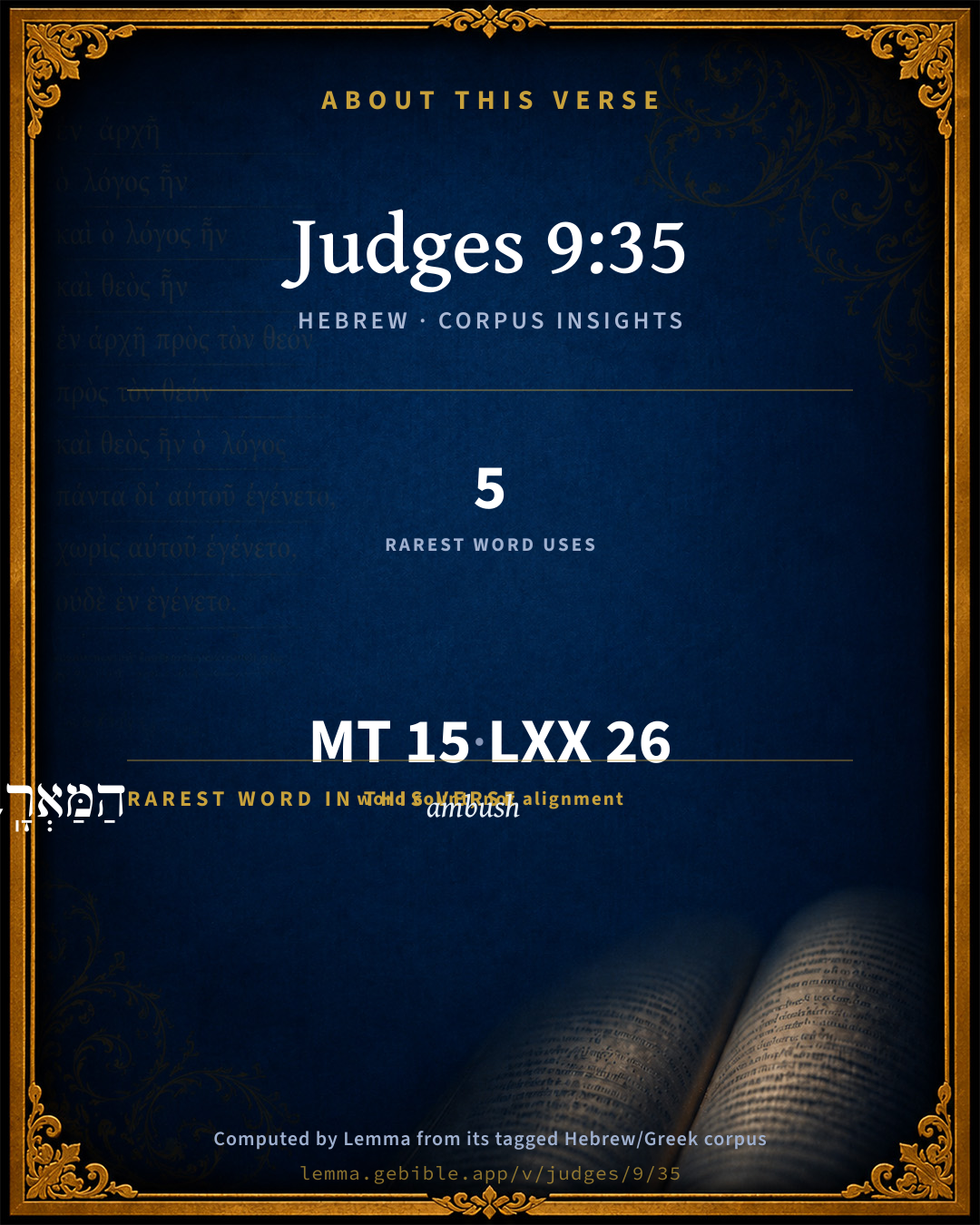
The rarest word here is הַמַּאְרָֽב ambush H3993 — appearing just 5 times in the whole Hebrew Bible.

Shared distinctive vocabulary

הַמַּאְרָֽב ambush H3993 occurs in 4 verses of the Hebrew Bible. Also found in:

Grammatical profile

  • 3 verbs
  • 9 nouns
  • 2 prepositions
  • 1 particle

Verb forms

  • וַיֵּצֵא֙ Qal · Sequential Imperfect
  • וַיַּעֲמֹ֕ד Qal · Sequential Imperfect
  • וַיָּ֧קָם Qal · Sequential Imperfect

Hebrew & Septuagint length

In English translation the verse runs 32 words from the Hebrew and 31 from the Septuagint (LXX English) — closely comparable.

A rough comparison of the two English renderings, which tokenize alike — not a word-level alignment.

Word counts can differ between the Hebrew and the Greek without any difference in meaning — e.g. the Hebrew direct-object marker אֵת has no separate Greek word, and Greek often adds the article ὁ.

In the original languages it is 15 Hebrew tokens and 26 Greek tokens — but the two are counted differently (Hebrew bundles its prefixes and suffixes into one token; the Greek is in lemma form), so that isn’t a like-for-like length.

Hebrew and Greek witnesses Masoretic Hebrew ↔ Greek Septuagint

The same verse in the two great witnesses to the Old Testament, shown verse-for-verse.

These are two independent witnesses, not word-aligned to each other, and the Septuagint is shown in lemma (dictionary) form.

Hebrew Judges 9:35 Masoretic · Westminster Leningrad Codex

וַיֵּצֵא֙ גַּ֣עַל בֶּן עֶ֔בֶד וַיַּעֲמֹ֕ד פֶּ֖תַח שַׁ֣עַר הָעִ֑יר וַיָּ֧קָם אֲבִימֶ֛לֶךְ וְהָעָ֥ם אֲשֶׁר אִתּ֖וֹ מִן הַמַּאְרָֽב

Gaal the son of Ebed went out, and stood in the entrance of the gate of the city: and Abimelech rose up, and the people who were with him, from the ambush.

World English Bible · Public Domain

Greek LXX Judges 9:35 Septuagint · lemma form

καί ἐκἔρχομαι γααλ υἱός ιωβηλ καί ἵστημι πρός ὁ θύρα ὁ πύλη ὁ πόλις καί ἀναἵστημι αβιμελεχ καί ὁ λαός ὁ μετά αὐτός ἀπό ὁ ἔνεδρον

And Gaal the son of Jobel went forth, and stood by the door of the gate of the city: and Abimelech and the people with him rose up from the ambuscade.

LXX2012 (modern English Septuagint) · Public Domain

Hebrew: Westminster Leningrad Codex (CC BY 4.0). Greek: Septuagint (public domain); English from LXX2012 (modern English Septuagint) (Public Domain). How the Septuagint differs from the Hebrew →

Targum (Aramaic paraphrase)

1

The Targum is the ancient Jewish Aramaic paraphrase of the Hebrew Scriptures — an interpretive translation, not the Hebrew text itself. Onkelos (literal) and Pseudo-Jonathan (expansive) render the Torah, and Jonathan the Prophets. Coverage is partial: where no permissively-licensed English translation exists for a verse, only the Aramaic is shown. This is verse-level text, not a word-by-word alignment to the Hebrew.

  1. Targum Jonathan Prophets (Joshua–Malachi)
    וּנְפַק גַעַל בַּר עֶבֶד וְקָם בְּמַעֲלָנָא דִתְרַע קַרְתָּא וְקָם אֲבִימֶלֶךְ וְעַמָא דִי עִמֵיהּ מִן כְּמָנָא:

    (no public-domain English translation for this verse)

    Targum Jonathan — Aramaic: “Mikraot Gedolot” (public domain). English: “Sefaria Community Translation” (CC0 1.0 (public-domain dedication)); “London "Chaldee Paraphrase," 1871” (public domain). Text via Sefaria.

Commentary

Notes on Judges 9:35 from classic Christian and Jewish commentators (each source and its license shown beneath its notes). The classic Christian expositions comment on the surrounding passage and are grouped to its opening verse, so a note may address several verses; the Jewish commentaries on the Tanakh (Rashi and others) are per-verse, so they appear only where the commentator wrote on this verse.

Lemma curates 59 commentaries, every one of them public domain or Creative Commons licensed, each selected and text-cleaned for this edition rather than reprinted as found. About our sources →

Trapp's Complete Commentary

John Trapp

Jdg 9:35 And Gaal the son of Ebed went out, and stood in the entering of the gate of the city: and Abimelech rose up, and the people that [were] with him, from lying in wait.

Ver. 35. And stood in the entering of the gate of the city.] To see what he could discover of the enemy: and had he been as valiant as he was vigilant, it might have gone better with him and his partisans.

John Trapp, A Commentary or Exposition upon All the Books of the Old and New Testament (1647–1656) — public domain. Text from a community e-Sword module.

Joseph Benson's Commentary

Jdg 9:35-36. Gaal went out and stood — To put his army in order, and to conduct them against Abimelech, whom he supposed to be at a great distance. He said to Zebul — Who concealed the anger which he had conceived, (Jdg 9:30,) and pretended compliance with him in this expedition, that he might draw him forth into the field, where Abimelech might have the opportunity of fighting with him, and overthrowing him. The shadow — For in the morning, as this was, and in the evening, the shadows are longest, and move quickest.

Joseph Benson's Commentary on the Old and New Testaments (1811–1818) — public domain. Text from a community e-Sword module.

Adam Clarke's Commentary

Verse 35. Stood in the entering of the gate] Having probably got some intimation of the designs of Zebul and Abimelech.

Adam Clarke's Commentary on the Bible (1810–1826) — public domain. Text from a community e-Sword/MySword module.

Ellicott's Commentary for English Readers

(35) Stood in the entering of the gate of the city.—This was the ordinary station of kings, judges, &c.; but Gaal only seems to have gone there in order to keep a look-out (Jos_20:4).

A Bible Commentary for English Readers, edited by Charles John Ellicott (1878–1897) — public domain. Text from a community e-Sword module.

John Gill's Exposition

And when Gaal saw the people, he said to Zebul,.... Who was up as early, and came to the gate of the city, to see how things went, and whether there was any appearance of Abimelech and his forces, and whether any opportunity offered to let him into the city; and it seems as if he came and stood by Gaul, and appeared friendly with him:

behold, there come people down from the tops of the mountains; the mountains of Ebal and Gerizim, which were near to Shechem:

and Zebul said unto him, thou seest the shadow of the mountains, as if they were men; either deriding him, as being just out of his bed, and his eyes scarce open, that he could not discern shadows from men; or rather as being of such a timorous spirit, that he was afraid of shadows; or else he said this, putting on an air of seriousness, as if he really believed this to be the case, on purpose to deceive him, and keep him from talking about them, while Abimelech and his men made further advances before Gaul could make any preparation to meet them.

John Gill's Exposition of the Whole Bible (1746–1763) — public domain (CC PDM 1.0). Text via the HelloAO Bible API.

Haydock's Catholic Bible Commentary

CHAPTER IX.

George Leo Haydock (1774–1849), Haydock's Catholic Family Bible and Commentary, 1859 edition — public domain. Excludes Psalms (Douay-Rheims chapter numbering differs from Protestant) and Deuterocanonical books (Catholic canon only).

Matthew Poole's English Annotations

Stood in the entering of the gate of the city, to put his army in order, and to conduct them against Abimelech, whom he supposed to be at a great distance.

Matthew Poole's English Annotations on the Holy Bible (1683–1685) — public domain. Text from a community e-Sword/MySword module.

The Pulpit Commentary

And Gaal, etc. It does not appear certain whether Gaal, who, as is clear from ver. 36, was accompanied by Zebul, went out of the city gate with his men in consequence of any intelligence of Abimelech"s movements, or any alarm or suspicion of danger, or merely upon some other enterprise. But whatever the cause was, as soon as he was there, Abimelech, according to Zebul"s advice in ver. 33, had begun to descend from the mountains into the valley to "set upon the city." Gaal"s quick eye detected them in the morning light.

The Pulpit Commentary (1880–1919), ed. H.D.M. Spence-Jones & Joseph S. Exell — public domain. Text from a community e-Sword module.

John Wesley's Explanatory Notes

And stood - To put his army in order, and to conduct them against Abimelech, whom he supposed to be at a great distance.

John Wesley, Explanatory Notes Upon the Whole Bible (1754–1765) — public domain. Text via the GEBible commentary corpus.

Keil & Delitzsch

C. F. Keil & F. Delitzsch

When Gaal went out in the morning with his retinue upon some enterprise, which is not more clearly defined, and stood before the city gate, Abimelech rose up with his army out of the ambush. On seeing this people, Gaal said to Zebul (who must therefore have come out of the city with him): "Behold, people come down from the tops of the mountains." Zebul replied, for the purpose of deceiving him and making him feel quite secure, "Thou lookest upon the shadow of the mountains as men."

Keil & Delitzsch — Biblical Commentary on the Old Testament (1861–1891) — public domain (CC PDM 1.0). Text via the HelloAO Bible API. (Old Testament only.)

Lesson kit

Teaching starters — assembled from the data on this page, not authored interpretation. Every prompt links to the verse data it draws on. Edit before teaching.

Judges, in the Historical, opens this verse with 15 words (15 distinct Hebrew lemmas). Its most distinctive word is maʼărâb (“ambush”). A historical commentator’s framing appears above. Read the whole chapter for the surrounding context.

Discussion questions

  1. The word maʼărâb carries the sense “ambush.” How does it shape the verse?
  2. How does Joshua 8:9, which shares the word «ambush», read alongside this verse?
  3. These translations render this verse differently. What is at stake in choosing one wording over another?
  4. «וַיֵּצֵא֙» is a Qal Sequential Imperfect verb. How does that grammatical form shape the action described?
  5. Compare how Trapp's Complete Commentary and Joseph Benson's Commentary read this verse. Where do they agree or differ?

Things to notice

Reading settings

Reading text

Shown beneath each verse's original-language words.

Old Testament
Old Testament edition

Read the OT as the Masoretic Hebrew (MT) or the Greek Septuagint (LXX).

English shown for the Greek Septuagint (in the Hebrew ↔ Greek comparison).

Comparing translations? Open the Compare panel on any verse page to stack up to four side by side.