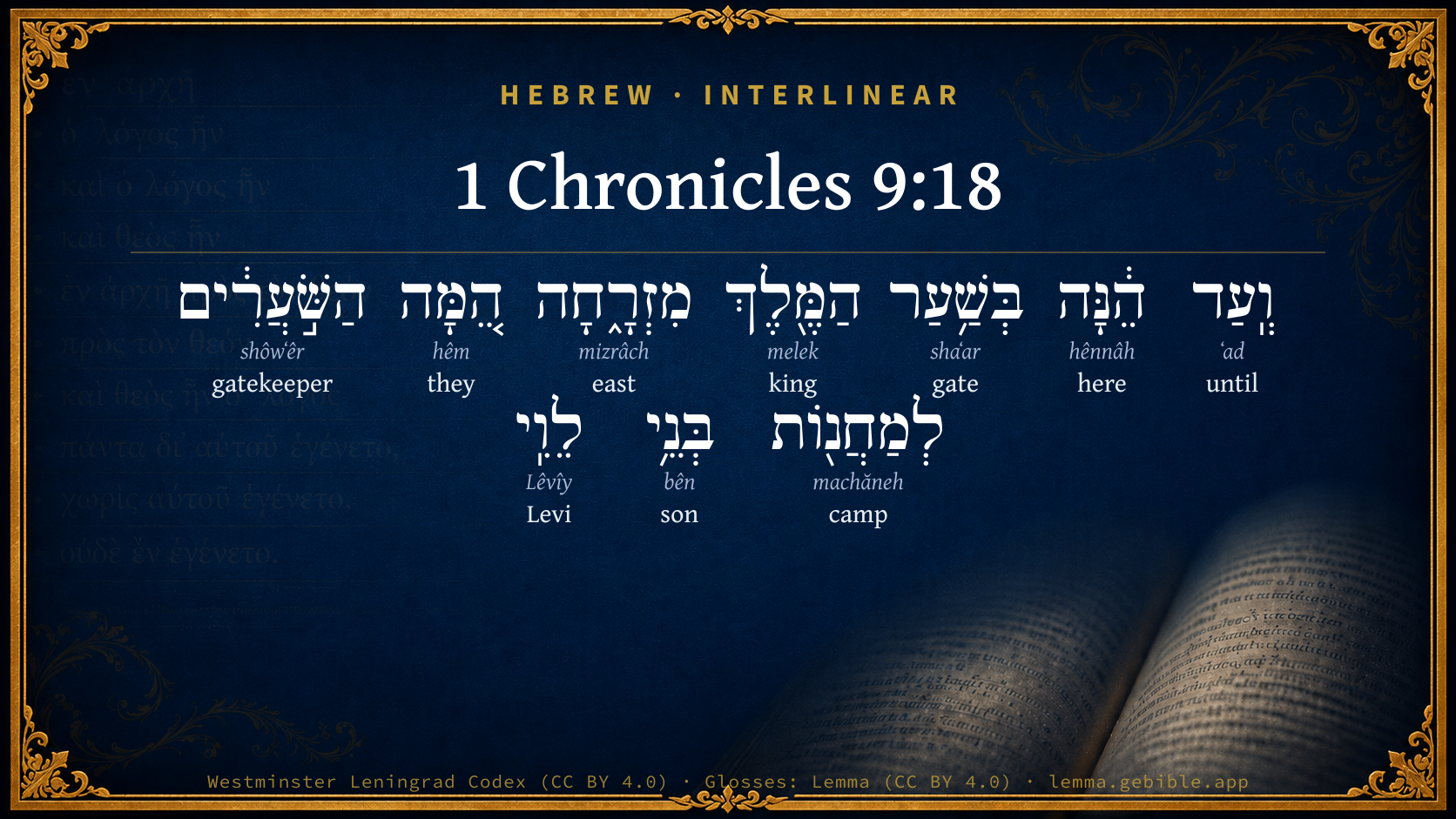
1 Chronicles 9:18

Hebrew (Westminster Leningrad Codex) 1 Chronicles 9:18 appears in the Hebrew Old Testament. The text above is from the Westminster Leningrad Codex. Each word links to its Strong’s number, a concise gloss, and parsing drawn from the Open Scriptures Hebrew Bible morphology. Click any word for its full Brown-Driver-Briggs (BDB) entry.
Download image
Cite this verse

1 Chronicles 9:18 (World English Bible). Public Domain. Lemma interlinear Bible study tool, https://lemma.gebible.app/v/1-chronicles/9/18.

Show BibTeX & RIS
BibTeX
RIS
English Translation
who hitherto [waited] in the king's gate eastward: they were the porters for the camp of the children of Levi.
World English Bible · Public Domain
Download a study sheet

One document with this verse’s original text, its word-by-word gloss line, the meaning frame, cross-references with their text, attributed commentary, and full source and license credits — printable, and it pastes into notes with its structure intact.

This verse Autodidact and up

Study sheet (.html) Plain text (.txt)

A passage Seminary Student

Up to 50 verses in one chapter. A passage sheet keeps up to 6 commentary sources and 12 cross-references per verse, in the order this page ranks them, and says so on the sheet whenever that leaves anything out. Ask for a single verse and you get the Autodidact verse sheet above.

Everything on this page stays free to read, with no account — the sheet is a download of what is already on screen, not access to it.

Want to remove ads? Support Godless Engineer
Compare translations 3

The same verse in 3 English versions, stacked beneath the original-language interlinear above. Click any original word for its lexicon entry.

Each is an independent rendering of the whole verse — the interlinear is not word-aligned to these translations.

Highlighted words mark where these versions differ — a whole-verse word diff, not a word-by-word alignment.

  • World English Bible Public Domain
    who hitherto [waited] in the king's gate eastward: they were the porters for the camp of the children of Levi.
  • King James Version Public Domain
    Who hitherto waited in the king's gate eastward: they were porters in the companies of the children of Levi.
  • unfoldingWord Literal Text CC BY-SA 4.0
    And until now at the gate of the king from the east, they gatekeepers for the camps of the sons of Levi.

unfoldingWord Literal Text — © unfoldingWord, licensed CC BY-SA 4.0. Word-aligned USFM3 via Door43 (git.door43.org/unfoldingWord/en_ult).

Versions to compare (up to 4)

3 of 4 selected

Show all 18 translations

Every available English version of this verse, each an independent rendering of the whole verse.

  • World English Bible Public Domain
    who hitherto [waited] in the king's gate eastward: they were the porters for the camp of the children of Levi.
  • Berean Standard Bible Public Domain
    he was previously stationed at the King’s Gate on the east side. These were the gatekeepers from the camp of the Levites.
  • Majority Standard Bible Public Domain
    he was previously stationed at the King’s Gate on the east side. These were the gatekeepers from the camp of the Levites.
  • King James Version Public Domain
    Who hitherto waited in the king's gate eastward: they were porters in the companies of the children of Levi.
  • American Standard Version (1901) Public Domain
    who hitherto `waited' in the king's gate eastward: they were the porters for the camp of the children of Levi.
  • Revised Version (1885) Public Domain
    who hitherto waited in the king’s gate eastward: they were the porters for the camp of the children of Levi.
  • Geneva Bible (1599) Public Domain
    For they were porters to this time by companies of the children of Leui vnto the Kinges gate eastward.
  • Douay-Rheims (1899) Public Domain
    Until that time, in the king's gate eastward, the sons of Levi waited by their turns.
  • Young's Literal Translation Public Domain
    and hitherto they `are' at the gate of the king eastward; they `are' the gatekeepers for the companies of the sons of Levi.
  • Literal Standard Version CC BY-SA 4.0
    and until now they [are] at the gate of the king eastward; they [are] the gatekeepers for the companies of the sons of Levi.
  • Unlocked Literal Bible CC BY-SA 4.0
    Previously they stood guard at the king's gate on the east side for the camp of Levi's descendants.
  • unfoldingWord Literal Text CC BY-SA 4.0
    And until now at the gate of the king from the east, they gatekeepers for the camps of the sons of Levi.
  • Darby Bible Public Domain
    And they have been hitherto in the king's gate eastward: they were the doorkeepers in the camps of the children of Levi.
  • World Messianic Bible Public Domain
    who previously served in the king’s gate eastward. They were the gatekeepers for the camp of the children of Levi.
  • Webster's Bible Public Domain
    Who hitherto waited in the king's gate eastward: they were porters in the companies of the children of Levi.
  • Free Bible Version CC BY-SA 4.0
    They had the responsibility up until now of looking after the King's Gate on the east side. They were the gatekeepers of the camps of the Levites.
  • Bible in Basic English Public Domain
    Up till then they had been at the king's door to the east. They were door-keepers for the tents of the sons of Levi.
  • JPS Tanakh (1917) Public Domain
    who hitherto waited in the king's gate eastward; they were the porters for the camp of the children of Levi.

Literal Standard Version (2020), Covenant Press — licensed CC BY-SA 4.0. Text via the HelloAO Bible API (eBible.org). Unlocked Literal Bible (unfoldingWord) — licensed CC BY-SA 4.0. Text via the HelloAO Bible API (eBible.org). unfoldingWord Literal Text — © unfoldingWord, licensed CC BY-SA 4.0. Word-aligned USFM3 via Door43 (git.door43.org/unfoldingWord/en_ult). Free Bible Version, Dr. Jonathan Gallagher — licensed CC BY-SA 4.0. Text via the HelloAO Bible API (eBible.org).

Word by word

More ways to search: Search by grammar → Find every occurrence → Compare this word →

Practice this passage: Drill this verse → Learn its vocabulary →

הַשֹּׁ֣עֲרִ֔ים
shôwʻêr
H7778
“the · gatekeepers”
Particle, Definite Article + Noun, Common, Masculine, Plural, Absolute
Part of Speech
Particle + Noun
Type
Common
Gender
Masculine
Number
Plural
State
Absolute
Full BDB Definition

Origin: from H8179

TWOT: 2437b

gatekeeper, porter
  1. וְֽעַד ʻad H5704 “and · until” Conjunction + Preposition
  2. הֵ֔נָּה hênnâh H2008 “here” Adverb
  3. בְּשַׁ֥עַר shaʻar H8179 “in/at · gate of” Preposition + Noun, Common, Masculine, Singular, Construct
  4. הַמֶּ֖לֶךְ melek H4428 “the · king” Particle, Definite Article + Noun, Common, Masculine, Singular, Absolute
  5. מִזְרָ֑חָה mizrâch H4217 “east · toward” Noun, Common, Masculine, Singular, Absolute + Suffix, Demonstrative
  6. הֵ֚מָּה hêm H1992 “they” Pronoun, Personal, 3rd Person, Masculine, Plural
  7. לְמַחֲנ֖וֹת machăneh H4264 “to/for · camps of” Preposition + Noun, Common, Both, Plural, Construct
  8. בְּנֵ֥י bên H1121 “sons of” Noun, Common, Masculine, Plural, Construct
  9. לֵוִֽי Lêvîy H3878 “Levi” Noun, Proper

About this verse

These counts appear in no published source. They are computed here, from the morphology-tagged text and Lemma’s own curated glosses. What Lemma adds →

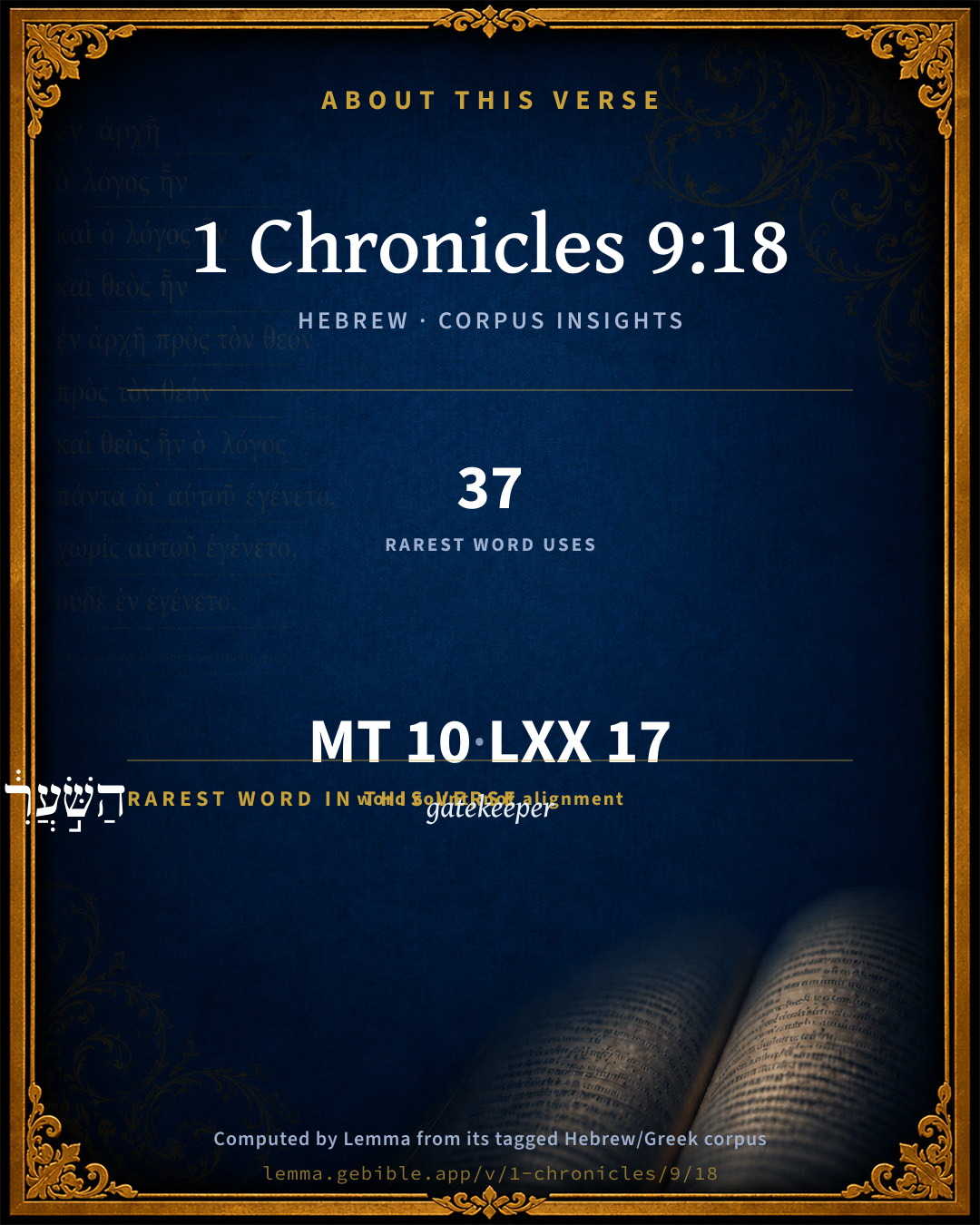
10
words
10
distinct lemmas
Historical
section

Shared distinctive vocabulary

הַשֹּׁ֣עֲרִ֔ים gatekeeper H7778 occurs in 37 verses of the Hebrew Bible. Also found in:

Grammatical profile

  • 7 nouns
  • 1 pronoun
  • 1 preposition
  • 1 adverb

Hebrew & Septuagint length

In English translation the verse runs 20 words from the Hebrew and 21 from the Septuagint (LXX English) — closely comparable.

A rough comparison of the two English renderings, which tokenize alike — not a word-level alignment.

Word counts can differ between the Hebrew and the Greek without any difference in meaning — e.g. the Hebrew direct-object marker אֵת has no separate Greek word, and Greek often adds the article ὁ.

In the original languages it is 10 Hebrew tokens and 17 Greek tokens — but the two are counted differently (Hebrew bundles its prefixes and suffixes into one token; the Greek is in lemma form), so that isn’t a like-for-like length.

Cross-references

6

Topical passages linked to 1 Chronicles 9:18 in the Treasury of Scripture Knowledge — connected by theme and wording, ordered by reader-vote popularity; previews shown in the World English Bible.

  • Ezekiel 46:1–2 Thus says the Lord Yahweh: The gate of the inner court that looks toward the east shall be shut the six working days; but on the Sabbath day it shall be opened, and on the day of the new moon it shall be opened.
  • 1 Kings 10:5 and the food of his table, and the sitting of his servants, and the attendance of his ministers, and their clothing, and his cup bearers, and his ascent by which he went up to the house of Yahweh; there was no more spirit in her.
  • 2 Kings 11:19 He took the captains over hundreds, and the Carites, and the guard, and all the people of the land; and they brought down the king from the house of Yahweh, and came by the way of the gate of the guard to the king's house. He sat on the throne of the kings.
  • 1 Chronicles 26:12–19 Of these were the divisions of the doorkeepers, even of the chief men, having offices like their brothers, to minister in the house of Yahweh.
  • Ezekiel 44:2–3 Yahweh said to me, This gate shall be shut; it shall not be opened, neither shall any man enter in by it; for Yahweh, the God of Israel, has entered in by it; therefore it shall be shut.
  • Acts 3:11 As the lame man who was healed held on to Peter and John, all the people ran together to them in the porch that is called Solomon's, greatly wondering.

Cross-references courtesy of OpenBible.info (CC BY 4.0).

Hebrew and Greek witnesses Masoretic Hebrew ↔ Greek Septuagint

The same verse in the two great witnesses to the Old Testament, shown verse-for-verse.

These are two independent witnesses, not word-aligned to each other, and the Septuagint is shown in lemma (dictionary) form.

Hebrew 1 Chronicles 9:18 Masoretic · Westminster Leningrad Codex

וְֽעַד הֵ֔נָּה בְּשַׁ֥עַר הַמֶּ֖לֶךְ מִזְרָ֑חָה הֵ֚מָּה הַשֹּׁ֣עֲרִ֔ים לְמַחֲנ֖וֹת בְּנֵ֥י לֵוִֽי

who hitherto [waited] in the king's gate eastward: they were the porters for the camp of the children of Levi.

World English Bible · Public Domain

Greek LXX 1 Chronicles 9:18 Septuagint · lemma form

καί ἕως οὗτος ἐν ὁ πύλη ὁ βασιλεύς κατά ἀνατολή οὗτος ὁ πύλη ὁ παρεμβολή υἱός λευί

and he waited hitherto in the king's gate eastward: these are the gates of the companies of the sons of Levi.

LXX2012 (modern English Septuagint) · Public Domain

Hebrew: Westminster Leningrad Codex (CC BY 4.0). Greek: Septuagint (public domain); English from LXX2012 (modern English Septuagint) (Public Domain). How the Septuagint differs from the Hebrew →

Commentary

Notes on 1 Chronicles 9:18 from classic Christian and Jewish commentators (each source and its license shown beneath its notes). The classic Christian expositions comment on the surrounding passage and are grouped to its opening verse, so a note may address several verses; the Jewish commentaries on the Tanakh (Rashi and others) are per-verse, so they appear only where the commentator wrote on this verse.

Lemma curates 59 commentaries, every one of them public domain or Creative Commons licensed, each selected and text-cleaned for this edition rather than reprinted as found. About our sources →

Trapp's Complete Commentary

John Trapp

1Ch 9:18 Who hitherto [waited] in the king’s gate eastward: they [were] porters in the companies of the children of Levi.

Ver. 18. Who hitherto.] Even till the time that this book was gathered out of the ancient chronicles. {1Ch 9:1}

John Trapp, A Commentary or Exposition upon All the Books of the Old and New Testament (1647–1656) — public domain. Text from a community e-Sword module.

Joseph Benson's Commentary

1Ch 9:18. King’s gate — In the east gate of the temple; which was so called, because the kings of Judah used to go to the temple through that gate. Under this gate he comprehends all the rest, which also were guarded by these porters. In the companies — Or, according to the courses. They kept the gates successively, according to that method into which the Levites were distributed, for the more convenient management of their several offices, among which this of the porters was one.

Joseph Benson's Commentary on the Old and New Testaments (1811–1818) — public domain. Text from a community e-Sword module.

Geneva Bible (1599)

Geneva Bible translators

So called because the king came into the Temple thereby, and not the common people.

Geneva Bible (1599) marginal notes — public domain. Text via Bolls.life.

Jamieson, Fausset & Brown

Robert Jamieson, A. R. Fausset & David Brown

the king's gate--The king had a gate from his palace into the temple (Kg2 16:18), which doubtless was kept constantly closed except for the monarch's use; and although there was no king in Israel on the return from the captivity, yet the old ceremonial was kept up, probably in the hope that the scepter would, ere long, be restored to the house of David. It is an honor by which Eastern kings are distinguished, to have a gate exclusively devoted to their own special use, and which is kept constantly closed, except when he goes out or returns (Eze 44:2). There being no king then in Israel, this gate would be always shut.

Next: 1 Chronicles Chapter 10

Jamieson, Fausset & Brown — Commentary Critical and Explanatory on the Whole Bible (1871) — public domain (CC PDM 1.0). Text via the HelloAO Bible API.

Adam Clarke's Commentary

Verse 18. The king's gate] That by which the kings of Judah went to the temple; see on 2Kg 16:18.

Adam Clarke's Commentary on the Bible (1810–1826) — public domain. Text from a community e-Sword/MySword module.

Ellicott's Commentary for English Readers

(18) They were porters in the companies of the children of Levi.—Rather, They are warders for the camps of the sons of Levi. (Comp. Num_3:23 et seq. where it is prescribed that the Levites encamp on the four sides of the tabernacle.) The primitive terminology is used in order to convey the idea that the Levitical wardership of the Temple went back historically to that of the Mosaic sanctuary.

A Bible Commentary for English Readers, edited by Charles John Ellicott (1878–1897) — public domain. Text from a community e-Sword module.

The Cambridge Bible for Schools and Colleges

gen. ed. J. J. S. Perowne

18. who] i.e. Shallum (1Ch_9:17), called Shelemiah in 1Ch_26:14 (= Meshelemiah, 1Ch_26:1). A family rather than an individual is meant.

the king’s gate eastward] That the king had an entrance into the Temple named after him appears from 2Ki_16:18, and that this gate was on the East from Eze_46:1-2.

in the companies] R.V. for the camp. This expression is borrowed from Num_2:17, where it refers to the circumstances of the Wandering in the Wilderness.

The Cambridge Bible for Schools and Colleges (gen. ed. J. J. S. Perowne; Cambridge University Press, 1878–1918) — public domain. Text from a community e-Sword module.

John Gill's Exposition

And Phinehas the son of Eleazar was the ruler over them in time past,.... Over the host, over the Levites, and the chief of them; which is to be understood of Phinehas the son of Eleazar, in the time of Moses, who succeeded his father in that post, see Num 3:32 though some think, as Kimchi observes, that this was not Phinehas the priest, but a certain Levite of this name in this post; but since he is said to be in time past, it may very well be understood of him: and it also is observed:

and the Lord was with him; inspiring him with zeal for his honour and glory, assisting and strengthening him to do his will and work, as particularly in the affair of Zimri, Num 25:7, the Targum is,"the Word of the Lord was for his help;''

this may be said for the encouragement of him that was in the same office now.

John Gill's Exposition of the Whole Bible (1746–1763) — public domain (CC PDM 1.0). Text via the HelloAO Bible API.

Albert Barnes' Notes on the Bible

Who hitherto waited - Translate, “Who to this day waits. These were the porters in the stations of the sons of Levi.” The words of the first clause refer to Shallum, and imply that, whereas Shallum (or his house) had originally the general superintendence of the temple gates, a change had been made when the author wrote, and Shallum’s charge had become the east gate only. The second clause means; “these were the porters in those fixed stations at the outer gates of the Temple, which corresponded to the camp stations of the Levites who guarded the tabernacle in the early times.”

Albert Barnes' Notes on the Bible (1834–1885) — public domain. Text from a community e-Sword/MySword module.

Haydock's Catholic Bible Commentary

Time. Hebrew, "and hitherto." This custom has been observed at the king’s gate, who entered his tribune by the eastern gate of the temple, 4 Kings xvi. 18. So far the ancient records reach. Some would infer from this passage, that a guard was still kept at the king’s gate, even though there was none sitting upon the throne after the captivity. (Calmet) --- Protestants, ("who hitherto waited in the king’s gate eastward.) They were porters in the companies of the children of Levi." (Haydock) --- These different bands attended by turns. (Menochius) --- But the captains were on duty every day, ver. 25, and 26, and 34.

George Leo Haydock (1774–1849), Haydock's Catholic Family Bible and Commentary, 1859 edition — public domain. Excludes Psalms (Douay-Rheims chapter numbering differs from Protestant) and Deuterocanonical books (Catholic canon only).

Matthew Poole's English Annotations

In the king’s gate eastward; in the east gate of the temple, which was so called, either because it was the chief and most magnificent of all the gates, or because the kings of Judah used to go to the temple through that gate, 2Ki 16:18 compare Eze 44:1,2. Under this gate he comprehends all the rest, which also were guarded by these porters.

In the companies, or, according to the companies, or orders, or courses, i.e. they kept the gates successively, according to that method into which themselves and the rest of their brethren the Levites were distributed, for the more convenient management of their several offices; among which this of the porters was one.

Matthew Poole's English Annotations on the Holy Bible (1683–1685) — public domain. Text from a community e-Sword/MySword module.

Whedon's Commentary on the Bible

Daniel D. Whedon

18. Porters — Gate or doorkeepers, whose work it was to open, close, and guard the entrances to the sanctuary. Theirs was a responsible office, and none but Levites were intrusted with its duties. The honour attaching to this position is enhanced by the statements of the following verses. Their fathers in the ancient time were intrusted with this noble service, “being over the host of the Lord,” that is, the encampment of his people in the wilderness, and even the distinguished “Phinehas the son of Eleazar” was their ruler in that ancient time.

Daniel D. Whedon (gen. ed.), Commentary on the Old and New Testaments (1874–1909) — public domain. Text from a community e-Sword module.

The Pulpit Commentary

Hitherto. (so Joh_5:17) The reference must be to Shallum, for see vers. 24-26 and Eze_46:1-3. The meaning of the remaining sentence of this verse is, "These were the gate-keepers for the Levite encampments side," or what, in later temple times, answered to it.

The Pulpit Commentary (1880–1919), ed. H.D.M. Spence-Jones & Joseph S. Exell — public domain. Text from a community e-Sword module.

John Wesley's Explanatory Notes

King's gate - In the east-gate of the temple, which was so called, because the kings of Judah used to go to the temple through that gate. Under this gate he comprehends all the rest, which also were guarded by these porters. Companies - Or, according to the courses. They kept the gates successively, according to that method into which the Levites were distributed, for the more convenient management of their several offices; among which this of the porters was one.

John Wesley, Explanatory Notes Upon the Whole Bible (1754–1765) — public domain. Text via the GEBible commentary corpus.

Keil & Delitzsch

C. F. Keil & F. Delitzsch

And Phinehas the son of Eleazar was the ruler over them in time past,.... Over the host, over the Levites, and the chief of them; which is to be understood of Phinehas the son of Eleazar, in the time of Moses, who succeeded his father in that post, see Num 3:32 though some think, as Kimchi observes, that this was not Phinehas the priest, but a certain Levite of this name in this post; but since he is said to be in time past, it may very well be understood of him: and it also is observed:

and the Lord was with him; inspiring him with zeal for his honour and glory, assisting and strengthening him to do his will and work, as particularly in the affair of Zimri, Num 25:7, the Targum is,"the Word of the Lord was for his help;''

this may be said for the encouragement of him that was in the same office now.

Keil & Delitzsch — Biblical Commentary on the Old Testament (1861–1891) — public domain (CC PDM 1.0). Text via the HelloAO Bible API. (Old Testament only.)

Rashi

Rabbi Shlomo Yitzchaki (Rashi)

And from here until the king’s gate to the east The meaning of עַד is: from here until a gate named the King’s Gate to the east.

they are the gate sentries Shallum and his brethren of the camps of the sons of Levi.

Rashi on the Tanakh — English translations: “The Judaica Press complete Tanach with Rashi, translated by A. J. Rosenberg” (CC BY 4.0); “Pentateuch with Rashi's commentary by M. Rosenbaum and A.M. Silbermann, 1929-1934” (public domain); “The Metsudah Tanach series, Lakewood, N.J” (CC BY 4.0); and “The Book of Joshua, Metsudah Publications, 1997” (CC BY 4.0). Text via Sefaria.

Lesson kit

Teaching starters — assembled from the data on this page, not authored interpretation. Every prompt links to the verse data it draws on. Edit before teaching.

1 Chronicles, in the Historical, opens this verse with 10 words (10 distinct Hebrew lemmas). Its most distinctive word is shôwʻêr (“gatekeeper”). A historical commentator’s framing appears above. Read the whole chapter for the surrounding context.

Discussion questions

  1. How does “gatekeeper” (shôwʻêr) shape what this verse is saying?
  2. How does 2 Samuel 18:26, which shares the word «gatekeeper», read alongside this verse?
  3. These translations render this verse differently; the difference is in the English rendering, not the original. What questions does that raise?
  4. Compare how Trapp's Complete Commentary and Joseph Benson's Commentary read this verse. Where do they agree or differ?

Things to notice

Reading settings

Reading text

Shown beneath each verse's original-language words.

Old Testament
Old Testament edition

Read the OT as the Masoretic Hebrew (MT) or the Greek Septuagint (LXX).

English shown for the Greek Septuagint (in the Hebrew ↔ Greek comparison).

Comparing translations? Open the Compare panel on any verse page to stack up to four side by side.