
Proverbs 31:23

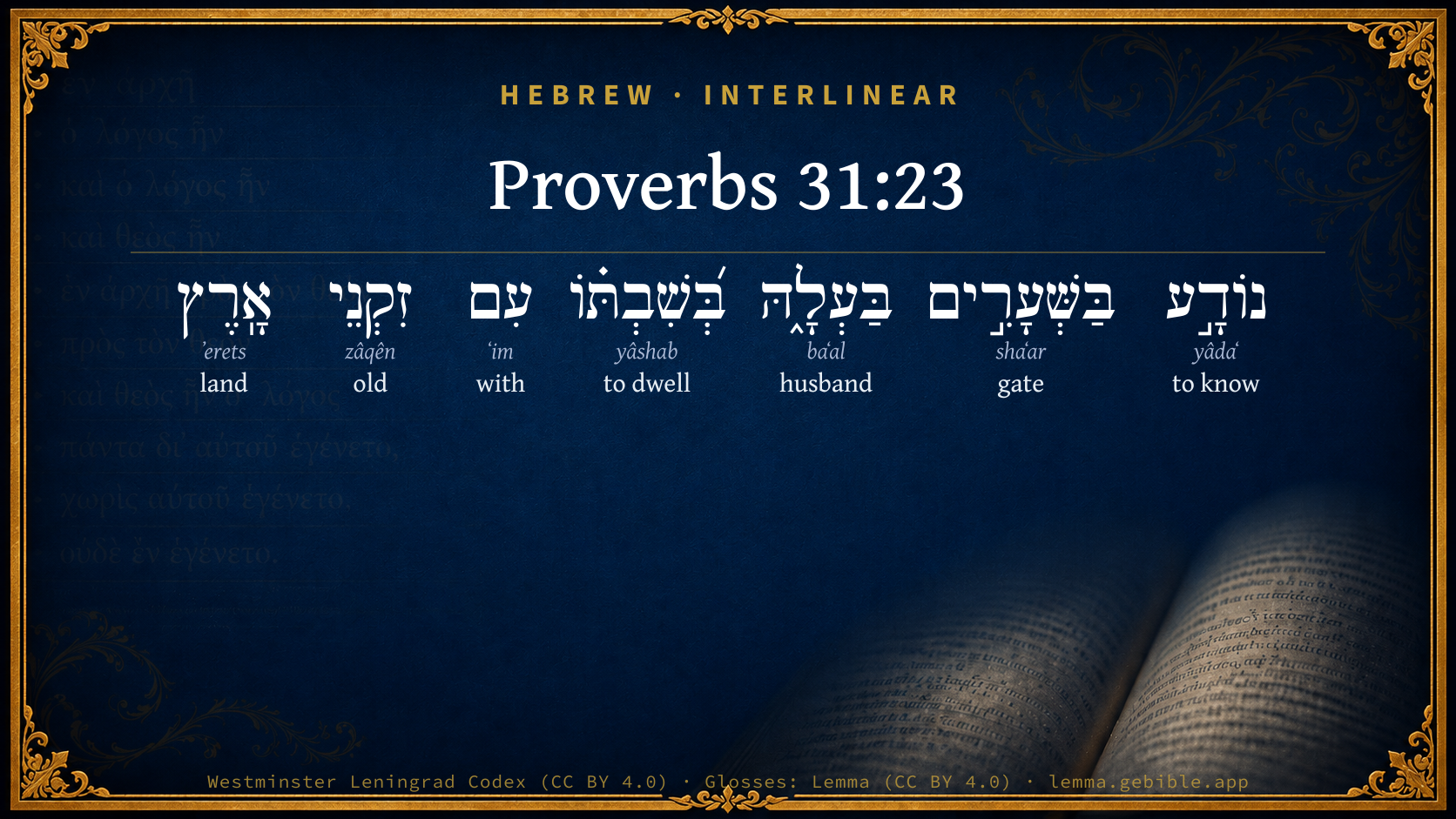
Hebrew (Westminster Leningrad Codex) Proverbs 31:23 appears in the Hebrew Old Testament. The text above is from the Westminster Leningrad Codex. Each word links to its Strong’s number, a concise gloss, and parsing drawn from the Open Scriptures Hebrew Bible morphology. Click any word for its full Brown-Driver-Briggs (BDB) entry.
Download image
Cite this verse

Proverbs 31:23 (World English Bible). Public Domain. Lemma interlinear Bible study tool, https://lemma.gebible.app/v/proverbs/31/23.

Show BibTeX & RIS
BibTeX
RIS
English Translation
Her husband is respected in the gates, When he sits among the elders of the land.
World English Bible · Public Domain
Download a study sheet

One document with this verse’s original text, its word-by-word gloss line, the meaning frame, cross-references with their text, attributed commentary, and full source and license credits — printable, and it pastes into notes with its structure intact.

This verse Autodidact and up

Study sheet (.html) Plain text (.txt)

A passage Seminary Student

Up to 50 verses in one chapter. A passage sheet keeps up to 6 commentary sources and 12 cross-references per verse, in the order this page ranks them, and says so on the sheet whenever that leaves anything out. Ask for a single verse and you get the Autodidact verse sheet above.

Everything on this page stays free to read, with no account — the sheet is a download of what is already on screen, not access to it.

Want to remove ads? Support Godless Engineer
Compare translations 3

The same verse in 3 English versions, stacked beneath the original-language interlinear above. Click any original word for its lexicon entry.

Each is an independent rendering of the whole verse — the interlinear is not word-aligned to these translations.

Highlighted words mark where these versions differ — a whole-verse word diff, not a word-by-word alignment.

  • World English Bible Public Domain
    Her husband is respected in the gates, When he sits among the elders of the land.
  • King James Version Public Domain
    Her husband is known in the gates, when he sitteth among the elders of the land.
  • unfoldingWord Literal Text CC BY-SA 4.0
    Her husband is known at the gates, when he sits with the elders of the land.

unfoldingWord Literal Text — © unfoldingWord, licensed CC BY-SA 4.0. Word-aligned USFM3 via Door43 (git.door43.org/unfoldingWord/en_ult).

Versions to compare (up to 4)

3 of 4 selected

Show all 18 translations

Every available English version of this verse, each an independent rendering of the whole verse.

  • World English Bible Public Domain
    Her husband is respected in the gates, When he sits among the elders of the land.
  • Berean Standard Bible Public Domain
    Her husband is known at the city gate, where he sits among the elders of the land.
  • Majority Standard Bible Public Domain
    Her husband is known at the city gates, where he sits among the elders of the land.
  • King James Version Public Domain
    Her husband is known in the gates, when he sitteth among the elders of the land.
  • American Standard Version (1901) Public Domain
    Her husband is known in the gates, When he sitteth among the elders of the land.
  • Revised Version (1885) Public Domain
    Her husband is known in the gates, when he sitteth among the elders of the land.
  • Geneva Bible (1599) Public Domain
    Her husband is knowen in the gates, when he sitteth with the Elders of the land.
  • Douay-Rheims (1899) Public Domain
    Her husband is honourable in the gates, when he sitteth among the senators of the land.
  • Young's Literal Translation Public Domain
    Known in the gates is her husband, In his sitting with elders of the land.
  • Literal Standard Version CC BY-SA 4.0
    Her husband is known in the gates, || In his sitting with [the] elderly of [the] land.
  • Unlocked Literal Bible CC BY-SA 4.0
    Her husband is known at the gates, when he sits with the elders of the land.
  • unfoldingWord Literal Text CC BY-SA 4.0
    Her husband is known at the gates, when he sits with the elders of the land.
  • Darby Bible Public Domain
    Her husband is known in the gates, when he sitteth among the elders of the land.
  • World Messianic Bible Public Domain
    Her husband is respected in the gates, when he sits among the elders of the land.
  • Webster's Bible Public Domain
    Her husband is known in the gates, when he sitteth among the elders of the land.
  • Free Bible Version CC BY-SA 4.0
    Her husband is well-respected in the council at the town gates, where he sits with the town elders.
  • Bible in Basic English Public Domain
    Her husband is a man of note in the public place, when he takes his seat among the responsible men of the land.
  • JPS Tanakh (1917) Public Domain
    Her husband is known in the gates, when he sitteth among the elders of the land.

Literal Standard Version (2020), Covenant Press — licensed CC BY-SA 4.0. Text via the HelloAO Bible API (eBible.org). Unlocked Literal Bible (unfoldingWord) — licensed CC BY-SA 4.0. Text via the HelloAO Bible API (eBible.org). unfoldingWord Literal Text — © unfoldingWord, licensed CC BY-SA 4.0. Word-aligned USFM3 via Door43 (git.door43.org/unfoldingWord/en_ult). Free Bible Version, Dr. Jonathan Gallagher — licensed CC BY-SA 4.0. Text via the HelloAO Bible API (eBible.org).

Word by word

More ways to search: Search by grammar → Find every occurrence → Compare this word →

Practice this passage: Drill this verse → Learn its vocabulary →

About this verse

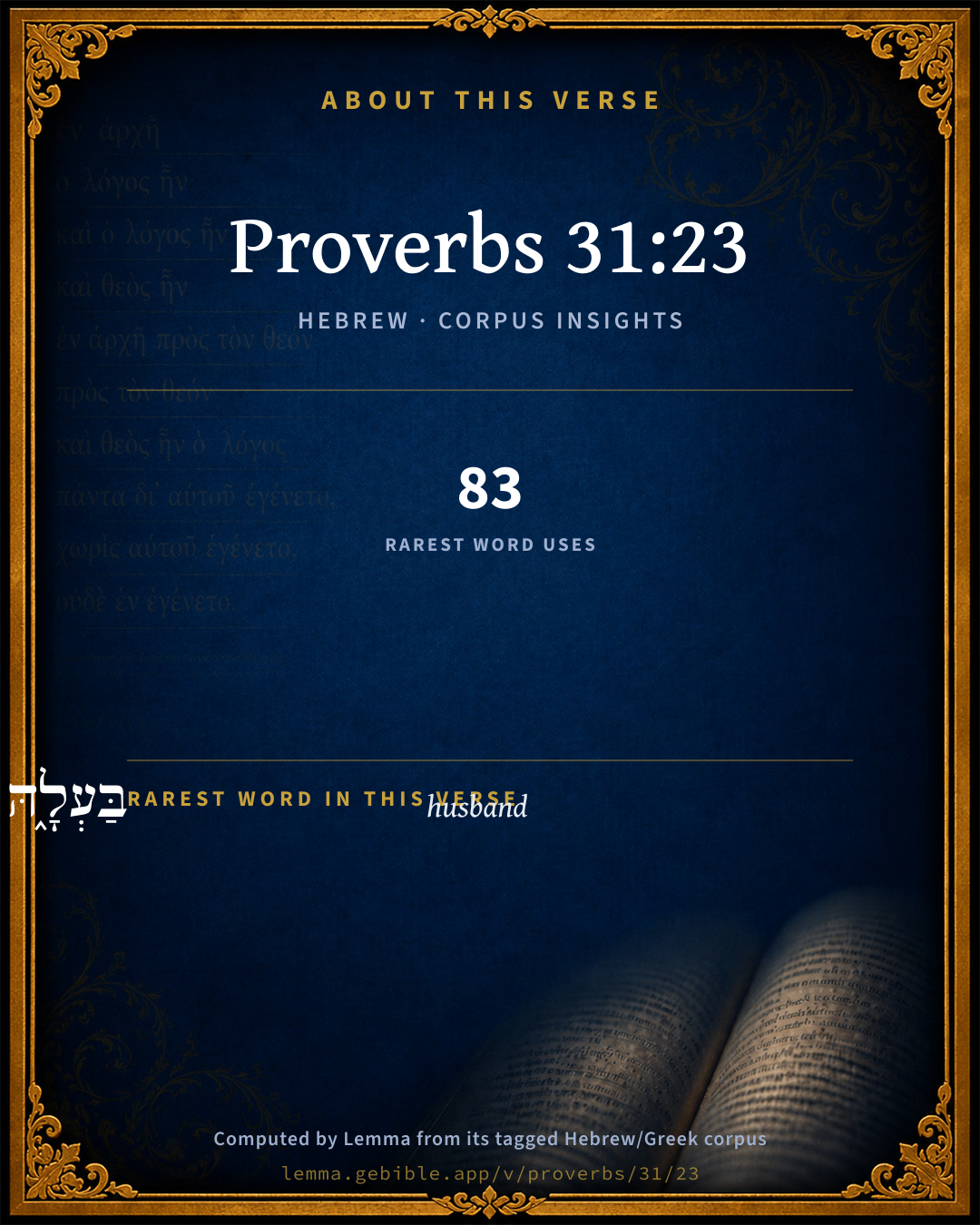
These counts appear in no published source. They are computed here, from the morphology-tagged text and Lemma’s own curated glosses. What Lemma adds →

7
words
7
distinct lemmas
Wisdom
section

Grammatical profile

  • 2 verbs
  • 3 nouns
  • 1 adjective
  • 1 preposition

Verb forms

  • נוֹדָ֣ע Niphal · Participle Active
  • בְּ֝שִׁבְתּ֗וֹ Qal · Infinitive Construct

Hebrew & Septuagint length

In English translation the verse runs 16 words from the Hebrew and 22 from the Septuagint (LXX English) — closely comparable.

A rough comparison of the two English renderings, which tokenize alike — not a word-level alignment.

Word counts can differ between the Hebrew and the Greek without any difference in meaning — e.g. the Hebrew direct-object marker אֵת has no separate Greek word, and Greek often adds the article ὁ.

Cross-references

7

Topical passages linked to Proverbs 31:23 in the Treasury of Scripture Knowledge — connected by theme and wording, ordered by reader-vote popularity; previews shown in the World English Bible.

  • Proverbs 12:4 A worthy woman is the crown of her husband, But a disgraceful wife is as rottenness in his bones.
  • Ruth 4:1 Now Boaz went up to the gate, and sat him down there: and, behold, the near kinsman of whom Boaz spoke came by; to whom he said, Ho, such a one! turn aside, sit down here. He turned aside, and sat down.
  • Deuteronomy 16:18 Judges and officers shall you make you in all your gates, which Yahweh your God gives you, according to your tribes; and they shall judge the people with righteous judgment.
  • Deuteronomy 21:19 then shall his father and his mother lay hold on him, and bring him out to the elders of his city, and to the gate of his place;
  • Ruth 4:11 All the people who were in the gate, and the elders, said, We are witnesses. Yahweh make the woman who has come into your house like Rachel and like Leah, which two built the house of Israel: and do you worthily in Ephrathah, and be famous in Bethlehem:
  • Job 29:7 When I went forth to the city gate, When I prepared my seat in the street,
  • Proverbs 24:7 Wisdom is too high for a fool: He doesn't open his mouth in the gate.

Cross-references courtesy of OpenBible.info (CC BY 4.0).

Hebrew and Greek witnesses Masoretic Hebrew ↔ Greek Septuagint

The same verse in the two great witnesses to the Old Testament, shown verse-for-verse.

These are two independent witnesses, not word-aligned to each other, and the Septuagint is shown in lemma (dictionary) form.

Hebrew Proverbs 31:23 Masoretic · Westminster Leningrad Codex

נוֹדָ֣ע בַּשְּׁעָרִ֣ים בַּעְלָ֑הּ בְּ֝שִׁבְתּ֗וֹ עִם זִקְנֵי אָֽרֶץ

Her husband is respected in the gates, When he sits among the elders of the land.

World English Bible · Public Domain

Greek LXX Proverbs 31:23 Septuagint · lemma form

περίβλεπτος δέ γίγνομαι ἐν πύλη ὁ ἀνήρ αὐτός ἡνίκα ἄν καταἵζω ἐν συνέδριον μετά ὁ γέρων κατοίκος ὁ γῆ

And her husband becomes a distinguished person in the gates, when he sits in council with the old inhabitants of the land.

LXX2012 (modern English Septuagint) · Public Domain

On this verse, Keil & Delitzsch discusses the Septuagint’s reading. Read the note in Commentary ↓

Hebrew: Westminster Leningrad Codex (CC BY 4.0). Greek: Septuagint (public domain); English from LXX2012 (modern English Septuagint) (Public Domain). How the Septuagint differs from the Hebrew →

Commentary

Notes on Proverbs 31:23 from classic Christian and Jewish commentators (each source and its license shown beneath its notes). The classic Christian expositions comment on the surrounding passage and are grouped to its opening verse, so a note may address several verses; the Jewish commentaries on the Tanakh (Rashi and others) are per-verse, so they appear only where the commentator wrote on this verse.

Lemma curates 59 commentaries, every one of them public domain or Creative Commons licensed, each selected and text-cleaned for this edition rather than reprinted as found. About our sources →

Trapp's Complete Commentary

John Trapp

Pro 31:23 Her husband is known in the gates, when he sitteth among the elders of the land.

Ver. 23. Her husband is known in the gates.] Is renowned and noted for his wife’s worth, besides that he is a ruler in Israel.

John Trapp, A Commentary or Exposition upon All the Books of the Old and New Testament (1647–1656) — public domain. Text from a community e-Sword module.

Geneva Bible (1599)

Geneva Bible translators

In the assemblies and places of judgment.

Geneva Bible (1599) marginal notes — public domain. Text via Bolls.life.

Jamieson, Fausset & Brown

Robert Jamieson, A. R. Fausset & David Brown

in the gates--(compare Pro 22:22). His domestic comfort promotes his advancement in public dignity.

Jamieson, Fausset & Brown — Commentary Critical and Explanatory on the Whole Bible (1871) — public domain (CC PDM 1.0). Text via the HelloAO Bible API.

Adam Clarke's Commentary

Verse 23. Her husband is known in the gates]

14. She is a loving wife, and feels for the respectability and honour of her husband. He is an elder among his people, and he sits as a magistrate in the gate. He is respected not only on account of the neatness and cleanliness of his person and dress, but because he is the husband of a woman who is justly held in universal esteem. And her complete management of household affairs gives him full leisure to devote himself to the civil interests of the community.

Adam Clarke's Commentary on the Bible (1810–1826) — public domain. Text from a community e-Sword/MySword module.

Ellicott's Commentary for English Readers

(23) Her husband is known in the gates.—See above on Pro_22:22. Instead of being a hindrance to her husband’s advancement, she furthers it. Her influence for good extends to him also. Having no domestic anxieties, he is set free to do his part in public life.

A Bible Commentary for English Readers, edited by Charles John Ellicott (1878–1897) — public domain. Text from a community e-Sword module.

The Cambridge Bible for Schools and Colleges

gen. ed. J. J. S. Perowne

23. is known] both by the fitting attire and by the freedom from anxiety and distraction, which her care and industry secure to him. Dean Plumptre in Speaker’s Comm. quotes the words of Nausicaa to her father in Hom. Odyss. vi. 60:

“’Tis meet for thee to sit among the princes,

And hold thy council, with thy body clad

In raiment fair and clean.”

The Cambridge Bible for Schools and Colleges (gen. ed. J. J. S. Perowne; Cambridge University Press, 1878–1918) — public domain. Text from a community e-Sword module.

John Gill's Exposition

Her husband is known in the gates,.... Of the city, where courts of justice were kept, and causes heard and tried by the judges, the elders of the land, later mentioned; among whom the husband of the virtuous woman was, where he was known, taken notice of, and celebrated; not so much for the beautiful garments she made him, as Jarchi; but rather for his wisdom, as Gersom, and for being the husband of such a woman; who, taking such care of his domestic affairs, he was more at leisure to attend public business, and transact it with reputation. Christ is the husband of the church in general, and of particular churches, and of every private believer; he fell in love with them, asked them of his Father, and betrothed them to himself; and is a kind, tender, loving, and sympathizing husband to his church and people; that nourishes and cherishes them, and provides all things for them, and interests them in all he has: and he is "known" by them, in the dignity of his person, in the excellency of his offices, and the fulness of his grace; he is known by them in the relation of an husband; he is well known in the church of God, in the assembly of his saints, Psa 76:1; he is known in the gates of Zion, in the public ministering of the word and ordinances; his name is celebrated, it becomes great and famous, wherever his Gospel is preached in the world; he is,

"known in the provinces,''

as the Targum; or,

"among the cities,''

as the Syriac version; among the nations of the world, in the cities of the Gentiles; as he will be, even from the rising of the sun to the going down of the same, Mal 1:11;

when he sitteth among the elders of the land; when he sits in his house, at his table, circled by his saints, his ancient ones; or as King, head, and husband of his people, on his throne in the church, encompassed with, the four and twenty elders, the representatives of Gospel churches, Rev 4:2. And especially when he shall take to himself his great power, and reign gloriously before his ancients, the patriarchs, prophets, and apostles, and all his saints, which will come with him; whom he has loved with an everlasting love; who were chosen in him before the foundation of the world; and had grace given them, in him, before the world began, Isa 24:23; and when he shall come to judge the world, and will appear in great glory, and be seen and known of all; and shall sit on his throne of glory, and his elders also, sitting on twelve thrones, judging the tribes of Israel, Mat 19:28; so Ambrose interprets it of the universal judgment.

John Gill's Exposition of the Whole Bible (1746–1763) — public domain (CC PDM 1.0). Text via the HelloAO Bible API.

Albert Barnes' Notes on the Bible

The industry of the wife leaves the husband free to take his place among the elders that sit in councils.

Albert Barnes' Notes on the Bible (1834–1885) — public domain. Text from a community e-Sword/MySword module.

Haydock's Catholic Bible Commentary

Gates. Chaldean, "provinces." The rich were chosen for judges. (Calmet)

George Leo Haydock (1774–1849), Haydock's Catholic Family Bible and Commentary, 1859 edition — public domain. Excludes Psalms (Douay-Rheims chapter numbering differs from Protestant) and Deuterocanonical books (Catholic canon only).

Matthew Poole's English Annotations

Known; observed and respected, not only for his own worth, but for his wife’s sake; not only for those rich ornaments which by her care and diligence she provides for him, which others of his brethren, by reason of their wives’ sloth or luxury, are not able to procure, but also for his wisdom in choosing, and his happiness in enjoying, so excellent a wife, by whose prudent care, in the management of his domestic concerns, he hath perfect freedom wholly to attend upon public affairs.

Sitteth among the elders of the land, in counsel or judgment.

Matthew Poole's English Annotations on the Holy Bible (1683–1685) — public domain. Text from a community e-Sword/MySword module.

Whedon's Commentary on the Bible

Daniel D. Whedon

23. Known in the gates — He is recognised and honoured in the courts, or public assemblies.

When he sitteth among the elders — The senators or magistrates, who sit by the gates to decide cases and to transact public business. He is eminent among the public men. It is intimated that something of this is due to his wife’s thrift and good management. She conducts the domestic affairs so well and so profitably as to allow him time and means to devote to the public service. His genteel deportment and becoming attire indicate the wife of good taste and rare accomplishments. Blessed is the man that has a wife capable of correcting his foibles, smoothing down his rough points, and teaching him becoming deportment. Many a man is more indebted to his wife than he is aware of for his advancement in the world.

Daniel D. Whedon (gen. ed.), Commentary on the Old and New Testaments (1874–1909) — public domain. Text from a community e-Sword module.

The Pulpit Commentary

NUN. Her husband is known in the gates. Such a woman advances her husband"s interests, increases his influence, and, by attending to his domestic concerns, enables him to take his share in public matters, so that his name is in great repute in the popular assemblies at the city gates. (ver. 31; Pro_8:3) She is indeed "a crown to her husband". (Pro_12:4) When he sitteth among the elders of the land. Homer introduces Nausikaa speaking to her father of her duty to see that he is honourably clad when he goes to the council Kai de soi autw eoike meta prwtoisin eonta Boulaein kayara croi eimat econta . ("Odyssey," 6:60.) "For our costly robes, All sullied now, the cleansing stream require; And thine especially, when thou appear"st In council with the princes of the land, Had need be pure. (Cowper)

St. Gregory sees here an adumbration of the day of judgment: "For the Redeemer of mankind is the "Husband" of holy Church, who shows himself "renowned" (nobilis, Vulgate) in the gates. Who first came in sight in degradation and in mockings, but shall appear on high at the entering in of his kingdom; and "he sitteth among the elders of the land," for that he shall decree sentence of condemnation together with the holy preachers of that same Church, as himself declares in the gospel (Mat_19:28) ("Moral.," 6:9).

The Pulpit Commentary (1880–1919), ed. H.D.M. Spence-Jones & Joseph S. Exell — public domain. Text from a community e-Sword module.

John Wesley's Explanatory Notes

It known - Observed and respected, not only for his own worth, but for his wife's sake. Sitteth - In counsel or judgment.

John Wesley, Explanatory Notes Upon the Whole Bible (1754–1765) — public domain. Text via the GEBible commentary corpus.

Keil & Delitzsch

C. F. Keil & F. Delitzsch

Now, first, the description turns back to the husband, of the woman who is commended, mentioned in the introduction:

23 נ 32 Well known in the gates is her husband,

Where he sitteth among the elders of the land.

Such a wife is, according to Pro 12:4, עטרת בּעלּהּ, - she advances the estimation and the respect in which her husband is held. He has, in the gates where the affairs of the city are deliberated upon, a well-known, reputable name; for there he sits, along with the elders of the land, who are chosen into the council of the city as the chief place of the land, and has a weighty voice among them. The phrase wavers between נודע (lxx περίβλεπτος γίνεται; Venet. ἔλνωσται) and נודע. The old Venetian edd. have in this place (like the Cod. Jaman.), and at Psa 9:17, נודע; on the contrary, Psa 76:2; Ecc 6:10, נודע, and that is correct; for the Masora, at this place and at Psa 76:2 (in the Biblia rabb), is disfigured.

Keil & Delitzsch — Biblical Commentary on the Old Testament (1861–1891) — public domain (CC PDM 1.0). Text via the HelloAO Bible API. (Old Testament only.)

Rashi

Rabbi Shlomo Yitzchaki (Rashi)

Her husband is known in the gates He is recognizable among his peers because of his garments, which are beautiful.

Rashi on the Tanakh — English translations: “The Judaica Press complete Tanach with Rashi, translated by A. J. Rosenberg” (CC BY 4.0); “Pentateuch with Rashi's commentary by M. Rosenbaum and A.M. Silbermann, 1929-1934” (public domain); “The Metsudah Tanach series, Lakewood, N.J” (CC BY 4.0); and “The Book of Joshua, Metsudah Publications, 1997” (CC BY 4.0). Text via Sefaria.

Lesson kit

Teaching starters — assembled from the data on this page, not authored interpretation. Every prompt links to the verse data it draws on. Edit before teaching.

Proverbs, in the Wisdom, opens this verse with 7 words (7 distinct Hebrew lemmas). Its most distinctive word is baʻal (“husband”). A historical commentator’s framing appears above. Read the whole chapter for the surrounding context.

Discussion questions

  1. The word baʻal carries the sense “husband.” How does it shape the verse?
  2. Proverbs 12:4 shares this passage’s theme. How do the two illuminate each other?
  3. These translations render this verse differently. What is at stake in choosing one wording over another?
  4. The verb «נוֹדָ֣ע» is Niphal Participle Active. How does its form color the action?
  5. Reading how Trapp's Complete Commentary and Geneva Bible (1599) read this verse, where do the two commentators agree and where do they part?

Things to notice

Reading settings

Reading text

Shown beneath each verse's original-language words.

Old Testament
Old Testament edition

Read the OT as the Masoretic Hebrew (MT) or the Greek Septuagint (LXX).

English shown for the Greek Septuagint (in the Hebrew ↔ Greek comparison).

Comparing translations? Open the Compare panel on any verse page to stack up to four side by side.