1 Chronicles 26:16

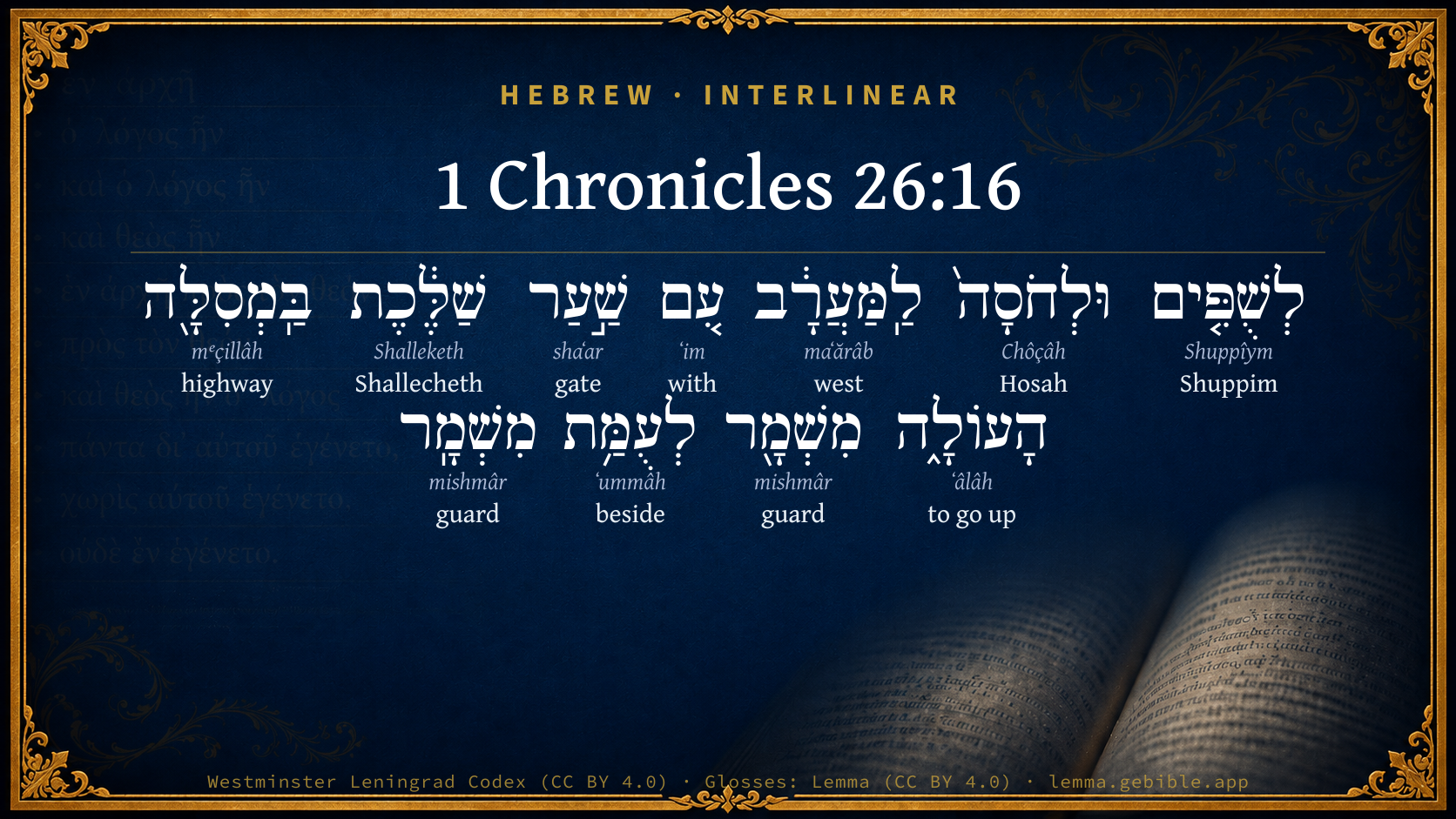
Hebrew (Westminster Leningrad Codex) 1 Chronicles 26:16 appears in the Hebrew Old Testament. The text above is from the Westminster Leningrad Codex. Each word links to its Strong’s number, a concise gloss, and parsing drawn from the Open Scriptures Hebrew Bible morphology. Click any word for its full Brown-Driver-Briggs (BDB) entry.
Download image
Cite this verse

1 Chronicles 26:16 (World English Bible). Public Domain. Lemma interlinear Bible study tool, https://lemma.gebible.app/v/1-chronicles/26/16.

Show BibTeX & RIS
BibTeX
RIS
English Translation
To Shuppim and Hosah westward, by the gate of Shallecheth, at the causeway that goes up, watch against watch.
World English Bible · Public Domain
Highlights
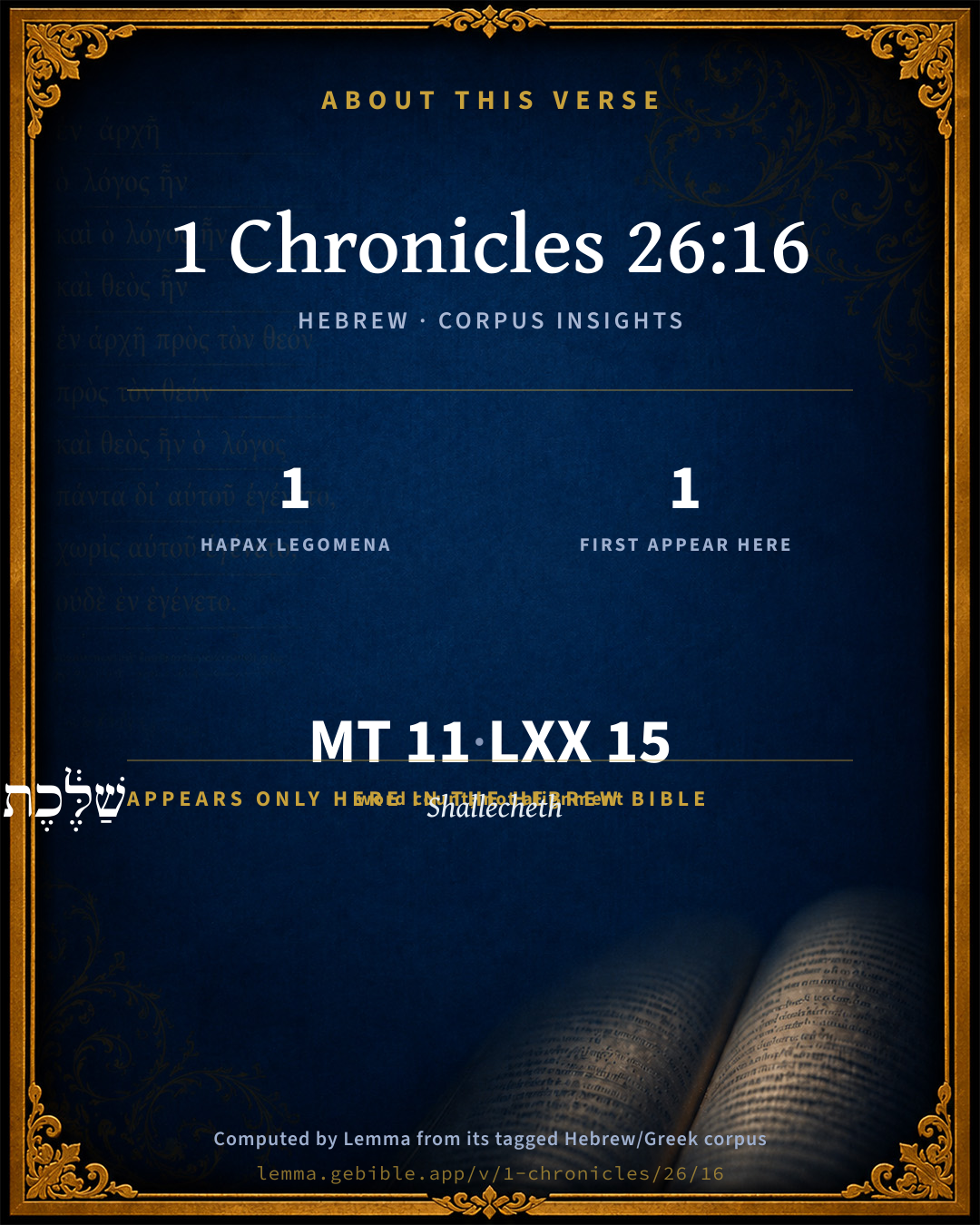
  • 1 hapax legomenon — only here in the Hebrew Bible
  • 1 first appearance in the Hebrew Bible
Full analysis ↓
Download a study sheet

One document with this verse’s original text, its word-by-word gloss line, the meaning frame, cross-references with their text, attributed commentary, and full source and license credits — printable, and it pastes into notes with its structure intact.

This verse Autodidact and up

Study sheet (.html) Plain text (.txt)

A passage Seminary Student

Up to 50 verses in one chapter. A passage sheet keeps up to 6 commentary sources and 12 cross-references per verse, in the order this page ranks them, and says so on the sheet whenever that leaves anything out. Ask for a single verse and you get the Autodidact verse sheet above.

Everything on this page stays free to read, with no account — the sheet is a download of what is already on screen, not access to it.

Want to remove ads? Support Godless Engineer
Compare translations 3

The same verse in 3 English versions, stacked beneath the original-language interlinear above. Click any original word for its lexicon entry.

Each is an independent rendering of the whole verse — the interlinear is not word-aligned to these translations.

Highlighted words mark where these versions differ — a whole-verse word diff, not a word-by-word alignment.

  • World English Bible Public Domain
    To Shuppim and Hosah westward, by the gate of Shallecheth, at the causeway that goes up, watch against watch.
  • King James Version Public Domain
    To Shuppim and Hosah the lot came forth westward, with the gate Shallecheth, by the causeway of the going up, ward against ward.
  • unfoldingWord Literal Text CC BY-SA 4.0
    For Shuppim and for Hosah, to the west, with the gate of Shalleketh on the ascending highway, guard beside guard.

unfoldingWord Literal Text — © unfoldingWord, licensed CC BY-SA 4.0. Word-aligned USFM3 via Door43 (git.door43.org/unfoldingWord/en_ult).

Versions to compare (up to 4)

3 of 4 selected

Show all 18 translations

Every available English version of this verse, each an independent rendering of the whole verse.

  • World English Bible Public Domain
    To Shuppim and Hosah westward, by the gate of Shallecheth, at the causeway that goes up, watch against watch.
  • Berean Standard Bible Public Domain
    The lots for the West Gate and the Shallecheth Gate on the ascending highway fell to Shuppim and Hosah. There were guards stationed at every watch.
  • Majority Standard Bible Public Domain
    The lots for the West Gate and the Shallecheth Gate on the ascending highway fell to Shuppim and Hosah. There were guards stationed at every watch.
  • King James Version Public Domain
    To Shuppim and Hosah the lot came forth westward, with the gate Shallecheth, by the causeway of the going up, ward against ward.
  • American Standard Version (1901) Public Domain
    To Shuppim and Hosah westward, by the gate of Shallecheth, at the causeway that goeth up, watch against watch.
  • Revised Version (1885) Public Domain
    To Shuppim and Hosah westward, by the gate of Shallecheth, at the causeway that goeth up, ward against ward.
  • Geneva Bible (1599) Public Domain
    To Shuppim and to Hosah Westwarde with the gate of Shallecheth by the paued streete that goeth vpward, warde ouer against warde.
  • Douay-Rheims (1899) Public Domain
    To Sephim, and Hosa towards the west, by the gate which leadeth to the way of the ascent: ward against ward.
  • Young's Literal Translation Public Domain
    to Shuppim and to Hosah to the west, with the gate Shallecheth, in the highway, the ascent, charge over-against charge;
  • Literal Standard Version CC BY-SA 4.0
    to Shuppim and to Hosah to the west, with Shallecheth Gate, in the highway, the ascent, watch next to watch;
  • Unlocked Literal Bible CC BY-SA 4.0
    Shuppim and Hosah were assigned the west gate along with the gate of Shalleketh, on the upper road. Watches were established for each family.
  • unfoldingWord Literal Text CC BY-SA 4.0
    For Shuppim and for Hosah, to the west, with the gate of Shalleketh on the ascending highway, guard beside guard.
  • Darby Bible Public Domain
    To Shuppim and Hosah westward, with the gate Shallecheth, by the causeway of the ascent, watch against watch.
  • World Messianic Bible Public Domain
    To Shuppim and Hosah westward, by the gate of Shallecheth, at the causeway that goes up, watchman opposite watchman.
  • Webster's Bible Public Domain
    To Shuppim and Hosah the lot came forth westward, with the gate Shallecheth, by the way of the ascent, ward against ward.
  • Free Bible Version CC BY-SA 4.0
    Shuppim and Hosah received the west gate and the gate of Shallecheth on the road that leads up. They were always guarded.
  • Bible in Basic English Public Domain
    To Hosah, the door on the west, by the door of Shallecheth, at the footway which goes up, watch by watch.
  • JPS Tanakh (1917) Public Domain
    To Shuppim and Hosah westward, by the gate of Shallecheth, at the causeway that goeth up, ward against ward.

Literal Standard Version (2020), Covenant Press — licensed CC BY-SA 4.0. Text via the HelloAO Bible API (eBible.org). Unlocked Literal Bible (unfoldingWord) — licensed CC BY-SA 4.0. Text via the HelloAO Bible API (eBible.org). unfoldingWord Literal Text — © unfoldingWord, licensed CC BY-SA 4.0. Word-aligned USFM3 via Door43 (git.door43.org/unfoldingWord/en_ult). Free Bible Version, Dr. Jonathan Gallagher — licensed CC BY-SA 4.0. Text via the HelloAO Bible API (eBible.org).

Word by word

More ways to search: Search by grammar → Find every occurrence → Compare this word →

Practice this passage: Drill this verse → Learn its vocabulary →

שַׁלֶּ֔כֶת
Shalleketh
H7996
“Shallecheth”
Noun, Proper
Part of Speech
Noun
Type
Proper
Full BDB Definition

Origin: the same as H7995

TWOT: None

Shallecheth = "overthrow" - one of the temple gates on the west side
  1. לְשֻׁפִּ֤ים Shuppîym H8206 “to/for · Shuppim” Preposition + Noun, Proper
  2. וּלְחֹסָה֙ Chôçâh H2621 “and · to/for · Hosah” Conjunction + Preposition + Noun, Proper
  3. לַֽמַּעֲרָ֔ב maʻărâb H4628 “to/for the · west” Preposition, Determined + Noun, Common, Masculine, Singular, Absolute
  4. עִ֚ם ʻim H5973 “with” Preposition
  5. שַׁ֣עַר shaʻar H8179 “gate of” Noun, Common, Masculine, Singular, Construct
  6. בַּֽמְסִלָּ֖ה mᵉçillâh H4546 “in/at the · highway” Preposition, Determined + Noun, Common, Feminine, Singular, Absolute
  7. הָעוֹלָ֑ה ʻâlâh H5927 “the · going up” Particle, Definite Article + Verb, Qal, Participle Active, Feminine, Singular, Absolute
  8. מִשְׁמָ֖ר mishmâr H4929 “guard” Noun, Common, Masculine, Singular, Absolute
  9. לְעֻמַּ֥ת ʻummâh H5980 “to/for · beside of” Preposition + Noun, Common, Feminine, Singular, Construct
  10. מִשְׁמָֽר mishmâr H4929 “guard” Noun, Common, Masculine, Singular, Absolute

About this verse

These counts appear in no published source. They are computed here, from the morphology-tagged text and Lemma’s own curated glosses. What Lemma adds →

11
words
10
distinct lemmas
Historical
section

Notable vocabulary

1 hapax legomenon — a word that appears only here in the entire Hebrew Bible:

  • שַׁלֶּ֔כֶת Shallecheth H7996

First appearance in Scripture

This word makes its first canonical appearance in the Hebrew Bible here:

  • שַׁלֶּ֔כֶת Shallecheth H7996

Shared distinctive vocabulary

לְשֻׁפִּ֤ים Shuppim H8206 occurs in 3 verses of the Hebrew Bible. Also found in:

Grammatical profile

  • 1 verb
  • 9 nouns
  • 1 preposition

Verb forms

  • הָעוֹלָ֑ה Qal · Participle Active

Repetition

A word recurs within this verse — often emphatic in Hebrew:

  • מִשְׁמָ֖ר guard H4929 ×2

Hebrew & Septuagint length

In English translation the verse runs 19 words from the Hebrew and 22 from the Septuagint (LXX English) — closely comparable.

A rough comparison of the two English renderings, which tokenize alike — not a word-level alignment.

Word counts can differ between the Hebrew and the Greek without any difference in meaning — e.g. the Hebrew direct-object marker אֵת has no separate Greek word, and Greek often adds the article ὁ.

In the original languages it is 11 Hebrew tokens and 15 Greek tokens — but the two are counted differently (Hebrew bundles its prefixes and suffixes into one token; the Greek is in lemma form), so that isn’t a like-for-like length.

Cross-references

5

Topical passages linked to 1 Chronicles 26:16 in the Treasury of Scripture Knowledge — connected by theme and wording, ordered by reader-vote popularity; previews shown in the World English Bible.

  • 1 Kings 10:5 and the food of his table, and the sitting of his servants, and the attendance of his ministers, and their clothing, and his cup bearers, and his ascent by which he went up to the house of Yahweh; there was no more spirit in her.
  • 1 Chronicles 25:8 They cast lots for their offices, all alike, as well the small as the great, the teacher as the scholar.
  • 1 Chronicles 26:10–12 Also Hosah, of the children of Merari, had sons: Shimri the chief, (for though he was not the firstborn, yet his father made him chief),
  • 2 Chronicles 9:4 and the food of his table, and the sitting of his servants, and the attendance of his ministers, and their clothing, his cup bearers also, and their clothing, and his ascent by which he went up to the house of Yahweh; there was no more spirit in her.
  • Nehemiah 12:24 The chiefs of the Levites: Hashabiah, Sherebiah, and Jeshua the son of Kadmiel, with their brothers over against them, to praise and give thanks, according to the commandment of David the man of God, watch next to watch.

Cross-references courtesy of OpenBible.info (CC BY 4.0).

Hebrew and Greek witnesses Masoretic Hebrew ↔ Greek Septuagint

The same verse in the two great witnesses to the Old Testament, shown verse-for-verse.

These are two independent witnesses, not word-aligned to each other, and the Septuagint is shown in lemma (dictionary) form.

Hebrew 1 Chronicles 26:16 Masoretic · Westminster Leningrad Codex

לְשֻׁפִּ֤ים וּלְחֹסָה֙ לַֽמַּעֲרָ֔ב עִ֚ם שַׁ֣עַר שַׁלֶּ֔כֶת בַּֽמְסִלָּ֖ה הָעוֹלָ֑ה מִשְׁמָ֖ר לְעֻמַּ֥ת מִשְׁמָֽר

To Shuppim and Hosah westward, by the gate of Shallecheth, at the causeway that goes up, watch against watch.

World English Bible · Public Domain

Greek LXX 1 Chronicles 26:16 Septuagint · lemma form

εἰς δεύτερος ὁ ωσα πρός δυσμή μετά ὁ πύλη παστοφόριον ὁ ἀνάβασις φυλακή κατέναντι φυλακή

They gave the lot for the second to Osa westward, after the gate of the chamber by the ascent, watch against watch.

LXX2012 (modern English Septuagint) · Public Domain

On this verse, Ellicott's Commentary for English Readers discusses the Septuagint’s reading. Read the note in Commentary ↓

Hebrew: Westminster Leningrad Codex (CC BY 4.0). Greek: Septuagint (public domain); English from LXX2012 (modern English Septuagint) (Public Domain). How the Septuagint differs from the Hebrew →

Commentary

Notes on 1 Chronicles 26:16 from classic Christian and Jewish commentators (each source and its license shown beneath its notes). The classic Christian expositions comment on the surrounding passage and are grouped to its opening verse, so a note may address several verses; the Jewish commentaries on the Tanakh (Rashi and others) are per-verse, so they appear only where the commentator wrote on this verse.

Lemma curates 59 commentaries, every one of them public domain or Creative Commons licensed, each selected and text-cleaned for this edition rather than reprinted as found. About our sources →

John Gill's Exposition

At Parbar westward,.... A gate at the western wall; the Jewish writers generally interpret it an outward place, but Dr. Lightfoot (c) thinks it is the same with Parvar, which signifies suburbs, Kg2 23:11, and which agrees with the description Josephus (d) gives of one of the western gates, that it led to the suburbs:

four at the causeway; by which was the gate Shallecheth, Ch1 26:16.

and two at Parbar; the gate before mentioned.

(c) Ib. (Prospect of the Temple, ch. 5.) sect. 2. (d) Ut supra. (Antiqu. l. 15. c. 11. sect. 5.)

John Gill's Exposition of the Whole Bible (1746–1763) — public domain (CC PDM 1.0). Text via the HelloAO Bible API.

Trapp's Complete Commentary

John Trapp

1Ch 26:16 To Shuppim and Hosah [the lot came forth] westward, with the gate Shallecheth, by the causeway of the going up, ward against ward.

Ver. 16. With the gate Shallecheth,] i.e., Of casting out; this was the dung gate of the temple.

By the causeway of the going up.] Which is thought to be the same with that called Silla {2Ki 12:20}

John Trapp, A Commentary or Exposition upon All the Books of the Old and New Testament (1647–1656) — public domain. Text from a community e-Sword module.

Joseph Benson's Commentary

1Ch 26:16. With the gate Shallecheth — A gate of the court, so called, as some think, because the ashes and filth of the temple were cast out on that side, which was the most convenient for that purpose, because that was a private quarter, the great ways to the temple lying on the other sides. By the causeway of going up — By which causey they went up toward the temple. Ward against ward — As one gate was over against another, the west against the east, and the north against the south, so one ward was over against another.

Joseph Benson's Commentary on the Old and New Testaments (1811–1818) — public domain. Text from a community e-Sword module.

Keil & Delitzsch

C. F. Keil & F. Delitzsch

At Parbar westward,.... A gate at the western wall; the Jewish writers generally interpret it an outward place, but Dr. Lightfoot (c) thinks it is the same with Parvar, which signifies suburbs, Kg2 23:11, and which agrees with the description Josephus (d) gives of one of the western gates, that it led to the suburbs:

four at the causeway; by which was the gate Shallecheth, Ch1 26:16.

and two at Parbar; the gate before mentioned.

(c) Ib. (Prospect of the Temple, ch. 5.) sect. 2. (d) Ut supra. (Antiqu. l. 15. c. 11. sect. 5.)

Keil & Delitzsch — Biblical Commentary on the Old Testament (1861–1891) — public domain (CC PDM 1.0). Text via the HelloAO Bible API. (Old Testament only.)

Geneva Bible (1599)

Geneva Bible translators

Whereat they used to cast out the filth of the city.

Geneva Bible (1599) marginal notes — public domain. Text via Bolls.life.

Jamieson, Fausset & Brown

Robert Jamieson, A. R. Fausset & David Brown

the gate Shallecheth--probably the rubbish gate, through which all the accumulated filth and sweepings of the temple and its courts were poured out.

by the causeway of the going up--probably the ascending road which was cast up or raised from the deep valley between Mount Zion and Moriah, for the royal egress to the place of worship (Ch2 9:4).

ward against ward--Some refer these words to Shuppim and Hosah, whose duty it was to watch both the western gate and the gate Shallecheth, which was opposite, while others take it as a general statement applicable to all the guards, and intended to intimate that they were posted at regular distances from each other, or that they all mounted and relieved guard at the same time in uniform order.

Jamieson, Fausset & Brown — Commentary Critical and Explanatory on the Whole Bible (1871) — public domain (CC PDM 1.0). Text via the HelloAO Bible API.

Adam Clarke's Commentary

Verse 16. The gate Shallecheth] The gate of the projections: probably that through which all the offal of the temple was carried out.

Adam Clarke's Commentary on the Bible (1810–1826) — public domain. Text from a community e-Sword/MySword module.

Ellicott's Commentary for English Readers

(16) To Shuppim and Hosah.—No such name as Shuppim (1Ch_7:12) occurs among those of the Levitical warders as given above in 1Ch_26:1-11. It is almost certainly a mistaken repetition of the last two syllables of Asuppim, which immediately precedes it. (The mistake is as old as the Vulgate; the LXX. has εἰς δεύτερον, perhaps reading lishnàyîm instead of le Shuppîm.) Read: And to Hosah (the lot fell) to the west, with the gate Shallèketh on the highway that goeth up.

The gate Shalleketh, mentioned here only. The name means casting down (in Isa_6:13, it denotes felling a tree); and hence this gate has been identified with the “Rubbish” or “Refuse Gate.” (Comp. Neh_3:13.) It seems an objection to this, that the gate faced the highway that goeth up from the lower city to the Temple. Perhaps the name alludes to the drop, or steep descent, from the Sanctuary to the city.

Ward against ward.—Heb., mishmâr lĕ‘ummath mishmâr. Compare the use of the same preposition in 1Ch_26:12 and 1Ch_25:8; 1Ch_24:31. Here the meaning seems to be that Hosah had to guard two posts, viz., the western gate of the Temple, and the gate Shalleketh which lay opposite, in the western wall of the Temple area. (The LXX. has φυλακὴ κατέναντι φυλακῆς; the Vulgate custodia contra custodiam; implying that Hosah’s warders were stationed opposite to each other.) But perhaps these concluding words refer to all four stations, and should be rendered, ward like ward, or ward and ward alike, or post over against post.

A Bible Commentary for English Readers, edited by Charles John Ellicott (1878–1897) — public domain. Text from a community e-Sword module.

The Cambridge Bible for Schools and Colleges

gen. ed. J. J. S. Perowne

16. To Shuppim and Hosah] Read, To Hosah. The word “Shuppim” (LXX. B, εἰς δεύτερον) seems to be an accidental repetition (in a corrupt form) of “Asuppim” (1Ch_26:15), and so should be omitted from the text.

Hosah … going up] R.V. Hosah westward, by the gate of Shallecheth (mg. “casting forth”), at the causeway that goeth up. There is no other mention in the Bible of a gate “Shallecheth,” but it is perhaps to be identified with “the entering in of the house of the Lord … which was in the precincts” (“Parvârim” Heb.) mentioned 2Ki_23:11; cp. note on 1Ch_26:18. “The causeway” led up to the Temple either from Ophel (on the S.) or from the Western City (across the Tyropœon Valley). Traces of two causeways have been discovered by excavation, viz., “Wilson’s Arch” (Bädeker, p. 57) and “Robinson’s Arch” (ib. p. 59). The second of these arches probably marks the site of a causeway belonging to the period of the Kings.

The Cambridge Bible for Schools and Colleges (gen. ed. J. J. S. Perowne; Cambridge University Press, 1878–1918) — public domain. Text from a community e-Sword module.

Albert Barnes' Notes on the Bible

All recent commentators seem to be agreed that the words “to Shuppim” ought to be cancelled, the name having arisen from an accidental repetition of the preceding word, “Asuppim.”

The gate Shallecheth - literally, “the gate of projection” - the gate, i. e., through which were “thrown out” the sweepings of the temple, the ashes, the offal of the victims, and the like.

The causeway of the going up - Compare the marginal reference note.

Ward against ward - Or, “watch opposite to watch.” Hosah had in charge both the western gate of the temple, and also the gate Shallecheth, which was in the outer wall, opposite. Hence, he had to keep two watches, one over against the other.

Albert Barnes' Notes on the Bible (1834–1885) — public domain. Text from a community e-Sword/MySword module.

Haydock's Catholic Bible Commentary

Which. Hebrew Shalecheth, (Calmet) or ssolcoth, (Haydock) "which leads or casts out" the filth from the temple. (Villalpand) (Isaias vi. 13.) (Menochius) --- But there were conduits for that purpose; and the meaning of the Vulgate is more accurate. (Calmet) --- The palace lay below the tabernacle and the temple, (Tirinus) on the west. (Josephus, [Antiquities?] xv. 14.) (Calmet) --- Ward. The centinels where opposite to each other, (Menochius) or at equal distances. All were replaced at the same time. (Calmet) --- Two captains were stationed on this road, for greater respect to the king, (Haydock) and because the concourse and dangers were increased, ver. 18. (Tirinus)

George Leo Haydock (1774–1849), Haydock's Catholic Family Bible and Commentary, 1859 edition — public domain. Excludes Psalms (Douay-Rheims chapter numbering differs from Protestant) and Deuterocanonical books (Catholic canon only).

Matthew Poole's English Annotations

Shuppim and Hosah for some reason were joined together in the custody of that gate.

The gate Shallecheth; a gate of the court so called, as some think, because the ashes and filth of the temple were cast out on that side, which was the most convenient gate for that purpose, because that was a private quarter, the great ways to the temple lying on the other sides.

By the causeway of the going up; by which causeway they went up towards the temple.

Ward against ward; which may respect either,

1. The time of their watching, that when one guard went off another came on. Or rather,

2. The place of their guard; and so this may be understood, either,

1. Of this western quarter, where there was a double guard, either because there were two gates there, as some think, or for some other cause now unknown. Or rather,

2. Of all the quarters compared together; of all which having spoken he adds this, that as one gate was over against another, the west against the east, and the north against the south, so one ward was over against another.

Matthew Poole's English Annotations on the Holy Bible (1683–1685) — public domain. Text from a community e-Sword/MySword module.

John Wesley's Explanatory Notes

Shallecheth - A gate of the court so called, as some think, because the ashes and filth of the temple were cast out on that side, which was the most convenient for that purpose, because that was a private quarter, the great ways to the temple lying on the other sides. Going up - By which causeway they went up towards the temple. Ward against ward - As one gate was over against another, the west against the east, and the north against the south, so one ward was over against another.

John Wesley, Explanatory Notes Upon the Whole Bible (1754–1765) — public domain. Text via the GEBible commentary corpus.

Lesson kit

Teaching starters — assembled from the data on this page, not authored interpretation. Every prompt links to the verse data it draws on. Edit before teaching.

1 Chronicles, in the Historical, opens this verse with 11 words (10 distinct Hebrew lemmas). Its most distinctive word is Shalleketh (“Shallecheth”). A historical commentator’s framing appears above. Read the whole chapter for the surrounding context.

Discussion questions

  1. How does “Shallecheth” (Shalleketh) shape what this verse is saying?
  2. This verse holds 1 word here found nowhere else in the Hebrew Bible. What might the rare word draw attention to?
  3. The word “Shallecheth” first appears here in Scripture. What is being introduced at this debut?
  4. 1 Chronicles 7:12 shares the word «Shuppim» with this verse. How do the two illuminate each other?
  5. “guard” occurs 2× in this one verse. What is the effect of the repetition?
  6. These translations render this verse differently. What is at stake in choosing one wording over another?
  7. The verb «הָעוֹלָ֑ה» is Qal Participle Active. How does its form color the action?
  8. Reading how John Gill's Exposition and Trapp's Complete Commentary read this verse, where do the two commentators agree and where do they part?

Things to notice

  • 1 word in this verse appears nowhere else in the Hebrew Bible.
  • 1 word makes its first canonical appearance in Scripture here.
  • This verse counts 11 Hebrew ↔ 15 Greek words.
  • These translations choose different wording for 18 words in this verse.
  • “guard” occurs 2× in this single verse.

Reading settings

Reading text

Shown beneath each verse's original-language words.

Old Testament
Old Testament edition

Read the OT as the Masoretic Hebrew (MT) or the Greek Septuagint (LXX).

English shown for the Greek Septuagint (in the Hebrew ↔ Greek comparison).

Comparing translations? Open the Compare panel on any verse page to stack up to four side by side.