
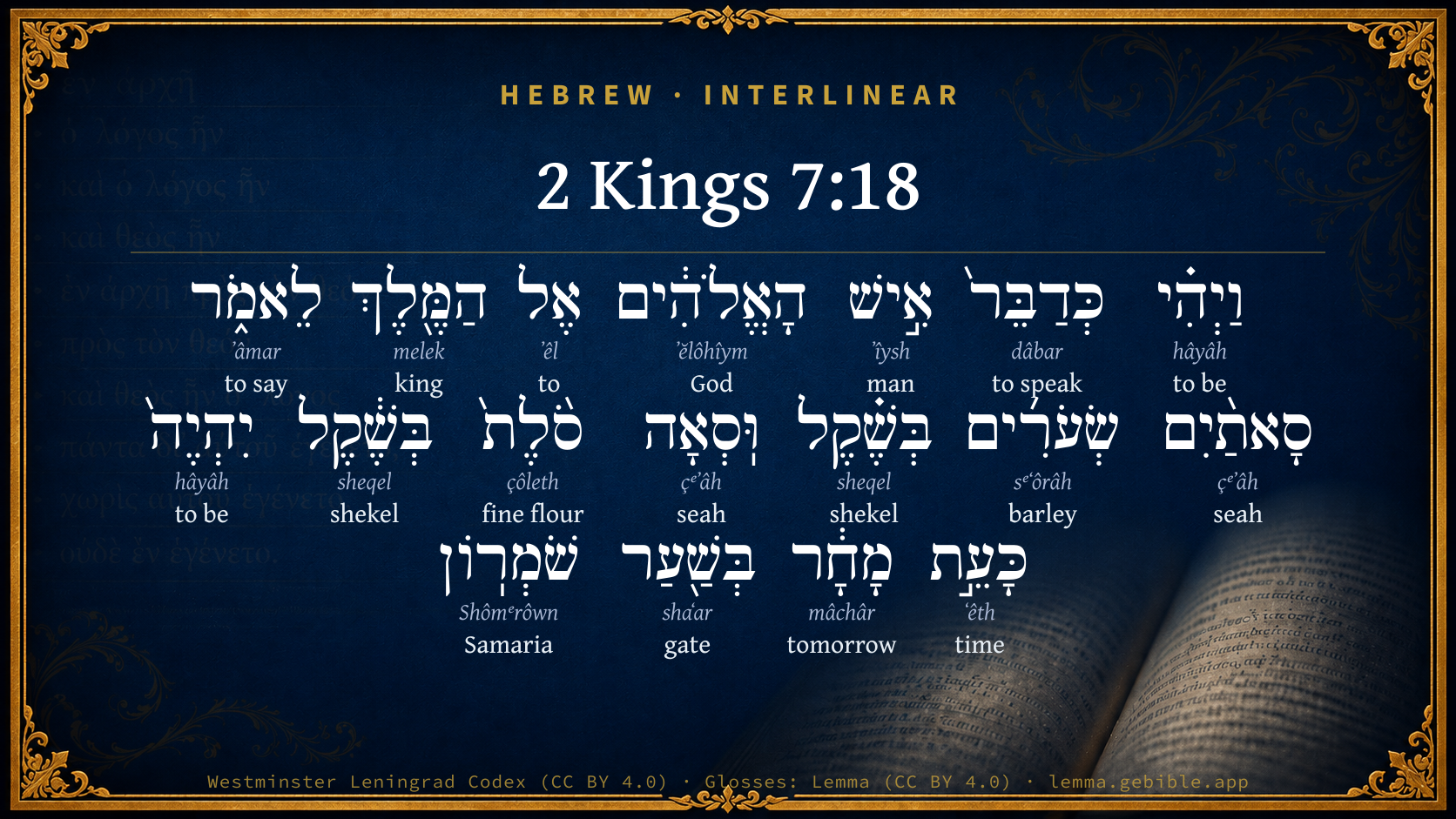
2 Kings 7:18

Hebrew (Westminster Leningrad Codex) 2 Kings 7:18 appears in the Hebrew Old Testament. The text above is from the Westminster Leningrad Codex. Each word links to its Strong’s number, a concise gloss, and parsing drawn from the Open Scriptures Hebrew Bible morphology. Click any word for its full Brown-Driver-Briggs (BDB) entry.
Download image
Cite this verse

2 Kings 7:18 (World English Bible). Public Domain. Lemma interlinear Bible study tool, https://lemma.gebible.app/v/2-kings/7/18.

Show BibTeX & RIS
BibTeX
RIS
English Translation
It happened, as the man of God had spoken to the king, saying, Two measures of barley for a shekel, and a measure of fine flour for a shekel, shall be tomorrow about this time in the gate of Samaria;
World English Bible · Public Domain
Download a study sheet

One document with this verse’s original text, its word-by-word gloss line, the meaning frame, cross-references with their text, attributed commentary, and full source and license credits — printable, and it pastes into notes with its structure intact.

This verse Autodidact and up

Study sheet (.html) Plain text (.txt)

A passage Seminary Student

Up to 50 verses in one chapter. A passage sheet keeps up to 6 commentary sources and 12 cross-references per verse, in the order this page ranks them, and says so on the sheet whenever that leaves anything out. Ask for a single verse and you get the Autodidact verse sheet above.

Everything on this page stays free to read, with no account — the sheet is a download of what is already on screen, not access to it.

Want to remove ads? Support Godless Engineer
Compare translations 3

The same verse in 3 English versions, stacked beneath the original-language interlinear above. Click any original word for its lexicon entry.

Each is an independent rendering of the whole verse — the interlinear is not word-aligned to these translations.

Highlighted words mark where these versions differ — a whole-verse word diff, not a word-by-word alignment.

  • World English Bible Public Domain
    It happened, as the man of God had spoken to the king, saying, Two measures of barley for a shekel, and a measure of fine flour for a shekel, shall be tomorrow about this time in the gate of Samaria;
  • King James Version Public Domain
    And it came to pass as the man of God had spoken to the king, saying, Two measures of barley for a shekel, and a measure of fine flour for a shekel, shall be to morrow about this time in the gate of Samaria:
  • unfoldingWord Literal Text CC BY-SA 4.0
    And it had happened, when the man of God spoke to the king, saying, “Two seahs of barley at a shekel, and a seah of flour at a shekel, it will be at time tomorrow in the gate of Samaria,”

unfoldingWord Literal Text — © unfoldingWord, licensed CC BY-SA 4.0. Word-aligned USFM3 via Door43 (git.door43.org/unfoldingWord/en_ult).

Versions to compare (up to 4)

3 of 4 selected

Show all 18 translations

Every available English version of this verse, each an independent rendering of the whole verse.

  • World English Bible Public Domain
    It happened, as the man of God had spoken to the king, saying, Two measures of barley for a shekel, and a measure of fine flour for a shekel, shall be tomorrow about this time in the gate of Samaria;
  • Berean Standard Bible Public Domain
    It happened just as the man of God had told the king: “About this time tomorrow at the gate of Samaria, two seahs of barley will sell for a shekel, and a seah of fine flour will sell for a shekel.”
  • Majority Standard Bible Public Domain
    It happened just as the man of God had told the king: “About this time tomorrow at the gate of Samaria, two seahs of barley will sell for a shekel, and a seah of fine flour will sell for a shekel.”
  • King James Version Public Domain
    And it came to pass as the man of God had spoken to the king, saying, Two measures of barley for a shekel, and a measure of fine flour for a shekel, shall be to morrow about this time in the gate of Samaria:
  • American Standard Version (1901) Public Domain
    And it came to pass, as the man of God had spoken to the king, saying, Two measures of barley for a shekel, and a measure of fine flour for a shekel, shall be to-morrow about this time in the gate of Samaria;
  • Revised Version (1885) Public Domain
    And it came to pass, as the man of God had spoken to the king, saying, Two measures of barley for a shekel, and a measure of fine flour for a shekel, shall be tomorrow about this time in the gate of Samaria;
  • Geneva Bible (1599) Public Domain
    And it came to passe, as the man of God had spoken to the King, saying, Two measures of barley at a shekel, and a measure of fine floure shall be at a shekel, to morowe about this time in the gate of Samaria.
  • Douay-Rheims (1899) Public Domain
    And it came to pass according to the word of the man of God, which he spoke to the king, when he said: Two bushels of barley shall be for a stater, and a bushel of fine flour for a stater, at this very time to morrow in the gate of Samaria.
  • Young's Literal Translation Public Domain
    yea, it cometh to pass, according to the speaking of the man of God unto the king, saying, `Two measures of barley at a shekel, and a measure of fine flour at a shekel are, at this time to-morrow, in the gate of Samaria;'
  • Literal Standard Version CC BY-SA 4.0
    indeed, it comes to pass, according to the speaking of the man of God to the king, saying, “Two measures of barley at a shekel, and a measure of fine flour at a shekel are, at this time tomorrow, in the Gate of Samaria”;
  • Unlocked Literal Bible CC BY-SA 4.0
    So it happened as the man of God had said to the king, saying, “About this time in the gate of Samaria, two measures of barley will be available for a shekel, and a measure of fine flour for a shekel.”
  • unfoldingWord Literal Text CC BY-SA 4.0
    And it had happened, when the man of God spoke to the king, saying, “Two seahs of barley at a shekel, and a seah of flour at a shekel, it will be at time tomorrow in the gate of Samaria,”
  • Darby Bible Public Domain
    And it came to pass as the man of God had spoken to the king saying, Two measures of barley shall be at a shekel, and the measure of fine flour at a shekel, to-morrow about this time in the gate of Samaria.
  • World Messianic Bible Public Domain
    It happened as the man of God had spoken to the king, saying, “Two seahs of barley for a shekel, and a seah of fine flour for a shekel, shall be tomorrow about this time in the gate of Samaria;”
  • Webster's Bible Public Domain
    And it came to pass as the man of God had spoken to the king, saying, Two measures of barley for a shekel, and a measure of fine flour for a shekel, shall be to-morrow about this time in the gate of Samaria:
  • Free Bible Version CC BY-SA 4.0
    What the man of God had told the king also came true when he said, “Around this time tomorrow a seah of the best flour will sell for a shekel, and two seahs of barley will sell for a shekel at the gate of Samaria.”
  • Bible in Basic English Public Domain
    So the words of the man of God came true, which he said to the king: Two measures of barley will be offered for the price of a shekel and a measure of good meal for a shekel, tomorrow about this time in the market-place of Samaria.
  • JPS Tanakh (1917) Public Domain
    And it came to pass, as the man of God had spoken to the king, saying: 'Two measures of barley for a shekel, and a measure of fine flour for a shekel, shall be to-morrow about this time in the gate of Samaria';

Literal Standard Version (2020), Covenant Press — licensed CC BY-SA 4.0. Text via the HelloAO Bible API (eBible.org). Unlocked Literal Bible (unfoldingWord) — licensed CC BY-SA 4.0. Text via the HelloAO Bible API (eBible.org). unfoldingWord Literal Text — © unfoldingWord, licensed CC BY-SA 4.0. Word-aligned USFM3 via Door43 (git.door43.org/unfoldingWord/en_ult). Free Bible Version, Dr. Jonathan Gallagher — licensed CC BY-SA 4.0. Text via the HelloAO Bible API (eBible.org).

Word by word

More ways to search: Search by grammar → Find every occurrence → Compare this word →

Practice this passage: Drill this verse → Learn its vocabulary →

סָאתַ֨יִם
çᵉʼâh
H5429
“seahs”
Noun, Common, Feminine, Dual, Absolute
Part of Speech
Noun
Type
Common
Gender
Feminine
Number
Dual
State
Absolute
Full BDB Definition

Origin: from an unused root meaning to define

TWOT: 1452

seah, a measure of flour or grain - probably equal to 1/3 ephah
  1. וַיְהִ֗י hâyâh H1961 “and · to be” Conjunction + Verb, Qal, Sequential Imperfect, 3rd Person, Masculine, Singular
  2. כְּדַבֵּר֙ dâbar H1696 “like/as · to speak” Preposition + Verb, Piel, Infinitive Construct
  3. אִ֣ישׁ ʼîysh H376 “man of” Noun, Common, Masculine, Singular, Construct
  4. הָאֱלֹהִ֔ים ʼĕlôhîym H430 “the · God(s)” Particle, Definite Article + Noun, Common, Masculine, Plural, Absolute
  5. אֶל ʼêl H413 “to” Preposition
  6. הַמֶּ֖לֶךְ melek H4428 “the · king” Particle, Definite Article + Noun, Common, Masculine, Singular, Absolute
  7. לֵאמֹ֑ר ʼâmar H559 “to say” Preposition + Verb, Qal, Infinitive Construct
  8. שְׂעֹרִ֜ים sᵉʻôrâh H8184 “barley” Noun, Common, Feminine, Plural, Absolute
  9. בְּשֶׁ֗קֶל sheqel H8255 “in/at · shekel” Preposition + Noun, Common, Masculine, Singular, Absolute
  10. וּֽסְאָה çᵉʼâh H5429 “and · seah” Conjunction + Noun, Common, Feminine, Singular, Absolute
  11. סֹ֨לֶת֙ çôleth H5560 “fine flour” Noun, Common, Feminine, Singular, Absolute
  12. בְּשֶׁ֔קֶל sheqel H8255 “in/at · shekel” Preposition + Noun, Common, Masculine, Singular, Absolute
  13. יִהְיֶה֙ hâyâh H1961 “to be” Verb, Qal, Imperfect, 3rd Person, Masculine, Singular
  14. כָּעֵ֣ת ʻêth H6256 “like/as the · time” Preposition, Determined + Noun, Common, Both, Singular, Absolute
  15. מָחָ֔ר mâchâr H4279 “tomorrow” Noun, Common, Masculine, Singular, Absolute
  16. בְּשַׁ֖עַר shaʻar H8179 “in/at · gate of” Preposition + Noun, Common, Masculine, Singular, Construct
  17. שֹׁמְרֽוֹן Shômᵉrôwn H8111 “Samaria” Noun, Proper

About this verse

These counts appear in no published source. They are computed here, from the morphology-tagged text and Lemma’s own curated glosses. What Lemma adds →

18
words
15
distinct lemmas
Historical
section

Notable vocabulary

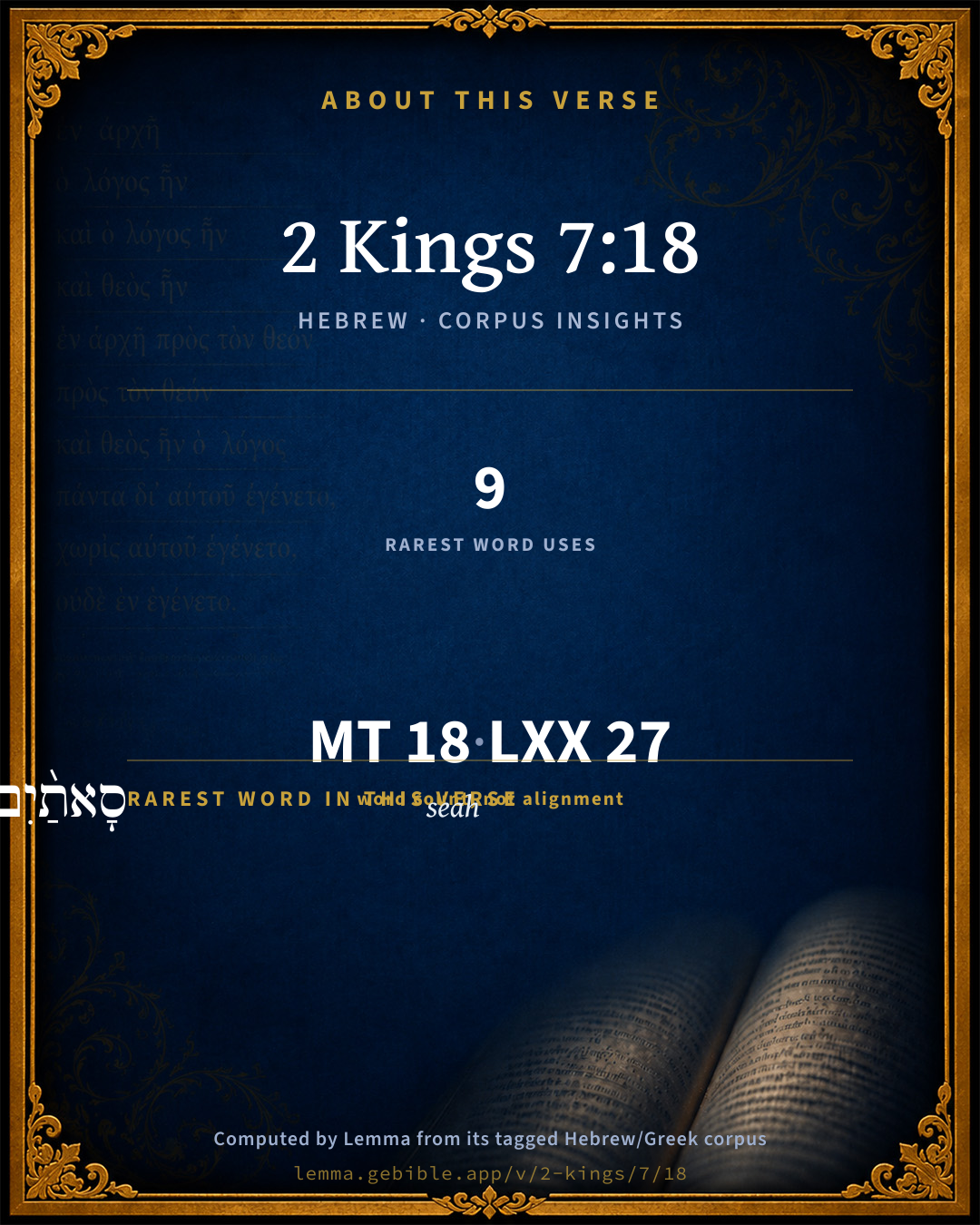
The rarest word here is סָאתַ֨יִם seah H5429 — appearing just 9 times in the whole Hebrew Bible.

Shared distinctive vocabulary

סָאתַ֨יִם seah H5429 occurs in 6 verses of the Hebrew Bible. Also found in:

Grammatical profile

  • 4 verbs
  • 13 nouns
  • 1 preposition

Verb forms

  • וַיְהִ֗י Qal · Sequential Imperfect
  • כְּדַבֵּר֙ Piel · Infinitive Construct
  • לֵאמֹ֑ר Qal · Infinitive Construct
  • יִהְיֶה֙ Qal · Imperfect

Repetition

Words recur within this verse — often emphatic in Hebrew:

  • וַיְהִ֗י to be H1961 ×2
  • סָאתַ֨יִם seah H5429 ×2
  • בְּשֶׁ֗קֶל shekel H8255 ×2

Hebrew & Septuagint length

In English translation the verse runs 40 words from the Hebrew and 46 from the Septuagint (LXX English) — closely comparable.

A rough comparison of the two English renderings, which tokenize alike — not a word-level alignment.

Word counts can differ between the Hebrew and the Greek without any difference in meaning — e.g. the Hebrew direct-object marker אֵת has no separate Greek word, and Greek often adds the article ὁ.

In the original languages it is 18 Hebrew tokens and 27 Greek tokens — but the two are counted differently (Hebrew bundles its prefixes and suffixes into one token; the Greek is in lemma form), so that isn’t a like-for-like length.

Cross-references

3

Topical passages linked to 2 Kings 7:18 in the Treasury of Scripture Knowledge — connected by theme and wording, ordered by reader-vote popularity; previews shown in the World English Bible.

  • Genesis 18:14 Is anything too hard for Yahweh? At the set time I will return to you, when the season comes round, and Sarah will have a son."
  • 2 Kings 6:32 But Elisha was sitting in his house, and the elders were sitting with him; and [the king] sent a man from before him: but before the messenger came to him, he said to the elders, See you how this son of a murderer has sent to take away my head? behold, when the messenger comes, shut the door, and hold the door fast against him: isn't the sound of his master's feet behind him?
  • 2 Kings 7:1–2 Elisha said, Hear you the word of Yahweh: thus says Yahweh, Tomorrow about this time shall a measure of fine flour be [sold] for a shekel, and two measures of barley for a shekel, in the gate of Samaria.

Cross-references courtesy of OpenBible.info (CC BY 4.0).

Hebrew and Greek witnesses Masoretic Hebrew ↔ Greek Septuagint

The same verse in the two great witnesses to the Old Testament, shown verse-for-verse.

These are two independent witnesses, not word-aligned to each other, and the Septuagint is shown in lemma (dictionary) form.

Hebrew 2 Kings 7:18 Masoretic · Westminster Leningrad Codex

וַיְהִ֗י כְּדַבֵּר֙ אִ֣ישׁ הָאֱלֹהִ֔ים אֶל הַמֶּ֖לֶךְ לֵאמֹ֑ר סָאתַ֨יִם שְׂעֹרִ֜ים בְּשֶׁ֗קֶל וּֽסְאָה סֹ֨לֶת֙ בְּשֶׁ֔קֶל יִהְיֶה֙ כָּעֵ֣ת מָחָ֔ר בְּשַׁ֖עַר שֹׁמְרֽוֹן

It happened, as the man of God had spoken to the king, saying, Two measures of barley for a shekel, and a measure of fine flour for a shekel, shall be tomorrow about this time in the gate of Samaria;

World English Bible · Public Domain

Greek LXX 2 Kings 7:18 Septuagint · lemma form

καί γίγνομαι καθά λαλέω ελισαιε πρός ὁ βασιλεύς λέγω δίμετρον κριθή σίκλος καί μέτρον σεμίδαλις σίκλος καί εἰμί ὡς ὁ ὥρα οὗτος αὔριον ἐν ὁ πύλη σαμαρεία

So it came to pass as Elisaie had spoken to the king, saying, Two measures of barley shall be sold for a shekel, and a measure of fine flour for a shekel; and it shall be as at this time to-morrow in the gate of Samaria.

LXX2012 (modern English Septuagint) · Public Domain

On this verse, Ellicott's Commentary for English Readers discusses the Septuagint’s reading. Read the note in Commentary ↓

Hebrew: Westminster Leningrad Codex (CC BY 4.0). Greek: Septuagint (public domain); English from LXX2012 (modern English Septuagint) (Public Domain). How the Septuagint differs from the Hebrew →

Targum (Aramaic paraphrase)

1

The Targum is the ancient Jewish Aramaic paraphrase of the Hebrew Scriptures — an interpretive translation, not the Hebrew text itself. Onkelos (literal) and Pseudo-Jonathan (expansive) render the Torah, and Jonathan the Prophets. Coverage is partial: where no permissively-licensed English translation exists for a verse, only the Aramaic is shown. This is verse-level text, not a word-by-word alignment to the Hebrew.

  1. Targum Jonathan Prophets (Joshua–Malachi)
    וַהֲוָה כַּד מַלֵיל נְבִיָא דַייָ עִם מַלְכָּא לְמֵימָר סָאתָן סְעוֹרִין בְּסִלְעָא וּסְאָה סוּלְתָּא בְּסִלְעָא יִהֵי כְּעִדָנָא הָדֵין מְחַר בְתַרְעָא דְשֹׁמְרוֹן:

    (no public-domain English translation for this verse)

    Targum Jonathan — Aramaic: “Mikraot Gedolot” (public domain). English: “Sefaria Community Translation” (CC0 1.0 (public-domain dedication)); “London "Chaldee Paraphrase," 1871” (public domain). Text via Sefaria.

Commentary

Notes on 2 Kings 7:18 from classic Christian and Jewish commentators (each source and its license shown beneath its notes). The classic Christian expositions comment on the surrounding passage and are grouped to its opening verse, so a note may address several verses; the Jewish commentaries on the Tanakh (Rashi and others) are per-verse, so they appear only where the commentator wrote on this verse.

Lemma curates 59 commentaries, every one of them public domain or Creative Commons licensed, each selected and text-cleaned for this edition rather than reprinted as found. About our sources →

Trapp's Complete Commentary

John Trapp

2Ki 7:18 And it came to pass as the man of God had spoken to the king, saying, Two measures of barley for a shekel, and a measure of fine flour for a shekel, shall be to morrow about this time in the gate of Samaria:

Ver. 18. Two measures of barley.] See on 2Ki 7:1, and observe the infallibility of God’s both promises and menaces.

John Trapp, A Commentary or Exposition upon All the Books of the Old and New Testament (1647–1656) — public domain. Text from a community e-Sword module.

Tyndale Open Study Notes

Tyndale Open Resources

7:18-20 The repetition of Elisha’s previous conversation with Joram’s officer emphasizes the exact fulfillment of the prophecy.

Tyndale Open Study Notes — © Tyndale Open Resources, licensed CC BY-SA 4.0. Text via the HelloAO Bible API.

Ellicott's Commentary for English Readers

(18) To the king.—The LXX. and Syriac have, “to the messenger.” (See Note on 2Ki_6:23.)

In this and the following verse the author repeats the prediction and its fulfilment with obvious satisfaction. The moral is a warning against unbelief.

A Bible Commentary for English Readers, edited by Charles John Ellicott (1878–1897) — public domain. Text from a community e-Sword module.

John Gill's Exposition

And it came to pass, as the man of God had spoken to the king, saying,.... As in Kg2 7:1, and what he said to the king there, and to the lord, in Kg2 7:2, are repeated in this and the next verse, that it might be observed how exactly the prophecies were fulfilled.

, are repeated in this and the next verse, that it might be observed how exactly the prophecies were fulfilled.

2 Kings 7:19

kg2 7:19

kg2 7:19

kg2 7:19And that lord answered the man of God, and said,.... As in Kg2 7:2.

and he said; that is, Elisha, as in the same place.

John Gill's Exposition of the Whole Bible (1746–1763) — public domain (CC PDM 1.0). Text via the HelloAO Bible API.

The Pulpit Commentary

And it came to pass as the man of God had spoken to the king, saying, Two measures of barley for a shekel, and a measure of fine flour for a shekel, shall be tomorrow about this time in the gate of Samaria. The otiose repetition of almost the whole of ver. 1 can only be explained as a mode of emphasizing, and so impressing upon the reader two main points:

(1) Elisha"s prophetic powers; and

(2) the dreadful consequences that follow on scornful rejection of a message from God (see the comment on ver. 2).

The Pulpit Commentary (1880–1919), ed. H.D.M. Spence-Jones & Joseph S. Exell — public domain. Text from a community e-Sword module.

unfoldingWord translationNotes

Door43 World Missions Community

General Information:

In these verses, the writer summarizes what happened by repeating the events that he described in 2 Kings 7:1-2. (See: End of Story)

About this time

"About this time tomorrow"

two measures of barley ... a measure of fine flour

Here the word "measure" translates the word "seah," which is a unit of dry measurement equal to about 7 liters. AT: "14 liters of barley ... 7 liters of fine flour" (See: Biblical Volume)

a shekel

A shekel is a unit of weight equal to about 11 grams. AT: "about 11 grams of silver" or "one silver coin" (See: Biblical Money)

See

"Look" or "Listen" or "Pay attention to what I am about to tell you"

even if Yahweh should make windows in heaven

Yahweh causing much rain to fall in order to make the crops grow is spoken of as if Yahweh were opening windows in heaven through which he pours down rain. See how you translated this in 2 Kings 7:2. AT: "even if Yahweh were to cause much rain to fall from heaven" (See: Metaphor)

can this thing happen?

The captain asks this question to express his unbelief. This question can be translated as a statement. See how you translated this in 2 Kings 7:2. AT: "this could never happen!" (See: Rhetorical Question)

you will watch it happen with your own eyes

The phrase "with your own eyes" emphasizes that the captain will certainly see the things that Elisha prophesied. See how you translated this in 2 Kings 7:2. AT: "you yourself will watch these things happen" (See: Synecdoche)

but you will not eat any of it

"but you will not eat any of the flour or barley"

translationWords

Samaria

Yahweh

heaven

unfoldingWord translationNotes — © Distant Shores Media and the Door43 World Missions Community, licensed CC BY-SA 4.0. Source: git.door43.org/Door43/en_tn.

Lesson kit

Teaching starters — assembled from the data on this page, not authored interpretation. Every prompt links to the verse data it draws on. Edit before teaching.

2 Kings, in the Historical, opens this verse with 18 words (15 distinct Hebrew lemmas). Its most distinctive word is çᵉʼâh (“seah”). A historical commentator’s framing appears above. Read the whole chapter for the surrounding context.

Discussion questions

  1. The word çᵉʼâh carries the sense “seah.” How does it shape the verse?
  2. Genesis 18:6 shares the word «seah» with this verse. How do the two illuminate each other?
  3. “to be” occurs 2× in this one verse. What is the effect of the repetition?
  4. These translations render this verse differently; the difference is in the English rendering, not the original. What questions does that raise?
  5. The verb «וַיְהִ֗י» is Qal Sequential Imperfect. How does its form color the action?
  6. Reading how Trapp's Complete Commentary and Tyndale Open Study Notes read this verse, where do the two commentators agree and where do they part?

Things to notice

Reading settings

Reading text

Shown beneath each verse's original-language words.

Old Testament
Old Testament edition

Read the OT as the Masoretic Hebrew (MT) or the Greek Septuagint (LXX).

English shown for the Greek Septuagint (in the Hebrew ↔ Greek comparison).

Comparing translations? Open the Compare panel on any verse page to stack up to four side by side.