Exodus 32:26

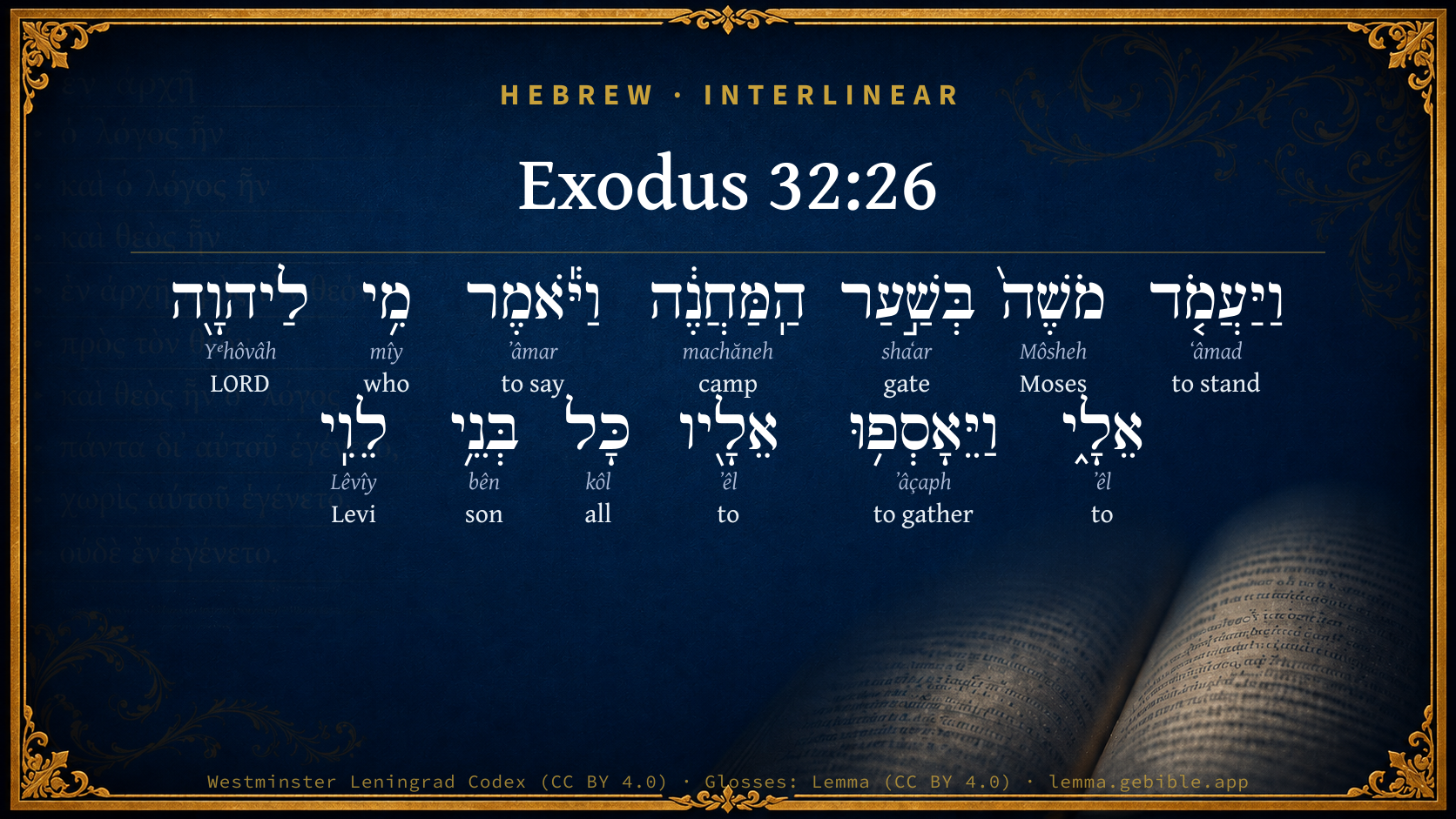
Hebrew (Westminster Leningrad Codex) Exodus 32:26 appears in the Hebrew Old Testament. The text above is from the Westminster Leningrad Codex. Each word links to its Strong’s number, a concise gloss, and parsing drawn from the Open Scriptures Hebrew Bible morphology. Click any word for its full Brown-Driver-Briggs (BDB) entry.
Download image
Cite this verse

Exodus 32:26 (World English Bible). Public Domain. Lemma interlinear Bible study tool, https://lemma.gebible.app/v/exodus/32/26.

Show BibTeX & RIS
BibTeX
RIS
English Translation
then Moses stood in the gate of the camp, and said, "Whoever is on Yahweh's side, come to me!" All the sons of Levi gathered themselves together to him.
World English Bible · Public Domain
Download a study sheet

One document with this verse’s original text, its word-by-word gloss line, the meaning frame, cross-references with their text, attributed commentary, and full source and license credits — printable, and it pastes into notes with its structure intact.

This verse Autodidact and up

Study sheet (.html) Plain text (.txt)

A passage Seminary Student

Up to 50 verses in one chapter. A passage sheet keeps up to 6 commentary sources and 12 cross-references per verse, in the order this page ranks them, and says so on the sheet whenever that leaves anything out. Ask for a single verse and you get the Autodidact verse sheet above.

Everything on this page stays free to read, with no account — the sheet is a download of what is already on screen, not access to it.

Want to remove ads? Support Godless Engineer
Compare translations 3

The same verse in 3 English versions, stacked beneath the original-language interlinear above. Click any original word for its lexicon entry.

Each is an independent rendering of the whole verse — the interlinear is not word-aligned to these translations.

Highlighted words mark where these versions differ — a whole-verse word diff, not a word-by-word alignment.

  • World English Bible Public Domain
    then Moses stood in the gate of the camp, and said, "Whoever is on Yahweh's side, come to me!" All the sons of Levi gathered themselves together to him.
  • King James Version Public Domain
    Then Moses stood in the gate of the camp, and said, Who is on the LORD's side? let him come unto me. And all the sons of Levi gathered themselves together unto him.
  • unfoldingWord Literal Text CC BY-SA 4.0
    And Moses stood in the gate of the camp and said, “Who for Yahweh, to me!” And all of the sons of Levi gathered themselves to him.

unfoldingWord Literal Text — © unfoldingWord, licensed CC BY-SA 4.0. Word-aligned USFM3 via Door43 (git.door43.org/unfoldingWord/en_ult).

Versions to compare (up to 4)

3 of 4 selected

Show all 18 translations

Every available English version of this verse, each an independent rendering of the whole verse.

  • World English Bible Public Domain
    then Moses stood in the gate of the camp, and said, "Whoever is on Yahweh's side, come to me!" All the sons of Levi gathered themselves together to him.
  • Berean Standard Bible Public Domain
    So Moses stood at the entrance to the camp and said, “Whoever is for the LORD, come to me.” And all the Levites gathered around him.
  • Majority Standard Bible Public Domain
    So Moses stood at the entrance to the camp and said, “Whoever is for the LORD, come to me.” And all the Levites gathered around him.
  • King James Version Public Domain
    Then Moses stood in the gate of the camp, and said, Who is on the LORD's side? let him come unto me. And all the sons of Levi gathered themselves together unto him.
  • American Standard Version (1901) Public Domain
    then Moses stood in the gate of the camp, and said, Whoso is on Jehovah's side, `let him come' unto me. And all the sons of Levi gathered themselves together unto him.
  • Revised Version (1885) Public Domain
    then Moses stood in the gate of the camp, and said, Whoso is on the LORD’S side, let him come unto me. And all the sons of Levi gathered themselves together unto him.
  • Geneva Bible (1599) Public Domain
    And Moses stoode in ye gate of the campe, and sayde, Who pertaineth to the Lord? let him come to mee. And all the sonnes of Leui gathered themselues vnto him.
  • Douay-Rheims (1899) Public Domain
    Then standing in the gate of the camp, he said: If any man be on the Lord's side let him join with me. And all the sons of Levi gathered themselves together unto him:
  • Young's Literal Translation Public Domain
    and Moses standeth in the gate of the camp, and saith, `Who `is' for Jehovah? -- unto me!' and all the sons of Levi are gathered unto him;
  • Literal Standard Version CC BY-SA 4.0
    and Moses stands in the gate of the camp and says, “Who [is] for YHWH? [Come] to me!” And all the sons of Levi are gathered to him;
  • Unlocked Literal Bible CC BY-SA 4.0
    Then Moses stood at the entrance to the camp and said, “Whoever is on Yahweh's side, come to me.” All the Levites gathered around him.
  • unfoldingWord Literal Text CC BY-SA 4.0
    And Moses stood in the gate of the camp and said, “Who for Yahweh, to me!” And all of the sons of Levi gathered themselves to him.
  • Darby Bible Public Domain
    And Moses stood in the gate of the camp, and said, He that is for Jehovah, [let him come] to me. And all the sons of Levi gathered to him.
  • World Messianic Bible Public Domain
    then Moses stood in the gate of the camp, and said, “Whoever is on the LORD’s side, come to me!” All the sons of Levi gathered themselves together to him.
  • Webster's Bible Public Domain
    Then Moses stood in the gate of the camp, and said, Who is on the LORD'S side? let him come to me. And all the sons of Levi assembled themselves to him.
  • Free Bible Version CC BY-SA 4.0
    So he went and stood at the entrance to the camp, and shouted out, “Whoever is on the Lord's side, come and join me!” All the Levites gathered around him.
  • Bible in Basic English Public Domain
    Then Moses took his place at the way into the tents, and said, Whoever is on the Lord's side, let him come to me. And all the sons of Levi came together to him.
  • JPS Tanakh (1917) Public Domain
    then Moses stood in the gate of the camp, and said: 'Whoso is on the LORD'S side, let him come unto me.' And all the sons of Levi gathered themselves together unto him.

Literal Standard Version (2020), Covenant Press — licensed CC BY-SA 4.0. Text via the HelloAO Bible API (eBible.org). Unlocked Literal Bible (unfoldingWord) — licensed CC BY-SA 4.0. Text via the HelloAO Bible API (eBible.org). unfoldingWord Literal Text — © unfoldingWord, licensed CC BY-SA 4.0. Word-aligned USFM3 via Door43 (git.door43.org/unfoldingWord/en_ult). Free Bible Version, Dr. Jonathan Gallagher — licensed CC BY-SA 4.0. Text via the HelloAO Bible API (eBible.org).

Word by word

More ways to search: Search by grammar → Find every occurrence → Compare this word →

Practice this passage: Drill this verse → Learn its vocabulary →

לֵוִֽי
Lêvîy
H3878
“Levi”
Noun, Proper
Part of Speech
Noun
Type
Proper
Full BDB Definition

Origin: from H3867

TWOT: 1093

Levi = "joined to" - the 3rd son of Jacob by Leah and progenitor of tribe of Levites
  1. וַיַּעֲמֹ֤ד ʻâmad H5975 “and · to stand” Conjunction + Verb, Qal, Sequential Imperfect, 3rd Person, Masculine, Singular
  2. מֹשֶׁה֙ Môsheh H4872 “Moses” Noun, Proper
  3. בְּשַׁ֣עַר shaʻar H8179 “in/at · gate of” Preposition + Noun, Common, Masculine, Singular, Construct
  4. הַֽמַּחֲנֶ֔ה machăneh H4264 “the · camp” Particle, Definite Article + Noun, Common, Both, Singular, Absolute
  5. וַיֹּ֕אמֶר ʼâmar H559 “and · to say” Conjunction + Verb, Qal, Sequential Imperfect, 3rd Person, Masculine, Singular
  6. מִ֥י mîy H4310 “who” Particle, Interrogative
  7. לַיהוָ֖ה Yᵉhôvâh H3068 “to/for · LORD” Preposition + Noun, Proper
  8. אֵלָ֑י ʼêl H413 “to · me” Preposition + Suffix, Personal, 1st Person, Common, Singular
  9. וַיֵּאָסְפ֥וּ ʼâçaph H622 “and · to gather” Conjunction + Verb, Niphal, Sequential Imperfect, 3rd Person, Masculine, Plural
  10. אֵלָ֖יו ʼêl H413 “to · him” Preposition + Suffix, Personal, 3rd Person, Masculine, Singular
  11. כָּל kôl H3605 “all of” Noun, Common, Masculine, Singular, Construct
  12. בְּנֵ֥י bên H1121 “sons of” Noun, Common, Masculine, Plural, Construct

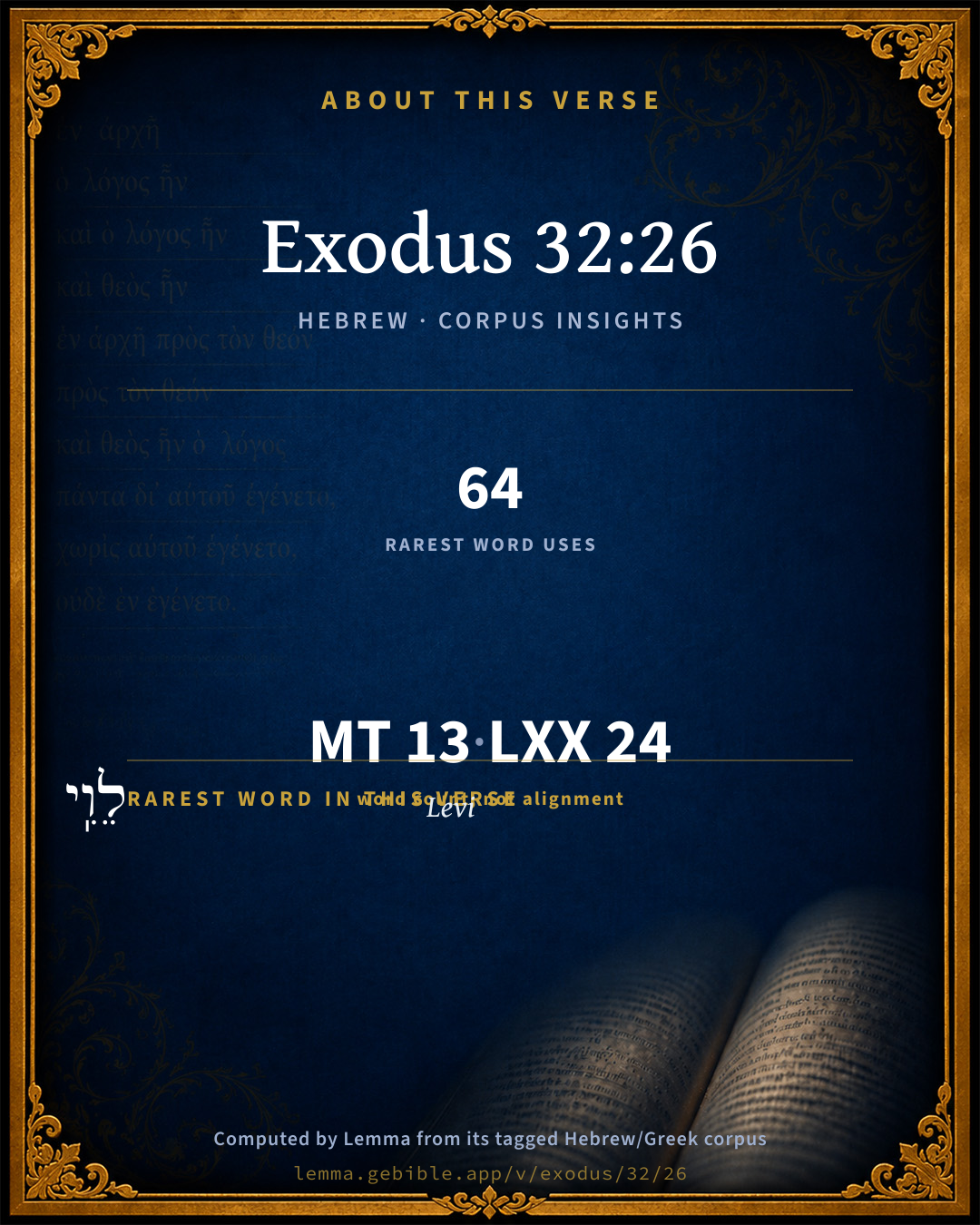
About this verse

These counts appear in no published source. They are computed here, from the morphology-tagged text and Lemma’s own curated glosses. What Lemma adds →

13
words
12
distinct lemmas
Pentateuch
section

Grammatical profile

  • 3 verbs
  • 7 nouns
  • 2 prepositions
  • 1 particle

Verb forms

  • וַיַּעֲמֹ֤ד Qal · Sequential Imperfect
  • וַיֹּ֕אמֶר Qal · Sequential Imperfect
  • וַיֵּאָסְפ֥וּ Niphal · Sequential Imperfect

Repetition

A word recurs within this verse — often emphatic in Hebrew:

  • אֵלָ֑י to H413 ×2

Hebrew & Septuagint length

In English translation the verse runs 29 words from the Hebrew and 31 from the Septuagint (LXX English) — closely comparable.

A rough comparison of the two English renderings, which tokenize alike — not a word-level alignment.

Word counts can differ between the Hebrew and the Greek without any difference in meaning — e.g. the Hebrew direct-object marker אֵת has no separate Greek word, and Greek often adds the article ὁ.

In the original languages it is 13 Hebrew tokens and 24 Greek tokens — but the two are counted differently (Hebrew bundles its prefixes and suffixes into one token; the Greek is in lemma form), so that isn’t a like-for-like length.

Cross-references

4

Topical passages linked to Exodus 32:26 in the Treasury of Scripture Knowledge — connected by theme and wording, ordered by reader-vote popularity; previews shown in the World English Bible.

  • 2 Kings 9:32 He lifted up his face to the window, and said, Who is on my side? who? There looked out to him two or three eunuchs.
  • Matthew 12:30 "He who is not with me is against me, and he who doesn't gather with me, scatters.
  • Joshua 5:13 It happened, when Joshua was by Jericho, that he lifted up his eyes and looked, and, behold, there stood a man over against him with his sword drawn in his hand: and Joshua went to him, and said to him, Are you for us, or for our adversaries?
  • 2 Samuel 20:11 There stood by him one of Joab's young men, and said, He who favors Joab, and he who is for David, let him follow Joab.

Cross-references courtesy of OpenBible.info (CC BY 4.0).

Hebrew and Greek witnesses Masoretic Hebrew ↔ Greek Septuagint

The same verse in the two great witnesses to the Old Testament, shown verse-for-verse.

These are two independent witnesses, not word-aligned to each other, and the Septuagint is shown in lemma (dictionary) form.

Hebrew Exodus 32:26 Masoretic · Westminster Leningrad Codex

וַיַּעֲמֹ֤ד מֹשֶׁה֙ בְּשַׁ֣עַר הַֽמַּחֲנֶ֔ה וַיֹּ֕אמֶר מִ֥י לַיהוָ֖ה אֵלָ֑י וַיֵּאָסְפ֥וּ אֵלָ֖יו כָּל בְּנֵ֥י לֵוִֽי

then Moses stood in the gate of the camp, and said, "Whoever is on Yahweh's side, come to me!" All the sons of Levi gathered themselves together to him.

World English Bible · Public Domain

Greek LXX Exodus 32:26 Septuagint · lemma form

ἵστημι δέ μωυσῆς ἐπί ὁ πύλη ὁ παρεμβολή καί εἶπον τίς πρός κύριος εἶμι πρός ἐγώ συνἔρχομαι οὖν πρός αὐτός πᾶς ὁ υἱός λευί

then stood Moses at the gate of the camp, and said, Who is on the Lord's side? let him come to me. Then all the sons of Levi came to him.

LXX2012 (modern English Septuagint) · Public Domain

Hebrew: Westminster Leningrad Codex (CC BY 4.0). Greek: Septuagint (public domain); English from LXX2012 (modern English Septuagint) (Public Domain). How the Septuagint differs from the Hebrew →

Targum (Aramaic paraphrase)

2

The Targum is the ancient Jewish Aramaic paraphrase of the Hebrew Scriptures — an interpretive translation, not the Hebrew text itself. Onkelos (literal) and Pseudo-Jonathan (expansive) render the Torah, and Jonathan the Prophets. Coverage is partial: where no permissively-licensed English translation exists for a verse, only the Aramaic is shown. This is verse-level text, not a word-by-word alignment to the Hebrew.

  1. Targum Onkelos Torah (Genesis–Deuteronomy)
    וְקָם משֶׁה בִּתְרַע מַשְׁרִיתָא וַאֲמַר מָן דַחֲלַיָא דַיְיָ יֵיתוּן לְוָתִי וְאִתְכַּנָשׁוּ לְוָתֵהּ כָּל בְּנֵי לֵוִי:

    (no public-domain English translation for this verse)

    Targum Onkelos — Aramaic: “Onkelos Genesis” (public domain); “Onkelos Exodus” (public domain); “Onkelos Leviticus” (public domain); “Onkelos Numbers” (public domain); “Onkelos Deuteronomy” (public domain). English: “Sefaria Community Translation” (CC0 1.0 (public-domain dedication)); “J.W. Etheridge. The Targums of Onkelos and Jonathan Ben Uzziel on the Pentateuch. London: Longmans, Green, 1862” (public domain). Text via Sefaria.

  2. Targum Pseudo-Jonathan Torah (Genesis–Deuteronomy)
    וְקָם משֶׁה בִּתְרַע סַנְהֶדְרִין דְּמַשְׁרִיתָא וַאֲמַר מַאן הוּא דַחֲלַיָא דַיְיָ יֵיתוּן לְוָותִי וְאִתְכְּנָשׁוּ לְוָותֵיהּ כָּל בְּנוֹי דְּלֵוִי

    And Mosheh stood in the sanhedrin gate of the camp, and said, Who feareth the Lord, let him come to me. And there gathered to him all the sons of Levi.

    Targum Pseudo-Jonathan — Aramaic: “Targum Jonathan on Genesis” (public domain); “Targum Jonathan on Exodus” (public domain); “Targum Jonathan on Leviticus” (public domain); “Targum Jonathan on Numbers” (public domain); “Targum Jonathan on Deuteronomy” (public domain). English: “The Targum of Jonathan ben Uzziel, trans. J. W. Etheridge, London, 1862” (public domain). Text via Sefaria.

Commentary

Notes on Exodus 32:26 from classic Christian and Jewish commentators (each source and its license shown beneath its notes). The classic Christian expositions comment on the surrounding passage and are grouped to its opening verse, so a note may address several verses; the Jewish commentaries on the Tanakh (Rashi and others) are per-verse, so they appear only where the commentator wrote on this verse.

Lemma curates 59 commentaries, every one of them public domain or Creative Commons licensed, each selected and text-cleaned for this edition rather than reprinted as found. About our sources →

Trapp's Complete Commentary

John Trapp

Exo 32:26 Then Moses stood in the gate of the camp, and said, Who [is] on the LORD’S side? [let him come] unto me. And all the sons of Levi gathered themselves together unto him.

Ver. 26. Let him come.] This word through haste and earnestness Moses omitteth. The Chaldee and Greek version supply it.

John Trapp, A Commentary or Exposition upon All the Books of the Old and New Testament (1647–1656) — public domain. Text from a community e-Sword module.

The Biblical Illustrator

Joseph S. Exell

Exo_32:26

Who is on the Lords side?

Who is on the Lords side

I. The conflict, and which is the Lords side. The commands of God versus self-pleasing. Holiness and right, against sin and oppression.

II. The Lords friends, and what they must do.

1. They must own their allegiance openly (Exo_32:29).

2. They should come out and rally to the standard. We do this by open union with the Church, by boldly rebuking sin, by testifying for truth, by not conforming to the world, and by conforming to Christ our Lord (2Co_8:5).

3. They must be willing to be in a minority.

4. They must become aggressive (Exo_32:27).

5. Their zeal must overcome natures ties (Deu_33:9).

6. They must do what they are bidden (Exo_32:28).

III. The Lords host and its encouragements.

1. Their cause is that of right and truth.

2. It is Gods cause.

3. Christ Himself is our Captain.

4. The angels are with us.

5. Thousands of the best of men have been on this side (Heb_12:1).

6. It is the side of conscience and of a clean heart.

7. It is that side of the warfare which ends in heaven and victory.

IV. The question of the text, and proposals for enlistment. (C. H. Spurgeon.)

Who is on the Lords side?

I. This is a divine question. If any man love not the Lord Jesus, etc.

II. A spiritual question. Are we new men in Christ Jesus by the new birth?

III. A crisis question. Truth cannot be divided; conduct cannot have two hearts.

IV. A vital question. Treason is in Gods government, what it is everywhere, a capital crime.

V. A determinate question. Ithuriels spear disclosed whatever it touched. This inquiry settles fixedly the state of each man for the eternity he is to enter.

VI. An experimental question.

1. There are only two sides ever to be found.

2. There is great comfort in being on the right side.

3. It is unsatisfactory, profitless, and perilous to be upon the wrong side. The soul will rest nowhere there. There will come no possible advantage from rebellion; danger and destruction are directly in the path of one who lifts himself against God.

4. Any one can know which side he is on, if he truly desires it. (C. S. Robinson, D. D.)

On which side are you?

I. Decision.

1. It is a decision upon the most sublime and important theme which can ever come under a mans notice. God and Satan, truth and falsehood, holiness and sin.

2. This decision, so important and weighty, should be made as early as possible. When Agesilaus came to the borders of Macedon he sent the laconic message, As friends or as enemies? The answer was, We must stop awhile, and take advice. His reply was, While you advise, we march. Wait not. Every hour renders it more likely that you will make a foolish choice.

3. This is a decision of the greatest importance, for it will influence every subsequent decision throughout life. True religion gives a tincture to everything with which the man comes in contact.

4. As to this decision there ought to be no possible difficulty. A man should decide for God, since He is his Creator, Redeemer, Preserver.

5. This decision involves but one alternative. There is no synagogue of the undecided on earth, and no purgatory of middle men in the unseen world.

II. The avowal. Let him come unto me. For God--to me.

1. A coming out from amongst the idolaters. Do not conceal your religion.

2. They were to come to the leader. Follow the Lamb whithersoever He goeth.

3. Those who were to come to Moses were, of course, to come to one another. Do not birds of a feather flock together? If God has made you birds of paradise, hasten to fly like doves to your windows.

III. Consecration.

1. Obey Gods will

2. Serve God actively and energetically.

3. Do this at all hazards and costs. (C. H. Spurgeon.)

Only two sides

1. To be on the Lords side is, in the first place, to put your whole weight on Christ Jesus as your personal Saviour.

2. To be on the Lords side is publicly to profess Him.

3. To be on the Lords side you must consecrate your life to Him.

4. Reasons for being on the Lords side.

(1) It is the happy side.

(2) It is the safe side. (T. De Witt Talmage.)

Religious decision

We would enforce upon you the importance of coming to a determinate and decided judgment on the great business of religion. Examine its claims: if they be spurious or unfounded, then reject them; but if they be true, if they agree with certain powers and feelings of your mind, then give to religion the attention its importance demands. Do not play with so keen a weapon; do not trifle on the most solemn of all subjects. Decision of character is a highly valuable quality of mind. It gives to its possessor great advantages over others in the ordinary affairs of life. This quality of mind is needed in proportion to the difficulties which obstruct the attainment of any end.

I. We address ourselves to those who vacillate between God and the world, between religion and irreligion. There is a class, and a numerous class of men, especially in our own enlightened country, who may be considered in this condition.

II. To those who entertain a scriptural hope of salvation, but have not made a public avowal of their faith. This backwardness to associate with the professing people of God results from various causes. In some it is the effect of mistaken views of what is required in order to the fellowship of the Church. In other men, this backwardness publicly to acknowledge the Saviour is the effect of a very lax and unscriptural view of what religion requires. They suppose that if their hearts are right with God it is not at all necessary that they should make a public profession.

III. The language of Moses is applicable to those who have made a profession of religion. That many Christians are open to a charge of compromising their principles cannot be doubted by any who are conversant with the transactions of daily life. (S. Summers.)

Duty of being on the Lords side

I. What is implied by being on the Lords side.

1. On the side of His truth.

2. On the side of His character.

3. On the side of His gospel.

4. On the side of His law.

5. On the side of His honour.

II. Why we ought all to be on the Lords side.

1. The first reason which I shall offer why we ought all to be on the Lords side is, that it is the side of truth and righteousness.

2. As another reason why you ought to be on the Lords side, let me beseech you to consider seriously on what side you are if you are not on His.

3. Consider, further, why you ought to be on the Lords side, how much the Lord has done for you.

4. Another reason why we ought to be on the Lords side is, that it is the side of happiness.

5. Further: let me entreat those who are not yet on the Lords side to consider that they have not one reasonable plea for being on the side of Satan. (Preachers Treasury.)

Decision of character

I. The text clearly implies a solemn fact, that there is a side in antagonism to the Lords--that there are interests, that there are opinions, that there are principles, that there are lives that are in diametrical opposition to the side of God, and truth, and of righteousness. No reflective mind can survey our humanity without coming to this conviction: Surely all this unrighteousness, all this living for self, all this oppression, this worldliness, cannot be on the side of Gods moral government. There are questions of science, and of politics, and of literature on which a man may assume a neutral position; but in the great matter of your salvation, Gods claim to your love, there is and there can be no neutrality. It is not a matter optional with you whether you repent or not, whether you believe or not, whether you are the follower and disciple of Christ or not. It is not a matter to you of utter indifference whether or not you are known in this world to be a child of God and an heir of glory.

II. What is it truly to be on the Lords side ?

1. Let me remark, simply and emphatically, that to be on the Lords side is to love Him. Love and hate to one and the selfsame being are emotions not only incongruous, but impossible in the human breast. There are no two properties in chemistry more opposite to each other in their nature and in their operations than are these two emotions--love and hate.

2. To be on the Lords side is to be on the side of His truth. The truth of God, next to His beloved Son, is the most precious thing that He possesses. Declare yourself on the side of the gospel and on the side of Gods truth; let there be no compromise; let there be no doubt whatever as to the firmness and sincerity with which you hold it.

3. To be on the Lords side is, then, to be on the side of the Lords people. If you are on the side of the Lord, you will not be ashamed of the Lords people. You may find many of them in lowly life, you may find many of them battling and struggling with its difficulties, you may find many of them unlearned and ignorant as touching the lore of this world.

4. But to be on the side of holiness it is essential to be on the side of the Lord. The Lords side is holiness in conflict with sin, righteousness in antagonism with unholiness.

III. Who is on the Lords side? There are many considerations with which one might enforce the challenge, and press it upon your personal and solemn consideration. Let these suffice--

1. It is the only right side.

2. I remark, in addition to this, that it is the only winning side. (C. Winslow.)

Who is on the Lords side?

I. The text implies an opposition.

II. The text advocates a duty. It is the duty of being on the Lords side.

1. To be on the Lords side is to acknowledge Him as the only Lord.

2. To be on the Lords side is to render from the heart actually to Him emotions of reverence, of admiration, and of gratitude, which are permanent and supreme.

3. To be on the Lords side is to abandon and repudiate all refuges which are false, in connection with the great principle of acceptance before Him, and to rest entirely and implicitly upon the one method which He has been pleased to propound, and which is found in the expiation and in the imputed righteousness of His Son.

4. To be on the Lords side is to become practically conformed to His commandments.

5. To be on the Lords side is to be diligent in the advancement of His glory. Again: you are to observe what are the inducements to be on the Lords side.

1. You should be on the Lords side because He possesses an unimpeachable and absolute right to you.

(1) He has the right of a Creator.

(2) The right of a benefactor.

(3) In order to save you from that wrath, He has rendered His most precious and incomparable gift: He gave His own Son.

(4) Because you will be made partakers of vast and incomparable blessings.

(5) Because by not being so you are exposed to overwhelming punishment and sorrow.

III. The text demands a declaration. Moses stood in the gate of the camp, and said, Who is on the Lords side? let him come unto me. God will not have His servants to live in secret and in retirement; they are to proclaim and publish the fact that they are for Him.

1. This declaration should be made by verbal announcement in the intercourse of social life: With the mouth confession is made unto salvation.

2. This declaration is also to be made by union with the people of God in the Church of His Son.

3. This declaration also is to be made by active and devoted diligence in promoting the cause of God among the apostate and the rebellious of your race. (J. Parsons.)

The Lords side

I. What is implied in being on the Lords side. It implies--

1. A decided renunciation of the cause of sin.

2. Believingly to choose God as our portion.

3. Cheerful obedience to His commands.

4. An undaunted profession of His religion.

5. A consecration of all we possess to His honour and glory.

II. The advantages arising from being on the Lords side.

1. It is the most honourable side.

2. It is the most happy side.

3. It is the most useful side.

4. It is the most safe side.

Application:

1. Congratulate those on the Lords side. Exhort them to steadfastness and perseverance.

2. Invite poor ruined sinners to throw down their weapons and sue for mercy.

3. Plead with the miserable backslider, that he may return to the Shepherd and Bishop of his soul. I will heal his backslidings, etc., saith the Lord. (J. Burns, D. D.)

On decision in religion

I. There are two great interests in the world--God and Satan. No neutrality.

II. Some are undecided about serving God. They wish to become Christians, and yet will not give up their beloved sins. They have too much knowledge to enjoy the world, and too great a love of the world to enjoy religion; and thus they halt between two opinions.

III. All ought to decide for God.

IV. The sin and danger of remaining undecided. It is base ingratitude and the most presumptuous rebellion.

V. We press immediate decision. It is your duty to God, to yourself, and to the Church of Christ; it is your privilege, and will be both to your honour and advantage.

VI. The way to show your decision. (Evangelical Preacher.)

The right position

I. Great dancer of delusion here.

1. Think not that you are on the Lords side because you have been baptized and confirmed. You may have broken the covenant and trampled upon its mercies.

2. Think not that you are on the Lords side because you attend the Holy Communion. It cannot make a saint of a hypocrite.

3. Think not that you are on the Lords side because you take pleasure in religious services. Herod heard John gladly, but would not abandon his vicious course of life.

4. Think not that you are on the Lords side because you are conscious of no hostility to Him. Few men, however depraved and guilty, really believe themselves the enemies of Christ. Nothing special has occurred to call forth their opposition.

5. Think not that you are on the Lords side because you meditate with delight upon His character. Such is the constitution of the human mind, that it cannot help admiring a high degree of virtue. No doubt the conscience of hell itself is with God.

6. Think not that you are on the Lords side because you faultlessly perform all your social duties. The young ruler.

7. Think not that you are on the Lords side because you sometimes experience slight compunctions for sin. Felix, Agrippa.

8. Think not that you are on the Lords side because you cherish in your heart an ardent desire of salvation. Who has not had such desires? Who would not die the death of the righteous?

9. Think not that you are on the Lords side because you show a commendable zeal in the propagation of your religious opinions. The Jesuit is more zealous than you. So are the Hindoo, Mussulman, Mormon.

10. Think not that you are on the Lords side because you are successful in your efforts to promote Christianity around you. Have you ever equalled the success of the Arabian impostor or of the profligate saints of Utah?

11. Think not that you are on the Lords side because your fair exterior makes others regard you as a true servant of God.

II. What is it, then, to be on the Lords side, and how are you to ascertain your true position? What is implied in loyalty to God and an alliance with Jesus Christ? It implies baptism, for this is the entrance into the Christian covenant. It implies confirmation, for this is the public recognition and ratification of that sacred compact with the Lord. It implies Holy Communion, for this is the formal and frequent repetition of the believers oath of allegiance to his King, the Captain of his salvation. But it implies much more, which is involved in all these, and without which all these can make no man a thorough Christian. If you are on the Lords side, you are for His Church, against all schism; for His truth, against all heresy; for the faith of His saints, against all human theories and speculations. (J. Cross, D.D.)

The Lords side

I. In outward profession they are on the Lords side who have become partakers of the peculiar ordinances which the Saviour has established for His Church. These ordinances He has made imperative.

II. There is another standard which looks far beyond all outward professions in a determination of this question. There is a character which the power of man cannot feign, and which accurately marks those who have enlisted themselves under the banner of the King of saints. These evidences are to be presented, not as the marks by which we may form an opinion of others, but as the testimony by which we may examine ourselves.

1. They who are on the Lords side have been converted by the power of the Holy Ghost from their natural state of blindness and enmity to God.

2. They who are on the Lords side in this division of the world make it their object to live by faith in His promises and power, and as pilgrims on the earth, to become prepared for a better country--that is, an heavenly.

3. They who are on the Lords side experience a daily conflict with the principles of sin. While men are unconverted, this contest is unknown.

4. They who are on the Lords side are going on from grace to grace. The mind of Christ is forming within them. (S. H. Tyng, D.D.)

The challenge of Moses

I. The truths which the text teaches.

1. That there are two great interests in the world--a good one and a bad one--God, the great eternal, on the one side, and Satan, the prince of darkness, on the other. I should not say too much, I presume, if I venture to affirm all belong to God by right. But Satan has usurped a dominion. All are on one side or the other.

2. Some are undecided about serving God. Not from the want of conviction; their consciences speak for God, but their wills rebel.

II. that it is or the utmost importance for us to ascertain to which class we belong. What is implied in being on the Lords side?

1. Enlightenment of mind. It is necessary for us to see both the error and danger there is in being on the side of Satan and sin, and to discover the excellency and superiority of Christs cause and gospel.

2. It is believingly to choose Christ for our portion.

3. It includes obedience to His truth. If we are on the Lords side, we shall delight in His law.

4. It includes a determination of mind to sacrifice everything for Him.

III. Point out some of the advantages of being on the Lords side.

1. It is the most honourable side. It is not the side of the despot or tyrant, but it is the cause and service of the God of love. It is not the service of sin, but of purity.

2. It is the strongest side. And it is astonishing to see how fond some persons are of being on the strongest side.

3. It is the most happy side. This cannot be confuted. For while there is no peace for the wicked, the Christian hath peace with God--an inward tranquillity, to which the world are strangers; the retrospect, and their present experience as well as their future prospects, are fraught with happiness and joy.

4. It is the most useful side. Sin injures others as well as ourselves.

5. It is the most safe side. In fact, no other state is safe.

Learn--

1. The important question,Who is on the Lords side? We congratulate those who are, and would say to them, Be steadfast, unmovable (1Co_15:58).

2. The sin and danger of remaining undecided. It deprives you of present happiness, and, if grace prevent not, it will shut you out of heaven at last.

3. That the way to show your decision is to come out from the world and be separate. (W. Rose.)

Holding up the colours

I remember a story of the Crimean war, of that terrible day at Inkerman in which our little wasted and dispirited army was suddenly overwhelmed, in the mist and in the darkness of a thick November morning, by vast masses of Russians. The men had to fight their way out as best they could. There was one little company surrounded and hemmed in on every side by the enemy, but there were a few gallant and brave men in their midst fighting their way through hosts of foes that hedged them in on every side. There was a voice heard by a spectator at a distance, Hold up the colours; and still as they pressed on, and still as one and another fell, and still as that little company became smaller, still the cry went up, Hold up the colours. Holding up the colours, they fought their way through to life and liberty and victory. Oh, it is a lesson to us; whatever else we do, hold up the colours. Let men know what we are; let them know that we are Christs. On our colours is engraven, Christ and His salvation. Hold fast the colours--there is no fear of the victory. (G. Rogers.)

Are we on the Lords side?

We trust the Lord is on our side, Mr. Lincoln, said the speaker of a delegation of Christian people to that good man, during one of the darkest days of the American Civil War. I do not regard that as so essential as something else, replied Mr. Lincoln. The worthy visitors looked horror-struck, until the President added: I am most concerned to know that we are on the Lords side. The right side is not my side or your side. The Lords side is the place to which every one of us should rally. His banner has right, truth, love, and holiness written on it. Be sure yon stand up for Gods banner, even if you stand alone. (C. H. Spurgeon.)

The choice to be made

Guizot, in his life of St. Louis of France, says that the latter had many vassals who were also vassals of the King of England, and that many subtle and difficult questions arose as to the extent of the service which they owed to these kings. At length the French king commanded all those nobles who held lands in English territory to appear before him, and then he said to them: As it is impossible for any man living in my kingdom and having possessions in England rightly to serve two masters, you must either attach yourselves altogether to me or inseparably to the King of England. After saying this, he gave them a certain day by which to make their choice.

Out and out for Christ

An Irish gentleman, pointing to a young man, once said: Is he an O. O.? What do you mean by O. O.? I mean, was the reply, is he out and out for Christ? This is what all ought to be who bear Christs name. When all who belong to the Lord, one says, are willing to speak for Him, willing to work for Him, willing to die for Him, then Christianity will advance, and we shall see the work of the Lord prosper.

The Biblical Illustrator, edited by Joseph S. Exell (c. 1880s–1900s) — public domain. Text from a community e-Sword module.

Joseph Benson's Commentary

Exo 32:26. Moses stood in the gate of the camp — The place of judgment; and said, Who is on the Lord’s side? — Who abhors this idolatry, and adheres to the true worship of God? The Chaldee interprets it, Who feareth the Lord; let him come to me — Let him take God’s part, and plead his cause against idolatry and idolaters. They had set up the golden calf for their standard, and Moses sets up his in opposition to them. The sons of Levi gathered themselves together to him — This shows that the defection of the people to this idolatrous worship was general, since none but the sons of Levi joined Moses on this occasion: and it is probable, that even they were not all free from the sin.

Joseph Benson's Commentary on the Old and New Testaments (1811–1818) — public domain. Text from a community e-Sword module.

Tyndale Open Study Notes

Tyndale Open Resources

32:26-29 Moses had asked God to spare the people, but now he called on those who followed the Lord to kill those who had sinned. The Levites (32:26) were willing to confront the sin that Aaron had let loose. Although Moses commanded them to kill everyone (32:27), the number 3,000 (32:28) makes it clear that the word everyone had a restricted meaning. The reference to your own sons and brothers suggests that as Aaron had led in the idolatry, many of the Levites had led in the worship of the idol, and they were the ones that the rest of the Levites killed. Aaron may have escaped because God had already designated him as high priest (28:1).

Tyndale Open Study Notes — © Tyndale Open Resources, licensed CC BY-SA 4.0. Text via the HelloAO Bible API.

Jamieson, Fausset & Brown

Robert Jamieson, A. R. Fausset & David Brown

Moses stood in the gate of the camp, and said--The camp is supposed to have been protected by a rampart after the attack of the Amalekites.

Who is on the Lord's side? let him come unto me--The zeal and courage of Moses was astonishing, considering he opposed an intoxicated mob. The people were separated into two divisions, and those who were the boldest and most obstinate in vindicating their idolatry were put to death, while the rest, who withdrew in shame or sorrow, were spared.

Jamieson, Fausset & Brown — Commentary Critical and Explanatory on the Whole Bible (1871) — public domain (CC PDM 1.0). Text via the HelloAO Bible API.

Adam Clarke's Commentary

Verse 26. Who is on the Lord's side?] That is, Who among you is free from this transgression?

And all the sons of Levi, &c.] It seems they had no part in this idolatrous business.

Adam Clarke's Commentary on the Bible (1810–1826) — public domain. Text from a community e-Sword/MySword module.

Ellicott's Commentary for English Readers

(26) Then Moses stood in the gate of the camp.—The third and crowning step was now to be taken. Though the idol had been seized and its destruction commenced, though Aaron had been rebuked and put to shame, yet the revel continued. Once launched on an evil course, the bulk of the people persisted in it. Moses felt that God was openly insulted by such conduct, against which death was denounced by the Law (Exo_22:20), and which might at any moment provoke God to destroy the whole people (Exo_32:10). He therefore proceeded to suppress the idolatry by a stern act of judicial severity—an execution on a large scale of those taken flagrante delicto. Standing in the gate—i.e., the principal gate—of the camp, he summoned to his aid those who were on the Lord’s side, and gave them orders to go through the camp from end to end, and put to death all whom they found still engaged in the mad revel.

All the sons of Levi.—This must not be understood literally. All the Levites would not have heard the summons of Moses, and some were evidently among those who persisted in idolatry (Exo_32:27-29). In the language of the sacred writers, “all” constantly means “the greater part.”

A Bible Commentary for English Readers, edited by Charles John Ellicott (1878–1897) — public domain. Text from a community e-Sword module.

The Cambridge Bible for Schools and Colleges

gen. ed. J. J. S. Perowne

26. Who, &c.] In the Heb., more tersely and forcibly, Who is for Yahweh? To me!

26, 27. Moses decides quickly that prompt measures must be taken.

26–28. The zeal of the sons of Levi for Jehovah. At Moses’ summons, they seize their swords, and slay 3000 of the rebels.

The Cambridge Bible for Schools and Colleges (gen. ed. J. J. S. Perowne; Cambridge University Press, 1878–1918) — public domain. Text from a community e-Sword module.

John Gill's Exposition

And he said unto them, thus saith the Lord God of Israel,.... The following orders are given by Moses, not of himself the chief magistrate, and as the effect of heat and passion, but there were from the Lord, who was Israel's God and King; he had them expressly from him, or by an impulse on his spirit, or in such a way and manner that he knew it was of God, and this was his will:

put every man his sword by his side; girt there, ready to be drawn upon order:

and go in and out from gate to gate throughout the camp; not into the tents, where good men might be bemoaning the sin committed, but throughout the streets, where many were loitering, it being a holy day with the idolaters:

and slay every man his brother, and every man his companion, and every man his neighbour; who were idolaters; none were to be spared on account of relation, friendship, and acquaintance.

John Gill's Exposition of the Whole Bible (1746–1763) — public domain (CC PDM 1.0). Text via the HelloAO Bible API.

Haydock's Catholic Bible Commentary

All the sons; that is, the great majority of them; for some were probably slain, ver. 29.

George Leo Haydock (1774–1849), Haydock's Catholic Family Bible and Commentary, 1859 edition — public domain. Excludes Psalms (Douay-Rheims chapter numbering differs from Protestant) and Deuterocanonical books (Catholic canon only).

Matthew Poole's English Annotations

He chose the gate of the camp,

1. As the usual place of judicature.

2. That he might withdraw himself from the company of idolaters as far as he might.

3. As a fit place of concourse and resort for those that were on God’s side.

4. To prevent the escape of the greatest delinquents, the rest of the camp being probably surrounded with some trench, or such like thing, else gates had been superfluous and unprofitable.

Who is on the Lord’s side? who will take God’s part, and plead his cause against idolatry and idolaters?

All the sons of Levi, i.e. the most of that tribe, as that universal particle is oft understood; for some of them were destroyed as guilty.

Matthew Poole's English Annotations on the Holy Bible (1683–1685) — public domain. Text from a community e-Sword/MySword module.

Whedon's Commentary on the Bible

Daniel D. Whedon

26. Who is on the Lord’s side — A fair call to repentance and loyal return to Jehovah.

All the sons of Levi — It was most natural that the men of Moses’s own tribe should at once rally to his side, and thus make atonement in part for their complicity in the sin. Simeon and Levi had troubled Jacob with their swords, (Gen_34:25, compare Gen_32:30 and Gen_49:5;) now Levi’s sons win a distinction which was afterward celebrated in song. Deu_33:9.

Daniel D. Whedon (gen. ed.), Commentary on the Old and New Testaments (1874–1909) — public domain. Text from a community e-Sword module.

The Pulpit Commentary

Moses stood in the gate of the camp. We must understand "the principal gate," since the camp had several (ver. 27) Who is on the Lord"s side? Let him come to me. Literally, "Who for Jehovah? To me but expressed, as the Hebrew idiom allows, in three words, forming anexcellent rallying cry. All the sons of Levii.e. , all who heard the cry. It is evident that there were Levites among the idolaters (vers. 27, 29.)

Vers. 26-28. The punishment of idolatry.

God did not long allow the sin against his majesty to remain unpunished. He declared his will to Moses (ver. 27) saith the Lord God of Israel and Moses, with his usual dutifulness, was prompt to execute his will. Having obtained the necessary force, he lost no time in inflicting the punishment. Of the punishment itself, we shall do well to note

I ITS SEVERITY. Men talk and think very slightingly in these days of sins against God"s majesty. They profess scepticism, agnosticism, atheism, "with a light heart." The idea does not occur to them that their conduct is likely to bring upon them any punishment. But "God"s thoughts are not as man"s thoughts God visits such sins with death. Three thousand are slain with the sword on one day because of a few hours of idol-worship. Such is God"s award. And the record of it has been "written for our learning, upon whom the ends of the world are come." It is intended to teach us that God will visit for these things; and, if not in this world, then assuredly in the next.

II ITS JUSTICE. Idolatry is apostasy. It is a "casting of God behind the back a turning away from him, and a deliberate preference to him of something which is not he, and which cannot therefore but be infinitely inferior. The heart witnesses against idolatry; it tells us that we are bound, being God"s creatures, to devote our whole existence to him. Idolatry might well be punished with death, if it had never been positively forbidden. But the Israelites had heard it forbidden amid the thunders of. (Exo_20:4, Exo_20:5) They had a law against it in "the Book of the Covenant". (Exo_20:23) They had pledged themselves to obey this. (Exo_24:3) They could not therefore now complain. If all who had taken part in the calf-worship had perished, no injustice would have been done. But God tempers justice with mercy. There were well-nigh six hundred thousand sinners; but the lives of three thousand only were taken.

III THE METHOD WHEREBY IT WAS ESCAPED. Those escaped who put away their sin as,

1. The Levites, who hastened to repent, and placed themselves on theLord"s side at the first summons made by Moses. This was the best course, and the only safe one. This was "turning to the Lord with all the heart;" and, though no atonement for past sin, was accepted by God through the (coming) atonement of his Son, and obtained from him, not only forgiveness, but a blessing (ver. 29).

2. Those escaped who desisted either when Moses made his first appeal, oreven when they saw the swords drawn, and vengeance about to be taken. To draw back from sin is the only way to escape its worst consequences. Even then, all its consequences are not escaped. Their iniquity was still "visited" on those who were now allowed to escape with their lives Lord plagued the people because they made the calf" (ver. 35) at a later date.

Who is on the Lord"s side? Let him come unto me.

The following points suggest a practical treatment of the passage

I IN THE WARFARE BETWEEN GOOD AND EVIL, THERE IS NEED FOR TAKING SIDES. Some side we must take. We cannot remain neutral. Not to be on the Lord"s side, is to be on the side of his enemies. It is our duty to choose the Lord"s side.

(1) He has a claim on our allegiance.

(2) It is the side of honour and of duty.

(3) It is the side we will ultimately wish we had chosen.

II THE EXAMPLE OF ONE GOOD MAN, IN DECLARING HIMSELF ON THE LORD"S SIDE, AFFORDS A RALLYING-POINT FOR OTHERS. He gathers others around him. His influence decides and emboldens them.

III THE TEST OF BEING ON THE LORD"S SIDE IS, THAT, WHEN OTHERS ARE APOSTATISING AROUND US, WE REMAIN FAITHFUL. Weak natures will always go with the multitude. Decided piety shows itself in being able to resist the contagion of numbers. It needs courage to be singular.

IV BEING ON THE LORD"S SIDE CARRIES WITH IT CERTAIN OBLIGATIONS.

(1) The obligation of personal consecration.

(2) The obligation of renouncing earthly ties, so far as inconsistent with the higher allegiance.

(3) The obligation of doing the Lord"s work.

V FIDELITY ON THE LORD"S SIDE WILL MEET WITH AN ULTIMATE REWARD. J.O.

The Pulpit Commentary (1880–1919), ed. H.D.M. Spence-Jones & Joseph S. Exell — public domain. Text from a community e-Sword module.

John Wesley's Explanatory Notes

Then Moses stood in the gate of the camp, the place of judgment; and said, Who is on the Lord's side? - The idolaters had set up the golden calf for their standard, and now Moses sets up his in opposition to them.

John Wesley, Explanatory Notes Upon the Whole Bible (1754–1765) — public domain. Text via the GEBible commentary corpus.

Rashi

Rabbi Shlomo Yitzchaki (Rashi)

מי לה' אלי means, WHOEVER IS FOR THE LORD let him come TO ME.

כל בני לוי ALL THE SONS OF LEVI — All the sons — from this we may gather that all the tribe of Levi remained worthy men (consequently “slay every man his brother” in the next verse can refer only to one who was his brother from the same mother, as explained by Rashi there) (Yoma 66b).

Rashi on the Tanakh — English translations: “The Judaica Press complete Tanach with Rashi, translated by A. J. Rosenberg” (CC BY 4.0); “Pentateuch with Rashi's commentary by M. Rosenbaum and A.M. Silbermann, 1929-1934” (public domain); “The Metsudah Tanach series, Lakewood, N.J” (CC BY 4.0); and “The Book of Joshua, Metsudah Publications, 1997” (CC BY 4.0). Text via Sefaria.

Ramban (Nachmanides)

Rabbi Moshe ben Nachman (Ramban / Nachmanides)

AND MOSES STOOD IN THE GATE OF THE CAMP. This is connected with what is said in the preceding verse, thus stating that when Moses saw that the people would be a source of derision and disgrace amongst their enemies, and would thereby profane the Name of G-d, he stood in the gate of the camp and called out loudly, Whoso is on the Eternal’s side, let him come unto me; and they killed publicly all those who worshipped the calf, so that the matter be heard about amongst their enemies, and G-d’s Name would thus be sanctified, in place of the profanation that they had caused.

Ramban (Nachmanides) on the Tanakh — English translation: “Commentary on the Torah by Ramban (Nachmanides). Translated and annotated by Charles B. Chavel. New York, Shilo Pub. House, 1971-1976” (CC BY 4.0). Text via Sefaria.

Lesson kit

Teaching starters — assembled from the data on this page, not authored interpretation. Every prompt links to the verse data it draws on. Edit before teaching.

Exodus, in the Pentateuch, opens this verse with 13 words (12 distinct Hebrew lemmas). Its most distinctive word is Lêvîy (“Levi”). A historical commentator’s framing appears above. Read the whole chapter for the surrounding context.

Discussion questions

  1. How does “Levi” (Lêvîy) shape what this verse is saying?
  2. How does 2 Kings 9:32, which shares this passage’s theme, read alongside this verse?
  3. What does the repetition of “to” (2× in this one verse) do in this verse?
  4. These translations render this verse differently. What is at stake in choosing one wording over another?
  5. «וַיַּעֲמֹ֤ד» is a Qal Sequential Imperfect verb. How does that grammatical form shape the action described?
  6. Compare how Trapp's Complete Commentary and The Biblical Illustrator read this verse. Where do they agree or differ?

Things to notice

Reading settings

Reading text

Shown beneath each verse's original-language words.

Old Testament
Old Testament edition

Read the OT as the Masoretic Hebrew (MT) or the Greek Septuagint (LXX).

English shown for the Greek Septuagint (in the Hebrew ↔ Greek comparison).

Comparing translations? Open the Compare panel on any verse page to stack up to four side by side.