1 Chronicles 11:17

Hebrew (Westminster Leningrad Codex) 1 Chronicles 11:17 appears in the Hebrew Old Testament. The text above is from the Westminster Leningrad Codex. Each word links to its Strong’s number, a concise gloss, and parsing drawn from the Open Scriptures Hebrew Bible morphology. Click any word for its full Brown-Driver-Briggs (BDB) entry.
Download image
Cite this verse

1 Chronicles 11:17 (World English Bible). Public Domain. Lemma interlinear Bible study tool, https://lemma.gebible.app/v/1-chronicles/11/17.

Show BibTeX & RIS
BibTeX
RIS
English Translation
David longed, and said, Oh that one would give me water to drink of the well of Bethlehem, which is by the gate!
World English Bible · Public Domain
Download a study sheet

One document with this verse’s original text, its word-by-word gloss line, the meaning frame, cross-references with their text, attributed commentary, and full source and license credits — printable, and it pastes into notes with its structure intact.

This verse Autodidact and up

Study sheet (.html) Plain text (.txt)

A passage Seminary Student

Up to 50 verses in one chapter. A passage sheet keeps up to 6 commentary sources and 12 cross-references per verse, in the order this page ranks them, and says so on the sheet whenever that leaves anything out. Ask for a single verse and you get the Autodidact verse sheet above.

Everything on this page stays free to read, with no account — the sheet is a download of what is already on screen, not access to it.

Want to remove ads? Support Godless Engineer
Compare translations 3

The same verse in 3 English versions, stacked beneath the original-language interlinear above. Click any original word for its lexicon entry.

Each is an independent rendering of the whole verse — the interlinear is not word-aligned to these translations.

Highlighted words mark where these versions differ — a whole-verse word diff, not a word-by-word alignment.

  • World English Bible Public Domain
    David longed, and said, Oh that one would give me water to drink of the well of Bethlehem, which is by the gate!
  • King James Version Public Domain
    And David longed, and said, Oh that one would give me drink of the water of the well of Bethlehem, that is at the gate!
  • unfoldingWord Literal Text CC BY-SA 4.0
    And David desired, and he said, “Who will give me waters from the well of Bethlehem that at the gate?”

unfoldingWord Literal Text — © unfoldingWord, licensed CC BY-SA 4.0. Word-aligned USFM3 via Door43 (git.door43.org/unfoldingWord/en_ult).

Versions to compare (up to 4)

3 of 4 selected

Show all 18 translations

Every available English version of this verse, each an independent rendering of the whole verse.

  • World English Bible Public Domain
    David longed, and said, Oh that one would give me water to drink of the well of Bethlehem, which is by the gate!
  • Berean Standard Bible Public Domain
    David longed for water and said, “Oh, that someone would get me a drink of water from the well near the gate of Bethlehem!”
  • Majority Standard Bible Public Domain
    David longed for water and said, “Oh, that someone would get me a drink of water from the well near the gate of Bethlehem!”
  • King James Version Public Domain
    And David longed, and said, Oh that one would give me drink of the water of the well of Bethlehem, that is at the gate!
  • American Standard Version (1901) Public Domain
    And David longed, and said, Oh that one would give me water to drink of the well of Beth-lehem, which is by the gate!
  • Revised Version (1885) Public Domain
    And David longed, and said, Oh that one would give me water to drink of the well of Beth-lehem, which is by the gate!
  • Geneva Bible (1599) Public Domain
    And Dauid longed, and said, Oh, that one would giue me to drinke of the water of the well of Beth-lehem that is at the gate.
  • Douay-Rheims (1899) Public Domain
    And David longed, and said: O that some man would give me water of the cistern of Bethlehem, which is in the gate.
  • Young's Literal Translation Public Domain
    and David longeth, and saith, `Who doth give me to drink water from the well of Beth-Lehem, that `is' at the gate!'
  • Literal Standard Version CC BY-SA 4.0
    and David longs and says, “Who gives me water to drink from the well of Beth-Lehem that [is] at the gate!”
  • Unlocked Literal Bible CC BY-SA 4.0
    David was longing for water and said, “If only someone would give me water to drink from the well at Bethlehem, the well that is by the gate!”
  • unfoldingWord Literal Text CC BY-SA 4.0
    And David desired, and he said, “Who will give me waters from the well of Bethlehem that at the gate?”
  • Darby Bible Public Domain
    And David longed, and said, Oh that one would give me to drink of the water of the well of Bethlehem, which is in the gate!
  • World Messianic Bible Public Domain
    David longed, and said, “Oh, that someone would give me water to drink from the well of Bethlehem, which is by the gate!”
  • Webster's Bible Public Domain
    And David longed, and said, Oh that one would give me drink of the water of the well of Beth-lehem, that is at the gate!
  • Free Bible Version CC BY-SA 4.0
    David was feeling really thirsty, and he said, “If only someone could bring me a drink of water from the well beside the entrance gate to Bethlehem!”
  • Bible in Basic English Public Domain
    And David, moved by a strong desire, said, If only someone would give me a drink of the water from the water-hole of Beth-lehem by the doorway into the town!
  • JPS Tanakh (1917) Public Domain
    And David longed, and said: 'Oh that one would give me water to drink of the well of Beth-lehem, which is by the gate!'

Literal Standard Version (2020), Covenant Press — licensed CC BY-SA 4.0. Text via the HelloAO Bible API (eBible.org). Unlocked Literal Bible (unfoldingWord) — licensed CC BY-SA 4.0. Text via the HelloAO Bible API (eBible.org). unfoldingWord Literal Text — © unfoldingWord, licensed CC BY-SA 4.0. Word-aligned USFM3 via Door43 (git.door43.org/unfoldingWord/en_ult). Free Bible Version, Dr. Jonathan Gallagher — licensed CC BY-SA 4.0. Text via the HelloAO Bible API (eBible.org).

Word by word

More ways to search: Search by grammar → Find every occurrence → Compare this word →

Practice this passage: Drill this verse → Learn its vocabulary →

ויתאו
ʼâvâh
H183
“and · to desire”
Conjunction + Verb, Hithpael, Sequential Imperfect, 3rd Person, Masculine, Singular
Part of Speech
Conjunction + Verb
Stem
Hithpael
Form
Sequential Imperfect
Person
3rd Person
Gender
Masculine
Number
Singular
Full BDB Definition

Origin: a primitive root

TWOT: 40

desire, incline, covet, wait longingly, wish, sigh, want, be greedy, prefer - (Piel) to desire, crave (food and drink) - (Hithpael) to desire, long for, lust after (of bodily appetites)
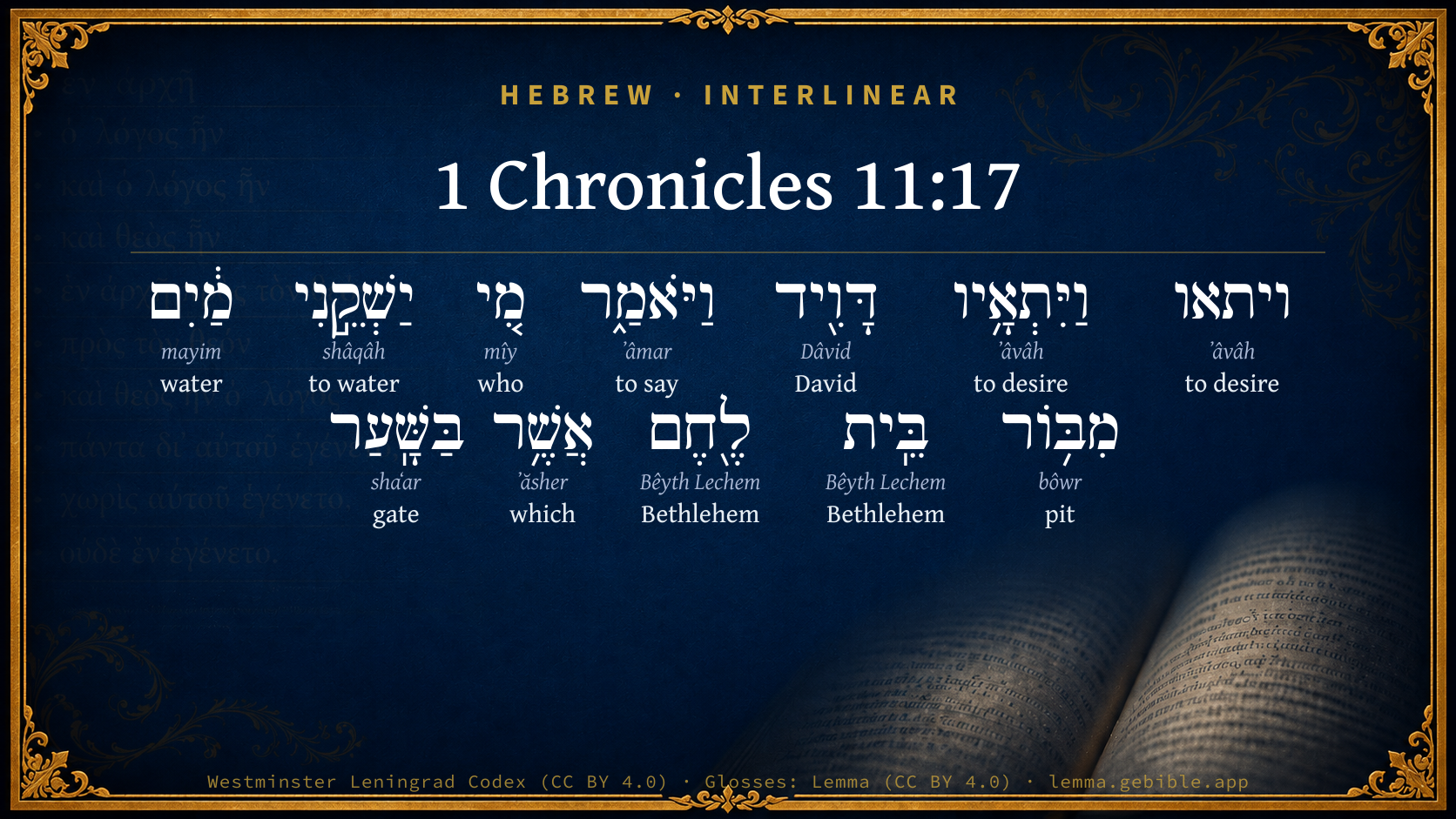
  1. וַיִּתְאָ֥יו ʼâvâh H183 “and · to desire” Conjunction + Verb, Hithpael, Sequential Imperfect, 3rd Person, Masculine, Singular
  2. דָּוִ֖יד Dâvid H1732 “David” Noun, Proper
  3. וַיֹּאמַ֑ר ʼâmar H559 “and · to say” Conjunction + Verb, Qal, Sequential Imperfect, 3rd Person, Masculine, Singular
  4. מִ֚י mîy H4310 “who” Particle, Interrogative
  5. יַשְׁקֵ֣נִי shâqâh H8248 “to water · me” Verb, Hiphil, Imperfect, 3rd Person, Masculine, Singular + Suffix, Personal, 1st Person, Common, Singular
  6. מַ֔יִם mayim H4325 “water(s)” Noun, Common, Masculine, Plural, Absolute
  7. מִבּ֥וֹר bôwr H953 “from · pit of” Preposition + Noun, Common, Masculine, Singular, Construct
  8. בֵּֽית Bêyth Lechem H1035 “Bethlehem” Noun, Proper
  9. לֶ֖חֶם Bêyth Lechem H1035 “Bethlehem” Noun, Proper
  10. אֲשֶׁ֥ר ʼăsher H834 “which” Particle, Relative
  11. בַּשָּֽׁעַר shaʻar H8179 “in/at the · gate” Preposition, Determined + Noun, Common, Masculine, Singular, Absolute

About this verse

These counts appear in no published source. They are computed here, from the morphology-tagged text and Lemma’s own curated glosses. What Lemma adds →

12
words
10
distinct lemmas
Historical
section

Shared distinctive vocabulary

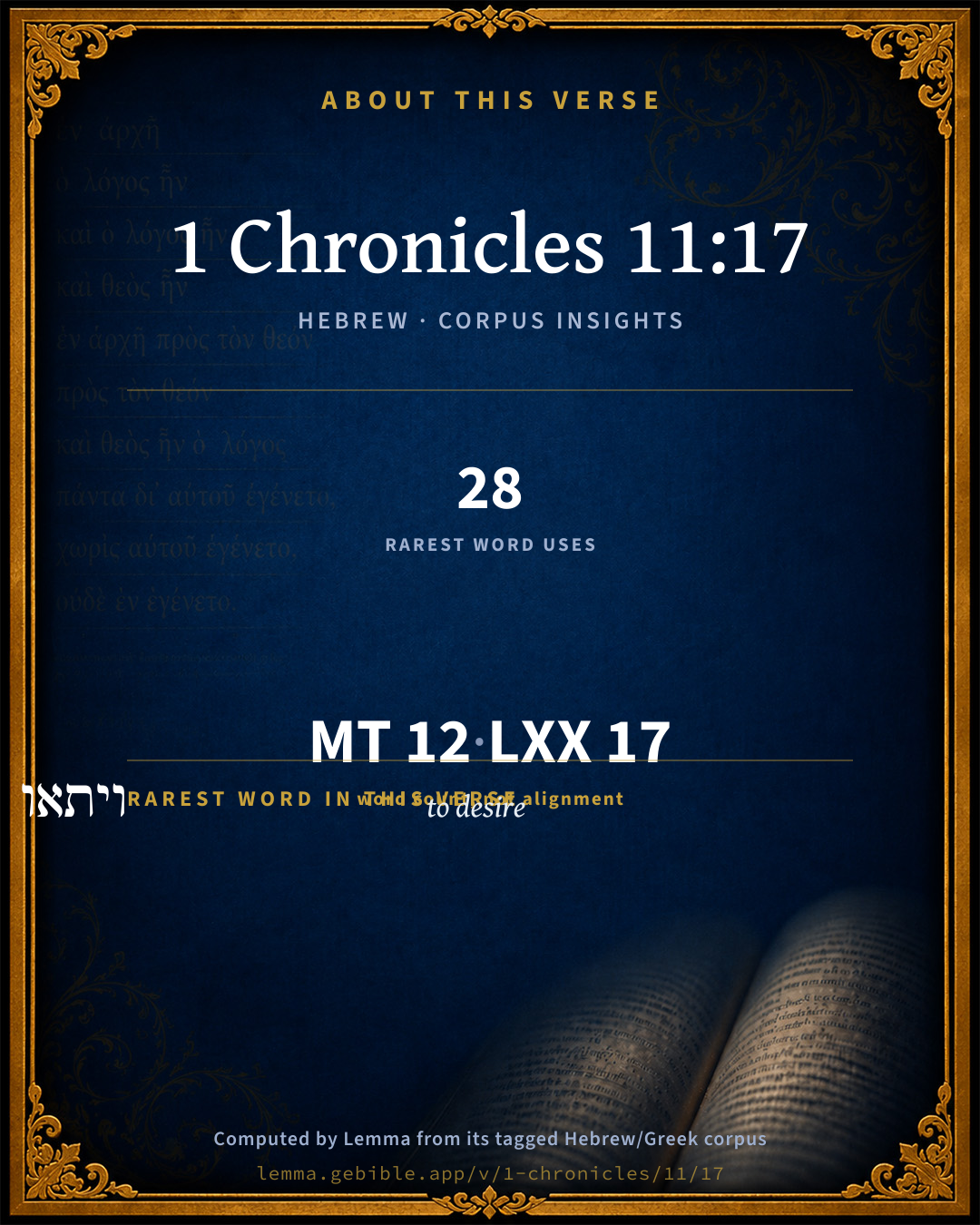
ויתאו to desire H183 occurs in 25 verses of the Hebrew Bible. Also found in:

Grammatical profile

  • 4 verbs
  • 6 nouns
  • 2 particles

Verb forms

  • ויתאו Hithpael · Sequential Imperfect
  • וַיִּתְאָ֥יו Hithpael · Sequential Imperfect
  • וַיֹּאמַ֑ר Qal · Sequential Imperfect
  • יַשְׁקֵ֣נִי Hiphil · Imperfect

Repetition

Words recur within this verse — often emphatic in Hebrew:

  • ויתאו to desire H183 ×2
  • בֵּֽית Bethlehem H1035 ×2

Hebrew & Septuagint length

In English translation the verse runs 23 words from the Hebrew and 22 from the Septuagint (LXX English) — closely comparable.

A rough comparison of the two English renderings, which tokenize alike — not a word-level alignment.

Word counts can differ between the Hebrew and the Greek without any difference in meaning — e.g. the Hebrew direct-object marker אֵת has no separate Greek word, and Greek often adds the article ὁ.

In the original languages it is 12 Hebrew tokens and 17 Greek tokens — but the two are counted differently (Hebrew bundles its prefixes and suffixes into one token; the Greek is in lemma form), so that isn’t a like-for-like length.

Cross-references

8

Topical passages linked to 1 Chronicles 11:17 in the Treasury of Scripture Knowledge — connected by theme and wording, ordered by reader-vote popularity; previews shown in the World English Bible.

  • 2 Samuel 23:15–16 David longed, and said, Oh that one would give me water to drink of the well of Bethlehem, which is by the gate!
  • Isaiah 12:3 Therefore with joy you shall draw water out of the wells of salvation.
  • John 4:10 Jesus answered her, "If you knew the gift of God, and who it is who says to you, 'Give me a drink,' you would have asked him, and he would have given you living water."
  • John 4:14 but whoever drinks of the water that I will give him will never thirst again; but the water that I will give him will become in him a well of water springing up to eternal life."
  • Psalms 63:1 God, you are my God. I will earnestly seek you. My soul thirsts for you, My flesh longs for you, In a dry and weary land, where there is no water.
  • Numbers 11:4–5 The mixed multitude that was among them lusted exceedingly: and the children of Israel also wept again, and said, Who shall give us flesh to eat?
  • Psalms 42:1–2 As the deer pants for the water brooks, So my soul pants after you, God.
  • Psalms 143:6 I spread forth my hands to you. My soul thirsts for you, like a parched land. Selah.

Cross-references courtesy of OpenBible.info (CC BY 4.0).

Hebrew and Greek witnesses Masoretic Hebrew ↔ Greek Septuagint

The same verse in the two great witnesses to the Old Testament, shown verse-for-verse.

These are two independent witnesses, not word-aligned to each other, and the Septuagint is shown in lemma (dictionary) form.

Hebrew 1 Chronicles 11:17 Masoretic · Westminster Leningrad Codex

ויתאו וַיִּתְאָ֥יו דָּוִ֖יד וַיֹּאמַ֑ר מִ֚י יַשְׁקֵ֣נִי מַ֔יִם מִבּ֥וֹר בֵּֽית לֶ֖חֶם אֲשֶׁ֥ר בַּשָּֽׁעַר

David longed, and said, Oh that one would give me water to drink of the well of Bethlehem, which is by the gate!

World English Bible · Public Domain

Greek LXX 1 Chronicles 11:17 Septuagint · lemma form

καί ἐπιθυμέω δαυίδ καί εἶπον τίς ποτίζω ἐγώ ὕδωρ ἐκ ὁ λάκκος βαιθλεεμ ὁ ἐν ὁ πύλη

And David longed, and said, Who will give me water to drink of the well of Bethleem, that is in the gate?

LXX2012 (modern English Septuagint) · Public Domain

Hebrew: Westminster Leningrad Codex (CC BY 4.0). Greek: Septuagint (public domain); English from LXX2012 (modern English Septuagint) (Public Domain). How the Septuagint differs from the Hebrew →

Commentary

Notes on 1 Chronicles 11:17 from classic Christian and Jewish commentators (each source and its license shown beneath its notes). The classic Christian expositions comment on the surrounding passage and are grouped to its opening verse, so a note may address several verses; the Jewish commentaries on the Tanakh (Rashi and others) are per-verse, so they appear only where the commentator wrote on this verse.

Lemma curates 59 commentaries, every one of them public domain or Creative Commons licensed, each selected and text-cleaned for this edition rather than reprinted as found. About our sources →

Adam Clarke's Commentary

Verse 17. David longed] See the notes on 2Sa 23:15-17.

Adam Clarke's Commentary on the Bible (1810–1826) — public domain. Text from a community e-Sword/MySword module.

Ellicott's Commentary for English Readers

(17) That is at (in) the gate !—No such well is now known. The so-called “David’s well” is half a mile north-east of the town.

A Bible Commentary for English Readers, edited by Charles John Ellicott (1878–1897) — public domain. Text from a community e-Sword module.

The Cambridge Bible for Schools and Colleges

gen. ed. J. J. S. Perowne

17. give me drink of the water] R.V. give me water to drink.

that is at] R.V. which is by (so Sam.).

The Cambridge Bible for Schools and Colleges (gen. ed. J. J. S. Perowne; Cambridge University Press, 1878–1918) — public domain. Text from a community e-Sword module.

Haydock's Catholic Bible Commentary

O that. Hebrew, "Who will." David wished to see his native country freed from the troops of the Philistines. --- In. Hebrew, "by the gate."

George Leo Haydock (1774–1849), Haydock's Catholic Family Bible and Commentary, 1859 edition — public domain. Excludes Psalms (Douay-Rheims chapter numbering differs from Protestant) and Deuterocanonical books (Catholic canon only).

The Pulpit Commentary

The well of Bethlehem at the gate. Nothing else is known of this well. No trace of it exists now, according to Dr. Robinson ("Bibl. Res.," 1:473). The traditional well is half a mile distant, to the north of the town, and consists of a group of three cisterns, while the present town is supplied with water by an aqueduct.

Vers. 17-19.

David"s drink offering.

This incident is narrated also in 2Sa_23:13-17. The "hold" that is mentioned is probably the frontier fortress of Adullam, on the Philistine border, "which, from its strength and position and the neighbourhood of the caverns, was judged by David to be the best place of defence against the invasions of the Philistines." Robinson says, "There is no well of living water in or near the town of Bethlehem." "There is, however, a cistern of "deep, clear, cool water," called by the monks David"s well, about three-quarters of a mile to the north of Bethlehem. Possibly the old well has been filled up since the town was supplied with water by the aqueduct." Josephus speaks of the well as being near the gate. David would not drink of the water when it was brought him, for this reason he looked upon it, not as water, but as blood, seeing that it had been procured at the hazard of men"s lives; and, knowing that it was forbidden by the Law to drink blood, (Lev_17:11, Lev_17:12) he poured it out upon the ground as a solemn offering unto the Lord, and as a thanksgiving for the preservation of their lives.

I DAVID"S HOME FEELINGS. In him there was strong family affection. This is seen in his relations with his grown-up sons. There was also strong attachment to his early home, the place of his youthful associations. Strong home feeling is usually found in the inhabitants of hilly and mountainous countries; as may be illustrated from the mal-du-pays, the characteristic sickness of the Swiss when away from their mountains. It does not appear that David did more than give utterance to a suddenly conceived wish. It was an impulsive utterance, which he did not mean should be taken as a command. Herein is given us a lesson on the importance of guarding carefully our speech, watching the door of our lips. He is not wise who utters all he feels. It is a great grace to be enabled to keep silence.

II THE DEVOTION OF DAVID"S FOLLOWERS. This is one of the most interesting features of the incident. It brings to view the relations between David and his men, and helps us to realize the fascination which David exerted. Some men have this power over their fellows a gracious power, if they use it to lead their fellow-men to higher and holier things; a fatal power, if they make it the means of dragging others down to their own doom. It may be pointed out that special gifts ensure this kind of leadership. Of these, grace of body, generosity of disposition, a skill of getting on otherslevel, an absence of stir-assertive pride, and a winning geniality of manner, are important. If God gives grace of natural disposition, such as wins for us general favour, let us remember that this brings its holy burden of responsibility.

III THE PROWESS IN WHICH DEVOTION FOUND EXPRESSION. Estimate it from a military point of view. It could but be regarded as a "foolhardy "enterprise; and yet the very suddenness and dash of it almost guaranteed its success. To gratify a wish these men would imperil their lives.

IV THE PIOUS ESTIMATE OF THE VALUE OF LIFE. This tended to bind David"s followers yet more closely to him. Such considerateness for them showed his loving and thoughtful and pious character. It was worth while serving one who eared for them so tenderly. Compare Wellington"s personal interest in his soldiers, and the personal enthusiasm which he created. The sense of the value of human life is the very foundation of social morality, it stays man"s hand from being lifted up against his fellowman. And respect for man"s best treasure his life finds varied expression in respect for all his other treasures and possessions. We will not injure him, in his life, nor in taking anything that is his. Lead on to show how the value of life is enhanced when we add to it two considerations

(1) Man"s immortality;

(2) man"s salvation, through a sacrifice of infinite value. R.T.

The Pulpit Commentary (1880–1919), ed. H.D.M. Spence-Jones & Joseph S. Exell — public domain. Text from a community e-Sword module.

Rashi

Rabbi Shlomo Yitzchaki (Rashi)

If only someone would give me to drink water from the cistern of Bethlehem This was David’s place, as it is written (I Sam. 17:58): “The son of your servant, Jesse the Bethlehemite,” and because he was accustomed and used to that water, he desired it; any water or air that a person is accustomed to is beneficial to him, and that which he is not used to is harmful to him. A similar case is [found] in the beginning of Josiphon about a queen who became ill because she was carried away from the land of her birth, and all the physicians said, “She has no cure until she bathes and derives benefit from the water of her place,” and they did this for her.

Rashi on the Tanakh — English translations: “The Judaica Press complete Tanach with Rashi, translated by A. J. Rosenberg” (CC BY 4.0); “Pentateuch with Rashi's commentary by M. Rosenbaum and A.M. Silbermann, 1929-1934” (public domain); “The Metsudah Tanach series, Lakewood, N.J” (CC BY 4.0); and “The Book of Joshua, Metsudah Publications, 1997” (CC BY 4.0). Text via Sefaria.

Lesson kit

Teaching starters — assembled from the data on this page, not authored interpretation. Every prompt links to the verse data it draws on. Edit before teaching.

1 Chronicles, in the Historical, opens this verse with 12 words (10 distinct Hebrew lemmas). Its most distinctive word is ʼâvâh (“to desire”). A historical commentator’s framing appears above. Read the whole chapter for the surrounding context.

Discussion questions

  1. How does “to desire” (ʼâvâh) shape what this verse is saying?
  2. How does Numbers 11:4, which shares the word «to desire», read alongside this verse?
  3. What does the repetition of “to desire” (2× in this one verse) do in this verse?
  4. These translations render this verse differently; the difference is in the English rendering, not the original. What questions does that raise?
  5. «ויתאו» is a Hithpael Sequential Imperfect verb. How does that grammatical form shape the action described?
  6. Compare how Adam Clarke's Commentary and Ellicott's Commentary for English Readers read this verse. Where do they agree or differ?

Things to notice

Reading settings

Reading text

Shown beneath each verse's original-language words.

Old Testament
Old Testament edition

Read the OT as the Masoretic Hebrew (MT) or the Greek Septuagint (LXX).

English shown for the Greek Septuagint (in the Hebrew ↔ Greek comparison).

Comparing translations? Open the Compare panel on any verse page to stack up to four side by side.