
Joshua 20:4

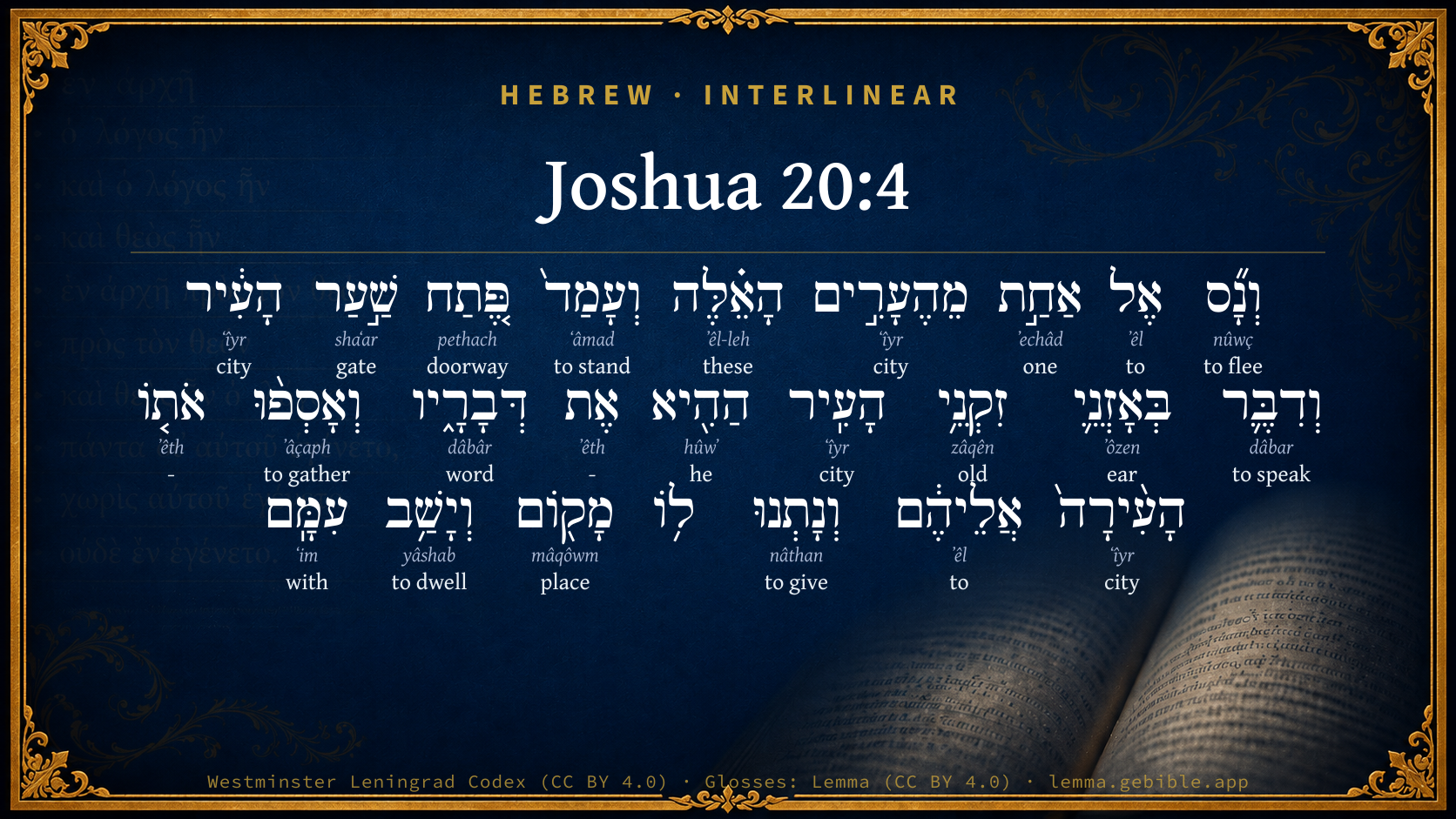
Hebrew (Westminster Leningrad Codex) Joshua 20:4 appears in the Hebrew Old Testament. The text above is from the Westminster Leningrad Codex. Each word links to its Strong’s number, a concise gloss, and parsing drawn from the Open Scriptures Hebrew Bible morphology. Click any word for its full Brown-Driver-Briggs (BDB) entry.
Download image
Cite this verse

Joshua 20:4 (World English Bible). Public Domain. Lemma interlinear Bible study tool, https://lemma.gebible.app/v/joshua/20/4.

Show BibTeX & RIS
BibTeX
RIS
English Translation
He shall flee to one of those cities, and shall stand at the entrance of the gate of the city, and declare his cause in the ears of the elders of that city; and they shall take him into the city to them, and give him a place, that he may dwell among them.
World English Bible · Public Domain
Download a study sheet

One document with this verse’s original text, its word-by-word gloss line, the meaning frame, cross-references with their text, attributed commentary, and full source and license credits — printable, and it pastes into notes with its structure intact.

This verse Autodidact and up

Study sheet (.html) Plain text (.txt)

A passage Seminary Student

Up to 50 verses in one chapter. A passage sheet keeps up to 6 commentary sources and 12 cross-references per verse, in the order this page ranks them, and says so on the sheet whenever that leaves anything out. Ask for a single verse and you get the Autodidact verse sheet above.

Everything on this page stays free to read, with no account — the sheet is a download of what is already on screen, not access to it.

Want to remove ads? Support Godless Engineer
Compare translations 3

The same verse in 3 English versions, stacked beneath the original-language interlinear above. Click any original word for its lexicon entry.

Each is an independent rendering of the whole verse — the interlinear is not word-aligned to these translations.

Highlighted words mark where these versions differ — a whole-verse word diff, not a word-by-word alignment.

  • World English Bible Public Domain
    He shall flee to one of those cities, and shall stand at the entrance of the gate of the city, and declare his cause in the ears of the elders of that city; and they shall take him into the city to them, and give him a place, that he may dwell among them.
  • King James Version Public Domain
    And when he that doth flee unto one of those cities shall stand at the entering of the gate of the city, and shall declare his cause in the ears of the elders of that city, they shall take him into the city unto them, and give him a place, that he may dwell among them.
  • unfoldingWord Literal Text CC BY-SA 4.0
    And he shall flee to one from these cities and stand the entrance of the gate of the city, and he shall speak his words in the ears of the elders of that city. And they shall gather him into the city to themselves, and they shall give to him a place, and he shall dwell with them.

unfoldingWord Literal Text — © unfoldingWord, licensed CC BY-SA 4.0. Word-aligned USFM3 via Door43 (git.door43.org/unfoldingWord/en_ult).

Versions to compare (up to 4)

3 of 4 selected

Show all 18 translations

Every available English version of this verse, each an independent rendering of the whole verse.

  • World English Bible Public Domain
    He shall flee to one of those cities, and shall stand at the entrance of the gate of the city, and declare his cause in the ears of the elders of that city; and they shall take him into the city to them, and give him a place, that he may dwell among them.
  • Berean Standard Bible Public Domain
    When someone flees to one of these cities, stands at the entrance of the city gate, and states his case before its elders, they are to bring him into the city and give him a place to live among them.
  • Majority Standard Bible Public Domain
    When someone flees to one of these cities, stands at the entrance of the city gate, and states his case before its elders, they are to bring him into the city and give him a place to live among them.
  • King James Version Public Domain
    And when he that doth flee unto one of those cities shall stand at the entering of the gate of the city, and shall declare his cause in the ears of the elders of that city, they shall take him into the city unto them, and give him a place, that he may dwell among them.
  • American Standard Version (1901) Public Domain
    And he shall flee unto one of those cities, and shall stand at the entrance of the gate of the city, and declare his cause in the ears of the elders of that city; and they shall take him into the city unto them, and give him a place, that he may dwell among them.
  • Revised Version (1885) Public Domain
    And he shall flee unto one of those cities, and shall stand at the entering of the gate of the city, and declare his cause in the ears of the elders of that city; and they shall take him into the city unto them, and give him a place, that he may dwell among them.
  • Geneva Bible (1599) Public Domain
    And he that doeth flee vnto one of those cities, shall stand at the entring of the gate of the citie, and shall shewe his cause to the Elders of the citie: and they shall receiue him into the citie vnto them, and giue him a place, that hee may dwell with them.
  • Douay-Rheims (1899) Public Domain
    And when he shall flee to one of these cities: he shall stand before the gate of the city, and shall speak to the ancients of that city, such things as prove him innocent: and so shall they receive him, and give him a place to dwell in.
  • Young's Literal Translation Public Domain
    `When `one' hath fled unto one of these cities, and hath stood `at' the opening of the gate of the city, and hath spoken in the ears of the elders of that city his matter, then they have gathered him into the city unto them, and have given to him a place, and he hath dwelt with them.
  • Literal Standard Version CC BY-SA 4.0
    When [one] has fled to one of these cities, and has stood [at] the opening of the gate of the city, and has spoken his matter in the ears of [the] elderly of that city, then they have gathered him into the city to them, and have given a place to him, and he has dwelt with them.
  • Unlocked Literal Bible CC BY-SA 4.0
    He will run to one of those cities and will stand at the entrance of the city gate, and explain his case to the elders of that city. Then they will take him into the city and give him a place for him to live among them.
  • unfoldingWord Literal Text CC BY-SA 4.0
    And he shall flee to one from these cities and stand the entrance of the gate of the city, and he shall speak his words in the ears of the elders of that city. And they shall gather him into the city to themselves, and they shall give to him a place, and he shall dwell with them.
  • Darby Bible Public Domain
    And he shall flee unto one of those cities and stand at the entrance of the city-gate, and shall declare his matter in the ears of the elders of that city; and they shall take him into the city unto them, and give him a place, that he may dwell among them.
  • World Messianic Bible Public Domain
    He shall flee to one of those cities, and shall stand at the entrance of the gate of the city, and declare his case in the ears of the elders of that city. They shall take him into the city with them, and give him a place, that he may live among them.
  • Webster's Bible Public Domain
    And when he that doth flee to one of those cities shall stand at the entering of the gate of the city, and shall declare his cause in the ears of the elders of that city, they shall take him into the city to them, and give him a place, that he may dwell among them.
  • Free Bible Version CC BY-SA 4.0
    When he gets to one of these towns, he shall state his case to the elders at the town gates. They must allow him to enter, and they will also arrange a place for him to stay.
  • Bible in Basic English Public Domain
    And if anyone goes in flight to one of those towns, and comes into the public place of the town, and puts his cause before the responsible men of the town, they will take him into the town and give him a place among them where he may be safe.
  • JPS Tanakh (1917) Public Domain
    And he shall flee unto one of those cities, and shall stand at the entrance of the gate of the city, and declare his cause in the ears of the elders of that city; and they shall take him into the city unto them, and give him a place, that he may dwell among them.

Literal Standard Version (2020), Covenant Press — licensed CC BY-SA 4.0. Text via the HelloAO Bible API (eBible.org). Unlocked Literal Bible (unfoldingWord) — licensed CC BY-SA 4.0. Text via the HelloAO Bible API (eBible.org). unfoldingWord Literal Text — © unfoldingWord, licensed CC BY-SA 4.0. Word-aligned USFM3 via Door43 (git.door43.org/unfoldingWord/en_ult). Free Bible Version, Dr. Jonathan Gallagher — licensed CC BY-SA 4.0. Text via the HelloAO Bible API (eBible.org).

Word by word

More ways to search: Search by grammar → Find every occurrence → Compare this word →

Practice this passage: Drill this verse → Learn its vocabulary →

וְנָ֞ס
nûwç
H5127
“and · to flee”
Conjunction + Verb, Qal, Sequential Perfect, 3rd Person, Masculine, Singular
Part of Speech
Conjunction + Verb
Stem
Qal
Form
Sequential Perfect
Person
3rd Person
Gender
Masculine
Number
Singular
Full BDB Definition

Origin: a primitive root

TWOT: 1327

to flee, escape - (Qal) - to flee - to escape - to take flight, depart, disappear - to fly (to the attack) on horseback - (Polel) to drive at - (Hithpolel) to take flight - (Hiphil) - to put to flight - to drive hastily - to cause to disappear, hide
  1. אֶל ʼêl H413 “to” Preposition
  2. אַחַ֣ת ʼechâd H259 “one” Adjective, Cardinal number, Feminine, Singular, Absolute
  3. מֵהֶעָרִ֣ים ʻîyr H5892 “from · the · cities” Preposition + Particle, Definite Article + Noun, Common, Feminine, Plural, Absolute
  4. הָאֵ֗לֶּה ʼêl-leh H428 “the · these” Particle, Definite Article + Pronoun, Demonstrative, Common, Plural
  5. וְעָמַד֙ ʻâmad H5975 “and · to stand” Conjunction + Verb, Qal, Sequential Perfect, 3rd Person, Masculine, Singular
  6. פֶּ֚תַח pethach H6607 “doorway of” Noun, Common, Masculine, Singular, Construct
  7. שַׁ֣עַר shaʻar H8179 “gate of” Noun, Common, Masculine, Singular, Construct
  8. הָעִ֔יר ʻîyr H5892 “the · city” Particle, Definite Article + Noun, Common, Feminine, Singular, Absolute
  9. וְדִבֶּ֛ר dâbar H1696 “and · to speak” Conjunction + Verb, Piel, Sequential Perfect, 3rd Person, Masculine, Singular
  10. בְּאָזְנֵ֛י ʼôzen H241 “in/at · ears of” Preposition + Noun, Common, Feminine, Dual, Construct
  11. זִקְנֵ֥י zâqên H2205 “old of” Adjective, Adjective, Masculine, Plural, Construct
  12. הָעִֽיר ʻîyr H5892 “the · city” Particle, Definite Article + Noun, Common, Feminine, Singular, Absolute
  13. הַהִ֖יא hûwʼ H1931 “the · he” Particle, Definite Article + Pronoun, Personal, 3rd Person, Feminine, Singular
  14. אֶת ʼêth H853 “-” Particle, Direct Object
  15. דְּבָרָ֑יו dâbâr H1697 “words · his” Noun, Common, Masculine, Plural, Construct + Suffix, Personal, 3rd Person, Masculine, Singular
  16. וְאָסְפ֨וּ ʼâçaph H622 “and · to gather” Conjunction + Verb, Qal, Perfect, 3rd Person, Common, Plural
  17. אֹת֤וֹ ʼêth H853 “- · him” Particle, Direct Object + Suffix, Personal, 3rd Person, Masculine, Singular
  18. הָעִ֨ירָה֙ ʻîyr H5892 “the · city · toward” Particle, Definite Article + Noun, Common, Feminine, Singular, Absolute + Suffix, Demonstrative
  19. אֲלֵיהֶ֔ם ʼêl H413 “to · them” Preposition + Suffix, Personal, 3rd Person, Masculine, Plural
  20. וְנָתְנוּ nâthan H5414 “and · to give” Conjunction + Verb, Qal, Sequential Perfect, 3rd Person, Common, Plural
  21. מָק֖וֹם mâqôwm H4725 “place” Noun, Common, Masculine, Singular, Absolute
  22. וְיָשַׁ֥ב yâshab H3427 “and · to dwell” Conjunction + Verb, Qal, Sequential Perfect, 3rd Person, Masculine, Singular
  23. עִמָּֽם ʻim H5973 “with · them” Preposition + Suffix, Personal, 3rd Person, Masculine, Plural

About this verse

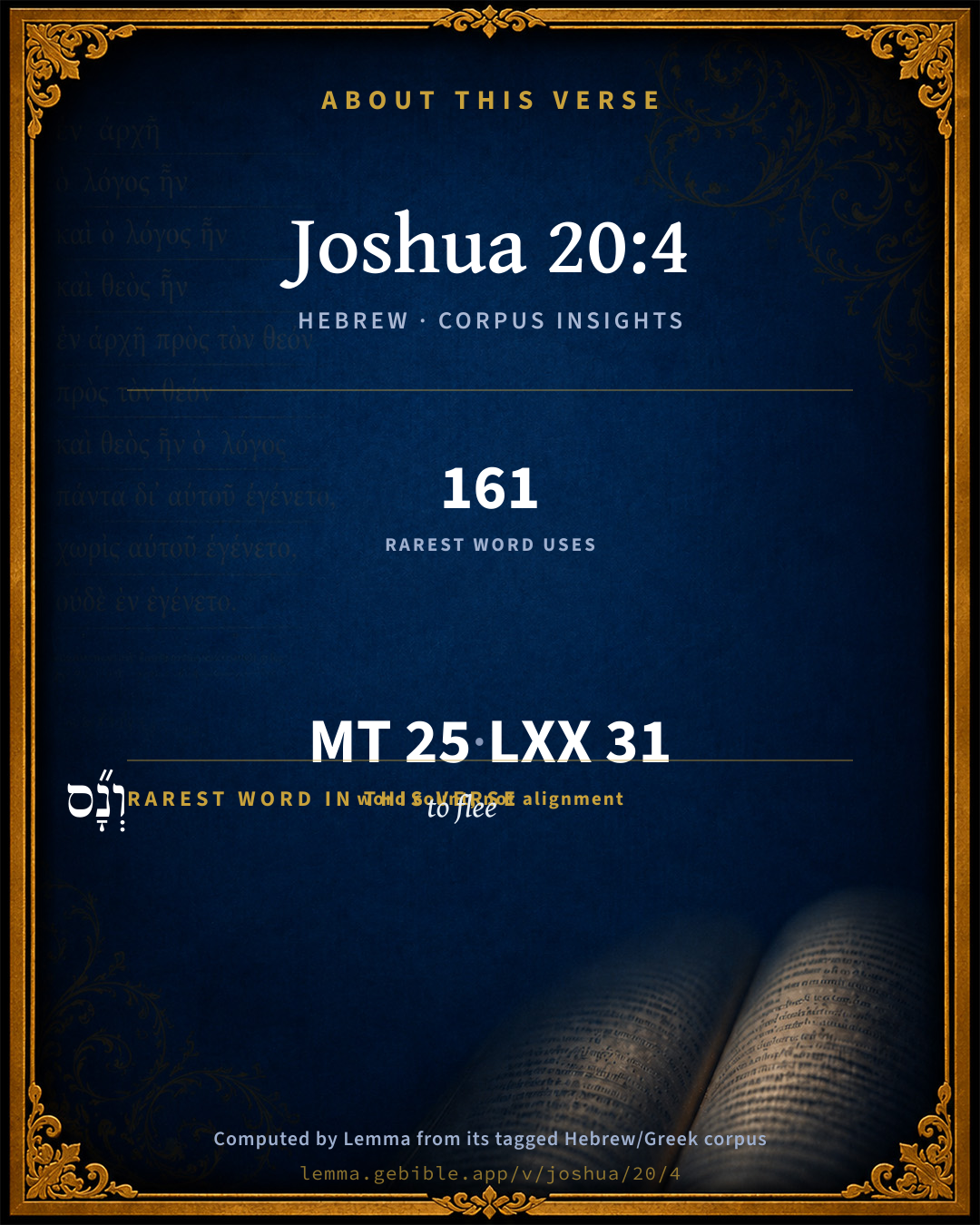
These counts appear in no published source. They are computed here, from the morphology-tagged text and Lemma’s own curated glosses. What Lemma adds →

25
words
19
distinct lemmas
Historical
section

Grammatical profile

  • 6 verbs
  • 9 nouns
  • 2 adjectives
  • 2 pronouns
  • 4 prepositions
  • 2 particles

Verb forms

  • וְנָ֞ס Qal · Sequential Perfect
  • וְעָמַד֙ Qal · Sequential Perfect
  • וְדִבֶּ֛ר Piel · Sequential Perfect
  • וְאָסְפ֨וּ Qal · Perfect
  • וְנָתְנוּ Qal · Sequential Perfect
  • וְיָשַׁ֥ב Qal · Sequential Perfect

Repetition

Words recur within this verse — often emphatic in Hebrew:

  • מֵהֶעָרִ֣ים city H5892 ×4
  • אֶל to H413 ×2

Hebrew & Septuagint length

In English translation the verse runs 54 words from the Hebrew and 29 from the Septuagint (LXX English) — the Septuagint runs noticeably shorter here. See the side-by-side →

A rough comparison of the two English renderings, which tokenize alike — not a word-level alignment.

Word counts can differ between the Hebrew and the Greek without any difference in meaning — e.g. the Hebrew direct-object marker אֵת has no separate Greek word, and Greek often adds the article ὁ.

In the original languages it is 25 Hebrew tokens and 31 Greek tokens — but the two are counted differently (Hebrew bundles its prefixes and suffixes into one token; the Greek is in lemma form), so that isn’t a like-for-like length.

Cross-references

7

Topical passages linked to Joshua 20:4 in the Treasury of Scripture Knowledge — connected by theme and wording, ordered by reader-vote popularity; previews shown in the World English Bible.

  • Jeremiah 38:7 Now when Ebedmelech the Ethiopian, a eunuch, who was in the king's house, heard that they had put Jeremiah in the dungeon (the king then sitting in the gate of Benjamin),
  • Ruth 4:1–2 Now Boaz went up to the gate, and sat him down there: and, behold, the near kinsman of whom Boaz spoke came by; to whom he said, Ho, such a one! turn aside, sit down here. He turned aside, and sat down.
  • Job 5:4 His children are far from safety, They are crushed in the gate. Neither is there any to deliver them,
  • Job 29:7 When I went forth to the city gate, When I prepared my seat in the street,
  • Psalms 26:9 Don't gather my soul with sinners, Nor my life with bloodthirsty men;
  • Proverbs 31:23 Her husband is respected in the gates, When he sits among the elders of the land.
  • Hebrews 6:18 that by two immutable things, in which it is impossible for God to lie, we may have a strong encouragement, who have fled for refuge to take hold of the hope set before us.

Cross-references courtesy of OpenBible.info (CC BY 4.0).

Hebrew and Greek witnesses Masoretic Hebrew ↔ Greek Septuagint

The same verse in the two great witnesses to the Old Testament, shown verse-for-verse.

Here the Septuagint runs noticeably shorter than the Hebrew — LXX2012 (modern English Septuagint) 29 words vs World English Bible 54. A rough length comparison of the two English translations, not a word-level alignment — read both below.

These are two independent witnesses, not word-aligned to each other, and the Septuagint is shown in lemma (dictionary) form.

Hebrew Joshua 20:4 Masoretic · Westminster Leningrad Codex

וְנָ֞ס אֶל אַחַ֣ת מֵהֶעָרִ֣ים הָאֵ֗לֶּה וְעָמַד֙ פֶּ֚תַח שַׁ֣עַר הָעִ֔יר וְדִבֶּ֛ר בְּאָזְנֵ֛י זִקְנֵ֥י הָעִֽיר הַהִ֖יא אֶת דְּבָרָ֑יו וְאָסְפ֨וּ אֹת֤וֹ הָעִ֨ירָה֙ אֲלֵיהֶ֔ם וְנָתְנוּ ל֥וֹ מָק֖וֹם וְיָשַׁ֥ב עִמָּֽם

He shall flee to one of those cities, and shall stand at the entrance of the gate of the city, and declare his cause in the ears of the elders of that city; and they shall take him into the city to them, and give him a place, that he may dwell among them.

World English Bible · Public Domain

Greek LXX Joshua 20:4 Septuagint · lemma form

καί διαστέλλω ὁ καδης ἐν ὁ γαλιλαία ἐν ὁ ὄρος ὁ νεφθαλι καί συχεμ ἐν ὁ ὄρος ὁ ἐφράιμ καί ὁ πόλις αρβοκ οὗτος εἰμί χεβρων ἐν ὁ ὄρος ὁ ιουδα

And Joshua separated Cades in Galilee in the mount Nephthali, and Sychem in the mount Ephraim, and the city of Arboc; this is Chebron, in the mountain of Juda.

LXX2012 (modern English Septuagint) · Public Domain

Hebrew: Westminster Leningrad Codex (CC BY 4.0). Greek: Septuagint (public domain); English from LXX2012 (modern English Septuagint) (Public Domain). How the Septuagint differs from the Hebrew →

Targum (Aramaic paraphrase)

1

The Targum is the ancient Jewish Aramaic paraphrase of the Hebrew Scriptures — an interpretive translation, not the Hebrew text itself. Onkelos (literal) and Pseudo-Jonathan (expansive) render the Torah, and Jonathan the Prophets. Coverage is partial: where no permissively-licensed English translation exists for a verse, only the Aramaic is shown. This is verse-level text, not a word-by-word alignment to the Hebrew.

  1. Targum Jonathan Prophets (Joshua–Malachi)
    וְיַעֲרוֹק לַחֲדָא מִקִרְוַיָא הָאִלֵין וִיקוּם בְּמַעֲלָנָא דִתְרַע קַרְתָּא וִימַלֵיל קֳדָם סָבֵי קַרְתָּא הַהִיא יַת פִּתְגָמוֹהִי וִיכַנְשׁוּן יָתֵיהּ לְקַרְתָּא לְוַתְהוֹן וְיִתְּנוּן לֵיהּ אֲתַר וִיתֵיב עִמְהוֹן:

    (no public-domain English translation for this verse)

    Targum Jonathan — Aramaic: “Mikraot Gedolot” (public domain). English: “Sefaria Community Translation” (CC0 1.0 (public-domain dedication)); “London "Chaldee Paraphrase," 1871” (public domain). Text via Sefaria.

Commentary

Notes on Joshua 20:4 from classic Christian and Jewish commentators (each source and its license shown beneath its notes). The classic Christian expositions comment on the surrounding passage and are grouped to its opening verse, so a note may address several verses; the Jewish commentaries on the Tanakh (Rashi and others) are per-verse, so they appear only where the commentator wrote on this verse.

Lemma curates 59 commentaries, every one of them public domain or Creative Commons licensed, each selected and text-cleaned for this edition rather than reprinted as found. About our sources →

Trapp's Complete Commentary

John Trapp

Jos 20:4 And when he that doth flee unto one of those cities shall stand at the entering of the gate of the city, and shall declare his cause in the ears of the elders of that city, they shall take him into the city unto them, and give him a place, that he may dwell among them.

Ver. 4. And when he that doth flee unto one of these cities.] Which were to be cities of Levites, who were presumed to be both wise and merciful men, and such as would not favour wilful offenders. These cities also were to be at a just distance, that the party might repair thereunto from all parts in due time. And lastly, a way thereunto was to be paved, and marks of direction set up, as some note from Deu 19:2-3.

They shall take him into the city unto them.] God’s laws are not as Draco’s, that punished every peccadillo almost with death; and were, therefore, said to be written not with black but with blood. Howbeit that saying of King James is memorable, that if God did allow him to kill a man, though by casualty or beside his intention, he should think that God did not love him.

John Trapp, A Commentary or Exposition upon All the Books of the Old and New Testament (1647–1656) — public domain. Text from a community e-Sword module.

Joseph Benson's Commentary

Jos 20:4. The gate — Where the judges used to sit. His cause — Shall give them a true relation of the fact, and all its circumstances. They shall take him — If they are satisfied in the relation he makes concerning the fact, otherwise it had been a vain thing to examine. Give a place — Which they might well allow him, because God gave them the city with a reservation for such persons.

Joseph Benson's Commentary on the Old and New Testaments (1811–1818) — public domain. Text from a community e-Sword module.

Geneva Bible (1599)

Geneva Bible translators

Hebrew, in the ears of the Elders.

Geneva Bible (1599) marginal notes — public domain. Text via Bolls.life.

Jamieson, Fausset & Brown

Robert Jamieson, A. R. Fausset & David Brown

he that doth flee unto one of those cities shall stand at the entering of the gate of the city--It was the place of public resort, and on arriving there he related his tale of distress to the elders, who were bound to give him shelter and the means of support, until the local authorities (Jos 20:6), having carefully investigated the case, should have pronounced the decision. If found guilty, the manslayer was surrendered to the blood-avenger; if extenuating circumstances appeared, he was to remain in the city of refuge, where he would be safe from the vindictive feelings of his pursuers; but he forfeited the privilege of immunity the moment he ventured beyond the walls.

Jamieson, Fausset & Brown — Commentary Critical and Explanatory on the Whole Bible (1871) — public domain (CC PDM 1.0). Text via the HelloAO Bible API.

The Cambridge Bible for Schools and Colleges

gen. ed. J. J. S. Perowne

4. shall stand at the entering of the gate of the city] not i.e. outside the gate of the city, but in the forum, or public place of judgment. Comp. Rth_4:1-2.

in the ears of the elders of that city] Before the fugitive could avail himself of the shelter conceded by the laws, he was to undergo a solemn trial, and make it appear to the satisfaction of the magistrates of the place (“the aldren of the citie,” Wyclif), where the homicide was committed, that it was purely accidental.

and give him a place] If he succeeded in so doing, the elders were to “give him a place,” i.e. receive him into the protection of the city, and permit him to reside there.

The Cambridge Bible for Schools and Colleges (gen. ed. J. J. S. Perowne; Cambridge University Press, 1878–1918) — public domain. Text from a community e-Sword module.

John Gill's Exposition

And when he that doth flee unto one of those cities,.... Any one of them, that was nearest to him:

shall stand at the entering of the gate of the city; for he might not rush in without leave:

and shall declare his cause in the ears of the elders of that city; lay before them the whole matter, how that he had killed a person unawares, by what means it came about, and that it was merely through error, without any malicious design, and was a mere accident:

they shall take him into the city unto them; directly, lest the avenger of blood should come and seize on him, and kill him; and they were to take him into the city, not only to prevent that, but to examine him still more closely about the matter, and get further satisfaction; and being satisfied, were to continue him in it:

and give him a place, that he might dwell among them; until his death, or the death of the high priest, if that was first. Kimchi observes from their Rabbins, the he was not to hire a house all the time of his dwelling there, but was to have one freely, because it is said, "and give him", &c.

John Gill's Exposition of the Whole Bible (1746–1763) — public domain (CC PDM 1.0). Text via the HelloAO Bible API.

Albert Barnes' Notes on the Bible

As soon as the manslayer presented himself at the city of refuge, the elders of the city were to hold an inquiry, and receive him provisionally into the city. Afterward, when the avenger of blood should have tracked his victim to the city, and appear to claim him, a more formal and thorough investigation Jos 20:6 was to be made. Consult the marginal references.

Albert Barnes' Notes on the Bible (1834–1885) — public domain. Text from a community e-Sword/MySword module.

Haydock's Catholic Bible Commentary

Gate, where justice was administered. (Menochius) --- Here the ancients heard what the manslayer had to say in his own defence; and if they thought his account plausible, they gave him a retreat till he might be safely brought to answer the charges of the avenger, who might endeavour to prove that the murder was wilful.

George Leo Haydock (1774–1849), Haydock's Catholic Family Bible and Commentary, 1859 edition — public domain. Excludes Psalms (Douay-Rheims chapter numbering differs from Protestant) and Deuterocanonical books (Catholic canon only).

Matthew Poole's English Annotations

The judges used to sit

at the entering of the gate. His cause, or, his matters or business, what he hath done, and why, and how; he shall give them a true relation of the fact, and all its circumstances.

They shall take him into the city; understand, if they are satisfied in the relation he makes concerning the fact, otherwise it had been a vain thing to examine his cause.

Give him a place; which they might well allow him, because God gave them the city with a reservation for such persons.

Matthew Poole's English Annotations on the Holy Bible (1683–1685) — public domain. Text from a community e-Sword/MySword module.

Whedon's Commentary on the Bible

Daniel D. Whedon

4. Gate of the city — The tribunal of justice, the forum, was at the city gate. The refugee was not kept out of the city till his innocence was proved, but he was permitted to enter, and to relate his cause, and to receive the protection of the city, for this is the meaning of the clause, they shall take him into the city unto them. He must at the earliest possible moment be recognized as a fugitive, or the purpose of his flight may be defeated. This recognition he is entitled to have till his case can be examined by the local authorities. The Rabbins relate how every possible facility was to be afforded to the refugee. “The roads to these cities were to be kept in good repair; no hillock was left, no river nor stream was allowed over which there was not a bridge; the road was to be at least thirty-two cubits broad, (three rods,) and every kind of obstruction was to be removed that might hurt the foot or hinder the speed of the fugitive. At every turning or branching of roads posts were erected bearing the words, REFUGE! REFUGE! to guide the fugitive in his flight; so benign and considerate was the provision made for the benefit of the accidental slayer of his fellow-man.” — Bush. Infinitely greater pains has God taken to lead guilty souls to the refuge of the atoning blood of Jesus Christ. He has opened this refuge, built a highway to it from every human soul, sent his Spirit to enlighten every eye, and his heralds to cry in every ear, “This is the way; walk ye therein.” This way is not for the innocent but for the guilty.

Daniel D. Whedon (gen. ed.), Commentary on the Old and New Testaments (1874–1909) — public domain. Text from a community e-Sword module.

The Pulpit Commentary

And when he that doth flee unto one of those cities. This passage is in accordance with the instructions given in Numbers 35, but is not a quotation from it. The passage may be translated, "and he shall flee ... and shall stand." Shall declare his cause. Literally, shall speak. This was to be clone at the "gate of the city," the place where all legal business was transacted. (see Rth_4:1 2Sa_15:2)

The Pulpit Commentary (1880–1919), ed. H.D.M. Spence-Jones & Joseph S. Exell — public domain. Text from a community e-Sword module.

John Wesley's Explanatory Notes

The gate - Where the Judges used to sit. His cause - Shall give them a true relation of the fact, and all its circumstances. They shall take him - If they are satisfied in the relation he makes, concerning the fact, otherwise it had been a vain thing to examine. Give a place - Which they might well allow him, because God gave them the city with a reservation for such persons.

John Wesley, Explanatory Notes Upon the Whole Bible (1754–1765) — public domain. Text via the GEBible commentary corpus.

unfoldingWord translationNotes

Door43 World Missions Community

He will run

Here the word "he" refers to the person who unintentionally killed someone.

explain his case to the elders of that city

"convince the elders of that city that he had not intentionally killed the person.

Then they will take him

The word "they" refers to the elders and "him" refers to the person who unintentionally killed someone.

live among them

This refers to the city as a whole, not to the elders only.

translationWords

gate

elder

unfoldingWord translationNotes — © Distant Shores Media and the Door43 World Missions Community, licensed CC BY-SA 4.0. Source: git.door43.org/Door43/en_tn.

Lesson kit

Teaching starters — assembled from the data on this page, not authored interpretation. Every prompt links to the verse data it draws on. Edit before teaching.

Joshua, in the Historical, opens this verse with 25 words (19 distinct Hebrew lemmas). Its most distinctive word is nûwç (“to flee”). The Greek Septuagint runs shorter here. A historical commentator’s framing appears above. Read the whole chapter for the surrounding context.

Discussion questions

  1. The word nûwç carries the sense “to flee.” How does it shape the verse?
  2. Jeremiah 38:7 shares this passage’s theme. How do the two illuminate each other?
  3. “city” occurs 4× in this one verse. What is the effect of the repetition?
  4. Compared with the Hebrew, the Septuagint runs shorter here. What questions does that raise?
  5. These translations render this verse differently. What is at stake in choosing one wording over another?
  6. The verb «וְנָ֞ס» is Qal Sequential Perfect. How does its form color the action?
  7. Reading how Trapp's Complete Commentary and Joseph Benson's Commentary read this verse, where do the two commentators agree and where do they part?

Things to notice

Reading settings

Reading text

Shown beneath each verse's original-language words.

Old Testament
Old Testament edition

Read the OT as the Masoretic Hebrew (MT) or the Greek Septuagint (LXX).

English shown for the Greek Septuagint (in the Hebrew ↔ Greek comparison).

Comparing translations? Open the Compare panel on any verse page to stack up to four side by side.